Questions

M.C.Q. [1 Marks Each]

🎯

Test yourself on this topic

30 questions · timed · auto-graded

MCQ 11 Mark
Encircle the odd one of the following:
  • A
    $(-3, 3)$
  • B
    $(-5, 5)$
  • $(-6, 1)$
  • D
    $(-8, 8)$
Answer
Correct option: C.
$(-6, 1)$
$(-6, 1)$
By observation, we can say that both the values are same in options (a), (b) and (d).
So, odd one is option $(c)$.
View full question & answer
MCQ 21 Mark
By observing the above number line (Fig.), state which of the following statements is true.
  • A
    $B$ is $2$
  • B
    $A$ is $-4$
  • C
    $B$ is $-13$
  • $B$ is $-4$
Answer
Correct option: D.
$B$ is $-4$
$B$ is $-4$
Since, $8$ lies at the left side of $0$, so it will be negative and it is at $4th$ place.
So, $8 = -4$
Similarly, A lies at the right side of $0$, so it will be positive and it is at $7th$ place.
So, $A = 7$ Hence, the value of $A - 7$ and value of $8 = -4.$
View full question & answer
MCQ 31 Mark
Which of the following shows the maximum rise in temperature?
  • A
    $23^\circ$ to $32^\circ $
  • $-10^\circ$ to $+ 1^\circ $
  • C
    $-18^\circ$ to $-11^\circ $
  • D
    $-5^\circ$ to $5^\circ$
Answer
Correct option: B.
$-10^\circ$ to $+ 1^\circ $
Rise in temperature,
$a. 32^\circ - 23^\circ = 9^\circ $
$b. 1^\circ - (-10)^\circ = 1^\circ + 10^\circ = 11^\circ ($maximum$)$
$c. -11^\circ - (-18)^\circ = -11^\circ + 18^\circ = 7^\circ $
$d. 5^\circ - (-5^\circ ) = 5^\circ + 5^\circ = 10^\circ $
View full question & answer
MCQ 41 Mark
Which of the following is the multiplicative identity for an integer a?
  • A
    $a$
  • $1$
  • C
    $0$
  • D
    $-1$
Answer
Correct option: B.
$1$
Multiplicative identity for an integer $a$ is $1.$
[$\because$ a multiplicative identity is that identity in which any number is multiplied by that identity, it gives out the same number]
View full question & answer
MCQ 51 Mark
$-35 \times 107$ is not same as:
  • A
    $-35 \times (100 + 7)$
  • B
    $(-35) \times 7 + (-35) \times 100$
  • $-35 \times 7 + 100$
  • D
    $(-30 - 5) \times 107$
Answer
Correct option: C.
$-35 \times 7 + 100$
$-35 \times 107$
$= -35 \times (100 + 7)$
$= (-35) \times 100 + (-35) \times 7$
[using distributive property, i.e.$ a \times (b + c) = a \times b + a \times c]$
$= (-35) \times 7 + (-35) \times 100$
[as addition is commutative, i.e. $a + b = b + a)$
Also, $-35 \times 107$
$= (-30 - 5) \times 107$
[$\therefore$ $(-30 - 5) = (-35)$]
Hence, $-35 \times 107$ is not same as $ -35 \times 7 + 100.$
View full question & answer
MCQ 61 Mark
$(-25) \times [6 + 4]$ is not same as:
  • A
    $(-25) \times 10$
  • B
    $(-25) \times 6 + (-25) \times 4$
  • $(25) \times 6 \times 4$
  • D
    $-250$
Answer
Correct option: C.
$(25) \times 6 \times 4$
$(-25) \times [6 + 4] = (-25) \times 10$
Also,$ (-25) \times [6 + 4] = –25 \times 6 + (-25) \times 4$
$[$using distributive property, i.e. $a \times (b + c) = a \times b + a \times c]$
$= -150 - 100 = -250$
Hence, $(-25) \times (6 + 4)$ is not same as $-25 \times 6 \times 4.$
View full question & answer
MCQ 71 Mark
Which of the following is different from the others?
  • A
    $20 + (-25)$
  • B
    $(-37) - (-2)$
  • $(-5) \times (-1)$
  • D
    $( 45 ) ÷ (-9)$
Answer
Correct option: C.
$(-5) \times (-1)$
$a. 20 + (-25) = 20 - 25 = -5$
$b. (-37) - (-32) = -37 + 32 = -5$
$c. (-5) \times (-1) = 5$
$d. (45)\div(-9)=\frac{45}{-9}=-5$
View full question & answer
MCQ 81 Mark
Encircle the odd one of the following:
  • A
    $(-100) ÷ 5$
  • B
    $(-81) ÷ 9$
  • C
    $(-75) ÷ 5$
  • $(-32) ÷ 9$
Answer
Correct option: D.
$(-32) ÷ 9$
$a. \frac{-100}{5}=-20$
$b. \frac{-81}{9}=-9$
$c. \frac{-75}{5}=-15$
$d. \frac{-32}{9}$
Here, option $(a), (b)$ and $(c)$ are the negative integers, but option $(d)$ is not the negative integer.
So, odd one is option $(d)$.
View full question & answer
MCQ 91 Mark
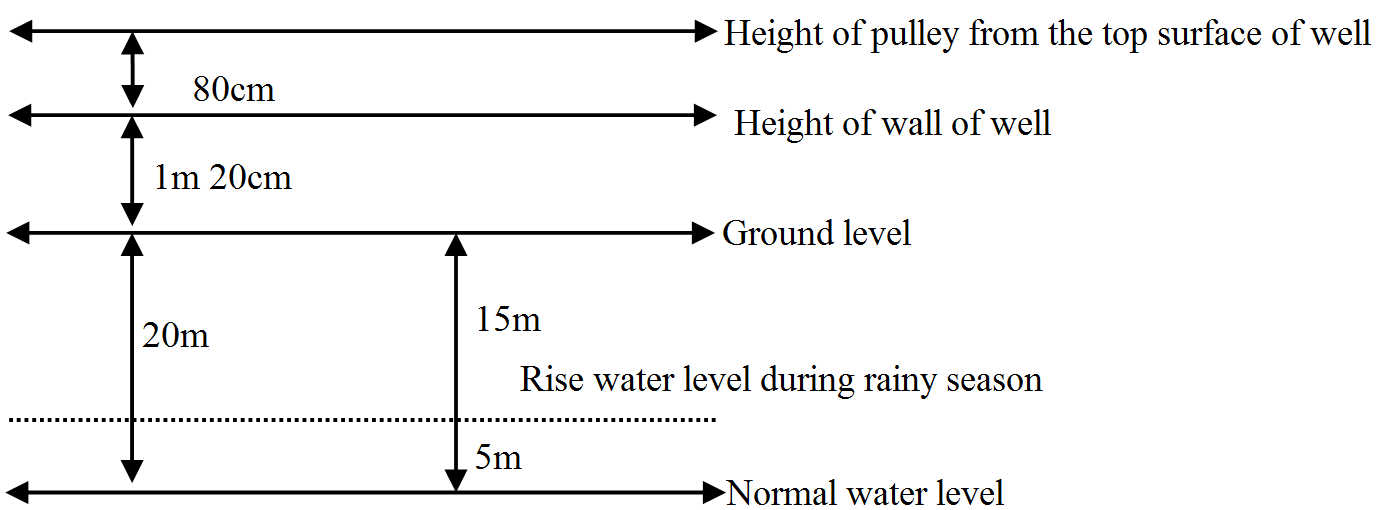
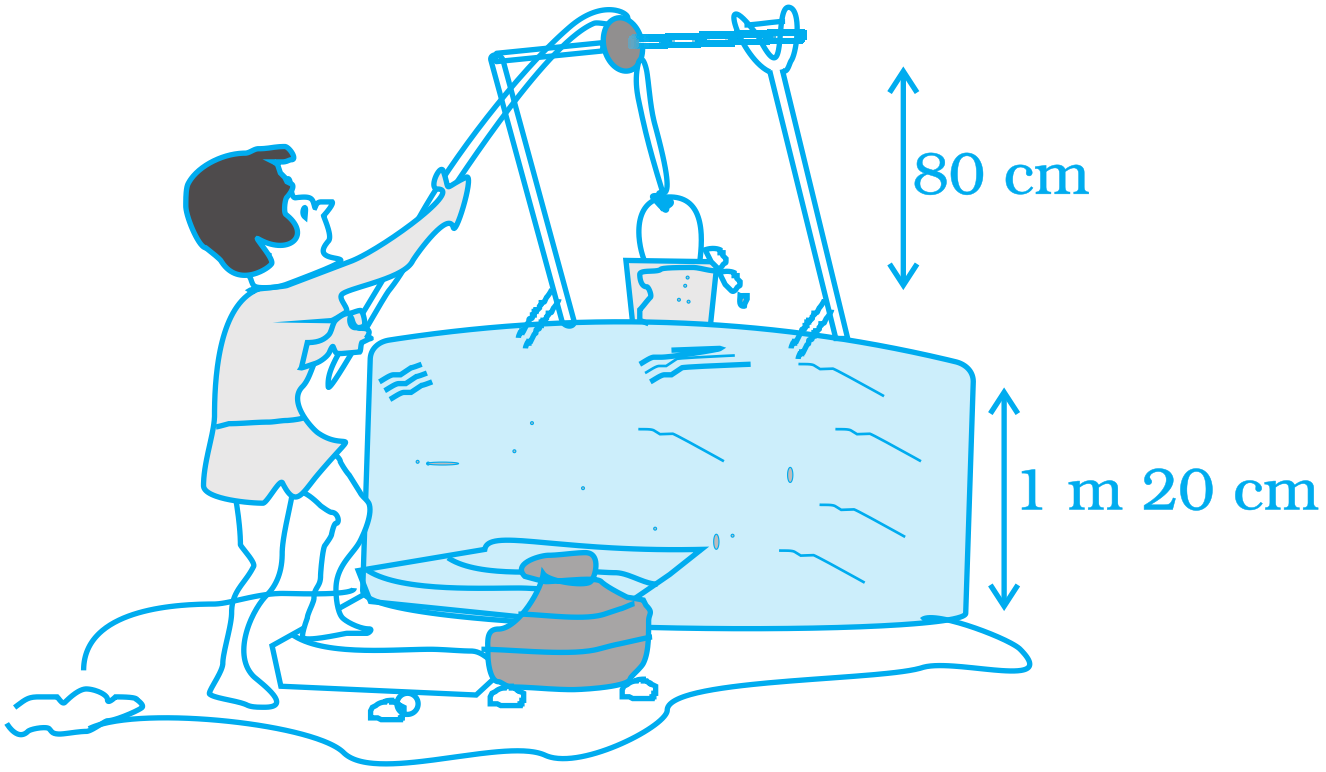
Water level in a well was $20m$ below ground level. During rainy season, rain water collected in different water tanks was drainedinto the well and the water level rises $5m$ above the previous level. The wall of the well is $1m\ 20\ cm$ high and a pulley is fixed at a height of $80\ cm$. Raghu wants to draw water from the well. The minimum length of the rope that he can use is:
  • $17m$
  • B
    $18m$
  • C
    $96m$
  • D
    $97m$
Answer
Correct option: A.
$17m$
Details given in the question, can be described in the figure shown below.

From the above figure, it is clear that.
Minimum length of the rope required to draw the water during the rainy season
= Distance between pulley and wall of + Height of wall of wall + Distance between
$=80\text{cm}+1\text{m}20\text{cm}+15\text{m}$
$=(0.8+1.2+15)\text{m}$$\bigg[\because1\text{cm}=\frac{1}{100}\text{m}\Rightarrow80\text{cm}=\frac{80}{100}\text{m}=0.80\text{m}\ \text{and}\ 1\text{cm}=120\text{m}\bigg]$
$=17\text{m}$
View full question & answer
MCQ 101 Mark
(-16) ÷ 4 is not same as:
  • (-4) ÷ 16
  • B
    -( 16 ÷ 4)
  • C
    16 ÷ (-4)
  • D
    -4
Answer
Correct option: A.
(-4) ÷ 16

$(-16) + 4 = -(16 \div4)$
$=-16+4\ \div(-4)=\frac{16}{-4}=-4$
But division is not commutative hence
$-16+4\neq(-4)\div16$

View full question & answer
MCQ 111 Mark
Encircle the odd one of the following:
  • A
    $(-1, -2)$
  • B
    $(-5, + 2)$
  • C
    $(-4, + 1)$
  • $(-9, + 7)$
Answer
Correct option: D.
$(-9, + 7)$
By observation, we can say that the sum of both values are same in options $(a), (b)$ and $(c)$.
So, odd one is option $(d).$
View full question & answer
MCQ 121 Mark
The value of $5 ÷ (-1)$ does not lie between:
  • A
    $0$ and $-10$
  • $0$ and $10$
  • C
    $-4$ and $-15$
  • D
    $-6$ and $6$
Answer
Correct option: B.
$0$ and $10$
$5 ÷ (-1)$ equals to $-5$.On the number line, it is placed as

Now, as we can see,$ -5$ lies between $(0$ and $-10)$$ , (-4 $ and $-15)$ and $(-6$ and $6).$ But it does not lie between $0$ and $10.$
View full question & answer
MCQ 131 Mark
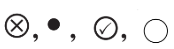
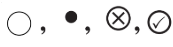
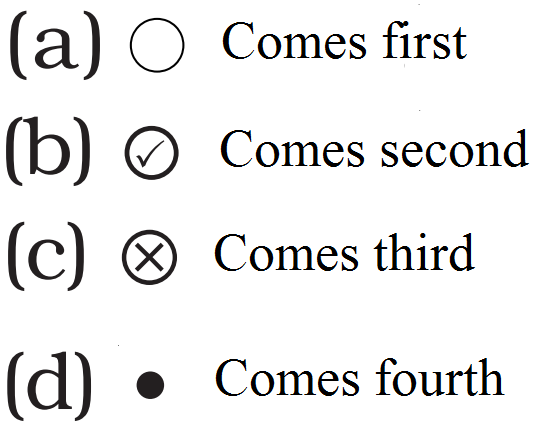
If $⊗, O,$ and $•$ represent some integers on number line, then descending order of these numbers is.

 
  • A
  • B
  • D
Answer
Correct option: C.


Descending order in number line, is from right to left.
Accordingly.
View full question & answer
MCQ 141 Mark
Which of the folllowing is not the additive inverse of $a?$
  • $-(-a)$
  • B
    $a \times (-1)$
  • C
    $-a$
  • D
    $a ÷ (-1)$
Answer
Correct option: A.
$-(-a)$
Additive inverse of $a$ is $-(-a).$
$[$additive inverse of an integer is the same integer value, with opposite sign$]$
So,
$a. -(-a) = a$
$b. a \times (-1) = -a$
$c. -a$
$d. a + (-1) = -a$
View full question & answer
MCQ 151 Mark
Encircle the odd one of the following:
  • A
    $(-1) \times (-1)$
  • B
    $(-1) \times (-1) \times (-1)$
  • C
    $(-1) \times (-1) \times (-1) \times (-1)$
  • $(-1) \times (-1) \times (-1) \times (-1) \times (-1) \times (-1)$
Answer
Correct option: D.
$(-1) \times (-1) \times (-1) \times (-1) \times (-1) \times (-1)$
$a. (-1) \times (-1) = 1$
$b. (-1) \times (-1) \times (-1) = - 1$
$c. (-1) \times (-1) \times (-1) \times (-1) = 1$
$d. (-1) \times (-1) \times (-1) \times (-1) \times (-1) \times (-1)$
Hence, value of options $(a), (c), (b)$ are same but value of option $(d)$ is different.
View full question & answer
MCQ 161 Mark
Which of the following does not represent an integer?
  • A
    $0 ÷ (-7)$
  • B
    $20 ÷ (-4)$
  • C
    $(-9) ÷ 3$
  • $(-12) ÷ 5$
Answer
Correct option: D.
$(-12) ÷ 5$
An integer is a whole number $($not a fractional number$)$ that can be positive, negative or zero. So,
$a. \frac{0}{-7}=0$
$b. \frac{20}{-4}=-5$
$c. \frac{-9}{3}=-3$
$d. \frac{-12}{5}($not an integer$)$
View full question & answer
MCQ 171 Mark
$(-11) \times 7$ is not equal to:
  • A
    $11 \times (-7)$
  • B
    $-(11 \times 7)$
  • $(-11) \times (-7)$
  • D
    $7 \times (-11)$
Answer
Correct option: C.
$(-11) \times (-7)$
$(-11) \times 7 = (-77) ($we know, in multiplication, if sign of both numbers are different, then the sign of the resultant is negative and if sign of both numbers are same, then the sign of the resultant is positive$.)$
$a. 11 \times (-7) = -77$
$b. -(11 \times 7) = -77$
$c. (-11) \times (-7) = 77$
$d. 7 \times (-11) = -77$
View full question & answer
MCQ 181 Mark
On the following number line value ‘Zero’ is shown by the point.
  • A
    $X$
  • B
    $Y$
  • $Z$
  • D
    $W$
Answer
Correct option: C.
$Z$
All the points are equally spaced.
One division = $5$ units
So, $X = -15 + 5 = -10$
$Y = -10 + 5 = -5$
$Z = -5 + 5 = 0$
Hence, zero is shown by the point $Z$.
View full question & answer
MCQ 191 Mark
$[(-8) \times (-3)] \times (-4)$ is not equal to:
  • A
    $(-8) \times [(-3) \times (-4)]$
  • B
    $[(-8) \times (-4)] \times (-3)$
  • C
    [(-3) \times (-8)] \times (-4)
  • $(-8) \times (-3) - (-8) \times (-4)$
Answer
Correct option: D.
$(-8) \times (-3) - (-8) \times (-4)$
[$\because$ as multiplication is commutative, i.e. $a \times b = b \times a]$
$= (-3) \times [(-8) \times (-4)]$
[$\because$ as multiplication is associative, i.e. $a \times (b \times c) = (a \times b) \times c]$
$= [(-8) \times (-4)] \times (-3)$
$= (-8) \times [(-4) \times (-3)]$
$= (-8) \times [(-3) \times (-4)]$
Hence, $[(-8) \times (-3)] \times (-4)$ is not equal $(-8) \times (-3) \times (-8) \times (-4).$
View full question & answer
MCQ 201 Mark
On the number line, the value of $(-3) \times 3$ lies on right hand side of:
  • $-10$
  • B
    $-4$
  • C
    $0$
  • D
    $9$
Answer
Correct option: A.
$-10$
$(-3) \times 3$ equals to $-9.$
On the number line, it is shown as

So, as we can see $-9$ lies on the right hand side of $-10$.
View full question & answer
MCQ 211 Mark
By observing the number line (Fig.), state which of the following statements is not true.
  • A
    $B$ is greater than $-10$
  • B
    $A$ is greater than $0$
  • $B$ is greater than $A$
  • D
    $B$ is smaller than $0$
Answer
Correct option: C.
$B$ is greater than $A$
As we know that, if a point or number lies on the right side to the other number, then the number is greater.
Here, $B$ is greater than $-10$ but smaller than $0$ and $A$ is greater than $0$ but smaller than $10$. Also, $6$ is smaller than $A$.
View full question & answer
MCQ 221 Mark
If $a$ and $b$ are two integers, then which of the following may not be an integer?
  • A
    $a + b$
  • B
    $a - b$
  • C
    $a \times b$
  • $a ÷ b$
Answer
Correct option: D.
$a ÷ b$
Addition, subtraction and multiplication of two or more integers is always an integer. But, division of integers may or may not be an integer. e.g.
$2+3=\frac{2}{3}\text{not an integer}$
$3+3=1(\text{integer})$
View full question & answer
MCQ 231 Mark
Which of the following statements is not true?
  • A
    When two positive integers are added, we always get a positive integer.
  • B
    When two negative integers are added we always get a negative integer.
  • When a positive integer and a negative integer is added we always get a negative integer.
  • D
    Additive inverse of an integer $2$ is $(-2)$ and additive inverse of $(-2)$ is $2$.
Answer
Correct option: C.
When a positive integer and a negative integer is added we always get a negative integer.
$i.$ True, when two positive integers are added, the resultant number is also a positive integer.
$ii.$ True, while adding integers, if both the numbers have same sign, the resultant number also get that sign.
$iii.$ False, while adding the integers of different signs, the resultant number get the sign of greater number.
$iv.$ True, additive inverse of an integer is the same integer value, with opposite sign.
View full question & answer
MCQ 241 Mark
When the integers $10, 0, 5, -5, -7$ are arranged in descending or ascending order, them find out which of the following integers always remains in the middle of the arrangement.
  • $0$
  • B
    $5$
  • C
    $-7$
  • D
    $-5$
Answer
Correct option: A.
$0$
To arrange these integers in ascending or descending order, first we locate these points on number line.

As we know, if a point or number lies on the right side to the other number, then the number is greater. Then,
Ascending order $-7, -5, 0, 5, 10$
Middle term $= 0$
Descending order $\rightarrow 10, 5, 0, -5, -7$
Middle term $= 0$
Hence, zero always remains in the middle of the arrangement.
View full question & answer
MCQ 251 Mark
For a non-zero integer a which of the following is not defined?
  • $a ÷ 0$
  • B
    $0 ÷ a$
  • C
    $a ÷ 1$
  • D
    $1 ÷ a$
Answer
Correct option: A.
$a ÷ 0$
Division of any number by zero is not defined,
$a ÷ 0 =$ not defined.
View full question & answer
MCQ 261 Mark
$(-43) × (-99) + 43$ is equal to:
  • $4300$
  • B
    $-4300$
  • C
    $4257$
  • D
    $-4214$
Answer
Correct option: A.
$4300$
$(-43) \times (-99) + 43$
$= (-1) (43) \times (- 99) + 43$
$= 43 {-(-99) + 1}$ [taking $43$ as common]
$= 43 (99 + 1)$
$= 43 \times 100$
$= 4300$
View full question & answer
MCQ 271 Mark
The next number in the pattern $-62, -37, -12$ _____ is.
  • A
    $25$
  • $13$
  • C
    $0$
  • D
    $-13$
Answer
Correct option: B.
$13$
By observing the series, difference between two consecutive numbers is 25, i.e.
$-37 - (-62)$
$= -37 + 62 = 25$
$-12 - (-37)$
$= -12 + 37 = 25$
So, next number will be $-12 + 25 = 13.$
View full question & answer
MCQ 281 Mark
Encircle the odd one of the following:
  • A
    $(-9) \times 5 \times 6 \times (-3)$
  • B
    $9 \times (-5) \times 6 \times (-3)$
  • $(-9) \times (-5) \times (-6) \times 3$
  • D
    $9 \times (-5) \times (-6) \times 3$
Answer
Correct option: C.
$(-9) \times (-5) \times (-6) \times 3$
$a. (-9) \times 5 \times 6 \times (-3) = (-45) \times (-18) = 810$
$b. 9 \times (-50 \times 6 \times (-3) = (-45) \times (-18) = 810$
$c. (-9) \times (-50 \times (-6) \times 3 = 45 \times (-18) = 810$
$d. 9 \times 9-50 \times (-60 \times (-3) = (-45) \times (-18) = 810$
So, odd one is option $(c)$.

View full question & answer
MCQ 291 Mark
$(-10) × (-5) + (-7)$ is equal to:
  • A
    $-57$
  • B
    $57$
  • C
    $-43$
  • $43$
Answer
Correct option: D.
$43$
$(-10) \times (- 5) + (-7)$
$= {(-10) \times (-5)} + (-7)$
$= 50 + (-7)$
$= 50 - 7$
$= 43.$
View full question & answer
MCQ 301 Mark
Next three consecutive numbers in the pattern $11, 8, 5, 2, --, --, --$ are:
  • A
    $0, -3, -6$
  • B
    $-1, -5, -8$
  • C
    $-2, -5, -8$
  • $-1, -4, -7$
Answer
Correct option: D.
$-1, -4, -7$
By observing the series, difference between two consecutive numbers is $3$
i.e, $11 - 8 = 3$
$8 - 5 = 3$
$5 - 2 = 3$
So, next number will be
$2 - 3 = -1$
Similarly, next two number are
$-1 - 3 = -4$
$-4 - 3 = -7.$
View full question & answer