Question 11 Mark
Sum of interior angles on the same side of transversal of two parallel lines is………… $\left(90^{\circ}, 120^{\circ}, 180^{\circ}\right)$
View full question & answer→Question 21 Mark
An angle which is double of its supplement is…………. $\left(60^{\circ}, 120^{\circ}, 180^{\circ}\right)$
View full question & answer→Question 31 Mark
The supplement of an acute angle is always…………...angle. (acute, right, obtuse)
Question 41 Mark
Hands of a clock make a/an………...angle at $6 \ pm$. (acute, straight, obtuse)
View full question & answer→Question 51 Mark
Hands of a clock make a/an………...angle at $1$ am. (acute. right, obtuse)
View full question & answer→Question 61 Mark
$1$ straight angle = ………...right angle/s. $(0. 1. 2)$
View full question & answer→Question 71 Mark
A supplementary angle of a right angle measures……….. $\left(0^{\circ}, 90^{\circ}, 180^{\circ}\right)$
View full question & answer→Question 81 Mark
If two parallel lines are intersected by a transversal then a pair of alternate angle is……….. (complementary, equal, supplementary)
Question 91 Mark
If two angles are supplementary as well as vertically opposite angles.then each angle measures…………. $\left(45^{\circ}, 90^{\circ}, 180^{\circ}\right)$
View full question & answer→Question 101 Mark
$\angle MNO$ and $\angle PQR$ are............angles, if $\angle MNO =35^{\circ}$ and $\angle PQR =55^{\circ}$. (supplementary. corresponding. complementary)
View full question & answer→Question 111 Mark
The common point where angle forms is called………… (vertex. arm, ray)
Question 121 Mark
$\overrightarrow{A B}$ and $\overrightarrow{A C}$ forms............ $(\angle B A C, \angle A B C, \angle C B A)$
View full question & answer→Question 131 Mark
Ray $PQ$ is represented as…………. $(\overrightarrow{P Q}, \quad \overleftrightarrow{P Q}, \overrightarrow{P Q})$
Answer$\overrightarrow{ PQ }$
View full question & answer→Question 141 Mark
A………..has one end point. (line, line segment, ray)
Question 151 Mark
A…………has neither starting point nor end point. (line, line segment, ray)
Question 161 Mark
Sum of interior angles on the same side of transversal of two parallel lines is………… $\left(90^{\circ}, 120^{\circ}, 180^{\circ}\right)$
View full question & answer→Question 171 Mark
An angle which is double of its supplement is…………. $\left(60^{\circ}, 120^{\circ}, 180^{\circ}\right)$
View full question & answer→Question 181 Mark
The supplement of an acute angle is always…………...angle. (acute, right, obtuse)
Question 191 Mark
Hands of a clock make a/an………...angle at 6 pm. (acute, straight, obtuse)
Question 201 Mark
Hands of a clock make a/an………...angle at $1$ am. (acute. right, obtuse)
View full question & answer→Question 211 Mark
$1$ straight angle = ………...right angle/s. $(0. 1. 2)$
View full question & answer→Question 221 Mark
A supplementary angle of a right angle measures……….. $\left(0^{\circ}, 90^{\circ}, 180^{\circ}\right)$
View full question & answer→Question 231 Mark
If two parallel lines are intersected by a transversal then a pair of alternate angle is……….. (complementary, equal, supplementary)
Question 241 Mark
If two angles are supplementary as well as vertically opposite angles.then each angle measures…………. $\left(45^{\circ}, 90^{\circ}, 180^{\circ}\right)$
View full question & answer→Question 251 Mark
$\angle MNO$ and $\angle PQR$ are............angles, if $\angle MNO =35^{\circ}$ and $\angle PQR =55^{\circ}$. (supplementary. corresponding. complementary)
View full question & answer→Question 261 Mark
The common point where angle forms is called………… (vertex. arm, ray)
Question 271 Mark
$\overrightarrow{A B}$ and $\overrightarrow{A C}$ forms............ $(\angle B A C, \angle A B C, \angle C B A)$
View full question & answer→Question 281 Mark
Ray $PQ$ is represented as…………. $(\overrightarrow{P Q}, \quad \overleftrightarrow{P Q}, \overrightarrow{P Q})$
Answer$\overrightarrow{ PQ }$
View full question & answer→Question 291 Mark
A………..has one end point. (line, line segment, ray)
Question 301 Mark
A…………has neither starting point nor end point. (line, line segment, ray)
Question 311 Mark
The supplement of an obtuse angle is always _________ angle.
AnswerThe supplement of an obtuse angle is always $90^\circ$ angle.Solution:
Two angles are said to be complementary angles, if their sum is $90^\circ $.
Hence, if two angles are complementary, then each angle cannot be more than $90^\circ .$
View full question & answer→Question 321 Mark
If sum of measures of two angles is $90^\circ $, then the angles are _______.
AnswerIf sum of measures of two angles is $90^\circ $, then the angles are Complementary. Solution: The sum of two complementary angles is $90^\circ .$
View full question & answer→Question 331 Mark
Sum of interior angles on the same side of a transversal is ________.
AnswerSum of interior angles on the same side of a transversal is $180^\circ $.
Solution:
Sum of interior angles on the same side of a transversal is $180^\circ .$
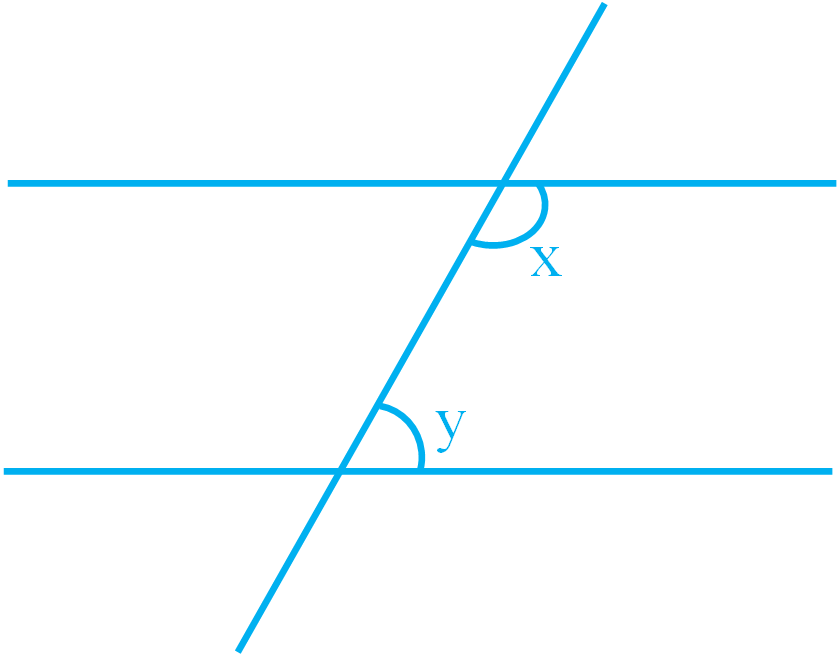
In the above figure, $x + y = 180^\circ .$ View full question & answer→Question 341 Mark
Two lines in a plane which do not meet at a point anywhere are called _________ lines.
Answer Two lines in a plane which do not meet at a point anywhere are called Parallel lines.
Solution:
If two lines are parallel, then they will never meet each other.
View full question & answer→Question 351 Mark
The supplement of an acute is always __________ angle.
AnswerThe supplement of an acute is always Obtuse angle. Solution: If angle is acute angle, then its supplement will be an obtuse angle. As, if we subtract an angle which is less than $90^\circ $ from $180^\circ $, then result will be an angle greater than $90^\circ .$
View full question & answer→Question 361 Mark
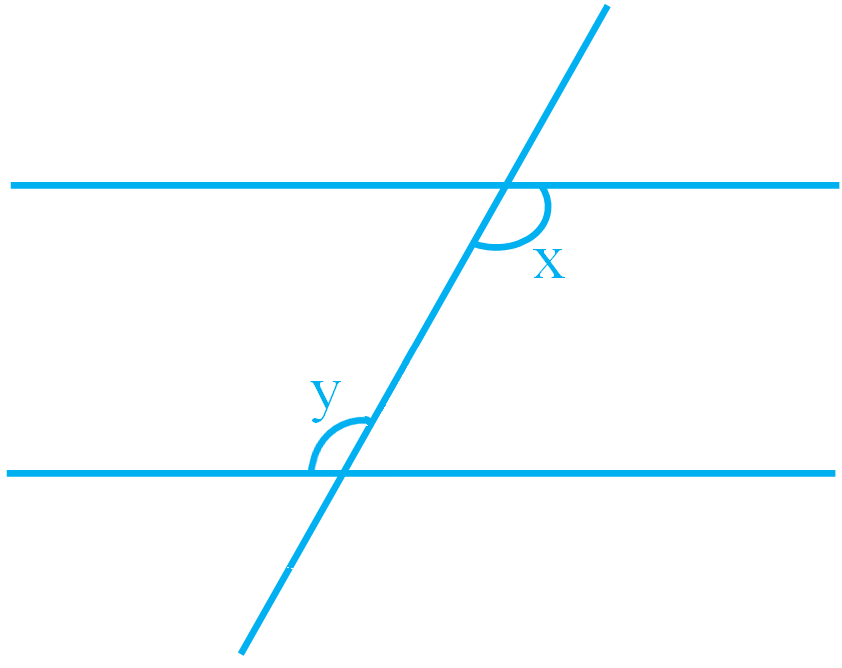
Alternate interior angles are on the _______ side of the transversal.
AnswerAlternate interior angles are on the
Opposite side of the transversal.
Solution:
Two alternate interior angles are on the opposite side of the transversal.
View full question & answer→Question 371 Mark
Alternate interior angles have one common __________ .
AnswerAlternate interior angles have one common Arm. Solution: Two alternate interior angles have one common arm.
View full question & answer→Question 381 Mark
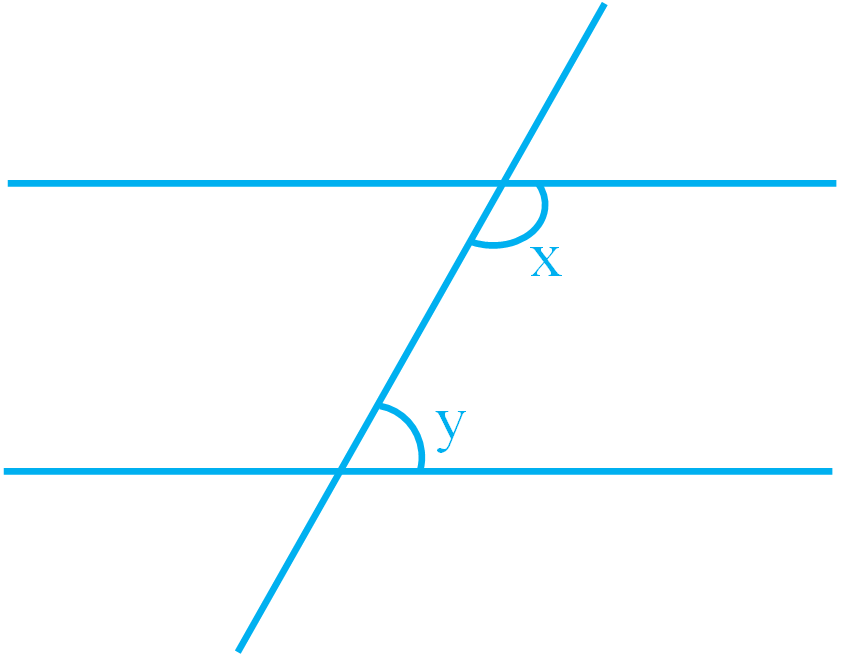
Corresponding angles are on the ____________ side of the transversal.a
AnswerCorresponding angles are on the
Same side of the transversal.
Solution: Two corresponding angles are on the same side of the transversal.
View full question & answer→Question 391 Mark
The supplement of a right angle is always _________ angle.
AnswerThe supplement of a right angle is always Right angle.
Solution: Let $x$ be the supplement of the right angle.
Then, $x + 90^\circ = 180^\circ $
$\Rightarrow x = 180^\circ - 90^\circ = 90^\circ $
View full question & answer→Question 401 Mark
An angle is $45^\circ $. Its complementary angle will be _________.
AnswerAn angle is $45^\circ .$ Its complementary angle will be $45^\circ .$
Solution:
Let $x$ be the required angle.
Then, $x + 45^\circ = 90^\circ \Rightarrow x = 90^\circ - 45^\circ = 45^\circ $
View full question & answer→Question 411 Mark
Two angles forming a ___________ pair are supplementary.
AnswerTwo angles forming a Linear pair are supplementary.
Solution :
If two angles form a linear pair, then their sum will be $180^\circ $.
Hence, they are supplementary.
View full question & answer→Question 421 Mark
The supplement of an obtuse angle is always ________ angle.
AnswerThe supplement of an obtuse angle is always Acute angle. Solution: The supplement of an obtuse angle is always an acute angle. As, if we subtract an obtuse angle from $180^\circ $, then result will be an acute angle, i.e. $90^\circ .$
View full question & answer→Question 431 Mark
An angle which is half of its supplement is of __________.
AnswerLet the required angle be $x$. Then, its supplement will be $(180^\circ - x).$
It is given that $x$ is the half of it supplement i.e. $(180^\circ - x).$
Therefoer, $\text{x}\frac{1}{2}(180^\circ-\text{x})$
$\Rightarrow2\text{x}=180^\circ-\text{x}$
$\Rightarrow2\text{x}+\text{x}=180^\circ$
$\Rightarrow3\text{x}=180^\circ$
$\Rightarrow\text{x}=\frac{180^\circ}{3}$
$\Rightarrow\text{x}=60^\circ$
View full question & answer→Question 441 Mark
If the sum of measures of two angles is $180^\circ $, then they are __________.
AnswerIf the sum of measures of two angles is $180^\circ $, then they are Supplementary. Solution: The sum of two supplementary angles is $180^\circ .$
View full question & answer→Question 451 Mark
A transversal intersects two or more than two lines at _________ points.
AnswerA transversal intersects two or more than two lines at Distinct points. Solution: A transversal intersects two or more than two lines at distinct points.
View full question & answer→