Questions

5 Marks Questions

🎯

Test yourself on this topic

9 questions · timed · auto-graded

Question 15 Marks
The plan and measurement for a house are given in Fig. The house is surrounded by a path $1m$ wide.
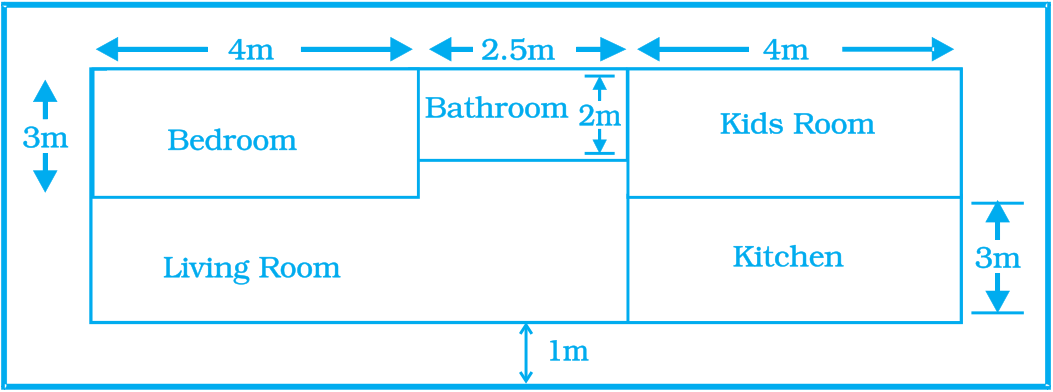
Find the following:
$i.$ Cost of paving the path with bricks at rate of $Rs. 120$ per $m^2.$
$ii.$ Cost of wooden flooring inside the house except the bathroom at the cost of $Rs. 1200$ per $m^2.$
$iii.$ Area of Living Room.
Answer
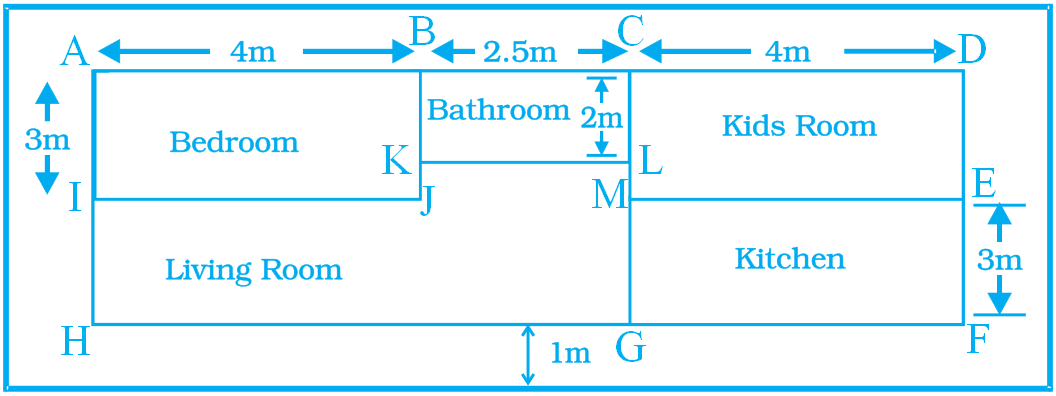
$ i. $ Area of path $=$ Area of rectangle $\mathrm{PQRS}-$ Area of ractangle $\text{ADFH}$
$ =P Q \times Q R-A D \times D F$
$ =(4+2.5+4+1+1) \times(3+3+1+1)-(4+2.5+4) \times(3+3)$
$ =12.5 \times 8-10.5 \times 6$
$ =37 \mathrm{~m}^2$
Cost of paving the path with bricks
$ =$ Cost per unit $\mathrm{m}^2 \times$ Total area of path
$ =120 \times 37$
$ = Rs. 4440$
$ ii.$ Area of house excepted bathroom
$ =$ Area of house $-$ Area of bathroom
$ =$ Area of ractangle $\text{ADFH }-$ Area of ractangle $\text{BCLK }$
$ =(4+2.5+4) \times(3+3)-2 . .5 \times 2$
$ =63-5$
$=58 m^2$
$ \therefore$ Cost of flouring $=$ Cost per unit $\mathrm{m}^2 \times$ Total area
$ =1200 \times 58$
$=Rs. 69600$
$iii.$ Area of living room
$=$ Area of ractangle $\text{ACGH}-$ Area of ractangle $\text{ABJI} -$ Area of ractangle $\text{BCLK}$
$=(4+2.5) \times(3+3)-4 \times 3-2.5 \times 2$
$=39-12-5$
$ =22 \mathrm{~m}^2$
View full question & answer
Question 25 Marks
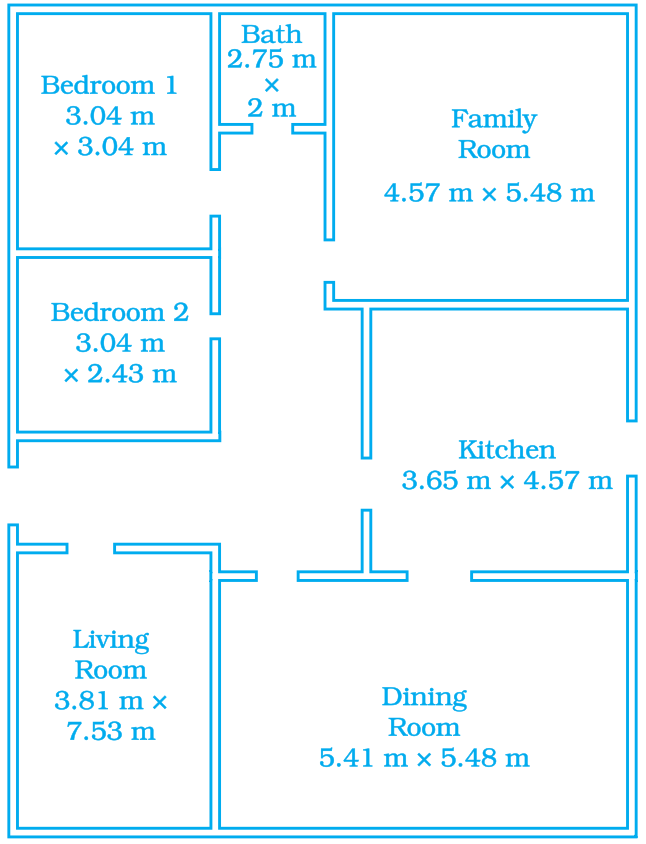
Architects design many types of buildings. They draw plans for houses, such as the plan shown in Fig.

An architect wants to install a decorative moulding around the ceilings in all the rooms. The decorative moulding costs $Rs. 500/$metre.
$a.$ Find how much moulding will be needed for each room.
$i.$ Family room.
$ii.$ Living room.
$iii.$ Dining room.
$iv.$ Bedroom $1$
$v.$ Bedroom $2$
$b.$ The carpet costs $Rs. 200/m^2$. Find the cost of carpeting each room.
$c.$ What is the total cost of moulding for all the five rooms.
Answer
$a.$
$i.$ Family room
Given, breadth of the family room $=5.48 \mathrm{~m}$
and length of the family room $=4.57 \mathrm{~m}$
$\therefore$ perimeter of the family room $=2($Length $+$ Breadth$)$
$=2(5.48+4.57)$
$=2 \times 10.05$
$=20.10 \mathrm{~m}$
$ii.$ Living room
Given, length of the living room $=3.81 \mathrm{~m}$
and breadth of the living room $=7.53 \mathrm{~m}$
$\therefore$ Perimete of the living room $=2 ($Length $+$ Breadth$)$
$=2(3.81+7.53)$
$=2 \times 11.34$
$=22.68 \mathrm{~m}$
$iii.$ Dining room
Given, breadth of the dining room $=5.48 \mathrm{~m}$
and of the dining room $=5.41 \mathrm{~m}$
$\therefore$ Perimeter of dining room $=2 ($Length $+$ Breadth$) $
$=2(5.41+5.48)$
$=2 \times 10.89$
$=21.78 \mathrm{~m}$
$iv.$ Bedroom $1$
Given, length of bedroom $1=3.04 \mathrm{~m}$
and breadth of room $1=3.04 \mathrm{~m}$
$\therefore$ Perimetar of brdroom $1=2($Length $+$ Breadth$)$
$=2(3.04+3.04)$
$=2 \times 6.08$
$=12.16 \mathrm{~m}$
$v.$ Bedroom $2$
Given, breadth of bedroom $2=2.43 \mathrm{~m}$ and length of bedroom $2=3.04 \mathrm{~m}$
$\therefore$ Perimeter of the bedroom $2=2 ($Length $+$ Breadth$)$
$=2(3.04+2.43)$
$=2 \times 5.47$
$=10.94 \mathrm{~m}$
$b.$ For bedroom $1,$​​​​​​​
Given, length of bedroom $1=3.04 \mathrm{~m}$ and breadth of bedroom $1=3.04 \mathrm{~m}$
$\therefore$ Area of the bedroom $1=$ Lenght $\times$ Breadth
$\therefore$ Area of the bedroom $1=3.04 \times 3.04=9.2416 \ \mathrm{sq} \mathrm{m}$
$\because$ Cost of the carpeting $1 \ \mathrm{sq} \mathrm{m}= Rs. 200$
$\therefore$ Cost of carpeting $9.2416 \mathrm{~m}^2=9.2416 \times 200= Rs. 1848$
For bedroom $2,$
Given, length of bedroom $2=3.04 \mathrm{~m}$
and breadth of brdroom $2=2.43 \mathrm{~m}$
$\therefore$ Area of bedroom $2=$ Length $\times$ Breadth $=3.04 \times 2.43=7.3872 \mathrm{~m}^2$
$\therefore$ Cost of carpenting $1 \mathrm{~m}^2= Rs. 200$
$\therefore$ Cost of carpeting $7.3872 \mathrm{~m}^2=7.3872 \times 200= Rs. 1477$
For living room,
Given, lenght of living room $=3.81 \mathrm{~m}$ and breadth of living room $=7.53 \mathrm{~m}$
$\therefore$ Area of living room $3.81 \times 7.53=28.6893 \mathrm{~m}^2$
Cost of carpating of living room $1 \mathrm{~m}^2= Rs. 200$
$\because$ Cost of carpating $28.6893 \mathrm{~m}^2=  Rs. 200 \times 28.6893= Rs. 5737.86$​​​​​​​
For dining room,
Given, length of dining room $=5.41 \mathrm{~m}$
and bradth of dining room $=5.48 \mathrm{~m}$
$\because$ Area of dining room $=5.41 \times 5.48=29.6468 \mathrm{~m}^2$
$\because$ Cost of carpenting $1 \mathrm{~m}^2= Rs. 200$
$\therefore$ Cost of carpating $29.6468 \mathrm{~m}^2=29.6468 \times 200= Rs. 5929.36$​​​​​​​
For family room,
Given, length of family room $=4.57 \mathrm{~m}$
and bradth of family room $=5.48 \mathrm{~m}$
$\therefore$ Area of family room $=5.48 \times 4.57=25.0436 \mathrm{~m}^2$
So, cost of carpeting family room $=25.0436 \times 200= Rs. 5008.72$
$c.$ Total permeter of all the five rooms
$=20.10 m+22.68+21.78 m+12.16 m+1094 m=87.66 m$
$\because$ Given, cost of moulding each room $= Rs. 500$ per $m$
$\therefore$ Totale cost of moulding all five rooms $=87.66 \times 500= Rs. 43830$
View full question & answer
Question 35 Marks
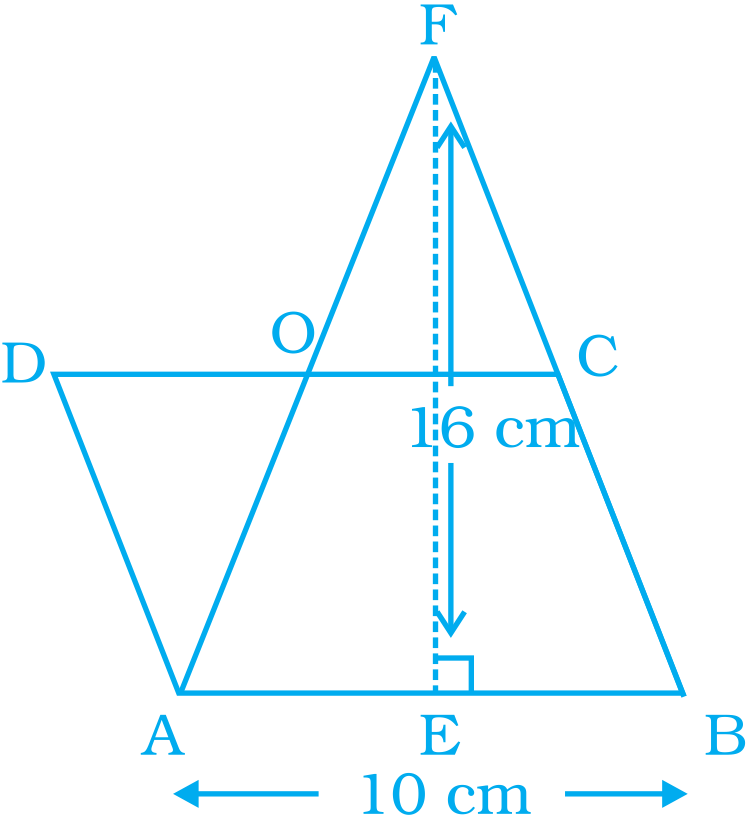
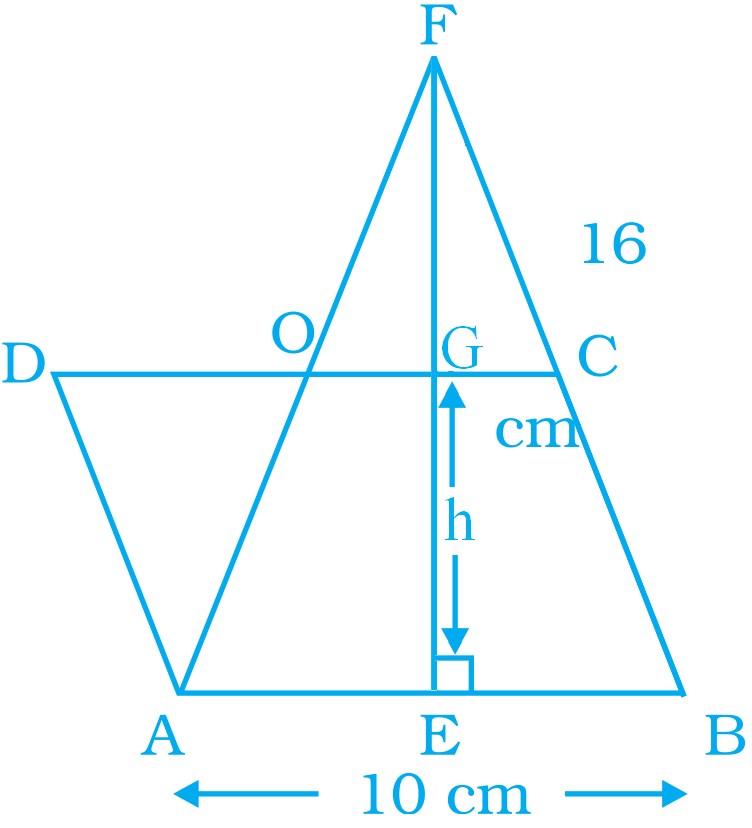
In Fig. area of $\angle \text{AFB}$ is equal to the area of parallelogram $ABCD$. If altitude $EF$ is $16\ cm$ long, find the altitude of the parallelogram to the base $AB$ of length $10\ cm.$
What is the area of $\angle \text{DAO}$, where $O$ is the mid point of $DC?$
Answer
Given,
Area of $\triangle\text{AFB}$ = Area of parallelogram $ABCD$
$\Rightarrow\frac{1}{2}\times\text{AB}\times\text{EF}\times\text{CD}\times\text{(Corresponding height)}$ [$\because$ area of triangle = base $\times $ height and area of parallelogrm = base $\times $ corresponding height]
$\Rightarrow\frac{1}{2}\times\text{AB}\times\text{EF}=\text{CD}\times\text{EG}$

Let the corresponding height be $h.$
Then,$\frac{1}{2}\times10\times16\times=10\times\text{h}$
[$\therefore$ Altitude, $EF = 16cm$ and base, $AB = 10cm$, given]
$\Rightarrow \text{h}= 8\text{cm}$ [$\because AB = CD]$
$\text{In }\triangle\text{DAO},\text{DO}=5\text{cm}$
[$\because O$ is the mid-point of $CD]$
$\therefore\text{Area}\text{ of }\triangle\text{DAO}=\frac{1}{2}\times\text{OD}\times\text{h}$
$=\frac{1}{2}\times5\times8=20\text{cm}^2$
View full question & answer
Question 45 Marks
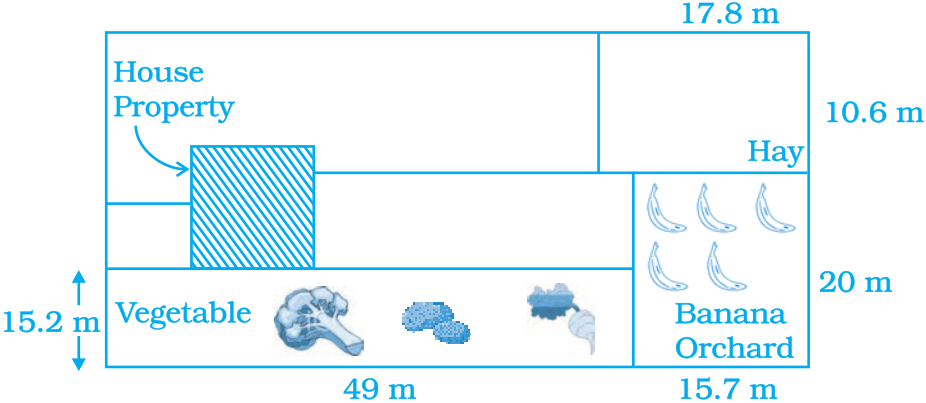
Use the Fig. showing the layout of a farm house:

$a.$ What is the area of land used to grow hay?
$b.$ It costs $Rs. 91$ per $m^2$ to fertilise the vegetable garden. What is the total cost?
$c.$ A fence is to be enclosed around the house. The dimensions of the house are $18.7m \times 12.6m$. At least how many metres of fencing are needed?
$d.$ Each banana tree required $1.25m^2$ of ground $sp$
Answer
$a.$ Area of land to grow hay $=17.8 \mathrm{~m} \times 10.6 \mathrm{~m}=188.68 \mathrm{~m}^2[\because$ area of rectangle $=$ length $\times$ breadth$]$
$b. \therefore$ Area of vegetable gardan $=49 \mathrm{~m} \times 15.2 \mathrm{~m} = 744.80 \mathrm{~m}^2$
$\because$ Cost to fertilise $1 \mathrm{~m}^2$ vegetable garden $= Rs. 91$
$\therefore$ Cost to fertilise $744.80 \mathrm{~m}^2$ vegetable garden $=  Rs. 19 \times 744.80=Rs. 67776.80$
$c.$ Since, fence is to be enclosed around the house of dimensions $18.7 \mathrm{~m} \times 12.6 \mathrm{~m}$.
$\because$ Perimeter of the house $=2 \times(1+b)$
$\therefore$ Total lenght of fence $=2 \times(18.7+12.6) \mathrm{m}=2 \times 31.3 \mathrm{~m}=62.6 \mathrm{~m}$
$d.$ Area coverd by banana orchaed $=20 \mathrm{~m} \times 15.7 \mathrm{~m}=314 \mathrm{~m}^2$
Since, $1.25 \mathrm{~m}^2$ area is required by $1$ banana tree.
$\therefore 314 \mathrm{~m}^2$ area is required by number of banana trees $=\frac{314}{1.25}=251.25=251$ tress
View full question & answer
Question 55 Marks
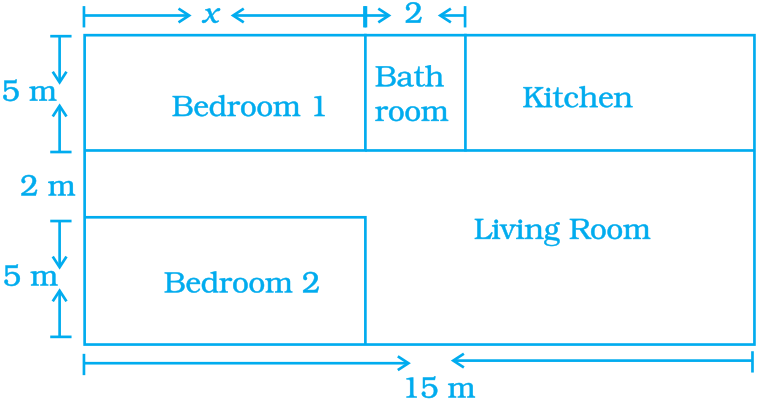
Study the layout given below in Fig. and answer the questions:

$a.$ Write an expression for the total area covered by both the bedrooms and the kitchen.
$b.$ Write an expression to calculate the perimeter of the living room.
$c.$ If the cost of carpeting is $Rs. 50/m^2,$ write an expression for calculating the total cost of carpeting both the bedrooms and the living room.
$d.$ If the cost of tiling is $Rs. 30/m^2,$ write an expression for calculating the total cost of floor tiles used for the bathroom and kitchen floors.
$e.$ If the floor area of each bedroom is $35m^2,$ then find $x.$
Answer
$a.$ Area of both bedroom and the kitchen $=($ Area of bedroom $) \times 2+$ Area of kitchen
$=(5 \times x) 2+15-(x+2) \times 5$
$=10 x+(75-5 x-10)$
$=10 x+65-5 x$
$=(65+5 x) \mathrm{m}^2$
$b.$ Perimeter of the living room $=15+2+5+(15-x)+5+x+2=44 \mathrm{~m}$
$c.$ Total area of both the bedrooms and the living room $=5 \times x+7 \times 15=(5 x+105) \mathrm{m}^2$
$\therefore$ Total cost of carpeting $=(5 x+105) \times 50=  Rs. 250(x+21)$
$d.$ Total area of bathroom and kitchen $=(15-\mathrm{x}) \times 5 \mathrm{~m}^2$
$\therefore$ Total cost of tiling $=(15-\mathrm{x}) \times 5 \times 30=  Rs.  150(15-\mathrm{x})$
$e.$ Given, area of floor of each bedroom $=35 \mathrm{~m}^2$
Area of one bedroom $=5\ \mathrm{xm}^2$
$\therefore 5 x=35$
$\Rightarrow x=7 m$
View full question & answer
Question 65 Marks
Perimeter of a parallelogram shaped land is $96\ m$ and its area is $270$ square metres. If one of the sides of this parallelogram is $18\ m,$ find the length of the other side. Also, find the lengths of altitudes l and m Fig.
Answer
Given, perimeter of parallelogram $= 96m$ and area of parallelogram = $270m^2$.
In a parallelogram $ABCD, AB = CD 18m$ and $AD = BC$

As we know, perimeter of a parallelogram $A B C D=A B+B C+C D+A D$
$\Rightarrow 96=18+A D+18+A D[\because A D=B C]$
$\Rightarrow 96=36+2 A D$
$\Rightarrow 2 A D=60$
$\Rightarrow A D=30 \mathrm{~cm}$
So, $A D=B C=30 \mathrm{~cm}$
Now, area parallelogram $\mathrm{ABCD}=$ Base $\times$ corresponding hight
$\Rightarrow 270=\mathrm{AB} \times \mathrm{DE}[\because \text { base }=\mathrm{AB}]$
$\Rightarrow 270=18 \times \mathrm{DE}$
$\Rightarrow \frac{270}{18}=\mathrm{DE}$
$\Rightarrow \mathrm{DE}=15 \mathrm{~cm}$
Also, area of parallelogram $A B C D=A D \times B F$
$\Rightarrow 270=30 \times l[\because \text { base }=A D]$
$\Rightarrow l=\frac{270}{30}$
$\Rightarrow l=9 \mathrm{~m}$
Hence, altitudes $\mathrm{l}=9 \mathrm{~m}$ and $\mathrm{m}=15 \mathrm{~m}$.
View full question & answer
Question 75 Marks
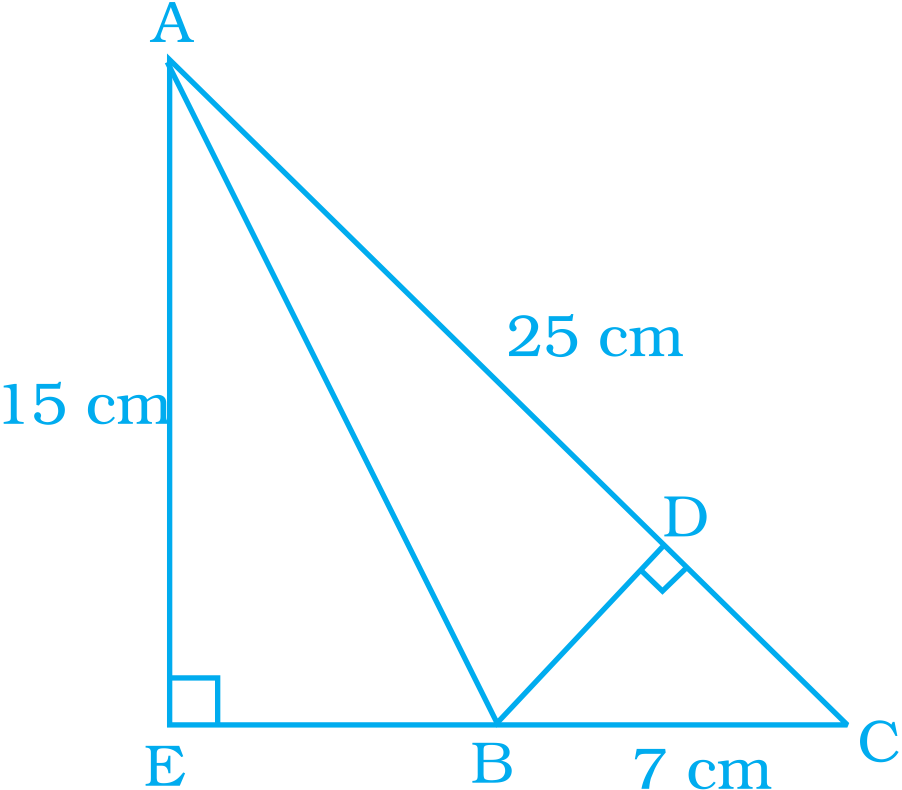
In Fig. triangle $AEC$ is right-angled at $E, B$ is a point on $EC, BD$ is the altitude of triangle $ABC, AC = 25\ cm, BC = 7\ cm$ and $AE = 15\ cm.$ Find the area of triangle $ABC$ and the length of $DB.$
Answer
Given, $\mathrm{AC}=25 \mathrm{~cm}, \mathrm{BC}=7 \mathrm{~cm}$, and $\mathrm{AE}=15 \mathrm{~cm}$
In $\triangle \mathrm{AEC}$, using Pythagores theorem,
$\mathrm{AC}^2=\mathrm{AE}^2+\mathrm{EC}^2$
$\Rightarrow \mathrm{EC}^2=\mathrm{AC}^2+\mathrm{AE}^2$
$\Rightarrow \mathrm{EC}^2=(25)^2-(15)^2=625-225=400$
$\mathrm{EC}=\sqrt{400}=20 \mathrm{~cm}$
And $\mathrm{EB}=\mathrm{EC}-\mathrm{BC}=20-7=13 \mathrm{~cm}$
$\text { Area of } \triangle \mathrm{AEC}=\frac{1}{2} \times \mathrm{AE} \times \mathrm{EC}$
$=\frac{1}{2} \times 15 \times 20=150 \mathrm{~cm}^2$
And Area of $\triangle \mathrm{AEB}=\frac{1}{2} \times \mathrm{AE} \times \mathrm{EB}=\frac{1}{2} \times 15 \times 13=97.5 \mathrm{~cm}^2$
$\therefore$ Area of $\triangle \mathrm{ABC}=$ Area of $\triangle \mathrm{AEC}-$ Area of $\triangle \mathrm{AEB}$
$=150-97.5$
$=52.5 \mathrm{~cm}^2$
Again, Area of $\triangle \mathrm{ABC}=\frac{1}{2} \times \mathrm{BD} \times \mathrm{AC}$
$52.5=\frac{1}{2} \times \mathrm{BD} \times 25$
$\Rightarrow \mathrm{BD}=\frac{25.5 \times 2}{25}=4.2 \mathrm{~cm}$
Hence, the area of $\triangle \mathrm{ABC}$ is $52.5 \mathrm{~cm}^2$ and the length of $DB$ is $4.2 \ cm.$
View full question & answer
Question 85 Marks
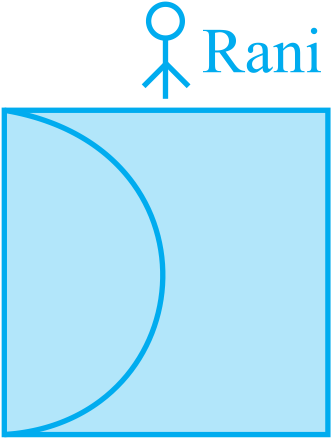
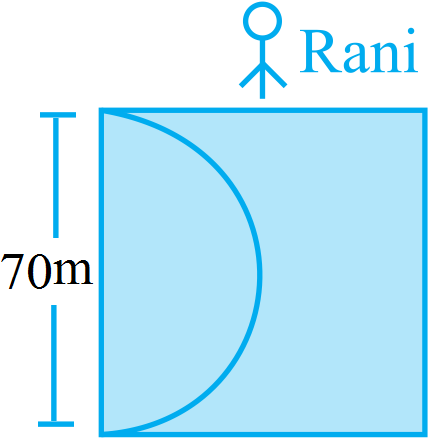
Rani bought a new field that is next to one she already owns Fig. This field is in the shape of a square of side $70\ m$. She makes a semi circular lawn of maximum area in this field.
$i.$ Find the perimeter of the lawn.
$ii.$ Find the area of the square field excluding the lawn.
Answer
$i.$ Given, side of a square $= 70\ m$

From the given figure, the diameter of semi$-$circle is same as the side of a square.
$\therefore$ Diameter of semi$-$circle $= 70\ cm$
$\because$ Diameter of semi$-$circle $=$ Side od square
$\therefore\text{Radius}=\frac{70}{2}=35\text{m}$ $\bigg[\because\text{radius}=\frac{\text{diameter}}{2}\bigg]$
$\therefore$ Perimeter of lawn $=\pi\text{r}+2\text{r}-=\frac{22}{7}\times35+2\times35= 110+70=180\text{m}$
$ii.$ Area of square $=$ side $\times $ side $= 70 \times 70 = 4900m^2$
$\therefore$ Required area $=$ area of square $-$ Area of semi$-$circle
$=4900-\frac{1}{2}\times\pi\times(35)^2 \bigg[\because \text{area of semi-circle}=\frac{1}{2}\pi\text{r}^2\bigg]$
$=4900-\frac{1}{2}\times\frac{22}{7}\times35\times35=4900-1925$
$=2975\text{m}^2$
View full question & answer
Question 95 Marks
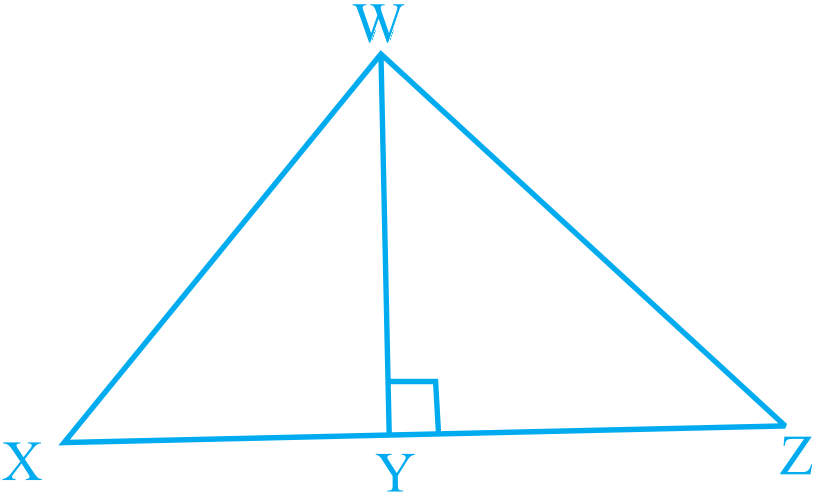
Ratio of the area of $\triangle\text{WXY}$ to the area of $\triangle\text{WZY}$ is $3 : 4.$ If the area of $\triangle\text{WXZ}$ is $56cm^2$ and $WY = 8cm$, find the lengths of $XY$ and $YZ.$
Answer
Given, are of $\triangle\text{WXZ}=56\text{cm}^2$$\Rightarrow\frac{1}{2}\times\text{WY}\times\text{XZ}=56$
$\bigg[\because \text{Area of triangle}=\frac{1}{2}\times\text{base}\times\text{height}\bigg]$
$\Rightarrow\frac{1}{2}\times8\times\text{XZ}=56$
$\Rightarrow \text{XZ}=14\text{cm}$ [$\because WY = 8cm$, given]
$\therefore \text{Area of }\triangle\text{WXY}:\text{Area of}\triangle\text{WZY}=3 :4$
$\Rightarrow \frac{\text{Area of }\triangle\text{WXY}}{\text{Area of }\triangle\text{WZY}}=\frac{3}{4}$
$\Rightarrow \frac{\frac{1}{2}\times\text{WY}\times\text{XY}}{\frac{1}{2}\times\text{YD}\times\text{WY}}=\frac{3}{4}$
$\Rightarrow\frac{\text{XY}}{\text{YZ}}\frac{3}{4}$
$\Rightarrow\frac{\text{XY}}{\text{XZ}-\text{XY}}\frac{3}{4}$
$[\because\text{YZ}= \text{XZ}-\text{XY}]$
$\Rightarrow\frac{\text{XY}}{14-\text{XY}}\frac{3}{4}$[by cross-multiplication]
$\Rightarrow4\text{XY}=42-3\text{XY}$
$\Rightarrow7\text{XY}=42$
$\Rightarrow\text{XY}=6\text{cm}$
So, $\text{YZ}=\text{XZ}-\text{XY}=14-6$
$\text{YZ}=8\text{cm}$
Hence, $XY = 6cm$ and $YZ = 8cm.$
View full question & answer
5 Marks Questions - Maths STD 7 Questions - Vidyadip