Question types

Visualising Solid Shapes question types

237 questions across 8 question groups — pick any mix to generate a Maths paper with step-by-step answer keys.

237
Questions
8
Question groups
5
Question types
Sample Questions

Visualising Solid Shapes questions

One sample from each question group in this chapter. Select any group above to see the full set with answer keys.

The difference between a rectangle and a cube is:
  • A
    Rectangle is $B$ - dimensional and cube is $2$ - dimensional.
  • B
    Rectangle and cube are both $2$ - dimensional.
  • Rectangle is $2$ - dimensional and cube is $3$ - dimensional.
  • D
    None of these.

Answer: C.

View full solution
Directions: In the following questions, the Assertions $(A)$ and Reason$(s)$ $(R)$ have been put forward. Read both the statements carefully and choose the correct alternative from the following:
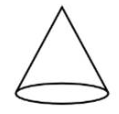
Assertion: Number of vertices a cone has $1$
Reasons: $A$ cone is a three-dimensional geometric shape that tapers smoothly from a flat base
  • Both $A$ and $R$ are true and $R$ is the correct explanation of $A$.
  • B
    Both $A$ and $R$ are true but $R$ is not the correct explanation of $A$.
  • C
    $A$ is true but $R$ is false.
  • D
    $A$ is false but $R$ is true.

Answer: A.

View full solution
Directions: In the following questions, the Assertions $(A)$ and Reason$(s)$ $(R)$ have been put forward. Read both the statements carefully and choose the correct alternative from the following:
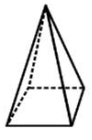
Assertion (A): $3$ faces does a triangular pyramid have.
Reasons (R): A triangular pyramid is a geometric solid with a triangular base, and all three lateral faces are also triangles with a common vertex.
  • A
    Both $A$ and $R$ are true and $R$ is the correct explanation of $A$.
  • B
    Both $A$ and $R$ are true but $R$ is not the correct explanation of $A$.
  • C
    $A$ is true but $R$ is false.
  • $A$ is false but $R$ is true.

Answer: D.

View full solution
Directions: In the following questions, the Assertions $(A)$ and Reason$(s)$ $(R)$ have been put forward. Read both the statements carefully and choose the correct alternative from the following:
Assertion (A): 4 faces does a triangular prism have.
 Reasons (R): A triangular prism is a $3D$ shape with two identical faces in the shape of a triangle connected by three rectangular faces.
  • A
    Both $A$ and $R$ are true and $R$ is the correct explanation of $A$.
  • B
    Both $A$ and $R$ are true but $R$ is not the correct explanation of $A$.
  • C
    $A$ is true but $R$ is false.
  • $A$ is false but $R$ is true.

Answer: D.

View full solution
Directions: In the following questions, the Assertions $(A)$ and Reason$(s)$ $(R)$ have been put forward. Read both the statements carefully and choose the correct alternative from the following:
Reasons: The number of edges is $15$.
 
  • Both $A$ and $R$ are true and $R$ is the correct explanation of $A$.
  • B
    Both $A$ and $R$ are true but $R$ is not the correct explanation of $A$.
  • C
    $A$ is true but $R$ is false.
  • D
    $A$ is false but $R$ is true.

Answer: A.

View full solution
Directions: In the following questions, the Assertions $(A)$ and Reason$(s)$ $(R)$ have been put forward. Read both the statements carefully and choose the correct alternative from the following:
Assertion: The base of a prism is any shape.
Reasons: A prism is a $3-$dimensional shape with two identical shapes facing each other.
  • Both $A$ and $R$ are true and $R$ is the correct explanation of $A$.
  • B
    Both $A$ and $R$ are true but $R$ is not the correct explanation of $A$.
  • C
    $A$ is true but $R$ is false.
  • D
    $A$ is false but $R$ is true.

Answer: A.

View full solution
 
Examine if the following are true statements:
$i.$ The cube can cast a shadow in the shape of a rectangle.
$ii.$ The cube can cast a shadow in the shape of a hexagon.
 
View full solution
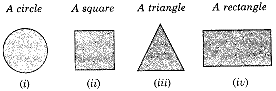
Here are the shadows of some $3-D$ objects, when seen under the lamp of an Over$-$head projector. Identify the solid$(s)$ that match each shadow. $($There may be multiple answers for these$.)$
View full solution
What cross$-$sections do you get when you give a
$i.$ vertical cut
$ii.$ horizontal cut to the following solids?
$a.$ A brick
$b.$ A round apple
$c.$ A die
$d.$ A circular pipe
$e.$ An ice cream cone
View full solution
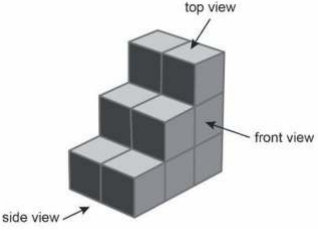
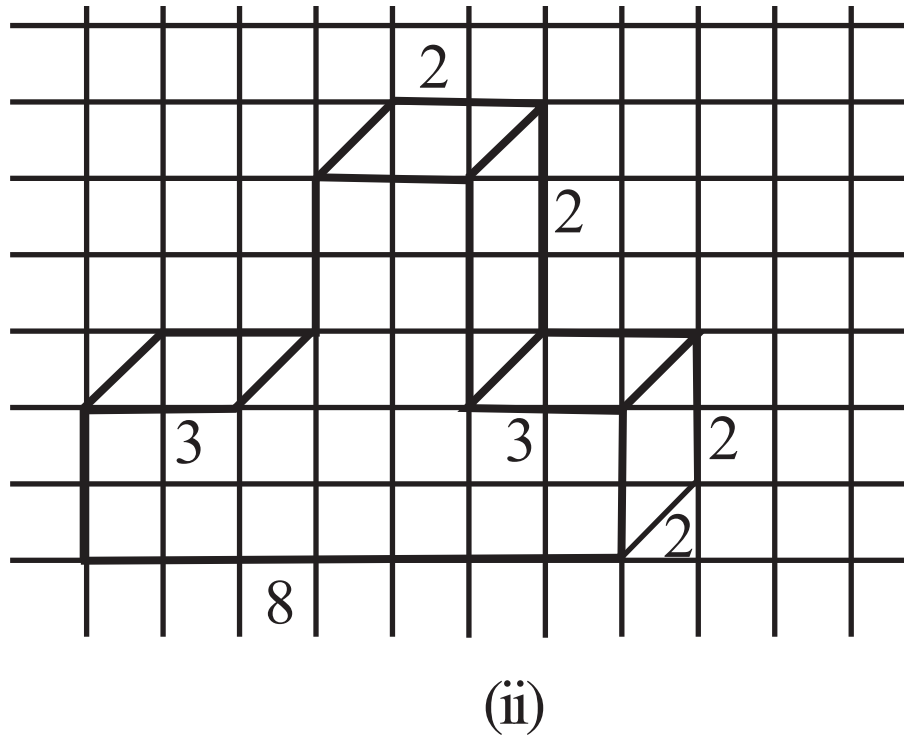
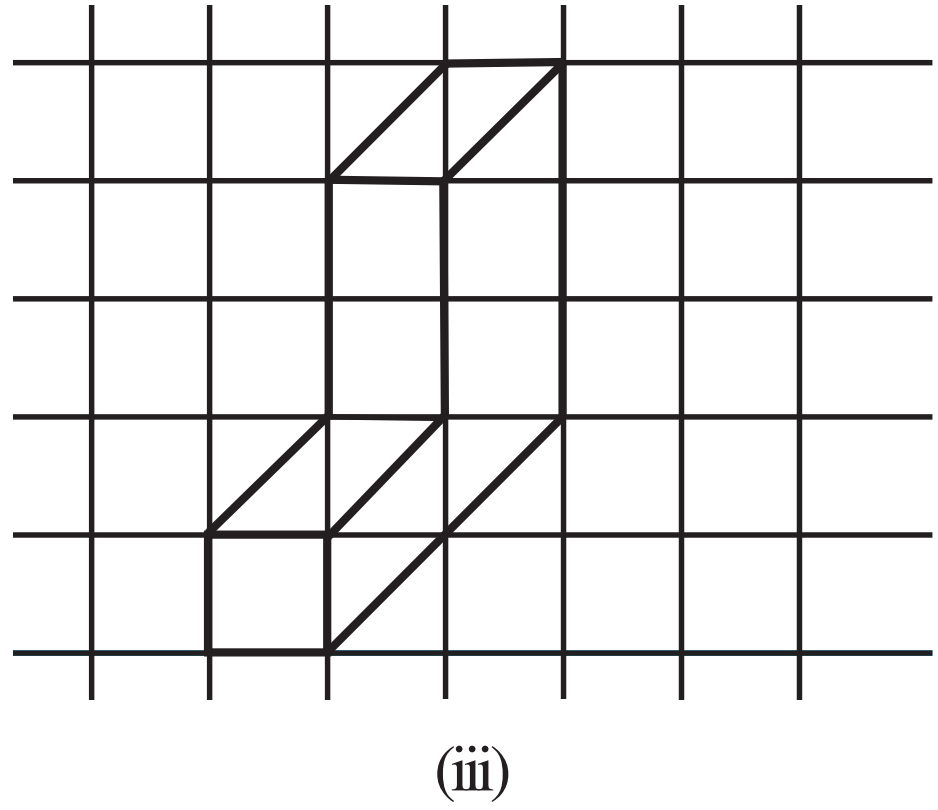
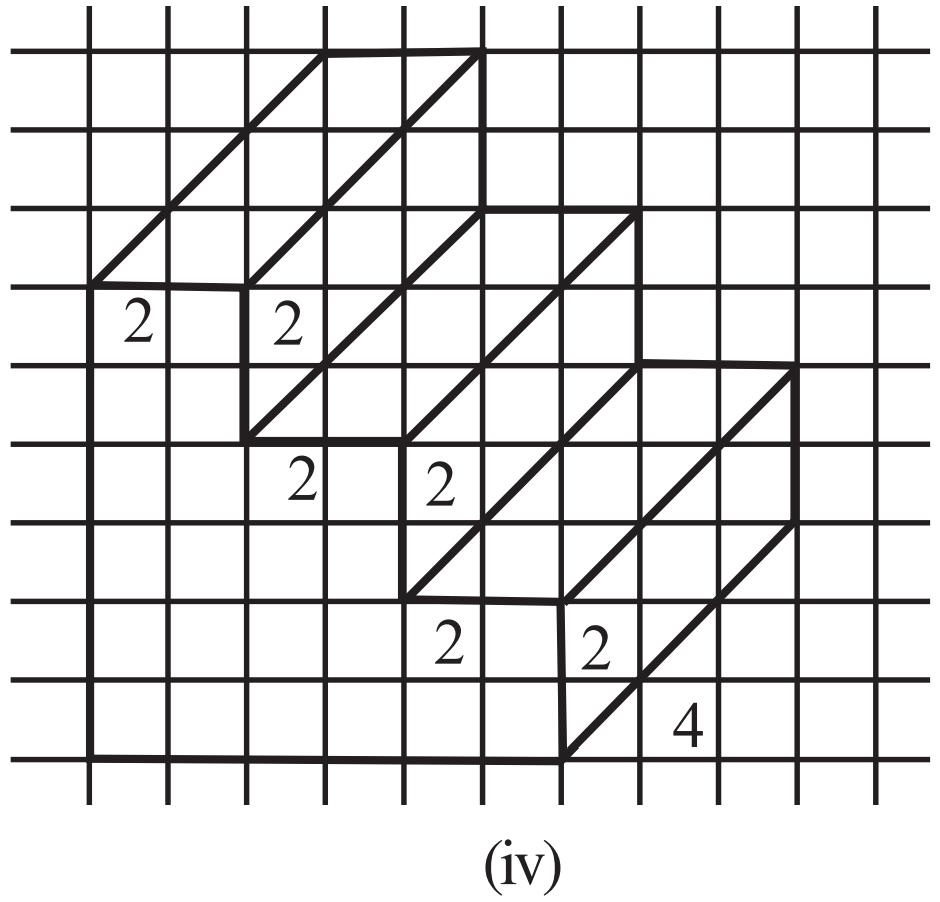
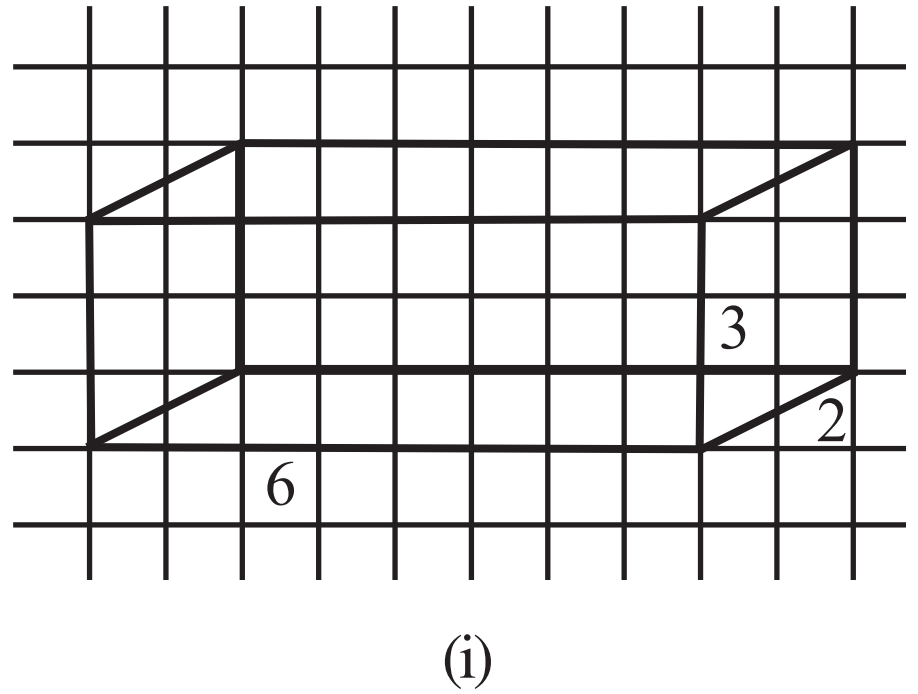
Rajat arranged some cubes as below.
Image
$1.$ How many cubes did he use$?$
$A. 6$
$B. 9$
$C. 12$
$D. 18$
$2.$ “An equal number of cubes are seen in the top, front and side views in this cubical arrangement.”
Is the statement correct? Explain your answer
View full solution
Q 323 Marks Question3 Marks
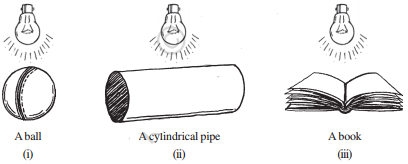
A bulb is kept burning just right above the following solids. Name the shape of the shadows obtained in each case. Attempt to give a rough sketch of the shadow. $($You may try to experiment first and then answer these questions$).$
View full solution
Q 343 Marks Question3 Marks
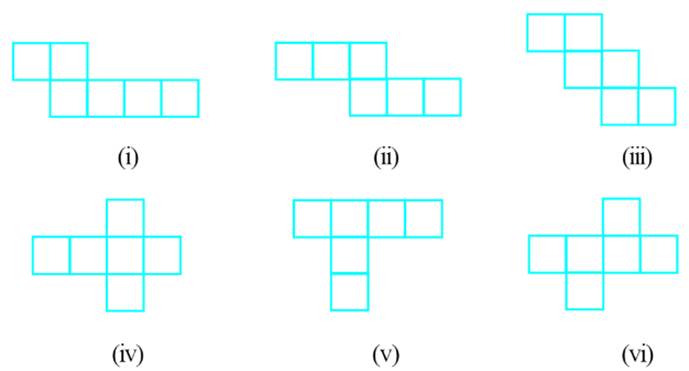
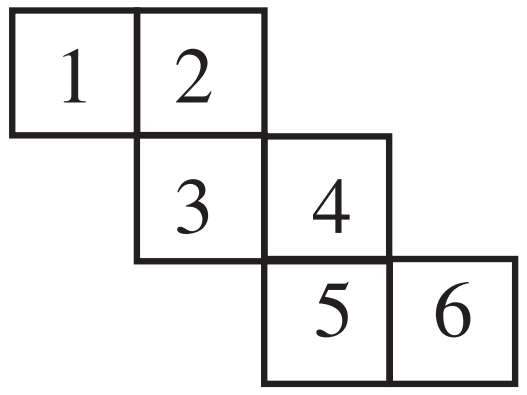
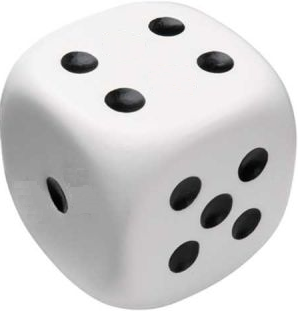
Dice are cubes with dots on each face. Opposite faces of a die always have a total of seven dots on them.  Here are two nets to make dice $($cubes$);$ the numbers inserted in each square indicate the number of dots in that box.
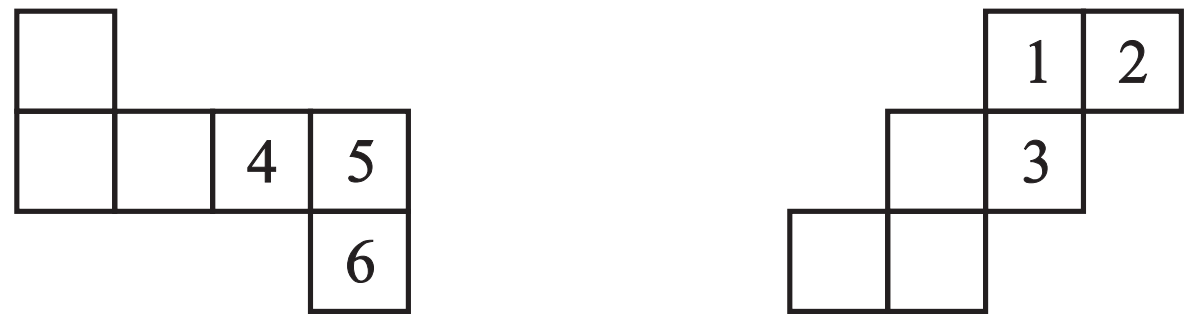
Insert suitable numbers in the blanks, remembering that the number on the opposite faces should total to $7.$
View full solution

Generate a Visualising Solid Shapes paper free

Pick question groups from the list above, set marks and difficulty, and export a branded PDF with step-by-step answer keys. First 3 chapters free — no signup.

Download App