Questions

2 Marks Questions

🎯

Test yourself on this topic

37 questions · timed · auto-graded

Question 12 Marks
What is a virtual image? Give one situation where a virtual image is formed.
Answer
When an image cannot be obtained on a screen, it is called a virtual image.

The image formed by a plane mirror is virtual, because the image cannot be obtained on a screen when placed either in front of the mirror or behind it.

View full question & answer
Question 22 Marks
State the characteristics of the image formed by a plane mirror.
Answer
The image formed by a plane mirror is erect, laterally inverted, and of the same size as that of the object. The left side of the object appears on the right side of the image. Also, the distance of the image from the plane mirror is same as the distance between the plane mirror and the object.
View full question & answer
Question 32 Marks
It was observed that when the distance between an object and a lens decreases, the size of the image increases. What is the nature of this lens? If you keep on decreasing the distance between the object and the lens, will you still able to obtain the image on the screen? Explain.
Answer
If on decreasing the distance between the object and lens, the size of the image increases, then the nature of the lens is convex type. No, if the distance between object and lens is less than the focal length of the lens, then it will form a virtual image which cannot be obtained on a screen.
View full question & answer
Question 42 Marks
Boojho made light from a laser torch to fall on a prism. Will he be able to observe a band of seven colours? Explain with a reason.
Answer
No, he will not observe band of seven colours because laser light consists of monochromatic light of a single colour. However, seven colours of bands are observed, when a white light is passed through a prism and dispersion takes place.
View full question & answer
Question 52 Marks
Define the following:
  1. Real image.
  2. Virtual image.
Answer
  1. Real image: Real image are those images that can be captured on a screen are known as real images. For example, in a camera, images are real and can be captured on the negative, which acts as a screen.
  2. Virtual image: The image formed by a plane mirror cannot be captured on a screen, and is called a virtual image.
View full question & answer
Question 62 Marks
What is a virtual image? Give one situation where a virtual image is formed.
Answer
An image which cannot be obtained on a screen is called a virtual image. A virtual image can be formed by a plane mirror, convex mirror, concave mirror, convex lens and concave lens. Polished Metallic surface or liquid surface such as lakes or water bodies can also form a virtual image.
View full question & answer
Question 72 Marks
Images in a mirror are located at the same distance behind the mirror as the object in front of it. Explain the importance of this property of mirror.
Answer
Images in a mirror are located at the same distance behind the mirror as the object in front of it is mainly used in interior decoration and in architecture to make rooms appear brighter and bigger. Moreover, placing a mirror near lights, chandeliers and table lamps reflects the light over a larger area, and makes the room appear brighter. Images that cannot be captured on a screen are called virtual images.
View full question & answer
Question 82 Marks
The distance between an object and a convex lens is changing. It is noticed that the size of the image formed on a screen is decreasing. Is the object moving in a direction towards the lens or away from it?
Answer
In case of convex lens, when we move the object away from the lens, the size of image decreases and ultimately, when object is at infinite distance a point image is formed at the focus of lens.
View full question & answer
Question 92 Marks
Name the three important characteristics of the image formed by a plane mirror.
Answer
Image formed by a plane mirror is:
  1. is erect.
  2. It is virtual and is of the same size as the object.
  3. The image is at the same distance behind the mirror as the object is in front of it.
View full question & answer
Question 102 Marks
Explain the term lateral inversion.
Answer
When an image is formed by the mirror in such a way that the left side of image is object’s right side and right side of image is object’s left side. So, this process of change in the sides of the object as well as of image is known as lateral inversion.
View full question & answer
Question 112 Marks
We need a shiny surface for reflection. Explain why.
Answer
Since, the extent of reflection depends upon the shine and smoothness of the surface. So, greater the shining and smoothness of the surface, greater will be the reflection. So, this is a reason why we require a shiny surface for reflection.
View full question & answer
Question 122 Marks
How is the rainbow formed?
Answer
A rainbow is formed by the refraction and reflection of the sun's rays through raindrops. When it is raining in one part of the sky and sunny in another, a rainbow appears. The centre of the rainbows arc is always directed away from the sun.
View full question & answer
Question 132 Marks
We can see objects when the lighted reflected from the objects falls upon our eyes. Why can't walls act as mirror even the light is reflected through walls and reach our eyes?
Answer
In case of mirror, the reflected rays of light are parallel and reach our eyes. That's why we can see objects through mirror or any shining surface. Walls surface are rough and reflection of light is diffused. Due to which walls do not act as mirror.
View full question & answer
Question 142 Marks
Distinguish between the following. Convergent beam and Divergent beam.
Answer
S. No.
Convergent beam
Divergent beam
$(i)$
It is a beam of light which comes together as if to meet or join.
It is a beam which proceeds in different directions from a point.
$(ii)$
Beams converge in convex lenses and concave mirrors.
Beams diverge in concave lenses and convex mirrors.
View full question & answer
Question 152 Marks
Define the following:
  1. Opaque Spherical Surface.
  2. Transparent Spherical Surface.
Answer
  1. In an opaque spherical surface, the silvered surface acts as a mirror. So, a concave mirror will have its concave side silvered, while a convex mirror will have its convex side silvered.
  2. For a transparent spherical surface, if the concave surface is silvered and later coated with red oxide, then the mirror acts as a convex mirror. Also, if the convex surface is silvered and later coated with red oxide, then it acts as a concave mirror.
View full question & answer
Question 162 Marks
You are given three mirrors of different types. How will you identify each one of them?
Answer
We can identify the mirrors by forming images of an object which are given as below:
  1. Plane mirror In case of plane mirror, image will be virtual, erect and of same size as that of object.
  2. Concave mirror In case of concave mirror, image may be real or virtual, inverted or erect and magnified or diminished depending upon the position of object.
  3. Convex mirror In case of convex mirror, image formed will always be virtual, erect and diminished in spite of the position of object.
View full question & answer
Question 172 Marks
What is a lens?
Answer
A piece of transparent material bound by curved surfaces. There are two types of lens concave lens and convex lens. Convex lens is thick at the centre and thinner at edges, it is called converging lens concave lens is thin at the center and thicker at edge, it is called diverging lens.
View full question & answer
Question 182 Marks
What are the uses of concave mirror?
Answer
Mirror Following are the uses of concave:
  1. Used by the $ENT$ Specialists, dentists.
  2. Used as Shaving mirror.
  3. Used by makeup artists.
  4. Used in torches & Car headlights to get a parallel beam of light.
View full question & answer
Question 192 Marks
State the characteristics of images formed by a concave mirror.
Answer
The characteristics of image formed by a concave mirror are:
  1. The image formed by a concave mirror is not always the same size as the object. It can be either larger or smaller depending on the distance of the object to the mirror.
  2. The image formed by a concave mirror is inverted when the object is kept far from the mirror. So, when it is brought very close to the concave mirror, then an erect and enlarged image is formed.
View full question & answer
Question 202 Marks
Briefly explain why in ambulance words are written laterally inverted.
Answer
In case of mirror, the image formed by it is laterally inverted, i.e. left seems to be right and right seems to be left. So, in ambulance there is emergency for patients to reach hospital and by viewing in rear mirror, it can be easily identified of a vehicle and everyone give him a way.
View full question & answer
Question 212 Marks
Why concave mirror is called a converging mirror and a convex mirror is called a diverging mirror?
Answer
Concave mirror is called a converging mirror because parallel rays of light fall on the mirror they converge at a point called focus. Convex mirror is called a diverging mirror because parallel rays of light fall on it they diverge after reflection.
View full question & answer
Question 222 Marks
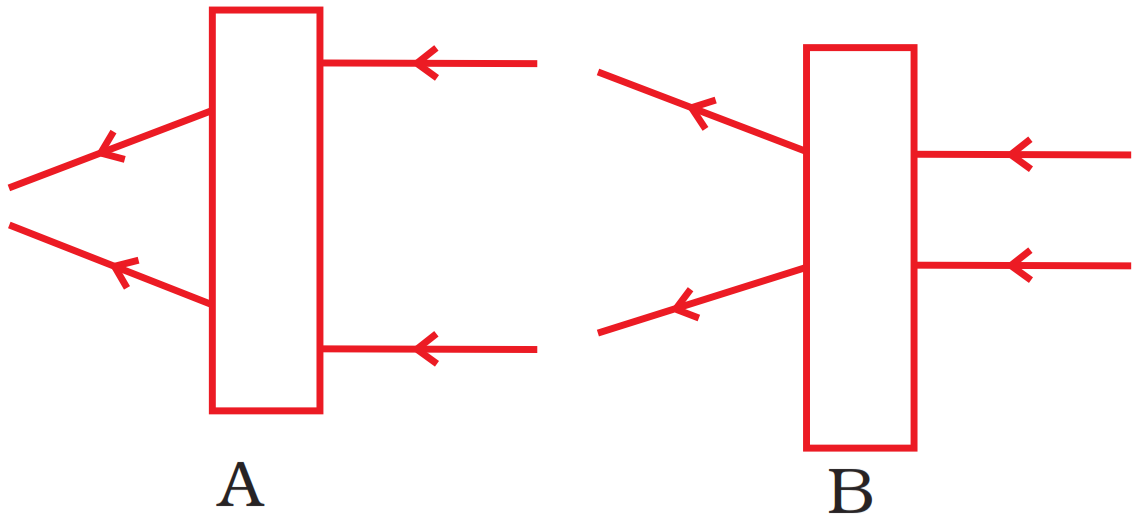
Observe the figures given as Figure $15.1$ carefully.

The given figures show the path of light through lenses of two different types, represented by rectangular boxes $A$ and $B$. What is the nature of lenses $A$ and $B$?
Answer
Since, in first case, light rays are converging towards a point, so the lens $A$ will be a convex lens and in case of lens $S$, light rays diverge or spread out. So, the lens $B$ will be a concave lens.
View full question & answer
Question 232 Marks
Briefly mention how many types of lens are there. Explain each of them.
Answer
There are two types of lenses:
  1. The lens which is thinner in the middle than at the edges is called a concave lens while the lens.
  2. Which is thicker in the middle than at the edges is called a convex lens.
View full question & answer
Question 242 Marks
The image formed by a lens is always virtual, erect and smaller in size for an object kept at different positions in front of it. Identify nature of lens.
Answer
Such types of lens which always forms virtual, erect and smaller image in spite of the different positions of an object is called concave lens.
View full question & answer
Question 252 Marks
Explain a spherical mirror.
Answer
Spherical mirror have curved reflecting surfaces and are also called curved mirrors. These mirrors are made from a hollow sphere. There are two types of curved surfaces at each hemisphere. The inner curved surface is termed as concave, while the outer is called convex. Spherical mirrors are different from plane mirrors due to their reflecting surface.
View full question & answer
Question 262 Marks

Namit was driving a car and suddenly became aware of a loud sound coming from behind. He looked through his rear view mirror and saw an ambulance. He recalled reading that such emergency vehicles often have their name written in the mirror $(AMBULANCE)$ or writing, i. e.

He quickly made way for the ambulance, murmuring a quick prayer for the speedy recovery of the patient inside the ambulance.
  1. Name the type of mirror which is used as a rear view mirror and why?
  2. Mention values did Namit exhibit.
Answer
  1. Convex mirror is a mirror which is used as a rearview mirror. It is used to get a wide view of traffic behind.
  2. The values exhibit by Namit here is courtesy concerned for other, sympathy, knowledgeable.
View full question & answer
Question 272 Marks
Explain the nature of image formed in a concave mirror.
Answer
The nature of image formed in a concave mirror depends on the portion of the object in front of the mirror. If the object is very close to the mirror the image is virtual, erect & magnified. As the distance increases image becomes real, inverted & its size keeps changing.
View full question & answer
Question 282 Marks
Mention the type of image:
  1. Which can be formed on the screen.
  2. Which cannot be formed on the screen.
Answer
  1. The image which can be formed on the screen is real image.
  2. The image which cannot be formed on the screen is virtual image.
View full question & answer
Question 292 Marks
What do you mean by left right inversed?
Answer
Images are inversed, i.e. the right part of an object appears on the left in its images, and the left part of the object appears to the right. For example, the word $'AMBULANCE'$ is painted left-right inversed on the vehicle so that when the driver of a vehicle in front looks into his rear view mirror, he can make out the word $'AMBULANCE'$ quickly and give way.
View full question & answer
Question 302 Marks
The concave reflecting surface of a torch got rusted. What effect would this have on the beam of light from the torch?
Answer
If the concave reflecting surface of a torch get rusted, it will produce diffused beam of light with lower intensity, the objects will not be clearly visible in this diffused and lower intensity of light.
View full question & answer
Question 312 Marks
What are the laws of reflection?
Answer
The two laws of reflection are:
  1. Angle of incidence is equal to angle of reflection.
  2. Incident reflected ray & the normal lie on the same plane.
View full question & answer
Question 322 Marks
A shopkeeper wanted to fix a mirror which will give a maximum view of his shop. What type of mirror should he use? Give reason.
Answer
If a shopkeeper wanted to fix a mirror which will give him maximum view of his shop, he should use a convex mirror. As a convex mirror can form images of objects spread over a large area, i.e. it can give a wider field of view.
View full question & answer
Question 332 Marks
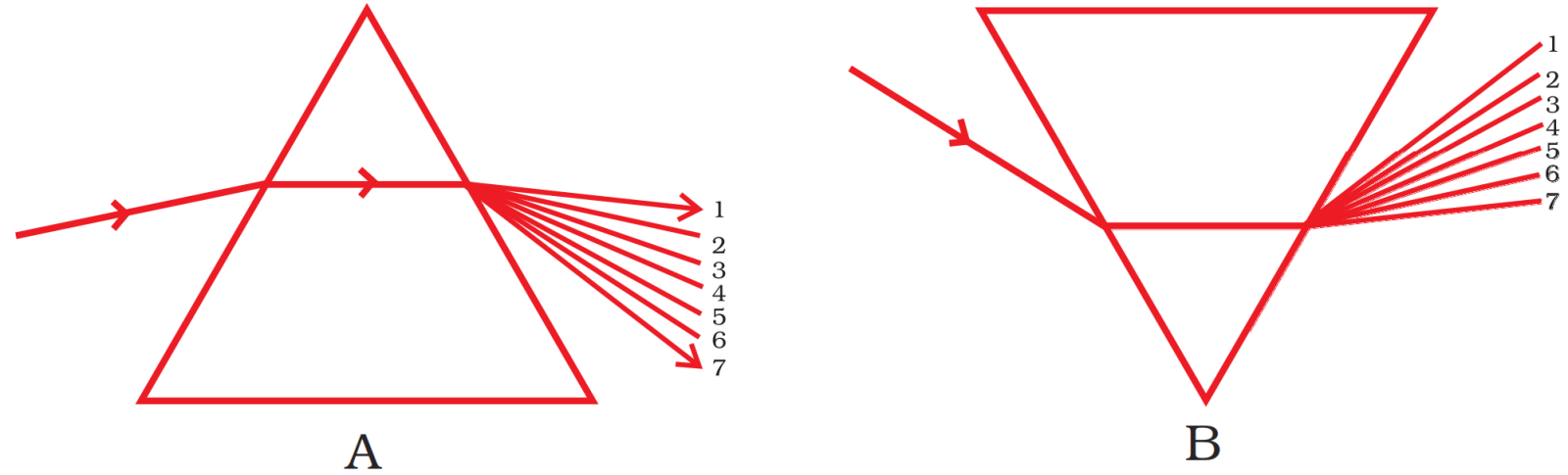
State the correct sequence $(1-7)$ of colours in the spectrum formed by the prisms $A$ and $B$, shown in Figure $15.2.$
Answer
Whena white light is passed through a prism, it disperses into its seven constituent colours.
 
 
For A
 
 
For B
$1.$
Rad
$1.$
Violet
$2.$
Orange
$2.$
Indigo
$3.$
Yellow
$3.$
Blue
$4.$
Green
$4.$
Green
$5.$
Blue
$5.$
Yellow
$6.$
Indigo
$6.$
Orange
$7.$
Violet
$7.$
Red
View full question & answer
Question 342 Marks
What type of mirror is used as a side mirror in a scooter? Why is this type of mirror chosen?
Answer
Convex mirror is used as a side mirror in a scooter because it can form diminished images of objects spread over a larger area. So, this helps the driver to have a wide field of view of traffic.
View full question & answer
Question 352 Marks
Two different types of lenses are placed on a sheet of newspaper. How will you identify them without touching?
Answer
On identifying the letters of newspaper, we can differentiate the two types of lenses. If image is large or magnified, then the lens is a convex lens and if the image is smaller or diminished in size for all the positions of object, then the lens is concave.
View full question & answer
Question 362 Marks
An erect and enlarged image of an object is formed on a screen. Explain how this could be possible.
Answer
An erect and enlarged image of an object can be formed by either concave mirror or convex lens if an object is placed upside down between the focus and centre of curvature of concave mirror or convex lens.
View full question & answer
Question 372 Marks
How you can create a mirror image?
Answer
Mirror maze is created based on the principle of reflection in plane mirrors. The maze has several plane mirrors placed at fixed angles to each other. When a person enters a mirror maze, he finds several images of himself and several passages. There is only one passage that is real, while all the others are all just images.
View full question & answer