Questions

3 Marks Question

🎯

Test yourself on this topic

35 questions · timed · auto-graded

Question 13 Marks
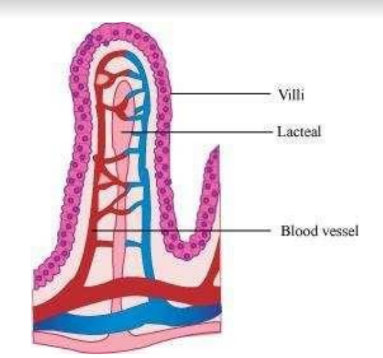
What are villi? What is their location and function?
Answer

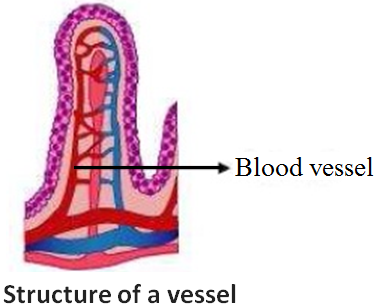
Villi are tiny finger-like projections originating from the walls of the small intestine. They increase the surface area for absorption of the digested food. The blood vessels present inside the villi can absorb the nutrients from the digested food.
Image

Structure of a villus

View full question & answer
Question 23 Marks
Explain how the digestion of cellulose occurs in grass eating animals.
Answer
Digestion in Grass-Eating Animals The herbivorous animals such as cow, buffaloes, etc eat grass. These animals quickly swallow the grass and store it in a part of stomach called rumen. The food is not chewed completely. Rumen possess cellulose digesting bacteria which breakdown the food by fermentation. This partially digested food or grass present in the rumen of cow is called cud. This cud is brought back into the mouth of the cow from the rumen into small lumps and animal chews it again. This process is called rumination and animals are called ruminants. When this cud is thoroughly chewed in the mouth of the cow, it is swallowed again. This time the chewed cud does not go back to rumen but enter into the other compartments of cow’s stomach and then into the small intestine for complete digestion and absorption of food. The cellulose digesting bacteria are not present in the body of human being, therefore human beings and other carnivore cannot digest cellulose present in plant food items.
View full question & answer
Question 33 Marks
Match the items of Column $I$ with those given in Column $II$:
Column I
Column II
Food components
Product $(s)$ of digestion
Carbohydrates
Fatty acids and glycerol
Proteins
Sugar
Fats
Amino acids
Answer
Column I
Column II
Food components
Product $(s)$ of digestion
Carbohydrates
Sugar
Proteins
Amino acids
Fats
Fatty acids and glycerol
View full question & answer
Question 43 Marks
Give a brief account of process of digestion of different nutrients in human being.
Answer
Digestion in mouth $\text{Starch}\xrightarrow[]{\text{Saliva}}\text{Sugar}$ Digestion in stomach: Stomach secrets mucous, hydrochloric acid and digestive juices.
  • Mucous protects the lining of the stomach.
  • The acid kills the bacteria and provide acidic medium.
  • Digestive juices breakdown the proteins into simpler substances.
Digestion in small intestine: Liver secretes bile juice, that helps in digestion of fats. Pancreas secretes pancreatic juice which acts on carbohydrates and proteins and converts into simpler form. Intestinal juice completes the digestion of all components of food. Such as: Carbohydrates → Glucose Fats → Fatty acids and glycerol Proteins → Amino acids
View full question & answer
Question 53 Marks
What are villi? What is their location and function?
Answer
Villi are tiny finger-like projections originating from the walls of the small intestine. They increase the surface area for absorption of the digested food. The blood vessels present inside the villi can absorb the nutrients from the digested food.
View full question & answer
Question 63 Marks
Write the function of the following:
  • Tongue
  • Stomach
  • Small intestine
  • Large intestine
Answer
  • Tongue: It moves the food around the mouth and mixes with saliva into a ball. It also helps in tasting the food.

  • Stomach: It secretes digestive secretions containing enzymes that digests the food.

  • Small intestine: Digestion of food completes in the small intestine and the villi on its wall help in complete absorption of digested food.

  • Large intestine: It absorbs water and salts from the undigested food material.

View full question & answer
Question 73 Marks
Match the animals in Column $I$ with their mode of feeding listed in Column $II$
  Column I   Column II
  Animals   Mode of Feeding
$(a)$ House fly $(i)$ Biting and chewing
$(b)$ Cockroach $(ii)$ Suckling
$(c)$ Mosquito $(iii)$ Sponging
$(d)$ Infants $(iv)$ Sucking
Answer
  Column I   Column II
  Animals   Mode of Feeding
$(a)$ House fly $(iii)$ Sponging
$(b)$ Cockroach $(i)$ Biting and chewing
$(c)$ Mosquito $(iv)$ Sucking
$(d)$ Infants $(ii)$ Suckling
  1. Housefly is a sponging insect with sponge-like mouth parts that allow them to eat only liquid foods.
  2. Cockroach has primitive arrangement of mouthparts for biting and chewing.
  3. Mosquito has piercing and sucking mouth parts that pierce food items to enable sucking of internal fluids.
  4. Infants suckle milk, as they have no teeth.
View full question & answer
Question 83 Marks

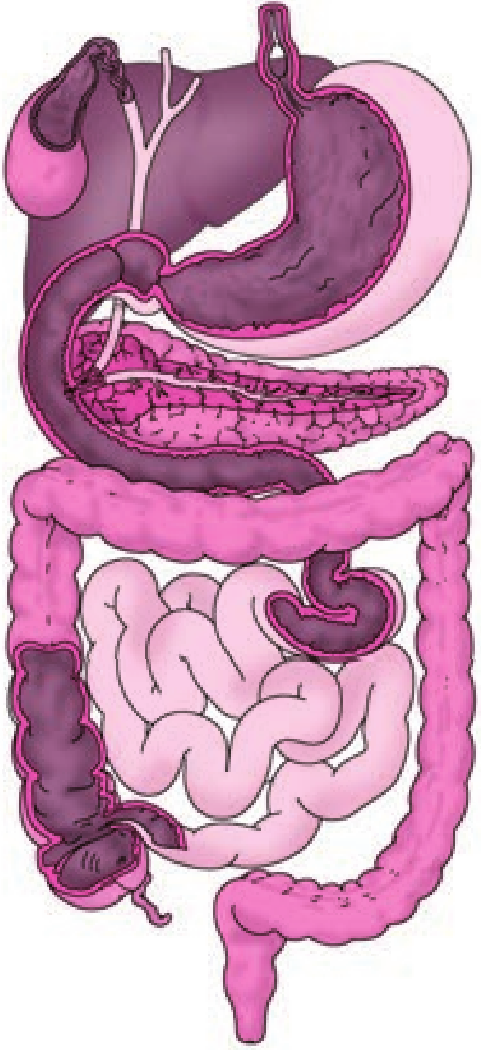
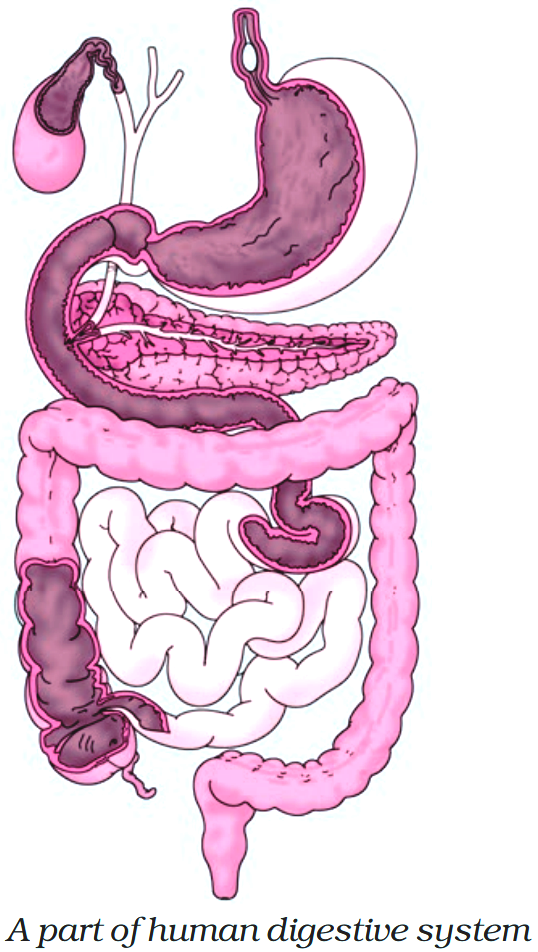
Label the following parts in Figure and name them.
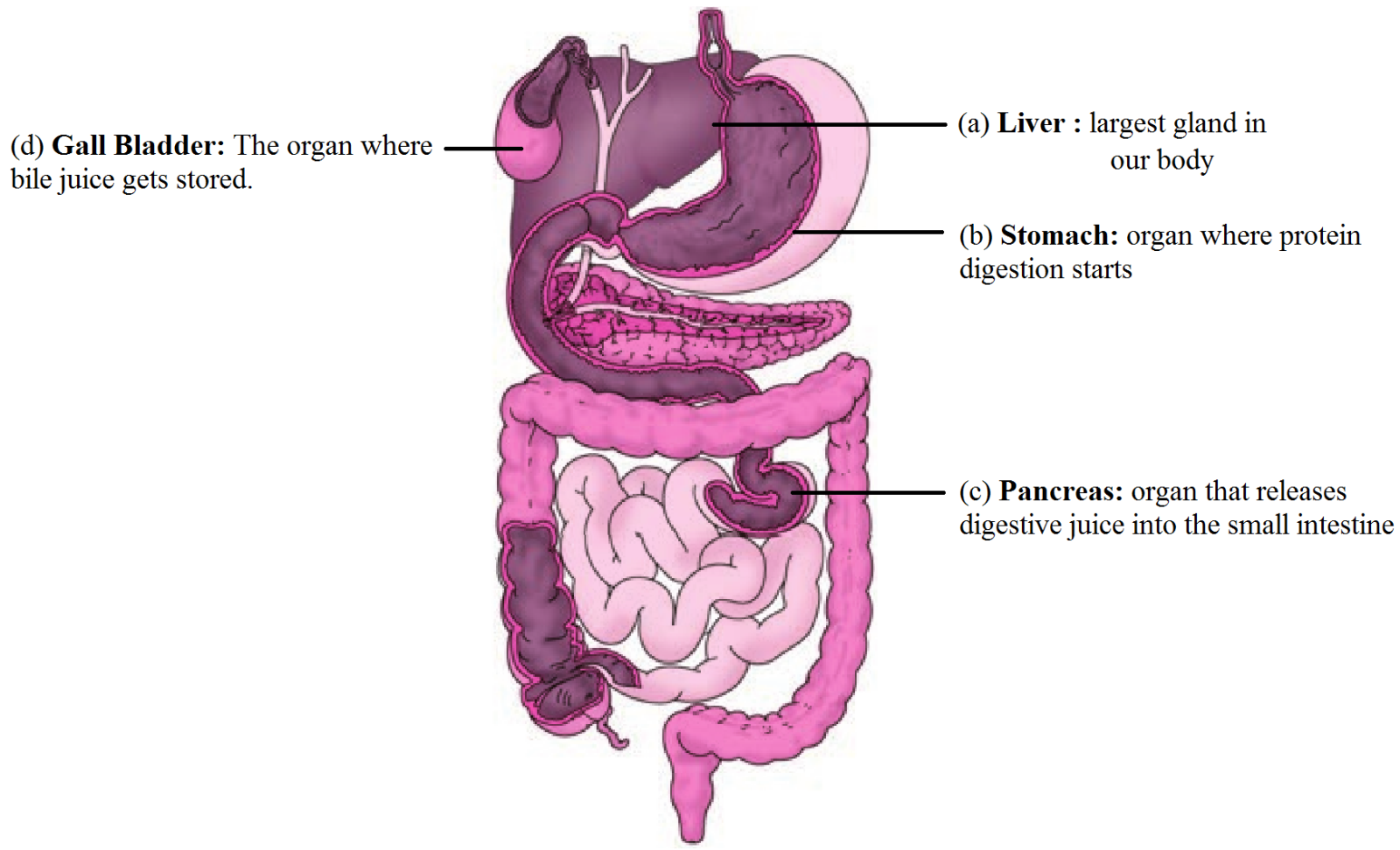
  1. The largest gland in our body.
  2. The organ where protein digestion starts.
  3. The organ that releases digestive juice into the small intestine.
  4. The organ where bile juice gets stored.
Answer

The parts of figure and their name are as given:
View full question & answer
Question 93 Marks
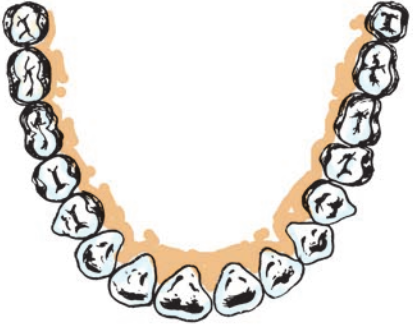
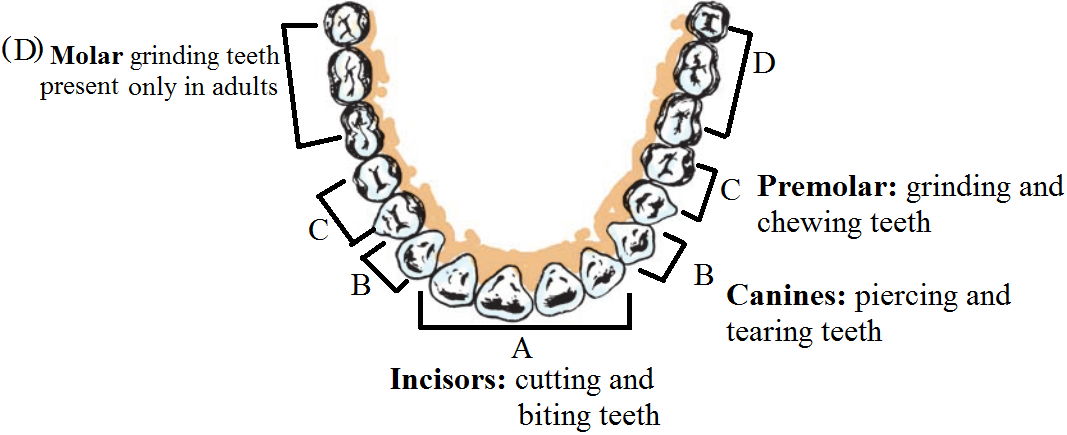
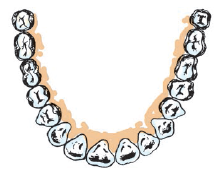
Label the below given Figure as directed below in $(i)$ to $(iv)$ and give the name of each type of teeth.
  1. The cutting and biting teeth as $‘A’$
  2. The piercing and tearing teeth as $‘B’$
  3. The grinding and chewing teeth as $‘C’$
  4. The grinding teeth present only in adult as $‘D’$
Answer

The name of each type of teeth are as given:
View full question & answer
Question 103 Marks
What happens to the food in small intestine of the digestive tract?
Answer
The small intestine is highly coiled and is about $7.5$ metres long. Liver is the largest gland in the body. It secretes bile juice that is stored in a sac called the gall bladder. It digests fats. The pancreas is cream colour red gland secretes pancreatic juice that acts on carbohydrates and proteins and changes them into simpler forms. The carbohydrates get broken into simple sugars such as glucose, fats into fatty acids and glycerol, and proteins into amino acid, she digested food can now pass into the blood vessels in the wall of the intestine having thousands of finger-like villi. The surface of the villi absorbs the digested food materials. The absorbed substances are transported via the blood vessels to different organs of the body.
View full question & answer
Question 113 Marks
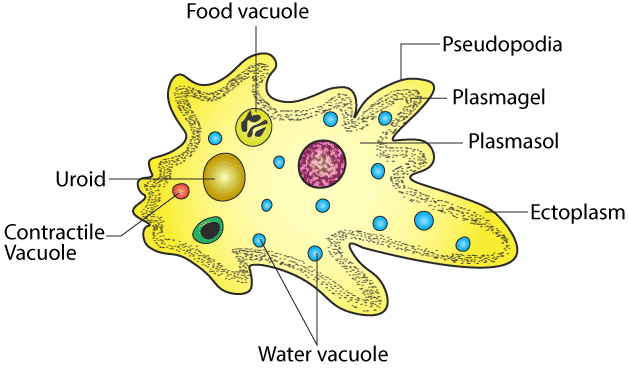
Draw a neat and clean diagram of Amoeba showing the correct location of the following components: nucleus, vacuole, pseudopodia.
View full question & answer
Question 123 Marks
Explain the digestion process in Amoeba with the help of diagram.
Answer

Amoeba is unicellular organisms, it captures food with the help of finger like projections called pseudopodia helps amoeba to engulf the food. Food now become trapped in food vacuole and with the help of digestive juices complex food converts into simple substances. Gradually the digested food is absorbed and undigested food is expelled outside by the vacuole.
View full question & answer
Question 133 Marks
Write one similarity and one difference between the nutrition in amoeba and human beings.
Answer
  1. Similarity: The basic process of digestion of food and release of energy is the same in amoeba as well as in human beings. In amoeba, Digestive juices are secreted into the food vacuole. They act on the food and break it down into simpler substances. Gradually the digested food is absorbed. Similarly, in human beings various digestive juices (mouth, stomach, intestine etc.) act on food and break it down to simpler substances.
  2. Difference: The digestion process in amoeba is simple while in human beings it s a complex process. The process of ingestion and egestion are also quite different. Amoeba engulf its food by surrounding the food particle with its pseudopodia. The undigested food which is largely carbon dioxide gas is expelled outside by the vacuole. While in human beings, the food (which is complex substance) is taken inside the mouth and undergoes a complex process of digestion and absorption. Finally the undigested food it expelled in the form of faeces.
View full question & answer
Question 143 Marks
Ruminants such as cows and buffaloes swallow their food hurriedly and then sit restfully and chew their food. Can you reason why?
Answer
Ruminants such as cows and buffaloes swallow their food hurriedly and store it in a part of the stomach called rumen. The cellulose of the food is digested here by the action of certain bacteria which are not present in humans. Later, this partially digested food (cud) is returned to the buccal cavity of the animals in small lumps and animal chews it sitting restfully to complete the process of digestion. This process is called rumination. The thoroughly chewed cud is swallowed again to other compartment of stomach and then into small intestine for complete digestion and absorption.
View full question & answer
Question 153 Marks
Boojho took some grains of boiled rice in test tube $‘A’$ and Paheli took boiled and chewed rice in test tube $‘B’$. Both of them poured $1-2$ drops of iodine solution into the test tube and observed the colour change. What colour change would they have observed? Give reasons for your answer.
Answer
Iodine solution gives a blue-black colour on reacting with starch. In test tube $A$, blue-black colour appeared because starch was present. In test tube $6$, colour of iodine would not change because it contained chewed rice. Starch in this case has been broken down into simple sugars by the action of amylase present in saliva. The saliva gets mixed with food on chewing.
View full question & answer
Question 163 Marks
Write the difference between milk teeth and permanent teeth.
Answer
The difference between milk teeth and permanent teeth are:
S.No.
Milk teeth
Permanent teeth
$i.$
They grow during infancy, i.e. when one is small baby.
They grow at the age of $6-8$ years.
$ii.$
They are also called as temporary teeth because these are lost at the age of 6-8 years.
They do not fall till the old age.
$iii.$
They can be replaced by permanent teeth.
If these teeth fall down no new teeth arises on its place.
View full question & answer
Question 173 Marks
Open your mouth, look into a mirror and try to count the different types of teeth in your mouth. Compare them with Figure on page 13 of your $NCERT$ textbook. Record your observations in the table below:
Type of teeth Number of teeth
In my mouth In the figure
Incisors    
Canines    
Premolar    
Molar    
  1. Did you observe any difference in the number of teeth? If yes, could you identify which type of teeth showed the difference?
  2. Compare the number and type of teeth in an adult (say your parents or cousins who have reached the age of $25–30$ or more). Note your observation.
Answer
Type of teeth Number of teeth
In my mouth In the figure
Incisors $4$ $4$
Canines $2$ $2$
Premolar $4$ $4$
Molar $4$ $6$
  1. Yes, the difference has been observed in the number of molars.
  2. The number and type of teeth vary in an adult as compared to a child.
Children have $28$ teeth in their mouth.
There are only four molars in each jaw. While, adults have $32$ teeth in their mouth which means six molars in each jaw. The third molars, present only in adults are known as wisdom teeth.
View full question & answer
Question 183 Marks
Jaya returned from school and found that grandmother was scolding her maid, Rani as she did not come yesterday. The maid told that his son was passing watery stools frequently that’s why she didn’t come. Jaya’s mother who was listening the discussion came to them and told Rani not to come for coming $3-4$ days. She also suggested her to give his son a solution of sugar and salt in clean water, many times a day for fast recovery. Jaya was surprised. She rushed to her mother and asked the scientific reason for it. Her mother smiled and explained her the importance of this solution.
  1. Name the term used to describe the condition in which a person passes out watery stools.
  2. Name the solution of sugar and salt in water. Why is it given to a person suffering from diarrhoea?
  3. What are the values shown by Jaya?
Answer
  1. Diarrhoea.
  2. Oral Rehydration Solution $(ORS)$. It is given to a person suffering from diarrhoea to prevent the dehydration.
  3. She is sincere, curious and has interest in science.
View full question & answer
Question 193 Marks
Recall and name the main organs of the digestive system in our body.
Answer
The different organs of the alimentary canal are as follows:
  1. Mouth and mouth cavity.
  2. Oesophagus.
  3. Stomach.
  4. Small intestine.
  5. Large intestine.
  6. Anus.
View full question & answer
Question 203 Marks
Explain tooth decay?
Answer
Our mouth contains some useful bacteria but if we do not clean our teeth and mouth after eating, many harmful bacteria also begin to live and grow in it. These bacteria break down the sugars present from the leftover food and release acids. These acids gradually damage the teeth and causes tooth decay.
View full question & answer
Question 213 Marks
What is the various steps involved in Digestion process?
Answer
Digestion is a complex process involving:
  • Ingestion
  • Digestion
  • Absorption
  • Assimilation
  • Egestion
View full question & answer
Question 223 Marks
Write one similarity and one difference between the nutrition in amoeba and human beings.
Answer
Similarity between nutrition in Amoeba and human beings: Both Amoeba and humans require energy for the growth and maintenance of their bodies. This energy is derived from the food that they eat. The food that they consume is always in a complex form and is therefore broken down into simpler forms by the process of digestion. Hence, both these organisms are heterotrophy.
Differences between nutrition in Amoeba and human beings:
 
Digestion in Humans
 
Digestion in Amoeba
$(i)$
Humans have a mouth and a complex digestive system.
$(i)$
Mouth and digestive system are absent in Amoeba.
$(ii)$
Digestive juices are secreted in the buccal cavity, stomach, and small intestine.
$(ii)$
Digestive juices are secreted in the food vacuole.
$(iii)$
Digestion of carbohydrates, proteins, and fats starts in separate regions.
$(iii)$
All the food components are digested in the food vacuole.
View full question & answer
Question 233 Marks
Describe nutrition in amoeba.
Answer
Amoeba is a single-celled organism found in pond water. It has a cell membrane, a dense, rounded nucleus and many bubble-like vacuoles. Amoeba constantly changes its shape and position. It pushes out one or more finger like projections, called pseudopodia or false feet for movement and capturing of food. Amoeba feeds on microscopic organisms. When it senses food, it pushes out pseudopodia around the food particle and engulfs it. The food becomes trapped in a food vacuole and digested by the digestive juices.
View full question & answer
Question 243 Marks
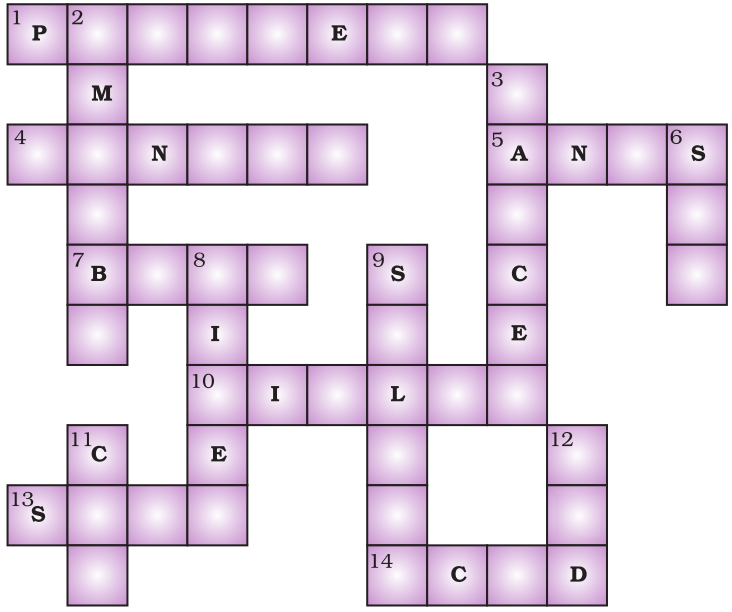
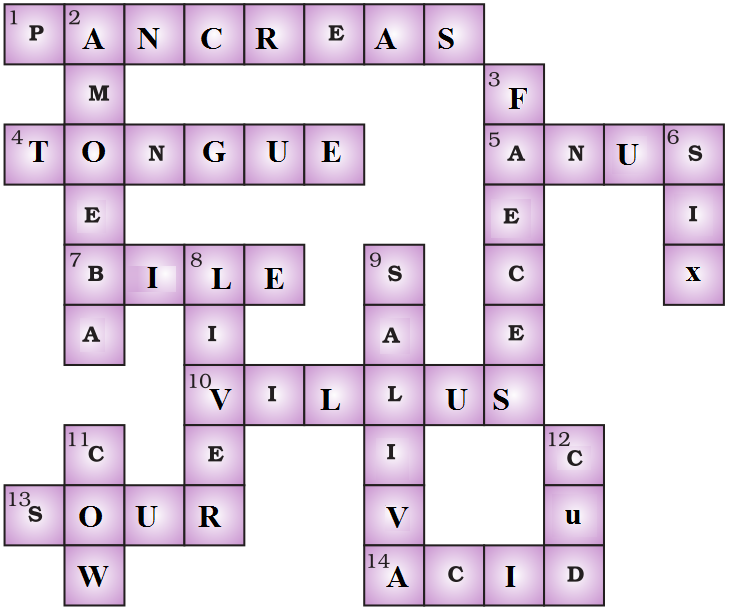
Solve the crossword given as Figure.

Across:
  1. Cream-coloured digestive gland
  1. Undigested excretory solid residues
  2. Organ that mixes saliva with the food
  1. Point of defecation
  1. Stored in gall bladder
  1. Finger-like outgrowth in the small intestine
  1. Kind of taste buds
  1. Kills bacteria in the stomach
Down:
  1. Feeds with the help of pseudopodia
  1. Total number of molars in one jaw of an adult
  1. Largest gland
  2. Watery secretion in the mouth
  1. A ruminant
  2. Form of food chewed by ruminants
Answer


Across:
  1. PANCREAS
  1. TONGUE
  2. ANUS
  1. BILE
  1. VILLUS
  1. SOUR
  2. ACID
Down:
  1. AMOEBA
  2. FAECES
  1. SIX
  1. LIVER
  2. SALIVA
  1. COW
  2. CUD
View full question & answer
Question 263 Marks
Label the given figure as directed below in $A$ to $D$ and give the name of each type of teeth.
  1. The cutting and biting teeth as $A.$
  2. The piercing and tearing teeth as $B.$
  3. The grinding and chewing teeth as $C.$
  4. The grinding teeth present only in adult as $D.$
View full question & answer
Question 273 Marks
Name the type of carbohydrate that can be digested by ruminants but not by humans. Give the reason also.
Answer
Cellulose is a type of carbohydrate that can be digested by ruminants and not by humans. Ruminants have a large sac-like structure between small and large intestine where the food containing cellulose is digested by the action of certain bacteria. On the other hand, humans cannot digest cellulose, as the cellulose digesting enzymes are absent in them.
View full question & answer
Question 293 Marks
Why do we get instant energy from glucose?
Answer
Glucose is a simple sugar. Carbohydrates, when consumed, have to be digested into glucose. As glucose can be easily absorbed in blood, it provides energy to the body. Hence, when glucose is directly taken, it does not have to be digested and thus acts as an instant source of energy.
View full question & answer
Question 303 Marks
Discuss the various associated glands of digestive system and their role in digestion.
Answer
The various associated glands of digestive system and their role in digestion are as follows:
  1. Salivary gland digestion of starch in mouth.
  2. Liver secretes bile juices which help in the digestion of fats.
  3. Pancreas secretes pancreatic juices which act on carbohydrate, fats and proteins and change them into simpler compounds.
View full question & answer
Question 313 Marks
Name the various components of food and their simpler forms.
Answer
The various components of food and their simpler forms are:
Components of food
Simpler form
Carbohydrate
Glucose
Fats
Fatty acids and glycerol
Proteins
Amino acids
Vitamins
Vitamins
Minerals and water
Minerals and water
View full question & answer
Question 323 Marks
What are the functions of the tongue in human body?
Answer
The functions of the tongue are as follows:
  • It is used for talking, it is not possible to talk without this.
  • It mixes saliva with the food during chewing and helps in swallowing of food.
  • Due to the presence of taste buds on it, It is used to identify the taste of food like sweet or salty etc.
View full question & answer
Question 333 Marks
Can we survive only on raw, leafy vegetables/ grass? Discuss.
Answer
We know that animals like most of the bacteria, non-green plants and human being do not possess the ability to synthesize their own food. Therefore they depend upon autotrophs for their food supply either directly or indirectly. The green plants (leafy vegetables/ grass) trap solar energy and manufacture their food in the form of glucose. So, leafy vegetables and grass can provide sufficient energy required for the survival of human being.
View full question & answer
Question 343 Marks
What happens to the food in mouth and oesophagus of the digestive tract?
Answer
When food is ingested the salivary glands which secrete saliva acts on it in the mouth. The saliva breaks down the starch into sugars. Oesophagus is along, narrow, muscular tube which directly leads to the stomach. It is about $25\ cm$ long and passes downwards through the neck, the thorax and the abdominal cavity. Oesophagusgently pushes masticated food down to the stomach in a wave- like action, called peristalsis.
View full question & answer
Question 353 Marks
Little Rishi (student of class $VI$) was watching his favourite cartoon serial on television. Suddenly he got hiccups. His elder brother Shubham who was sitting near by him gave him a glass of water and suggested not to eat too fast in a hurry. Little Rishi got confused as he had heard that ‘hicki’ comes when someone remembers. He asked his father. His father smiled and explained him that it is only a myth. He also explained him the proper scientific reason behind it.
  1. What is hiccup?
  2. Why do we get hiccup?
  3. What are the values shown by Rishi?
Answer
  1. Hiccup is a choking sensation that produces a characteristic gulping sound repeatedly. It is called ‘hicki’ in our local language.
  2. Sometimes, when we eat too fast in a hurry or talk too much or laugh while eating, then a little of windpipe remains open due to which food particles may enter the windpipe. It may result in a choking sensation called hiccups.
  3. He is sincere and curious to know about the things at an early age.
View full question & answer