Questions · Page 1 of 2

2 Marks Questions

🎯

Test yourself on this topic

50 questions · timed · auto-graded

Question 12 Marks
Why do organisms need to take food?
Answer
All living organisms require food to survive. It gives them energy to perform various activities. All activities such as playing, running, walking, studying, etc. require energy. The various components present in our food such as carbohydrates, proteins, fats, vitamins, and minerals provide energy to our body. These are also important for growth and development of the body.
View full question & answer
Question 22 Marks
Why do farmers grow many fruits and vegetable crops inside large green houses?
What are the advantages to the farmers?
Answer
Green house protects the plants to inside from the climatic conditions outside and gives it suitable temperature for growth.
The advantages to the farmers are:
$(i)$ It protects crops from many diseases
$(ii)$ It also protects the plant from heavy winds and rodents.
View full question & answer
Question 32 Marks
Autotrophs and heterotrophs are two different organisms with distinct modes of nutrition state. How are they different from each other?
Answer
The difference between autotrophs and heterotrophs are as follows:
S.No.
Autotrophs
Heterotrophs
$(i)$
They can prepare their own food.
They cannot prepare their own food.
$(ii)$
Autotrophs take simple inorganic substances and change it into complex organic food, e.g. green plants.
They take in complex food and breakdown it into simple compounds, e.g. all animals, fungi and non-green plants.
View full question & answer
Question 42 Marks
From where do the plants obtain nitrogen?
Answer
Soil has certain bacteria that convert gaseous nitrogen into a usable form and release it into the soil. These soluble forms are absorbed by the plants along with water. By adding fertilizers rich in nitrogen to the soil farmers also made nitrogen available for plants.
View full question & answer
Question 52 Marks
Water and minerals are absorbed by the roots and then transported to leaves. How?
Answer
Water and minerals are transported to the leaves by the vessels which run like pipes throughout the root, stem, branches and the leaves. These vessels are xylem and phloem, forming a continuous path or passage for the nutrients to make them reach the leaf.
View full question & answer
Question 62 Marks
What is the role of leguminous plants in replenishing soil fertility?
Answer
Rhizobium is a type of bacteria that cannot make its own food and lives in the roots of gram, peas, moong beans and other legumes, it converts atmospheric nitrogen into useable form which increases the fertility of soil, and legumes provide food and shelter to the bacteria.
View full question & answer
Question 72 Marks
How humans and animals are directly or indirectly dependent on plants?
Answer
All living organisms require food. Plants can make their food themselves by organic substances but animals including humans cannot make their food themselves. They get it from plants or animals that eat plants. Thus, humans and animals are directly or indirectly dependent on plants.
View full question & answer
Question 82 Marks
Define insectivorous plants along with examples.
Answer
There are few plants which can trap insects and digest them. Such plants may be green or of some other colour. Such insect-eating plants are called insectivorous plants.
Example: Venus Flytrap and Pitcher plant.
View full question & answer
Question 92 Marks
Can you give me a name? Solve each of the following riddles by writing the name of the organism and its mode of nutrition. One riddle is solved to help you. I am white and soft. I grow well in the rainy season. Children pluck me from the ground and admire me. I absorb nutrients from decomposed dead parts of plants and animals in the soil. , .
Answer
I am white and soft. I grow well in the rainy season. Children pluck me from the ground and admire me. I absorb nutrients from decomposed dead parts of plants and animals in the soil. Mushroom, saprophyte. Explanation: Fungi such as mushroom under warm conditions grow on dead parts of plants (e.g. rotting wood of a dead tree) and animals. They obtain nutrition from decaying organic matter. So, they are saprophytes.
View full question & answer
Question 102 Marks
How do plants get nitrogen to synthesise proteins?
Answer
Plants cannot take nitrogen in free state present in the atmosphere. They absorb the nitrogen fixed in the soil by roots, or by symbiotic relationship that are capable of nitrogen fixation from the air with microorganisms.
View full question & answer
Question 112 Marks
What do you understand by symbiotic relationship present in some organism?
Answer
Some organisms live together and share shelter and nutrients. This is called symbiotic relationship. E.g. an alga, and a fungus live together fungus provides shelter, water and minerals to the alga and, in return, the alga provides food which it prepares by photosynthesis. In this kind of association both partners are benefited.
View full question & answer
Question 122 Marks
Why do organisms take food?
Answer
Organism needs food to:
  • Get energy to do work.
  • Build body.
  • Repair damage in the body.
  • Maintain the functions of the body.
View full question & answer
Question 132 Marks
What are nutrients? Name the different nutrients.
Answer
Nutrients are chemical substances present in our food that provide energy and other materials required by the body to live and grow.Examples of nutrients are:
  1. Carbohydrates.
  2. Proteins.
  3. Fats.
  4. Minerals.
  5. Vitamins.
View full question & answer
Question 142 Marks
Wild animals like tiger, wolf, lion and leopard do not eat plants. Does this mean that they can survive without plants? Can you provide a suitable explanation?
Answer
It is true that these animals do not eat plants. They hunt and eat herbivorous animals like deer, gaur, bison, zebra, giraffe, etc. which are dependent on plants for food. If there are no plants, herbivorous animals will not survive and in that case animals like tiger, wolf, lion and leopard will have nothing to eat.
View full question & answer
Question 152 Marks
Potato and ginger are both underground parts that store food. Where is the food prepared in these plants?
Answer
In both the plants, shoot system and leaves are above ground. They prepare food through photosynthesis and transport it to the underground parts for storage.
View full question & answer
Question 162 Marks
Based on eating habits, in what categories animals are divided?
Answer
  1. Herbivores: Plant eaters e.g. cow, buffalo, goat etc.
  2. Carnivores: Meat eaters e.g. lion, tiger etc.
  3. Omnivores: eat both plants and animals e.g. human, bear etc.
View full question & answer
Question 172 Marks
Some plants have deep red, violet or brown coloured leaves. Can these leaves perform the photosynthesis process?
Answer
Yes, plants having deep red, violet or brown coloured leaves can also carry out photosynthesis because they contain chlorophyll. But their green colour of chlorophyll is masked by the large amount of all other coloured pigments.
View full question & answer
Question 182 Marks
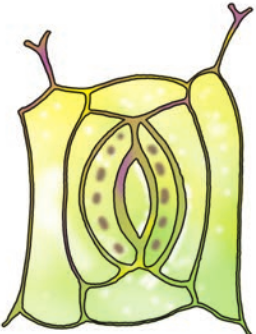
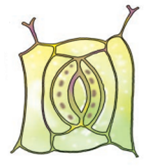
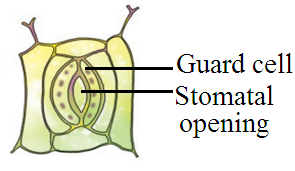
Observe the diagram given as Figure and label the following terms given in the box. stomatal opening, guard cell
Answer
Labelled figure is given below: Note: stomata are the tiny pores for gaseous exchange present on leaf surface. Their opening and closing is controled by guard cells.
View full question & answer
Question 192 Marks
Pooja is worried about her new shoes which she wore on special occassions that they were spoiled by fungus during rainy season. Is she right to worry, if yes, then tell why does fungi suddenly appears during the rainy season?
Answer
Yes, the fungi reproduces by spores which are generally present in the air and grow on any article that are left in hot and humid weather for a long time. During rainy season they land on wet and warm things and begin to germinate and grow.
View full question & answer
Question 202 Marks
Unscramble the following to form terms related to modes of nutrition.
  1. $RASPAEIT.$
  2. $ROPEHYTSAP.$
  3. $TOROPHAUT.$
  4. $SIBIOMSYS.$
Answer
  1. $PARASITE.$
  2. $SAPROPHYTE.$
  3. $AUTOTROPH.$
  4. $SYMBIOSIS.$
View full question & answer
Question 212 Marks
Why do plants use the nitrogen present in soil? How is this nitrogen replenished in the soil?
Answer
Plants cannot absorb nitrogen in gas form, they need it in soluble form. Therefore, they use the nitrogen present in soil to prepare proteins.
Atmospheric nitrogen is fixed in soil by nitrogen-fixing bacteria such as Rhizobium, which live in the root nodules of leguminous plants such as gram, peas, beans, etc. In return, the plants provide food and shelter to the bacteria.
View full question & answer
Question 222 Marks
Distinguish between a parasite and a saprotroph.
Answer
 
Parasite
 
Saprotroph
i.
Parasite derives nutrients form the living organism.
i.
They derive nutrients from dead and decaying organism.
ii.
Parasites mostly live on or in the host.
ii.
They live on dead and decaying stuff.
View full question & answer
Question 232 Marks
Wheat dough if left in the open, after a few days, starts to emit a foul smell and becomes unfit for use. Give reason.
Answer
Carbohydrates in wheat dough encourage the growth of yeast and other saprophytic fungi. They breakdown carbohydrates into simpler compounds like $\mathrm{CO}_2$ and alcohol that leads to afoul smell.
View full question & answer
Question 242 Marks
What do you mean by parasitic nutrition?
Answer
The mode of by which parasitic organism get and synthesize their food is called parasitic nutrition. Example Cucuta. It does not have chlorophyll; it takes readymade food from the plant on which it is climbing. The plant on which it climbs is called a host. In a parasitic nutrition only one of the partners is benefited and other is not.
View full question & answer
Question 252 Marks
How water and minerals are transported to leaves from roots?
Answer
There are vessels inside a plant which run like pipes throughout the root, stem branches and leaves, by going through these vessels water and minerals are transported to leaves from roots.
View full question & answer
Question 262 Marks
Define Photosynthesis.
Answer
The process of preparing food with the help of water, carbon dioxide, sunlight and chlorophyll in plants is called photosynthesis. $\text{Water + Carbon Dioxide}\xrightarrow[\text{Sunlight}]{\text{Chlorophyll}}\text{Starch + Oxygen}$ Chlorophyll component present in leaves, in the presence of sunlight, converts Water and Carbon Dioxide into food.
View full question & answer
Question 272 Marks
Can you give me a name? Solve each of the following riddles by writing the name of the organism and its mode of nutrition. One riddle is solved to help you. I am tall but I cannot move. I am green and can prepare my own food. , .
Answer
I am tall but I cannot move. I am green and can prepare my own food. tree, autotroph.
View full question & answer
Question 282 Marks
How nutrients are replenished in soil?
Answer
Nutrients are replenished in soil by following ways:By spreading manure or fertilizers that contain nutrients such as nitrogen in the fields.
By the bacterium Rhizobium that is commonly present in rot nodules of leguminous plant that can take atmospheric nitrogen and convert it into a soluble form like nitrates.
View full question & answer
Question 292 Marks
Explain the food factory of plants.
Answer
Leaves are called food factory of plants, as the synthesis of food takes place in leaves of plants. Water and minerals present in soil are absorbed by roots and transported to leaves via stem. Carbon dioxide from air is taken in through tiny pores on surface of leaves called stomata.
View full question & answer
Question 302 Marks
Distinguish between a parasite and a saprotroph.
Answer
  • Organisms derive nutrition from the body of other living organisms (host) are parasites. e.g. Cuscata (amarbel).
  • Organisms which organisms derive nutrition from dead and decaying organisms are called saprotrophs. e.g. Mushrooms.
View full question & answer
Question 312 Marks
A goat eats away all the leaves of a small plant (balsam). However, in a few days, new leaves could be seen sprouting in the plant again. How did the plant survive without leaves?
Answer
Plants store the food that they produced by photosynthesis in the stem and roots. So, when goat ate away all the leaves of the plant, the plant fulfilled its requirement by the food stored in stem and roots.
View full question & answer
Question 322 Marks
"Life on the earth would be impossible in the absence of photosynthesis". Give reasons to support this statement.
Answer
Food is the basic need of all living organisms and plants are the basic source of food for all the organisms, and prepare food by the process of photosynthesis. So, if there is no photosynthesis, life would be impossible.
View full question & answer
Question 332 Marks
Plants are considered an essential part of earth as they keep a check on lot of process occurring all over. What would happen if all the green plants are wiped from earth?
Answer
Green plants are the source of energy for all the living organisms so that they can perform their normal functions. If all green plants and trees disappear, all the organism depending on them for food and shelter will also die.The lack of gaseous exchange will lead to increase in amount of $\mathrm{CO}_2$, causing death in humans and other animals also. The cycle of life will gradually disappear.
View full question & answer
Question 342 Marks
What do you mean by Symbiosis?
Answer
Symbiosis is the type of nutrition in which two different kinds of organisms depend on each other for their nutrition. In this both the organisms are benefitted by each other e.g., lichen is a symbiotic association between algae and fungi. In this one alga and one fungus live together and remain in symbiotic relationship.
View full question & answer
Question 352 Marks
Explain the role of chlorophyll in the process of photosynthesis.
Answer
Chlorophyll is the green colour pigment which helps leaves to capture energy from sunlight to carry out the food making process of plants by the leaves. It is the green photosynthesis pigment which provides energy necessary for photosynthesis.
View full question & answer
Question 362 Marks
What is saprotrophic mode of nutrition?
Answer
This mode of nutrition in which organisms take in nutrients in solution form from dead and decaying matter is called saprotrophic nutrition. Plants which use saprotrophic mode of nutrition are called saprotrophs. Example Fungi that secrete digestive juices on the dead and decaying matter and convert it into a solution. Then they absorb the nutrients from it.
View full question & answer
Question 372 Marks
Define photosynthesis along with the equation for the same.
Answer
Photosynthesis is the food manufacturing process of green plants containing chlorophyll, in presence of sunlight, with the help of carbon dioxide and water to synthesise carbohydrates.
The equation for the process is as follow:
Carbon dioxide + water → carbohydrate + Oxygen
View full question & answer
Question 382 Marks
Differentiate between autotrophs and heterotrophs.
Answer
Green plants are called autotrophs as they prepare their own food from simple substances, but animals and most other organisms are called heterotrophs as they take in ready-made food prepared by the plants.
View full question & answer
Question 392 Marks
Differentiate between nutrients and nutrition.
Answer
Carbohydrates, proteins, fats, vitamins and minerals are essential components of food, these components are called nutrients, but Nutrition is the mode of taking food by an organism and its utilisation by the body.
View full question & answer
Question 402 Marks
Explain how Pitcher plants get their nutrition?
Answer
When an insect lands in the pitcher, the lid closes and the trapped insect gets entangled into the hair. The insect is digested by the digestive juices secreted in the pitcher.
View full question & answer
Question 412 Marks
What is the cell membrane?
Answer
The cell is enclosed by a thin outer boundary, called the cell membrane Many cells have a distinct, centrally located spherical structure called the nucleus. The nucleus is surrounded by a jelly-like substance called cytoplasm.
View full question & answer
Question 422 Marks
How would you test the presence of starch in leaves?
Answer
Presence of starch in leaves can be tested by iodine test. Iodine turns starch solution into blue-black colour. Pour few drops of dilute iodine solution on the boiled leaf. The leaf becomes blue-black which proves the presence of starch in it. The starch is a carbohydrate.
View full question & answer
Question 432 Marks
Photosynthesis requires chlorophyll, and a few other raw materials. Add the missing raw materials to the list given below: Water, minerals.
Answer
  1. Sunlight.
  2. Carbon dioxide.
Photosynthesis is a process by which green plants make their own food, from $\mathrm{CO}_2$ and $\mathrm{H}_2 \mathrm{O}$ by using sunlight, in the presence of chlorophyll.
View full question & answer
Question 442 Marks
Can you give me a name? Solve each of the following riddles by writing the name of the organism and its mode of nutrition. One riddle is solved to help you. I live in water; people keep me in an aquarium and feed me. , .
Answer
I live in water; people keep me in an aquarium and feed me. Fish, heterotroph. Explanation: Fish is an aquatic animal. It is kept in aquarium by people. It cannot make its own food. So, its heterotroph.
View full question & answer
Question 452 Marks
How are heterotrophic plants are categorized?
Answer
  1. Parasitic plants.
  2. Saprophytic plants.
  3. Insectivorous (Carnivorous) plants.
  4. Symbiotic plants.
View full question & answer
Question 462 Marks
Photosynthesis requires chlorophyll and a few other raw materials. Add the missing raw materials to the list given below: Water, minerals, $(a)$ _______ $(b)$ ________.
Answer
  1. Sunlight.
  2. Carbon dioxide.
View full question & answer
Question 472 Marks
Observe the given figure and label the following terms given in the box. Stomatal opening, guard cell,
Answer
Labelled figure is given below:
View full question & answer
Question 482 Marks
Can you give me a name?
Solve each of the following riddles by writing the name of the organism and its mode of nutrition. One riddle is solved to help you.
I am small and I can fly. I disturb your sleep, bite you and suck your blood which is my food. , .
Answer
I am small and I can fly. I disturb your sleep, bite you and suck your blood which is my food. Mosquito, omnivore.
A mosquito during its life cycle passes through different modes of nutrition. The larvae feeds on microorganisms, the adult female feeds on blood to supply proteins for eggs and adults of both sexes feed on plant nectar. So it is most appropriate to consider them as an omnivore.
View full question & answer
Question 492 Marks
Wild animals like tiger, wolf, lion and leopard do not eat plants. Does this mean that they can survive without plants? Can you provide a suitable explanation?
Answer
Animals like tiger, wolf, lion and leopard are carnivores and do not eat plants. They hunt and eat herbivorous animals like deer, gaur, bison, zebra, giraffe, etc., which are dependent on plants for food. If there are no plants, herbivorous animals will not survive and ultimately animals like tiger, wolf, lion and leopard will have nothing to eat.
View full question & answer