Questions

5 Marks Questions

🎯

Test yourself on this topic

10 questions · timed · auto-graded

Question 15 Marks
Explain wind storms and cyclones along with their effects?
Answer
A windstorm is just a storm with high winds or violent but with little or no rain. The main effects of tropical cyclones include heavy rain, strong wind, large storm surges at landfall, and tornadoes. The destruction from a tropical cyclone depends mainly on its intensity, its size, and its location. Severe tropical cyclones are responsible for large number of causalities and considerable damage to property and agricultural crop. The destruction is confined to the coastal districts and the maximum destruction being within 100km from the centre of the cyclone and on the right side of the storm track.
Principal dangers from cyclones are:
  • Very strong winds.
  • Torrential rain.
  • High storm tides.
In case cyclone approaches our village or town, we can help our neighbours in following way:
  • We should not ignore the warnings issued by the meteorological department through $TV,$ radio, or newspapers.
  • We should make necessary arrangements to shift the essential household goods, domestic animals and vehicles, etc. to safer places;
  • Avoid driving on roads through standing water, as floods may have damaged the roads; and keep ready the phone numbers of all emergency services like police, fire brigade, and medical centres.
  • Do not drink water, that could be contaminated. Always store drinking water for emergencies.
  • Do not touch wet switches and fallen power lines.
  • Do not go out just for the sake of fun.
  • Do not pressurise the rescue force by making undue demands.
  • Cooperate and help your neighbours and friends.
With help of satellites and radars, Cyclone alert or Cyclone watch is issued $48$ hours in advance of any expected storm and a Cyclone warning is issued $24$ hrs in advance. The message is broadcast every hour or half hour when a cyclone is nearer the coast. We should not ignore the warnings issued by the meteorological department through $TV,$ radio, or newspapers. We should make necessary arrangements to shift the essential household goods, domestic animals and vehicles, etc. to safer places.
View full question & answer
Question 25 Marks
Describe an activity to demonstrate that warm air is lighter than cool air.
Answer
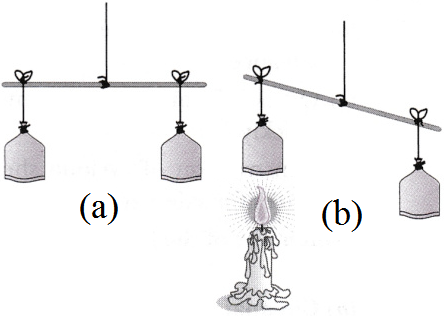
  1. Take two paper bags of the same size.
  2. Hang the two bags in the inverted position on the two ends of a wooden stick.
  3. Tie a piece of thread in the middle of stick and hold the stick by the thread in balance, as shown in the figure $(A).$
  4. Place a burning candle below one of the bags as shown in figure $(S).$
  5. You will observe that the balance of the bags is disturbed.

This activity indicates that as the warm air rises up it pushes the bag above the candle. This is because on heating, air expands and occupies more space. When same thing occupies more space, it becomes lighter. Thus, we can conclude that warm air is lighter than cool air.
View full question & answer
Question 35 Marks
How will you help your neighbours in case cyclone approaches your village/ town?
Answer
In case cyclone approaches our village or town, we can help our neighbours in following way:
  • We should not ignore the warnings issued by the meteorological department through TV, radio, or newspapers.
  • We should make necessary arrangements to shift the essential household goods, domestic animals and vehicles, etc. to safer places.
  • Avoid driving on roads through standing water, as floods may have damaged the roads; and keep ready the phone numbers of all emergency services like police, fire brigade, and medical centres.
  • Do not drink water, that could be contaminated. Always store drinking water for emergencies.
  • Do not touch wet switches and fallen power lines.
  • Do not go out just for the sake of fun.
  • Do not pressurise the rescue force by making undue demands.
  • Cooperate and help your neighbours and friends.
View full question & answer
Question 45 Marks
What are the global wind patterns?
Answer

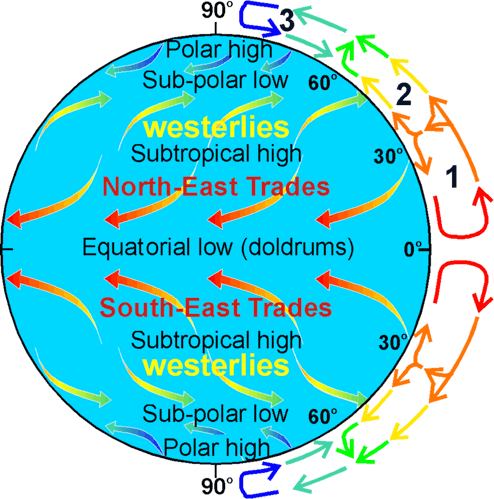
The equator receives the Sun's direct rays. Here, air is heated and rises, leaving low pressure areas behind. Moving to about thirty degrees north and south of the equator, the warm air from the equator begins to cool and sink. Between thirty degrees latitude and the equator, most of the cooling sinking air moves back to the equator. The rest of the air flows toward the poles.

View full question & answer
Question 55 Marks
Tornado is different from a cyclone. Briefly explain Tornado. What destructions does it cause$?$
Answer
These are formed over sea and are called water spouts. Tornado develops from thunderstorm and are formed mostly on the land. These are violent and can reach the speeds of more than $500\ km/h$ destroying everything in their path. These are not very common in India but occurs in Canada and $USA.$
Most of the tornadoes are weak. When the warm air from the earth’s surface rises up, it whirls around it and causes very high speed winds. These are much smaller than cyclones, i.e. from a few metre to a few hundred metre but the wind speed can rise as high as $500\ km/h.$ The funnel of tornado sucks up everything at its base like dust, debris, cars, trees and even houses.
View full question & answer
Question 65 Marks
What is lightning?
Answer

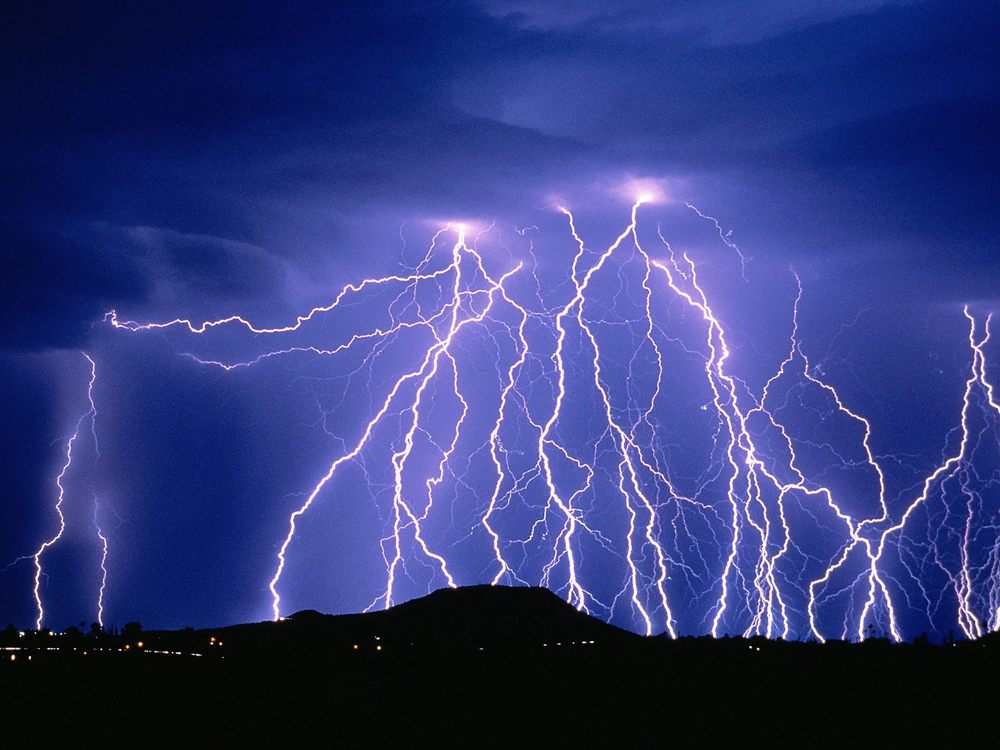
Lightning is a bright flash of electricity produced by a thunderstorm. All thunderstorms produce lightning and are very dangerous. If you hear the sound of thunder, then you are in danger from lightning. Lightning kills and injures people and properties.

View full question & answer
Question 75 Marks
Advanced technology has helped people to save them from natural calamities like thunder storm and cyclone. Explain how.
Answer
During the early part of the last century, the people residing in coastal regions have less than a day for the preparations or to evacuate their homes from an overcoming cyclone. But, the today’s situation is very different. Today we are much protected. We have satellites and radars which can issue the cyclone watch or cyclone alert before $48$ hrs (in advance) of any expected storm and a cyclone warning is issued $24$ hrs in advance. Therefore, the coastal residents have sufficient time to prepare and evacuate their homes. The message related to cyclone is broadcasted over the ratio every hour or half hour when a cyclone is nearer the coast. In this way, the advanced technology has helped us in giving better protection from cyclones. Several national and international organisations cooperate to monitor the cyclone related disasters.
View full question & answer
Question 85 Marks
What causes lightening?
Answer
Lightning is an electric current. Within a thundercloud way up in the sky, many small bits of ice frozen raindrops bump into each other as they move around in the air. All of those collisions create an electric charge. After a while, the whole cloud fills up with electrical charges. The positive charges or protons form at the top of the cloud and the negative charges or electrons form at the bottom of the cloud. Since opposites attract, that causes a positive charge to build up on the ground beneath the cloud. The grounds electrical charge concentrates around anything that sticks up, such as mountains, people, or single trees. The charge coming up from these points eventually connects with a charge reaching down from the clouds and - zap - lightning strikes!
View full question & answer
Question 95 Marks
A cyclone is generated from a thunderstorm. How a thunderstorm becomes a cyclone? Explain.
Answer
When air moves gently (low speed), it is called a breeze while when it moves violently (high speed), it is called a storm. When the pressure of air drops, it indicates the possibility of a storm. The swift movement of the falling water along with the rising warm air producing sound, lightning, heavy rain and strong wind is called thunderstorm. It develops in hot and humid tropical areas like India and is accompanied by heavy rains or hail. Thunderstorms are produced by the dark clouds which form at fairly low altitude in the atmosphere. In the tropical area, the air gets warmed up and makes it to rise, whereas humidity provides the water vapour for the formation of cloud. Therefore, it can be said that to occur a thunderstorm, it requires moisture, rapidly rising warm air and sea breeze or mountains.
View full question & answer
Question 105 Marks
Name some effective safety measures against cyclone?
Answer
On the part of government:
  • Cyclone forecast and warning system must be installed.
  • Information about cyclone should be given to the people in time through rapid communication system.
  • Construction of cyclone-shelter in cyclone-prone areas.
  • Administrative arrangement should be taken to move people faster to safer places.
On the part of the people:
  • People should follow the essential guidelines provided by the agencies through $TV$ radio, phones, etc.
  • Proper arrangement should be made to shift the essential household goods, domestic animals, etc. to the safer places.
  • Avoid driving on road which are under water because flood might have damaged the road.
  • Phone numbers of all the emergency services like police, fire brigade, hospitals, etc. should be kept ready.
These are produced by the dark clouds which form at fairly low altitude in the atmosphere.
View full question & answer
5 Marks Questions - Science STD 7 Questions - Vidyadip