Question types

From Barter to Money question types

42 questions across 8 question groups — pick any mix to generate a Social Studies paper with step-by-step answer keys.

42
Questions
8
Question groups
5
Question types
Sample Questions

From Barter to Money questions

One sample from each question group in this chapter. Select any group above to see the full set with answer keys.

Q 1MCQ (1 Mark)1 Mark
Which of the following is the correct statement?
  • Coinage is a modem form of money.
  • B
    Coinage was introduced in the 20th century.
  • C
    Minting is done by common citizens.
  • D
    Coins are made from precious metals.

Answer: A.

View full solution
Q 2MCQ (1 Mark)1 Mark
Consider the following statement:
(i) The barter system used metallic money
(ii) 1 anna was equal to 1/16 of a ruppee
(iii) Roman gold coins have been excavated in Pudukottai.
  • (i) only
  • B
    (ii) only
  • C
    (iii) only
  • D
    (i) and (ii)

Answer: A.

View full solution
Assertion (A): The use of coins boosted maritime trade in India.
Reason (R): Coins were accepted across regions and helped easy transactions.
  • A
    Both (A) and (R) are true and (R) is the correct explanation of (A).
  • Both (A) and (R) are true but (R) is not the correct explanation of (A).
  • C
    (A) is correct but (R) is wrong.
  • D
    (A) is wrong but (R) is correct.

Answer: B.

View full solution
Assertion (A): Double coincidence of wants was a problem in barter.
Reason (R): Both parties needed to want what the other had.
  • Both (A) and (R) are true and (R) is the correct explanation of (A).
  • B
    Both (A) and (R) are true but (R) is not the correct explanation of (A).
  • C
    (A) is correct but (R) is wrong.
  • D
    (A) is wrong but (R) is correct.

Answer: A.

View full solution
Assertion (A): Money can be stored for future use.
Reason (R): It acts as a store of value.
  • A
    Both (A) and (R) are true and (R) is the correct explanation of (A).
  • Both (A) and (R) are true but (R) is not the correct explanation of (A).
  • C
    (A) is correct but (R) is wrong.
  • D
    (A) is wrong but (R) is correct.

Answer: B.

View full solution
Assertion (A): Coinage replaced paper money due to durability.
Reason (R): Paper notes tear easily.
  • Both (A) and (R) are true and (R) is the correct explanation of (A).
  • B
    Both (A) and (R) are true but (R) is not the correct explanation of (A).
  • C
    (A) is correct but (R) is wrong.
  • D
    (A) is wrong but (R) is correct.

Answer: A.

View full solution
Assertion (A): Money is a medium of exchange.
Reason (R): It allows buying and selling without direct product exchange.
  • A
    Both (A) and (R) are true and (R) is the correct explanation of (A).
  • Both (A) and (R) are true but (R) is not the correct explanation of (A).
  • C
    (A) is correct but (R) is wrong.
  • D
    (A) is wrong but (R) is correct.

Answer: B.

View full solution
Q 21VSQ (2 Marks)2 Marks
Suppose you need to buy a book. You have ?50 in your pocket. You visit the bookshop in your neighbourhood where the shopkeeper tells you that the book is worth ?100. What options do you have to buy the book today? Will you request the shopkeeper to allow you to make the rest of the payment later?
View full solution
Q 22VSQ (2 Marks)2 Marks
Look at a 50 and a 100-rupee note. Can you identify the motifs depicting India’s cultural heritage on the reverse side of the notes? Find out more about them. Feel the surface of the notes. What special features of currency notes help visually impaired persons to identify the notes’ denominations?
View full solution
Q 23VSQ (2 Marks)2 Marks
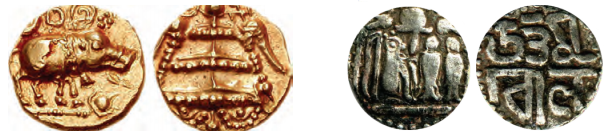
Organise yourselves into groups of five students each. Take up a group project to collect old coins from family members, neighbours, shopkeepers, and so on. Document their various features what are they made of, what is the year inscribed on the coins, what do you observe on the obverse and reverse sides of the coins. What can you guess from your observations? How would you know if your guesses are true?
View full solution
What are the instances of double coincidence of wants in the above example? Even if there are two people who want each other’s goods and are also willing to make an exchange, other issues could arise—in what proportion should the two goods be exchanged? In such cases, it becomes difficult to compare the value of one good against another. If one of the people feels that the exchange is disadvantageous, they would not be interested in the exchange. This is because there is no common standard measure of value.
In the situation given above, what are the cases where you could encounter the lack of a common standard measure of value?
View full solution

Generate a From Barter to Money paper free

Pick question groups from the list above, set marks and difficulty, and export a branded PDF with step-by-step answer keys. First 3 chapters free — no signup.

Download App