Question types

New Beginnings Cities and States question types

43 questions across 8 question groups — pick any mix to generate a Social Studies paper with step-by-step answer keys.

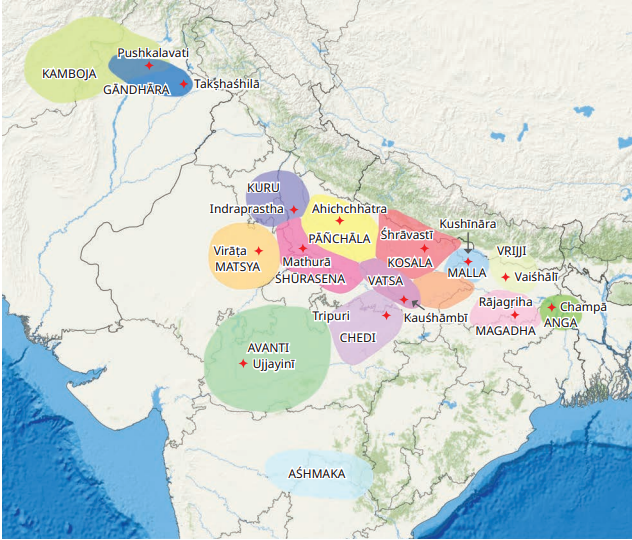
43
Questions
8
Question groups
5
Question types
Sample Questions

New Beginnings Cities and States questions

One sample from each question group in this chapter. Select any group above to see the full set with answer keys.

Q 1MCQ (1 Mark)1 Mark
What major innovation contributed to the rise of the Mahajanapadas?
  • The introduction of iron tools and weapons
  • B
    The discovery of writing
  • C
    The use of horses in warfare
  • D
    The establishment of Buddhist monasteries

Answer: A.

View full solution
Q 2MCQ (1 Mark)1 Mark
In early Vedic society, the term ‘Varna’ referred to:
  • A
    The different occupations people could choose
  • B
    A fixed caste system based on hereditary roles
  • The ideal division of society based on function and qualities
  • D
    A term used for warriors only

Answer: C.

View full solution
Q 3MCQ (1 Mark)1 Mark
Which two Mahajanapadas are known for their early democratic or republican traditions?
  • A
    Kashi and Kosala
  • B
    Magadha and Avanti
  • Vajji and Malla
  • D
    Anga and Gandhara

Answer: C.

View full solution
Q 4MCQ (1 Mark)1 Mark
How were some rulers chosen in the early Yedic period before hereditary monarchy became common?
  • A
    By divine selection
  • B
    By war
  • By elections or decisions made in tribal assemblies
  • D
    By priests only

Answer: C.

View full solution
Assertion (A): The Sangam literature provides evidence of urban centers and trade in ancient South India.
Reason (R): It was written during the later Vedic period in North India.
  • A
    Both (A) and (R) are true and (R) is the correct explanation of (A).
  • B
    Both (A) and (R) are true but (R) is not the correct explanation of (A).
  • (A) is correct but (R) is wrong.
  • D
    (A) is wrong but (R) is correct.

Answer: C.

View full solution
Assertion (A): All Mahajanapadas followed hereditary monarchies.
Reason (R): Democracy was unknown in ancient India.
  • A
    Both (A) and (R) are true and (R) is the correct explanation of (A).
  • B
    Both (A) and (R) are true but (R) is not the correct explanation of (A).
  • C
    (A) is correct but (R) is wrong.
  • (A) is wrong but (R) is correct.

Answer: D.

View full solution
Assertion (A): The introduction of iron tools contributed to the growth of the Mahajanapadas. Reason
(R): Iron tools increased agricultural productivity and supported larger settlements.
  • Both (A) and (R) are true and (R) is the correct explanation of (A).
  • B
    Both (A) and (R) are true but (R) is not the correct explanation of (A).
  • C
    (A) is correct but (R) is wrong.
  • D
    (A) is wrong but (R) is correct.

Answer: A.

View full solution
Assertion (A): In the early Vedic period, the Varna system was more flexible.
Reason (R): People could change their vama based on their karma (actions) and guna (qualities).
  • Both (A) and (R) are true and (R) is the correct explanation of (A).
  • B
    Both (A) and (R) are true but (R) is not the correct explanation of (A).
  • C
    (A) is correct but (R) is wrong.
  • D
    (A) is wrong but (R) is correct.

Answer: A.

View full solution
Assertion (A): The Vajji confederacy is considered one of the earliest examples of a republican form of government.
Reason (R): It was ruled by a monarch with absolute powers.
  • A
    Both (A) and (R) are true and (R) is the correct explanation of (A).
  • B
    Both (A) and (R) are true but (R) is not the correct explanation of (A).
  • (A) is correct but (R) is wrong.
  • D
    (A) is wrong but (R) is correct.

Answer: C.

View full solution
Inequalities within society can exist in many forms. Have you encountered any incident where you or anyone you know might have been made to feel different from others? Do you think equality is desirable in a society? If so, why? Have you come across people or initiatives that lessened inequalities?
View full solution
Why was the development of iron metallurgy so important for the growth of urbanism in the 1 st mil¬lennium BCE? You may use points from the chapter but also from your knowledge or imagination.
View full solution
Imagine you are a historian studying ancient India. What types of sources (archaeological, literary, etc.) would you use to leam more about the mahajana- padas? Explain how each source might contribute to your understanding.
View full solution
Consider the quotation given below and discuss in several groups. Compare your observations and conclusions on what Kautilya recommends for a kingdom. Is it very different today?
The kingdom shall be protected by fortifying the capital and the towns at the frontiers. The land should not only be capable of sustaining the population but also outsiders in times of calamities. …… It should be beautiful, being endowed with cultivable land, mines, timber forests, elephant forests, and good pastures rich in cattle. It should not depend [only on] rain for water. It should have good roads and waterways. It should have a productive economy, with a wide variety of commodities….
_ Kautilya, Arthashastra
View full solution
Fill up the following table with a Yes (or tick mark) or No (or cross mark) in each square, which provides an interesting comparison between these two phases of Indian civilisation.
First UrbanisationSecond Urbanisation
Ganga plains
Monasteries
Literature
Trade
Warfare
Copper/bronze
Iron
View full solution

Generate a New Beginnings Cities and States paper free

Pick question groups from the list above, set marks and difficulty, and export a branded PDF with step-by-step answer keys. First 3 chapters free — no signup.
Download App