Questions

VSQ (2 Marks)

Take a timed test

20 questions · self-marked practice — reveal the answer and mark yourself.
Question 12 Marks
Choose any 5 products and check out the label with the certification signs discussed in the chapter. Did you find products that did not have a logo? Why do you think this is so?
Answer
self
View full question & answer
Question 22 Marks
Have you heard about or visited a school carnival fair organized by your school or any other school? Discuss with your friends and teachers about the kind of activities organized by students there. How do they conduct selling and negotiation with the buyers?
Answer
self
View full question & answer
Question 32 Marks
There are some districts in India that are famous for growing tomatoes. However, during some seasons, the situation is not good for farmers. With a large quantity of harvest, there are reports of farmers throwing away their produce and all their hard work going to waste. Why do you think farmers do this? What role can wholesalers play in such situations? What are the possible ways of ensuring that the tomatoes are not wasted, and the farmers are also not at a loss?
Answer
Farmers throw away tomatoes during a surplus season because excessive supply leads to low prices, making it unprofitable to sell them. Wholesalers can help by buying in bulk at a reasonable price and distributing them to different regions. Possible solutions to prevent wastage include setting up food processing industries to make tomato-based products, government support in price regulation, better storage facilities, and linking farmers to alternative markets to ensure they get fair prices.
View full question & answer
Question 42 Marks
Look at the real life situation that a retail seller of vegetables encountered: A family came to shop for vegetables. The price of beans that the seller on the cart was offering was? ₹30/kg. The lady started to bargain with the seller to bring the price down to ₹25/kg. The seller protested and refused to sell at that price saying he would make a loss at that price. The lady walks away. The family then goes to a super bazaar nearby. They buy vegetables in the super bazaar where they pay ₹40/kg for the beans that is neatly packed in a plastic bag. What are the reasons that the family does this? Are there factors that affect buying and selling which are not directly connected to price?
Answer
The family may have bought vegetables at a higher price from the super bazaar due to convenience, cleanliness, better packaging, or trust in the store’s quality. Factors like hygiene, availability of multiple products in one place, and a preference for organized retail stores also influence buying decisions. Sometimes, customers are willing to pay more for perceived quality and shopping experience rather than just focusing on the price.
View full question & answer
Question 52 Marks
Prices are generally determined by the interaction between demand from buyers and supply by sellers. Can you think of products where prices are high despite lesser number of buyers demanding the product? What could be the reasons for that?
Answer
Some products remain expensive despite having fewer buyers due to factors like exclusivity, branding, and production costs. Examples include luxury cars, designer clothing, rare antiques, and limited-edition electronics. These products are priced high due to their uniqueness, high-quality materials, and brand value, making them desirable to a select group of buyers.
View full question & answer
Question 62 Marks
In the example of buying and selling of guavas, imagine that the seller is getting a good price, and is able to make a profit. He will try to get more guavas from farmers to be able to sell them at the same price and increase his earnings. What is the farmer likely to do in this kind of a situation? Do you think he will start thinking about the demand for guavas in the next season? What is likely to be his response?
Answer
If the seller gets a good price for guavas, he will demand more from farmers. The farmer, noticing the high demand, may try to produce more guavas in the next season to increase his income. He might also consider expanding his farmland, using better farming techniques, or storing guavas to sell when prices rise. However, he will also assess market trends to avoid overproduction, which could lead to lower prices.
View full question & answer
Question 72 Marks
Remember the epigraph from a famous economist at the beginning of the chapter? Discuss its relevance in the context of the chapter you have read.
Answer
The epigraph at the beginning of the chapter provides insight into how markets function and influence economic activities. It is relevant because it highlights key aspects such as demand and supply, pricing, competition, and the role of buyers and sellers. Understanding the quote helps in relating economic theories to real-life market situations.
View full question & answer
Question 82 Marks
You and your classmates have manufactured a soap bar. Design a label for its packaging. What in your opinion should be mentioned on the label for the consumer to know the product better?
Answer
self
View full question & answer
Question 92 Marks
Some services require in-person contact like tailoring and cannot be provided online. Can you suggest other services where physical markets are needed?
Answer
Services needing physical markets are haircuts, medical check-ups, car repair, plumbing, and furniture making.
View full question & answer
Question 102 Marks
Can you think of a type of market where negotiation is less common and why?
Answer
A market where negotiation is less common is a supermarket or online store. This is because the prices are fixed, and customers pick products with marked prices without bargaining.
View full question & answer
Question 112 Marks
What will happen if the people supplying onions do not bring the required quantities to the market? What do you think the government should do in this situation?
Answer
If onion suppliers do not bring enough onions to the market, there will be a shortage, and prices will rise sharply. This can make it difficult for people to afford onions. In this situation, the government can take steps such as importing onions from other countries, providing subsidies to fanners to increase production, and controlling hoarding to ensure a stable supply and reasonable prices for consumers.
View full question & answer
Question 122 Marks
Onions are an important part of the cuisine in most parts of India. In some seasons, the supply of onions comes down in the market. What do you think happens to the price of onions when this happens?
Answer
When the supply of onions decreases in the market, their price increases. This happens because there are fewer onions available, but the demand remains the same. As a result, people have to pay more to buy onions.
View full question & answer
Question 132 Marks
In south India, the sellers of haldi and kumkum (turmeric and vermilion) give a small quantity of haldi and kumkum separately at no charge, as a mark of auspiciousness and good wishes to the buyer. Have you observed any such practices in your community or neighbourhood? Describe the practice as a drawing or in a short paragraph.
Answer
Yes, similar practices are observed in many parts of India. In my community, during festivals like Diwali and Navratri, shopkeepers often give a small packet of haldi (turmeric) and kumkum (vermilion) along with the purchase as a blessing. It is considered a symbol of good fortune and prosperity. Additionally, in traditional markets, when someone buys a new saree or jewellery, the seller sometimes offers betel leaves and nuts as a gesture of goodwill. Such customs reflect the deep-rooted cultural traditions of exchanging good wishes through symbolic items.
View full question & answer
Question 142 Marks
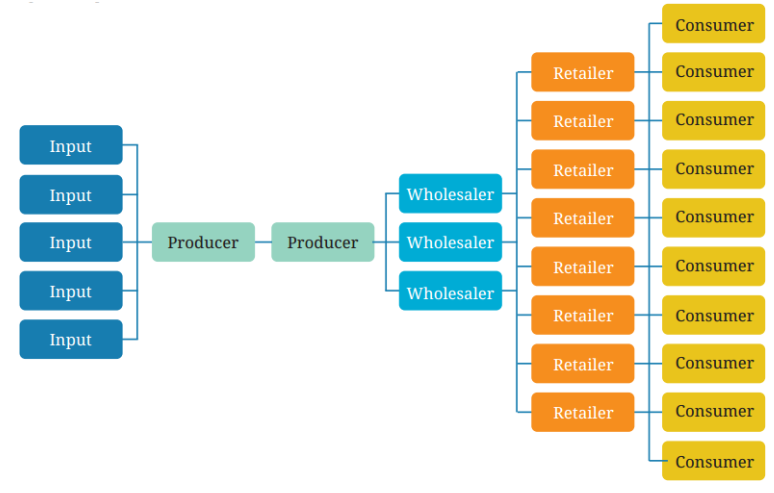
Ask your nearest retailer about a product, its place of origin, and the chain of suppliers in the process of the product reaching the shop. Trace this using a flow chart like the above figure (given in question no. 4) and share it in class.
Answer
self
View full question & answer
Question 152 Marks
Observe the diagram and describe the flow of goods from the manufacturer /producer to the consumer. What is the role of the wholesaler and the retailer in the flow?
Image
Answer
self
View full question & answer
Question 162 Marks
Do you know any other old markets from your state? How could it be similar or different from today’s markets? Discuss with elders in the family and community.
Answer
Yes, in my state, the Chandni Chowk market in Delhi is a famous old market. It is similar to today’s markets in that it is still crowded and has many shops. However, it is different because it has narrow lanes, traditional shops, and sells many items in bulk. Modern markets, in contrast, are more organized, have fixed prices, and offer digital payment options.
View full question & answer
Question 172 Marks
How can consumers assess the quality of goods and services they purchase?
Answer
Consumers can check certification marks like FSSAI for food, ISI for industrial products, and AGMARK for agricultural goods. Reading labels, verifying expiry dates, and looking at customer reviews help ensure they buy safe and good-quality products.
View full question & answer
Question 182 Marks
What role does the government play in markets?
Answer
The government regulates markets by setting price limits on essential goods to prevent unfair pricing. It ensures product quality through certification marks like FSSAI, ISI, and AGMARK. The government also provides infrastructure like roads and public facilities to support smooth market functioning.
View full question & answer
Question 192 Marks
What is the role of markets in people’s lives?
Answer
Markets provide essential goods and services, making daily life easier. They create job opportunities and support businesses, helping the economy grow. Markets also promote social interaction and cultural exchange as people from different backgrounds come together to trade.
View full question & answer
Question 202 Marks
What are markets and how do they function?
Answer
Markets are places where buyers and sellers exchange goods and services. They can be physical, like bazaars and malls, or online, where transactions happen virtually. Markets function based on supply and demand, where sellers olfer products, and buyers purchase them based on their needs and affordability. Prices are determined through competition, bargaining, and government regulations.
View full question & answer
VSQ (2 Marks) - Social Studies STD 7 Questions - Vidyadip