Questions

SHORT ANSWER QUESTIONS(3 Mark)

🎯

Test yourself on this topic

33 questions · timed · auto-graded

Question 13 Marks
How do ocean currents influence us?
Answer
  1. The ocean currents influence the temperature conditions of the area.
  2. Warm currents bring about warm temperature over land surface. The areas where the warm and cold currents meet provide the best fishing grounds of the world.
  3. Seas around Japan and the eastern coast of North America are its example.
  4. The areas where warm and cold currents meet provide foggy weather making the navigation difficult.
View full question & answer
Question 23 Marks
How are Tsunamis formed? How do they cause destruction?
Answer
Tsunami is a Japanese word meaning harbour waves.
  • Winds blowing at high speed during a storm form huge waves.
  • An earthquake, volcanic eruption or underwater landslides can shift large amount of ocean water.
  • These tidal waves called Tsunami may be as high as 15m. It travels at a speed of more than 700km/ hr.
  • The areas near the coasts get submerged and it leads to earthquakes also.
View full question & answer
Question 33 Marks
Define vertical distribution of sea water.
Answer
When surface water gets heated by sun, water evaporates and increases the concentration of salts. Surface water becomes denser sinks and sub surface water rises up. Thus, salinity of sea water causes vertical circulation.
View full question & answer
Question 43 Marks
What were the effects of the Tsunami?
Answer
Tsunami caused severe destruction:
  • Some of the islands of Indian Ocean were completely washed away.
  • Indira point in Andaman got completely submerged.
  • More than 10,000 people were killed and more than a lakh of houses were affected.
  • Coastal areas of Tamil Nadu. Kerala, Puducherry, Andhra Pradesh and the Andaman and Nicobar islands were worst affected.
View full question & answer
Question 53 Marks
Describe the importance of tides to man.
Answer
  • High tides help in navigation.
  • They raise the water level close to the shores.
  • This helps the ships to arrive at the harbour more easily.
  • The high tides also help in fishing.
  • Many more fish come closer to the shore during the high tides.
  • This enables fishermen to get a plentiful catch.
  • The rise and fall of water due to tides is used to generate electricity in some places like the gulf of Khambant.
View full question & answer
Question 63 Marks
How are high tides useful?
Answer
  1. High tides help in navigation.
  2. They raise the water level close to the shores.
  3. High tides also help in fishing. As high tides come closer to the shores, they enable fishermen to get a plentiful catch.
  4. The rise and fall of water due to tides is being used to generate electricity.
View full question & answer
Question 73 Marks
Explain the advantages and disadvantages of ocean currents to man.
Answer
The ocean currents influence the temperature conditions of the coastal areas.
  • Warm currents increase the temperature over land surface.
  • The areas where warm and cold currents meet, provide the best fishing grounds of the world.
  • Seas Around Japan and the eastern coast of North America are such examples.
  • The areas where a warm and cold current meet, also experience foggy weather making it difficult for navigation.
View full question & answer
Question 83 Marks
Why is water important to us? Suggest few ways to conserve water.
Answer
Water is very necessary for us. Water alone can quench the thirst thirsty. Water is needed for survival of plant and animal life.Water is very essential and we should conserve it:
  • By not wasting it during brushing, bathing, washing etc.
  • By trapping the rain water by water shed development or rain water harvesting.
  • By recycling water.
  • By making check dams and bunds on the fields etc.
View full question & answer
Question 93 Marks
Name the two types of current and its movement on earth.
Answer
Ocean currents are broadly of two types of warm and cold currents. The warm currents flow from low latitudes in tropical zones towards the high latitudes in the temperate and sub polar zones. The cold current flow from high latitudes to low latitudes.
View full question & answer
Question 103 Marks
What are spring and neap tides?
Answer
The water of the earth closer to the moon gets pulled under the influence of the moon’s gravitational force and causes high tide. During the full moon and new moon days, the sun, the moon and the earth are in the same line and the tides are highest. These tides are called spring tides. But when the moon is in its first and last quarter, the ocean waters get drawn in diagonally opposite directions by the gravitational pull of sun and earth resulting in low tides. These tides are called neap tides.
View full question & answer
Question 113 Marks
How are spring and neap tides formed.
Answer
During the full moon and new moon days, the sun, the moon and the earth are in the same line and the tides are highest. These tides are called spring tides. But when the moon is in its first and last quarter, the ocean waters get drawn in diagonally opposite directions by the gravitational pull of sun and earth resulting in low tides. These tides are called neap tides.
View full question & answer
Question 123 Marks
Write a brief note on Tsunami.
Answer
Tsunami is a Japanese word that means 'harbour waves' as the harbours get destroyed whenever there is tsunami. An earthquake, a volcanic eruption or underwater landslides can shift large amounts of ocean water. As a result tsunami occurs which may be as high as 15m. The tsunami of 2004 is still in our mind. It caused huge death and destruction in the coastal areas of India. The Indira point in the Andaman and Nicobar Islands got submerged after the tsunami.
View full question & answer
Question 133 Marks
Give any three advantage of high tide.
Answer
  1. High tides help in negative. They raise the water level close to the shores. This helps the ships to arrive at the harbour more easily.
  2. The high tides also helps in fishing, Many more fish come closer the shore during the high tide this enables fishermen to get a plentiful catch.
  3. The rise and fall of water due tides is begin used to generate electricity in some places.
View full question & answer
Question 143 Marks
Explain Spring and Neap Tides.
Answer
During the full moon and new moon days, the sun, the moon and the earth are in the same line.
  • On this day the tides are highest.
  • These tides are called Spring Tides.
  • But when the moon is in its first and last quarter, the ocean waters get drawn in diagonally opposite direction by the gravitational pull of the sun and the earth.
  • It results in low tides.
  • These tides are called Neap Tides.
View full question & answer
Question 153 Marks
How do ocean current influence the climate of the coastal regions?
Answer
  1. Warm ocean raise the temperature of the coast along which they flow while cold ocean current lower the temperature.
  2. Winds blowing over warm currents are moist and bring rainfall to the coastal region while wind blowing over cold current are dry and cool thus hardly vary any moisture.
  3. In the places where warm and cold current meet dense fog is produced which reduce visibility and can cause accidents.
View full question & answer
Question 163 Marks
What are sea waves?
Answer
Sea Waves:
  • When the water on the surface of the ocean rises and falls alternately, they are called waves.
  • When we are playing throw ball on the beach and the ball falls into the water, it begins to go up and down.
  • It is fun that the ball gets washed back to the shore by the waves.
View full question & answer
Question 173 Marks
What are waves? Write a short note on it.
Answer
Waves are the rise and fall of the water on the surface of the ocean. Waves are formed when winds scrape across the ocean surface. The stronger the wind blows, the bigger the wave becomes. During the storm, the winds blow at very high speed and therefore huge waves are formed. These waves are very strong, hence very destruction. They may cause huge devastation.
View full question & answer
Question 183 Marks
Write a short note on ocean currents?
Answer
  1. Ocean currents are streams of water flowing constantly on the ocean surface in definite directions.
  2. The ocean currents may be warm or cold. Generally, the warm ocean currents originate near the equator and move towards the poles. The cold currents carry water from polar or higher latitudes to tropical or lower latitudes. The Labrador Ocean current is cold current while the Gulf Stream is a warm current.
  3. The ocean current influence the temperature conditions of the area. Warm currents bring about warm temperature over land surface. The areas where the warm and cold currents meet provide the best fishing grounds of the world. Seas around Japan and the eastern coast of North America are such examples. The areas where a warm and cold current meet also experience foggy weather making it difficult for navigation.
View full question & answer
Question 193 Marks
When you think of water, what images came to your mind?
Answer
Three states of water: solid, liquid and gaseous.
  • Water running in rivers, canals, streams etc.
  • Frozen and moving like glaciers.
  • In the form of steam (evaporation).
  • In the form of droplets (condensation).
  • Falling as rainfall (Rainfall).
  • As ground water/ Water in taps.
  • In the wells, ponds, pools etc.
View full question & answer
Question 203 Marks
What are neap tides?
Answer
When the moon is in its first and last quarter, the ocean waters get drawn in diagonally opposite directions by the gravitational pull of the sun and the Earth resulting in low tides. These are called neap tides.
View full question & answer
Question 213 Marks
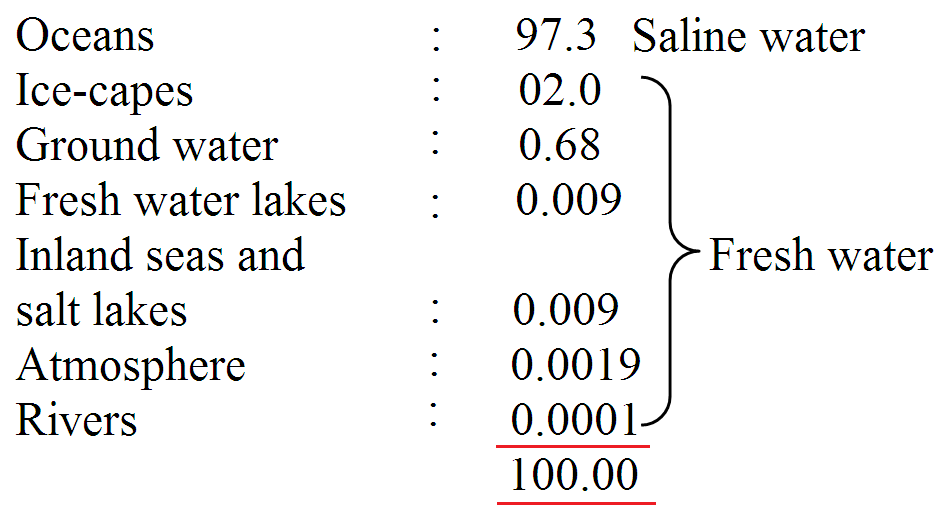
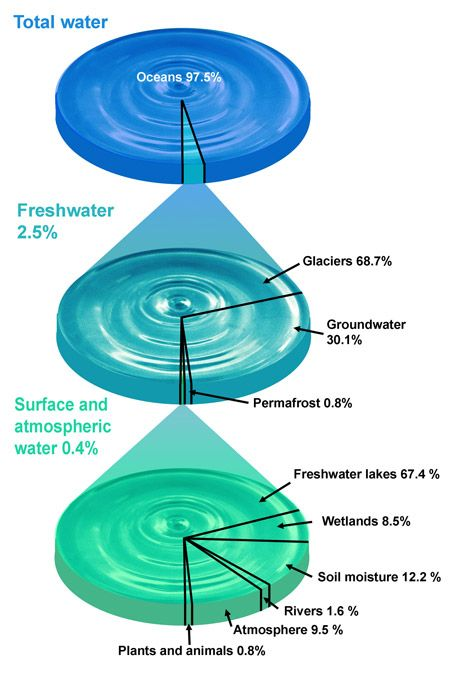
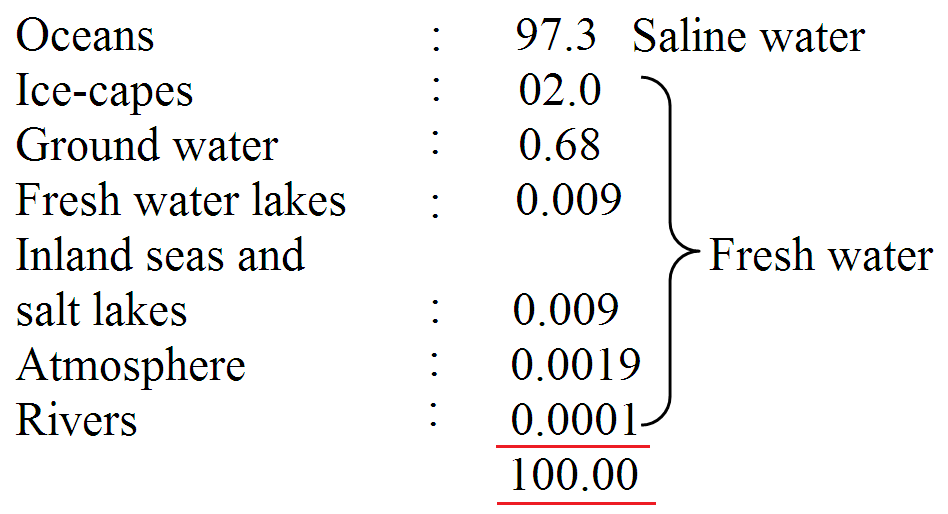
Three-fourth of the earth surface is covered by water. Give the distribution of water in percentage?
Answer
The following table gives the distribution of water in percentage.
View full question & answer
Question 223 Marks
Our unique planet earth is covered by different categories of water. Give the distribution of water in percentage.
Answer
We all know that three fourth of the earth surface is covered by water. Water plays a major role on the earth surface for the survival of different modes of life. The different categories of the water according to their catchment area are- Ocean 97%, ice caps 02.0%, ground water 0.68%, fresh water 0.009%, Inland seas and salt lakes 0.009%, atmosphere 0.0019%, rivers 0.0001%.
View full question & answer
Question 233 Marks
What are the major movements of ocean water?
Answer
The movements that occur in oceans can be broadly categorised as:
  • Waves: When the water on the surface of the ocean rises and falls alternately, they are called waves. Waves are formed when winds scrape across the ocean surface. The stronger the wind blows, the bigger the wave becomes.
  • Tides: The rhythmic rise and fall of ocean water twice in a day is called a tide. It is high tide when water covers much of the shore by rising to its highest level. It is low tide when water falls to its lowest level and recedes from the shore. The strong gravitational pull exerted by the sun and the moon on the earth’s surface causes the tides.
  • Ocean Currents: Ocean currents are streams of water flowing constantly on the ocean surface in definite directions. The ocean currents may be warm or cold. Generally, the warm ocean currents originate near the equator and move towards the poles. The cold currents carry water from polar or higher latitudes to tropical or lower latitudes. The Labrador Ocean current is cold current while the Gulf Stream is a warm current.
View full question & answer
Question 243 Marks
Three forth of the earth's surface is covered by water, still many countries face water scarcity. Explain why?
Answer
  1. All the water is not available for human use - 97.3% is in the oceans that is saline water which is unit for human use. 2% is frozen as ice caps in the polar and high altitude regions.
  2. Rising population - Due to increasing population water consumption for human domestic use is increasing although the amount of water remains constant.
  3. Increasing cropland and industrialization - wateris being more ad more consumed in the modern techniques of agriculture to meet the demands of growing population. More fresh water is required to meet the increasing industries such as paper, food processing and even steel industries for cooling of metals.
View full question & answer
Question 253 Marks
Why are tides important to us?
Answer
Tides important to us because:
  1. High tides help in navigation.
  2. They raise the water level close to the shores. This helps the ships to arrive at the harbour more easily.
  3. The high tides also help in fishing. Many more fish come closer to the shore during the high tide. This enables fishermen to get a plentiful catch.
  4. The rise and fall of water due to tides is being used to generate electricity in some places.
View full question & answer
Question 263 Marks
i
Caspian Sea
a
Largest lake.
ii
Tide
b
Periodic rise and fall of water.
iii
Tsunami
c
Strong seismic waves.
iv
Ocean currents
d
Streams of water moving along definite paths.
 
 
e
Water cycle.
Answer
i
Caspian Sea
a
Largest lake.
ii
Tide
b
Periodic rise and fall of water.
iii
Tsunami
c
Strong seismic waves.
iv
Ocean currents
d
Streams of water moving along definite paths.
View full question & answer
Question 273 Marks
Discuss the distribution of water bodies.
Answer
  • Nearly 75% of the earth's surface is covered with water.
  • There is more water than land on the earth, still so many countries face water scarcity due to the fact that most of this water is salty or it is polluted beyond use.
  • Moreover all the water on the earth is not available to us.
  • The following table gives the distribution of water in percentage.

View full question & answer
Question 283 Marks
Write a note on the importance of water.
Answer
Water is life. Without water, we can not think of life. Its scarcity may create numerous problems but its absence would definitely lead to non-existence of all the living beings on the earth. It is a precious resource of the nature. We drink water whenever we feel thirsty. We use water in numerous activities such as washing clothes, cleaning house floors, watering garden etc. Industries also need water for their functioning. Thus, water is very essential and therefore we must conserve it. Our careless use of water has created several problems. Whatever water is there, it is not of good quality. We should think about the ways of its conservation for our own sake.
View full question & answer
Question 293 Marks
Why is water important for us? Suggest some ways in which water can be conserved (a) in your home (b) in your school.
Answer
Water is essential for the survival of all life forms on earth. human beings cannot survival without drinking water. But due to increased consumption levels, many regions are suffering from water shorter. Some ways by which we can conserve water are.
  • At home: regularly mending all leakages in water storage and pipelines, ensuring judicious use for domestic purposes such as bathing, washing mopping and gardening; reuse and recycles of water as mush possible, rainwater harvesting.
  • In schools: Using sprinkle to water taps, ensuring to turn off the taps after use, empty the leftover water from the bottles in the plants, spreading awareness by conducting water campaigns.
View full question & answer
Question 303 Marks
Give an account of ocean currents.
Answer
Ocean currents are streams of water flowing constantly on the ocean surface in definite directions. The ocean currents may be warm or cold. The warm ocean currents originate near the equator and move towards the poles. The cold current.
carry water from polar or higher latitudes to tropical or lower latitudes. For example the Labrador Ocean current is cold current while the Gulf Stream is a warm current. The ocean current influence the temperature conditions of the area.
Warm currents bring about warm temperature over land surface. The areas where the warm and cold currents meet provide the best fishing grounds of the world. For example seas around Japan and the eastern coast of North America. The areas where a warm and cold current meet also experience foggy weather and therefore navigation becomes difficult.
View full question & answer
Question 313 Marks
Briefly write about the sequence of events leading to Tsunami of 2004 in the Indian Ocean.
Answer
Tsunami of 26 December 2004 was the result of the earthquake that had its epicentre close to western boundary of Sumatra. It caused havoc in the Indian Ocean.
  • Due to the earthquake measuring 9.0 on Richter scale the Indian plate went under Burma plate.
  • The ocean floor was displaced by about 10-20m. Huge mass of ocean water flowed to fill the gap.
  • After thrusting the Indian plate and Burma plate, this water rushed back towards the coastline.
  • Tsunami at the speed of 800km/ hr washed some of the islands in the Indian Ocean.
  • As the wave moved away from the epicentre of earthquake the speed declined 700-900km/ hr to 70-80km/ hr.
  • Waves travelled up to a depth of 3km from the coast.
View full question & answer
Question 323 Marks
How are high tides important?
Answer
High tides are important for various reasons:
  • They help in navigation.
  • The raise the water level close to the shores. This helps the ships to arrive at the harbour more easily.
  • The high tides also help in fishing. Many more fish come closer to the shore during the high. This enables the fisherman to get a plentiful catch.
  • The rise and fall of water due to tides is being used to generate electricity in some places.
View full question & answer
Question 333 Marks
Write a short note on Tsunami?
Answer
  1. Tsunami is a Japanese word that means “Harbour waves” as the harbours get destroyed whenever there is tsunami.
  2. An earthquake, a volcanic eruption or underwater landslides can shift large amounts of ocean water.
  3. As a result a huge tidal wave called tsunami, that may be as high as 15m., is formed. The largest tsunami ever measured was 150m. high. These waves travel at a speed of more than 700km. per hour.
  4. The tsunami of 2004 caused wide spread damage in the coastal areas of India. The Indira point in the Andaman and Nicobar islands got submerged after the tsunami.
View full question & answer