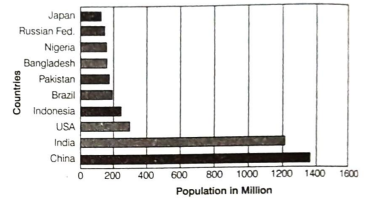
The way in which people are spread across the Earth's surface is known as the pattern of population distribution. More than 90 per cent of the world's population lives in about 30 per cent of the land surface. The distribution of population in the world is extremely uneven. Some areas are very crowded and some are sparsely populated. The crowded areas are South and South-East Asia, Europe and North-Eastern North America. Very few people live in high-latitude areas. tropical deserts, high mountains and areas of equatorial forests. Many more people live North of the Equator than South of the Equator. Almost three-quarters of the world's people live in two continents Asia and Africa. Sixty per cent of the world's people live in just 10 countries. All of them have more than 100 million people.
(I) What does the text imply about the distribution of the world's population?
(a) It is evenly spread across all regions.
(b) It is primarily concentrated in low-lying areas.
(c) It is highly uneven, with some areas densely populated and others sparsely populated.
(d) It is mostly located in regions with a Mediterranean climate.
(ii) What is the significance of the distribution of population in relation to a country's economic development?
(a) It has no impact on a country's economic development.
(b) It is the primary factor determining a country's economic development.
(c) It can affect a country's economic development, but other factors also play a role.
(d) It is directly correlated with a country's political stability.
(iii) Which of the following factors is not mentioned in the text as contributing to uneven population distribution?
(a) Health conditions
(b) Occupation
(c) Income level
(d) All of the above
(iv) What does a narrow population pyramid at the base and a wider top indicate in a country's population distribution?
(a) High birth rates and low death rates
(b) Low birth rates and high death rates
(c) High birth rates and high death rates
(d) Low birth rates and low death rates