Question types

Natural Resources and Their Use question types

90 questions across 12 question groups — pick any mix to generate a Social Studies paper with step-by-step answer keys.

90
Questions
12
Question groups
5
Question types
Sample Questions

Natural Resources and Their Use questions

One sample from each question group in this chapter. Select any group above to see the full set with answer keys.

Q 1MCQ (1 Mark)1 Mark
Which type of resource is replenished naturally over time?
  • A
    Non-renewable resources
  • Renewable resources
  • C
    Both renewable and non-renewable
  • D
    Artificial resources

Answer: B.

View full solution
Q 3MCQ (1 Mark)1 Mark
What is an example of a resource that is difficult to access?
  • A
    Trees in a park
  • Petroleum deep under the ocean
  • C
    Fruits growing on trees
  • D
    Water in a river

Answer: B.

View full solution
Q 4MCQ (1 Mark)1 Mark
What is an example of a resource?
  • Trees in a Tiger reserve forest
  • B
    Trees used for making furniture
  • C
    Sacred groves
  • D
    Petroleum under the glaciers

Answer: A.

View full solution
Q 5MCQ (1 Mark)1 Mark
What is one major environmental problem caused by cement production?
  • A
    Deforestation
  • B
    Desertification
  • C
    Water conservation
  • Air and soil pollution

Answer: D.

View full solution
Assertion (A): Natural resources are evenly distributed across countries.
Reason (R): All regions of the world have the same geographical and climatic features.
Codes:
  • A
    Both (A) and (R) are true, and (R) is the correct explanation of (A).
  • B
    Both (A) and (R) are true, but (R) is not the correct explanation of (A).
  • C
    (A) is true, but (R) is false.
  • (A) is false, but (R) is true.

Answer: D.

View full solution
Assertion (A): Punjab is facing a groundwater crisis.
Reason (R): Excessive extraction of groundwater and use of chemicals during the Green Revolution led to long-term depletion.
Codes:
  • Both (A) and (R) are true, and (R) is the correct explanation of (A).
  • B
    Both (A) and (R) are true, but (R) is not the correct explanation of (A).
  • C
    (A) is true, but (R) is false.
  • D
    (A) is false, but (R) is true.

Answer: A.

View full solution
Assertion (A): Solar energy is a nonrenewable resource.
Reason (R): Solar energy is available only during the daytime.
Codes:
  • A
    Both (A) and (R) are true, and (R) is the correct explanation of (A).
  • B
    Both (A) and (R) are true, but (R) is not the correct explanation of (A).
  • C
    (A) is true, but (R) is false.
  • (A) is false, but (R) is true.

Answer: D.

View full solution
Assertion (A): Coal is classified as a renewable resource.
Reason (R): It takes millions of years for coal to form naturally.
Codes:
  • A
    Both (A) and (R) are true, and (R) is the correct explanation of (A).
  • B
    Both (A) and (R) are true, but (R) is not the correct explanation of (A).
  • C
    (A) is true, but (R) is false.
  • (A) is false, but (R) is true.

Answer: D.

View full solution
Assertion (A): Trees become natural resources when humans use them to make furniture.
Reason (R): An element of Nature becomes a resource only when it is useful, accessible, and culturally acceptable to exploit.
Codes:
  • Both (A) and (R) are true, and (R) is the correct explanation of (A).
  • B
    Both (A) and (R) are true, but (R) is not the correct explanation of (A).
  • C
    (A) is true, but (R) is false.
  • D
    (A) is false, but (R) is true.

Answer: A.

View full solution
A crisis has unfolded in the fertile plains of Punjab where groundwater resources have been severely depleted. Punjab was home to the Green Revolution that fed a large proportion of our population, and contributed to India becoming self-sufficient in food. Today the same state faces issues of sustainability. Nature has been exploited beyond regeneration, at least in the short term.
In the 1960s farmers shifted to high-yielding varieties of wheat and rice. These required more water than the traditional seeds, and farmers began to extract groundwater to meet this need. In addition, the supply of free power led to the over-pumping of groundwater. Modem farming techniques also required the use of pesticides and fertilisers.
The combined effect of these factors is that the groundwater level in a large part of Punjab (see map) has become inaccessible till depths of about 30 metres; and the chemicals from the pesticides and fertilisers have dissolved in the groundwater causing health hazards.
Almost 80% of the area of Punjab has been classified as ‘over-exploited’; in other words, we have drawn water at a rate much greater than at which restoration and rejuvenation of groundwater is possible. We can see that food security was ensured for the short term, but the long- term consequences will take time and effort to heal.
Q.1. What caused the depletion of groundwater in Punjab?
Q.2. What does ‘over-exploited’ mean in the context of Punjab’s groundwater, and how do the immediate and long-term effects of the Green Revolution differ?
View full solution
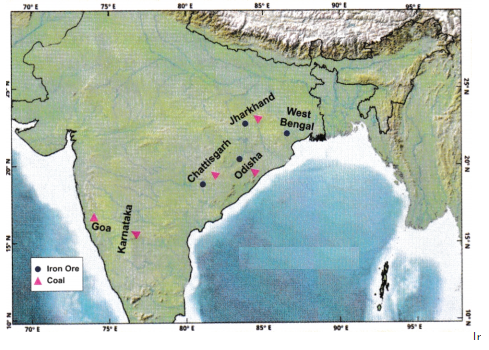
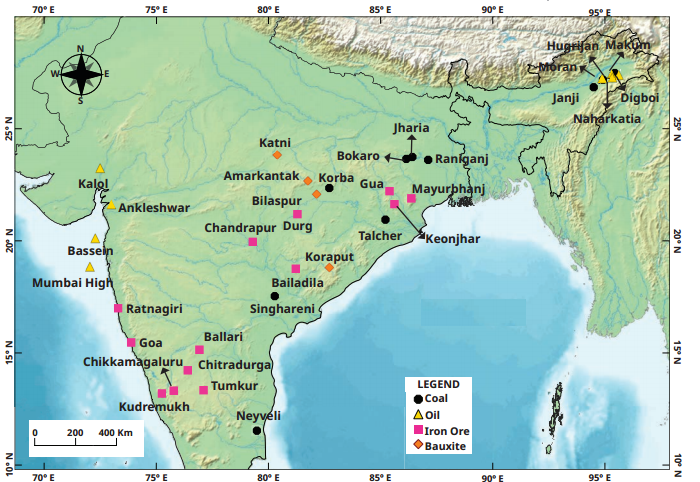
Select any two natural resources. Gather information about their availability across different parts of India. Mark them on a map. What do you observe about their distribution? What are the types of economic actimties connected with them?
Image
View full solution
View full solution
Column AColumn B
Q.1. Uneven Distribution of Resources (i) Sources of energy for buildings and transport
Q.2. Employment Opportunities (ii) Affects human settlements, trade, and conflicts
Q.3. Solar energy and wind (iii) Essential for human survival
Q.4. Air, water, and food (iv) Can regenerate naturally if managed properly
Q.5. Timber and forests (v) Local industries lead to job creation and economic growth
(a) 1 - (ii), 2 - (v), 3 - (i), 4 - (iii), 5 - (iv)
(b) 1 - (iii), 2 - (iv), 3 - (ii), 4 - (i), 5 - (v)
(c) 1 - (iii), 2 - (v), 3 - (ii), 4 - (i), 5 - (iv)
(d) 1 - (iv), 2 - (v), 3 - (ii), 4 - (i), 5 - (iii)
View full solution

Generate a Natural Resources and Their Use paper free

Pick question groups from the list above, set marks and difficulty, and export a branded PDF with step-by-step answer keys. First 3 chapters free — no signup.
Download App