Questions · Page 2 of 2

4 Marks Questions

Question 514 Marks
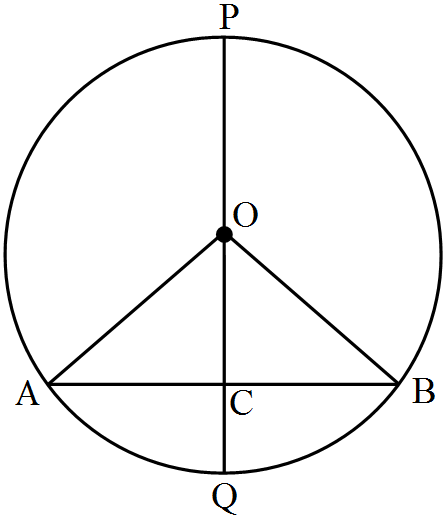
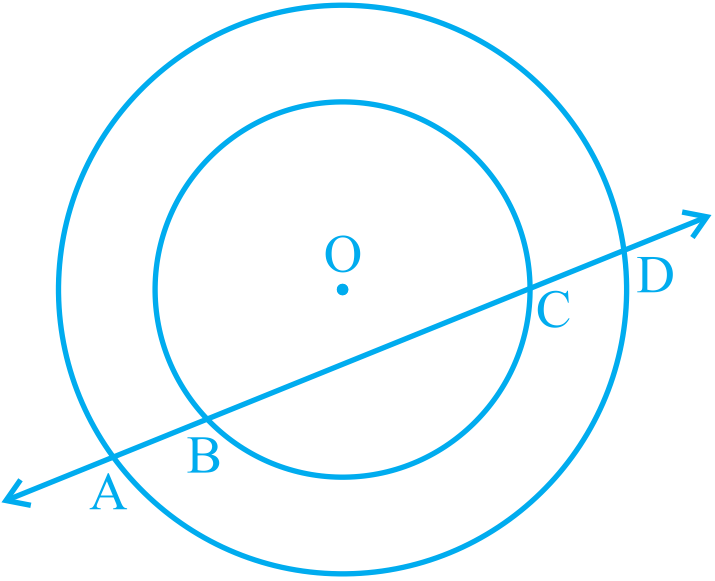
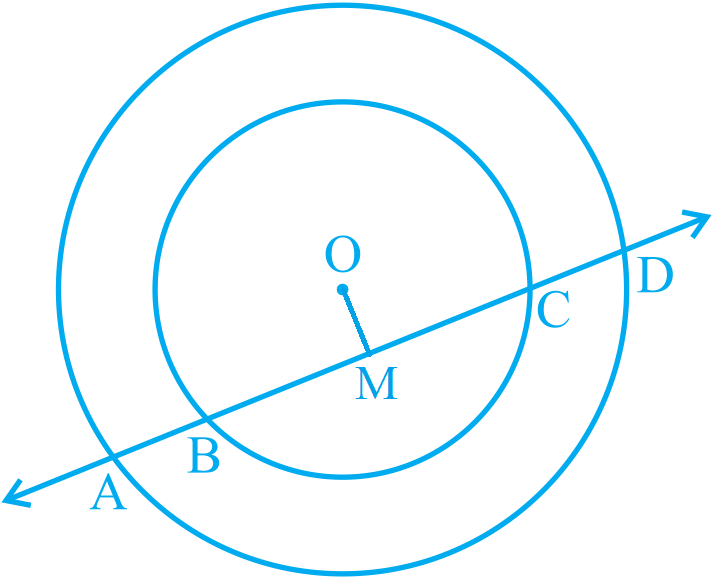
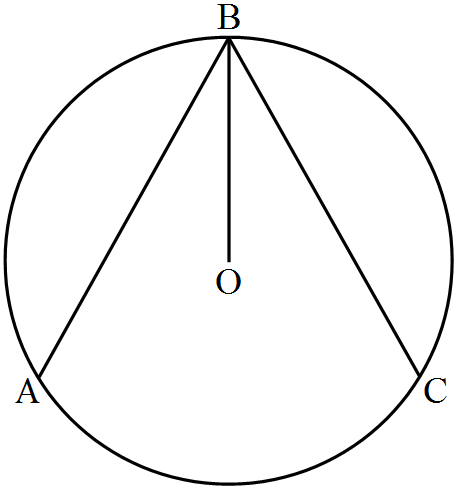
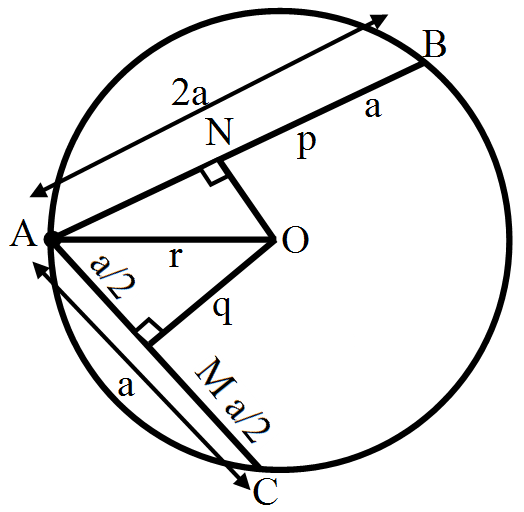
AB and AC are two chords of a circle of radius r such that AB = 2AC. If p and q are the distances of AB and AC from the centre, prove that 4q2 = p2 + 3r2.
View full question & answer
Question 524 Marks
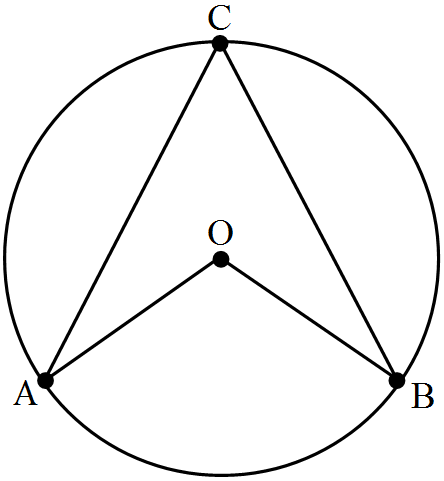
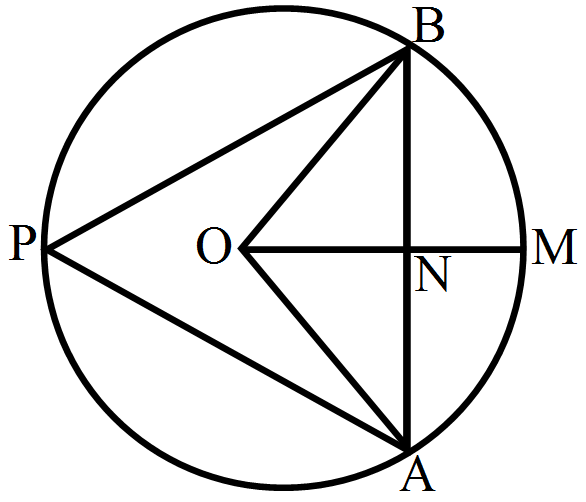
Prove that a diameter of a circle which bisects a chord of the circle also bisects the angle subtended by the chord at the centre of the circle.
View full question & answer
Question 534 Marks
View full question & answer
Question 544 Marks
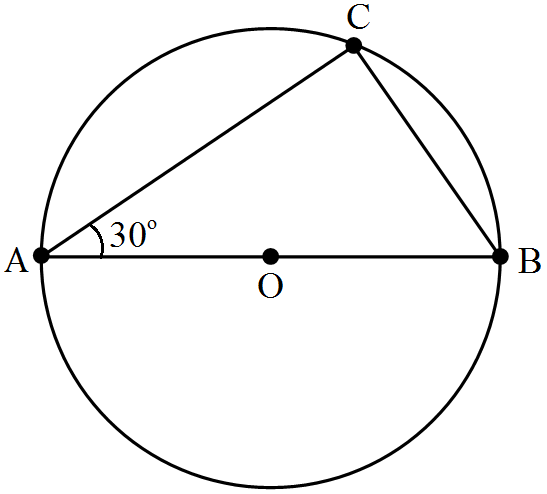
On a semi-circle with AB as diameter, a point C is taken, so that $\text{m}\big(\angle\text{CAB}\big)=30^\circ.$ Find $\text{m}\big(\angle\text{ACB}\big)$ and $\text{m}\big(\angle\text{ABC}\big).$
View full question & answer
Question 554 Marks
View full question & answer
Question 574 Marks
Answer
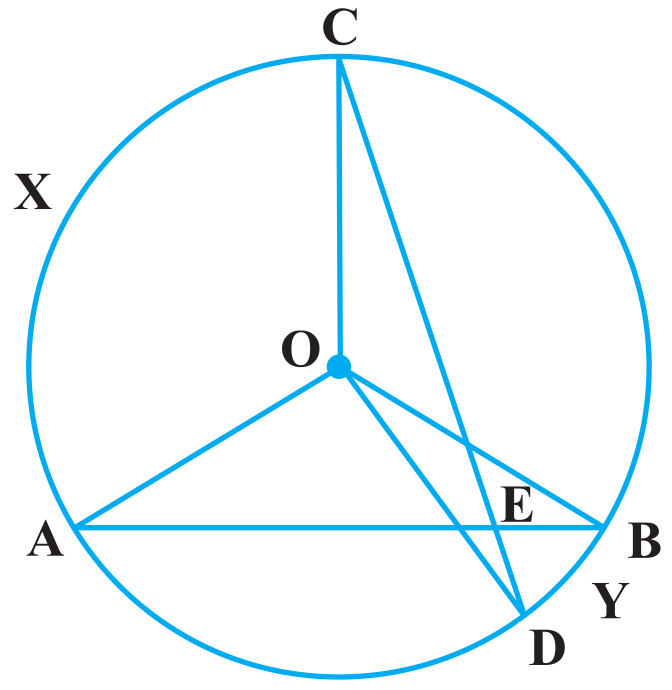
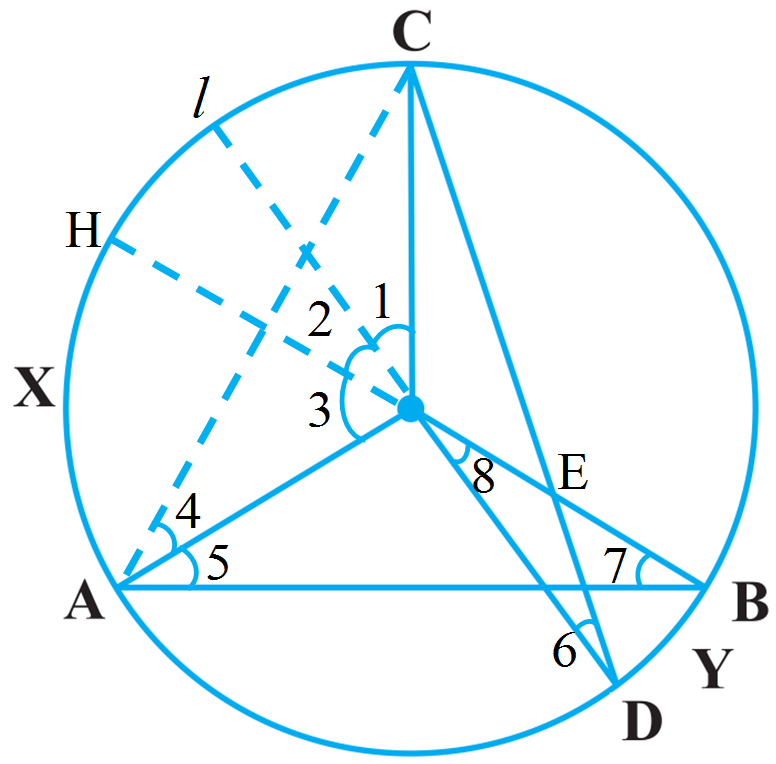
Given: In a figure, two chords AB and CD intersecting each other at point E.
To prove: $\angle\text{AEC}=\frac{1}{2}$ [angle subtended by arc C × A at centre + angle subtended by arc DYB at the centre]

Construction: Extend the line DO and BO at the points l and H on the circle. Also, join AC.
Proof: We know that, in a circle, the angle subtended by an arc at the centre is twice the angle subtended by it at the remaining part of the circle.
$\therefore\angle1=2\angle6\ \ ...(\text{i})$ and $\angle3=2\angle7\ \ ...(\text{ii)}$
In $\triangle\text{AOC},\ \ \text{OC}=\text{OA}$ [both are the radius of circle]
$\angle\text{OCA}=\angle4$ [angles opposite to equal sides are equal]
Also, $\angle\text{AOC}+\angle\text{OCA}+\angle4=180^\circ$ [by angle sum property of triangle]
$\Rightarrow\angle\text{AOC}+\angle4+\angle4=180^\circ$
$\Rightarrow\angle\text{AOC}=180^\circ-2\angle4\ \ \ ...(\text{iii})$
Now, in $\triangle\text{AEC},\ \ \ \angle\text{AEC}+\angle\text{ECA}+\angle\text{CAE}=180^\circ$ [by angle property sum of a triangle] $\Rightarrow\angle\text{AEC}=180^\circ-(\angle\text{ECA}+\angle\text{CAE})$
$\Rightarrow\angle\text{AEC}=180^\circ-[(\angle\text{ECO}+\angle\text{OCA})+\angle\text{CAO}+\angle\text{OAE}]$
$=180^\circ-(\angle6+\angle4+\angle4+\angle5)$ $\big[$In $\triangle\text{OCD},\angle6=\angle\text{ECO}$ angles opposite to equal sides are equal$\big]$
$=180^\circ-(2\angle4+\angle5+\angle6)$
$=180^\circ-(180^\circ-\angle\text{AOC}+\angle7+\angle6)$
[From Eq. (iii) and in $\triangle\text{AOB}.\angle5=\angle7,$ as (angles opposite to equal sides are equal)]
$=\angle\text{AOC}-\frac{\angle3}{2}-\frac{\angle1}{2}$ [from Eqs. (i) and (ii)]
$=\angle\text{AOC}-\frac{\angle1}{2}-\frac{\angle2}{2}-\frac{\angle3}{2}+\frac{\angle2}{2}$ [adding and subtracting $\frac{\angle2}{2}$]
$=\angle\text{AOC}-\frac{1}{2}(\angle1+\angle2+\angle3)+\frac{\angle8}{2}$ [$\because\angle2=\angle8$ (vertically opposite angles)]
$=\angle\text{AOC}=\frac{\angle\text{AOC}}{2}+\frac{\angle\text{DOB}}{2}$
$\Rightarrow\angle\text{AEC}=\frac{1}{2}(\angle\text{AOC}+\angle\text{DOB})$
$=\frac{1}{2}$ [angle subtended by arc CXA at the centre + angle subtended by arc DYB at the centre]

View full question & answer
Question 584 Marks
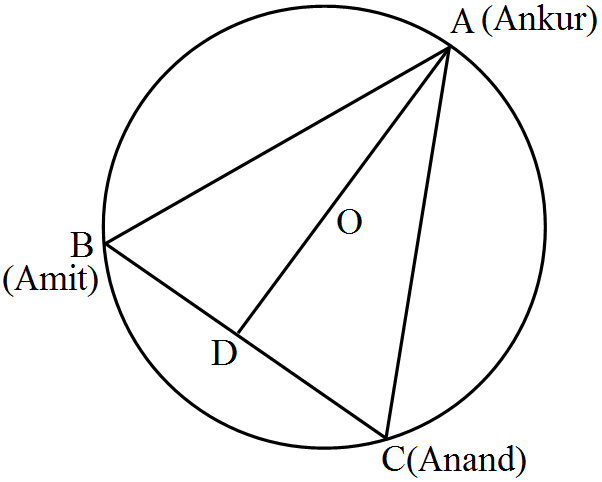
A circular park of radius 40m is situated in a colony. Three boys Ankur, Amit and Anand are sitting at equal distance on its boundary each having a toy telephone in his hands to talk to each other. Find the length of the string of each phone.
View full question & answer
Question 594 Marks
View full question & answer
Question 604 Marks
View full question & answer
Question 614 Marks
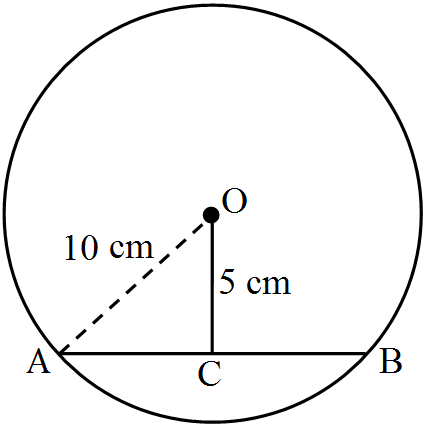
Find the length of a chord which is at a distance of 5cm from the centre of a circle of radius 10cm.
View full question & answer
Question 624 Marks
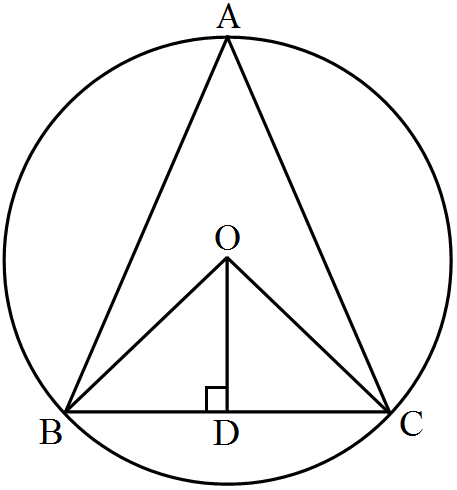
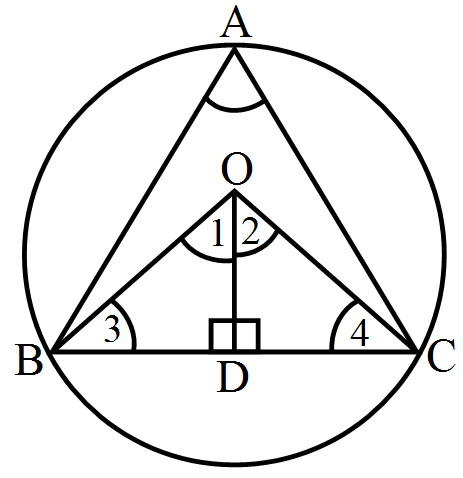
O is the circumference of the triangle ABC and OD is perpendicular on BC. Prove that $\angle\text{BOD}=\angle\text{A}.$
View full question & answer
Question 634 Marks
Answer
Given, BO is the bisector of $\angle\text{ABC}$
To prove AB = BC
Proof:
Since, BO is the bisector of $\angle\text{ABC}$
Then, $\angle\text{ABO}=\angle\text{CBO}\dots(\text{i})$
Since, OB = OA [Radius of circle]
Then, $\angle\text{ABO}=\angle\text{DAB}\dots(\text{ii})$ [opposite angles to equal sides]
Since OB = OC [Radius of circle]
Then, $\angle\text{OAB}=\angle\text{OCB}\dots(\text{iii})$ [opposite angles to equal sides]
Compare equations (i), (ii) and (iii)
$\angle\text{OAB}=\angle\text{OCB}\dots(\text{iii})$
In $\triangle\text{OAB}$ and $\triangle\text{OCB}$
$\angle\text{OAB}=\angle\text{OCB}$ [From (iv)]
$\angle\text{OBA}=\angle\text{OBC}$ [Given]
OB = OB [Common]
Then, $\triangle\text{OAB}\cong\triangle\text{OCB}$ [By AAS condition]
$\therefore\text{AB}=\text{BC}$ [C.P.C.T.]
View full question & answer
Question 644 Marks
A circle has radius $\sqrt{2}\text{cm}.$ It is divided into two segments by a chord of length 2cm. Prove that the angle subtended by the chord at a point in major segment is 45°.
View full question & answer
Question 654 Marks
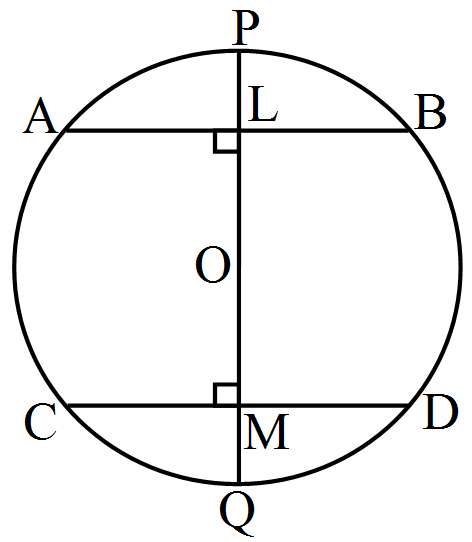
If a line segment joining mid-points of two chords of a circle passes through the centre of the circle, prove that the two chords are parallel.
View full question & answer
Question 664 Marks
Answer
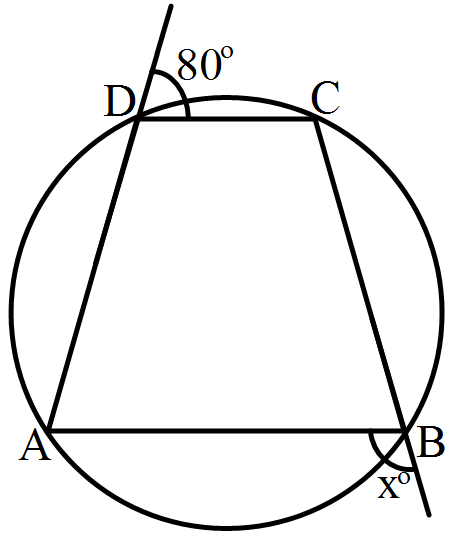
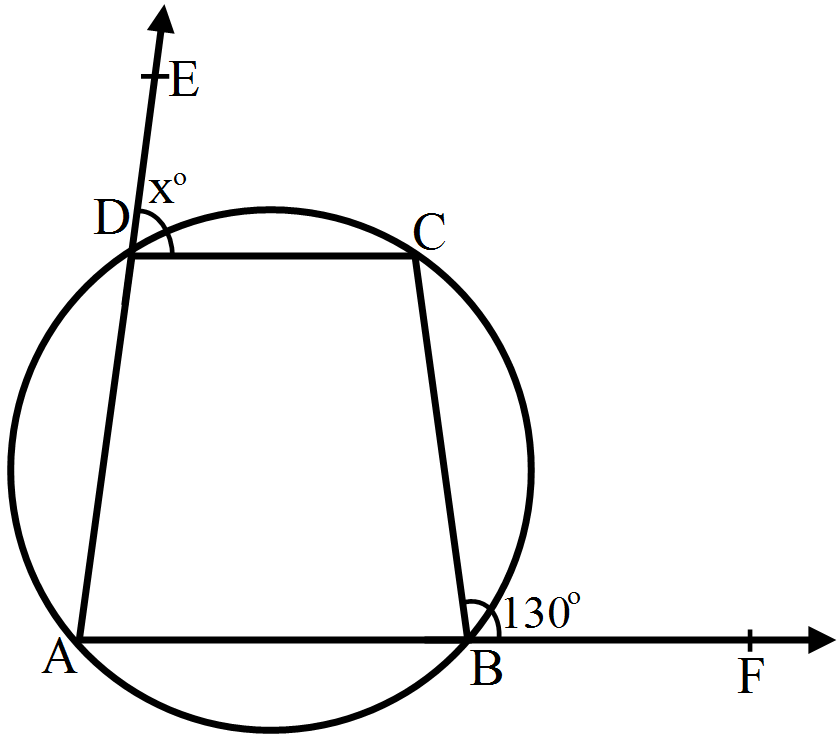
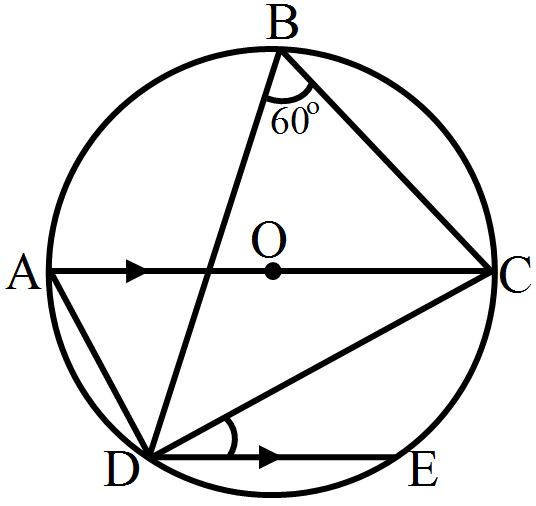
$\angle\text{EDC}+\angle\text{CDA}=180^\circ$ [Linear pair of angles]
$\Rightarrow80^\circ+\angle\text{CDA}=180^\circ$
$\Rightarrow\angle\text{CDA}=180^\circ-80^\circ=100^\circ$
Since, ABCD is a cyclic quadrilateral.
$\angle\text{ADC}+\angle\text{ABC}=180^\circ$
$\Rightarrow100^\circ+\angle\text{ABC}=180^\circ$
$\Rightarrow\angle\text{ABC}=180^\circ-100^\circ=80^\circ$
Now, $\angle\text{ABC}+\angle\text{ABF}=180^\circ$ [Linear pair of angles]
$\Rightarrow80^\circ+\text{x}^\circ=180^\circ$
$\Rightarrow\text{x}=180^\circ-80^\circ=100^\circ$
View full question & answer
Question 674 Marks
A chord of a circle is equal to its radius. Find the angle subtended by this chord at a point in major segment.
View full question & answer
Question 684 Marks
View full question & answer
Question 694 Marks
Answer
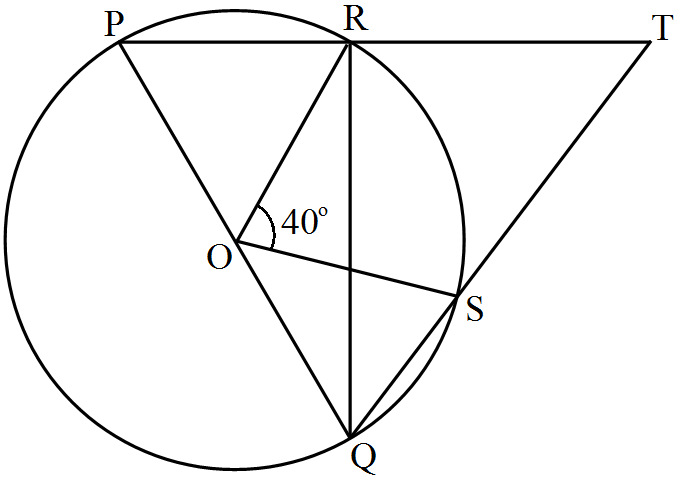
Since PQ is diameter
Then,
$\angle\text{PRQ} = 90^\circ$ [Angle in semicircle]
$\therefore\angle\text{PRQ}+\angle\text{TRQ}=180^\circ$ [Linear pair of angle]
$900+\angle\text{TRQ}=180^\circ$
$\angle\text{TRQ}=180^\circ-90^\circ=90^\circ$
By degree measure theorem
$\angle\text{ROS}=2\angle\text{RQS}$
$\Rightarrow40^\circ=2\angle\text{RQS}$
$\Rightarrow\angle\text{RQS}=\frac{40^\circ}{2}=20^\circ$
In $\triangle\text{RQT},$ by Angle sum property
$\angle\text{RQT}+\angle\text{QRT}+\angle\text{RTS}=180^\circ$
$\Rightarrow20^\circ+90^\circ+\angle\text{RTS}=180^\circ$
$\Rightarrow\angle\text{RTS}=180^\circ-20^\circ-90^\circ=70^\circ$
View full question & answer
Question 704 Marks
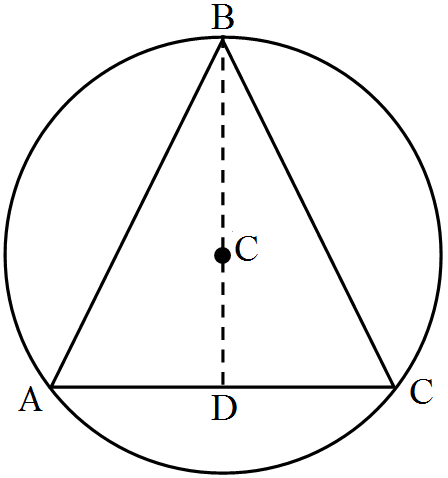
An equilateral triangle of side 9cm is inscribed in a circle. Find the radius of the circle.
View full question & answer
Question 714 Marks
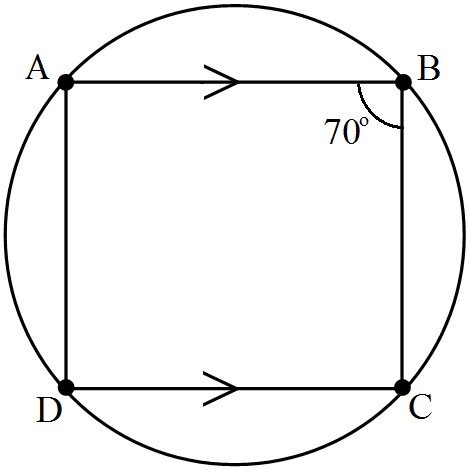
In a cyclic quadrilateral ABCD if AB || CD and $\angle\text{B}=70^\circ,$ find the remaining angles.
View full question & answer
Question 724 Marks
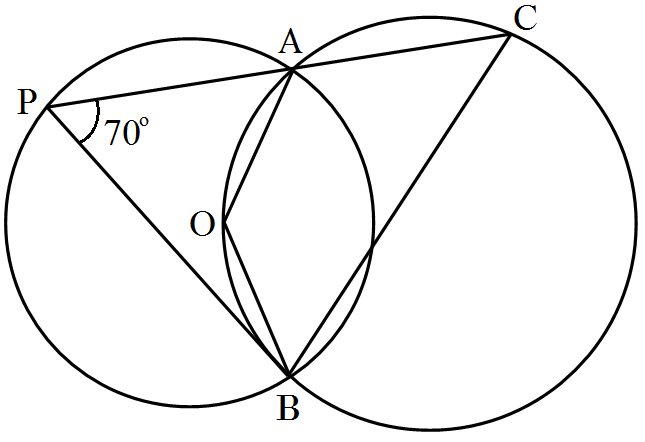
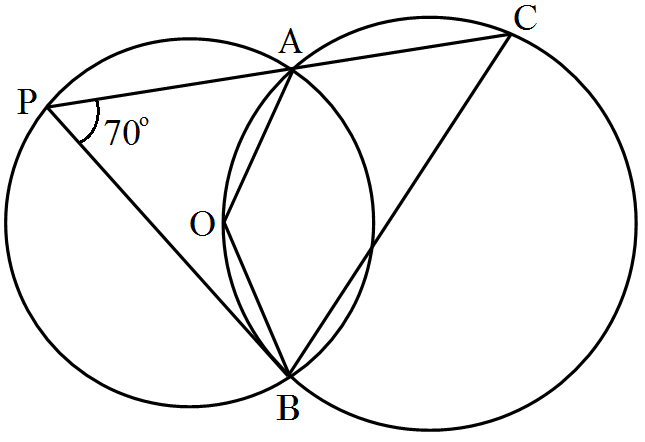
Answer
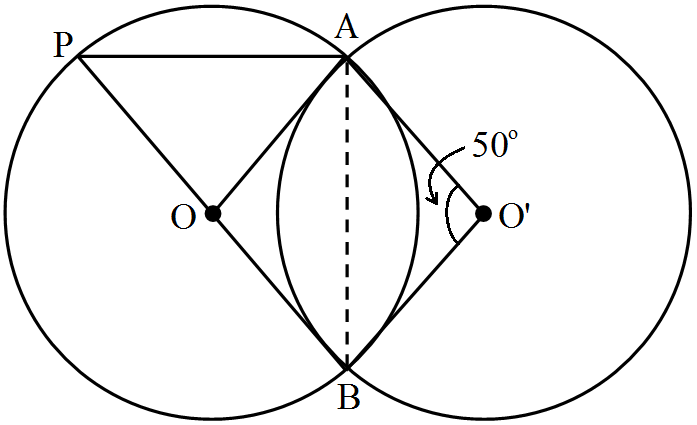
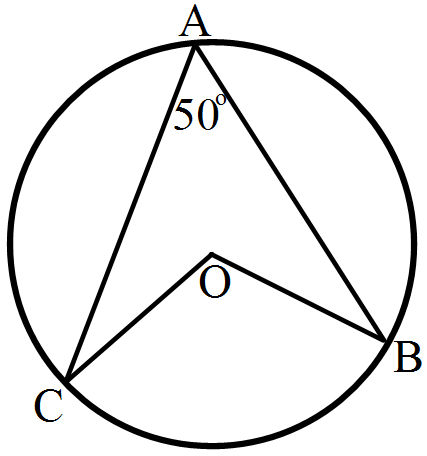
$\angle\text{APB}=50^\circ$

By degree measure theorem

$\angle\text{AOB}=2\angle\text{APB}$

$\Rightarrow\angle\text{APB}=2\times50^\circ=100^\circ$ since OA = OB [Radius of circle]

Then $\angle\text{OAB}=\angle\text{OBA}$ [Angles opposite toequalsides]

Let $\angle\text{OAB}=\text{x}$

In $\triangle\text{OAB},$ by angle sum property

$\angle\text{OAB}+\angle\text{OBA}+\angle\text{AOB}=180^\circ$

$\Rightarrow\text{x}+\text{x}+100^\circ=180^\circ$

$\Rightarrow\text{2x}=180^\circ-100^\circ$

$\Rightarrow\text{2x}=80^\circ$

$\Rightarrow\text{x}=40^\circ$

$\angle\text{OAB}=\angle\text{OBA}=40^\circ$

View full question & answer
Question 734 Marks
View full question & answer
Question 744 Marks
Answer
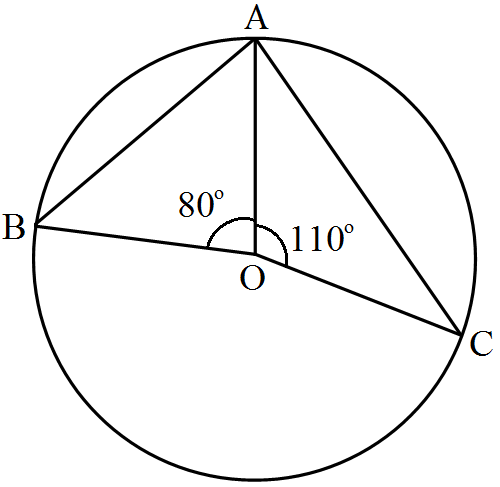
We have $\angle\text{AOB}=80^\circ$

And $\angle\text{AOC}=110^\circ$

Therefore, $\angle\text{AOB}+\angle\text{AOC}+\angle\text{BOC}=360^\circ$ [Complete angle]

$\Rightarrow80^\circ+100^\circ+\angle\text{BOC}=360^\circ$

$\Rightarrow\angle\text{BOC}=360^\circ-80^\circ-110^\circ$

$\Rightarrow\angle\text{BOC}=170^\circ$

By degree measure theorem

$\angle\text{BOC}=2\angle\text{BAC}$

$\Rightarrow170^\circ=2\angle\text{BAC}$

$\Rightarrow\angle\text{BAC}=\frac{170^\circ}{2}=85^\circ$

View full question & answer
Question 754 Marks
View full question & answer
Question 764 Marks
The circumcentre of the triangle ABC is O. Prove that $\angle\text{OBC} + \angle\text{BAC} = 90^\circ.$
View full question & answer
Question 774 Marks
View full question & answer
Question 784 Marks
Answer
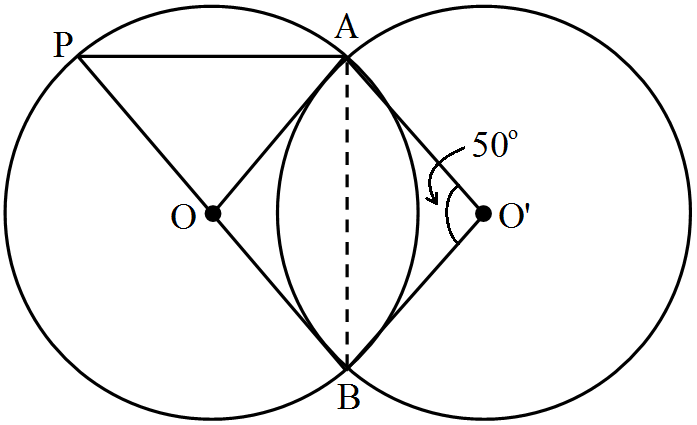
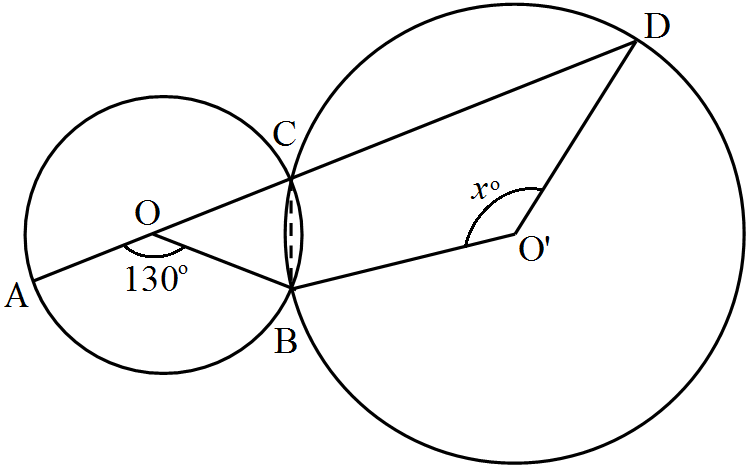
By degree measure theorem

$\angle\text{AOB} = 2\angle\text{ACB}$

$\Rightarrow130^\circ=2\angle\text{ACB}$

$\Rightarrow\angle\text{ACB}=\frac{130^\circ}{2}=65^\circ$ [Liner a pair of angles]

$\Rightarrow65^\circ+\angle\text{BCD}=180^\circ$

$\Rightarrow\angle\text{BCD}=180^\circ-65^\circ=115^\circ$ By degree measure theorem reflex

$\angle\text{BOD}=2\angle\text{BCD}$

$\Rightarrow\text{reflex }\angle\text{BOD}=2\times115^\circ=230^\circ$

Now, reflex $\angle\text{BOD}+\angle\text{BO}'\text{D}=360^\circ$ [Complex angle]

$\Rightarrow230^\circ+\text{x}=360^\circ$

$\Rightarrow\text{x}=360^\circ-230^\circ$

$\therefore\text{x}=130^\circ$
View full question & answer
Question 804 Marks
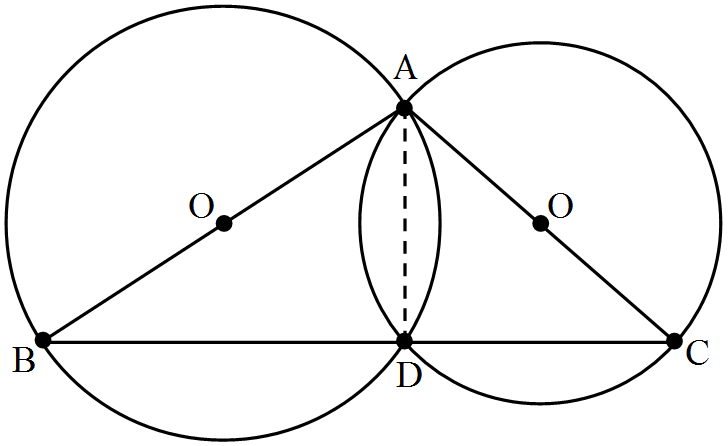
Circles are described on the sides of a triangle as diameters. Proved that the circle on any two sides intersect each other on the third side (or third side produced).
View full question & answer
Question 814 Marks
Answer
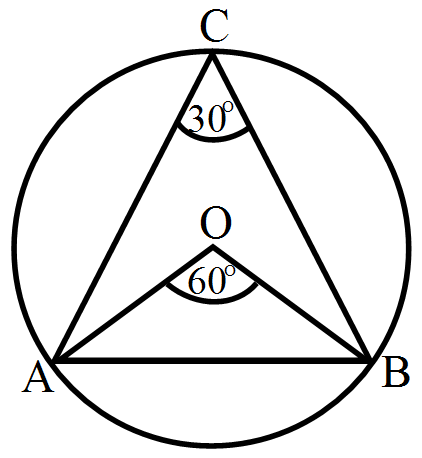
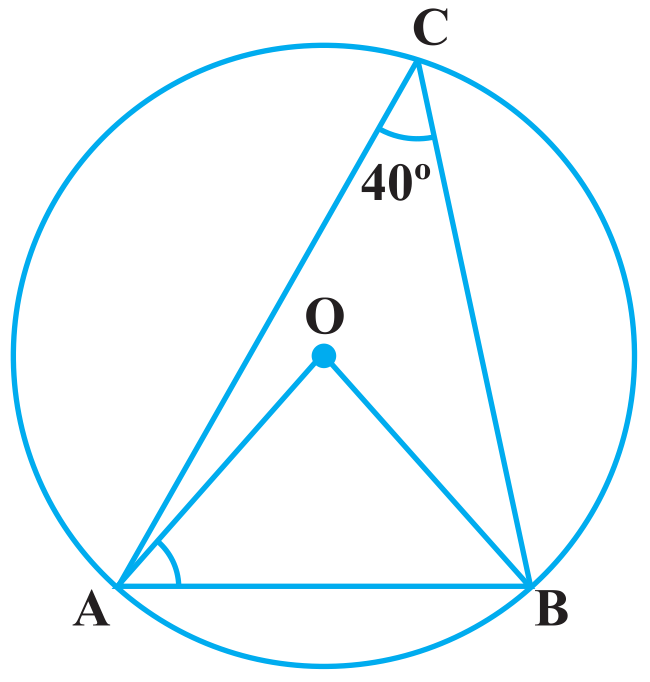
Given, $\angle\text{ACB}=40^\circ$
We know that, a segment subtends an angle to the circle is half the angle subtends to the centre.
$\therefore\angle\text{AOB}=2\angle\text{ACB}$
$\Rightarrow\angle\text{ACB}=\frac{\angle\text{AOB}}{2}$
$\Rightarrow40^\circ=\frac{1}{2}\angle\text{AOB}$
$\Rightarrow\angle\text{AOB}=80^\circ\ \ \ ...(\text{i})$
In $\triangle\text{AOB},\ \text{AO}=\text{BO}$ [both are the radius of a circle]
$\Rightarrow\angle\text{OBA}=\angle\text{OAB}\ \ ...(\text{ii})$ [angle opposite to the equal sides are equal]
We know that, the sum of all three angles in a triangle AOB is 180°.
$\therefore\angle\text{AOB}+\angle\text{OBA}+\angle\text{OAB}=180^\circ$
$\Rightarrow80^\circ+\angle\text{OAB}+\angle\text{OAB}=180^\circ$ [from Eqs. (i) and (ii)]
$\Rightarrow2\angle\text{OAB}=180^\circ-80^\circ$
$\Rightarrow2\angle\text{OAB}=100^\circ$
$\therefore\angle\text{OAB}=\frac{100^\circ}{2}=50^\circ$
View full question & answer
Question 824 Marks
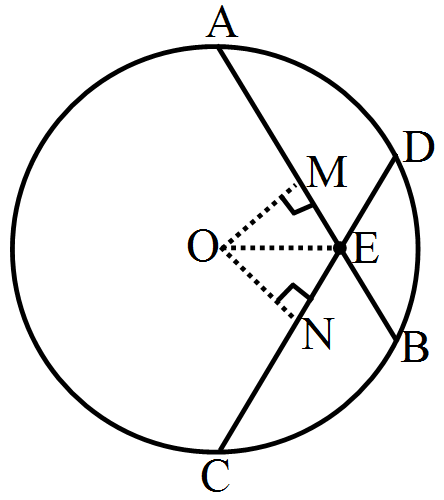
If two equal chords of a circle intersect, prove that the parts of one chord are separately equal to the parts of the other chord.
View full question & answer
Question 834 Marks
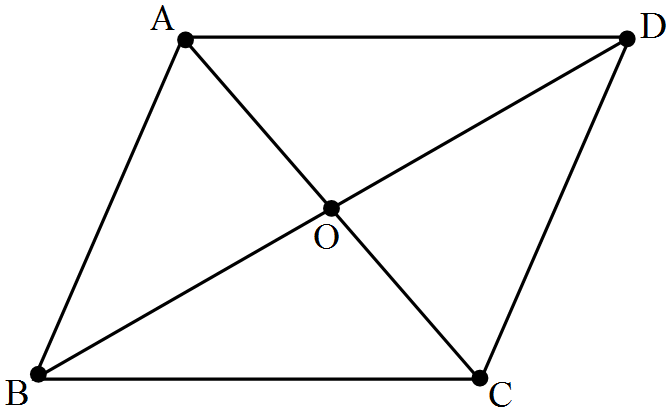
Prove that the circles described on the four sides of a rhombus as diameters, pass through the point of intersection of its diagonals.
View full question & answer