Questions

2 Marks Questions

🎯

Test yourself on this topic

7 questions · timed · auto-graded

Question 12 Marks
A hemispherical tank is made up of an iron sheet $1 \ cm$ thick. If the inner radius is $1 m,$ then find the volume of the iron used to make the tank.
Answer
Inner radius of hemispherical tank $( r )=1 m=100 \ cm$
Thickness of sheet $=1 \ cm$
$\therefore$ Outer radius of hemispherical tank $( R )=100+1=101 \ cm$
Volume of iron of hemisphere $=\frac{2}{3} \pi\left[ R ^3- r ^3\right] \ cm ^2$
$=\frac{2}{3} \times \frac{22}{7} \times\left[(101)^3-(100)^3\right] \ cm ^2$
$=\frac{44}{21}[1030301-1000000] \ cm ^2$
$=0.06348 m^2$
View full question & answer
Question 22 Marks
The surface areas of two spheres are in the ratio $1 : 4.$ Find the ratio of their volumes.
Answer
Suppose that the radii of the spheres are $r$ and $R.$
We have:
$\frac{4 \pi r^2}{4 \pi R^2}=\frac{1}{4}$
$\Rightarrow \frac{r}{R}=\sqrt{\frac{1}{4}}=\frac{1}{2}$
Now, ratio of the volumes $=\frac{\frac{4}{3} \pi r^3}{\frac{4}{3} \pi R^3}=\left(\frac{r}{R}\right)^3=\left(\frac{1}{2}\right)^3=\frac{1}{8}$
Therefore, The ratio of the volumes of the spheres is $1: 8$.
View full question & answer
Question 32 Marks
Evaluate: $(32)^{\frac{1}{5}}+(-7)^0+(64)^{\frac{1}{2}}$.
Answer
$(32)^{\frac{1}{5}}+(-7)^0+(64)^{\frac{1}{2}}$
$\left(2^5\right)^{\frac{1}{5}}+1+\sqrt{8 \times 8}\left[\because a^0=1\right]$
$=2^{\left(5 \times \frac{1}{5}\right)}+1+8$
$=2+1+8$
$=11$
View full question & answer
Question 42 Marks
Insert five rational numbers between $-\frac{2}{3}$ and $\frac{3}{4}$.
Answer
$-\frac{2}{3}=\frac{-2 \times 4}{3 \times 4}=\frac{-8}{12}$
$\frac{3}{4}=\frac{3 \times 3}{4 \times 3}=\frac{9}{12}$
So, the five rational numbers between $-\frac{2}{3}$ and $\frac{3}{4}$ are $\frac{8}{12}, \frac{7}{12}, \frac{6}{12}, \frac{5}{12}$ and $\frac{4}{12}$
View full question & answer
Question 52 Marks
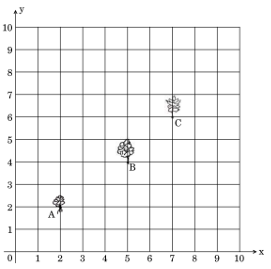
Seema has a $10 m \times 10 m$ kitchen garden attached to her kitchen. She divides it into a $10 \times 10$ grid and wants to grow some vegetables and herbs used in the kitchen. She puts some soil and manure in that and sows a green chilly plant at $A,$ a coriander plant at $B$ and a tomato plant at $C.$
Her friend Kusum visited the garden and praised the plants grown there. She pointed out that they seem to be in a straight line. See the below diagram carefully and answer the following questions :
Image
$i.$ Write the coordinates of the points $A, B,$ and $C$ taking the $10 \times 10$ grid as coordinate axes.
$ii.$ By distance formula or some other formula, check whether the points are collinear.
Answer
$(i)$
$ A (2,2)$
$B (5,4)$
$C (7,6)$
$(ii)$
$ AB =\sqrt{(5-2)^2+(2-2)^2}$
$=\sqrt{9+4}$
$=\sqrt{13}$
$BC =\sqrt{(7-5)^2+(6-4)^2}$
$=\sqrt{4+4}$
$=2 \sqrt{2}$
$AC =\sqrt{(7-2)^2+(6-2)^2}$
$=\sqrt{25+16}$
$=\sqrt{41}$
$\because AB + BC =\sqrt{13}+2 \sqrt{2}$
$AC =\sqrt{41}$
$\therefore AB + BC \neq AC$
$\therefore A , B , C$ are not collinear
View full question & answer
Question 62 Marks
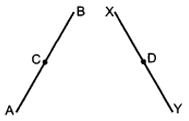
In fig. $AC = XD , C$ is the mid-point of AB and D is the mid-point of XY . Using a Euclid's axiom, show that AB = XY.
Image
Answer
In the above figure, we have
$A B=A C+B C=A C+A C=2 A C$ (Since, $C$ is the mid-point of $A B$ ) ..(1)
$X Y=X D+D Y=X D+X D=2 X D$ (Since, $D$ is the mid-point of $X Y$ ) ..(2)
Also, $AC = XD$ (Given) ..(3)
From (1),(2)and(3), we get
$AB = XY$, According to Euclid, things which are double of the same things are equal to one another.
View full question & answer
Question 72 Marks
Look at the Fig. Show that length AH > sum of lengths of AB + BC + CD.
Image
Answer
From the given figure, we have
$AB + BC + CD = AD [ AB , SC$ and CD are the parts of AD $]$ Here, AD is also the parts of AH .
By Euclid's axiom, the whole is greater than the part. i.e., $AH > AD$.
Therefore, length $A H>$ sum of lengths of $A B+B C+C D$.
View full question & answer