Questions

5 Marks Questions

🎯

Test yourself on this topic

6 questions · timed · auto-graded

Question 15 Marks
If $x-3$ and $x-\frac{1}{3}$ are both factors of $p x^2+5 x+r$, then show that $p=r$
Answer
$\because x-3$ and $x-\frac{1}{3}$ are factors of
$px ^2+5 x + r \therefore x =3, x =\frac{1}{3}$
zero of $p x^2+5 x+r$
Putting $x=3$ in given polynomial,
$\therefore p(3)^2+5 \times 3+r=0$
$9 p +15+ r =0$
$9 p+r=-15-----(1)$
Again putting $x=\frac{1}{3}$ in given polynomial,
$p\left(\frac{1}{3}\right)^2+5 \times \frac{1}{3}+r=0$
$\frac{p}{9}+\frac{5}{3}+r=0$
$\frac{p+15+9 r}{9}=0$
$p+9 r=-15------(2)$
Fron eq.$(1)$ and eq.$(2),$ we have,
$9p + r = p + 9r$
$9p-p=9r-r$
$8p=8r$
$p=r$
Hence proved
View full question & answer
Question 25 Marks
Find the area of a triangular field whose sides are $91 m, 98 m$ and $105 m$ in length. Find the height corresponding to the longest side.
Answer
Let:
$a =91 m, b =98 m$, and $c =105 m$
$\therefore s=\frac{a+b+c}{2}=\frac{91+98+105}{2}=147 m$
$\Rightarrow s =147 m$
By Heron's formula, we have:
$\text { Area of triangle }=\sqrt{s(s-a)(s-b)(s-c)}$
$=\sqrt{147(147-91)(147-98)(147-105)}$
$=\sqrt{147 \times 56 \times 49 \times 42}$
$=\sqrt{7 \times 3 \times 7 \times 2 \times 2 \times 2 \times 7 \times 7 \times 7 \times 7 \times 3 \times 2}$
$=7 \times 7 \times 7 \times 2 \times 3 \times 2$
$=1446 m^2$
We know that the longest side is $105 m.$
Thus, we can find out the height of the triangle corresponding to $42 \ cm.$
$\text { Area of triangle }=4116 m^2$
$\Rightarrow \frac{1}{2} \times \text { Base } \times \text { Height }=4116 $
$\Rightarrow \frac{1}{2} \times(105)(\text { Height })=4116$
$\Rightarrow \text { Height }=\frac{4116 \times 2}{105}=78.4 m$
View full question & answer
Question 35 Marks
Find the area of the triangle whose sides are $42 \ cm, 34 \ cm$ and $20 \ cm$ in length. Hence, find the height corresponding to the longest side.
Answer
Let:
$a =42 \ cm, b =34 \ cm$ and $c =20 \ cm$
$\therefore s=\frac{a+b+c}{2}$
$=\frac{42+34+20}{2}$
$=48 \ cm$
By Heron's formula, we have:
$\text { Area of triangle }=\sqrt{s(s-a)(s-b)(s-c)}$
$=\sqrt{48(48-42)(48-34)(48-20)}$
$=\sqrt{48 \times 6 \times 14 \times 28}$
$=\sqrt{4 \times 2 \times 6 \times 6 \times 7 \times 2 \times 7 \times 4}$
$=4 \times 2 \times 6 \times 7$
Area of triangle $=336 \ cm^2$
We know that the longest side is $42 \ cm.$
Thus, we can find out the height of the triangle corresponding to $42 \ cm.$
We have:
$\text { Area of triangle }=336 \ cm^2$
$\Rightarrow \frac{1}{2} \times \text { Base } \times \text { Height }=336$
$\Rightarrow \frac{1}{2}(42)(\text { height })=336$
$\Rightarrow \text { Height }=\frac{336 \times 2}{42}=16 \ cm$
View full question & answer
Question 45 Marks
A cloth having an area of $165 m^2$ is shaped into the form of a conical tent of radius $5 m .$
$i.$ How many students can sit in the tent if a student on an average, occupies $\frac{5}{7} m^2$ on the ground?
$ii.$ Find the volume of the cone.
Answer
Suppose $1$ be the slant height of the conical tent.
Radius of the base of conical tent $(r)=5 m$
$i.$ Area of the circular base of the cone $=\pi r ^2=\frac{22}{7} \times 5^2 m^2$
Number of student $=\frac{\text { Area of the base }}{\text { Area occupied by one student }}$
$=\frac{\frac{22}{7} \times 5 \times 5 m^2}{\frac{5}{7} m^2}$
$=\frac{22}{7} \times 5 \times 5 \times \frac{7}{5}$
$=110$
$ii.$ Also, curved surface area of cone $=\pi rl$
$\Rightarrow 165=\frac{22}{7} \times 5 \times 1$
$\Rightarrow 1=\frac{165 \times 7}{22 \times 5}$
$\Rightarrow 1=\frac{21}{2} m=10.5 m$
Also, $h^2=l^2-r^2$
$\Rightarrow h =\sqrt{(10.5)^2-5^2}=\sqrt{15.5 \times 5.5} \approx< p$
Volume of conical tent $=\frac{1}{3} \pi r ^2 h$
$=\frac{1}{3} \times \frac{22}{7} \times 5^2 \times 9.23 m^3$
$=241.74 m^3$.
View full question & answer
Question 55 Marks
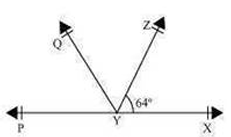
If is given that $\angle X Y Z=64^{\circ}$ and XY is produced to point P . Draw a figure from the given information. If ray YQ bisects $\angle ZYP$, find $\angle XYQ$ and reflex $\angle QYP$.
Answer
We are given that $\angle XYZ =64^{\circ}, XY$ is produced to P and YQ bisects $\angle ZYP$ We can conclude the given below figure for the given situation:
View full question & answer
Question 65 Marks
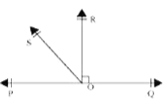
In the given figure, $\text{POQ}$ is a line. Ray $OR$ is perpendicular to line $PQ. OS$ is another ray lying between rays $OP$ and $OR$. Prove that $\angle R O S=\frac{1}{2}(\angle Q O S-\angle P O S)$.
Image
Answer
To Prove: $\angle R O S=\frac{1}{2}(\angle Q O S-\angle P O S)$
Given: $OR$ is perpendicular to $PQ ,$ or $\angle QOR =90^{\circ}$
From the given figure, we can conclude that $\angle POR$ and $\angle QOR$ form a linear pair.
We know that sum of the angles of a linear pair is $180^{\circ}$.
$\therefore \angle POR +\angle QOR =180^{\circ}$
or $\angle POR =90^{\circ}$
From the figure, we can conclude that
$\angle POR =\angle POS +\angle ROS$
$\Rightarrow \angle POS +\angle ROS =90^{\circ}$
$\Rightarrow \angle ROS =90^{\circ}-\angle POS \ldots (i)$
Again,
$\angle QOS +\angle POS =180^{\circ}$
$\Rightarrow \frac{1}{2}(\angle Q O S+\angle P O S)=90^{\circ} \text {.(ii) }$
Substitute $(ii)$ in $(i),$ to get
$\angle R O S=\frac{1}{2}(\angle Q O S+\angle P O S)-\angle P O S$
$=\frac{1}{2}(\angle Q O S-\angle P O S) .$
Therefore, the desired result is proved.
View full question & answer