Questions

M.C.Q

🎯

Test yourself on this topic

18 questions · timed · auto-graded

MCQ 11 Mark
If $p(x)= x ^3- x ^2+ x +1$, then the value of $\frac{p(-1)+p(1)}{2}$ is
  • A
    $2$
  • B
    $3$
  • $0$
  • D
    $1$
Answer
Correct option: C.
$0$
$p ( x )= x ^3- x ^2+ x +1$
$=\frac{p(-1)+p(1)}{2}$
$=\frac{(-1)^3-(-1)^2+(-1)+1+(1)^3-(1)^2+(1)+1}{2}$
$=\frac{-1-1-1+1+1-1+1+1}{2}$
$=\frac{0}{2}$
$=0$
View full question & answer
MCQ 21 Mark
The graph of $x + y = 6$ intersect coordinate axes at
  • A
    Both $(0,6)$ and $(6,0)$
  • B
    $(6,0)$
  • C
    $(0,6)$
  • D
    $(2,3)$
Answer
(a) Both $(0,6)$ and $(6,0)$
Explanation: Both $(0,6)$ and $(6,0)$
View full question & answer
MCQ 31 Mark
If $P (3,9)$ and $Q (-3,-4)$, then (abscissa of P ) - (ordinate of Q ) is
  • A
    1
  • B
    7
  • C
    $-1$
  • D
    $-7$
Answer
(b) 7
Explanation: From the given data we have,
The abscissa of $P =3$ and ordinate of $Q =-4$,
So, according to question, (abscissa of P) - (ordinate of Q)
abscissa of P) - (ordinate of Q)
= 3 - (-4)
= 7
View full question & answer
MCQ 41 Mark
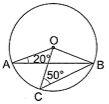
In the given figure, $O$ is the centre of a circle in which $\angle OAB =20^{\circ}$ and $\angle OCB =50^{\circ}$. Then, $\angle AOC =$ ?
Image
  • A
    $20^{\circ}$
  • B
    $70^{\circ}$
  • $60^{\circ}$
  • D
    $50^{\circ}$
Answer
Correct option: C.
$60^{\circ}$
$OA = OB $
$\Rightarrow \angle OBA =\angle OAB =20^{\circ}$.
In $\triangle OAB$,
$\angle OAB +\angle OBA +\angle AOB =180^{\circ}$
$\Rightarrow 20^{\circ}+20^{\circ}+\angle AOB =180^{\circ}$
$\Rightarrow \angle AOB =140^{\circ}$
$OB=OC $
$\Rightarrow \angle OBC=\angle OCB=50^{\circ} .$
In $\triangle OCB$,
$\angle OCB +\angle OBC +\angle COB =180^{\circ}$
$\Rightarrow 50^{\circ}+50^{\circ}+\angle COB =180^{\circ}$
$\Rightarrow \angle COB =80^{\circ} .$
$\angle AOB =140^{\circ} $
$\Rightarrow \angle AOC +\angle COB =140^{\circ}$
$\Rightarrow \angle AOC +80^{\circ}=140^{\circ}$
$\Rightarrow \angle AOC =140^{\circ}-80^{\circ}$
$\Rightarrow \angle AOC =60^{\circ} .$
View full question & answer
MCQ 51 Mark
The simplest rationalising factor of $\sqrt{3}+\sqrt{5}$, is
  • A
    $\sqrt{3}+\sqrt{5}$
  • B
    $\sqrt{3}-\sqrt{5}$
  • C
    $\sqrt{3}-5$
  • D
    $3-\sqrt{5}$
Answer
(b) $\sqrt{3}-\sqrt{5}$
Explanation: The simplest rationalising factor of $\sqrt{3}+\sqrt{5}$ is $\sqrt{3}-\sqrt{5}$
View full question & answer
MCQ 61 Mark
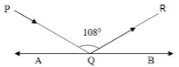
In the given figure $AB$ is a mirror, $PQ$ is the incident ray and $QR$ is the reflected ray. If $\angle PQR =108^{\circ}$, then $\angle AQP =?$
Image
  • $36^{\circ}$
  • B
    $72^{\circ}$
  • C
    $54^{\circ}$
  • D
    $18^{\circ}$
Answer
Correct option: A.
$36^{\circ}$
According to question,
$\angle AQP =\angle BQR = x$
$\angle AQP +\angle BQR +\angle PQR =180^{\circ} \text { (Linear Pair) }$
$2 x +108^{\circ}=180^{\circ}$
$x =36^{\circ}$
View full question & answer
MCQ 71 Mark
The taxi fare in a city is as follows: For the first kilometer, the fare is $₹\ 8$ and for the subsequent distance it is $₹\ 5$ per kilometer. Taking the distance covered as $x \ km$ and total fare as $₹\ y,$ write a linear equation for this information.
  • $y=5 x+3$
  • B
    $y=5 x-3$
  • C
    $x=5 y-3$
  • D
    $x=5 y+3$
Answer
Correct option: A.
$y=5 x+3$
Taxi fare for first kilometer $= 8$
Taxi fare for subsequent distance $= 5$
Total distance covered $= x$
Total fare $= y$
Since the fare for first kilometer $= 8$
According to problem, Fare for $(x-1)$ kilometer $=5(x-1)$
So, the total fare $y =5( x -1)+8$
$\Rightarrow y=5(x-1)+8$
$\Rightarrow y=5 x-5+8$
$\Rightarrow y=5 x+3$
Hence, $y=5 x+3$ is the required linear equation.
View full question & answer
MCQ 81 Mark
The value of $\frac{\sqrt{48}+\sqrt{32}}{\sqrt{27}+\sqrt{18}}$, is
  • $\frac{4}{3}$
  • B
    $4$
  • C
    $3$
  • D
    $\frac{3}{4}$
Answer
Correct option: A.
$\frac{4}{3}$
$=\frac{\sqrt{48}+\sqrt{32}}{\sqrt{27}+\sqrt{18}}$
$=\frac{\sqrt{4 \times 4 \times 3}+\sqrt{4 \times 4 \times 2}}{\sqrt{3 \times 3 \times 3}+\sqrt{3 \times 3 \times 2}}$
$=\frac{4 \sqrt{3}+4 \sqrt{2}}{3 \sqrt{3}+3 \sqrt{2}}$
$=\frac{4(\sqrt{3}+\sqrt{2})}{3(\sqrt{3}+\sqrt{2})}$
$=\frac{4}{3}$
View full question & answer
MCQ 91 Mark
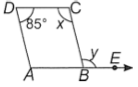
$\text{ABCD}$ is a parallelogram in which $\angle \text{ADC} =85^{\circ}$ and side $AB$ is produced to point $E$ as shown in the figure. Find the value of $(x+y)$.
Image
  • A
    $85^{\circ}$
  • $190^{\circ}$
  • C
    $95^{\circ}$
  • D
    $160^{\circ}$
Answer
Correct option: B.
$190^{\circ}$
$\angle \text{ADC} +\angle \text{DCB} =180^{\circ}\ ($Sum of adjacent angles of a parallelogram is $180^{\circ})$
$\Rightarrow 85^{\circ}+x=180^{\circ} $
$\Rightarrow x=95^{\circ}$
Now, $DC \| AE$ and $CB$ is a transversal.
$\therefore y - x -95^{\circ}\ ($Alternate interior angles$)$
$\therefore x + y =95^{\circ}+95^{\circ}=190^{\circ}$
View full question & answer
MCQ 101 Mark
The number $0 . \overline{3}$ in the form $\frac{p}{q}$, where $p$ and $q$ are integers and $q \neq 0$, is
  • A
    $\frac{3}{100}$
  • B
    $\frac{3}{10}$
  • C
    $\frac{33}{100}$
  • $\frac{1}{3}$
Answer
Correct option: D.
$\frac{1}{3}$
Let $x =0 . \overline{3}$
$i,e, x = 0.333 .....(i)$
multiply eq.$(i)$ by $10$ we get,
$10 x=3.333 \ldots . ...\text { (ii) }$
Subtracting eq. $(i)$ from $(ii)$ we get
$10 x-x=3.333 \ldots-0.333 \ldots$
$9 x=3$
$x=\frac{3}{9}$
$x=\frac{1}{3}$
View full question & answer
MCQ 111 Mark
Which of the following is a binomial?
  • A
    $x+3+\frac{1}{x}$
  • B
    $x^2+4$
  • C
    $2 x^2$
  • D
    $x^2+x+3$
Answer
(b) $x^2+4$
Explanation: Clearly, $x^2+4$ is an expression having two non-zero terms. So, it is a binomial.
View full question & answer
MCQ 121 Mark
Which of the following points lie on the line y = 3x – 4?
  • A
    $(2,2)$
  • B
    $(4,12)$
  • C
    $(5,15)$
  • D
    $(3,9)$
Answer
(a) $(2,2)$
Explanation: When we put $x=2$ in the given equation,
Then, $y =(3 \times 2)-4$
$y=6-4=2$, so point is $(2,2)$ satisfied the given equation,
Hence point $(2,2)$ will lie on the line $y=3 x-4$
View full question & answer
MCQ 131 Mark
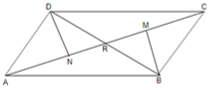
In quadrilateral $\text{ABCD , BM}$ and $DN$ are drawn perpendiculars to $AC$ such that $BM = DN$. If $BR =8 \ cm$. then $B D$ is
Image
  • A
    $12\ cm$
  • B
    $4\ cm$
  • $16\ cm$
  • D
    $2\ cm$
Answer
Correct option: C.
$16\ cm$
In triangles $\triangle \text{D N R}$ and $\triangle \text{B M R}$,
$\angle N =\angle M =90^{\circ}$
$\angle \text{NRD} =\angle \text{MRB} \ ($vertically opposite angles$) $
$BM = DN\ ($Given$)$
Therefore, $\triangle \text{D N R}$ and $\triangle \text{M R B}$ are congruent
Therefore, $BR = DR =8 \ cm$
$BD=16 \ cm$
View full question & answer
MCQ 141 Mark
The value of $7^{\frac{1}{2}} \cdot 8^{\frac{1}{2}}$ is
  • A
    $(28)^{1 / 2}$
  • $(56)^{1 / 2}$
  • C
    $(14)^{1 / 2}$
  • D
    $(42)^{1 / 2}$
Answer
Correct option: B.
$(56)^{1 / 2}$
$=7^{\frac{1}{2}} \cdot 8^{\frac{1}{2}}$
$=(7 \cdot 8)^{\frac{1}{2}}$
$=(56)^{1 / 2}$
View full question & answer
MCQ 151 Mark
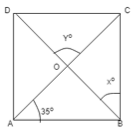
In the figure$, \text{ABCD}$ is a Rectangle. Find the values of $x$ and $y$?
Image
  • $x=55^{\circ}$ and $y=110^{\circ}$
  • B
    $x=100^{\circ}$ and $y=100^{\circ}$
  • C
    $x=50^{\circ}$ and $y=100^{\circ}$
  • D
    $x=60^{\circ}$ and $y=120^{\circ}$
Answer
Correct option: A.
$x=55^{\circ}$ and $y=110^{\circ}$
$\text{ABCD}$ is a rectangle
The diagonals of a rectangle are congruent and bisect each other.
Therefore, in $\triangle \text{AOB}$, we have: $ OA = OB$
$\angle \text{OAB} =\angle \text{OBA} =35^{\circ}$
$x=90^{\circ}-35^{\circ}=55^{\circ}$ and $\angle \text{AOB}=180^{\circ}-\left(35^{\circ}+35^{\circ}\right)=110^{\circ}$
$y =\angle AOB =110^{\circ}\ [$Vertically opposite angles$]$
Hence, $x=55^{\circ}$ and $y=110^{\circ}$
View full question & answer
MCQ 161 Mark
If a straight line APQB is drawn to cut two concentric circles, then
Image
  • A
    $A P>B Q$
  • B
    $AP < BQ$
  • C
    $A Q>P B$
  • D
    $A P=B Q$
Answer
(d) AP = BQ
Explanation:
Image
Let OD is perpendicular to AB.Then AD = DB.
Also DP = DQ
Therefore, AP = AD - PD
= BD - DQ
= BQ
Hence, AP = BQ
View full question & answer
MCQ 171 Mark
The sides of a triangle are $11 \ cm, 15 \ cm$ and $16 \ cm$. The altitude to the largest side is
  • A
    $30 \sqrt{7}, \ cm$
  • B
    $30 \ cm$
  • C
    $\frac{15 \sqrt{7}}{2} \ cm$
  • $\frac{15 \sqrt{7}}{4} \ cm$
Answer
Correct option: D.
$\frac{15 \sqrt{7}}{4} \ cm$
$s =\frac{11+15+16}{2}=21 \ cm$
Area of $=\Delta=\sqrt{s(s-a)(s-b)(s-c)}=\sqrt{21 \times 10 \times 6 \times 5}=30 \sqrt{7} \ cm^2$
Also if we choose largest side and its Altitude, the area would be
$ A =\frac{1}{2} \times \text { largest side } \times h$
$\Rightarrow \frac{1}{2} \times 16 \times h=30 \sqrt{7}$
$\Rightarrow h=\frac{30 \sqrt{7}}{8}=\frac{15 \sqrt{7}}{4} \ cm$
View full question & answer
MCQ 181 Mark
The signs of abscissa and ordinate of a point in quadrant II are respectively _______________ .
  • A
    $(-,-)$
  • B
    $(+,-)$
  • C
    $(-,+)$
  • D
    $(+,+)$
Answer
(c) $(-,+)$
Explanation: $(-,+)$
View full question & answer
M.C.Q - Maths STD 9 Questions - Vidyadip