Questions

4 Marks Questions

🎯

Test yourself on this topic

8 questions · timed · auto-graded

Question 14 Marks
A measuring jar of internal diameter $10\ cm$ is partially filled with water. Four equal spherical balls of diameter $2\ cm$ each are dropped in it and they sink down in water completely. What will be the change in the level of water in the jar?
Answer
Given that, Diameter of jar $= 10cm$
Radius of jar $= 5cm$
Let the level of water be raised by $h$ Diameter of the spherical bowl $= 2cm$
Radius of the ball $= 1cm$
Volume of jar $= 4$ (Volume of spherical ball)
$\pi\text{r}^2_1\text{r}=4\Big(\frac{4}{3}\pi\text{r}^3_2\Big)$
$\text{r}^2_1\text{h}=4\Big(\frac{4}{3}\text{r}^3_2\Big)$
$5\times5\times\text{h}=4\times\frac{4}{3}\text{r}^3_2$
$5\times5\times\text{h}=4\times\frac{4}{3}\times1\times1\times1$
$\text{h}=\frac{4\times4\times1}{3\times5\times5}$
Height of water in jar $=\frac{16}{75}\text{cm}.$
View full question & answer
Question 24 Marks
A sphere of radius $5\ cm$ is immersed in water filled in a cylinder, the level of water rises $\frac{5}{3}$cm. Find the radius of the cylinder.
Answer
Radius of cylinder $= r$
Radius of sphere $= 5\ cm$
Volume of sphere $=\frac{4}{3\pi\text{r}^3}$ $=\frac{4}{3}\times\pi\times(5)^3$
Height of water rised $=\frac{5}{3}\text{cm}$
Volume of water rised in cylinder $=\pi\text{r}^2\text{h}$
Therefore, Volume of water rises in cylinder= Volume of sphere Let $r$ be the radius of the cylinder
$\pi\text{r}^2\text{h}=\frac{4}{3\pi\text{r}^3}$
$\text{r}^2\times\frac{5}{3}=\frac{4}{3}\times\frac{22}{7}\times125$
$\text{r}^2=20\times5$ $\text{r}=\sqrt{100}$
$\text{r}=10\text{cm}$
View full question & answer
Question 34 Marks
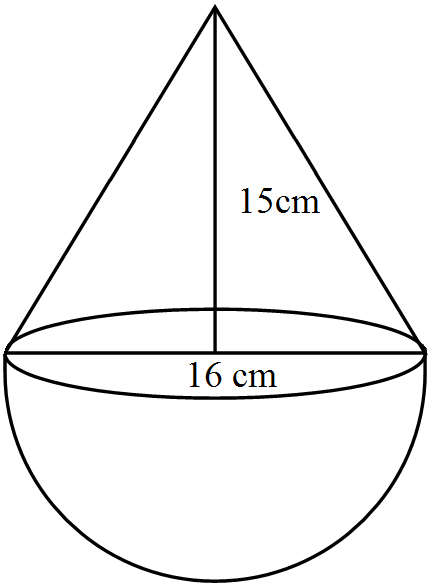
A wooden toy is in the form of a cone surmounted on a hemisphere. The diameter of the base of the cone is $16\ cm$ and its height is $15\ cm$. Find the cost of painting the toy at $Rs.$ $7$ per $100cm^2$
Answer
Diameter of cone $= 16\ cm$

Radius of cone$ = 8\ cm$
Height of cone $= 15\ cm$
Slant height of cone $=\sqrt{8^2+15^2}$
$=\sqrt{64+225}$
$=\sqrt{289}=17\text{cm}$
Therefore Total curved surface area of toy $=\pi\text{rl}+2\pi\text{r}^2$
$=\frac{22}{7}\times8\times17+2\frac{22}{7}\times8^2$
$=\frac{5808}{7}\text{cm}^2$
Now, cost of $100cm^2 = Rs. 7$
$1\text{cm}^2=\text{Rs}.\ \frac{7}{100}$
Hence cost of $\frac{5808}{7}\text{cm}^=\frac{5808}{7}\times\frac{7}{100}$
$=\text{Rs}.\ 58.08$
View full question & answer
Question 44 Marks
A spherical ball of lead $3\ cm$ in diameter is melted and recast into three spherical balls. If the diameters of two balls be $\frac{3}{2}$$cm$ and $2\ cm$, find the diameter of the third ball.
Answer
Volume of lead ball $=\frac{4}{3\pi\text{r}^3}$
$=\frac{4}{3}\times\frac{22}{7}\times\big(\frac{3}{2}\big) ^3$
Diameter of first ball $d_1$
$=\frac{3}{2}\text{cm}$ Radius of first ball $r_1$
$=\frac{\frac{3}{2}}{2}=\frac{3}{4}\text{cm}$
Diameter of second ball $d_2 = 2cm$ Radius of second ball $r_2$
$=\frac{2}{2}\text{cm}=1\text{cm}$ Diameter of third ball $d_3 $$= d$
Radius of third ball $r_3$​​​​​​​$=\frac{\text{d}}{2}\text{cm}$ Volume of lead ball $=\frac{4}{3}\pi\text{r}^3_1+\frac{4}{3}\pi\text{r}^3_2+\frac{4}{3}\pi\text{r}^3_3$
​​​​​​​Volume of lead ball $=\frac{4}{3}\times\pi\times\Big(\frac{3}{4}\Big)^3+\frac{4}{3}\times\pi\times\Big(\frac{2}{2}\Big)^3+\frac{4}{3}\times\pi\times\Big(\frac{\text{d}}{2}\Big)^3$
$\frac{4}{3}\times\frac{22}{7}\times\Big(\frac{3}{2}\Big)^3=\frac{4}{3}\times\pi\times\Big(\frac{3}{4}\Big)^3$
$+\frac{4}{3}\times\pi\times\Big(\frac{2}{2}\Big)^3+\frac{4}{3}\times\pi\times\Big(\frac{\text{d}}{2}\Big)^3$
$\frac{4}{3}\pi\bigg[\Big(\frac{3}{2}\Big)^3\bigg]=\frac{4}{3}\pi\bigg[\Big(\frac{3}{4}\Big)^3+\Big(\frac{2}{2}\Big)^3+\Big(\frac{\text{d}}{2}\Big)^3\bigg]$
$\frac{27}{8}=\frac{27}{64}+1+\frac{\text{d}^3}{8}$
$\text{d}^3=8\Big[\frac{27}{8}-\frac{27}{64}-1\Big]$
$\frac{\text{d}^3}{8}=\frac{125}{64}$
$\frac{\text{d}}{2}=\frac{5}{4}$
$\text{d}=\frac{10}{4}$
$\text{d}=2.5\text{cm}$
View full question & answer
Question 54 Marks
A hollow sphere of internal and external radii $2\ cm$ and $4\ cm$ respectively is melted into a cone of base radius $4\ cm$. Find the height and slant height of the cone.
Answer
Given that Hollow sphere external radii = $r_2 = 4\ cm$
Internal radii = $r_1 = 2\ cm$ Cone base radius $(R) = 4\ cm$
Height $= h$ Volume of cone = Volume of sphere
$\frac{1}{3}\pi\text{r}^2\text{h}=\frac{4}{3}\pi(\text{r}^2_2-\text{r}^2_1)$
$4^2\text{h}=4(4^3-2^3)$
$\text{h}=\frac{4\times65}{16}$
$\text{h}=14\text{cm}$ Slantheight $(1)$ $=\sqrt{\text{r}^2+\text{h}^2}$ Slantheight $(1)$ $=\sqrt{\text{r}^2_2+\text{h}^2}$
$\text{l}=\sqrt{4^2+(14^2)}$
$\text{l}=\sqrt{16+196}$
$\text{l}=\sqrt{212}$
$\text{l}=14.56\text{cm}$
View full question & answer
Question 64 Marks
If a hollow sphere of internal and external diameters $4\ cm$ and $8\ cm$ respectively melted into a cone of base diameter $8\ cm$, then find the height of the cone.
Answer
In the given problem, we have a hollow sphere of given dimensions; Internal diameter of the sphere $(d) = 4\ cm$ External diameter of the sphere $(D) = 8cm$
Now, the given sphere is molded into a cone, Diameter of the base of cone ($d_c$) $= 8\ cm$
Now, the volume of hollow sphere is equal to the volume of the cone.
So, let the height of cone $= hcm$ Therefore,
we get Volume of cone = the volume of hollow sphere
$\Big(\frac{1}{3}\Big)\pi\Big(\frac{\text{d}_\text{c}}{2}\Big)^2\text{h}=\Big(\frac{4}{3}\Big)\pi\bigg(\Big(\frac{\text{D}}{2}\Big)^3-\Big(\frac{\text{d}}{2}\Big)^3\bigg)$
$\Big(\frac{1}{3}\Big)\pi\Big(\frac{8}{2}\Big)^2(\text{h})=\Big(\frac{4}{3}\Big)\pi\bigg(\Big(\frac{8}{2}^3-\Big(\frac{4}{2}\Big)^3\bigg)$
$\Big(\frac{1}{3}\Big)\pi(4)^2(\text{h})=\Big(\frac{4}{3}\Big)\pi(64-8)$
Further, solving for h, $\text{h}=\frac{\Big(\frac{4}{3}\Big)\pi(56)}{\Big(\frac{1}{3}\Big)\pi(16)}$
$\text{h}=\frac{(4)(56)}{(16)}$
$\text{h}=14\text{cm}$
​​​​​​​So, height of the cone is $14\ cm$.
View full question & answer
Question 74 Marks
The surface area of a sphere of radius $5\ cm$ is five times the area of the curved surface of a cone of radius $4\ cm$. Find the height of the cone.
Answer
In the given problem, we are given a sphere and a cone of the following dimensions:
Radius of the sphere ($r_s$_)$ = 5\ cm$ So,
surface area of the sphere $=4\pi\text{r}^2_3$
$=4\pi(5)^2$
$=100\pi\text{ cm}^2$ Also, radius of the cone base ($r_c$​​​​​​​) = 4cm
So, curved surface area of the cone $=\pi\text{r}_\text{c}\text{l}$
$=4\pi\text{}\text{l}$ Now, it is given that the surface area of the sphere is $5$ times the curved surface are of the cone.
So, we get $100\pi=(5)(4\pi\text{l})$
$\text{l}=\frac{100}{20}$
$\text{l}=5\text{cm}$
Now, slant height $(l)$ of a cone is given by the formula: $\text{l}=\sqrt{\text{r}^2+\text{h}^2}$
So, let us take the height of the cone as $h$,
​​​​​​​We get, $5=\sqrt{(4)^2+(\text{h})^2}$ Squaring both sides, $(5)^2=\Big(\sqrt{16+(\text{h})^2}\Big)^2$
$25=16+\text{h}^2$
$\text{h}^2=25-16$
$\text{h}=3\text{cm}$ Therefore, height of the cone is $3\ cm$.
View full question & answer
Question 84 Marks
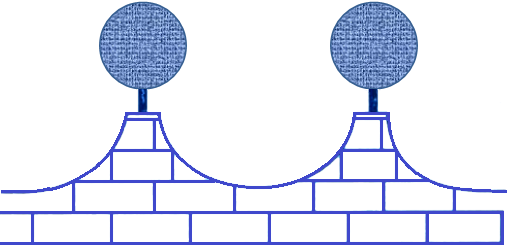
The front compound wall of a house is decorated by wooden spheres of diameter $21 \ cm $, placed on small supports as shown in the Fig. Eight such spheres are used for this purpose, and are to be painted silver. Each support is a cylinder of radius $1.5 \ cm$ and height $7 \ cm$ and is to be painted black. Find the cost of paint required if silver paint costs $25$ paise per $cm ^2$ and black paint costs $5$ paise per $cm ^2$
.
Answer
Wooden sphere radius $=\frac{21}{2}=10.5\text{cm}$
Surface area of a wooden sphere $=4\pi\text{r}^2=4\times\frac{22}{7}\times(10.5)^2=1386\text{cm}^2$
Radius $r$ of cylindrical support $= 1.5cm$
Height $h$ of cylindrical support $= 7cm$
Curved surface area of cylindrical support $=2\pi\text{rh}=2\times\frac{22}{7}\times1.5\times7=66\text{cm}^2$
Area of circular end of cylindrical support $=\pi\text{r}^2=\frac{22}{7}\times(1.5)^2=7.07\text{cm}^2$
Area to be painted silver $= 8(1386 - 7.07)cm^2 = 8(1378.93)cm^2 = 11031.44cm^2 $
Cost occurred in painting silver colour $= (11034.44 \times 0.25) = Rs. 2757.86$
Area to be painted black $= (8 \times 66)cm^2 = 528cm^2$​​​​​​​
Cost occurred in painting black colour $= (528 \times 5.05) = Rs. 26.40$
Therefore total cost in painting $= Rs.2757.86 + Rs. 26.40 = Rs. 2784.26$
View full question & answer
4 Marks Questions - Maths STD 9 Questions - Vidyadip