Questions

Assertion (A) & Reason (B) MCQ

🎯

Test yourself on this topic

16 questions · timed · auto-graded

MCQ 11 Mark
Statement-1 (A): In a $\triangle A B C$, if $\angle A=65^{\circ}$ and $\angle C=30^{\circ}$, then AC is the longest side of $\triangle A B C$.
Statement-2 (R) : Sum of the angles of a triangle is $180^{\circ}$.
  • A
    Statement-1 is true, Statement-2 is true; Statement-2 is a correct explanation for Statement-1.
  • Statement-1 is true, Statement-2 is true; Statement-2 is not a correct explanation for Statement-1.
  • C
    Statement-1 is true, Statement-2 is false.
  • D
    Statement-1 is false, Statement-2 is true.
Answer
Correct option: B.
Statement-1 is true, Statement-2 is true; Statement-2 is not a correct explanation for Statement-1.
(b)
We have, $\angle A=65^{\circ}$ and $\angle C=30^{\circ}$.
$\begin{array}{ll}\therefore & \angle A+\angle B+\angle C=180^{\circ} \Rightarrow 65^{\circ}+\angle B+\angle 30^{\circ}=180^{\circ} \Rightarrow \angle B=85^{\circ} \\
\text { Thus, } & \angle B>\angle A>\angle C \\
\Rightarrow & A C>B C>A B \quad \text { [In a triangle, side opposite to greater angle is greater] } \\
\Rightarrow & A C \text { is the longest side of } \triangle A B C\end{array}$
Thus, statement-1 is true.
Statement-2 is also true, but is not a correct explanation for statement-1. Hence, option (b) is correct.
View full question & answer
MCQ 21 Mark
Statement-1 (A): It is possible to construct a triangle with lengths of its sides as 8 cm, 7 cm and 4 cm .
Statement-2 (R): The sum of any two sides of a triangle is greater than the third side.
  • Statement-1 is true, Statement-2 is true; Statement-2 is a correct explanation for Statement-1.
  • B
    Statement-1 is true, Statement-2 is true; Statement-2 is not a correct explanation for Statement-1.
  • C
    Statement-1 is true, Statement-2 is false.
  • D
    Statement-1 is false, Statement-2 is true.
Answer
Correct option: A.
Statement-1 is true, Statement-2 is true; Statement-2 is a correct explanation for Statement-1.
(a)
Statement-2 is true. If possible, let ABC be a triangle such that AB = 8 cm, BC = 7 cm and AC = 4 cm. We find that these lengths satisfy $A B+B C>A C, B C+C A>A B$ and $A C+A B>B C$. Hence, it is possible to construct a triangle with lengths of its sides as 8 cm, 7 cm, and 4 cm . So, statement-1 is true. Also, statement-2 is a correct explanation for statement- 1 .
Hence, option (a) is correct.
View full question & answer
MCQ 31 Mark
Statement-1 (A): It is not possible to construct a triangle with lengths of its sides as 9 cm , 7 cm and 17 cm .
Statement-2 (R): The difference of any two sides of a triangles is less than the third side.
  • A
    Statement-1 is true, Statement-2 is true; Statement-2 is a correct explanation for Statement-1.
  • Statement-1 is true, Statement-2 is true; Statement-2 is not a correct explanation for Statement-1.
  • C
    Statement-1 is true, Statement-2 is false.
  • D
    Statement-1 is false, Statement-2 is true.
Answer
Correct option: B.
Statement-1 is true, Statement-2 is true; Statement-2 is not a correct explanation for Statement-1.
(b)
Statement-2 is true. If possible let ABC be a triangle such that AB = 9 cm, BC = 7 cm and AC = 17 cm. We find that $A B+B C \ngtr A C$. So, it is not possible to construct a triangle with lengths of its sides as 9 cm, 7 cm and 17 cm . Hence, statement -1 is true. Thus, both the statements are true but statement-2 is not a correct explanation for statement-1. Hence, option (b) is correct.
View full question & answer
MCQ 41 Mark
Statement-1 (A): In a $\triangle A B C$, the bisectors of $\angle B$ and $\angle C$ meet a point $O$ and the bisectors of ext $\angle B$ and ext $\angle C$ meet a point $O^{\prime}$. If $\angle B O C=135^{\circ}$, then $\angle B O^{\prime} C=45^{\circ}$
Statement-2 (R): In a $\triangle A B C$, if the bisectors of $\angle B$ and $\angle C$ meet at a point $O$ and the bisectors of ext $\angle B$ and ext $\angle C$ meet at a point $O^{\prime}$. Then, $\angle B O C$ and $\angle B O^{\prime} C$ are supplementary.
  • Statement-1 is true, Statement-2 is true; Statement-2 is a correct explanation for Statement-1.
  • B
    Statement-1 is true, Statement-2 is true; Statement-2 is not a correct explanation for Statement-1.
  • C
    Statement-1 is true, Statement-2 is false.
  • D
    Statement-1 is false, Statement-2 is true.
Answer
Correct option: A.
Statement-1 is true, Statement-2 is true; Statement-2 is a correct explanation for Statement-1.
(a)
Statement-2 is true. Using statement-2, we have,
$\angle B O C+\angle B O^{\prime} C=180^{\circ} \Rightarrow 135^{\circ}+\angle B O^{\prime}C=180^{\circ} \Rightarrow \angle B O^{\prime} C=45^{\circ}$
So, statement-1 is true and statement-2 is a correct explanation for statement-1.
Hence, option (a) is correct.
View full question & answer
MCQ 51 Mark
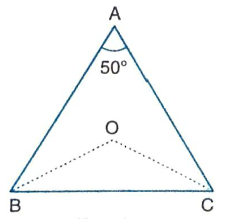
Statement-1 (A): In Fig., if the bisectors of angles $\angle B$ and $\angle C$ of $\triangle A B C$ meet at $O$, then $\angle B O C=140^{\circ}$
Statement-2 (R): If bisectors of angles $B$ and $C$ of a $\triangle A B C$ meet at $O$, then $\angle B O C=90^{\circ}+\frac{\angle A}{2}$
Image
  • A
    Statement-1 is true, Statement-2 is true; Statement-2 is a correct explanation for Statement-1.
  • B
    Statement-1 is true, Statement-2 is true; Statement-2 is not a correct explanation for Statement-1.
  • C
    Statement-1 is true, Statement-2 is false.
  • Statement-1 is false, Statement-2 is true.
Answer
Correct option: D.
Statement-1 is false, Statement-2 is true.
(d)
Statement-2 is true. Using statement-2, we obtain
$\angle B O C=90^{\circ}+\frac{1}{2} \times 50^{\circ}=115^{\circ}$
So, statement-1 is not true. Hence, option (d) is correct.
View full question & answer
MCQ 61 Mark
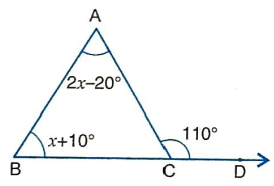
Statement-1 (A): In Fig., side BC of $\triangle A B C$ is produced to D. If $\angle A C D=110^{\circ}$, then $x=40^{\circ}$.
Statement-2 (R): If a side of a triangle is produced, the exterior angle so formed is equal to the sum of the two interior opposite angles.
Image
  • Statement-1 is true, Statement-2 is true; Statement-2 is a correct explanation for Statement-1.
  • B
    Statement-1 is true, Statement-2 is true; Statement-2 is not a correct explanation for Statement-1.
  • C
    Statement-1 is true, Statement-2 is false.
  • D
    Statement-1 is false, Statement-2 is true.
Answer
Correct option: A.
Statement-1 is true, Statement-2 is true; Statement-2 is a correct explanation for Statement-1.
(a)
Statement-2 is the Exterior angle theorem. So, it is true.
Using statement-2, we obtain
$2 x-20^{\circ}+x+10^{\circ}=110^{\circ} \Rightarrow 3 x=120^{\circ} \Rightarrow x=40^{\circ}
$
So, statement- 1 is also true. Also, statement- 2 is a correct explanation for statement-1 . Hence, option (a) is correct.
View full question & answer
MCQ 71 Mark
Statement-1 (A): If two sides and the included angle of one triangle are equal to the corresponding sides and the included angle of the other triangle, then the two triangles are congruent.
Statement-2 (R): If two sides and an angle of one triangle are equal to two sides and an angle of another triangle, then the two triangles are congruent.
  • A
    Statement-1 is true, Statement-2 is true; Statement-2 is a correct explanation for Statement-1.
  • B
    Statement-1 is true, Statement-2 is true; Statement-2 is not a correct explanation for Statement-1.
  • Statement-1 is true, Statement-2 is false.
  • D
    Statement-1 is false, Statement-2 is true.
Answer
Correct option: C.
Statement-1 is true, Statement-2 is false.
c
View full question & answer
MCQ 81 Mark
Statement-1 (A): If any two angles and a non-included side of one triangle are equal to the corresponding angles and side of the another triangle, then the two triangles are congruent.
Statement-2 (R): If two angles and a side of one triangle are equal to two angles and a side of another triangle, then the two triangles must be congruent.
  • A
    Statement-1 is true, Statement-2 is true; Statement-2 is a correct explanation for Statement-1.
  • B
    Statement-1 is true, Statement-2 is true; Statement-2 is not a correct explanation for Statement-1.
  • Statement-1 is true, Statement-2 is false.
  • D
    Statement-1 is false, Statement-2 is true.
Answer
Correct option: C.
Statement-1 is true, Statement-2 is false.
c
View full question & answer
MCQ 91 Mark
Statement-1 (A): If $\triangle A B C \cong \triangle R P Q$, then $B C=Q R$
Statement-2 (R): Corresponding parts of two congruent triangle are equal.
  • A
    Statement-1 is true, Statement-2 is true; Statement-2 is a correct explanation for Statement-1.
  • B
    Statement-1 is true, Statement-2 is true; Statement-2 is not a correct explanation for Statement-1.
  • C
    Statement-1 is true, Statement-2 is false.
  • Statement-1 is false, Statement-2 is true.
Answer
Correct option: D.
Statement-1 is false, Statement-2 is true.
d
View full question & answer
MCQ 101 Mark
Statement-1 (A): The sum of any two sides of a triangle is greater than the third side.
Statement-2 (R): It is possible to construct a triangle with lengths of its sides as 4 cm, 3 cm and 7 cm.
  • A
    Statement-1 is true, Statement-2 is true; Statement-2 is a correct explanation for Statement-1.
  • B
    Statement-1 is true, Statement-2 is true; Statement-2 is not a correct explanation for Statement-1.
  • Statement-1 is true, Statement-2 is false.
  • D
    Statement-1 is false, Statement-2 is true.
Answer
Correct option: C.
Statement-1 is true, Statement-2 is false.
c
View full question & answer
MCQ 111 Mark
Statement-1 (A): In an equilateral triangle ABC, if AD is the median, then AB + AC > 2 AD.
Statement-2 (R): In a right triangle, hypotenuse is the longest side.
  • A
    Statement-1 is true, Statement-2 is true; Statement-2 is a correct explanation for Statement-1.
  • Statement-1 is true, Statement-2 is true; Statement-2 is not a correct explanation for Statement-1.
  • C
    Statement-1 is true, Statement-2 is false.
  • D
    Statement-1 is false, Statement-2 is true.
Answer
Correct option: B.
Statement-1 is true, Statement-2 is true; Statement-2 is not a correct explanation for Statement-1.
b
View full question & answer
MCQ 121 Mark
Statement-1 (A): If AD is a median of $\triangle A B C$, then perimeter of $\triangle A B C$ is greater than 2 AD.
Statement-2 (R): The sum of any two sides of a triangle is greater than the third side.
  • Statement-1 is true, Statement-2 is true; Statement-2 is a correct explanation for Statement-1.
  • B
    Statement-1 is true, Statement-2 is true; Statement-2 is not a correct explanation for Statement-1.
  • C
    Statement-1 is true, Statement-2 is false.
  • D
    Statement-1 is false, Statement-2 is true.
Answer
Correct option: A.
Statement-1 is true, Statement-2 is true; Statement-2 is a correct explanation for Statement-1.
a
View full question & answer
MCQ 131 Mark
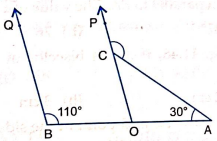
Statement-1 (A): In fig.  if $C P \| B Q$, then $\angle A C P=140^{\circ}$.
Image
Statement-2 (R): If two parallel lines are intersected by a transversal, then the corresponding angles are equal.
  • A
    Statement-1 is true, Statement-2 is true; Statement-2 is a correct explanation for Statement-1.
  • Statement-1 is true, Statement-2 is true; Statement-2 is not a correct explanation for Statement-1.
  • C
    Statement-1 is true, Statement-2 is false.
  • D
    Statement-1 is false, Statement-2 is true.
Answer
Correct option: B.
Statement-1 is true, Statement-2 is true; Statement-2 is not a correct explanation for Statement-1.
b
View full question & answer
MCQ 141 Mark
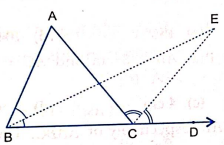
Statement-1 (A): In Fig. side $B C$ of $\triangle A B C$ is produced to a point $D$ such that the bisectors of $\angle A B C$ and $\angle A C D$ meet at a point $E$. If $\angle B A C=80^{\circ}$, then $\angle B E C=50^{\circ}$.
Image
Statement-2 (R): The angle between the internal bisector of one base angle and the external bisector of the other angle of a triangle is equal to one-half of the vertical angle.
  • A
    Statement-1 is true, Statement-2 is true; Statement-2 is a correct explanation for Statement-1.
  • B
    Statement-1 is true, Statement-2 is true; Statement-2 is not a correct explanation for Statement-1.
  • C
    Statement-1 is true, Statement-2 is false.
  • Statement-1 is false, Statement-2 is true.
Answer
Correct option: D.
Statement-1 is false, Statement-2 is true.
d
View full question & answer
MCQ 151 Mark
Statement-1 (A): In a $\triangle A B C$, sides $A B$ and $A C$ are produced to $P$ and $Q$ respectively. If the bisectors of $\angle P B C$ and $\angle Q C B$ intersect at O , then $\angle B O C$ is an acute angle.
Statement-2 (R): In a $\triangle A B C$, sides $A B$ and $A C$ are produced to $P$ and $Q$ respectively. If the bisectors of $\angle P B C$ and $\angle Q C B$ intersect at O , then $\angle B O C=90^{\circ}-\frac{A}{2}$.
  • Statement-1 is true, Statement-2 is true; Statement-2 is a correct explanation for Statement-1.
  • B
    Statement-1 is true, Statement-2 is true; Statement-2 is not a correct explanation for Statement-1.
  • C
    Statement-1 is true, Statement-2 is false.
  • D
    Statement-1 is false, Statement-2 is true.
Answer
Correct option: A.
Statement-1 is true, Statement-2 is true; Statement-2 is a correct explanation for Statement-1.
a
View full question & answer
MCQ 161 Mark
Statement-1 (A): In a $\triangle A B C$, if the bisectors of angles $\angle B$ and $\angle C$ meet at a point $O$, then $\angle B O C$ is always an obtuse angle.
Statement-2 (R): In a $\triangle A B C$, if the bisectors of angles $\angle B$ and $\angle C$ meet at a point O , then $\angle B O C=90^{\circ}+\frac{\angle A}{2}$.
  • Statement-1 is true, Statement-2 is true; Statement-2 is a correct explanation for Statement-1.
  • B
    Statement-1 is true, Statement-2 is true; Statement-2 is not a correct explanation for Statement-1.
  • C
    Statement-1 is true, Statement-2 is false.
  • D
    Statement-1 is false, Statement-2 is true.
Answer
Correct option: A.
Statement-1 is true, Statement-2 is true; Statement-2 is a correct explanation for Statement-1.
a
View full question & answer