Questions

case /data -based [Che-4M]

🎯

Test yourself on this topic

13 questions · timed · auto-graded

Question 14 Marks
Answer
self study
View full question & answer
Question 24 Marks
Answer
self study
View full question & answer
Question 34 Marks
Answer
self study
View full question & answer
Question 44 Marks
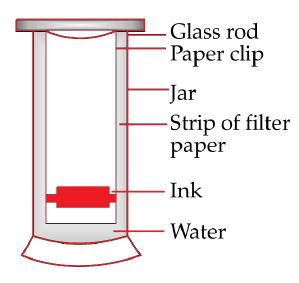
A child wanted to separate the mixture of dyes constituting a sample of ink. He marked a line by the ink on the filter paper and placed the filter paper in a glass containing water as shown in figure. The filter paper was removed when the water moved near the top of the filter paper.


(i) Identify the technique used by the child.

(a) Sedimentation(b) Filtration(c) Chromatography(d) Distillation

(ii) What would you expect to see, if the ink contains three different coloured components?
(a) We will not see any band on the filter paper.
(b) We would see three bands on the filter paper at various lengths.
(c) We would see infinite bands on the filter paper.
(d) We would see single band on the filter paper.


iii) Give one application where you can use this technique.
(a) To separate salt from sand
(b) To separate wheat from husk
(c) To separate oil from water
(d) To separate drugs from blood.


(iv) For the separation of what kind of substances is the above process used ?
(a) For the separation of insoluble substances
(b) For the separation of single solute that dissolves in single solvent.
(c) For the separation of those solutes that dissolve in the same solvent.
(d) For the separation of those solutes that dissolve in the different solvents.


(v) What is chromatography ?
(a) It is an agricultural method to separate grains
(b) A method to separate magnetic impurities from non-magnetic impurities
(c) The process of separating the suspended particles of an insoluble substance
(d) Method of separating and identifying various components in a mixture, which are present in small trace quantities.

Answer
(d) Method of separating and identifying various components in a mixture, which are present in small trace       quantities.

(c) For the separation of those solutes that dissolve in the same solvent.

(d) To separate drugs from blood.

(b) The components of the ink will travel with water and we would see three bands on the filter paper at             various lengths.

(c) Chromatography.

View full question & answer
Question 54 Marks
When the solid A is added to water, it dissolves with the evolution of a lot of heat and making little explosions to form two products B and C. The properties of products B and C are entirely different from those of solid A as well as water. Moreover, products B and C cannot be reconverted into solid A and water. When another solid D is added to water, it dissolves with the absorption of a little heat to form a product E which cools down. The product E shows the properties of both, solid D as well as water. Moreover, product E can be converted into solid D and water.
  1. What type of change occurs when solid A is dissolved in water? Why?
  2. What type of change occurs when sold D is dissolved in water? Why?
  3. Name a metal which you think could behave like solid A. Also name the products B and C.
  4. Name the solid D if it is the one which is used in making ordinary dry cells.
  5. Name the process by which D can be recovered from E.
Answer
  1. When solid A is dissolved in water, chemical change takes place. This is because the properties of products B and C are entirely different from those of solid A and water.
  2. Physical change occurs when solid D is dissolved in water. This is because product E shows the properties of both, solid D and water.
  3. Sodium metal could behave like solid A.
  • Product B is sodium hydroxide.
  • Product C is hydrogen.
  1. Solid D is ammonium chloride.
  2. D can be recovered from E by evaporation.
View full question & answer
Question 64 Marks
Tincture of iodine is a mixture of two materials X and Y. The material Y has a property that its solid form can be converted directly into vapours on heating by a process called Z.
  1. What could X be?
  2. What could Y be?
  3. Name the process Z.
  4. Which process would you use to recover both the components X and Y from tincture of iodine?
  5. Which process can be used to recover only component Y from tincture of iodine?
Answer
  1. Tincture iodine is a mixture of two materials X and Y. So, X is alcohol.
  2. The material Y has a property and its solid form can be converted directly into vapours on heating by the process called Z. So, Y is iodine.
  3. Process Z is called sublimation.
  4. Process used to recover both the components, i.e., alcohol and iodine, from the tincture of iodine is distillation.
  5. The process used to recover component Y only from the tincture of iodine is evaporation.
View full question & answer
Question 74 Marks
Three mixtures A, B and C are obtained by stirring three different solids in water taken in separate beakers. When mixture A is allowed to stand for some time, then its particles settle at the bottom of the beaker. When a beam of light is passed through mixture A in a dark room, the path of light becomes visible when observed from the side of the beaker. When mixture B is allowed to stand for a considerable time, even then its particles do not settle down. Mixture B, however, scatters the beam of light just like mixture A. The particles of mixture C do not settle down on keeping and it also does not scatter a beam of light passing through it.
  1. What are the mixtures like A known as?
  2. What are the mixtures like B known as?
  3. What are the mixtures like C known as?
  4. Name the phenomenon exhibited by A and B which occurs on passing a beam of light through them.
  5. Name one mixture each which is like (i) A (ii) B, and (iii) C.
Answer
  1. Mixtures like A are known as suspensions.
  2. Mixtures like B are known as colloids.
  3. Mixtures like C are known as true solutions.
  4. The phenomenon exhibited by A and B, which occur on passing a beam of light through them, is called Tyndall effect.
  5.  
  • Mud water mixture is like A.
  • Soap solution is a mixture like B.
  • Sugar solution is a mixture like C.
View full question & answer
Question 84 Marks
There are three liquids A, B and C, all having different densities and different boiling points. Liquids A and C are organic in nature whereas liquid B is considered to be inorganic. When liquids A and B are put together in a container, they form a single layer. On the other hand, when liquids B and C are mixed, they form two separate layers:
  1. Which process will you use to separate a mixture of A and B?
  2. Which method will you use to separate a mixture of B and C?
  3. Name the liquids which would behave like (i) a (ii) B and (iii) C.
Answer
  1. Liquid A is organic and liquid B is inorganic. When mixed, they form a single layer, i.e., they are miscible liquids. So, we will use fractional distillation to separate the mixture of liquid A and liquid B.
  2. Liquid B is inorganic and liquid C is organic. We will use a separating funnel to separate the mixture of liquid B and liquid C as they form two different layers.
  3.  
  1. Liquid A is organic. When liquid A and liquid B are put together in a container, they form a single layer. So, alcohol would behave like liquid A.
  2. Liquid B is inorganic. So, water would behave like liquid B.
  3. Liquid C is organic. When liquid B and liquid C are mixed together, they form two separate layers. Oil would behave like liquid C.
View full question & answer
Question 94 Marks
The liquid air has three components X, Y and Z whose boiling points are: -186°C, -183°C and -196°C, respectively. When liquid air is fed into a tall fractional distillation column from near its bottom and warmed up slowly:
  1. Which component will be collected from near the bottom of the fraction distillation column? Why?
  2. Which component will be collected from the top part of the fractional distillation column? Why?
  3. Which component will be collected from the middle part of the fractional distillation column? Why?
  4. What could the component X, Y and Z be?
Answer
  1. Y will be collected from the area near the bottom of the fractional distillation column because it has highest boiling point (-183°C).
  2. Z will be collected from the top part of the fractional distillation column because it has lowest boiling point (-196°C).
  3. X will be collected from the middle part of the fractional distillation column because it has a boiling point -186°C, which is lower than that of Y but higher than that of Z.
  4. X is liquid argon, Y is liquid oxygen, and Z is liquid nitrogen.
View full question & answer
Question 104 Marks
The given mixture contains three constituents A, B and C. The constituent A is a yellow coloured, solid element which dissolves in a liquid D. The constituents B is a blue coloured salt which is insoluble in liquid D but dissolves easily in another liquid E. The constitudent C is a liquid wlich is used in coolking food and forms a solid fat on hydrogenation.
  1. What do you think could (i) constituent A, and (ii) liquid D be?
  2. What could (i) constituent B, and (ii) liquid E be?
  3. What could liquid C be?
  4. How will you separate the mixture containing A, B and C.
Answer
  1.  
  1. Constituent A is yellow coloured solid element. It could be sulphur.
  2. Sulphur dissolves in liquid D. So, liquid D could be carbon disulphide.
  1.  
  1. Constituent B is a blue coloured salt, which is insoluble in carbon disulphide but dissolves in water. So, it could be copper sulphate.
  2. Liquid E could be water as it dissolves copper sulphate.
  1. Liquid C could be vegetable oil as it turns into a solid fat on hydrogenation.
  2. We will separate the mixture containing A, B, and C by following process:
  • At first, we filter the mixture of A, B, and C.
  • Vegetable oil C, being liquid, will be obtained as a filtrate.
  • Residue consists of A(sulphur) and B(copper sulphate).
  • We add water to the residue and shake it before filtering. A(sulphur) is obtained as residue.
  • Now, we evaporate filtrate to obtain B(copper sulphate).
View full question & answer
Question 114 Marks
Many indigestion mixtures are suspensions. What do the instructions written on the bottle of an indigestion mixture tell us before taking the mixture, and why?
Answer
The instruction written on the bottles of indigestion mixtures is “shake well before use”. This is because indigestion mixtures are suspensions. If they are left undisturbed, the particles of suspensions settle down. Therefore, it is instructed to shake the bottle before using it.
View full question & answer
Question 124 Marks
A solid mixture contains four constituents P, Q, R and S. P consists of tiny grains and it is mixed with cement for plastering the walls. Q is a white solid which is recovered on a large scale from sea water by the process of evaporation. R is in the form of tiny particles of a material whose corrosion is called rusting. And S is a white solid which is used in making ordinary dry cells.
  1. What could P, Q, R and S be?
  2. How would you separate a mixture containing P, Q, R and S?
Answer
  1. P consists of tiny grains and it is mixed with cement for plastering the walls. So, P is sand. Q is a white solid, which is recovered on a large scale from sea water by the process of evaporation. It is common salt. R is in the form of tiny particles of materials, whose corrosion is called rusting. It is, iron filings. S is ammonium chloride.
  2. At first, let us take the mixture of P, Q, R, and S.
  1. We first separate R(iron filings) by using a magnet to attract them. Then separate S(ammonium chloride) by sublimation.
  2. Now, we shake P(sand) and Q(common salt) with water. The mixture is then filtered.
  3. Sand is obtained as residue.
  4. Now, we will evaporate the filtrate to dryness to obtain Q(common salt).
View full question & answer
Question 134 Marks
100ml of water at room temperature of 25°C is taken in a beaker and a little of solid S is dissolved in it by stirring to obtain a solution X. More and more of solid S is added to the solution with constant stirring, while keeping the temperature of solution constant at 30°C. After some time it is observed that no more solid dissolves in water and at the same time some solid is also left undissolved at the bottom of the beaker. The contents of beaker are filtered through a filter paper to obtain solution Y in the form of a filtrate.
  1. What name is given to solutions like X?
  2. What name is given to solution like Y?
  3. What will you observe if the solution Y at 30°C is cooled down to 10°C by keeping the beaker in crushed ice? Why?
  4. What term is used to denote the amount of solid dissolved in 100 grams of water in a solution like Y?
Answer
  1. X type of solutions is known as unsaturated solution.
  2. Y type of solutions is known as saturated solution.
  3. If solution Y at 30°C is cooled down to 10°C by keeping the beaker in crushed ice, some of the dissolved parts of the solid will separate from the solution and will settle at the bottom of the beaker as crystals. This occurs because of the decrease in the solubility of solids and reduction in temperature.
  4. Solubility refers to the amount of a solid dissolved in 100 grams of water.
View full question & answer