Questions · Page 1 of 2

Do as directed; [Che-1 M]

🎯

Test yourself on this topic

50 questions · timed · auto-graded

Question 11 Mark
Write the relation between Kelvin scale and Celsius scale of temperature.
Answer
Temp. on Kelvin scale = Temp. on Celsius scale + 273
View full question & answer
Question 21 Mark
Write the full forms of the following:
LPG
Answer
LPG: Liquefied Petroleum Gas and Oxygen Gas respectively.
View full question & answer
Question 41 Mark
Why is solid carbon dioxide known as dry ice?
Answer
Since solid carbon dioxide directly changes into carbon dioxide gas (or sublimes), and does not melt to produce a liquid (like ordinary ice), it is called dry ice.
View full question & answer
Question 51 Mark
Why do gases diffuse very fast?
Answer
Gases diffuse very fast because the particles in gases move very quickly in all directions.
View full question & answer
Question 61 Mark
Which single term is used to describe the mixing of copper sulphate and water kept in a beaker, on its own?
Answer
Diffusion.
View full question & answer
Question 71 Mark
Which of the two diffuses slower: bromine vapour into air or copper sulphate into water?
Answer
Copper Sulphate into water.
View full question & answer
Question 91 Mark
When sugar is dissolved in water, there is no increase in the volume. Which characteristic of matter is illustrated by this observation?
Answer
The characteristic of matter illustrated by this observation is that the particles of matter have spaces between them.
View full question & answer
Question 101 Mark
When an incense stick (agarbatti) is lighted in one corner of a room, its fragrance spreads in the whole room quickly. Which characteristic of the particles of matter is illustrated by this observation?
Answer
This shows that the particles of matter are constantly moving in all direction.
View full question & answer
Question 111 Mark
When an incense stick (agarbatti) is lighted in one corner of a room, its fragrance quickly spreads in the entire room. Name the process involved in this.
Answer
Diffusion.
View full question & answer
Question 121 Mark
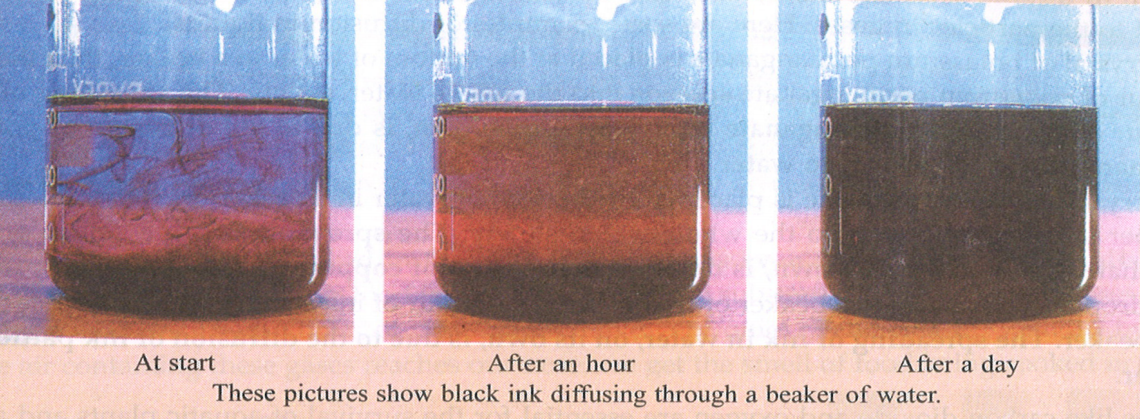
When a crystal of potassium permanganate is placed in a beaker, its purple colour spreads throughout the water. What does this observation tell us about the nature of potassium permanganate and water?
Answer
It shows that each potassium permanganate crystal is made up of millions of small particles and particles of water have spaces between them.
View full question & answer
Question 131 Mark
When a crystal of copper sulphate is placed at the bottom of a beaker containing water, the water slowly turns blue. Why?
Answer
The spreading of blue colour of copper sulphate into water, on its own, is due to the diffusion of copper sulphate particles into water.
View full question & answer
Question 141 Mark
What should be added to a Celsius scale reading so as to obtain the corresponding Kelvin scale reading?
Answer
273
View full question & answer
Question 191 Mark
What is the physical state of water:
at 100°C?
Answer
Either a liquid or a gas (steam) as 100°C is the boiling point of water as well as the condensation temperature of steam.
View full question & answer
Question 201 Mark
What is the physical state of water:
at 0°C?
Answer
Either solid (as ice) or liquid as 0°C is the melting point of ice as well as the freezing point of water.
View full question & answer
Question 221 Mark
What is the name of the process due to which dry ice changes into carbon dioxide gas?
Answer
Sublimation.
View full question & answer
Question 281 Mark
What is meant by saying that the latent heat of vaporization of water is 22.5 × 10⁵J/ kg?
Answer
It means that 22.5 × 10⁵J of heat is required to change 1Kg of water (at its boiling point, 100C) into steam at the same temperature of 100°C.
View full question & answer
Question 291 Mark
What is meant by saying that the latent heat of fusion of ice is 3.34 × 10⁵J/ kg?
Answer
It means that 3.34 × 10⁵J of heat has to be supplied to change 1Kg of ice (at its melting point, 0°C) into water at the same temperature of 0°C.
View full question & answer
Question 301 Mark
What do you understand by the term ‘latent heat’? What are the two types of latent heat?
Answer
The heat energy that has to applied to change the state of a substance is called ‘latent heat’.
They are of two types:
  1. Latent heat of fusion.
  2. Latent heat of vaporization.
View full question & answer
Question 311 Mark
What are the two ways in which the physical states of matter can be changed?
Answer
The physical states of matter can be changed by changing pressure and changing the temperature.
View full question & answer
Question 321 Mark
What are the conditions for 'something' to be called matter?
Answer
The condition for something to be called matter is that it should occupy space and have mass.
View full question & answer
Question 331 Mark
What are the characteristics of matter?
Answer
The characteristics of matter are:
  1. The particles of matter are very, very small.
  2. The particles of matter have spaces between them.
  3. The particles of matter are constantly moving.
  4. The particles of matter attract each other.
View full question & answer
Question 341 Mark
Under what conditions heat can be given to a substance without raising its temperature?
Answer
When a change of state of a substance has to take place the heat given would not raise the temperature.
View full question & answer
Question 351 Mark
The Kelvin temperature is 270K. What is the corresponding Celsius scale temperature?
Answer
270 - 273 = -3°C.
View full question & answer
Question 391 Mark
State one condition necessary to liquefy gases (other than applying high pressure).
Answer
Lowering temperature (or cooling).
View full question & answer
Question 431 Mark
Name two processes which provide the best evidence for the motion of particles in matter.
Answer
Diffusion and Brownian motion.
View full question & answer
Question 441 Mark
Name two gases which are supplied in compressed form in homes and hospitals.
Answer
LPG (Liquefied Petroleum Gas) and Oxygen Gas respectively.
View full question & answer
Question 471 Mark
Name the process by which a drop of ink spreads in a beaker of water.


Answer
Diffusion is the process by which a drop of ink spreads in a beaker containing water.
View full question & answer
Question 501 Mark
Name one property of liquids and gases which tells us that their molecules are moving constantly.
Answer
Diffusion.
View full question & answer
Do as directed; [Che-1 M] - Science STD 9 Questions - Vidyadip