Question types

Model Paper 1 question types

45 questions across 6 question groups — pick any mix to generate a Science paper with step-by-step answer keys.

45
Questions
6
Question groups
5
Question types
Sample Questions

Model Paper 1 questions

One sample from each question group in this chapter. Select any group above to see the full set with answer keys.

Q 1M.C.Q. [1 M]1 Mark
The enrichment of water bodies with nutrients leading to excessive growth of phytoplankton is known as:-
  • A
    Ammonification
  • B
    Nitrification
  • Eutrophication
  • D
    Phyto-enrichment

Answer: C.

View full solution
Q 2M.C.Q. [1 M]1 Mark
Select the correct statement(s).
i.A solution in which size of the solute particles is about 10-10 m, is called true solution.
ii.A solution which contains maximum possible amount of solute at any given temperature is called a saturated solution.
iii.In suspension, the size of particles is of the order of 107 m or larger
iv. A colloid is a heterogeneous system
  • I, II, III and IV
  • B
    I and II only
  • C
    III and IV only
  • D
    I, III and IV only

Answer: A.

View full solution
Q 3M.C.Q. [1 M]1 Mark
A change is said to be a physical change when
  • A
    No energy change occurs
  • All statements are correct
  • C
    The change can be easily reversed
  • D
    No new substances are formed

Answer: B.

View full solution
Q 4M.C.Q. [1 M]1 Mark
Plasmolysis in a plant cell is defined as
  • A
    shrinkage of nucleoplasm
  • shrinkage of cytoplasm in hypertonic medium
  • C
    break down (lysis) of plasma membrane in hypotonic medium
  • D
    shrinkage of nucleolus

Answer: B.

View full solution
Q 5M.C.Q. [1 M]1 Mark
To prepare a mount of human cheek cell, the sample is collected from:
  • A
    outer side of cheek with a blade
  • inner side of cheek with a toothpick
  • C
    inner side of cheek with a blade
  • D
    outer side of cheek with a toothpick

Answer: B.

View full solution
Assertion (A): Atom is electrically neutral.
Reason (R): A neutral particle, neutron is present in the nucleus of atom.
  • A
    Both A and R are true and R is the correct explanation of A
  • Both A and R are true but R is not the correct explanation of A.
  • C
    A is true but R is false.
  • D
    A is false but R is true

Answer: B.

View full solution
Assertion (A): Vessel and sieve tubes both are meant for transport purposes.
Reason (R): Vessels are lignified.
  • A
    Both A and R are true and R is the correct explanation of A.
  • Both A and R are true but R is not the correct explanation of A
  • C
    A is true but R is false.
  • D
    A is false but R is true.

Answer: B.

View full solution
Assertion (A): Solids do not diffuse in air.
Reason (R): The particles are closely packed in solids.
  • Both A and R are true and R is the correct explanation of A.
  • B
    Both A and R are true but R is not the correct explanation of A
  • C
    A is true but R is false
  • D
    A is false but R is true

Answer: A.

View full solution
Assertion (A): A boy is enjoying a ride on a merry-go-round which is moving at a constant speed of 10 m/s. The boy is in uniform accelerated motion.
Reason (R): A body has a uniform acceleration if it travels in a straight line and its velocity first decreases then increases by equal amounts in equal intervals of time.
  • A
    Both A and R are true and R is the correct explanation of A
  • B
    Both A and R are true but R is not the correct explanation of A
  • A is true but R is false.
  • D
    A is false but R is true

Answer: C.

View full solution
A stone of $1 \ kg$ is thrown with a velocity of $20\ ms$ across the frozen surface of the lake and comes to rest after travelling a distance of $50 m$. What is the force of friction between the stone and the ice?
View full solution
Give reason for the following:
i. Road accidents occurring due to high speeds are much worse than accidents due to low speeds of vehicles.
ii. When a motorcar makes a sharp turn at a high-speed, passenger tends to get thrown to one side.
View full solution
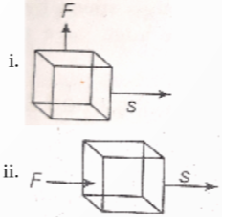
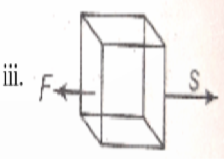
In each of the following, a force F is acting on an object of mass m. The direction of displacement is from West [ to east shown by the longer arrow. Observe the figure carefully and state whether the work done by the force is negative, positive or zero.
Image
Image
View full solution
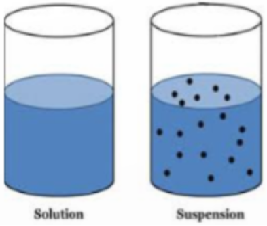
i. Distinguish among the true solution, suspension and colloid in a tabular form under the following heads:
a. Stability
b. Filterability
c. Type of mixture
ii. Give the expression for the concentration of a solution. How will you prepare a 10% solution of glucose by mass in the water?
View full solution
i. Describe the role played by the lysosomes. Why are they termed as suicidal bags? How do they perform their function?
ii. What happens to the dry raisins, when placed in plain water for some time? State the reason for whatever is observed. What would happen if these raisins are then placed in concentrated salt solution?
View full solution
$i.$ A person weighs $110.84 N$ on the moon, whose acceleration due to gravity is $1/6$ of that the earth. If the value of g on the earth is $9.8 m/s^2,$ then calculate
$a. g$ on the moon
$b.$ mass of person on the moon
$c.$ weight of person on the earth
$ii.$ How does the value of g on the earth is related to the mass of the earth and its radius? Derive it.
View full solution
$i$. At some moment, two giant planets Jupiter and Saturn of the solar system are in the same line as seen from the earth. Find the total gravitational force due to them on a person of mass $50 \ kg$ on the earth. Could the force due to the planets be important?
Mass of the Jupiter $= 2 x \ 1027 \ kg$
Mass of the Saturn $= 6 x \ 1026 \ kg$
The distance of Jupiter from the earth $= 6.3 x \ 10 \ m$
The distance of Saturn from the earth $= 1.28 x \ 1012 \ m$
$ii$. A bag of sugar weighs $'w\ '$ at a certain place on the equator. If this bag is taken to Antarctica, then will it weigh the same or more or less. Give a reason for your answer.
View full solution
View full solution
View full solution
Read the following text carefully and answer the questions that follow:
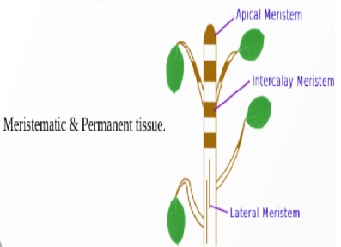
The tissue is a group of cells having similar origin, structure\& function. Study of tissues is called Histology. In unicellular organism (Amoeba) single cell performs all basic functions, whereas in multi-cellular organisms (Plants and Animals) shows division of labour as Plant tissue \& Animal tissues. Plant tissues are two types:
Image
Meristematic tissue:
The meristems are the tissues having the power of cell division. It is found on that region of the plant which grows.
Following are the types of Meristems:
The Apical meristems- It is present at the growing tip of the stem and roots and increases the length.
The lateral meristems- It present at the lateral side of stem and root (cambium) and increases the girth.
The intercalary meristems- It present at internodes or base of the leaves and increases the length between the nodes.
i. Which tissue help in the secondary growth of the plant?
ii. In what region of the plant does intercalary meristematic growth occur?
iil. Where does meristematic tissue mostly found in a plant?
View full solution

Generate a Model Paper 1 paper free

Pick question groups from the list above, set marks and difficulty, and export a branded PDF with step-by-step answer keys. First 3 chapters free — no signup.
Download App