Questions

Que-Ans (Each of 3 Mark )

🎯

Test yourself on this topic

9 questions · timed · auto-graded

Question 13 Marks
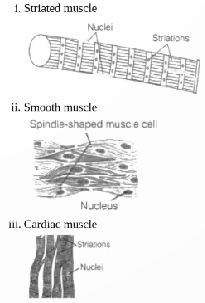
Differentiate between various types of muscular tissues. Draw appropriate diagrams.
View full question & answer
Question 23 Marks
Who discovered cells, and how?
Answer
In 1665, an English scientist named Robert Hooke discovered cells. He saw honey comb like structure while observing thin slice of cork under his self-designed microscope.
View full question & answer
Question 33 Marks
There would be no plant life if chloroplasts did not exist. Justify.
Answer
Chloroplasts contain the pigment chlorophyll which is responsible for food preparation in plants by the process of photosynthesis Hence, if there were no chloroplasts then there would not have been any plant life.
View full question & answer
Question 43 Marks
i. Explain, why is it difficult to walk on sand?
ii. Why is the recoil of a heavy gun, on firing, not so strong as that of a light gun using the same cartridge?
Answer
i. While walking on sand, the sand gets pressed down, impacting less reaction force on the person.
ii. The mass of the heavy gun is higher. So, its recoil velocity is less.
View full question & answer
Question 53 Marks
A test tube loaded with lead shots weighs 50 gf and floats upto the mark 'X' in water. The test tube is then made to float alcohol. It is found that 10 gf of lead shots have to be removed, so as to float it to level 'X'. Find RD of alcohol.
Answer
Weight of water displaced $=50 gf$
Weight of alcohol displaced $=(50-10) gf =40 gf$
As volume of water displaced $=$ Volume of alcohol displaced
RD of alcohol $=\frac{\text { weight of alcohol displaced }}{\text { weight of equal volume of water displaced }}=\frac{40}{50}$
View full question & answer
Question 63 Marks
Starting from a stationary position, Rahul paddles his bicycle to attain a velocity of $6 ms^1$ in $30 s$. Then he applies brakes such that the velocity of the bicycle comes down to $4 ms^1$ in the next $5 s$. Calculate the acceleration of the bicycle in both cases.
Answer
In the first case:
Since body starts from stationary position,
$\therefore$ Initial velocity, $u =0$
final velocity, $v=6 ms^{-1}$
time, $t =30 s$
$a=\frac{v-u}{t}$
Substituting the given values of $u , v$, and t in the above equation. we get
$a=\frac{\left(6 m s^{-1}-0 m s^{-3}\right)}{30 s}$
$=0.2 ms^2$
In the second case:
initial velocity, $u =6 ms^{-1}$
time, $t =5 s$
Then. $a=\frac{\left(4 ms^{-2}-6 m s ^{-2}\right)}{5 s}$
$=-0.4 ms^{-2}$
The acceleration of the bicycle in the first case is $0.2 ms^{-2}$ and in the second case, it is $-0.4 ms^{-2}$
View full question & answer
Question 73 Marks
The average time taken by a normal person to react to an emergency is one fifteenth of a second and is called the 'reaction time'. If a bus is moving with a velocity of 60 kmh¹ and its driver sees a child running across the road, how much distance would the bus had moved before he could press the brakes? The reaction time of the people increases when they are intoxicated. How much distance had the bus moved if the reaction time of the driver were 1/2 s under the influence of alcohol?
Answer
Given speed of the bus $=60 kmh ^{-1}=\frac{5}{15} \times 60=16.7 ms^{-1}$
Time of reaction $=\frac{1}{15} s$
Time of reaction under the influence of alcohol $=\frac{1}{2} s$
i) Distance travelled by the bus in the first case distance $=$ Speed $\times$ time $=16.7 \times \frac{1}{15}=1.11 m$
ii) Distance travelled by the bus in the second case distance $=$ Speed $\times$ time $=16.7 \times \frac{1}{2}=8.35 m$
View full question & answer
Question 83 Marks
Compare the properties of electrons, protons and neutrons.
Answer
ProtonNeutronElectron
(i) It is positively-charged sub-atomic particle.(i) It is neutral sub-atomic particle.(i) It is negatively-charged sub-atomic particle.
(ii) Its mass is equivalent to a hydrogen atom i.e. 1 a.m.u(ii) It mass is equal to the mass of a proton.(ii) Its mass is 1/1838 of the mass of a proton.
(iii) It is present inside the nucleus of an atom.(iii) It is also found inside the atomic nucleus.(iii) It is found outside the nucleus of an atom.
View full question & answer
Question 93 Marks
$i$. Sound is produced when your school bell is struck with a hammer. Why?
$ii.$ A powerful sound signal sent from a ship is received again after $4.8$ seconds. How deep is the ocean bottom? $($Speed of sound in water $= 1500 m/s).$
Answer
$i.$ Sound is produced when a material body is made to vibrate with some mechanical energy.
So, school bell is struck with a hammer to make it vibrate and thus the sound is produced.
$ii.$ The time taken by the signal to reach the bottom and come back is $4.8 s$
Speed of sound in water $=1500 m / s$
Depth of the ocean $h$
$h=\frac{vxt}{2}$
$h=\frac{1500 \times 4.8}{2}$
$h=1500 \times 2.4$
$h=3600 m$
View full question & answer