Questions

M.C.Q. [1 M]

Take a timed test

16 questions · auto-graded multiple-choice test.

MCQ 11 Mark
Which of the following type of irrigation system is used in areas closer to rivers?
  • A
    Dug wells
  • B
    Tanks
  • River lift
  • D
    Canals
Answer
Correct option: C.
River lift
(c) River lift
Explanation: When it is not possible to supply enough water through a normal canal system, then a river lift system is utilized
to ensure a steady supply. This can happen in areas with uneven topography, or in areas which are far from a water reservoir.
View full question & answer
MCQ 21 Mark
Which one is a physical change?
  • A
    Mixing $BaSO_4 + NaCl$
  • B
    Mixing $\text{NH3}$ and $\text{HCI}$
  • C
    Burning magnesium in air
  • Adding $\text{NaCl}$ to water
Answer
Correct option: D.
Adding $\text{NaCl}$ to water
Adding of common salt $\text{(NaCl)}$ to water is physical change as no new substance is formed and no heat is evolved during the addition of salt in water. Also, salt can be obtained by evaporation.
View full question & answer
MCQ 31 Mark
A food sample turned blue-black after addition of a few drops of iodine solution. This sample contains:
  • starch
  • B
    fat
  • C
    protein
  • D
    glucose
Answer
Correct option: A.
starch
(a) starch
Explanation: Many different food groups contain a carbohydrate known as starch. Using an iodine solution, you can test for
the presence of starch. When starch is present, the iodine changes from brown to blue-black or purple.
View full question & answer
MCQ 41 Mark
The only cell organelle seen in prokaryotic cell is
  • ribosomes
  • B
    mitochondria
  • C
    lysosomes
  • D
    plastids
Answer
Correct option: A.
ribosomes
(a) ribosomes
Explanation: Unlike eukaryotic cell, a prokaryotic cell lacks membrane-bound organelles like plastids, mitochondria and endoplasmic reticulum but smaller and randomly scattered ribosomes are seen.

View full question & answer
MCQ 51 Mark
Chlorenchyma and serenchyma are modified/specialised
  • A
    phloem
  • parenchyma
  • C
    sclerenchyma
  • D
    collenchyma
Answer
Correct option: B.
parenchyma
(b) parenchyma
Explanation: Parenchyma cells containing chloroplasts are collectively termed as chlorenchyma. Special parenchyma tissue is
found in the aquatic plants and some land plants (e.g., petiole of Banana, Canna). It is known as aerenchyma. It consists of a network of parenchyma cells that enclose very large air cavities.
View full question & answer
MCQ 61 Mark
Elements with valency 1 are
  • A
    always non-metals
  • either metals or non-metals
  • C
    always metalloids
  • D
    always metals
Answer
Correct option: B.
either metals or non-metals
(b) either metals or non-metals
Explanation: Elements with valency 1 are easily loss or gain electron. So, elements with valency 1 are either metals or nonmetals. For example hydrogen is nonmetal and Lithium is metal both having valency 1.
View full question & answer
MCQ 71 Mark
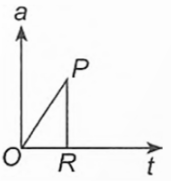
What would you conclude about the variation in velocity of a cyclist from the given graph?
Image
  • A
    Velocity changes linearly if acceleration is changing non$-$linearly.
  • Velocity changes non$-$linearly if acceleration is changing linearly.
  • C
    Velocity becomes uniform if acceleration becomes infinite
  • D
    Velocity becomes zero if acceleration becomes zero.
Answer
Correct option: B.
Velocity changes non$-$linearly if acceleration is changing linearly.
For the given graph, $\text{a} = \text{kt}$, where k is some positive constant.
So, velocity$ v = u + at = u + (kt)t = 4 + kt^2$ i.e., varies non$-$linearly.
View full question & answer
MCQ 81 Mark
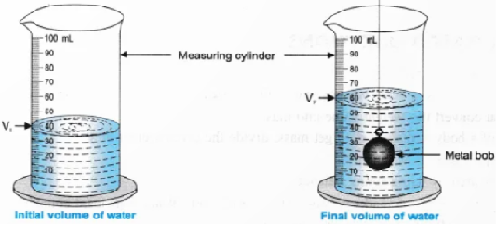
The water level in a measuring cylinder, before and after immersing a metal cube in it, is shown in the figure.
The volume of the metal cube is:
Image
  • A
    $18 \ cm^3$
  • B
    $24 \ cm^3$
  • $20 \ cm^3$
  • D
    $22 \ cm^3$
Answer
Correct option: C.
$20 \ cm^3$
$60 – 40 = 20 \ cm^3$
View full question & answer
MCQ 91 Mark
Survival of plants in terrestrial environment has been made possible by the presence of
  • conducting tissue
  • B
    apical meristem
  • C
    parenchymatos tissue
  • D
    intercalary meristem
Answer
Correct option: A.
conducting tissue
(a) conducting tissue
Explanation: The conducting tissues in plants conduct different saps and have different structures. The primary conducting
tissues of plants are xylem and phloem. Xylem conducts water from roots to the other parts of the plant, whereas phloem transports food and other material from the leaves to other parts of plants.

View full question & answer
MCQ 101 Mark
A sample of $CaCO _3$ contains $3.01 \times 10^{23}$ ions of $Ca ^{-2}$ and $CO _3^{-2}$. The mass of the sample is:
  • A
    200 g
  • 50 g
  • C
    100 g
  • D
    5g
Answer
Correct option: B.
50 g
(b) 50 g
Explanation: The mass of one mole of $CaCO _3$ is equal to $100 g .6 .022 \times 10^{23}$ ions are equivalent to one mole. Therefore, mass of $3.01 \times 10^{23}$ ions will be equivalent to $\left(\frac{100}{2}\right) g$ or 50 g .
View full question & answer
MCQ 111 Mark
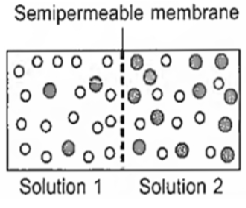
Study the given figure carefully. In which direction the net movement of water will take place?
Image
  • From solution 1 to solution 2
  • B
    Both From solution 1 to solution 2 and From solution 2 to solution 1
  • C
    From solution 2 to solution 1
  • D
    No movement will take place
Answer
Correct option: A.
From solution 1 to solution 2
(a) From solution 1 to solution 2
Explanation: The movement of water from a region of its higher concentration to a region of its lower concentration through a
semi-permeable membrane is called osmosis. Since, concentration of water is high in solution 1, therefore, water will move from solution 1 to solution 2 by the process of osmosis.

View full question & answer
MCQ 121 Mark
Select the incorrect differences between collenchyma and scierenchyma.
Original length of strip (mm)Final length of strip (mm)
(i)It is made up of dead cells.Its cells are living
(ii)Lumen or cell cavity is wide.Lumen or cell cavity is usually narrow.
(iii)It provides hardness to the region where it occurs.It keeps the organ soft.
(iv)Wall thickening is not uniform.Wall thickening is uniform.
(v)Pits are simple and straight.Pits are simple, oblique and may be branched.
  • A
    (i) and (iv) only
  • (i) and (iii) only
  • C
    (ii), (iv) and (v) only
  • D
    (i), (iii) and (iv) only
Answer
Correct option: B.
(i) and (iii) only
(b) (i) and (iii) only
Explanation: In plants, collenchyma is a permanent living tissue of primary body. It provides flexibility to soft aerial parts like
leaves, young stem of plant so that they can bend without breaking. Sclerenchyma consists of thick-walled, dead cells. It
provides hardness to the region where it occurs.

View full question & answer
MCQ 131 Mark
Gundhy bug is a pest of…………………….
  • A
    Groundnut
  • B
    Wheat
  • Rice
  • D
    Mustard
Answer
Correct option: C.
Rice
(c) Rice
Explanation: Gundhi bugs are also called stink bugs as a characteristic foul odor is produced by scent glands present on the
abdomen. These stink bugs are distributed in all the tropical and sub-tropical regions. In India, it is used as a pest of all ricegrowing areas.
View full question & answer
MCQ 141 Mark
A particle is moving in a straight line with initial velocity $u$ and uniform acceleration a. If the sum of the distances travelled in $t^{\text {th }}$ and $(t+1)^{\text {th }}$ seconds is $100\ cm , $then its velocity after $t$ seconds in $cm s ^{-1}$ is
  • $50$
  • B
    $80$
  • C
    $30$
  • D
    $20$
Answer
Correct option: A.
$50$
Distance travelled in $t ^{\text {th }}$ second of uniformly accelerated motion is $S_{t}=u+\frac{a}{2}(2 t-1) \ldots(i)$
Distance travelled in $(t+1)^{\text {th }}$ second can be written as $S_{t+1}=u+\frac{a}{2}[2(t+1)-1]$
$\text { or } S_{t+1}=u+\frac{a}{2}(2 t+1) \ldots \text { (ii) }$
$s_{t}+s_{t+1}=100 \ cm($ given $)$
$u+\frac{a}{2}(2 t-1)+u+\frac{a}{2}(2 t+1)=100[$ Using $(i)$ and $(ii)]$
or $2 u+2 at=100$ or $u+at=50$
$\therefore v=50 \ cms^{-1}$
 
View full question & answer
MCQ 151 Mark
Four strips are cut from a fresh potato. The length of each strip is measured. One strip is placed in water and others in different concentrations of sugar solution. After an hour, the strips were measured again. The results are shown in the table. Which of the liquids P, Q, R and S is water?
LiquidOriginal length of strip (mm)Final length of strip (mm)
P7578
Q7880
R8280
S8685
  • Q
  • B
    S
  • C
    P
  • D
    R
Answer
Correct option: A.
Q
(a) Q
Explanation: Sugar solution is hypertonic to cell sap of potato, whereas water acts as a hypotonic solution to it. When the
potato strip is placed in water, its cells will gain water by osmosis, resulting in increase in size of potato strip. When the potato
strips are put in sugar solution of different concentrations, the cells will lose water resulting in decrease in the size of strip. As
only potato strip placed in liquid ‘Q’ shows increase in length, this shows that liquid ‘Q’ is water.

View full question & answer
MCQ 161 Mark
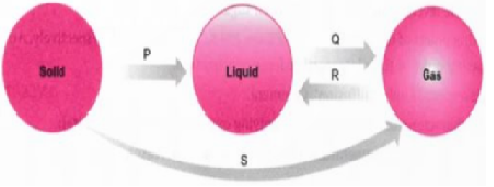
Which of the changes is/are exothermi
Image
  • A
    P,Q,S
  • R
  • C
    P, S
  • D
    S
Answer
Correct option: B.
R
(b) R
Explanation: Changes of state are examples of phase changes or phase transitions. All phase changes are accompanied by
changes in the energy of a system. The energy change in the phase transitions can be explained as follows:
Phase Change NamePhaseEnergy Change Example
Freezing Liquid to solidExothermicFreezing water
Melting (P) Solid to liquidEndothermicIce melting
Condensation (R)Gas to liquidExothermicWater vapour burns
Evaporation (Q)Liquid to gasEndothermicBoiling water
Sublimation (S)Solid to gasEndothermicDry ice
DepositionGas to solidExothermicFormation of frost
View full question & answer
M.C.Q. [1 M] - Science STD 9 Questions - Vidyadip