Questions

Que-Ans (Each of 2 Mark )

🎯

Test yourself on this topic

8 questions · timed · auto-graded

Question 12 Marks
What is the difference between cathode rays and canal rays. Why are canal rays called so?
Answer
Sr.NoCathod raysCanal rays
1Cathode rays are those which contain negative ions and are negatively charged.These negative ions are called electrons.Canal rays or positive rays are those which contain positive ions and are positively charged. These positive ions are called protons.
2For cathode rays, the value of e/m ratio of constituent particles does not depend upon nature of gas in the discharge tube.e/m ratio of constituent
particles depend upon nature.
3But magnitude of charge in cathode rays is always.Magnitude of charge in canal rays is +1, but also +2,$+3, \ldots .$.
Canal rays are also known as cathode rays because all the rays move towards the positive side which known as anode and it is because of this it is also known as anode rays
View full question & answer
Question 22 Marks
A bullet of mass $5 g$ travelling at a speed of $120 ms^{-1}$ penetrates deeply into the fixed target and is brought to rest in $0.01 s.$Calculate: $(a)$ the distance of penetration in the target, $(b)$ the average force exerted on the bullet.
Answer
$m=5 g=5 \times 10^{-3} \ kg u=120 ms^{-1}, v=0, t=0.01 s$
$a.$ From the relation $v = u +$ at
We have $0=120+a \times 0.01$
or $a =-\frac{120}{0.01}=-12000 ms^{-2} ($the negative sign here shows retardation$)$
Distance of penetration in the target
$S=ut+\frac{1}{2} at^2 \text { we have }$
$S=120 \times 0.01+\frac{1}{2} \times(-12000) \times(0.01)^2=0.6 m$
b. Average retarding force $F=m a=\left(5 \times 10^{-3}\right) \times(12000)=60 N$
View full question & answer
Question 32 Marks
An automobile vehicle has a mass of 1500 kg . What must be the force between the vehicle and road if the vehicle is to be stopped with a negative acceleration of $1.7 ms^{-2}$ ?
Answer
Here,
Mass of the automobile, $m =1,500 kg$
Negative acceleration, $a =-1.7 ms^{-2}$
Force needed to stop the vehicle, $F =$ ?
Using the relation, $F - ma$
$
=1500 kg \times\left(-1.7 ms^{-2}\right)=-2,550 kg ms^{-2}=-2550 N
$
The negative value of the force indicates that it is acting in the direction opposite to the direction of motion.So,the retarding force needed to stop the vehicle is 2550 N .
View full question & answer
Question 42 Marks
What is happen when solid ammonium chloride is heated?
Answer
It will directly change to the vapour state without passing through the liquid state. The process is known as sublimation.
View full question & answer
Question 52 Marks
What do you understand by loud and soft sound?
Answer
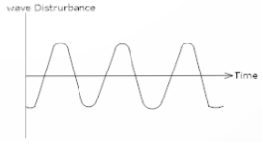
Louder sound: - Sound which has a higher amplitude and high energy are called louder sound.
Image
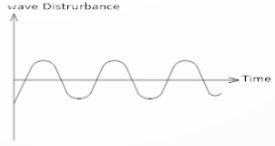
Softer sound: - Sound which has lesser amplitude and less energy are called soft sound.
Image
View full question & answer
Question 62 Marks
What is evaporation? What are the factors affecting it?
Answer
Evaporation is the process by which water (liquid) changes to vapours (gaseous form) at any temperature below its boiling point.
Factors on which evaporation depends:-
(a) Surface area
(b) Humidity
(c) Wind speed
(d) Temperature
View full question & answer
Question 72 Marks
The speed of a vehicle of mass $500 \ kg$ increases from $36 \ km/h$ to $72 \ km/h$. Calculate the increase in its kinetic energy.
Answer
Given mass, $m =500 \ kg$
The given unit of speed is $km / h$. It is to be converted into $m / s$.
$=1 \ km / h$
$=\frac{1 \times 1000 metrc}{3600 \text { second }}$
$=\frac{5}{18} m / s$
Initial speed, $u =36 \ km / h$
$=36 \times \frac{5}{18} m / s$
$=10 m / s$
Final speed $= v =72 \ km / h$
$=72 \times \frac{5}{18} m / s$
$=20 m / s$
$\text { Gain in KE }=\text { Final KE - Initial KE }$
$=\frac{1}{2} m v^2-\frac{1}{2} m u^2$
$=\frac{1}{2} m \times\left(v^2-u^2\right)$
$=\frac{1}{2} \times 500 \times\left[(20)^2-(10)^2\right]$
$=\frac{1}{2} \times 500 \times[400-100]$
$=\frac{1}{2} \times 500 \times 300$
$=75000 \text { joule }$
$=7.5 \times 10^4 J$
View full question & answer
Question 82 Marks
The weight of a person on a planet A is about half of that on the Earth. He can jump up to 0.4 m high on the Earth. How high can he jump on planet A?
Answer
Let, Potential energy of a person on Earth $=$ mg $_1 h_1$
Potential energy of same person on planet 'A' = mg $m _2$
Since, The potential energy of the person will remain the same on the Earth and on planet $A$.
Therefore, $mg _1 h_1= mg _2 h_2$
Since mass remains same, So, if $g _1= g$, then $g _2=\frac{1}{2} g$
Here, $h _1=0.4 ;$ Now h $_2=\frac{g_1 h_1}{g_2}=\frac{g \times 0.4}{g_2}$
or $h _2=0.4 \times 2=0.8 m$.
Therefore, he can jump on plant $\Lambda=0.8 m$
View full question & answer
Que-Ans (Each of 2 Mark ) - Science STD 9 Questions - Vidyadip