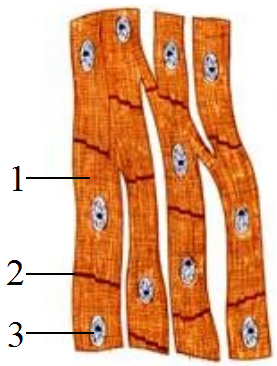
Question 512 Marks
Name two lateral meristems which help in secondary growth of stem and root.
Answer
View full question & answer→Cork cambium and vascular cambium help in secondary growth of stem and root.
Name two lateral meristems which help in secondary growth of stem and root.
Cork cambium and vascular cambium help in secondary growth of stem and root.
Name the type of muscles that accomplish peristalsis.
Smooth muscles are found in alimentary canal and accomplish peristalsis movement.
Name the protein is found in white fibre and yellow fibre.
White fibre: collagen protein.
Yellow fibre: elastin protein.
Name the plant tissue found in the husk of coconut and also identify the chemical which is responsible for its stiffness.
Plant tissue in husk of coconut is sclerenchvma fibres.
Reason for stiffness of scrererrchyma is deposition of iig'in in cell walls of its cells.
Name the living components common to both the complex permanent tissues found in plants. What is its function?
Parenchyma is the common living component of two complex permanent tissues, xylem and phloem.
Xylem parenchyma store food and helps in later conduction of water.
Phloem parenchyma store food, latex, resins, etc.
Name the leucocytes that increase in number during worm infestations.
Eosinophils increases during worm infection.
Name the following:
Name the following:
Name the following:
Name the different types of elements found in the xylem.
Xylem is composed of cells of four different types:
Except xylem parenchyma, all other xylem elements are dead and bounded by thick lignified walls. Vessels are shorter and wider than tracheids. Vessels are very long tube-like structures formed by a row of cells placed end to end. Tracheids are elongated cells with tapering ends. They also conduct water.
Name the complex tissue which helps in:
How many types of muscles occur in animals?
Three types of muscles occur in animals namely striated muscles, smooth muscles and cardiac muscles.
Give two examples of cartilage.
Cartilage is present at the tip of nose and in the external ear.
Give one example each of:
Explain how sieve tubes manage to be living?
Sieve tube elements do not have nuclei but have cytoplasm. They are dependent on adjacent companion cells which contains dense and very active cytoplasm and a large elongated nucleus.
Explain different types of elements present in phloem.
The different types of elements present in the phloem are:
Sieve tubes: Sieve tubes are slender, tube-like structures composed of elongated thin-walled cells, placed end to end. Their end walls are perforated by numerous pores and are called sieve plates.
Companion cells: It is a small thin-walled cell containing dense and very active cytoplasm and large elongated nucleus.
Phloem parenchyma: These are thin-walled, living cells of parenchyma of phloem. They have two functions, storage and slow lateral conduction of food.
Phloem Fibre: These are thick-walled, elongated spindled shaped dead cells which posses narrow lumen. They provide mechanical strength to the tissue.
Enumerate various cells of connective tissue.
The various cells of connective tissue are fibroblasts, adipose cells, macrophages, mast cells and lymphocytes.
Enumerate protein fibres of connective tissue.
The protein fibres of connective tissue are white fibres of collagen, yellow fibres of elastin and reticular fibres of reticulin.
Enumerate four main types of animal tissues.
Four main types of animal tissues are:
Draw a well labelled diagram of parenchyma and collenchymas.
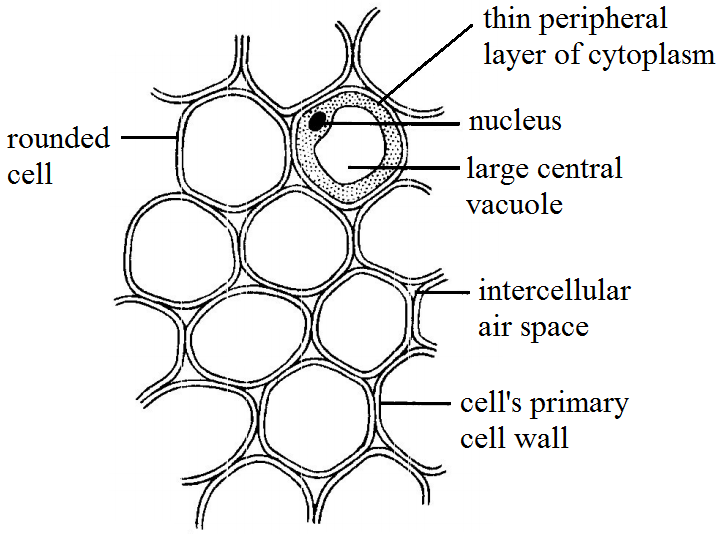
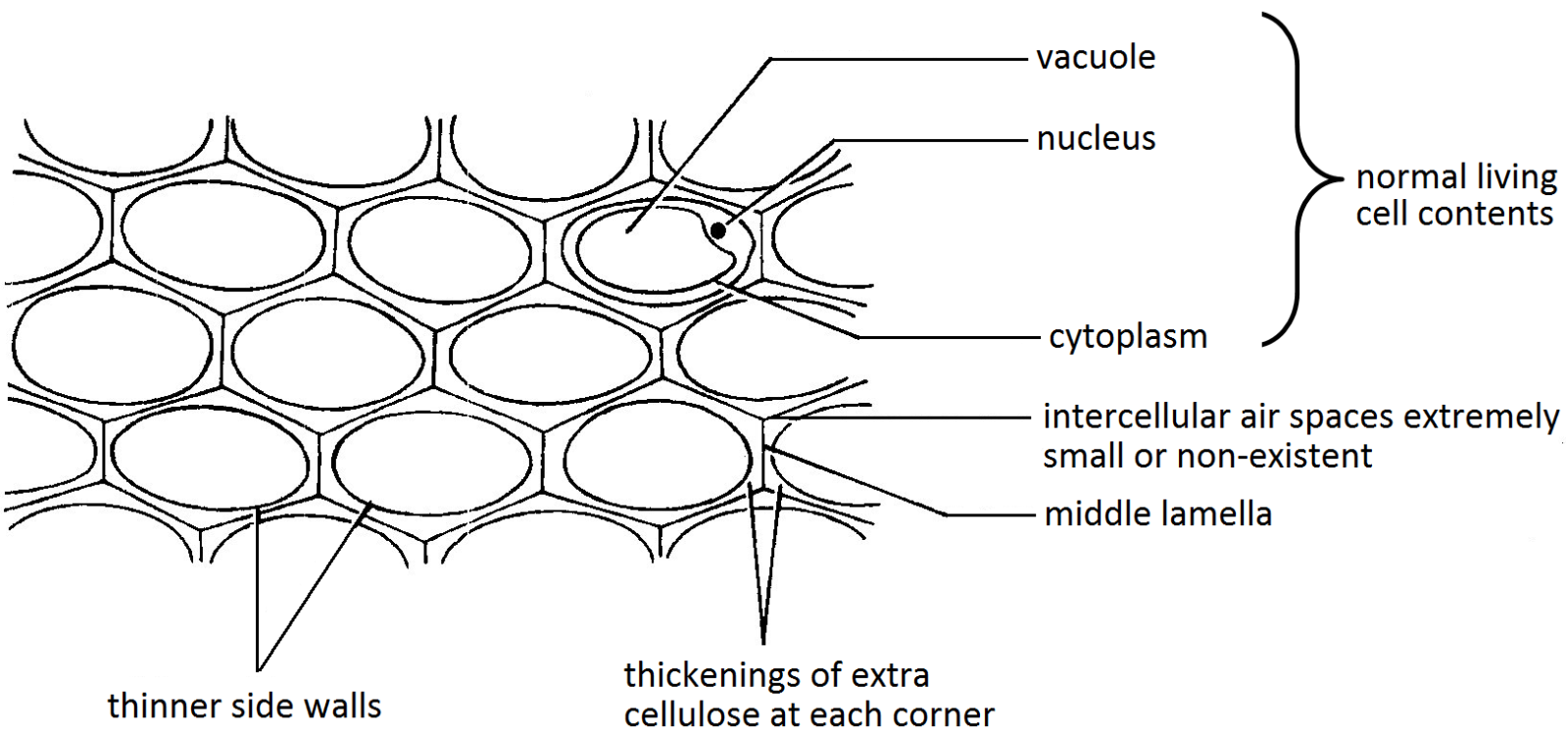
Distinguish between xylem and phloem.
Xylem:
Phloem:
Distinguish between tracheids and vessels.
Tracheids:
Vessels:
Distinguish between the following pairs in one or two sentences for each:
Tendon and ligament.
Tendon | Ligament | ||
1. | It is inelastic in nature. | 1. | It is elastic in nature. |
2. | It joins muscles to bones. | 2. | It joins bones to bones. |
Distinguish between the following pairs in one or two sentences for each:
Striated and unstriated muscles.
Striated Muscles | Unstriated Muscles | ||
1. | They are long and cylindrical in shape. | 1. | These are spindle shaped. |
2. | These muscles show alternate light and dark bands or striations. | 2. | These muscles do not show striations. |
Distinguish between the following pairs in one or two sentences for each:
RBCs and WBCs.
RBCs | WBCs | ||
1. | They are red in colour. | 1. | They are colourless. |
2. | Nucleus is absent. | 2. | Nucleus is present. |
Distinguish between the following pairs in one or two sentences for each:
Bone and cartilage.
Bone | Cartilage | ||
1. | It is hard and inflexible. | 1. | It is soft and flexible. |
2. | Blood vessels are present. | 2. | Blood vessels are absent. |
Distinguish between the following pairs in one or two sentences for each:
Blood and lyrnph.
Blood | Lymph | ||
1. | Blood is red in colour. | 1. | Lymph is a colourless fluid. |
2. | RBCs are present. | 2. | It's composition is almost similar to blood except RBCs are absent. |
Distinguish between the following pairs in one or two sentences for each:
Axon and dedrite.
Axon | Dendrite | ||
1. | It is a long uniformly thickened fibre like process of a neuron. | 1. | It is a short tapering process of the neuron. |
2. | It carried impulses away from the cell body. | 2. | It carries impulses towards the cell body. |
Describe functions of squamous epithelial tissue.
Squamous epithelium protects the underlying parts from germs, harmful chemicals and injury.
Describe columnar epithelium.
It is composed of a single layer of tall and slender cells. Their nuclei are located at the base. Free surface may have microvilli. It is generaly found in the lining of stomach and intestine and help in secretion and absorption.
Define connective tissue.
Connective tissues are most abundant and widely distributed in the body of complex animals. The cells of connective tissue are loosely spaced and embedded in an inercellular matrix. The matrix may be jelly like, fluid, dense or rigid.