Questions · Page 2 of 2

Answer the questions.[Bio-3M]

Question 513 Marks
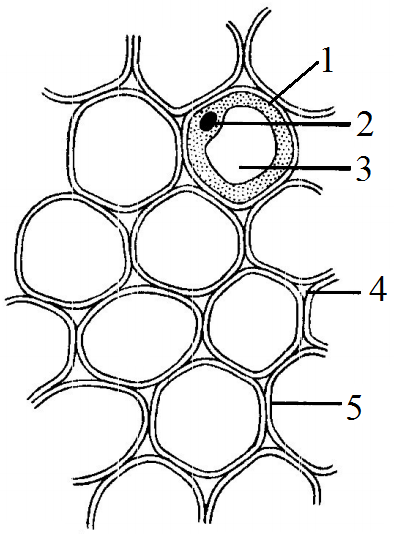
  1. Identify the plant tissue given in figure alongside.
  2. Label the parts markerd 1 to 5.
  3. Mention the function of this tissue.


Answer
  1. It is simple and living parenchyma tissue.
  2.  
  1. Cytoplasm.
  2. Nucleus.
  3. Vacuole.
  4. Intercellular space.
  5. Cell wall.
  1. The main function of parenchyma is the storage of food.
View full question & answer
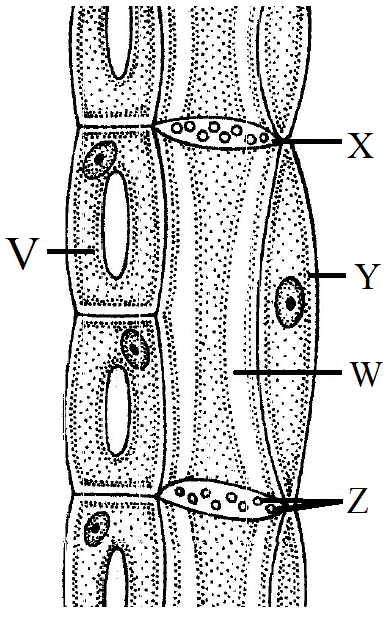
Question 523 Marks
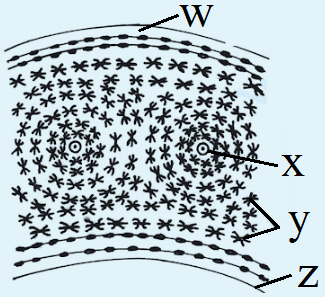
  1. Identify the figure. What is its function?
  2. Label V and W.
  3. Label X, Y and Z.
  4. W loses its nucleus in the mature state, still it remains alive. Explain how?


Answer
  1. It is a section of phloem, a complex tissue. Phloem transports food from leaves to the other parts of the plant.

  2. V: Phloem parenchyma.

W: Seive tube.

  1. X: Sieve plate.

Y: Companion cell.

Z: Sieve pores.

  1. Sieve tube are associated with companion cells. A mature sieve tube is living but it lacks a nucleus. Companion cells are living and associated with the sieve tubes. Living state of the mature sieve tube cells is regulated by nucleated cornpanion cells. These cells supply the RNA and proteins that keep the sieve tube alive. is associated with companion cells.
View full question & answer
Question 533 Marks
  1. Identify the figure.
  2. Label W, X, Y and Z
  3. What is chemical composition of material of the figure
  4. What of the function of X?


Answer
  1. It is section of a bone.
  2. W: Periosteum.

X: Haversian canel.

Y: Canaliculus (plural canaliculi).

Z: Endosteum.

  1. The chemical composition of material of bone includes:
  1. Ossein (30-40%).
  2. Mineral matter (60-70%) of calcium and magnesium carbonate and phosphate.
  1. Haversian canal tends to carry nutrients to the interior of the bone.
View full question & answer
Question 543 Marks
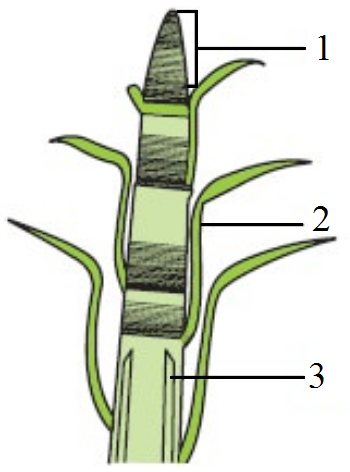
  1. Identify the figure.
  2. Labels the parts marked 1 to 3.
  3. Write the functions of parts marked 1 and 3.


Answer
  1. The figure represents the location of meristematic tissue in plant body.
  2.  
  1. Apical meristem.
  2. Intercalary meristem.
  3. Lateral meristem.
  1. Apical meristem increases the length of the stem and root.

Lateral meristem is responsible for growth in grith of stem and root.

View full question & answer
Question 553 Marks
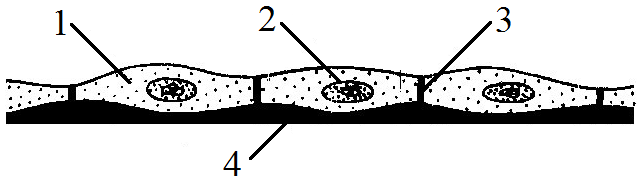
  1. Identify the animal tissue represented alongside.
  2. Label the parts of 1 to 4.
  3. Mention the function of this tissue.


Answer
  1. Squamous epithelium.
  2.  
  1. Cytoplasm.
  2. Nucleus.
  3. Cement substance.
  4. Basement membrane.
  1. Squamous epithelium protects the underlying body parts such as skin, nose, etc. from germs, harmful chemicals and injury.
View full question & answer
Answer the questions.[Bio-3M] - Page 2 - Science STD 9 Questions - Vidyadip