Questions

case /data -based [Bio-4M]

Take a timed test

5 questions · self-marked practice — reveal the answer and mark yourself.

Question 14 Marks
The covering or protective tissues in the animal body are epithelial tissues. Epithelium covers most organs and cavities within the body. External and Internal covering of the body and organs are all made of epithelial tissue.

Epithelial tissue cells are tightly packed and form a continuous sheet. They have only a small or almost no intercellular spaces.it plays an important role in regulating the exchange of materials between the body and the external environment and also between different parts of the body.

Simple squamous epithelial cells are extremely thin and flat and form a delicate lining. The oesophagus and the lining of the mouth are also covered with squamous epithelium. The skin, which protects the body, is also made of squamous epithelium.

Where absorption and secretion occur, as in the inner lining of the intestine, tall epithelial cells are present. This columnar (meaning ‘pillar-like’) epithelium facilitates movement across the epithelial barrier. In the respiratory tract, the columnar epithelial tissue also has cilia, which are hair-like projections on the outer surfaces of epithelial cells. These cilia can move, and their movement pushes the mucus forward to clear it. This type of epithelium is thus ciliated columnar epithelium.

Cuboidal epithelium (with cube-shaped cells) forms the lining of kidney tubules and ducts of salivary glands, where it provides mechanical support. Epithelial cells often acquire additional specialisation as gland cells, which can secrete substances at the epithelial surface. Sometimes a portion of the epithelial tissue folds inward, and a multicellular gland is formed. This is glandular epithelium.

(1) The ciliated columnar epithelium is present in

(a) Respiratory tract

(b) Bile duct and oesophagus

(c) Fallopian tube and urethra

(d) Eustachian tube and stomach lining

(2) The cuboidal epithelium is present in

(a) Bronchioles

(b) Bile duct and oesophagus

(c) Fallopian tube and urethra

(d) Kidney tubules ducts of salivary glands

(3) External and Internal covering of the body and organs are all made of ________

(a) Skin Tissue

(b) Epithelial Tissue

(c) Nerves Tissue

(d) Connective Tissue

(4) How are cells arranged in epithelial tissue?

(a) Loosely packed  

(b) Closely packed

(c) Arranged in discontinuous form   

(d) Both a and c

(5) Enlist the types of Epithelial Tissue?

Answer
(1) a

(2) d

(3) b

(4) b

(5) Type of epithelial tissue

  • Simple squamous epithelial tissue
  • Columnar epithelial tissue
  • Cuboidal epithelial tissue
  • Glandular epithelial tissue
View full question & answer
Question 24 Marks
Muscular tissue consists of elongated cells, also called muscle fibres. This tissue is responsible for movement in our body. Muscles contain special proteins called contractile proteins, which contract and relax to cause movement

We can move some muscles by conscious will. Such muscles are called voluntary muscles. These muscles are also called skeletal muscles as they are mostly attached to bones and help in body movement. Under the microscope, these muscles show alternate light and dark bands or striations, hence they are also called striated muscles. The cells of this tissue are long, cylindrical, unbranched and multinucleate.

The movement of food in the alimentary canal or the contraction and relaxation of blood vessels are involuntary movements. We can’t control these muscle movement. The Smooth muscles or involuntary muscles control such movements. They are also found in the iris of the eye, in ureters and in the bronchi of the lungs. The cells are long with pointed ends (spindle-shaped) and uninucleate. They are also called unstriated muscles.

The muscles of the heart show rhythmic contraction and relaxation throughout life. These involuntary muscles are called cardiac. Heart muscle cells are cylindrical, branched and uninucleate.

(1) Which of the following muscle tissue are voluntary in nature?

(a) Cardiac muscle

(b) Smooth muscle

(c) auto rhythmic muscle

(d) None of the above

(2) The muscles whose contraction is under our control are known as

(a) Voluntary muscles

(b) Involuntary movements

(c) Cardiac muscle

(d) Unstrained muscle

(3) The smooth muscle are found in the

(a) Iris of eye

(b) Uterus

(c) Bronchi of lungs

(d) All of above

(4) Give the characteristic of striated muscles.

(5) Give the characteristic of unstriated muscles.

Answer
(1) D

(2) A

(3) D

(4) Characteristic of striated muscles,

  • These muscles show alternate light and dark bands or striations, hence they are also called striated muscles.
  • The cells of this tissue are long, cylindrical, unbranched and multinucleate.

(5) Characteristic of unstriated muscles

  • The cells of this tissue are long with pointed ends spindle-shaped and uninucleate.
  • Striations are absent, hence they are also called unstriated muscles.
View full question & answer
Question 34 Marks
Meristematic tissue take up a specific role and lose the ability to divide. As a result, they form a permanent tissue. This process of taking up a permanent shape, size, and a function is called differentiation. Differentiation leads to the development of various types of permanent tissues.

Simple Permanent Tissue

Tissue made of one type of cells, which look like each other. Such tissues are called simple permanent tissue. Parenchyma is the most common simple permanent tissue. It consists of relatively unspecialised cells with thin cell walls. They are living cells. They are usually loosely arranged, thus large spaces between cells (intercellular spaces) are found in this tissue. This tissue generally stores food. In some situations, it contains chlorophyll and performs photosynthesis, and then it is called chlorenchyma. In aquatic plants, large air cavities are present in parenchyma to help them float. Such a parenchyma type is called aerenchyma.Yet another type of permanent tissue is sclerenchyma. It is the tissue which makes the plant hard and stiff. We have seen the husk of a coconut. It is made of sclerenchymatous tissue. The cells of this tissue are dead. They are long and narrow as the walls are thickened due to lignin.

Simple Permanent Tissue

Complex tissues are made of more than one type of cells. All these cells coordinate to perform a common function. Xylem and phloem are examples of such complex tissues. They are both conducting tissues and constitute a vascular bundle. Xylem fibres are mainly supportive in function. Phloem transports food from leaves to other parts of the plant. Except phloem fibres, other phloem cells are living cells.

(1) Tissue made of only one type of cell is termed as _________

(a) Simple permanent tissue

(b) Complex permanent tissue

(c) Simple Meristematic tissue

(d) Complex Meristematic tissue

(2) Xylem and phloem are examples of

(a) Meristematic tissue

(b) Simple tissue

(c) Protective tissue

(d) Complex tissue

(3) In aquatic plants, which type of parenchymatissue is found?

(a) Aerenchyma

(b) Chlorenchyma

(c) Sclerenchyma

(d) Parenchyma

(4) What is mean by Differentiation?

(5) Enlist the type of parenchyma tissue.

Answer
(1) A

(2) D

(3) A

(4) Meristematic tissue lose the ability to divide. As a result, they form a permanent tissue. This process of taking up a permanent shape, size, and a function is termed as differentiation.

(5) There are three type of parenchyma tissue

  • Aerenchyma
  • Chlorenchyma
  • Sclerenchyma
View full question & answer
Question 44 Marks
Blood is a type of connective tissue. The cells of connective tissue are loosely spaced and embedded in an intercellular matrix. The matrix may be jelly like, fluid, dense or rigid. The nature of matrix differs in concordance with the function of the particular connective tissue.

Blood has a fluid (liquid) matrix called plasma, in which red blood corpuscles (RBCs), white blood corpuscles (WBCs) and platelets are suspended. The plasma contains proteins, salts and hormones. Blood flows and transports gases, digested food, hormones and waste materials to different parts of the body.

Bone is another example of a connective tissue. It forms the framework that supports the body. It also anchors the muscles and supports the main organs of the body. It is a strong and nonflexible tissue. Bone cells are embedded in a hard matrix that is composed of calcium and phosphorus compounds. Two bones can be connected to each other by another type of connective tissue called the ligament. This tissue is very elastic.

Another type of connective tissue, cartilage, has widely spaced cells. The solid matrix is composed of proteins and sugars. Cartilage smoothens bone surfaces at joints and is also present in the nose, ear, trachea and larynx.

Areolar connective tissue is found between the skin and muscles, around blood vessels and nerves and in the bone marrow. It fills the space inside the organs, supports internal organs and helps in repair of tissues.

(1) A connective tissue

(a) Has no matrix

(b) Covers the skin

(c) Has abundant matrix

(d) None of these

(2) Areolar connective tissue is found between

(a) Skin and muscles

(b) Blood vessels and nerves

(c) Both a & b

(d) None of these

(3) Two bones are connected to each other by another type of connective tissue called__

(a) Ligament

(b) Cartilage

(c) Bone marrow

(d) Blood

(4) What are the function of connective tissue?

(5) Give the examples of connective tissue.

Answer
(1) c

(2) c

(3) a

(4) Functions of connective tissue

  • Binding together other tissues
  • Supporting various parts of the body
  • Forming a packing around organs

(5) Examples of connective tissue

  • Blood
  • Bone
  • Ligament
  • Cartilage
View full question & answer
Question 54 Marks
Answer
(1) d

(2) c

(3) b

(4) Characteristic of Meristematic tissue

  • Meristematic tissue are very active type of tissue.
  • They have dense cytoplasm.
  • The wall of Meristematic cells are thin cellulosic walls and prominent nuclei.
  • They lack vacuoles.

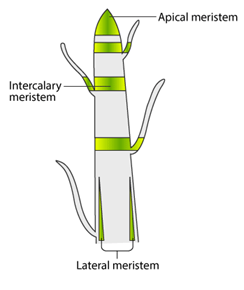
(5) There are three types of meristematic tissue

  • Apical Meristem
  • Intercalary Meristem
  • Lateral meristem
View full question & answer
case /data -based [Bio-4M] - Science STD 9 Questions - Vidyadip