Questions · Page 4 of 4

M.C.Q (1 Marks)

MCQ 1511 Mark
The lines $\frac{\text{x}}{1}=\frac{\text{y}}{2}=\frac{\text{z}}{3}$ and $\frac{\text{x}-1}{-2}=\frac{\text{y}-2}{-4}=\frac{\text{z}-3}{-6}$ are:
  • A
    Parallel.
  • B
    Intersecting.
  • C
    Skew.
  • Coincident.
Answer
Correct option: D.
Coincident.
The equations of the given lines are
$\frac{\text{x}}{1}=\frac{\text{y}}{2}=\frac{\text{z}}{3}\dots(1)$

$\frac{\text{x}-1}{-2}=\frac{\text{y}-2}{-4}=\frac{\text{z}-3}{-6}$

$\Rightarrow\frac{\text{x}-1}{1}=\frac{\text{y}-2}{2}=\frac{\text{z}-3}{3}\dots(2)$

Thus, the two lines are parallel to the vector $\vec{\text{b}}=\hat{\text{i}}+2\hat{\text{j}}+3\hat{\text{k}}$ and pass through the points (0, 0, 0) and (1, 2, 3).

Now,

$\big(\vec{\text{a}}_2-\vec{\text{a}}_1\big)\times\vec{\text{b}}=\big(\hat{\text{i}}+2\hat{\text{j}}+3\hat{\text{k}}\big)\times\big(\hat{\text{i}}+2\hat{\text{j}}+3\hat{\text{k}}\big)$

$=\vec{0}$ $\big[\because\vec{\text{a}}\times\vec{\text{a}}=\vec{0}\big]$

Since, the distence between the two parallel lines is 0, the given two lines are coincident lines.

Disclaimar: The answer given in the book is incorrect. This solution is created according to the question given in the book.
View full question & answer
MCQ 1521 Mark
The eqution of the plane which cute equal intercepts of unit length on the coordinate axes is:
  • x + y + z = 1
  • B
    x + y + z = 0
  • C
    x + y - z = 1
  • D
    x + y + z = 2
Answer
Correct option: A.
x + y + z = 1
We know that the equation of aplane whose intercepts are a, b, c is,

$\frac{\text{x}}{\text{a}}+\frac{\text{y}}{\text{b}}+\frac{\text{z}}{\text{c}}=1\ ....(1)$

It is given that a = b = c

So, from (1),

$\frac{\text{x}}{\text{a}}+\frac{\text{y}}{\text{b}}+\frac{\text{z}}{\text{c}}=1$

$\Rightarrow\text{x}+\text{y}+\text{z}=\text{a}\ ....(2)$

Since it is given that the intercepts of the required plane are of unit length,

a = b = c = 1

Substituting a = 1 in (2), we get

x + y + z = 1
View full question & answer
MCQ 1531 Mark
A straight line passes through (1, -2, 3) and perpendicular to the plane 2x + 3y - z = 7. Find the direction ratios of normal to plane:
  • < 2, 3, -1 >
  • B
    < 2, 3, 1 >
  • C
    < -1, 2, 3 >
  • D
    None of the above
Answer
Correct option: A.
< 2, 3, -1 >
concept: for any plane ax + by + cz + d =

0, normal vector to this plane is $\text{a}\hat{\text{i}}+\text{b}\hat{\text{j}}+\text{c}\hat{\text{k}}$

the normal vector of the plane 2x + 3y - z = 7 is $\text{2}\hat{\text{i}}+\text{3}\hat{\text{j}}+\hat{\text{k}}$

so the direction ratios of normal to plane are < 2, 3, -1 >
View full question & answer
MCQ 1541 Mark
The direction coisines of the $y-$axis are:
  • A
    $(6, 0, 0)$
  • B
    $(1, 0, 0)$
  • $(0, 1, 0)$
  • D
    $(0, 0, 1)$
Answer
Correct option: C.
$(0, 1, 0)$
View full question & answer
MCQ 1551 Mark
The distance of the point P(a, b, c) from the x-axis is:
  • $\sqrt{\text{b}^2+\text{c}^2}$
  • B
    $\sqrt{\text{a}^2+\text{c}^2}$
  • C
    $\sqrt{\text{a}^2+\text{b}^2}$
  • D
    $\text{none of these}$
Answer
Correct option: A.
$\sqrt{\text{b}^2+\text{c}^2}$
The projection of the point P(a, b, c) on the x-axis is a, (0, 0) as both Y and Z coordinates on any point on the x-axis are equal to zero.

$\therefore$ Distance of P(a, b, c) from x-axis = Distance of P(a, b, c) from a, (0, 0)

$=\sqrt{(\text{a}-\text{a})^2+(\text{b}-0)^2+(\text{c}-0)^2}$

$=\sqrt{\text{b}^2+\text{c}^2}$
View full question & answer
MCQ 1561 Mark
What are the DRs of vector parallel to (2, -1, 1) and (3, 4, -1):
  • (1, 5, -2)
  • B
    (-2, -5, 2)
  • C
    (-1, 5, 2)
  • D
    (-1, -5, -2)
Answer
Correct option: A.
(1, 5, -2)
Required DRs are (3 - 2, 4 + 1, -1 - 1) ie, (1, 5, -2)
View full question & answer
MCQ 1571 Mark
If a plane passes through the point (1, 1, 1) and is perpendicular to the line $\frac{\text{x}-1}{3}=\frac{\text{y}-1}{0}=\frac{\text{z}-1}{4}$ then its perpendicular distance from the origin is:
  • A
    $\frac{3}{4}$
  • B
    $\frac{4}{3}$
  • $\frac{7}{5}$
  • D
    $1$
Answer
Correct option: C.
$\frac{7}{5}$
Since the plane is perpendicular to the given line, its direction ratios are proportinal to 3, 0, 4.
So the required equation of the plane is of the form

3x + 0y + 4z + d = 0 .....(1), where d is a constant.

Since this plane passes through (1, 1, 1),

3 + 0 + 4 + d = 0

d = -7

Substituting this in (1), we get

3x + 0y + 4z -7 = 0 ......(2)

perpendicular distance of (2) from the origin

$=\frac{|3(0)+0+4(0)-7|}{\sqrt{3^2+0^2+4^2}}$

$=\frac{|0+0-7|}{\sqrt{25}}$

$=\frac{7}{5}\text{ units}$
View full question & answer
MCQ 1581 Mark
If l, m, n are the d.cs of the line joining (5, -3, 8) and (6, -1, 6) then l + m + n =
  • A
    $1$
  • $\frac{1}{3}$
  • C
    $-1$
  • D
    $\frac{5}{3}$
Answer
Correct option: B.
$\frac{1}{3}$
The line joining (5, -3, 8) and (6, -1, 6) is given by the vector -i + 2j - 2k.
the direction cosines are given by. l =

$\frac{1}{\sqrt{1^2+2^2+(-2)^2}}=\frac{1}{3}, \text{m}=\frac{2}{\sqrt{1^2+2^2+(-2)^2}}=\frac{2}{3}$

$\text{n}=\frac{-2}{1^2+2^2+(-2)^2}=\frac{-2}{3}$

$\Rightarrow\text{l + m + n}=\frac{1}{3}$
View full question & answer
MCQ 1591 Mark
$l = m = n = 1$ represents the direction cosines of:
  • A
    $x−$axis
  • B
    $y−$axis
  • C
    $z−$axis
  • none of these
Answer
Correct option: D.
none of these
Suppose$, l, m, n$ are direction cosines
$\Longrightarrow 1^2 + m^2 + n^2 = 1$
But $1 = m = n = 1$
$\Longrightarrow 3m^2 = 1$
$\Longrightarrow 1 = m = n = \frac{1}{\sqrt3}$
which are not direction cosines of either of the three $co-$ordinate axes.
View full question & answer
MCQ 1601 Mark
If a line makes angles $\alpha,\beta,\gamma,\delta$ with four diagonals of a cube, then $\cos^2\alpha+\cos^2\beta+\cos^2\gamma+\cos^2\delta$ is equal to:
  • A
    $\frac{1}{3}$
  • B
    $\frac{2}{3}$
  • $\frac{4}{3}$
  • D
    $\frac{8}{3}$
Answer
Correct option: C.
$\frac{4}{3}$


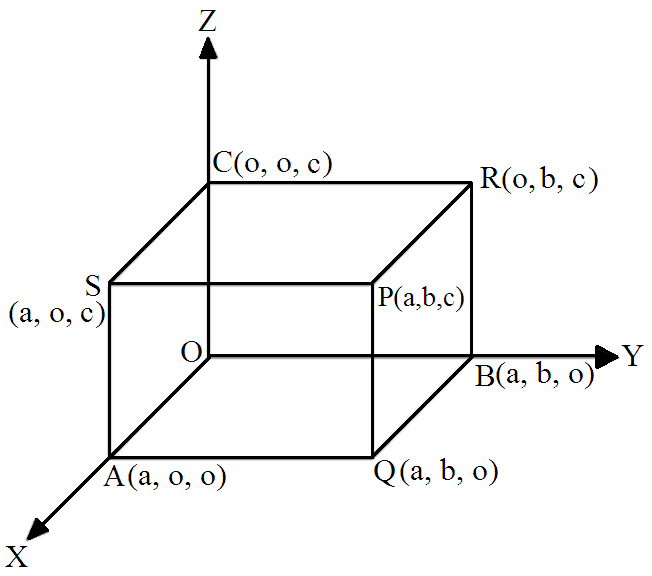
Let a be the length of an edge of the cube and let one corner be at the origin as shown in the figure. Clearly, OP, AR

The direction ratiosm of OP, AR, BS and CQ are

a - 0, a - 0, a - 0, i.e. a, a, a

0 - a, a - 0, a - 0, i.e. -a, a, a

a - 0, 0 - a, a - 0, i.e. a, -a, a

a - 0, a - 0, 0 - a, i.e. a, a, -a

Let the direction ratios of a line be proportional to l, m and n. Suppose this line makes angles $\alpha,\beta,\gamma$ and $\delta$ with OP, AR.

Now, $\alpha$ is the angle between OP and the line whose direction ratios are proportional to l, m and n.

$\cos\alpha=\frac{\text{a}.\text{l}+\text{a}.\text{m}+\text{a}.\text{n}}{\sqrt{\text{a}^2+\text{a}^2+\text{a}^2}\sqrt{\text{l}^2+\text{m}^2+\text{n}^2}}\Rightarrow\cos\alpha=\frac{\text{l}+\text{m}+\text{n}}{\sqrt{3}\sqrt{\text{l}^2+\text{m}^2+\text{n}^2}}$

Since $\beta$ is the angle between AR and the line with direction ratios proportional to l, m and n, we get

$\cos\beta=\frac{-\text{a}.\text{l}+\text{a}.\text{m}+\text{a}.\text{n}}{\sqrt{\text{a}^2+\text{a}^2+\text{a}^2}\sqrt{\text{l}^2+\text{m}^2+\text{n}^2}}\Rightarrow\cos\beta=\frac{-\text{l}+\text{m}+\text{n}}{\sqrt{3}\sqrt{\text{l}^2+\text{m}^2+\text{n}^2}}$

Similarly,

$\cos\gamma=\frac{\text{a}.\text{l}-\text{a}.\text{m}+\text{a}.\text{n}}{\sqrt{\text{a}^2+\text{a}^2+\text{a}^2}\sqrt{\text{l}^2+\text{m}^2+\text{n}^2}}\Rightarrow\cos\gamma=\frac{\text{l}-\text{m}+\text{n}}{\sqrt{3}\sqrt{\text{l}^2+\text{m}^2+\text{n}^2}}$

$\cos\delta=\frac{\text{a}.\text{l}+\text{a}.\text{m}-\text{a}.\text{n}}{\sqrt{\text{a}^2+\text{a}^2+\text{a}^2}\sqrt{\text{l}^2+\text{m}^2+\text{n}^2}}\Rightarrow\cos\delta=\frac{\text{l}+\text{m}-\text{n}}{\sqrt{3}\sqrt{\text{l}^2+\text{m}^2+\text{n}^2}}$

$\cos^2\alpha+\cos^2\beta+\cos^2\gamma+\cos^2\delta$

$=\frac{(\text{l}+\text{m}+\text{n})^2}{3(\text{l}^2+\text{m}^2+\text{n}^2)}+\frac{(-\text{l}+\text{m}+\text{n})^2}{3(\text{l}^2+\text{m}^2+\text{n}^2)}+\frac{(\text{l}-\text{m}+\text{n})^2}{3(\text{l}^2+\text{m}^2+\text{n}^2)}+\frac{(\text{l}+\text{m}-\text{n})^2}{\sqrt{3}\sqrt{\text{l}^2+\text{m}^2+\text{n}^2}}$

$=\frac{1}{3(\text{l}^2+\text{m}^2+\text{n}^2)}\Big\{(\text{l}+\text{m}+\text{n})^2+(-\text{l}+\text{m}+\text{n})^2+(\text{l}-\text{m}+\text{n})^2+(\text{l}+\text{m}-\text{n})^2\Big\}$

$=\frac{1}{3(\text{l}^2+\text{m}^2+\text{n}^2)}4\big(\text{l}^2+\text{m}^2+\text{n}^2\big)=\frac{4}{3}$.
View full question & answer
MCQ 1611 Mark
The distance of the plane through the intersection of the planes ax + by + cz +d = 0 and lx + my + nz + P = 0 and parallel to the line y = 0, z = 0
  • (bl - am)y + (cl - an)z + dl - ap = 0
  • B
    (am - bl)x + (mc - bn)z + md - bp = 0
  • C
    (na - cl)x + (bn - cm)y + nd - cp = 0
  • D
    None of these
Answer
Correct option: A.
(bl - am)y + (cl - an)z + dl - ap = 0
The equation of the plane passing through the intersection of the planes

ax + by + cz + d = 0

and lx + my + nz + p =0

Will be $(\text{ax} + \text{by} +\text{cz} +\text{d})+\lambda(\text{lm}+\text{my}+\text{nz}+\text{p})=0$

$\text{x}(\text{a}+\lambda1)+\text{y}(\text{b}+\lambda\text{m})+\text{z}(\text{c}+\lambda\text{n})+(\text{d}+\lambda\text{p})=0\ (1)$

Since the plane is parallel to the line y = 0 and z = 0

$\text{a}+\lambda1=0$

$\lambda=\frac{-\text{a}}{\text{l}}$

Putting the value of A in eqution (1), we get

$\text{x}\Big(\text{a}+\Big(\frac{\text{-a}}{\text{l}}\Big)\text{l}\Big)+\text{y}\Big(\text{b}+\Big(\frac{-\text{a}}{\text{l}}\Big)\text{m}+\text{y}\Big(\text{c}+\Big(\frac{-\text{a}}{\text{l}}\Big)\text{n}+\text{d}+\Big(\frac{-\text{a}}{\text{l}}\Big)\text{p}=0$

$\text{y}(\text{bl}-\text{am})+\text{z}(\text{cl}-\text{an})+\text{dl}-\text{ap}=0$

Heance, option (a)
View full question & answer
MCQ 1621 Mark
The eqution of the plane contaning the two lines $\frac{\text{x}-1}{2}=\frac{\text{y}+1}{-1}=\frac{\text{z}-0}{3}$ and $\frac{\text{x}}{-2}=\frac{\text{y}-2}{-3}=\frac{\text{z}+1}{-1}$ is:
  • A
    8x + y - 5z - 7 = 0
  • B
    8x + y + 5z - 7 = 0
  • C
    8x - y - 5z - 7 = 0
  • None of these
Answer
Correct option: D.
None of these
$\frac{\text{x}-1}{2}=\frac{\text{y}+1}{-1}=\frac{\text{z}-0}{3}$ and $\frac{\text{x}}{-2}=\frac{\text{y}-2}{-3}=\frac{\text{z}+1}{-1}$

Now, if these two lines lie on a plane, so the direction ratio of lines will be perpendicular to the plane's normal vector.
View full question & answer
MCQ 1631 Mark
If a line makes the angle $\alpha,\beta,\gamma$ with three dimensional coordinate axes respectively, then $\cos2\alpha+\cos2\beta+\cos2\gamma$ is equal to:
  • A
    -2
  • -1
  • C
    1
  • D
    2
Answer
Correct option: B.
-1
We need to find value of $\cos2\alpha+\cos2\beta+\cos2\gamma$
It is further equal to $\cos^2\alpha-1+\cos^2\beta-1+\cos^2\gamma-1$
$=2\big(\cos^2\alpha+\cos^2\beta+\cos^2\gamma\big)-3$
$= 2(1) - 3 = 2 = -1$
$\therefore(\text{l}^2 + \text{m}^2 + \text{n}^2 = 1)$
View full question & answer
MCQ 1641 Mark
The perpendicular distance of the point P(1, 2, 3) from the line $\frac{\text{x}-6}{3}=\frac{\text{y}-7}{2}=\frac{\text{z}-7}{-2}$ is:
  • 7
  • B
    5
  • C
    0
  • D
    None of these
Answer
Correct option: A.
7
$\frac{\text{x}-6}{3}=\frac{\text{y}-7}{2}=\frac{\text{z}-7}{-2}$
Let point (1, 2, 3) be P and the point through which the line passes be Q(6, 7, 7). Also, the line is parallel to the vector $\vec{\text{b}}=3\hat{\text{i}}+2\hat{\text{j}}-2\hat{\text{k}}.$
Now,
$\overrightarrow{\text{PQ}}=5\hat{\text{i}}+5\hat{\text{j}}+4\hat{\text{k}}$
$\therefore\vec{\text{b}}\times\overrightarrow{\text{PQ}} =\begin{vmatrix}\hat{\text{i}}&\hat{\text{j}}&\hat{\text{k}}\\3&2&-2\\5&5&4\end{vmatrix}$
$=18\hat{\text{i}}-22\hat{\text{j}}+5\hat{\text{k}}$
$\Rightarrow\big|\vec{\text{b}}\times\overrightarrow{\text{PQ}}\big|=\sqrt{18^2+(-22)^2+5^2}$
$=\sqrt{324+484+25}$
$=\sqrt{833}$
$\because\text{d}=\frac{\big|\vec{\text{b}}\times\overrightarrow{\text{PQ}}\big|}{\big|\vec{\text{b}}\big|}$
$=\frac{\sqrt{833}}{\sqrt{17}}$
$=\sqrt{49}$
$=7$
View full question & answer
MCQ 1651 Mark
Can $\frac{1}{\sqrt{3}},\frac{2}{\sqrt{3}},\frac{-2}{\sqrt{3}}$​ be the direction cosines of any directed line?
  • A
    Yes
  • No
  • C
    Cannot say
  • D
    None of these
Answer
Correct option: B.
No
No, they can not be the direction cosines of any directed line.
As the sum of square of them is not 1.
$\text{As}\Big(\frac{1}{\sqrt{3}}\Big)^2+\Big(\frac{2}{\sqrt{3}}\Big)^2+\Big(\frac{-2}{\sqrt{3}}\Big)^2$
$=\frac{1+4+4}{3}$
$=3$
View full question & answer
MCQ 1661 Mark
The angle between the lines $\frac{\text{x}-1}{1}=\frac{\text{y}-1}{1}=\frac{\text{z}-1}{2}$ and $\frac{\text{x}-1}{-\sqrt{3}-1}=\frac{\text{y}-1}{\sqrt{3}-1}=\frac{\text{z}-1}{4}$ is:
  • A
    $\cos^{-1}\big(\frac{1}{65}\big)$
  • B
    $\frac{\pi}{6}$
  • $\frac{\pi}{3}$
  • D
    $\frac{\pi}{4}$
Answer
Correct option: C.
$\frac{\pi}{3}$
We have
$\frac{\text{x}-1}{1}=\frac{\text{y}-1}{1}=\frac{\text{z}-1}{2}$
$\frac{\text{x}-1}{-\sqrt{3}-1}=\frac{\text{y}-1}{\sqrt{3}-1}=\frac{\text{z}-1}{4}$
The direction ratios of the given lines are proportional to 1, 1, 2 and $-\sqrt{3}-1,\sqrt{3}-1, 4$
The given lines are parallel to vectors $\vec{\text{b}}_1=\hat{\text{i}}+\hat{\text{j}}+2\hat{\text{k}}$ and $\vec{\text{b}}_2=\big(-\sqrt{3}-1\big)\hat{\text{i}}+\big(\sqrt{3}-1\big)\hat{\text{j}}+4\hat{\text{k}}$
Let $\theta$ be the angle between the given lines.
Now,
$\cos\theta=\frac{\vec{\text{b}}_1.\vec{\text{b}}_2}{\big|\vec{\text{b}}_1\big|\big|\vec{\text{b}}_2\big|}$
$=\frac{\big(\hat{\text{i}}+\hat{\text{j}}+2\hat{\text{k}}\big).\big\{\big(-\sqrt{3}-1\big)\hat{\text{i}}+\big(\sqrt{3}-1\big)\hat{\text{j}}+4\hat{\text{k}}\big\}}{\sqrt{1^2+1^2+1^2}\sqrt{\big(-\sqrt{3}-1\big)^2+\big(\sqrt{3}-1\big)^2+4^2}}$
$=\frac{-\sqrt{3}-1+\sqrt{3}-1+8}{\sqrt{3}\sqrt{24}}$
$=\frac{6}{6\sqrt{2}}$
$\frac{1}{\sqrt{2}}$
$\Rightarrow\theta=\frac{\pi}{3}$
View full question & answer
MCQ 1681 Mark
length of the $1^{er}$ from the point $(0, -1, 3)$ to the plane $2x + y - 2z + 1 = 0$ is:
  • A
    $0$
  • B
    $2\sqrt{3}$
  • C
    $\frac{2}{3}$
  • $2$
Answer
Correct option: D.
$2$
View full question & answer
MCQ 1691 Mark
The projection of the join of the two points (1, 4, 5), (6, 7, 2) on the line whose d.ss are (4, 5, 6) is:
  • $\frac{17}{\sqrt{77}}$
  • B
    $\frac{7}{6}$
  • C
    $21$
  • D
    $\frac{7}{9}$
Answer
Correct option: A.
$\frac{17}{\sqrt{77}}$
View full question & answer
MCQ 1701 Mark
If the diraction ratios of a line are proportional to 1, -3, 2, then its diraction cosines are:
  • $\frac{1}{\sqrt{14}},-\frac{3}{\sqrt{14}},\frac{2}{\sqrt{14}}$
  • B
    $\frac{1}{\sqrt{14}},\frac{2}{\sqrt{14}},\frac{3}{\sqrt{14}}$
  • C
    $-\frac{1}{\sqrt{14}},\frac{3}{\sqrt{14}},\frac{2}{\sqrt{14}}$
  • D
    $-\frac{1}{\sqrt{14}},-\frac{2}{\sqrt{14}},-\frac{3}{\sqrt{14}}$
Answer
Correct option: A.
$\frac{1}{\sqrt{14}},-\frac{3}{\sqrt{14}},\frac{2}{\sqrt{14}}$
The diraction ratios of the line are proportional to 1, -3, 2.
$\therefore$ The direction cosines of the line are
$\frac{1}{\sqrt{1^2+(-3)^2+2^2}},\frac{-3}{\sqrt{1^2+(-3)^2+2^2}},\frac{2}{\sqrt{1^2+(-3)^2+2^2}}$
$=\frac{1}{\sqrt{14}},-\frac{3}{\sqrt{14}},\frac{2}{\sqrt{14}}$
View full question & answer
MCQ 1711 Mark
If a line makes angles $Q_1, Q_{21}$ and $Q_3$ respectively with the coordinate axis then the value of $\cos^2 \text{Q}_{1} + \cos^2 \text{Q}_{2} + \cos^2 \text{Q}_{3}:$
  • A
    $2$
  • $1$
  • C
    $4$
  • D
    $\frac{3}{2}$
Answer
Correct option: B.
$1$
View full question & answer
MCQ 1721 Mark
The equation x² - x - 2 = 0 in three-dimensional space is represented by:
  • A pair of parallel planes
  • B
    A pair of straight lines
  • C
    A pair of the perpendicular plane
  • D
    None of these
Answer
Correct option: A.
A pair of parallel planes
View full question & answer
MCQ 1731 Mark
lf $\text{AB}\perp\text{BC}$ then the value of $\lambda$ equal, where A(2k, 2, 3), B(k, 1, 5), C(3 + k, 2, 1):
  • A
    $3$
  • B
    $\frac{1}{3}$
  • $-3$
  • D
    $-\frac{1}{3}$
Answer
Correct option: C.
$-3$
The drs of AB are (k, 1, -2)
The drs of BC are (3, 1, -4)
Since, they are perpendicular, AB.BC = 0
3k + 1 + 8 = 0
k = -3
View full question & answer
MCQ 1741 Mark
If 2x + 5y - 6z + 3 = 0 be the equation of the plane, then the equation of any plane parallel to the given plane is:
  • A
    3x + 5y – 6z + 3 = 0
  • B
    2x - 5y - 6z + 3 = 0
  • 2x + 5y - 6z + k = 0
  • D
    None of these
Answer
Correct option: C.
2x + 5y - 6z + k = 0
View full question & answer
MCQ 1751 Mark
The direction ratios of the line perprndicular to the lines $\frac{\text{x}-7}{2}=\frac{\text{y}+17}{-3}=\frac{\text{z}-6}{1}$ and, $\frac{\text{x}+5}{1}=\frac{\text{y}+3}{2}=\frac{\text{z}-4}{-2}$ are proportional to:
  • 4, 5, 7
  • B
    4, -5, 7
  • C
    4, -5, -7
  • D
    -4, 5, 7
Answer
Correct option: A.
4, 5, 7
We have
$\frac{\text{x}-7}{2}=\frac{\text{y}+17}{-3}=\frac{\text{z}-6}{1}$
$\frac{\text{x}+5}{1}=\frac{\text{y}+3}{2}=\frac{\text{z}-4}{-2}$
The direction ratios of the given lines are proportional to 2, -3, 1 and 1, 2, -2.
The vectors parallel to the given vectors are $\vec{\text{b}}_1=2\hat{\text{i}}-3\hat{\text{j}}+\hat{\text{k}}$ and $\vec{\text{b}}_2=\hat{\text{i}}+2\hat{\text{j}}-2\hat{\text{k}}.$
Vector perpendicular to the given two lines is
$\vec{\text{b}}=\vec{\text{b}}_1\times\vec{\text{b}}_2$
$=\begin{vmatrix}\hat{\text{i}}&\hat{\text{j}}&\hat{\text{k}}\\2&-3&1\\1&2&-2\end{vmatrix}$
$=4\hat{\text{i}}+5\hat{\text{j}}+7\hat{\text{k}}$
Hence, the direction ration of the line perpendicular to the given two lines are proportional to 4, 5, 7.
View full question & answer
MCQ 1761 Mark
The area of the quadrilateral ABCD, where A(0, 4, 1), B(2, 3, -1), C(4, 5, 0) and D(2, 6, 2) is equal to:
  • 9sq. units
  • B
    1sq. units
  • C
    27sq. units
  • D
    81sq. units
Answer
Correct option: A.
9sq. units
9sq. units
View full question & answer
MCQ 1771 Mark
The equation of the plane passing through the points (3, 2, −1), (3, 4, 2) and (7, 0, 6) is 5x + 3y −2z = λ where λ is:
  • 23
  • B
    21
  • C
    19
  • D
    27
Answer
Correct option: A.
23
23
View full question & answer
MCQ 1781 Mark
If the d.rs of two lines are 1, -2, 3 and 2, 0, 1, then the d.rs of the line perpendicular to both the given lines is:
  • -2, 5, 4
  • B
    2, -5
  • C
    2, 5, -4
  • D
    1, 5, -4
Answer
Correct option: A.
-2, 5, 4
OA and OB are given by (1, -2, 3), (2, 0, 1)
A line that will be perpendicular to both OA and OB can be obtained by doing the cross product of OA with OB.
Then, n = OA × OB
n = -2i + 5j + 4k
(-2, 5, 4).
View full question & answer
MCQ 1791 Mark
Can $\frac{1}{\sqrt{3}},\frac{2}{\sqrt{3}},\frac{-2}{\sqrt{3}}$ be the direction cosines of any directed line:
  • A
    Yes
  • No
  • C
    Cannot say
  • D
    None of these
Answer
Correct option: B.
No
No, they can not be the direction cosines of any directed line. As the sum of square of them is not 1.As
$=\Big(\frac{1}{\sqrt{3}}\Big)^2+\Big(\frac{2}{\sqrt{3}}\Big)^2+\Big(\frac{-2}{\sqrt{3}}\Big)^2=\frac{1+4+4}{3}=3$
View full question & answer
MCQ 1801 Mark
The angle between the planes 2x - y + z = 6 and x + y + 2z = 7 is:
  • A
    $\frac{\pi}{4}$
  • B
    $\frac{\pi}{6}$
  • $\frac{\pi}{3}$
  • D
    $\frac{\pi}{2}$
Answer
Correct option: C.
$\frac{\pi}{3}$
$\frac{\pi}{3}$
View full question & answer
M.C.Q (1 Marks) - Page 4 - Maths STD 12 Science Questions - Vidyadip