Question 12 Marks
A small terrace at a football ground comprises of $15$ steps each of which is $50\ m$ long and built of solid concrete.
Each step has a rise of $\frac{1}{4}$m and a tread of $\frac{1}{2}$m. (see figure). Calculate the total volume of concrete required to build the terrace.
$[$Hint: Volume of concrete required to build the first step = $\frac 14 \times \frac 12 \times 50\ m^3]$
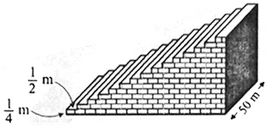
AnswerVolume of concrete required to build the first step, second step and third step (in $m^2$)
= $\frac{1}{4} \times \frac{1}{2} \times 50,\left( {2 \times \frac{1}{4}} \right) \times \frac{1}{2} \times 50,\left( {3 \times \frac{1}{4}} \right) \times \frac{1}{2} \times 50$
= $ \frac{{50}}{8},2 \times \frac{{50}}{8},3 \times \frac{{50}}{8},.....$
$\therefore $ Total volume of concrete required = $\frac{{50}}{8} + 2 \times \frac{{50}}{8} + 3 \times \frac{{50}}{8} + ....$
$ = \frac{{50}}{8}\left[ {1 + 2 + 3 + .......} \right]$
$ \mathrm{S}_{\mathrm{n}}=\frac{n}{2}[(2 \mathrm{a}+(\mathrm{n}-1) \mathrm{d}] $
$ \mathrm{S}_{15}=\frac{50}{8} \times \frac{15}{2}[2 \times 1+(15-1) \times 1][\because n=15]$
$ = \frac{{50}}{8} \times \frac{{15}}{2} \times 16$
$= 750\ m^3$
View full question & answer→Question 22 Marks
The houses of a row are numbered consecutively from $1$ to $49$. Show that there is a value of $x$ such that the sum of the numbers of the houses preceding the house numbered $x$ is equal to the sum of the numbers of the houses following it. Find this value of $x$.
$[$Hint: $S_{x-1}=S_{49}-S_x]$
AnswerAccording to the question,we have to find the value of $x$. We are given an $AP$, namely $1,2,3,..., (x -1), x, (x +1),..., 49$
such that $1 + 2 + 3 +... + (x -1) = (x +1) + (x + 2) +... + 49.$
Thus, we have $S_{x-1}=S_{49}-S_x \ldots$ $(i)$
Using the formula, $S_n=\frac{n}{2} (a + l)$ in $(i)$, we have,
$\frac { ( x - 1 ) } { 2 } \cdot \{ 1 + ( x - 1 ) \} = \frac { 49 } { 2 } \cdot ( 1 + 49 ) - \frac { x } { 2 } \cdot ( 1 + x )$
$\Rightarrow$$\frac { x ( x - 1 ) } { 2 } + \frac { x ( x + 1 ) } { 2 } = 1225$
$\Rightarrow 2x^2=2450 \Rightarrow x^2=1225 \Rightarrow x=\sqrt {1225} =35$
Hence, $x = 35.$
View full question & answer→Question 32 Marks
Which term of the AP: $121, 117, 113, .....$ is its first negative term?
$[$Hint: Find n for $a_n<0]$
AnswerGiven: $121, 117, 113, .......$
Here $a=121, d=117-121=4$
Now, $a_n=a+(n-1) d$
$=121+(n-1)(-4)=121-4 n+4=125-4 n$
For the first negative term, $a_n<0$
$ \Rightarrow 125 - 4n < 0 \Rightarrow 125 < 4n \Rightarrow \frac{{125}}{4} < n$
$ \Rightarrow 31\frac{1}{4} < n$
n is an integer and $n > 31\frac{1}{4}$.
Hence, the first negative term is $32^{nd}$ term
View full question & answer→Question 42 Marks
Find the sum of first 51 terms of an AP whose second and third terms are 14 and 18 respectively.
AnswerThe general term of an AP is given by $a_n=a+(n-1) d \text { and } S_n=\frac{n}{2}[2 a+(n-1) d$.
Given that $\mathrm{a}_2=14$ and $\mathrm{a}_3=18$
So, $d=a_3-a_2=18-14=4$
Now, $a_2=14 \Rightarrow a+4=14 \Rightarrow a=10$
Also, $\mathrm{S}_{51}=\frac{51}{2}[2(10)+(50) 4]$
$\Rightarrow \mathrm{S}_{51}=\frac{51}{2}[20+200]$
$\Rightarrow \mathrm{S}_{51}=\frac{51}{2}[220]$
$\Rightarrow S_{51}=51 \times 110$
$\Rightarrow S_{51}=5610$
View full question & answer→Question 52 Marks
The first and the last terms of an $A.P$ are $17$ and $350$ respectively. If the common difference is $9$, how many terms are there and what is their sum?
AnswerLet their be $n$ terms in the given $AP$.
First term, $a = 17$
Last term,$ l = 350$
Common difference, $d=9$
Now, $T_n=350$
$ \Rightarrow \mathrm{a}+(\mathrm{n}-1) \mathrm{d}=350$
$ \Rightarrow 17+(\mathrm{n}-1) 9=350 $
$ \Rightarrow(\mathrm{n}-1)(9)=333 $
$ \Rightarrow \mathrm{n}-1=37$
$ \Rightarrow \mathrm{n}=38$$$
$Therefore,there are $38$ terms in the $AP
Now, $S_n=\frac{n}{2}[a+l]$
$\Rightarrow S_{38}=\frac{38}{2}[17+350]=19 \times 367=6973$
View full question & answer→Question 62 Marks
In an $AP$: $a = 3, n = 8, s = 192$, find $d$.
AnswerHere, $a = 3$
$n = 8$
$S = 192$
We know that
$S = \frac{n}{2}[2a + (n - 1)d]$
$ \Rightarrow 192 = \frac{8}{2}\left[ {2(3) + (8 - 1)d} \right]$
$ \Rightarrow 192 = 4[6 + 7d]$
$ \Rightarrow \frac{{192}}{4} = 6 + 7d$
$ \Rightarrow $ $48 = 6 + 7d$
$ \Rightarrow $ $48 - 6 = 7d$
$ \Rightarrow $ $42 = 7d$
$ \Rightarrow $ $7d = 42$
$ \Rightarrow d = \frac{{42}}{7}$
$ \Rightarrow $ $d = 6$
View full question & answer→Question 72 Marks
Find the sum of $34 + 32 + 30 + … + 10$.
AnswerHere, $a = 34$
$d = 32 - 34 = -2$
$l = 10$
Let the number of terms of the $AP$ be $n$.
We know that,
$l = a + (n - 1)d$
$ \Rightarrow $ $10 = 34 + (n - 1) (-2)$
$ \Rightarrow $ $(n - 1) (-2) = - 24$
$ \Rightarrow $ $n - 1 = \frac{{ - 24}}{{ - 2}} = 12$
$ \Rightarrow n = 13$
Again, we know that,
${S_n} = \frac{n}{2}(a + l)$
$ \Rightarrow {S_{13}} = \frac{{13}}{2}(34 + 10)$
$ \Rightarrow {S_{13}} = 286$
Hence, the required sum is $286$.
View full question & answer→Question 82 Marks
Find the sum of the $APs$: $\frac{1}{{15}},\frac{1}{{12}},\frac{1}{{10}},.....$ to $11$ terms.
AnswerHere, $a = \frac{1}{{15}}$
$d = \frac{1}{{12}} - \frac{1}{{15}} = \frac{1}{{60}}$
$n = 11$
We know that
$ \Rightarrow {S_n} = \frac{n}{2}\left[ {2a + (n - 1)d} \right]$
$ \Rightarrow {S_{11}} = \frac{{11}}{2}\left[ {2\left( {\frac{1}{{15}}} \right) + (11 - 1)\left( {\frac{1}{{60}}} \right)} \right]$
$ \Rightarrow {S_{11}} = \frac{{11}}{2}\left[ {\frac{2}{{15}} + \frac{1}{6}} \right]$
$ \Rightarrow {S_{11}} = \frac{{11}}{2}\left[ {\frac{3}{{10}}} \right]$
$ \Rightarrow {S_{11}} = \frac{{33}}{{20}}$
So, the sum of the first $11$ terms of the given $AP$ is $\frac{{33}}{{20}}$.
View full question & answer→Question 92 Marks
If the $3^{rd}$ and the $9^{th}$ terms of an $AP$ are $4$ and $- 8$ respectively, then which term of the given $AP$ will be zero?
AnswerIt is given that $a_3= 4$ and $a_9= -8$
$a_3= a + 2d = 4 .....(i)$
$a_9= a + 8d = -8 .....(ii)$
Subtracting $eq^n$ $(i)$ from $eq^n$ $(ii)$ we get;
$a + 8d - a - 2d = -8 - 4 = -12$
$6d = -12$
$d = - 2$
Substituting the value of d in $eq^n$ $(i)$, we get
$a + 2 (-2) = 4$
$a - 4 = 4$
$a = 8$
Now;$ 0 = a + (n - 1)d$
$0 = 8 + (n - 1)(-2)$
$(n - 1)(- 2) = - 8$
$n - 1 = 4$
$n = 5$
Thus, $5^{th}$ term of the given $AP$ is zero.
View full question & answer→Question 102 Marks
Find the number of terms in $AP. 18,$ $15\frac{1}{2}$$, 13, ….., – 47.$
Answer$18,15\frac{1}{2},13,..., - 47$
Here, $a = 18$
$d = 15\frac{1}{2} - 18 = \frac{{31}}{2} - 18 = - \frac{5}{2}$
$a_n= -47$
Let the number of terms be $n$.
Then,
$a_n= -47$
$ \Rightarrow a + (n - 1)d = -47$
$ \Rightarrow 18 + (n - 1)\left( { - \frac{5}{2}} \right) = - 47$
$ \Rightarrow - \frac{5}{2}(n - 1) = - 47 - 18$
$ \Rightarrow - \frac{5}{2}(n - 1) = - 65$
$ \Rightarrow \frac{5}{2}(n - 1) = 65$
$ \Rightarrow n - 1 = \frac{{65 \times 2}}{5}$
$ \Rightarrow n - 1 = 26 $
$ \Rightarrow n = 26 + 1 $
$ \Rightarrow n = 27$
Hence, the number of terms of the given $AP$ is $27$.
View full question & answer→Question 112 Marks
Find the number of terms in $AP: 7, 13, 19, …., 205$
Answer$7, 13, 19, ...., 205$
Here $a = 7$
$d = 13 - 7 = 6$
$a_n= 205$
Let the number of terms be n.
Then, $a_n= 205$
$ \Rightarrow a + (n - 1)d = 205$
$ \Rightarrow 7 + (n - 1)6 = 205$
$ \Rightarrow 6(n - 1) = 205 - 7$
$ \Rightarrow 6(n - 1) = 198$
$ \Rightarrow n - 1 = \frac{{198}}{6}$
$ \Rightarrow n - 1= 33$
$ \Rightarrow n = 33 + 1$
$ \Rightarrow n = 34$
Hence, the number of terms of the given AP is 34.
View full question & answer→Question 122 Marks
Which term of the $AP$: $3, 8, 13, 18, ………..,$ is $78$
AnswerThe given AP is $3, 8, 13, 18, .....$
Here $a = 3$
$d = 8 - 3 = 5$
Let the nth term of the $AP$ be $78$.
then, $a_n= a + (n - 1) d$
$ \Rightarrow 78 = 3 + (n - 1) (5) $
$ \Rightarrow 5(n - 1) = 78 - 3$
$ \Rightarrow 5(n - 1) = 75 $
$ \Rightarrow n - 1 = \frac{{75}}{5}$
$ \Rightarrow n - 1 = 15$
$ \Rightarrow n = 15 + 1$
$ \Rightarrow n = 16$
View full question & answer→Question 132 Marks
In the $AP, –4, ?, ?, ?, ?, 6$ find the missing terms?
AnswerLet the common difference of the given $AP$ be $d$.
$a = -4$
$6\ th$ term $= 6$
$ \Rightarrow $ -4 + (6 - 1)d = 6 $\because {a_n} = a + \left| {a - 1} \right|d$
$ \Rightarrow $ $-4 + 5d = 6$
$ \Rightarrow $ $5d = 6 + 4$
$ \Rightarrow $ $5d = 10$
$ \Rightarrow d = \frac{{10}}{5}$
$ \Rightarrow $ $d = 2$
Therefore,
Second term$ = -4 + 2 = -2$
Third term $= -2 + 2 = 0$
Fourth term $= 0 + 2 = 2$
Fifth term $= 2 + 2 = 4$
Hence, the missing terms are $-2, 0, 2, 4$
View full question & answer→Question 142 Marks
In the $AP, 5,?,?,$ $9\frac{1}{2}$ find the missing terms?
AnswerLet the common difference of the given $AP$ be $d$.
$a = 5$
$4\ th$ term $ = 9\frac{1}{2}$
$ \Rightarrow 5 + (4 - 1)d = \frac{{19}}{2}\left[ {\because {a_n} = a + (n - 1)d} \right]$
$ \Rightarrow 3d = \frac{{19}}{2} - 5$
$ \Rightarrow 3d = \frac{9}{2}$
$ \Rightarrow d = \frac{3}{2}$
Therefore,
Second term $ = 5 + \frac{3}{2} = \frac{{13}}{2} = 6\frac{1}{2}$
and, third term $ = \frac{{13}}{2} + \frac{3}{2} = 8$
Hence, the missing terms in the boxes are $6\frac{1}{2}$ and 8.
View full question & answer→Question 152 Marks
In the$ AP, ?, 13, ?, 3$ find the missing terms?
AnswerLet the first term and the common difference of
the given $AP$ be $a$ and $d$ respectively.
Second term $= 13$
$ \Rightarrow $ $a + (2 - 1)d = 13$
$ \Rightarrow $ $a + d = 13 ....... (1)$
Fourth term $= 3$
$ \Rightarrow $ $a + (4 - 1) d = 3$
$ \Rightarrow $ $a + 3d = 3 .......... (2)$
Solving $(1)$ and $(2)$, we get
$a = 18$
$d = -5$
Therefore,
Third term$ = a + (3 - 1) d$
$= a + 2d$
$= 18 + 2(-5)$
$= 18 - 10$
$= 8$
Hence, the missing terms are $18$ and $8$.
View full question & answer→Question 162 Marks
Ramkali saves $₹5$ in the first week of a year and then increased her weekly savings by $₹1.75$. If in the nth week, her weekly savings becomes $₹20.75$, then find $n$.
AnswerHere, $a = ₹ 5$
$d = ₹ 1.75$
$a_n= ₹ 20.75$
We know that
$a_n= a + (n - 1)d$
$ \Rightarrow 20.75 = 5 + (n - 1)d $
$ \Rightarrow (n - 1) (1.75) = 20.75 - 5$
$ \Rightarrow (n - 1) (1.75) = 15.75$
$ \Rightarrow n - 1 = \frac{{15.75}}{{1.75}}$
$ \Rightarrow n - 1 = 9$
$ \Rightarrow n = 10 $
Hence, the required value of $n$ is $10$.
View full question & answer→Question 172 Marks
Two $APs$ have the same common difference. The difference between their $100\ th$ terms is $100$, what is the difference between their $1000\ th$ terms?
AnswerLet the common difference of two $AP's$ be $d$, their first terms as $a$ and $a'$ nth term of both the $AP's$ will be given by
$a_n= a + (n-1)d$ and
$a'_n= a' + (n - 1)d,$ respectively
Now $100\ th$ term of $1\ st$ $AP$ will be given by: $a_{100}= a + (100 - 1) d = a + 99d$
$100\ th$ term of second $AP$ will be given by: $a'_{100}= a + (100 - 1)d = a' + 99d$
Now given, $a_{100}- a'_{100}= (a + 99d) - (a' + 99d) = 100$
$\Rightarrow a_{100}-a^{\prime}_{100}=\left(a-a^{\prime}\right)=100$
So, difference does not depend on number of terms.Thus, $a_{1000}-a_{1000}^{\prime}=100=a_{100}-a^{\prime}_{100}$,
Hence, the difference between their $1000$ th terms is $100.$
View full question & answer→Question 182 Marks
Which term of the $AP : 3, 15, 27, 39, ......$ will be $132$ more than its $54^{th}$ term?
AnswerHere, first term $= a = 3$ and common difference $= d = 15 – 3 = 12$
Let nth term of the given $AP$ be $132$ more than its $54^{th}$ term, then
$a_n= a_{54}+ 132$
$\Rightarrow a + (n – 1)d = a + (54 – 1)d + 132$
$\Rightarrow (n – 1) d = (54 – 1)d + 132$
$\Rightarrow (n – 1) 12 = (53)12 + 132$
$\Rightarrow (n – 1) 12 = 768$
$\Rightarrow (n – 1) = 64$
$\Rightarrow n = 65$
Hence, the $65\ th$ term will be $132$ more than the $54th$ term.
View full question & answer→Question 192 Marks
The $17\ th$ term of an $AP$ exceeds its $10\ th$ term by $7$. Find the common difference.
AnswerLet the first term and the common difference of the $AP$ be $a$ and $d$ respectively.
$ a_{17}=a_{10}+7 $
$ \Rightarrow a+(17-1) d=a+(10-1) d+7\left[\because a_n=a+(n-1) d\right] $
$ \Rightarrow a+16 d=a+9 d+7 $
$ \Rightarrow 16 d-9 d=7 $
$ \Rightarrow 7 d=7 $
$ \Rightarrow d=\frac{7}{7}=1$
Hence, the common difference is $1.$
View full question & answer→Question 202 Marks
Is the given series: $0, -4, -8, -12, ....$forms an $AP?$ If it forms an $AP$, then find the common difference $d$ and write three more terms.
AnswerHere: $a_2-a_1=-4-0=-4$
$a_3-a_2=-8+4=-4$
$a_4-a_3=-12+8=-4$, since $a_{k+1}-a_k$ is same for all values of k
Hence, this is an $AP$.
The next three terms can be calculated as follows:
$a_5=a+4 d=0+4(-4)=-16 $
$ a_6=a+5 d=0+5(-4)=-20 $
$ a_7=a+6 d=0+6(-4)=-24$
Thus, the next three terms are: $-16, -20$ and $-24$
View full question & answer→Question 212 Marks
Is this $3,3 + \sqrt 2 ,3 + 2\sqrt 2 ,3 + 3\sqrt 2$, ..... an $AP?$ If it forms an $AP$, find the common difference $d$ and write three more terms.
Answer$3,3 + \sqrt 2 ,3 + 2\sqrt 2 ,3 + 3\sqrt 2 ,....$
${a_2} - {a_1} = (3 + \sqrt 2 ) - 3 = \sqrt 2 $
${a_3} - {a_2} = (3 + 2\sqrt 2 ) - (3 + \sqrt 2 ) = \sqrt 2 $
${a_4} - {a_3} = (3 + 3\sqrt 2 ) - (3 + 2\sqrt 2 ) = \sqrt 2 $
i.e. $a_{k+1}- a_k$ is the same every time.
So, the given list of numbers forms an AP with the common differenced d = $\sqrt 2 $
The next three terms are:
$(3 + 3\sqrt 2 ) + \sqrt 2 = 3 + 4\sqrt 2 ,$ $(3 + 4\sqrt 2 ) + \sqrt 2 = 3 + 5\sqrt 2 $ and $(3 + 5\sqrt 2 ) + \sqrt 2 = 3 + 6\sqrt 2 $
View full question & answer→Question 222 Marks
Is this $–10, –6, –2, 2, ....$ an $AP?$ If it forms an $AP$, find the common difference $d$ and write three more terms.
Answer$-10, -6, -2, 2, ....$
$ a_2-a_1=-6-(-10)=-6+10=4 $
$ a_3-a_2=-2-(-6)=-2+6=4$
$ a_4-a_3=2-(-2)=2+2=4$
$\text { i.e. } a_{k+1}-a_k \text { is the same every time. }$
So, the given lists of numbers form an $AP$ with the common difference $d = 4.$
The next three terms are:
$2 + 4 = 6, 6 + 4 = 10$ and $10 + 4 = 14$
View full question & answer→Question 232 Marks
Is this $–1.2, –3.2, –5.2, –7.2, …$ an $AP?$ If it forms an $AP$, find the common difference $d$ and write three more terms.
Answer$-1.2, -3.2, -5.2, -7.2, ....$
$ a^2-a^1=-3.2-(-1.2)=-3.2+1.2=-2.0$
$ a^3-a^2=-5.2-(-3.2)=-5.2+3.2=-2.0$
$ a^4-a^3=-7.2-(-5.2)=-7.2+5.2=-2.0$
i.e. $a_{k+1}-a_k$ is the same everytime, So, the given list of numbers form an $AP$ with the common differenced $d=-2.0$ The next three terms are:
$-7.2 + (-2.0) = -9.2$
$-9.2 + (-2.0) = -11.2$
and $-11.2 + (-2.0) = -13.2$
View full question & answer→Question 242 Marks
Is the given sequence:$1^2, 5^2, 7^2, 73.....$ forms an $AP?$ If it forms an $AP,$ then find the common difference $d$ and write the next three terms.
AnswerWe have given the numbers as follows: $1^2, 5^2, 7^2, 73.....$
now find
$ a_2-a_1=5^2-1=25-1=24 $
$ a_3-a_2=7^2-5^2=49-25=24 $
$ a_4-a_3=73-7^2=73-49=24$
As, the common difference is the same. The sequence is in $A.P.$
Next three terms are: $a_5=a_4+d=73+24=97$
$ a_6=a_5+d=97+24=121 $
$ a_7=a_6+d=121+24=145$
View full question & answer→Question 252 Marks
Is this $\sqrt 2 ,\sqrt 8 ,\sqrt {18} ,\sqrt {32} ,...$ an $AP?$ If it forms an $AP$, find the common difference $d$ and write three more terms.
Answer$\sqrt 2 ,\sqrt 8 ,\sqrt {18} ,\sqrt {32} ,...$
${a_2} - {a_1} = \sqrt 8 - \sqrt 2 = 2\sqrt 2 - \sqrt 2 = \sqrt 2 $
${a_3} - {a_2} = \sqrt {18} - \sqrt 8 = 3\sqrt 2 - 2\sqrt 2 = \sqrt 2 $
${a_4} - {a_3} = \sqrt {32} - \sqrt {18} = 4\sqrt 2 - 3\sqrt 2 = \sqrt 2 $
i.e. $a_{k+1}- a_k$ is the same every time.
So, the given list of numbers forms an $AP$ with the common difference d = $\sqrt 2 .$
The next three terms are:
$\sqrt {32} + \sqrt 2 = 4\sqrt 2 + \sqrt 2 = 5\sqrt 2 = \sqrt {50} $
$5\sqrt 2 + \sqrt 2 = 6\sqrt 2 = \sqrt {72} $
and $6\sqrt 2 + \sqrt 2 = 7\sqrt 2 = \sqrt {98} $
View full question & answer→Question 262 Marks
Is the given sequence: $a^1, a^2, a^3, a^4,...$ forms an $AP?$ If it forms an $AP$, then find the common difference $d$ and write the next three terms.
AnswerHere, it is given that the exponent is increasing in each subsequent term:
$ a_4=a^4, a_3=a^3, a_2=a^2, a_1=a^1$
$ a_2-a_1=a^2-a^1 $
$ a_3-a_2=a^3-a^2 $
$ a_4-a_3=a^4-a^3$
Since, the common difference is not same, since $a_{k+1}- a_k$ is not same for all values of $k$
Hence, the given sequence does not forms an $AP$. So,we can not find next three terms.
View full question & answer→Question 272 Marks
Is the given sequence $a, 2a, 3a, 4a,...$forms an $AP?$ If it forms an $AP$, then find the common difference d and write the next three terms.
Answerfrom the given sequence, we can have
$a_{2}-a_{1}=2 a-a=a$
$a_{3}-a_{2}=3 a-2 a=a$
$ a_{4}-a_{3}=4 a-3 a=a$
since $a_{k+1}-a_{k}$ i.e. the common difference is the same for all values of $k$
Hence, the given sequence forms an $AP.$
Now the next three terms are:
$a_5= a + 4d = a + 4a = 5a$
$a_6= a + 5d = a + 5a = 6a$
$a_7= a + 6d = a + 6a = 7a$
Next three terms are: $5a, 6a$ and $7a$
View full question & answer→Question 282 Marks
The amount of air present in a cylinder when a vacuum pump removes $\frac{1}{4}{/text}$ of the air remaining in the cylinder at a time. Is this situation make an arithmetic progression and why?
AnswerLet the volume of the cylinder be $16\ litres$$(a_1).$
Air removed by pump = ${1 \over 4} \times 16 = 4~litres$
Air present after first removal $= 16 - 4 = 12\ litres$$(a_2)$
Air again removed = ${1 \over 4} \times 12 = 3\ litres$
Air present after second removal $= 12 - 3 = 9\ litres$$(a_3)$
The amount of air present in the cyinder is the series
$16,12,9.....$
$ a_2-a_1=12-16=-4$
$ a_3-a_2=9-12=-3 $
Since the difference is not same. This is not $A.P$.
View full question & answer→Question 292 Marks
The taxi fare after each km when the fare is $₹ 15$ for the first km and $₹ 8$ for each additional km. Is this situation make an arithmetic progression and why?
AnswerTaxi fare for $1 km = Rs 15 = a_1$
Taxi Fare for 2 kms
$= R s 15 + R s 8 = R s 23 = a _ { 2 }$
Taxi fare for 3 km s
$= R s 23 + R s 8 = R s 31 = a _ { 3 }$
Taxi fare for 4 kms
$= R S 31 + R s 8 = R S 39 = a _ { 4 }$
and so on
$a _ { 2 } - a _ { 1 } = R s .23 - R s .15 = R s 8$
$a _ { 3 } - a _ { 2 } = R s 31 - R s \cdot 23 = R s 8$
$a _ { 4 } - a _ { 3 } = R s 39 - R s 31 = R s 8$
So, the arithmetic progression formed is:- i.e.,$a_{k+1}-a_k$ is the same every time.
So, this list of numbers form an arithmetic
Progression with the first term $a = Rs\ 15$ and
the common difference $d = Rs\ 8$.
View full question & answer→Question 302 Marks
Determine the $AP$ whose $3\ rd$ term is $5$ and the $7\ th$ term is $9$.
AnswerWe have
$a_3= a + (3 – 1) d = a + 2d = 5 ....(i)$
and $a_7= a + (7 – 1) d = a + 6d = 9 .....(ii)$
Solution by substitution method: Now from equation $(i)$, value of $a = 5 - 2d .....(iii)$
put value of a from equation $(iii)$ in equation $(ii)$, we get
$5 - 2d + 6d = 9$
$4d = 9 - 5$
$4d = 4$
$d = 1$
now put value of d in equation $(iii),$ we get
$a = 5 - 2\times1$
$a = 3$
Hence, the required $AP$ is $3, 4, 5, 6, 7,...$
View full question & answer→Question 312 Marks
Which term of the $A.P 21, 18, 15, . . .$ is $– 81?$ Also, is any term $0?$ Give reason for your answer.
AnswerHere, $a = 21, d = 18 – 21 = – 3$ and $a_n= – 81$, and we have to find $n$.
As $a_n= a + ( n – 1) d,$
we have $– 81 = 21 + (n – 1)(– 3)$
$– 81 = 24 – 3n$
$– 105 = – 3n$
So, $n = 35$
Therefore, the $35\ th$ term of the given A.P is $– 81.$
Next, we want to know if there is any n for which $an = 0$. If such an $n$ is there, then
$21 + (n – 1) (–3) = 0,$
$i.e., 3(n – 1) = 21$
$i.e., n = 8$
So, the eighth term is $0$.
View full question & answer→Question 322 Marks
Are the given numbers form an $AP?$ If they form an $AP$, write the next two terms: $1, 1, 1, 2, 2, 2, 3, 3, 3, ...$
AnswerFrom the given numbers,we can have
$ a_2-a_1=1-1=0 $
$ a_3-a_2=1-1=0 $
$ a_4-a_3=2-1=1$
$\text { Here, } a_2-a_1=a_3-a_2 \text { but } a_3-a_2 \neq a_4-a_3$
So, the given list of numbers does not form an $AP$. Thus we cannot find two terms.
View full question & answer→Question 332 Marks
Are the given numbers form an $AP?$ If they form an $AP,$ write the next two terms:$ -2, 2, -2, 2, -2, ...$
AnswerFrom the given numbers,we can have
$ a_2-a_1=2-(-2)=2+2=4$
$a_3-a_2=-2-2=-4$
$\text { As } a_2-a_1 \neq a_3-a_2 \text {, i.e. }$ the common difference is not same, so the given list of numbers does not form an $AP.$
Thus, we cannot find the next two terms.
View full question & answer→Question 342 Marks
Are the given numbers form an $AP?$ If they form an $AP$, write the next two terms: $1, -1, -3, -5, ...$
AnswerFrom the given numbers, we have
$ a_2-a_1=-1-1=-2 $
$ a_3-a_2=-3-(-1)=-3+1=-2 $
$ a_4-a_3=-5-(-3)=-5+3=-2$
$\text { i.e., } a_{k+1}-a_k \text { is the same every time }$
So, the given list of numbers forms an AP with the common difference $d = –2$
The next two terms are:
$-5 + (-2) = -7$ and
$-7 + (-2) = -9$
View full question & answer→Question 352 Marks
Are the given numbers form an $AP?$ If they form an $AP$, write the next two terms: $4, 10, 16, 22, ...$
AnswerFrom the given numbers, we can have
$ a_2-a_1=10-4=6 $
$ a_3-a_2=16-10=6 $
$ a_4-a_3=22-16=6$
i.e., $ a_{k+1}-a_k $ is the same every time
So, the given list of numbers forms an $AP$ with the common difference $d = 6$.
The next two terms are:
$22 + 6 = 28$ and
$28 + 6 = 34$
View full question & answer→Question 362 Marks
Find the sum of the first $n$ positive integers or natural numbers.
AnswerAs per the given statement we have to find $S_n= 1 + 2 + 3 +......+n$
Here $a = 1$ and the last term $l$ is $n$.
we know that, $S_{n}=\frac{n(a+l)}{2} $ or $S_{n}=\frac{n(1+n)}{2}$
So, the sum of the first $n$ positive integers is given by
$S_{n}=\frac{n(n+1)}{2}$
View full question & answer→Question 372 Marks
How many terms of the given $AP: 24, 21, 18, . . .$ must be taken so that their sum becomes $78?$
AnswerHere it is given that $a = 24, d = 21 – 24 = –3, Sn = 78,$ We need to find $n$.
We know that $S_{n}=\frac{n}{2}[2 a+(n-1) d]$
So,$78=\frac{n}{2}[48+(n-1)(-3)]=\frac{n}{2}[51-3 n]$
$or 3n^2– 51n + 156 = 0$
$n^2– 17n + 52 = 0$
$(n – 4)(n – 13) = 0$
$n = 4$ or $13$
Both values of $n$ are admissible. So, the number of terms is either $4$ or $13$
View full question & answer→Question 382 Marks
If the sum of the first $14$ terms of an$ A.P.$ is $1050$ and its first term is $10$ find its $20^{th}$ term.
AnswerGiven, $a = 10,$ and $S_{14}= 1050$
Let the common difference of the $A.P.$ be $d$
$\therefore \quad S _ { n } = \frac { n } { 2 } [ 2 a + ( n - 1 ) d ]$
$\therefore \quad S _ { 14 } = \frac { 14 } { 2 } [ 2 \times 10 + ( 14 - 1 ) d ]$
$1050 =$ $7 (20 + 13 d )$
$20 + 13d$ = $\frac{1050}{7}$
$20 + 13d = 150$
$13d = 150 - 20$
$13d = 130$
$d$ = $\frac{130}{13} = 10$
$a_{20} = a + (n - 1)d$
$= 10 + (20 - 1) 10$
$= 10 + 19 \times10$
$= 10 + 190$
$= 200$
Hence, $a_{20}= 200$
View full question & answer→Question 392 Marks
Find the sum of the first $10$ terms of the $AP: 2. 7. 12.......$
AnswerFor the given $AP\ 2,7,12, \ldots, a=2, d=7-2=5, n=10$ and $S_n$ is to be found.
$S_n=\frac{n}{2}[2 a+(n-1) d]$
$\therefore S_{10}=\frac{10}{2}[4+(10-1)(5)]$
$=5(49)$
$=245$
Thus, the sum of first $10$ terms of the given $AP$ is $245 .$
View full question & answer→Question 402 Marks
Find the $30^{th}$ term of an $A P\ 10,7,4,....$
AnswerFor the given $AP\ 10, 7, 4, ..., a = 10$
$d = 7 - 10 = - 3$ and $n = 30$
$\therefore a_n=a+(n-1) d$
$\therefore a_{30}=10+(30-1)(-3)$
$= 10 + (29)(- 3)$
$=10-87$
$=-77$
Thus the $30^{th}$ term of an $AP$ is $-77.$
View full question & answer→Question 412 Marks
Find the sum of all integers from 51 to 100.
Answerhe number of terms (n): There are 50 integers from 51 to 100 (100 - 51 + 1). So, n=50.
The first term $\left(a_1\right):$ The first integer is 51.
The last term $\left(a_n\right):$ The last integer is 100.
Now, substitute these values into the formula:
$S_{50}=\frac{50}{2}(51+100)$
First, simplify the terms inside the equation:
$\begin{array}{l}\frac{50}{2}=25 \\ 51+100=151\end{array}$
Substitute these simplified values back into the equation:
$S_{50}=25(151)$
Finally, multiply the numbers to get the final sum:
$S_{50}=3775$
Therefore, the sum of all integers from 51 to 100 is 3775.
View full question & answer→Question 422 Marks
Find 20th term of an A.P.: 2, 7, 12----.
AnswerTo find the 20th term of the given Arithmetic Progression (A.P.), we use the formula for the $n^{t h}$ term:
$a_n=a+(n-1) d$.
In the given A.P.: 2, 7, 12, ...
The first term (a) is 2.
The common difference (d) is the difference between any two consecutive terms.
$\begin{array}{l}d=7-2=5 \\ (\text { or } d=12-7=5)\end{array}$
Now, we can find the 20th term $\left(a_{20}\right)$ by substituting the values into the formula:
a=2,n=20,d=5
$\begin{array}{l}a_{20}=a+(20-1) d \\ a_{20}=2+(19) \times 5 \\ a_{20}=2+95 \\ a_{20}=97\end{array}$
The 20th term of the A.P. is 97.
View full question & answer→