Questions

4 Marks Questions

🎯

Test yourself on this topic

12 questions · timed · auto-graded

Question 14 Marks
The sum of the third and the seventh terms of an $AP$ is $6$ and their product is $8.$ Find the sum of the first sixteen terms of the $AP.$
Answer
Let the first term and the common difference of the $AP$ be a and d respectively.
According to the question,
Third term $+$ seventh term $= 6$
$ \Rightarrow [a + (3 - 1)d] + [a + (7 - 1)d] = 6 = a + (n - 1)d$
$ \Rightarrow   (a + 2d) + (a + 6d) = 6   \Rightarrow 2a + 8d = 6$
$ \Rightarrow a + 4d = 3 ..... (1)$
Dividing throughout by $2$ &
$($third term$) ($seventh term$) = 8$
$ \Rightarrow (a + 2d) (a + 6d) = 8 $
$ \Rightarrow (a + 4d - 2d) (a + 4d + 2d) = 8 $
$ \Rightarrow (3 - 2d) (3 + 2d) = 8$
$ \Rightarrow 9 - 4d^2= 8 $
$ \Rightarrow 4{d^2} = 1 \Rightarrow {d^2} = \frac{1}{4} \Rightarrow d + \pm \frac{1}{2}$
Case I, when $d = \frac{1}{2}$
Then from $(1), a + 4\left( {\frac{1}{2}} \right) = 3$
$ \Rightarrow  a + 2 = 3   \Rightarrow  a = 3 - 2   \Rightarrow a = 1$
$\therefore $ Sum of first sixteen terms of the $AP = S_{16}$
$ = \frac{{16}}{2}[2a + (16 - 1)d]$ $\because {S_n} = \frac{n}{2}[2a + (n - 1)d]$
$= 8[2a + 15d]$
$ = 8[2(1) + 15(\frac{1}{2})]$
$ = 8[12 + \frac{{15}}{2}]$
$ = 8[\frac{{19}}{2}]$
$ = 4 \times 19 = 76$
Case II. When $d = - \frac{1}{2}$
Then from $(1),$
$a + 4\left( { - \frac{1}{2}} \right) = 3$
$ \Rightarrow   a - 2 = 3  \Rightarrow  a = 3 + 2   \Rightarrow a = 5$
$\therefore $ Sum of first sixteen terms of the $AP = S_{16}$
$ = \frac{{16}}{2}[2a + (16 - 1)d] \because {S_n} = \frac{n}{2}[2a + (n - 1)d]$
$ = 8[2a + 15d] = 8\left[ {2(5) + 15\left( { - \frac{1}{2}} \right)} \right] = 8\left[ {10 - \frac{{15}}{2}} \right] = 8\left[ {\frac{5}{2}} \right] = 20$

View full question & answer
Question 24 Marks
In an $AP: a_n= 4, d = 2, S_n= -14,$ find $n$ and $a.$
Answer
Here, $a_n=4$
$d=2 $
$S_n=-14$
We know that
$a_n=a+(n-1) d$
$ \Rightarrow 4 = a + (n - 1)d$
$ \Rightarrow 4 = a + 2n - 2 $
$ \Rightarrow 4 + 2 = a + 2n$
$ \Rightarrow 6 = a + 2n$
$ \Rightarrow a + 2n = 6 ...... (1)$
Again, we know that
${S_n} = \frac{n}{2}\left[ {2a + (n - 1)d} \right]$
$ \Rightarrow - 14 = \frac{n}{2}\left[ {2a + (n - 1)2} \right]$
$ \Rightarrow -14 = n[a + (n - 1)]$
$ \Rightarrow -14 = n (a + n - 1)$
$ \Rightarrow -14 = n (6 - n - 1) ....... $ From $(1), (a + 2n = 6 \Rightarrow a + n = 6 - n)$
$ \Rightarrow -14 = n(-n + 5)$
$ \Rightarrow -14 = -n^2+ 5n$
$ \Rightarrow n^2- 7n + 2n - 14 = 0$
$ \Rightarrow n(n - 7) + 2(n - 7) = 0$
$ \Rightarrow (n - 7) (n + 2) = 0$
$ \Rightarrow n - 7 = 0$ or $n + 2 = 0$
$ \Rightarrow n = 7$ or $n = -2$
$ \Rightarrow n = - 2$ is in admissible as $n,$ being the number of terms, is a natural number.
$\therefore n = 7$
Putting $n = 7$ in equation $(1),$ we get
$a + 2(7) = 6$
$ \Rightarrow a + 14 = 6$
$ \Rightarrow a = 6 - 14$
$ \Rightarrow a = -8 $
View full question & answer
Question 34 Marks
In an $AP: a_3 = 15, S_{10} = 125,$ find $d$ and $a_{10}$.
Answer
Here, $a_3=15$
$S_{10}=125$
We know that
$ a_n=a+(n-1) d $
$ \Rightarrow a_3=a+(3-1) d $
$ \Rightarrow a_3=a+2 d $
$ \Rightarrow 15=a+2 d $
$ \Rightarrow a+2 d=15 \ldots \ldots . .(1)$
Again, we know that
$ S_n=\frac{n}{2}[2 a+(n-1) d] $
$ \Rightarrow S_{10}=\frac{10}{2}[2 a+(10-1) d] $
$ \Rightarrow S_{10}=5(2 \mathrm{a}+9 \mathrm{~d}) $
$ \Rightarrow 125=5(2 \mathrm{a}+9 \mathrm{~d}) $
$ \Rightarrow 25=2 \mathrm{a}+9 \mathrm{~d} $
$ \Rightarrow 2 \mathrm{a}+9 \mathrm{~d}=25 \ldots \ldots . \text { (2) }$
Solving equation $(1)$ and equation $(2),$ we get
$ a=17 $
$ d=-1$
Now an $=a+(n-1) d$
$\Rightarrow a_{10}=a+(10-1) d $
$ \Rightarrow a_{10}=a+9 d $
$ \Rightarrow a_{10}=17+9(-1) $
$ \Rightarrow a_{10}=17-9 $
$ \Rightarrow a_{10}=8$
View full question & answer
Question 44 Marks
$200$ logs are stacked in the following manner: $20$ logs in the bottom row, $19$ in the next row, $18$ in the row next to it and so on $($see Fig.$)$. In how many rows are the $200$ logs placed and how many logs are in the top row$?$
Answer
Self Learning
View full question & answer
Question 54 Marks
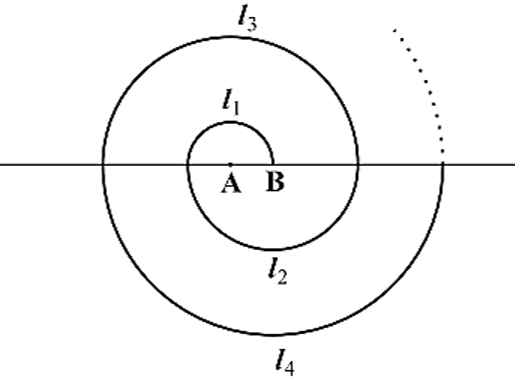
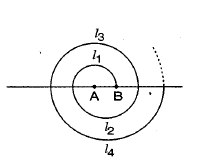
A spiral is made up of successive semicircles, with centres alternately at $A$ and $B,$ starting with centre at $A,$ of radii $0.5\ cm, 1.0\ cm, 1.5\ cm, 2.0\ cm, ...$ as shown in Figure. What is the total length of such a spiral made up of thirteen consecutive semicircles? $(Take\; \pi = \frac { 22 } { 7 } )$
$[$Hint: Length of successive semicircles is $l_1, l_2, l_3, l_4, ...$ with centres at $A, B, A, B, ... $ respectively.$]$​​​​​​​
Image
Answer
According to question we are given that a spiral is made up of successive semi-circles, with centres alternately at $A$ and $B,$ starting with centre at $A,$ of radii $0.5\ cm, 1.0 \ cm, 1.5 \ cm, 2.0 \ cm, ....$as shown in Fig.
Let $l_1, l_2, l_3, l_4,..l_{13}$ be the lengths $($circumferences$)$ of semi-circles of radii $r_1= 0.5\ cm, r_2=1.0\ cm, r_3= 1.5\ cm, r_4= 2.0\ cm, r_5= 2.5 cm,...$ respectively.

Now, Semi-perimeter of circle $= \pi\cdot r $
Therefore,
$l _ { 1 } = \pi r _ { 1 } = \pi \times 0.5 = \frac { \pi } { 2 } \mathrm { cm }$
$l _ { 2 } = \pi r _ { 2 } = \pi \times 1 = 2 \left( \frac { \pi } { 2 } \right) \mathrm { cm }$
$l _ { 3 } = \pi r _ { 3 } = \pi \times \frac { 3 } { 2 } = 3 \left( \frac { \pi } { 2 } \right) \mathrm { cm }$
$l _ { 4 } = \pi r _ { 4 } = \pi \times 2 = 4 \left( \frac { \pi } { 2 } \right) \mathrm { cm }$
and
$l _ { 13 } = \pi r _ { 13 } = \pi \times \frac { 13 } { 2 } \mathrm { cm } = 13 \left( \frac { \pi } { 2 } \right) \mathrm { cm }$
Therefore total length of the spiral $= l_1+ l_2+ l_3+...+ l_{13}$
$\bf= \left\{ \frac { \pi } { 2 } + 2 \left( \frac { \pi } { 2 } \right) + 3 \left( \frac { \pi } { 2 } \right) + \dots + 13 \left( \frac { \pi } { 2 } \right) \right\} $
$\bf= \frac { \pi } { 2 } ( 1 + 2 + 3 + \cdots + 13 ) $
$\bf= \frac { \pi } { 2 } \times \frac { 13 } { 2 } ( 1 + 13 ) \quad \left[ \text { Using } S _ { n } = \frac { n } { 2 } ( a + l ) \right]$
$\bf= \frac { \pi } { 2 } \times \frac { 13 } { 2 } \times 14$ = $\bf\frac { 1 } { 2 } \times \frac { 22 } { 7 } \times 13 \times 7$ = $\bf {143 cm}$
which is required length of the spiral made up of thirteen consecutive semi-circles.
View full question & answer
Question 64 Marks
A sum of $₹\ 700$ is to be used to give seven cash prizes to students of a school for their overall academic performance. If, each prize is $₹\ 20$ less than its preceding term, find the value of each of the prizes.
Answer
It is given that the sum of seven cash prizes is equal to $₹\ 700.$
And, each prize is $₹\ 20$ less than its preceding term.
Let the value of first prize $= ₹\ a$
Let the value of second prize $=₹ \ (a−20)$
Let the value of third prize $= ₹\ (a−40)$
So, we have a sequence of the form:
$a, a−20, a−40, ...................$
It is an arithmetic progression because the difference between consecutive terms is constant.
First term $= a,$ Common difference $= d = (a − 20) − a= −20$
$n = 7 ($Because there are total of seven prizes$)$
$S_7= ₹\ 700$ {given}
Applying formula, ${S_n} = \frac{n}{2}\left[ {2a + (n - 1)d} \right]$ to find sum of $n$ terms of $AP ,$ we get
${S_7} = \frac{7}{2}\left[ {2a + (7 - 1)( - 20)} \right]\;\;$
$\Rightarrow 700 = \frac{7}{2}[2a - 120]$
$⇒ 200 = 2a− 120$
$⇒ 320 = 2a$
$⇒ a =160$
Therefore, value of first prize $= ₹\ 160$
Value of second prize $= 160 - 20= ₹\ 140$
Value of third prize $= 140 - 20= ₹\ 120$
Value of fourth prize $= 120 - 20 = ₹\ 100$
Value of fifth prize $= 100 - 20 = ₹\ 80$
Value of sixth prize $= 80 - 20 = ₹\ 60$
Value of seventh prize $= 60 - 20 = ₹\ 40$
View full question & answer
Question 74 Marks
Find the sum of the odd numbers between $0$ and $50.$
Answer
The odd numbers between $0$ and $50$ are $1, 3, 5, 7, ....., 49.$
$\text { Here, } a_2-a_4=3-1=2$
$ a_3-a_2=5-3=2 $
$ a_4-a_3=7-5=2$
i.e. $a_{k+1} - a_k$ is the same everytime.
So, the above list of numbers forms an $AP.$
Here, $a = 1$
$d = 2$
$l = 49$
Let the number of terms of the $AP$ be $n.$
Then, $l = a + (n - 1)d$
$ \Rightarrow 49 = 1 + (n - 1)d$
$ \Rightarrow (n - 1)2 = 48$
$ \Rightarrow n - 1 = \frac{{48}}{2}$
$ \Rightarrow n - 1 = 24$
$ \Rightarrow n = 24 + 1$
$ \Rightarrow n = 25 $
Hence, the number of terms of the $AP$ be $25.$
$\therefore $ Sum of the odd numbers between 0 and $50 = S_{25}$
$ = \frac{{25}}{2}(a + l)$ ......$\because {S_n} = \frac{n}{2}(a + l)$
$ = \left( {\frac{{25}}{2}} \right)(1 + 49)$
$ = \left( {\frac{{25}}{2}} \right)(50)$
$= (25) (25)$
$= 625$
View full question & answer
Question 84 Marks
Show that $a_1, a_2, ........, a_n$, form an $AP$ where $a_n= 9 - 5n.$
Answer
We have $a_n= 9 - 5n$
Put $n = 1, 2, 3, 4,....$ in succession, we get
$a_1=9-5(1)=9-5=4 $
$a_2=9-5(2)=9-10=-1 $
$a_3=9-5(3)=9-15=-6 $
$a_4=9-5(4)=9-20=-11$
: : :
$\therefore $ $ a_2-a_1=-1-4=-5$
$ a_3-a_2=-6-(-1)=-6+1=-5$
$ a_4-a_5=-11-(-6)=-11+6=-5$
i.e. $a_{k+1}-a_k$ is the same everytime
So, $a_1, a_2, \ldots, an, ...... $ form an $AP$
Here, $a=a_1=4$
$a=a_2-a_1=-5$
$\therefore $ Sum of the first $15$ terms $= S_{15}$
$ = \frac{{15}}{2}\left[ {2a + (n - 1)d} \right]$ $\because {S_n} = \frac{n}{2}[2a + (n - 1)d]$
$ = \frac{{15}}{2}\left[ {2 \times a + (15 - 1)d} \right]$
$ = \frac{{15}}{2}\left[ {2a + 14d} \right]$
$= 15(a + 7d)$
$= (15) [4 + 7(-5)]$
$= (15) (4 - 35)$
$= (15) (-31)$
$= -465$
View full question & answer
Question 94 Marks
The sum of the $4th$ and $8th$ terms of an $AP$ is $24$ and the sum of the $6th$ and $10th$ term is $44.$ Find the first three terms of the $AP.$
Answer
Let the first term and the common difference of the $AP$ be a and d respectively.
Then,
$4th$ term $= a + (4 - 1)d = a + 3d \because {a_n} = a + (n - 1)d$
$8th$ term $ = a + (8 - 1)d = a + 7d \because {a_n} = a + (n - 1)d$
$6th$ term $= a + (6 - 1)d = a + 5d \because {a_n} = a + (n - 1)d$
and $10th$ term $= a + (10 - 1)d = a + 9d \because {a_n} = a + (n - 1)d$
According to the question,
$4^{\text {th }}$ term $+8^{\text {th }}$ term $=24$
$ \Rightarrow (a + 3d) + (a + 7d) = 24 $
$ \Rightarrow 2a + 10d = 24$
$ \Rightarrow a + 5d = 12 .......... (1) ($Dividing throughout by $2)$
$6th$ term $+$ $10th$ term $= 24$
$ \Rightarrow (a + 5d) + (a + 9d) = 44$
$ \Rightarrow 2a + 14d = 44$
$ \Rightarrow a + 7d = 22 .......... (2) ($Dividing throughout by $2)$
Solving $(1)$ and $(2),$ we get
$a = -13$
$d = 15$
So, First term $= -13$
Second term $= -13 + 5 = -8$
Third term $= -8 + 5 = -3$
Hence, the first three terms of the given $AP$ are $-13, -8$ and $-3.$
View full question & answer
Question 104 Marks
Find the $20th$ term from the last term of the $AP : 3, 8, 13, …., 253.$
Answer
The given $AP$ is $3, 8, 13, ..., 253$
Here, $a = 3$
$d = 8 - 3 = 5$
$l = 253$
Let the number of terms of the $AP$ be $n.$
Term, nth term $= l$
$ \Rightarrow  3 + (n - 1)5 = 253  \because {a_n} = a + (n - 1)d$
$ \Rightarrow (n - 1)5 = 253 - 3$
$ \Rightarrow (n - 1)5 = 250 $
$ \Rightarrow n - 1 = \frac{{250}}{5}$
$ \Rightarrow n - 1 = 50$
$ \Rightarrow n = 50 + 1$
$ \Rightarrow n = 51$
So, there are $51$ terms in the given $AP.$
Now, $20th $ term from the last term
$= (51 - 20 + 1)th$ term from the beginning
$= 32th$ term from the beginning
$= 3 + (32 - 1)5 \because {a_n} = a + (n - 1)d$
$= 3 + 155$
$= 158$
Hence, the $20th$ term from the last term of the given $AP$ is $158.$
Aliter. Let us write the given $AP$ in the reverse order.
Then the $AP$ becomes $253, 248, 243, ...., 3$
Here, $a = 253$
$d = 248 - 253 = -5$
Therefore, required term
$= 20th$ term of the $AP$
$= 253 + (20 - 1) (-5) \because {a_n} = a + (n - 1)d$
$= 253 - 95$
$= 158$
Hence, the $20th$ term from the last term of the given $AP$ is $158.$
View full question & answer
Question 114 Marks
Fill in the blanks in the following table, given that a is the first term, $d$ is the common difference and $a_n$ is the $n^{th}$ term of the $AP:$
  $a$ $d$ $n$ $a_n$
$i$ $7$ $3$ $8$ $...$
$ii$ $-18$ $...$ $10$ $0$
$iii$ $...$ $-3$ $18$ $-5$
$iv$ $-18.9$ $2.5$ $...$ $3.6$
$v$ $3.5$ $0$ $105$ $...$
Answer
  1. Given: $a = 7, d = 3$ and $n = 8,$
    $a_n= ?$
    We know that $a_n= a + (n – 1)d$
    Thus, $a_8= 7 + (8 – 1)3 = 7 + 21 = 28$
  2. Given: $a = - 18, n = 10, a_n= 0, d = ?$
    We know that $a_n= a + (n – 1)d$
    Thus, $0 = - 18 + (10 – 1)d$
    $0 = -18 + 9d$
    or, $9d = 18$
    $d = 18/9 = 2$
  3. Given: $d = - 3, n = 18, a_n= - 5, a = ?$
    We know that $a_n= a + (n – 1)d$
    $-5 = a + (18 - 1) (-3)$
    $-5 = a - 51$
    or $a = -5 + 51 = 46$
  4. Given: $a = -18.9, d = 2.5,  a_n = 3.6, n = ?$
    We know that $a_n= a + (n – 1)d$
    $3.6 = – 18.9 + (n – 1)2.5$
    or, $2.5(n – 1) = 3.6 + 18.9 = 22.5$
    $n – 1 = 22.5/2.5 = 9$
    $n = 9 + 1 = 10$
  5. Given: $a = 3.5, d = 0, n = 105, a_n = ?$
    We know $a_n=a + (n - 1)d$
    $a_{105}= 3.5 + (105 - 1)0$
    $a_{105}= 3.5 + 0$
    $a_{105}= 3.5$
View full question & answer
Question 124 Marks
Ramkali saved ₹5 in the first week of a year and then increased her weekly savings by ₹1.75. If in the n,th week, her weekly savings becomes ₹20.75 find n.
Answer
Here, a = ₹ 5
d = ₹ 1.75
an = ₹ 20.75
We know that
an = a + (n - 1)d
$ \Rightarrow $ 20.75 = 5 + (n - 1)d
$ \Rightarrow $ (n - 1) (1.75) = 20.75 - 5
$ \Rightarrow $ (n - 1) (1.75) = 15.75
$ \Rightarrow n - 1 = \frac{{15.75}}{{1.75}}$
$ \Rightarrow $ n - 1 = 9
$ \Rightarrow $ n = 10
Hence, the required value of n is 10.
View full question & answer
4 Marks Questions - Maths STD 10 Questions - Vidyadip