Question 14 Marks
The $17^{\text {th }}$ term of an $A.P.$ is $5$ more than twice its $8^{\text {th }}$ term. If the $11^{\text {th }}$ term of the $A.P.$ is $43$ . find the $n^{\text {th }}$ term.
AnswerGiven,
$a_{17}= 5 + 2(a_8) .....(i)$
and $a_{11}= 43$
We know, $a_n= a + (n - 1)d$
$8^{th}$ term, $a_8= a + (8 - 1)d$
$\Rightarrow a_8= a + 7d$
$11^{th}$ term, $a_{11} = a + (11 - 1)d$
$\Rightarrow 43 = a + 10d$
$\Rightarrow a = 43 - 10d .....(2)$
$17^{th}$ term, $a_{17} = a + (17 - 1)d$
$\Rightarrow a_{17}= a + 16d$
$\Rightarrow a_{17} = 43 - 10d + 16d$
$\Rightarrow a_{17}= 43 + 6d$
By putting value of $a_8$ and $a_{17}$ in eq. $(i)$
$\Rightarrow 43 + 6d = 5 + 2(a + 7d)$
$\Rightarrow 43 + 6d = 5 + 2a + 14d$
$\Rightarrow 43 - 5 = 2a + 14d - 6d$
$\Rightarrow 38 = 2a + 8d$
$\Rightarrow 38 = 2(43 - 10d) + 8d [$by eq. $(ii)]$
$\Rightarrow 38 = 86 - 20d + 8d$
$\Rightarrow 38 = 86 - 12d$
$\Rightarrow 12d = 86 - 38$
$\Rightarrow\ \text{d}=\frac{48}{12}=4$
From eq. $(ii) a = 43 - 10d$
$= 43 - 10 \times 4$
$= 43 - 40 = 3$
We know, $n^{th}$ term of A.P.
$a_n= a + (n - 1)d$
$= 3 + (n - 1)4$
$= 3 + 4n - 4$
$\Rightarrow a_n= 4n - 1$
Hence, $n^{th}$ term $4n - 1.$
View full question & answer→Question 24 Marks
How many terms of the A.P. $63, 60, 57, .....$ must be taken so that their sum is $693?$
AnswerGiven,
A.P. $63, 60, 57, .....$
and Sum of terms, $S_n= 693$
Here, First term $a = 63$
and Difference $d = 60 - 63 = -3$
We know, $\text{S}_\text{n}=\frac{\text{n}}{2}[2\text{a}+(\text{n}-1)\text{d}]$
$\Rightarrow\ 693=\frac{\text{n}}{2}[2(63)+(\text{n}-1)(-3)]$
$⇒ 693 × 2 = n[126 - 3n + 3]$
$⇒ 1386 = n[129 - 3n]$
$⇒ 1386 = 129n - 3n^2$
$⇒ 3n^2- 129n + 1386 = 0$
$⇒ 3(n^2- 43n + 462) = 0$
$⇒ n^2- 43n + 462 = 0$
$⇒ n^2- 22n - 21n + 462 = 0$
$⇒ n(n - 22) - 21(n - 22) = 0$
$⇒ (n - 22)(n - 21) = 0$
Now,
$n - 22 = 0$ and $n - 21 = 0$
$n = 22, n = 21$
Hence, no of terms are $21$ and $22.$
View full question & answer→Question 34 Marks
The sum $4^{\text {th }}$ and $8^{\text {th }}$ terms of an $A.P.$ is $24$ and the sum of $6^{\text {th }}$ and $10^{\text {th }}$ terms is $44 $. Find the $A.P.?$
Answer$\text { Given, } a_4+a_8=24 \ldots \ldots . \text { (i) } $
$ a_6+a_{10}=44 \ldots . . . \text { (ii) }$
We know, $a_n=a+(n-1) d$
Then,
$ 4^{\text {th }} \text { term, } a_4=a+(4-1) d $
$ \Rightarrow a 4=a+3 d $
$ 6^{\text {th }} \text { term, } a_6=a+(6-1) d $
$ \Rightarrow a_6=a+5 d $
$ 8^{\text {th }} \text { term, } a_8=a+(8-1) d $
$ \Rightarrow a_8=a+7 d $
$ 10^{\text {th }} \text { term, } a_{10}=a+(8-1) d $
$ \Rightarrow a_{10}=a+9 d$
Put the value of $a_4$ and $a_8$ in eq. (i)
$ \Rightarrow a+3 d+a+7 d=24 $
$ \Rightarrow 2 a+10 d=21 \ldots \ldots .(\text { iii) }$
Put the value of $\mathrm{a}_6$ and $\mathrm{a}_{10}$ in eq (ii)
$⇒ a + 5d + a + 9d = 44$
$⇒ 2a + 14d = 44 .....(iv)$
By substituting eq. (iii) from (iv)
$⇒ 2a + 14d - (2a + 10d) = 44 - 24$
$⇒ 2a + 14d - 2a - 10d = 20$
$⇒ 4d = 20$
$⇒ d = 5$
By putting value of d in eq. (iii)
$⇒ 2a + 10(5) = 24$
$⇒ 2a + 50 = 24$
$⇒ 2a = 24 - 50$
$⇒ a = -13$
We know, A.P. is
$a, a + d, a + 2d, .....$
$⇒ -13, -13 + 5, -13 + 2(5), .....$
$⇒ -13, -8, -13 + 10, .....$
$⇒ -13, -8, -3, .....$
Hence, A.P. is $-13, -8, -3, .....$
View full question & answer→Question 44 Marks
The sum of first seven terms of an $A.P$. is $182$ . If its $4^{\text {th }}$ and the $17^{\text {th }}$ terms are in the ratio $1: 5$, find the $A.P.$
AnswerLet a be the first term and d be the common difference.
We know that, sum of first n terms $=\text{S}_\text{n}=\frac{\text{n}}{2}[2\text{a}+(\text{n}-1)\text{d}]$
According to the question,
$S_7= 182$
$\Rightarrow\ \frac{7}{2}[2\text{a}+(7-1)\text{d}]=182$
$\Rightarrow\ \frac{1}{2}(2\text{a}+6\text{d})=26$
$\Rightarrow\ \text{a}+3\text{d}=26$
$\Rightarrow\ \text{a}=26-3\text{d}\ .....(\text{i})$
Also,
$\frac{\text{a}_4}{\text{a}_{17}}=\frac{1}{5}$
$\Rightarrow\ \frac{\text{a}+(4-1)\text{d}}{\text{a}+(17-1)\text{d}}=\frac{1}{5}$
$\Rightarrow\ \frac{\text{a}+3\text{d}}{\text{a}+16\text{d}}=\frac{1}{5}$
$\Rightarrow\ 5(\text{a}+3\text{d})=\text{a}+16\text{d}$
$\Rightarrow\ 5\text{a}+15\text{d}=\text{a}+16\text{d}$
$\Rightarrow\ 5\text{a}-\text{a}=16\text{d}-15\text{d}$
$\Rightarrow\ 4\text{a}=\text{d}\ .....(\text{ii})$
On Substituting $(ii)$ in $(i)$, we get
$a = 26 - 3(4a)$
$\Rightarrow a = 26 - 12a$
$\Rightarrow 12a + a = 26$
$\Rightarrow 13a = 26$
$\Rightarrow a = 2$
$\Rightarrow d = 4 \times 2 $[From $(ii)]$
$\Rightarrow d = 8$
Thus, the $A.P$. is $2, 10, 18, 26, .....$
View full question & answer→Question 54 Marks
The $6^{\text {th }}$ and $17^{\text {th }}$ terms of an $A.P.$ are $19$ and $41$ respectively, find the $40^{\text {th }}$ term?
Answer$6^{\text {th }}$ term $=a_6=19$
and $17^{\text {th }}$ term $=a_{17}=41$
We know, $\mathrm{n}^{\text {th }}$ term of A.P.
$a n=a+(n-1) d$
Then, $6^{\text {th }}$ term,
$ \Rightarrow a_6=a+(6-1) d $
$ \Rightarrow 19=a+5 d \ldots . . .(i)$
and $17^{\text {th }}$ term,
$\Rightarrow a_{17}=a+(17-1) d $
$ \Rightarrow 41=a+16 d \ldots . . .(i i)$
by substuting eq. (i) from (ii)
$ \Rightarrow 41-19=(a+16 d)-(a+5 d) $
$ \Rightarrow 22=a+16 d-a-5 d $
$ \Rightarrow 22=11 d $
$ \Rightarrow d=\frac{22}{11} $
$ \Rightarrow d=2$
Now from eq. $(i)$
$\Rightarrow 19=a+5 d $
$ \Rightarrow 19=a+5 \times 2 $
$ \Rightarrow a=19-10 $
$ \Rightarrow a=9$
We have to find $40^{\text {th }}$ term then putting $n=40$
$ a_{40}=a+(40-1) d $
$ =9+39 \times 2 $
$ \Rightarrow a_{40}=87$
Hence, $40^{\text {th }}$ term is 87.
View full question & answer→Question 64 Marks
Find the common difference of the $A.P$. and write the next two terms:
$0,\frac{1}{4},\frac{1}{2},\frac{3}{4}, .....$
AnswerGiven,
$0,\frac{1}{4},\frac{1}{2},\frac{3}{4}, .....$
$\text{a}_1=0,\text{a}_2=\frac{1}{4},\text{a}_3=\frac{1}{2},\text{a}_4=\frac{3}{4}$
Difference between terms
$\text{d}_1=\text{a}_2-\text{a}_1=\frac{1}{4}-0=\frac{1}{4}$
$\text{d}_2=\text{a}_3-\text{a}_2=\frac{1}{2}-\frac{1}{4}=\frac{1}{4}$
and $\text{d}_3=\text{a}_4-\text{a}_3=\frac{3}{4}-\frac{1}{2}=\frac{1}{4}$
So, common difference is $\frac{1}{4}$
New, next two terms:
$a_n= a_{n-1}+ d$
$5^{th}$ term,
$\text{a}_5=\text{a}_{5-1}+\frac{1}{4}$
$=\text{a}_4+\frac{1}{4}$
$\Rightarrow\ \text{a}_5=\frac{3}{4}+\frac{1}{4}=\frac{4}{4}=1$
$6^{th}$ term.
$\text{a}_6=\text{a}_{6-1}+\frac{1}{4}$
$=\text{a}_5+\frac{1}{4}$
$\Rightarrow\ \text{a}_6=1+\frac{1}{4}=\frac{4+1}{4}=\frac{5}{4}$
Hence, common difference is $\frac{1}{4}$ and next two terms 1 and $\frac{5}{4}$.
View full question & answer→Question 74 Marks
The students of a school decided to beautify the school on the annual day by fixing colourful on the straight passage of the school. They have $27$ flags to be fixed at intervals of every $2$ metre. The flags are stored at the position of the middle most flag Ruchi was given the responsibility of placing the flags. Ruchi kept her books where the flags were stored. She could carry only one flag at a time. How much distance did she cover in completing this job and returning back to collect her books? What is the maximum distance she travelled carrying a flag?
AnswerGiven that, the students of a school decided to beautify the school on the annual day by fixing colourful flags on the straight passage of the school.
Given that, the number of flags $= 27$
and distance between each flag $= 2m.$
Also, the flags are stored at the position of the middle most flag i.e., $14^{th}$ flag and Ruchi was given the responsibility of placing the flags.
Ruchi kept her books, where the flags were stored i.e., $14^{th}$ flag and she could carry only one flag at a time.
Let she placed 13 flags into her left position from middle most flag i.e., $14^{th}$ flag.
For placing second flag and return his initial position distance travelled $= 2 + 2 = 4m.$
Similarly, for placing third flag and return his initial position, distance travelled $= 4 + 4 = 8m.$
For placing fourth flag and return his initial position, distance travelled $= 6 + 6 = 12m.$
For placing fourteenth flag and return his initial position, distance travelled $= 26 + 26 = 52m.$
Proceed same manner into her right position from middle most flag i.e., $14^{th}$ flag.
Total distance travelled in that case $= 52m.$
Also, when Ruchi placed the last flag she return her middle position and collect her books.
This distance also included in placed the last flag.
So, these distances from a series.
$4 + 8 + 12 + 16 + ..... + 52$ [for left]
and $4 + 8 + 12 + 16 + ..... + 52$ [for right].
Total distance covered by Ruchi for placing these flags
$= 2 × (4 + 8 + 12 + ..... +52).$
$=2\times\Big[\frac{13}{2}\{2\times4+(13-1)\times(8-4)\}\Big]$
$\begin{Bmatrix}\because\frac{\text{Sumpf n terms of an A.P.}}{\text{S}_\text{n}=\frac{\text{n}}{2}[2\text{a}+(\text{n}-1)\text{d}]} \end{Bmatrix}$
$=2\times\Big[\frac{13}{2}(8+12\times4)\Big]$
[$\because$ both sides of Ruchi number of flags i.e., n $= 13]$
$= 2 × [13(4 + 12 × 2)] = 2 × 13(4 + 24)$
$= 2 × 13 × 28 = 728m$
Hence, the required is 728m in which she did cover in completing this job and returning back to collect her books.
Now, the maximum distance she travelled carrying a flag = Distance travelled by Ruchi during placing the $14^{th}$ flag in her left position or $27^{th}$ flag in her right position
$= (2 + 2 + 2 + ..... + 13$ times$)$
$= 2 × 13 = 26m.$
Hence, the required maximum distance she travelled carrying a flag is $26\ m.$
View full question & answer→Question 84 Marks
A man arranges to pay off a debt of Rs $3600$ by $40$ annual instalments which form an arithmetic series. When $30$ of the instalments are paid, he dies leaving one-third of all debt unpaid, find the value of the first instalment.
AnswerIn the given problem,
Total amount of debt to be paid in $40$ installments Rs. $3600$
After $30$ installments one-third of his debt is left unpaid. This means that he paid two third of the debt in $30$ installments. So,
Amount he paid in $30$ installments $=\frac{2}{3}(3600)$
$= 2(1200)$
$= 2400$
Let us take the first installment as a and common difference as d.
So, using the formula for the sum of n terms of an $A.P,$
$\text{S}_\text{n}=\frac{\text{n}}{2}[2\text{a}+(\text{n}-1)\text{d}]$
Let us find a and d, for 30 installments.
$\text{S}_{30}=\frac{30}{2}[2\text{a}+(30-1)\text{d}]$
$2400=15[2\text{a}+(29)\text{d}]$
$\frac{2400}{15}=2\text{a}+29\text{d}$
$160=2\text{a}+29\text{d}$
$\text{a}=\frac{160-29\text{d}}{2}\ .....\text{(i)}$
Similarly, we find a and d for 40 installments.
$\text{S}_{40}=\frac{40}{2}[2\text{a}+(40-1)\text{d}]$
$3600=20[2\text{a}+(39)\text{d}]$
$\frac{3600}{20}=2\text{a}+39\text{d}$
$180=2\text{a}+39\text{d}$
$\text{a}=\frac{180-39\text{d}}{2}\ .....\text{(ii)}$
Subtracting $(i)$ from $(ii)$, we get,
$\text{a}-\text{a}=\bigg(\frac{180-39\text{d}}{2}\bigg)-\bigg(\frac{160-29\text{d}}{2}\bigg)$
$0=\frac{180-39\text{d}-160+29\text{d}}{2}$
$0=20-10\text{d}$
Furhter solving for d,
$10\text{d}=20$
$\text{d}=\frac{20}{10}$
$\text{d}=2$
Substituting the value of d in $(i)$, we get,
$\text{a}=\frac{160-29(2)}{2}$
$=\frac{160-58}{2}$
$=\frac{102}{2}$
$=51$
Therefore, the first installment is Rs. $51$
View full question & answer→Question 94 Marks
In an $A.P.$, the sum of first ten terms is -$150$ and the sum of its next ten terms is -$550$. Find the $A.P.$
AnswerHere, we are given $S_{10}= -150$ and sum of the next ten terms is $-550.$
Let us take the first term of the $A.P.$ as a and the common difference as d.
So, let us first find $a_{10}$. For the sum of first $10$ terms of this $A.P,$
First term $= a$
Last term $= a_{10}$
So, we know,
$a_n= a + (n - 1)d$
For the $10^{th}$ term $(n = 10),$
$a_{10}= a + (10 - 1)d$
$= a + 9d$
So, here we can find the sum of the n terms of the given $A.P.,$
$\text{S}_\text{n}=\Big(\frac{\text{n}}{2}\Big)(\text{a}+\text{l})$
using the formula,
Where, a = the first term
$l =$ the last term
So, for the given $A.P,$
$\text{S}_{10}=\Big(\frac{10}{2}\Big)(\text{a}+\text{a}+9\text{d})$
$-150=5(2\text{a}+9\text{d})$
$-150=10\text{a}+45\text{d}$
$\text{a}=\frac{-150-45\text{d}}{10}\ .....(\text{i})$
Similarly, for the sum of next 10 terms $(S_{10})$,
First term $= a_{11}$
Last term $= a_{20}$
For the $11^{\text {th }}$ term $(n=11)$,
$ a_{11}=a+(11-1) d $
$ =a+10 d$
For the $20^{\text {th }}$ term $(\mathrm{n}=20)$,
$a_{20}=a+(20-1) d$
$ =a+19 d$
So, for the given $A.P,$
$\text{S}_{10}=\frac{10}{2}[\text{a}+10\text{d}+\text{a}+19\text{d}]$
$-550=5(2\text{a}+29\text{d})$
$-550=10\text{a}+145\text{d}$
$\text{a}=\frac{-550-145\text{d}}{10}\ .....\text{(ii)}$
Now, subtracting (i) from (ii),
$\text{a}-\text{a}=\Big(\frac{-550-145\text{d}}{10}\Big)-\Big(\frac{-150-45\text{d}}{10}\Big)$
$0=\frac{-550-145\text{d}+150+45\text{d}}{10}$
$0=-400-100\text{d}$
$100\text{d}=-400$
$\text{d}=-4$
Substituting the value of d in $(i)$
$\text{a}=\frac{-150-45(-4)}{10}$
$=\frac{-150+180}{10}$
$=\frac{30}{10}$
$=3$
So, the $A.P$. is $3, -1, -5, -9, .....$ with $a = 3, d = -4.$
View full question & answer→Question 104 Marks
How many terms are there in the $A.P.?$
$-1,\frac{5}{6},\frac{2}{3},\frac{1}{2}, .....\frac{10}{3}.$
AnswerHere, A.P. is $-1,\frac{5}{6},\frac{2}{3},\frac{1}{2}, .....\frac{10}{3}.$
The first term $(a) = -1$
The last term $(\text{a}_\text{n})=\frac{10}{3}$
Now,
Common difference $(d) = a_1- a$
$=-\frac{5}{6}-(-1)$
$=-\frac{5}{6}+1$
$=\frac{-5+6}{6}$
$=\frac{1}{6}$
Thus, using the above mentioned formula, we get,
$\frac{10}{3}=-1+(\text{n}-1)\frac{1}{6}$
$\frac{10}{3}+1=\frac{1}{6}\text{n}-\frac{1}{6}$
$\frac{13}{3}+\frac{1}{6}=\frac{1}{6}\text{n}$
Further solving for n, we get
$\frac{26+1}{6}=\frac{1}{6}\text{n}$
$\text{n}=\frac{27}{6}(6)$
$\text{n}=27$
Thus, $n = 27$
Therefore, the number of terms present in the given $A.P$. is $27.$
View full question & answer→Question 114 Marks
The $24^{\text {th }}$ term of an $A.P.$ is twice its $10^{\text {th }}$ term. Show that its $72^{\text {nd }}$ term is 4 times its $15^{\text {th }}$ term.
AnswerLet a be the first term and $d$ be the common difference.
We know that, $n^{\text {th }}$ term $=a_n=a+(n-1) d$
According to the question,
$ a_{24}=2 a_{10} $
$ \Rightarrow a+(24-1) d=2(a+(10-1) d) $
$ \Rightarrow a+23 d=2 a+18 d $
$ \Rightarrow 23 d-18 d=2 a-a $
$ \Rightarrow 5 d=a $
$ \Rightarrow a=5 d....(i)$
Also,
$ a_{72}=a+(72-1) d $
$ a_{72}=5 d=71 d[a=5 d \text { From (i) }] $
$ =76 d \ldots . . .(i i)$
$ \text { and } a_{15}=a+(15-1) d $
$ =5 d+14 d[\text { from (i)] } $
$ =19 \mathrm{~d} . \ldots . \text { (iii) }$
On comparing $(ii)$ and $(iii)$, we get
$76 d=4 \times 19 d $
$ \Rightarrow a_{72}=4 \times a_{15}$
Thus, $72^{\text {nd }}$ term of the given $A.P.$ is $4$ times its $15^{\text {th }}$ term.
View full question & answer→Question 124 Marks
All integers from $1$ to $500$ which are multiplies of $2$ or $5.$
AnswerSince, multiples of $2$ ot $5 =$ Multiple of $2 +$ Multiples of $5 -$ Multiples of $LCM (2, 5)$ i.e., $10$.
$\therefore$ MUltiples of $2$ or $5$ from $1$ to $500$
= List of multiples of 2 from $1$ to $500$ + list of multiple of 5 from $1$ to $500$ - list of multiple of $10$ from $1$ to $500$
$= (2, 4, 6, ....., 500) + (5, 10, 15, ....., 500) - (10, 20, ....., 500)$
All of these list from an $A.P.$
Now, number of terms in first list,
$500=2+\left(n_1-1\right) 2 \Rightarrow 498=\left(n_1-1\right) 2 $
$ \Rightarrow n_1-1=249 \Rightarrow n_1=250$
Number of terms in second list,
$ 500=5+\left(n_2-1\right) 5 \Rightarrow 495=\left(n_2-1\right) 5$
$ \Rightarrow 99=\left(n_2-1\right) \Rightarrow n_2=100$
and number of terms in third list,
$ 500=10+\left(n_3-1\right) 10 \Rightarrow 490=\left(n_3-1\right) 10$
$ \Rightarrow n_3-1=49 \Rightarrow n_3=50$
From Eq. (i), Sum of multiples of 2 or 5 from $1$ to $500$
$= $Sum of $(2, 4, 6, ....., 500) + $Sum of $(5, 10, ....., 500) - $Sum of $(10, 20, ...., 500)4$
$=\frac{\text{n}_1}{2}[2+500]+\frac{\text{n}_2}{2}[5+500]-\frac{\text{n}_3}{2}[10+500]$
$\Big[\because\ \text{S}_\text{n}=\frac{\text{n}}{2}(\text{a}+\text{l})\Big]$
$=\frac{250}{2}\times502=\frac{100}{2}\times505-\frac{50}{2}\times510$
$= 250 × 251 + 505 × 50 - 25 × 510$
$= 62750 + 25250 - 12750$
$= 88000 - 12750$
$= 75250$
View full question & answer→Question 134 Marks
The $26^{th}, 11^{th}$ and last term of an $A.P.$ are $0, 3$ and $-\frac{1}{5},$ respectively. Find the common difference and the number of terms.
AnswerLet the first term, common difference and number of terms of an $A.P$. are a, d and n, respectively.
We know that, if last term of an $A.P$. is known, then
$l = a + (n – 1) d ……(i)$
and $\mathrm{n}^{\text {th }}$ term of an $A.P$ is
$T_n=a+(n-1) d \ldots . .(\text { ii) }$
Given that, $26^{\text {th }}$ term of an A.P. $=0$
$ \Rightarrow T_{26}=a+(26-1) d=0[\text { From eq. (i)] } $
$ \Rightarrow a+25 d=0 \ldots . . \text { (iii) }$
$11^{\text {th }}$ term of an A.P. $=3$
$\Rightarrow T_{11}=a+(11-1) d=3[$ From eq. $(ii)]$
$\Rightarrow a + 10d = 3 .....(iv)$
and last term of an A.P. $=-\frac{1}{5}$
$\Rightarrow l = a + (n - 1)d [$From eq. $(i)]$
$\Rightarrow\ -\frac{1}{5}=\text{a}+(\text{n}-1)\text{d}$
Now, subtracting Eq. $(iv)$ from Eq. $(iii),$
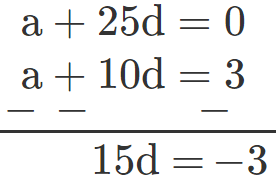
$\Rightarrow\ \text{d}=-\frac{1}{5}$
Put the value of d in Eq. $(iii)$, we get
$\text{a}+25\Big(-\frac{1}{5}\Big)=0$
$\Rightarrow a - 5 = 0 \Rightarrow a = 5$
Now, put the value of a, d in Eq. (v), we get
$-\frac{1}{5}=5+(\text{n}-1)\Big(-\frac{1}{5}\Big)$
$\Rightarrow -1 = 25 - (n - 1)$
$\Rightarrow -1 = 25 - n + 1$
$\Rightarrow n = 25 + 2 = 27$
Hencem the common difference and number of terms are $-\frac{1}{5}$ and $27$, respectively. View full question & answer→Question 144 Marks
Find the sum of the following arithmetic progressions:
$\frac{\text{x}-\text{y}}{\text{x}+\text{y}}\frac{3\text{x}-2\text{y}}{\text{x}+\text{y}}\frac{5\text{x}-3\text{y}}{\text{x}+\text{y}}, .....\text{ to n terms.}$
AnswerIn an $A.P$. let first term = a, common difference = d, and there are n terms. Then, sum of n terms is,
$\text{S}_\text{n}=\frac{\text{n}}{2}\{2\text{a} + (\text{n} - 1)\text{d}\}$
Given, $\frac{\text{x}-\text{y}}{\text{x}+\text{y}}\frac{3\text{x}-2\text{y}}{\text{x}+\text{y}}\frac{5\text{x}-3\text{y}}{\text{x}+\text{y}}, .....$
Here,
First term $\text{a}=\frac{\text{x}-\text{y}}{\text{x}+\text{y}}$
Difference $\text{d}=\frac{3\text{x}-2\text{y}}{\text{x}+\text{y}}-\frac{\text{x}-\text{y}}{\text{x}+\text{y}}$
$\Rightarrow\ \text{d}=\frac{3\text{x}-2\text{y}-(\text{x}-\text{y})}{\text{x}+\text{y}}$
$\Rightarrow\ \text{d}=\frac{3\text{x}-2\text{y}-\text{x}+\text{y}}{\text{x}+\text{y}}$
$\Rightarrow\ \text{d}=\frac{2\text{x}-\text{y}}{\text{x}+\text{y}}$
No of terms $n = n$
We know, $\text{S}_\text{n}=\frac{\text{n}}{2}\{2\text{a} + (\text{n} - 1)\text{d}\}$
$\Rightarrow\ \text{S}_\text{n}=\frac{\text{n}}{2}\bigg[2\Big(\frac{\text{x}-\text{y}}{\text{x}+\text{y}}+(\text{n}-1)\frac{(2\text{x}-\text{y})}{(\text{x}+\text{y})}\bigg]$
$\Rightarrow\ \text{S}_\text{n}=\frac{\text{n}}{2}\bigg[\frac{2\text{x}-2\text{y}}{\text{x}+\text{y}}+\frac{\text{n}(2\text{x}-\text{y})-1(2\text{x}-\text{y})}{\text{x}+\text{y}}\bigg]$
$\Rightarrow\ \text{S}_\text{n}=\frac{\text{n}}{2}\bigg[\frac{2\text{x}-2\text{y}+\text{n}(2\text{x}-\text{y})-2\text{x}+\text{y}}{\text{x}+\text{y}}\bigg]$
$\Rightarrow\ \text{S}_\text{n}=\frac{\text{n}}{2}\bigg[\frac{\text{n}(2\text{x}-\text{y})-\text{y}}{\text{x}+\text{y}}\bigg]$
$\Rightarrow\ \text{S}_\text{n}=\frac{\text{n}}{2(\text{x}+\text{y})}[\text{n}(2\text{x}-\text{y})-\text{y}]$
Hence, sum of n terms is $\frac{\text{n}}{2(\text{x}+\text{y})}[\text{n}(2\text{x}-\text{y})-\text{y}]$.
View full question & answer→Question 154 Marks
The sum of first n terms of an $A.P$ is $5n^2+ 3n.$ If its $m^{th}$ terms is $168$, find the value of m. Also, find the $20^{th}$ term of this $A.P.$
Answer$ S_n=5 n^2+3 n, T_m=168 $
$ S_1=5(1)^2+3 \times 1=5+3=8 $
$ S_2=5(2)^2+3 \times 2=20+6=26 $
$ \therefore T_2=26-8=18\left\{\because T_2=\left(S_2-S_1\right)\right\} $
$ d=T_2-T_1 $
$ d=18-8=10, a=8 $
$ \therefore T_m=a+(m-1) d $
$ 168=8+(m-1) \times 10 $
$ \Rightarrow 168-8=(m-1) \times 10 $
$ 160=10(m-1) $
$ \frac{160}{10}=m-1 $
$ \Rightarrow m-1=16 $
$ m=16+1=17 $
$ \therefore m=17 $
$ \text { Now, } T_{20}=a+(20-1) d $
$ =8+19 \times 10=8+190=198 .$
View full question & answer→Question 164 Marks
Write the first five terms of the following sequences whose $n^{th}$ terms are:
$a_n=n^2-n+1$
Answer$a_n=n^2-n+1$
Here, the $\mathrm{n}^{\text {th }}$ term is givne by the above expression. So, to find the first term we use $\mathrm{n}=1$, we get,
$a_1=(1)^2-(1)+1 $
$ =1-1+1 $
$ =1$
Similarly, we find the other four terms,
$\text { Second term }(n=2) $
$ a_2=(2)^3-(2)+1 $
$ =4-2+1 $
$ =3 $
$ \text { Third term }(n=3) $
$ a_3=(3)^2-(3)+1 $
$ =9-3+1 $
$ =7$
Fourth term $(\mathrm{n}=4)$,
$ a_4=(4)^2-(4)+1 $
$ =16-4+1 $
$ =13$
$ \text { Fifth term }(\mathrm{n}=5) $
$ \mathrm{a}_5=(5)^2-(5)+1 $
$ =25-5+1 $
$ =21$
Therefore, the first terms for the given sequence are $a_1=1, a_2=3, a_3=7, a_4=13, a_5=21$.
View full question & answer→Question 174 Marks
Let there be an $A.P$. with first term 'a', common difference 'd'. If $a_n$ denotes in $n^{th}$ term and $S_n$ the sum of first n terms, find.
n and d, if $a = 8, a_n= 62$ and $S_n= 210.$
AnswerHere, we have an A.P. Whose $n^{th}$ term $(a_n)$, Sum of first n terms $(S_n)$ and first term (a) are given. We need to find the number of terms (n) and the common difference (d).
Here,
First term $(a) = 8$
Last term $(a_n) = 62$
Sum of n terms $(S_n) = 210$
Now, here the sum of the n terms is given by the formula,
$\text{S}_\text{n}=\Big(\frac{\text{n}}{2}\Big)(\text{a}+\text{l})$
Where, a = the first term
l = the last term
So, for the given A.P. on substituting the values in the formula for the sum of n terms of an A.P., we get,
$210=\Big(\frac{\text{n}}{2}\Big)[8+62]$
$210(2)=\text{n}(70)$
$\text{n}=\frac{420}{70}$
$\text{n}=6$
Also, here we will find the value of d using the formula.
$a_n= a + (n - 1)d$
So, Substituting the values in the above mentioned formula
$62 = 8 + (6 - 1)d$
$62 - 8 = (5)d$
$\frac{54}{5}=\text{d}$
$\text{d}=\frac{54}{5}$
Therefore, for the given A.P. $n = 6$ and $\text{d}=\frac{54}{5}$.
View full question & answer→Question 184 Marks
The first term of an $A.P$. is $5$ and its $100^{th}$ term is -292. Find the $50^{th}$ term of this $A.P.$
AnswerGiven
First term $\mathrm{a}=5$
and $100^{\text {th }}$ term $a_{100}=-292$
We know $\mathrm{n}^{\text {th }}$ term of $A.P.$
$a_n=a+(n-1) d$
then,
$ \Rightarrow a_{100}=5+(100-1) d $
$ \Rightarrow-292=5+99 d $
$ \Rightarrow 99 d=-297 $
$ \Rightarrow d=\frac{-297}{99}=\frac{-27}{9} $
$ \Rightarrow d=-3$
Now, we have to find $50^{\text {th }}$ term, then
$ \Rightarrow a_{50}=a+(50-1) d $
$ \Rightarrow a_{50}=5+49 \times(-3) $
$ \Rightarrow a_{50}=5-147 $
$ \Rightarrow a_{50}=142$
Hence, $50^{\text {th }}$ term of given $A.P$. is$ -142 .$
View full question & answer→Question 194 Marks
The first term of an $A.P$. is $2$ and the last term is $50$. The sum of all these terms is $442$. Find the common difference.
AnswerIn the given problem, we have the first and the last term of an $A.P$. along with the sum of all the terms of $A.P$. Here, we need to find the common difference of the $A.P$.
Here,
The first term of the $A.P$ $(a) = 2$
The last term of the A.P $(l) = 50$
Sum of all the terms $S_n= 442$
Let the common difference of the $A.P$. be d.
So, let us first find the number of the terms $(n)$ using the formula,
$442=\Big(\frac{\text{n}}{2}\Big)(2+50)$
$442=\Big(\frac{\text{n}}{2}\Big)(52)$
$442=({\text{n}})(26)$
$\text{n}=\frac{442}{26}$
$\text{n}=17$
Now, to find the common difference of the $A.P$. we use the following formula,
$l = a + (n - 1)d$
We get,
$50 = 2 + (17 - 1)d$
$50 = 2 + 17d - d$
$50 = 2 + 16d$
$\frac{50-2}{16}=\text{d}$
Further, solving For d,
$\text{d}=\frac{48}{16}$
$\text{d}=3$
Therefore the common difference of the $A.P$. $d = 3.$
View full question & answer→Question 204 Marks
Three numbers are in $A.P$. If the sum of these numbers be $27$ and the product $648$, find the numbers.
AnswerLet,
Three numbers are $(a - d), a, (a + d)$
Sum of three numbers,
$\Rightarrow (a - d) + a + (a + d) = 27$
$\Rightarrow a - d + a + a + d = 27$
$\Rightarrow 3a = 27$
$\Rightarrow a = 9$
Product of three numbers,
$ \Rightarrow(a-d) a(a+d)=648 $
$ \Rightarrow\left(a^2-d^2\right) a=648 $
$ \Rightarrow\left[(9)^2-d^2\right] 9=648 $
$ \Rightarrow 81-d^2=\frac{648}{9} $
$ \Rightarrow 81-d^2=72 $
$ \Rightarrow 81-72=d^2 $
$ \Rightarrow 9=d^2$
$\Rightarrow\ \text{d}=\sqrt{9}$
$\Rightarrow d = 3$
Now, the numbers are,
$(a - d), a, (a + d)$
$\Rightarrow (9 - 3), 9, (9 + 3)$
$\Rightarrow 6, 9, 12$
Hence, numbers are $6, 9, 12.$
View full question & answer→Question 214 Marks
Find the four numbers in $A.P$., whose sum is $50$ and in which the greatest number is $4$ times the least.
AnswerHere, we are given that four number are in $A.P$., such that there sum is $50$ and the greater number is $4$ times the smallest.
So let us take the four terms as $a - d, a, a + d, a + 2d.$
Now, we are given that sum of these numbers is $50$, so we get,
$(a - d) + (a) + (a + d) + (a + 2d) = 50$
$a - d + a + a + d + a + 2d = 50$
$4a + 2d = 50$
$2a + d = 25 .....(i)$
Also, the greater numbets is 4 times the smallest, so we get,
$a + 2d = 4(a - d)$
$a + 2d = 4a - 4d$
$4d + 2d = 4a - a$
$6d = 3a$
$\text{d}=\frac{3}{6}\text{a}\ .....\text{(ii)}$
Now using (ii) in (i), we get,
$2\text{a}+\frac{3}{6}\text{a}=25$
$\frac{12\text{a}+3\text{a}}{6}=25$
$15\text{a}=150$
$\text{a}=\frac{150}{15}$
$\text{a}=10$
Now, using the value of a in (ii), we get
$\text{d}=\frac{3}{6}(10)$
$\text{d}=\frac{10}{2}$
$\text{d}=5$
So, first term is given by,
$a - d = 10 - 5$
$= 5$
Second term is given by,
$a = 10$
Third term is given by,
$a + d = 10 + 5$
$= 15$
Fourth term is given by,
$a + 2d = 10 + (2)(5)$
$= 10 + 10$
$= 20$
Therefore, the four terms are $5, 10, 15, 20.$
View full question & answer→Question 224 Marks
A man saved Rs. $16500$ in ten years. In each year after the first he saved Rs. $100$ more than he did in the preceding year. How much did he save in the first year?
AnswerHere,
We are given that the total saving of a man is Rs. $16500$ and every year he saved Rs. $100$ more than the previous year.
So, let us take the first installment as a.
Second installment $= a + 100$
Third installment $= a + 100 + 100$
So, there installment will from an $A.P.$ with the common difference $(d) = 100$
The sum of his savings every year $S_n = 16500$
Number of years $(n) = 10$
So, to find the first installment, we use the following formula for the sum of n terms of an A.P.,
$\text{S}_\text{n}=\frac{\text{n}}{2}[2\text{a}+(\text{n}-1)\text{d}]$
Where; a = first term for the given $A.P.$
$d =$ common difference of the given $A.P.$
$n =$ number of terms
So, using the formula for $n = 10,$ we get,
$\text{S}_{10}=\frac{10}{2}[2(\text{a})+(10-1)(100)]$
$16500 = 5[2a + (9)(100)]$
$16500 = 10a + 4500$
$16500 - 4500 = 10a$
Further solving for a,
$10a = 12000$
$a = Rs. 1200$
Therefore, man saved Rs. 1200 in the first year.
View full question & answer→Question 234 Marks
Write the expression $a_n- a_k$ for the $A.P.$ $a, a + d, a + 2d, ...$
Hence, find the common difference of the $A.P$. for which,
$20^{th}$ term is $10$ more than the $18^{th}$ term.
AnswerWe know,
$a_n=a+(n-1) d $
$ \text { Let, } $
$ n^{\text {th }} \text { term } a_n=a+(n-1) d $
$ \Rightarrow a_n=a+n d-d $
$ k^{\text {th }} \text { term, } a_k=a+(k-1) d $
$ \Rightarrow a_k=a+k d-d$
Now,
$ \Rightarrow a_n-a_k=(a+n d-d)-(a+k d-d) $
$ \Rightarrow=a+n d-d-a-k d+d $
$ \Rightarrow=n d-k d $
$ \Rightarrow=d(n-k)$
Given,
$a_{20}=10+a_{18} \ldots . . \text { (i) }$
We know, $a_n=a+(n-1) d$
Then, $20^{\text {th }}$ term, $a_{20}=a+(20-1) d$
$\Rightarrow a_{20}=a+19 d $
$ 18^{\text {th }} \text { term, } a_{18}=a+(18-1) d $
$ \Rightarrow a_{18}=a+17 d$
By putting value of a20 and a18
$\Rightarrow a + 19d = 10 + a + 17d$
$\Rightarrow 19d = 17d + 10 + a - a$
$\Rightarrow 19d - 17d = 10$
$\Rightarrow 2d = 10$
$\Rightarrow d = 5$
Hence, Common differecne is $5.$
View full question & answer→Question 244 Marks
A man saved Rs. $32$ during the first year, Rs. $36$ in the second year and in this way he increases his saving by Rs. $4$ every year. Find in what time his saving will be Rs. $200.$
AnswerSavings for the first year $= Rs.\ 32$
For the second year $= Rs.\ 36$
$ \therefore a=32 \text { and } d=36-32=4 $
$ S_n=200 $
$ \Rightarrow 200=\frac{n}{2}[2 a+(n-1) d] $
$ \Rightarrow 400=n[2 \times 32+(n-1) 4] $
$ \Rightarrow 400=n[64+4 n-4] $
$ \Rightarrow 400=n(60+4 n)=60 n+4 n^2 $
$ \left.\Rightarrow 4 n^2+60 n-400=0 \text { (Dividing by } 4\right) $
$ \Rightarrow 4\left(n^2+15 n-100=0\right. $
$ \Rightarrow n^2+15 n-100=0 $
$ \Rightarrow n^2+20 n-5 n-100=0 $
$ \Rightarrow n(n+20)-5(n+20)=0 $
$ \Rightarrow n=-20, n=5.$
View full question & answer→Question 254 Marks
Find the sum of all odd numbers between:
$100$ and $200.$
AnswerIn this problem, we need to find the sum of all odd numbers lying between $100$ and $200.$
So, we know that the first odd number after $0$ is $101$ and the last odd number before $200$ is $199.$
Also, all these terms will from an $A.P$. with the common difference of $2.$
So here,
First term $(a) = 101$
Last term $(l) = 199$
Common difference $(d) = 2$
So, here the first step is to find the total number of terms. Let us take the number of terms as n.
Now, as we know,
$a_n = a + (n - 1)d$
So, for the last term,
$199 = 101 + (n - 1)2$
$199 = 101 + 2n - 2$
$199 = 99 + 2n$
$199 - 99 = 2n$
Further simplifying,
$100 = 2n$
$\text{n}=\frac{100}{2}$
$n = 50$
Now, using the formula for the sum of n terms.
$\text{S}_\text{n}=\frac{\text{n}}{2}[2\text{a}+(\text{n}-1)\text{d}]$
$\text{S}_\text{n}=\frac{50}{2}[2(101)+(50-1)2]$
$= 25[202 + (49)2]$
$= 25(202 + 98)$
$= 25(300)$
$= 7500$
therefore, the sum of all the odd numbers lying between $100$ and $200$ is $S_n= 7500.$
View full question & answer→Question 264 Marks
Find the sum of all odd numbers between:
$0$ and $50$
AnswerIn this problem, we need to find the sum of all odd numbers lying between $0$ and $50.$
So, we know that the first odd number after $0$ is $1$ and the last odd number before 50 is $49.$
Also. all these terms will form an $A.P$. with the common difference of $2.$
So here,
First term $(a) = 1$
Last term $(l) = 49$
Common difference $(d) = 2$
So, here the first step is to find the total number of terms. Let us take the number of terms as n.
Now, as we know,
$a_n = a + (n - 1)d$
So, for the last term,
$49 = 1 + (n - 1)2$
$49 = 1 + 2n - 2$
$49 = 2n - 1$
$49 + 1 = 2n$
Further simplifying,
$50 = 2n$
$\text{n}=\frac{50}{2}$
$n = 25$
Now, using the formula for the sum of n terms,
$\text{S}_\text{n}=\frac{\text{n}}{2}[2\text{a}+(\text{n}-1)\text{d}]$
For $n = 25$, we get
$\text{S}_{25}=\frac{25}{2}\Big[2\times1+(25-1)2\Big]$
$=\frac{25}{2}[2+48]$
$=\frac{25}{2}(50)=25\times25$
$=625$
Therefore, the sum of all the odd numberes lying between $0$ and $50$ is $S_n= 625$.
View full question & answer→Question 274 Marks
If the sum of the first $n$ terms of an $A.P$ is $4 n-n^2$, what is the first term? What is the sum of first two terms? What is the second term? Similarly, find the third, the tenth and the $n ^{\text {th }}$ terms.
AnswerIn the given problem, the sum of $n$ terns of an $A.P$. is given by the expression,
$S_n=4 n-n^2$
So here, we can find the first term by susbstituting $n =1$,
$S_n=4 n-n^2$
$S_1=4(1)-(1)^2$
$=4-1$
$=3$
Similarly, the sun of first two terms can be given by,
$S^2=4(2)-(2)^2$
$=8-4$
$=4$
Now, as we know,
$a_n=S_n-S_{n-1}$
So,
$a_2=S_2-S_1$
$=4-3$
$=1$
Now, using the same method we have to find the third, tenth and $n ^{\text {th }}$ term of the A.P.
So, for the third term
$a_3=S_3-S_2$
$=\left[4(3)-(3)^2\right]-\left[4(2)-(2)^2\right]$
$=(12-9)-(8-4)$
$=3-4$
$=1$
Also, for the tenth term,
$a_{10}=S_{10}-S_9$
$=\left[4(10)-(10)^2\right]-\left[4(9)-(9)^2\right]$
$=(40-100)-(36-81)$
$=-60+45$
$=-15$
So, for the nth term,
$a_n=S_n-S_{n-1}$
$=\left[4(n)-(n)^2\right]-[4(n-1)-(n-1) 2]$
$=\left(4 n-n^2\right)-\left(4 n-4-n_2-1+2 n\right)$
$=4 n-n_2-4 n+4+n_2+1-2 n$
$=5-2 n$
Therefore, $a=3, S_2=4, a_2=1, a_3=-1, a_{10}=-15$
View full question & answer→Question 284 Marks
Find the sum of all even integers between $101$ and $999.$
AnswerIn this problem, we need to find the sum of all the even numbers lying between $101$ and $999.$
So, we know that the first even number after $101$ is $102$ and the last even number before $999$ is $998.$
Also, all these terms will form an $A.P$. with the common difference of $2.$
So here,
First term $(a) = 102$
Last term $(l) = 998$
Common difference $(d) = 2$
So, here the first step is to find the total number of terms. Let us take the number of terms as n.
Now, as we know,
$a_n= a + (n - 1)d$
So, for the last term,
$998 = 102 + (n - 1)2$
$998 = 102 + 2n - 2$
$998 = 100 + 2n$
$998 - 100 = 2n$
Further Simplifying,
$898 = 2n$
$\text{n}=\frac{898}{2}$
$n = 449$
Now, using the formula for the sum of n terms,
$\text{S}_\text{n}=\frac{\text{n}}{2}[2\text{a}+(\text{n}-1)\text{d}]$
For n = 449, we get,
$\text{S}_\text{449}=\frac{449}{2}[2(102)+(449-1)2]$
$=\frac{449}{2}[204+(448)2]$
$=\frac{449}{2}(204+896)$
$=\frac{449}{2}(1100)$
On further simplification, we get,
$S_n= 449(550)$
$= 246950$
Therefore, the sum of all the even numbers lying between $101$ and $999$ is $S_n= 246950.$
View full question & answer→Question 294 Marks
The sum of the first $7$ terms of an $A.P.$ is $63$ and the sum of its next $7$ terms is $161.$ Find the $28^{th}$ term of this $A.P.$
AnswerSum of first $7$ terms $(S_7) = 63$
Sum of next $7$ terms $= 161$
$\therefore S_{14}=63+161=224$
Let a be first term and d be the common difference, then
$\therefore\ \text{S}_\text{n}=\frac{\text{n}}{2}[2\text{a}+(\text{n}-1)\text{d}]$
$\text{S}_7=\frac{7}{2}[2\text{a}+(7-1)\text{d]}$
$=\frac{7}{2}[2\text{a}+6\text{d}]$
$\Rightarrow\ 63=7\text{a}+21\text{d}$
$\therefore\ \text{a}+3\text{d}=9\ .....(\text{i})$
and $\text{S}_{14}=\frac{14}{2}[2\text{a}+(14-1)\text{d}]$
$224=7[2\text{a}+13\text{d}]$
$32=2\text{a}+13\text{d}$
$\Rightarrow\ 2\text{a}+13\text{d}=32$
Multiply $(i)$ by $2$ and $(ii)$ by $1$
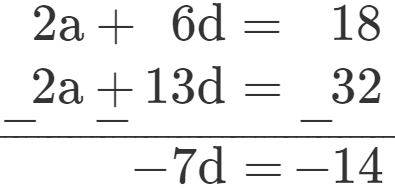
$\therefore\ \text{a}=9-3\text{d}=9-3\times2=9-6=3$
$\therefore\ \text{a}=3,\text{d}=2$
Now $\text{T}_{28}=\text{a}+(\text{n}-1)\text{d}=3+(28-1)\times2$
$=3+27\times2=3+54=57$ View full question & answer→Question 304 Marks
Find the common difference and write the next four terms of the following arithmetic progressions:
$-1,\frac{5}{6},\frac{2}{3},\ .....$
AnswerHere, first term $\left(a_1\right)=-1$
Common difference $(d)=a_2-a_1$
$=-\frac{5}{6}-(-1) $
$ =\frac{-5+6}{6} $
$ =\frac{1}{6}$
Now, we need to find the next four terms of the given A.P
That is we need to find $a_4, a_5, a_6, a_7$.
So, using the formula $a_n=a+(n-1) d$
Substituting $n=4,5,6,7$ in the above formula
Substituting $\mathrm{n}=4$, we get
$\text{a}_4=-1+(4-1)\Big(\frac{1}{6}\Big)$
$\text{a}_4=-1+\Big(\frac{1}{2}\Big)$
$\text{a}_4=\frac{-2+1}{2}=\frac{-1}{2}$
Substituting n = 5, we get
$\text{a}_5=-1+(5-1)\Big(\frac{1}{6}\Big)$
$\text{a}_5=-1+\frac{2}{3}$
$\text{a}_5=\frac{-3+2}{3}$
$\text{a}_5=-\frac{1}{3}$
Substituting n = 6, we get
$\text{a}_6=-1+(6-1)\Big(\frac{1}{6}\Big)$
$\text{a}_6=-1+\frac{5}{6}$
$\text{a}_6=\frac{-6+5}{6}$
$\text{a}_6=-\frac{1}{6}$
Substituting n = 7, we get
$\text{a}_7=-1+(7-1)\Big(\frac{1}{6}\Big)$
$\text{a}_7=-1+1$
$\text{a}_7=0$
Therefore, the common difference is $\text{d}=\frac{1}{6}$ and the next four terms are $-\frac{1}{2},-\frac{1}{3},-\frac{1}{6},0$.
View full question & answer→Question 314 Marks
Find the middle term of the $A.P. 213, 205, 197, ...., 37.$
AnswerLet a be the first term and d be the common difference.
We know that, $n^{\text {th }}$ term $=a_n=a+(n-1) d$
It is given that $\mathrm{a}=213, \mathrm{~d}=-8$ and $\mathrm{a}_{\mathrm{n}}=37$
According to the question,
$\Rightarrow 37 = 213 + (n - 1)(-8)$
$\Rightarrow 37 = 213 - 8n + 8$
$\Rightarrow 8n = 221 - 37$
$\Rightarrow 8n = 184$
$\Rightarrow n = 23 .....(i)$
Therefore, Total number of terms is $23.$
Since, there are odd number of terms.
So, Middle term will be $\Big(\frac{23 + 1}{2}\Big)^{\text{th}}$ term, i.e., the $12^{th}$ term.
$\therefore a_{12} = 213 + (12 - 1)(-8)$
$= 213 - 88$
$= 125$
Thus, the middle term of the A.P. $213, 205, 197, ....., 37$ is $125.$
View full question & answer→Question 324 Marks
Find the next five terms of the following sequences given:
$a_1=4, a_n=4 a_{n-1}+3, n > 1$.
AnswerGiven,
First term $(a_1) = 4$
$n^{\text {th }} \operatorname{term}\left(a_n\right)=4 a_{n-1}+3, n>1$
To find next fice terms i.e., $a_2, a_3, a_4, a_5, a_6$ we put $n=2,3,4,5,6$ is $a_n$
Then, we get
$ a_2=4 a_{2-1}+3=4 \cdot a_1+3=4(4)+3=19\left(\therefore a_1=4\right) $
$ a_3=4 a_{3-1}+3=4 \cdot a_2+3=4(19)+3=79 $
$ a_4=4 a_{4-1}+3=4 \cdot a_3+3=4(79)+3=319 $
$ a_5=4 a_{5-1}+3=4 \cdot a_4+3=4(319)+3=1279 $
$ a_6=4 a_{6-1}+3=4 \cdot a_5+3=4(1279)+3=5119 .$
$\therefore$ The required next five terms are,
$a_2=19, a_3=79, a_4=319, a_5=1279, a_6=5119 .$
View full question & answer→Question 334 Marks
Find the next five terms of the following sequences given:
$a_1=a_2=2, a_n=a_{n-1}-3, n>2$
Answer$a_1=a_2=2 $
$a_n=a_{n-1}-3 $
$\text { Let } n=3,4,5,6,7 $
$a_3=a_{3-1}-3=a_2-3 $
$=2-3=-1 $
$a_4=a_{4-1}-3=a_3-3 $
$=-1-3=-4 $
$a_5=a_{5-1}-3=a_4-3 $
$=-4-3=-7 $
$a_6=a_{6-1}-3=a_5-3 $
$=-7-3=-10 $
$a_7=a_{7-1}-3=a_6-3 $
$=-10-3=-13$.
View full question & answer→Question 344 Marks
If the $n^{th}$ term of the $A.P. 9, 7, 5, ..$. is same as the $n^{th}$ term of the $A.P. 15, 12, 9, ...$ find n.
AnswerGiven,
$ \mathrm{AP}_1=9,7,5, \ldots . \mathrm{n}_1 $
$\mathrm{AP}_2=15,12,9, \ldots \ldots \mathrm{n}_2$
$\mathrm{n}^{\text {th }}$ term of both AP is equal then
$\mathrm{n}_1=\mathrm{n}_2=\mathrm{n}$
we know, $\mathrm{n}^{\text {th }}$ term of A.P.
$a_n=a+(n-1) d$
For $\text{AP}_1,\text{a}_{\text{n}_1}=\text{n}$
$a = 9$
and $d = (7 - 9) = -2$
then, $n = 9 + (n - 1) -2$
$\Rightarrow n = 9 - 2n + 2$
$\Rightarrow n = 11 - 2n .....(i)$
For $\text{AP}_2,\text{a}_{\text{n}_2}=\text{n}$
$a = 15$
and $d = (12 - 15) = -3$
then,$ n = 15 + (n - 1) - 3$
$\Rightarrow n = 15 - 3n + 3$
$\Rightarrow n = 18 - 3n .....(ii)$
From eq. (i) and (ii), we get
$\Rightarrow 11 - 2n = 18 - 3n$
$\Rightarrow -2n + 3n = 18 - 11$
$\Rightarrow n = 7$
Hence, value of n is $7.$
View full question & answer→Question 354 Marks
In an $A.P.$, if the $5^{\text {th }}$ and $12^{\text {th }}$ terms are $30$ and $65$ respectively, what is the sum of first $20$ terms?
AnswerGiven,
$5^{\text {th }}$ term $a_5=30$
$12^{\text {th }}$ term $a _{12}=65$
We know $a_n=a+(n-1) d$
$\Rightarrow 30=a+4 d \ldots . . \text { (i) }$
$12^{\text {th }} \text { term } a_{12}=a+(12-1) d$
$\Rightarrow 65=a+11 d \ldots . . . \text { (ii) }$
Subtracting eq. $(i)$ from Eq. $(ii)$
$\Rightarrow 65-30=a+11 d-(a+4 d)$
$\Rightarrow 35=a+11 d-a-4 d$
$\Rightarrow 35=7 d$
$\Rightarrow d=\frac{35}{7}$
$\Rightarrow d=5$
From eq. (i) $30=a+4 \times 5$
$\Rightarrow 30=a+20$
$\Rightarrow a=30-20$
$\Rightarrow a=10$
We know, Sum of n terms
$S_n=\frac{n}{2}[2 a+(n-1) d]$
$\Rightarrow S_{20}=\frac{20}{2}[2 \times 10+(20-1) 5]$
$\Rightarrow S_{20}=10[20+19 \times 5]$
$\Rightarrow S_{20}=10[20+95]$
$\Rightarrow S_{20}=10 \times 115$
$\Rightarrow S_{20}=1150$
$\text { Hence, Sum of first } 20 \text { terms is } 1150 .$
View full question & answer→Question 364 Marks
In an $A.P$. the first term is $8, n^{th}$ term is $33$ and the sum to first n terms is $123$. Find n and d, the common differences.
AnswerIn an $A.P,$
First term $(a) = 8$
$n^{th}$ term $(a_n) = 33$
$S_n= 123$
Let d the common difference an n be the number of terms
$\therefore a_n= a + (n - 1)d$
$⇒ 33 = 8 + (n - 1)d$
$⇒ (n - 1)d = 33 - 8 = 25 .....(i)$
and $\text{S}_\text{n}=\frac{\text{n}}{2}[2\text{a}+(\text{n}-1)\text{d}]$
$\Rightarrow\ 123=\frac{\text{n}}{2}[2\times8+25]\ [\text{ from (i)}]$
$123\times2=\text{n}(16+25)=41\text{n}$
$\Rightarrow\ \text{n}=\frac{123\times2}{41}=6$
From $(i) (n - 1)d = 25$
$\Rightarrow\ (6-1)\text{d}=25\Rightarrow\ 5\text{d}=25$
$\Rightarrow\ \text{d}=\frac{25}{5}=5$
Hence $n = 6, d = 5.$
View full question & answer→Question 374 Marks
Find the sum:
$1 + 3 + 5 + 7 + ..... + 199.$
AnswerGiven,
A.P. $1 + 3 + 5 + 7 + ..... + 199.$
Here,
First term, $a=1$
Difference, $d=3-1=2$
and Last term $a_n=199$
We know, $a_n=a+(n-1) d$
$ \Rightarrow 199=1+(n-1) 2$
$\Rightarrow 199=1+2 n-2 $
$ \Rightarrow 200=2 n $
$\Rightarrow n=100$
We know, Sum of n terms,
$\text{S}_\text{n}=\frac{\text{n}}{2}[2\text{a}+(\text{n}-1)\text{d}]$
$\Rightarrow\ \text{S}_{100}=\frac{100}{2}[2(1)+(100-1)2]$
$ \Rightarrow \mathrm{S}_{100}=50[2+99 \times 2] $
$ \Rightarrow \mathrm{S}_{100}=50[2+198] $
$ \Rightarrow \mathrm{S}_{100}=50[200] $
$ \Rightarrow \mathrm{S}_{100}=10000 .$
Hecne, Sum of given A.P. is $10000.$
View full question & answer→Question 384 Marks
The first and the last terms of an $A.P$. are $5$ and $45$ respectively. If the sum of all its terms is $400$, find its common difference.
AnswerLet a be the first term and d be the common difference.
We know that, Sum of first n terms $=\text{S}_\text{n}=\frac{\text{n}}{2}[2\text{a}+(\text{n}-1)\text{d}]$
Also, $n^{\text {th }}$ term $a_n=a+(n-1) d$
According to the question,
$a=5, a_n=45 \text { and } S_n=400$
Now,
$a_n=a(n-1) d$
$\Rightarrow 45 = 5 + (n - 1)d$
$\Rightarrow 40 = nd - d$
$\Rightarrow nd - d = 40 .....(1)$
Also,
$\text{S}_\text{n}=\frac{\text{n}}{2}[2\times5+(\text{n}-1)\text{d}]$
$\Rightarrow\ 400=\frac{\text{n}}{2}[10+\text{nd}-\text{d}]$
$\Rightarrow 800 = n[10 + 40] [$From $(i)]$
$\Rightarrow 50n = 800$
$\Rightarrow n = 16 .....(ii)$
On substituting (ii) in (i), we get
$nd - d = 40$
$\Rightarrow (16 - 1)d = 40$
$\Rightarrow 15d = 40$
$\Rightarrow\ \text{d}=\frac{8}{3}$
Thus, common difference of the given A.P. is $\frac{8}{3}$.
View full question & answer→Question 394 Marks
Write the expression $a_n-a_k$ for the $A.P.$ $a, a+d, a+2 d, \ldots$ Hence, find the common difference of the $A.P$. for which, $11^{\text {th }}$ term is $5$ and $13^{\text {th }}$ term is $79.$
AnswerWe know,
$a_n=a+(n-1) d$
$\text { Let, }$
$n^{\text {th }} \text { term } a_n=a+(n-1) d$
$\Rightarrow a_n=a+n d-d$
$k^{\text {th }} \text { term, } a_k=a+(k-1) d$
$\Rightarrow a_k=a+k d-d$
Now,
$\Rightarrow a_n-a_k=(a+n d-d)-(a+k d-d)$
$\Rightarrow=a+n d-d-a-k d+d$
$\Rightarrow=n d-k d$
$\Rightarrow=d(n-k)$
Given, $11^{\text {th }}$ term, $a_{11}=5$
and $13^{\text {th }}$ term, $a_{13}=79$
We know, $a n=a+(n-1) d$
then,
$11^{\text {th }} \text { term, } a_{11}=a+(11-1) d$
$\Rightarrow 5=a+10 d \ldots . . \text { (i) }$
$13^{\text {th }} \text { term, } a_{13}=a+(13-1) d$
$\Rightarrow 79=a+12 d \ldots . . \text { (ii) } By subtituting eq. (i) from eq. (ii)$
$\Rightarrow 79-5=a+12 d-(a+10 d)$
$\Rightarrow 74=a+12 d-a-10 d$
$\Rightarrow 74=2 d$
$\Rightarrow d=37$
View full question & answer→Question 404 Marks
If 10 times the $10^{\text {th }}$ term of an $A.P$. is equal to $15$ times the $15^{\text {th }}$ term, show that $25^{\text {th }}$ term of the $A.P.$ is zero.
Answersolution Here, let us take the first term of the $A.P.$ as a and the common difference as d.
We are given that $10$ times the $10^{\text {th }}$ term is equal to $15$ times the $15^{\text {th }}$ term. We need to show that $25^{\text {th }}$ term is zero. So, let us first find the two terms.
So, as we know,
$a_n=a+(n-1) d$
For $10^{\text {th }}$ term $(n=10)$
$a_{10}=a+(10-1) d$
$=a+9 d$
For $15^{\text {th }}$ term $( n =15)$,
$a_{15}=a+(15-1) d$
$=a+14 d$
Now, we are given
$10(a+9 d)=15(a+14 d)$
Solving this, we get,
$10 a+90 d=15 a+210 d$
$90 d-210 d=15 a-10 a$
$-120 d=5 a$
$-24 d=a \ldots . . .(i)$
Next, we need to prove that the $25^{\text {th }}$ term of the $A.P$. is zero. For that, let us find the $25^{\text {th }}$ term using $n =25$,
$a_{25}=a+(25-1) d$
$=-24 d+24 d \text { (using 1) }$
$=0$
Thus, the $25^{\text {th }}$ term of the given $A.P$. is zero.
Hence proved.
View full question & answer→Question 414 Marks
The sum of first $9$ terms of an $A.P.$ is $162.$ The ratio of its $6^{th}$ term to its $13^{th}$ term is $1 : 2$. Find the first and $15^{th}$ term of the $A.P?$
AnswerSum of first $9$ terms $= 162$
Ratio of its $6^{th}$ term and $13^{th}$ term $= 1 : 2$
$\text{S}_9=\frac{9}{2}[2\text{a}+(9-1)\text{d}]=162\ .....(\text{i})$
$\text{T}_6=[\text{a}+(6-1)\text{d}]=(\text{a}+5\text{d})$
$=\text{a}+5\text{d}$
and $\text{T}_{13}=[\text{a}+(13-1)\text{d}]=(\text{a}+12\text{d})$
But $\text{T}_6:\text{T}_{13}=1:2\Rightarrow\ \frac{\text{T}_6}{\text{T}_{13}}=\frac{1}{2}$
$\Rightarrow\ \frac{\text{a}+5\text{d}}{\text{a}+12\text{d}}=\frac{1}{2}\Rightarrow\ 2\text{a}+10\text{d}=\text{a}+12\text{d}$
$\Rightarrow\ 2\text{a}-\text{a}=12\text{d}-10\text{d}\Rightarrow\ \text{a}=2\text{d}$
From (i),
$\because\ \frac{9}{2}[2\text{a}+(9-1)\text{d}]=162$
$\Rightarrow\ \frac{9}{2}(2\text{a}+8\text{d})=162$
$\Rightarrow\ \frac{9}{2}(4\text{d}+8\text{d})=162\ (\because\ \text{a}=2\text{d})$
$\Rightarrow\ \frac{9}{2}\times12\text{d}=162\Rightarrow\ 54\text{d}=162$
$\Rightarrow\ \text{d}=\frac{162}{54}=3$
$\text{a}=2\text{d}=2\times3=6$
Now $\text{T}_{15}=\text{a}+(15-1)\text{d}=\text{a}+14\text{d}$
$=6+14\times3=6+42=48$
Hence first term = 6 and $T_{15}= 48.$
View full question & answer→Question 424 Marks
If $12^{th}$ term of an $A.P$. is -$13$ and the sum of the first four terms is $24$, what is the sum of first $10$ terms?
AnswerGiven,
$a_{12}=-13, a+a_2+a_3+a_4=24$
$\text{S}_4=\frac{4}{2}(2\text{a}+3\text{d})=24$
$2\text{a}+3\text{d}=\frac{24}{2}=12\ .....(\text{i})$
$\Rightarrow\ \text{a}+(12-1)\text{d}=-13$
$\text{a}+11\text{d}=-13\ .....(\text{ii})$
Subtract $(i)$ from $(ii) \times 2$
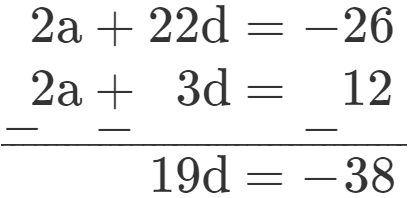
$\text{d}=\frac{-38}{19}=-2$
put $d = -2$ in $(ii)$
$a + 11(-2) = -13$
$a = -13 + 22$
$a = 9$
Given to find sum of first $10$ terms.
$\text{S}_{10}=\frac{10}{2}[2\text{a}+(10-1)\text{d}]$
$\text{S}_{10}=5\big[2\times9+9\times(-2)\big]$
$=5(18-18)$
$=0$
$\therefore\ \text{S}_{10}=0$ View full question & answer→Question 434 Marks
If the sum of $7$ terms of an $A.P$. is $49$ and that of $17$ terms is $289$, find the sum of n terms.
AnswerLet a be the first term and d be the common difference of an $A.P.$
Sum of $7$ terms $= 49$
and sum of $17$ terms $= 289$
$\text{S}_7=\frac{7}{2}[2\text{a}+(7-1)\text{d}]=49$
$\Rightarrow\ \frac{7}{2}[2\text{a}+6\text{d}]=49$
$7\text{a}+21\text{d}=49\Rightarrow\ \text{a}+3\text{d}=7\ (\text{Dividing by }7)$
$\therefore\ \text{a}+3\text{d}=7\ .....(\text{i})$
Similarly $\text{S}_{17}=\frac{17}{2}[2\text{a}+(17-1)\text{d}]=289$
$\Rightarrow\ \frac{17}{2}[2\text{a}+16\text{d}]=289$
$\Rightarrow\ 17\text{a}+136\text{d}=289\ (\text{Dividing by }17)$
$\Rightarrow\ \text{a}+8\text{d}=17\ .....(\text{ii})$
Subtracting $(i)$ from $(ii)$
$5\text{d}=10\Rightarrow\ \text{d}=\frac{10}{5}=2$
and $\text{a}+3\text{d}=7\Rightarrow\ \text{a}+2\times3=7$
$\Rightarrow\ \text{a}+6=7\Rightarrow\ \text{a}=7-6=1$
$\therefore\ \text{a}=1,\text{d}=2$
$\therefore\ \text{S}_\text{n}=\frac{\text{n}}{2}[2\text{a}+(\text{n}-1)\text{d}]$
$=\frac{\text{n}}{2}[2\times1+(\text{n}-1)2]$
$=\frac{\text{n}}{2}[2+2\text{n}-2]=\frac{\text{n}}{2}\times2\text{n}=\text{n}^2$
View full question & answer→Question 444 Marks
If $S_n$ denotes the sum of first n terms of an $A.P.$, prove that $S_{12}= 3(S_8- S_4).$
AnswerLet a be the first term and d be the common difference
We know that, Sum of first n terms $=\text{S}_\text{n}=\frac{\text{n}}{2}[2\text{a}+(\text{n}-1)\text{d}]$
Now,
$\text{S}_4=\frac{4}{2}[2\text{a}+(4-1)\text{d}]$
$=2(2\text{a}+3\text{d})$
$=4\text{a}+6\text{d} \ .....\text{(i)}$
$\text{S}_8=\frac{8}{2}[2\text{a}+(8-1)\text{d}]$
$=4(2\text{a}+7\text{d})$
$=8\text{a}+28\text{d}\ .....(\text{ii})$
$\text{S}_{12}=\frac{12}{2}[2\text{a}+(12-1)\text{d}]$
$=6(2\text{a}+11\text{d})$
$=12\text{a}+66\text{d}\ .....(\text{iii})$
On Subtracting (i) from (ii), we get
$ S_8-S_4=8 a+28 d-(4 a+6 d) $
$ =4 a+22 d$
Multiplying both sides by $3$ , we get
$ 3\left(S_8-S_4\right)=3(4 a+22 d) $
$=12 a+66 d$
$ =S_{12}[\text { from (iii) }]$
Thus, $\mathrm{S}_{12}=3\left(\mathrm{~S}_8-\mathrm{S}_4\right)$.
View full question & answer→Question 454 Marks
Find the $12^{th}$ term from the end of the following arithmetic progressions:
$1, 4, 7, 10, ....., 88.$
Answer$1, 4, 7, 10, ....., 88.$
Here, to find the $12^{th}$ term from the end let us first find the total number of terms. Let us take the total number of terms as n.
So,
First term $(a) = 1$
Last term $(a_n = 8)8$
Common difference, $d = 4 - 1 = 3$
Now, as we know
$a_n= a + (n - 1)d$
So, for the last term,
$88 = 1 + (n - 1)3$
$88 = 1 + 3n - 3$
$88 = -2 + 3n$
$88 + 2 = 3n$
Further simplifying,
$90 = 3n$
$\text{n}=\frac{90}{3}$
$n = 30$
So, the $12^{th}$ term from the end means the $19^{th}$ term from the beginning.
So, for the $19^{th}$ term $(n = 19)$
$a_{19}= 1 + (19 - 1)3$
$= 1 + (18)3$
$= 1 + 54$
$= 55$
Therefore, the $12^{th}$ term the end of the given A.P. is 55.
View full question & answer→Question 464 Marks
Find the next five terms of the following sequences given:
$\text{a}_1=-1,\text{a}_\text{n}=\frac{\text{a}_\text{n}-1}{\text{n}},\text{n}\geq2$
AnswerGiven, first term $(a_1) = -1$
$n^{th}$ term $(a_n) =\frac{\text{a}_\text{n}-1}{\text{n}},\text{n}\geq2$
To find next five terms i.e., $a_2, a_3, a_4, a_5, a_6$ we put $n=2,3,4,5,6$ is an
$\text{a}_2=\frac{\text{a}_{2-1}}{2}=\frac{\text{a}_1}{2}=\frac{-1}{2}$
$\text{a}_3=\frac{\text{a}_{3-1}}{3}=\frac{\text{a}_2}{3}=\frac{-\frac{1}{2}}{3}=\frac{-1}{6}$
$\text{a}_4=\frac{\text{a}_{4-1}}{4}=\frac{\text{a}_3}{4}=\frac{\frac{-1}{6}}{4}=\frac{-1}{24}$
$\text{a}_5=\frac{\text{a}_{5-1}}{5}=\frac{\text{a}_4}{5}=\frac{\frac{-1}{24}}{5}=\frac{-1}{120}$
$\therefore$ The next five terms are,
$\text{a}_2=\frac{-1}{2},\text{a}_3=\frac{-1}{6},\text{a}_4=\frac{-1}{24},\text{a}_5=\frac{-1}{120},\text{a}_6=\frac{-1}{720}$
View full question & answer→Question 474 Marks
Find the sum of all integers between $84$ and $719$, which are multiples of $5.$
AnswerIn this problem, we need to find the sum of all the multiples of $5$ lying between $84$ and $719.$
So, we know that the first multiple of $5$ after $84$ is $85$ and the last multiple of $5$ before $719$ is $715.$
Also, all these terms will form an $A.P.$ with the common difference of $5.$
So here,
First term $(a) = 85$
Last term $(l) = 715$
Common difference $(d) = 5$
So, here the first step is to find the total number of terms. Let us take the number of terms as n.
Now, as we know,
$a_n= a + (n - 1)d$
So, for the last term,
$715 = 85 + (n - 1)5$
$715 = 85 + 5n - 5$
$715 = 80 + 5n$
$715 - 80 = 5n$
Further simplifying,
$635 = 5n$
$\text{n}=\frac{635}{5}$
$n = 127$
Now, using the formula for the sum of n terms,
$\text{S}_\text{n}=\frac{\text{n}}{2}[2\text{a}+(\text{n}-1)\text{d}]$
We get,
$\text{S}_\text{n}=\frac{127}{2}[2(85)+(127-1)5]$
$=\frac{127}{2}[170+(126)5]$
$=\frac{127}{2}(170+630)$
$=\frac{127(800)}{2}$
On further simplification, we get,
$S_n= 127(400)$
$= 50800$
Therefore, the sum of all the multiples of $5$ lying between $84$ and $719$ is $S_n= 50800.$
View full question & answer→Question 484 Marks
Find the sum of n terms of an $A.P$. whose nth terms is given by $an = 5 - 6n.$
AnswerGiven, $a_n= 5 - 6n$
By putting $n = 1, 2, 3, .....$
$ a_1=5-6(1)=5-6=-1$
$ a_2=5-6(2)=5-12=-7$
and $a_3= 5 - 6(3) = 5 - 18 = -13$
So, A.P. is $-1, -7, -13, .....$
Here,
First term $a = -1$
and Difference $d = -7 - (-1) = -7 + 1 = -6$
we know, sum of n terms
$\text{S}_\text{n}=\frac{\text{n}}{2}[2\text{a}+(\text{n}-1)\text{d}]$
$\Rightarrow\ \text{S}_\text{n}=\frac{\text{n}}{2}[2(-1)+(\text{n}-1)-6]$
$\Rightarrow\ \text{S}_\text{n}=\frac{\text{n}}{2}[-2+6\text{n}+6]$
$\Rightarrow\ \text{S}_\text{n}=\frac{\text{n}}{2}[4-6\text{n}]$
$\Rightarrow\ \text{S}_\text{n}=\frac{\text{n}}{2}\times2[2-3\text{n}]$
$\Rightarrow\ \text{S}_\text{n}=\text{n}[2-3\text{n}]$
Hence, Sum of n terms is n[2 - 3n].
View full question & answer→Question 494 Marks
The $4^{th}$ term of an $A.P$. is three times the first and the $7^{th}$ term exceeds twice the third term by $1$. Find the first term and the common difference.
AnswerGiven,
$4^{th}$ term of an $A.P.$ is three times the times the first term
$a_4= 3.a$
$n^{th}$ term of a sequence $a_n= a + (n - 1).d$
$a + (4 - 1)d = 3a$
$a + 3d = 3a$
$3d = 2a$
$\text{a}=\frac{3}{2}\text{d}\ .....(\text{i})$
Seventh term exceeds twice the third term by $1.$
$a_7+ 1 = 2.a3$
$\text{a}+(7-1)\text{d}+1=2(\text{a}+(3-1)\text{d})$
$a + 6d + 1 = 2a + 4d$
$a = 2d + 1 .....(ii)$
By equating (1), (2)
$\frac{3}{2}\text{d}=2\text{d}+1$
$\frac{3}{2}\text{d}-2\text{d}=1$
$-d = 2$
$d = -2$
Put $\text{d}=-2\text{ in a}=\frac{3}{2}\text{d}$
$=\frac{3}{2}.\text{x}$
$=-3$
$\therefore$ First term $a = -3,$ common difference $d = -2.$
View full question & answer→Question 504 Marks
Which of the following sequences are arithmetic progressions. For those which are arithmetic progressions, find out the common difference.
$12, 2, -8, -18, .....$
AnswerIn the given problem, we are given various sequences.
We need to find out that the given sequences are an A.P. of not and then find its common difference $(d).$
$12, 2, -8, -18, .....$
$ \text { Let } a_1=12, a_2=2, a_3=-8, a_4=-18 $
$ \text { Now } a_2-a_1=2-12=-10 $
$ a_3-a_2=-8-2=-10 $
$ a_4-a_3=-18-(-8)=-18+8=-10$
$\therefore$ We see that common difference is$ -10$
$\therefore$ It is an $A.P.$
View full question & answer→