Questions

2 Marks Questions

🎯

Test yourself on this topic

4 questions · timed · auto-graded

Question 12 Marks
The length of a tangent from a point $A$ at distance $5 \ cm$ from the centre of the circle is $4 \ cm.$ Find the radius of the circle.
Answer
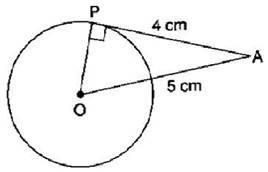
We know that the tangent at any point of a circle is $\perp$ to the radius through the point of contact.
$\therefore \angle OPA = 90^\circ$
$\therefore OA^2 = OP^2 + AP^2 [$By Pythagoras theorem$]$
$\Rightarrow  (5)^2 = (OP)^2 + (4)^2$
$\Rightarrow  25 = (OP)^2 + 16$
$\Rightarrow OP^2= 9$
$\Rightarrow OP = 3 \ cm$
View full question & answer
Question 22 Marks
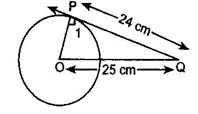
From a point $Q,$ the length of tangent to a circle is $24 \ cm$ and the distance of $Q$ from the centre is $25 \ cm.$ The radius of the circle is
Answer


Here $\angle OPQ = 90^\circ [$Tangent makes right angle with the radius at the point of contact$]$
in right angled $\triangle  OPQ$
$\therefore  OQ^2 = OP^2+ PQ^2 \Rightarrow   (25)^2 = OP^2 + (24)^2$
$ \Rightarrow OP^2 = 625 - 576$
$ \Rightarrow OP = 7 \ cm$ Therefore, the radius of the circle is $7 \ cm$
View full question & answer
Question 32 Marks
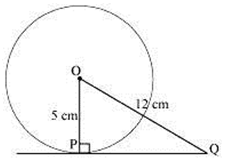
A tangent $PQ$ at a point $P$ of a circle of radius $ 5 \ cm$ meets a line through the centre $O$ at a point $Q$ so that $OQ = 12 \ cm.$ Length $PQ$ is:
Answer
We know that the line drawn from the centre of the circle to the tangent is perpendicular to the tangent.
$OP \perp PQ$
By applying Pythagoras theorem in $\triangle OPQ,$

$OP^2 + PQ^2 = OQ^2$
$5^2 + PQ^2 =12^2$
$PQ^2 =144 - 25$
$\mathrm{PQ}=\sqrt{119} \ \mathrm{cm}$
View full question & answer
Question 42 Marks
Two concentric circles are of radii 5 cm and 13 cm. Find the length of the chord of the larger circle which touches the smaller circle.
Answer
Let the two concentric circles have center O. Let the larger circle have radius R=13 cm and the smaller circle have radius r=5 cm.
Draw a chord AB of the larger circle that touches the smaller circle at point P. This means that OP is perpendicular to AB and is the radius of the smaller circle.
Consider the right-angled triangle OPA.
OA is the radius of the larger circle (R=13 cm).
OP is the radius of the smaller circle (r=5 cm).
Using the Pythagorean theorem:
$\begin{array}{l}O A^2=O P^2+A P^2 \\ 13^2=5^2+A P^2 \\ 169=25+A P^2 \\ A P^2=169-25 \\ A P^2=144 \\ A P=\sqrt{144} \\ A P=12 cm\end{array}$
Since the perpendicular from the center to a chord bisects the chord, the length of the chord AB is twice the length of AP.
$A B=2 \times A P=2 \times 12=24 cm$.
View full question & answer
2 Marks Questions - Maths STD 10 Questions - Vidyadip