Questions

2 Marks Questions

🎯

Test yourself on this topic

21 questions · timed · auto-graded

Question 12 Marks
What is the distance between two parallel tangents of a circle of radius $4\ cm?$
Answer
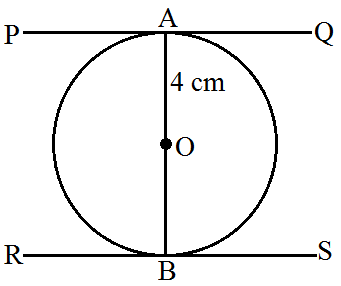
$PQ$ and $RS$ are parallel length.
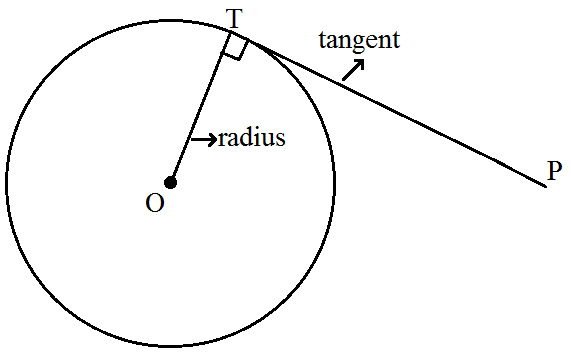
we know radius always perpendicular to tangent.
So, we say distance between two parallel tangents is equal to diameter.
Then, Diameter $= 2 \ ×\ $radius.
Diameter $ = 2 × 4\ cm$
Diameter $= 8\ cm$
Hence, Distance between two parallel tangents are $8\ cm.$
View full question & answer
Question 22 Marks
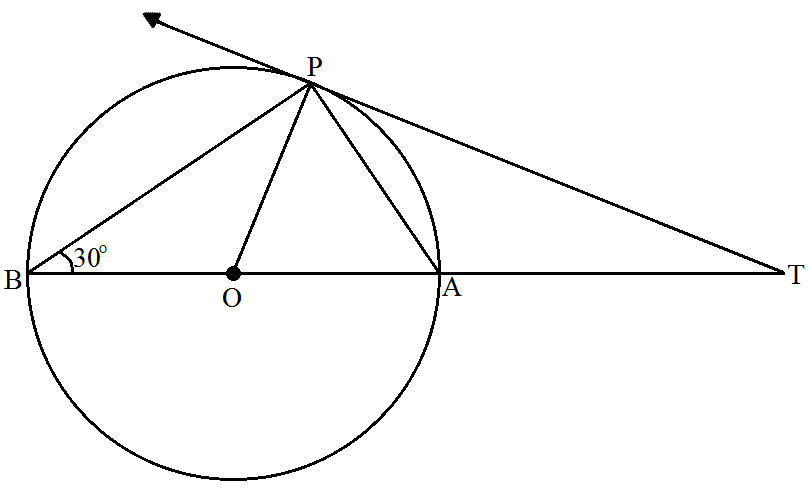
In the figure, $BOA$ is a diameter of a circle and the tangent at a point $P$ meets $BA$ produced at $T.$ If $\angle\text{PBO}=30^{\circ}$ then find $\angle\text{PTA}.$
Answer
As, $\angle\text{BPA}=90^{\circ}$
$\angle\text{PAB}=\angle\text{OPA}=60^{\circ}$
Also $\text{OP}\bot\text{OT}$
Therefore,$\angle\text{APT}=30^{\circ}$
and $\angle\text{PTA}=60^{\circ}-30^{\circ}=30^{\circ}$
View full question & answer
Question 32 Marks
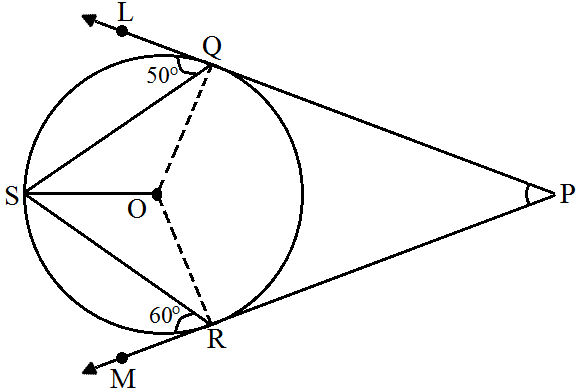
In the figure, $PQL$ and $PRM$ are tangents to the circle with centre $O$ at the points $Q$ and $R$ respectively and $S$ is a point on the circle such that $\angle\text{SQL}=50^{\circ}$ and
$\angle\text{SRM}=60^{\circ}.$ Then, find $\angle\text{QSR}.$
Answer
Here $\angle\text{OSQ}=\angle\text{OQS}=90^{\circ}-50^{\circ}=40^{\circ}$
and $\angle\text{RSO}=\angle\text{SRO}=90^{\circ}-60^{\circ}=30^{\circ}$
Therefore, $\angle\text{QSR}=40^{\circ}+30^{\circ}=70^{\circ}$
View full question & answer
Question 42 Marks
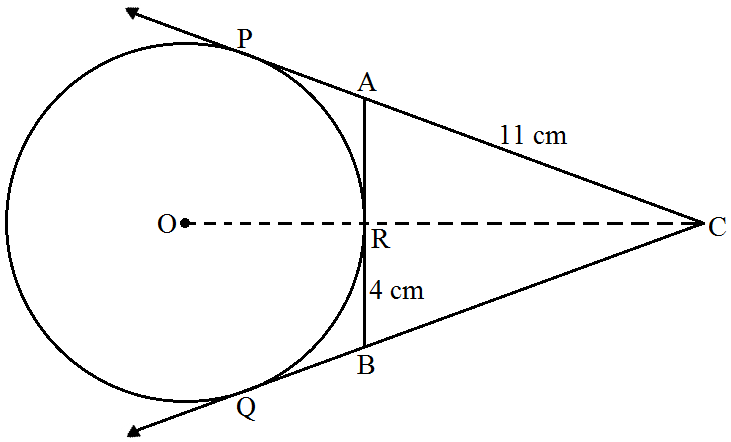
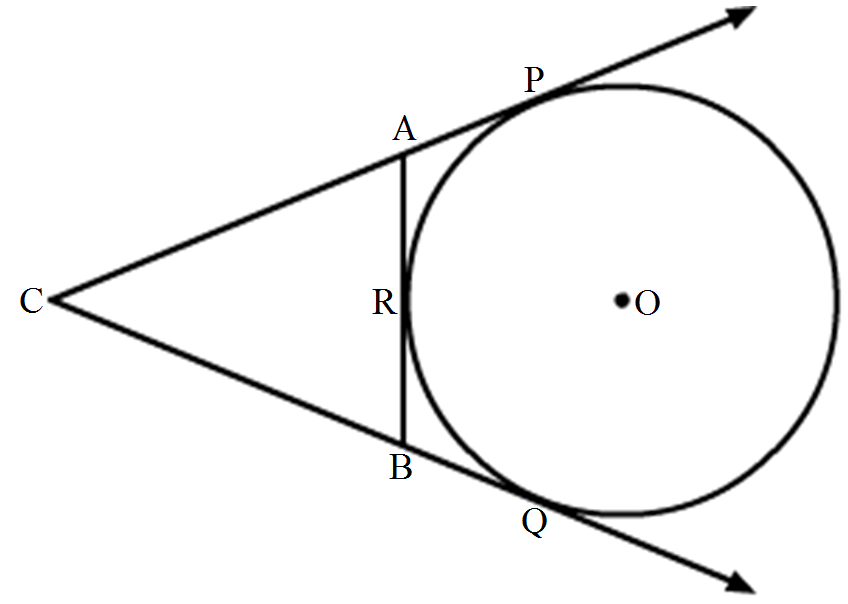
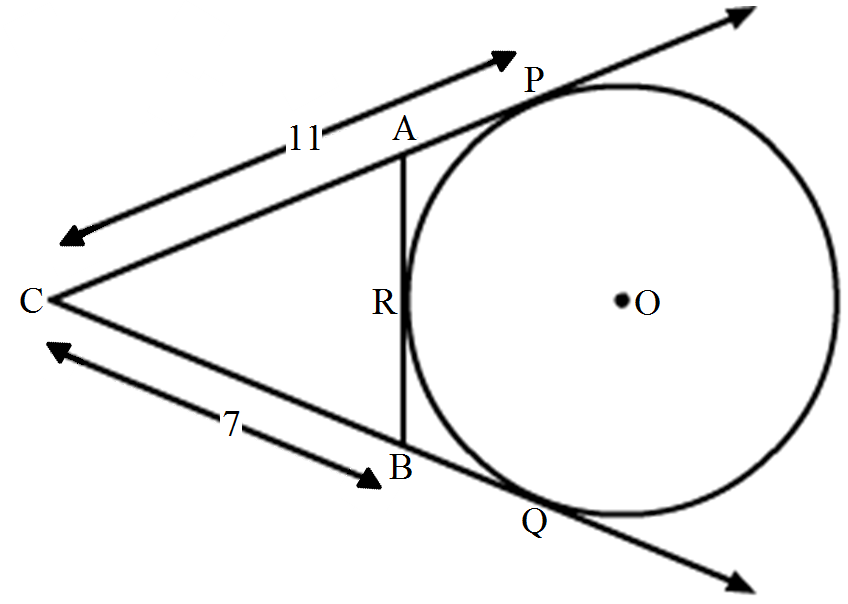
In the figure, $CP$ and $CQ$ are tangents from an external point $C$ to a circle with centre $O. AB$ is another tangent which touches the circle at $R.$ If $CP = 11\ cm$ and $BR = 4\ cm,$ find the length of $BC.$
Answer
$CP$ and $CQ$ are the tangents to the circle from $C.$
$AB$ is another tangent to the same circle which touches at $R$ and meets the first two tangents at $A$ and $B$. $O$ is the centre of the circle.
$OC$ is joined
$CP = 11\ cm, BR = 4\ cm$
$CP$ and $CQ$ are tangents to the circle
$CP = CQ = 11\ cm$
Similarly from $B, CR$ and $BQ$ are the tangents
$BQ = BR = 4\ cm$
Now $BC = CQ – BQ = 11 – 4 = 7\ cm$
View full question & answer
Question 52 Marks
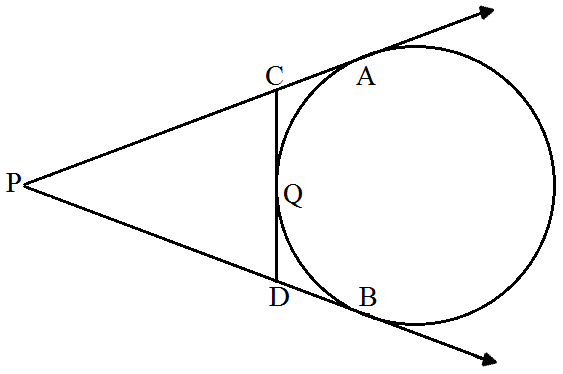
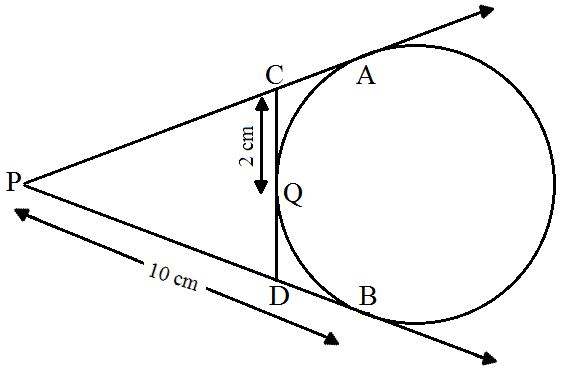
In the figure, $PA$ and $PB$ are tangents to the circle drawn from an external point $P.\ CD$ is a third tangent touching the circle at $Q$. If $PB = 10\ cm$ and $CQ = 2\ cm,$ what is
the length $PC?$
Answer
In the figure, $PA$ and $PB$ are the tangents to the circle drawn from $P.$
$CD$ is the third tangent to the circle drawn at $Q.$
$PB = 10\ cm, CQ = 2\ cm$
$PA$ and $PB$ are tangents to the circle.
$PA = PB = 10\ cm$
Similarly $CQ$ and $CA$ are tangents to the circle.
$CQ = CA = 2\ cm$
$PC = PA – CA = 10 – 2 = 8\ cm.$
View full question & answer
Question 62 Marks
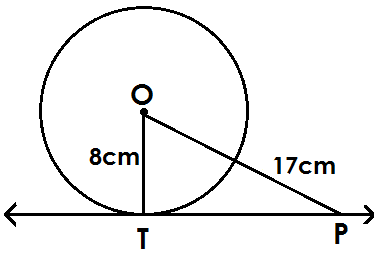
If $PT$ is a tangent at $T$ to a circle whose centre is $O$ and $OP = 17\ cm, OT = 8\ cm,$ Find the length of the tangent segment $PT.$
Answer

Given,
$OT = 8\ cm$
$OP = 17\ cm$
Now by $PGT$ in $\triangle\text{OTP}$
$(\mathrm{OP})^2=(\mathrm{OT})^2+(\mathrm{PT})^2$
$(17)^2=(8)^2+(\mathrm{PT})^2$
$289 - 64 + (PT)^2$
$289 - 64 = (PT)^2$
$(PT)2 = 225$
$\text{PT}=\sqrt{225}$
$PT = 15\ cm.$
View full question & answer
Question 72 Marks
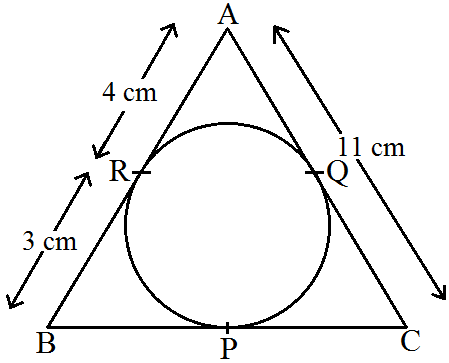
In the figure, $\triangle\text{ABC}$ is circumscribing a circle. Find the length of $BC.$
Answer
$\triangle\text{ABC}$ is circumscribing a circle which touches it at $P, Q$ and $R.$
$AC = 11\ cm, AR = 4\ cm, BR = 3\ cm$
Now we have to find $BC.$
$AR$ and $AQ$ are tangents to the circle from $A.$
$AQ = AR = 4\ cm$
Then $CQ = AC – AQ = 11 – 4 = 7\ cm$
Similarly,
$CP$ and $CQ$ are tangents from $C.$
$CP = CQ = 7\ cm$
and $BP$ and $BR$ are tangents from $B.$
$BP = BR = 3\ cm$
Now $BC = BP + CP = 3 + 7 = 10\ cm.$
View full question & answer
Question 82 Marks
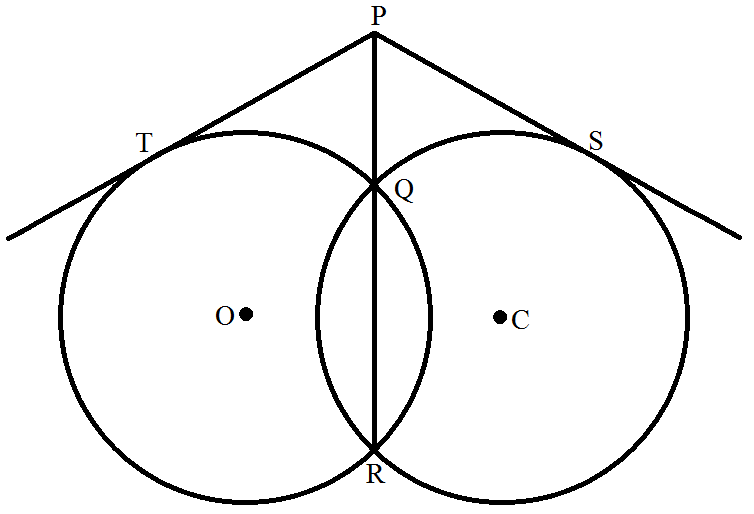
If from any point on the common chord of two intersecting circles, tangents be drawn to the circles, prove that they are equal.
Answer
Given: $QR$ is the common chord of two circles intersecting each other at $Q$ and $R.$
$P$ is a point on $RQ$ when produced From $PT$ and $RS$ are the tangents drawn to tire circles with centres $O$ and $C$ respectively.
To prove: $PT = PS$
Proof: $PT$ is the tangent and $PQR$ is the secant to the circle with centre $O$.
$PT^2= PQ × PR ….(i)$
Similarly PS is the tangent and $PQR$ is the secant to the circle with centre $C$.
$PS^2= PQ × PR ….(ii)$
From $(i)$ and $(ii)$
$PT^2= PS^2$
$PT = PS$
Hence proved.
View full question & answer
Question 92 Marks
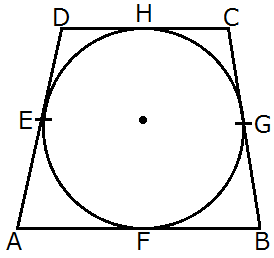
If the sides of a quadrilateral touch a circle. prove that the sum of a pair of opposite sides is equal to the sum of the other pair.
Answer
we have to prove sum of a pair of opposite sides is equal to sum of other pair.

First, we consider, $AB + DC$
there
$AB + DC = AF + FB + DH + HC$
from the property of tangent.
we know,
$AF = AE$
$FB = BG$
$DH = DE$
$HC = CG$
By putting these value in eq in $(i),$ we get
$⇒ AB + DC = AE + BG + DE + CG$
$⇒ AB + DC = (AE + DE) + (BG + CG)$
$⇒ AB + DC = AD + BC$
we have proved that sum of pair of opposite sides is equal to sum of other pair.
View full question & answer
Question 102 Marks
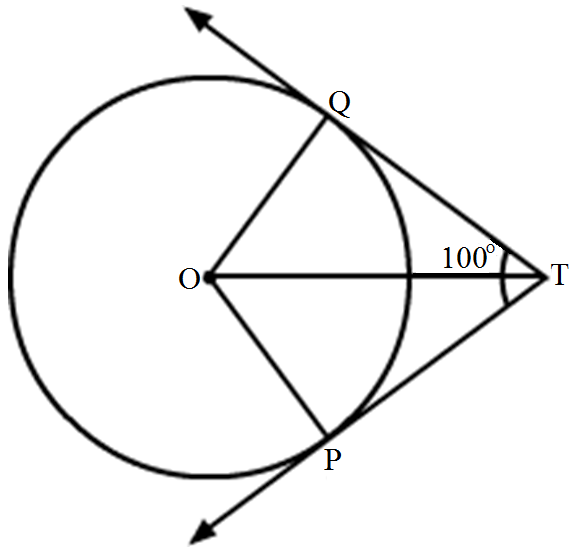
Two tangents $TP$ and $TQ$ are drawn from an external point $T$ to a circle with centre $O .$ If they are inclined to each other at an angle of $100^\circ ,$ then what is the value of $\angle\text{POQ}$?
Answer
Consider the quadrilateral $OPTQ.$ It is given that $\angle\text{PTQ}=100^{\circ}$
From the property of the tangent we know that the tangent will always be perpendicular to the radius at the point of contact. Therefore we have,
$\angle\text{OQT}=90^{\circ}$
$\angle\text{OPT}=90^{\circ}$
We know that the sum of all angles of a quadrilateral will always be equal to $360^\circ .$
Therefore,
$\angle\text{PTQ}+\angle\text{OQT}+\angle\text{OPT}+\angle\text{POQ}=360^{\circ}$
Let us substitute the values of all the known angles. We have,
$100^\circ+ 90^\circ+ 90^\circ+\angle\text{POQ}=360^{\circ}$
$280 + \angle\text{POQ}=360^{\circ}$
$\angle\text{POQ}=80^{\circ}$
Therefore, the value of angle$\angle\text{POQ}\ \text{is}\ 80^{\circ}.$
View full question & answer
Question 112 Marks
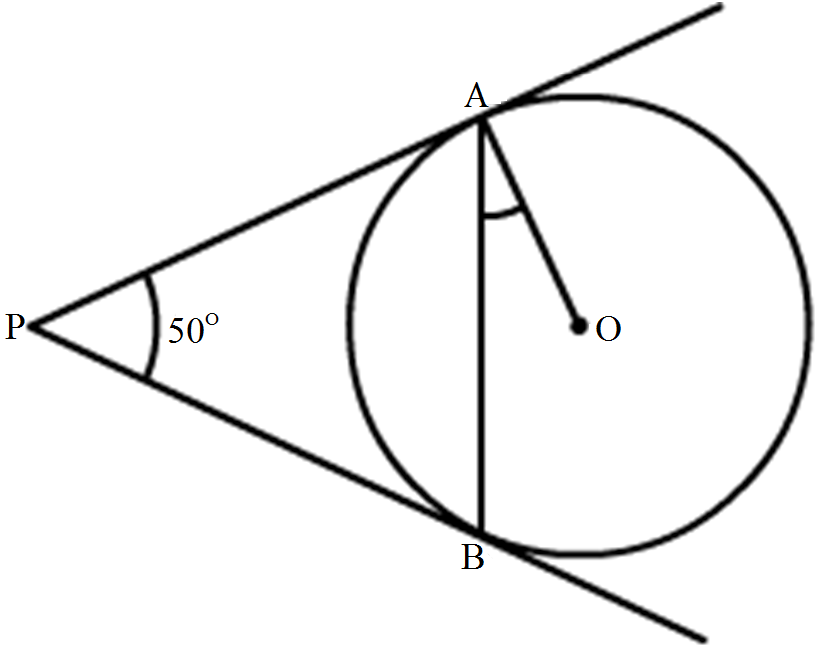
In the given figure, $PA$ and $PB$ are tangents to the circle with centre $O$ such that $\angle\text{APB}=50^{\circ}$. Write the measure of $\angle\text{OAB}.$
Answer
In the given figure,
$PA$ and $PB$ are tangents to the circle from $P.$
$PA = PB$
$\angle\text{APB}=50^{\circ}, OA $ is joined.
To find $\angle\text{OAB}$
In$\triangle\text{PAB}$
$PA = PB$
$\therefore\angle\text{PAB}=\angle\text{PBA}$
$\therefore\angle\text{PAB}=\frac{180^{\circ}-\angle\text{APB}}{2}=\frac{180^{\circ}-50^{^{\circ}}}{2}$
$=\frac{130^{\circ}}{2}=65^{\circ}$
But $\angle\text{OAP}=90^{\circ}$
$\therefore\angle\text{OAB}=90^{\circ}-\angle\text{PAB}$
$=90^\circ-65^\circ=25^\circ$
View full question & answer
Question 122 Marks
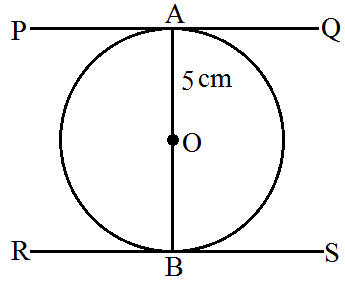
What the distance between two parallel tangents to a circle of radius $5\ cm?$
Answer

$PQ$ and $RS$ are parallel tangent.
we know radius always perpendicular to tangent.
So, we say distance between two parallel tangent is equal to diameter.
then, Diameter $= 2\ ×$ radius.
Diameter $= 2 × 5\ cm$
Diameter $= 10\ cm$
Hence, Distance between two parallel tangents are $10\ cm.$
View full question & answer
Question 132 Marks
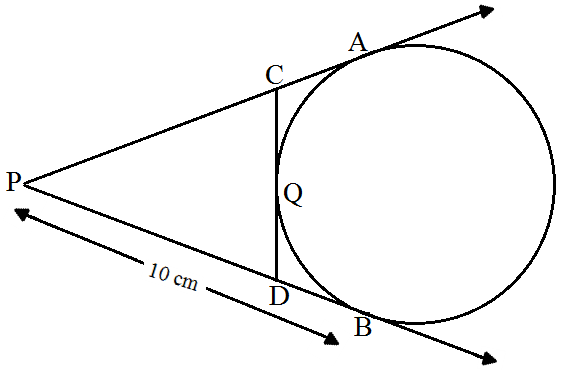
In the figure, $PA$ and $PB$ are tangents to the circle drawn from an external point $P. \ CD$ is a third tangent touching the circle at $Q.$ If $PB = 10\ cm$ and $CQ = 2\ cm,$ what is the length $PC ?,$ if $PB = 10\ cm,$ what is the perimeter of $\triangle\text{PCD}$?
Answer

By the property of tangent
$PA = PB = 10\ cm$ tangent from point $P$
$CA = CQ ($tangent from point $C)$
$DQ = DB ($tangent from point $D)$
Given, $PB = 10\ cm$
Then,
Perimeter of $\triangle\text{PCD} = PC + CD + PD$
Perimeter of $ \triangle\text{PCD} = PC + CQ + QD + PD$
Perimeter of $\triangle\text{PCD} = PC + CA + DB + PD$
Perimeter of $\triangle\text{PCD} = PA + PB$
Perimeter of $\triangle\text{PCD} = 2 PB$
Perimeter of $\triangle\text{PCD} = 2 × 10 = 20\ cm$
Hence, Perimeter of $\triangle\text{PCD}$ is $20\ cm.$
View full question & answer
Question 142 Marks
How many tangents can a circle have?
Answer
Tengent: A line intersecting circle in one point is called a tangent.

As there are infinite number of point on the circle a circle has many(infinite) tangents.
View full question & answer
Question 152 Marks
In the given figure, $CP$ and $CQ$ are tangents to a circle with centre $O$. $ARB$ is another tangent touching the circle at $R.$ If $CP = 11\ cm$ and $BC = 7\ cm,$ then find the length of $BR.$
Answer

By the property of tangent
$CP = CQ = 11\ cm ($tangent from point $c)$
$AP = AR ($tangent from point $A)$
$BQ = BR ($tangent from point $B)$
$CB = 7 ($given$)$
Now, we have to find $BR,$
$BQ = CQ - CB$
$⇒ BR = 11 - 7$
$⇒ BR = 4\ cm$
Hence, length of $BR$ is $4\ cm.$
View full question & answer
Question 162 Marks
Prove that the perpendicular at the point of contact to the tangent to a circle passes through the centre of the circle.
Answer
We know that,

The at point of contact, the tangent is perpendicular to the radius. Radius is line from center to point on circle. Therefore, perpendicular to tangent will pass
through center of the circle.
View full question & answer
Question 172 Marks
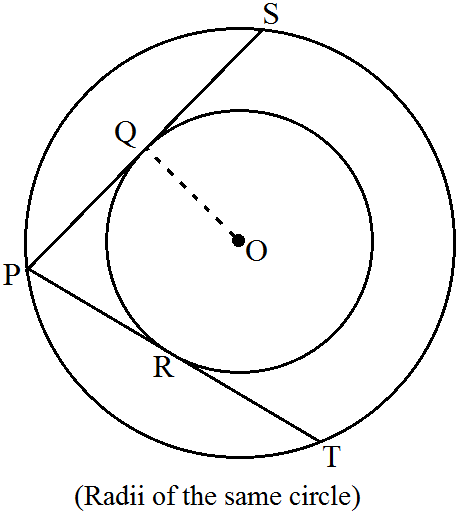
In the figure, there are two concentric circles with centre $O$. $PRT$ and $PQS$ are tangents to the inner circle from a point $P$ lying on the outer circle. If $PR = 5\ cm,$ find the
lengths of $PS.$
Answer
Given that $PR = 5\ cm.$
$PR$ and $PQ$ are the tangents to the inner circle so,
$PR = PQ = 5\ cm ($Tangents drawn from an external point to the circle are equal$)$
Now draw a perpendicular from the centre $O$ to the tangent $PS.$
$PS$ is the chord of the inner circle. we know that the perpendicular drawn from the centre of the circle to the chord bisects the chord. So, $PQ = QS = 5\ cm.$
$PS = PQ + QS = 5\ cm + 5\ cm = 10\ cm$
View full question & answer
Question 182 Marks
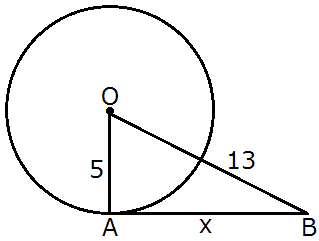
Find the length of a tangent drawn to a circle with radius $5\ cm,$ from a point $13\ cm$ from the centre of the circle.
Answer

Given,
$OA = 5\ cm$
$OB = 13\ cm$
we know, $AB = x \ cm$
radius $OT$ is always perpendicular to tangent $TP$
By using pythagoras, we find $OP$
$ O B^2=O A^2+A B^2 $
$ \Rightarrow(13)^2=(5)^2+(x)^2 $
$ \Rightarrow 169=25+x^2 $
$ \Rightarrow x^2=169-25$
$\Rightarrow\text{x}=\sqrt{144}$
Hence, length of $OA$ is $12\ cm.$
View full question & answer
Question 192 Marks
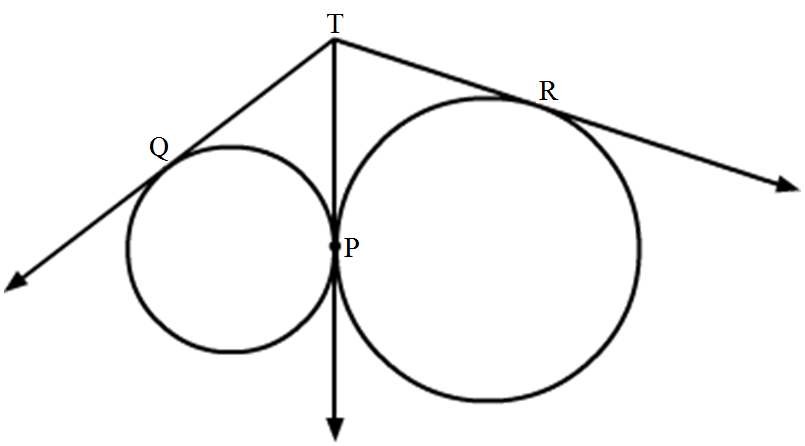
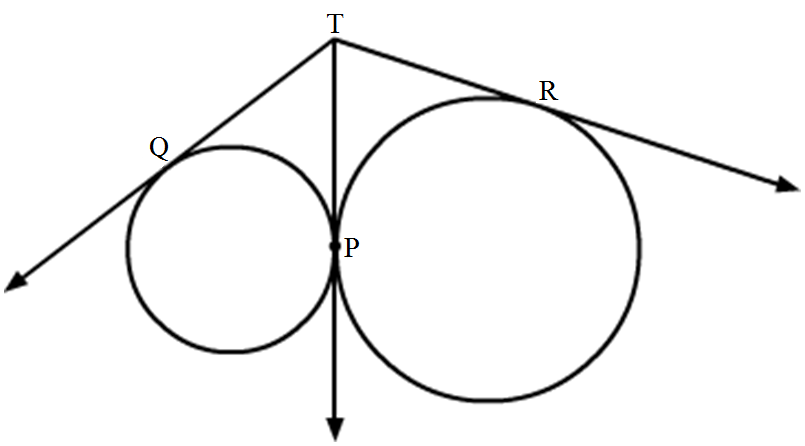
Two circles touch externally at a point $P.$ From a point $T$ on the tangent at $P,$ tangents $TQ$ and $TR$ are drawn to the circles with points of contact $Q$ and $R$ respectively.
Prove that $TQ = TR.$
Answer

By using property of tangent from external point,
$TQ = TP ...(i)$
$TR = TP ...(ii)$
From eq. $(i)$ and eq. $(ii)$
$⇒ TR = TQ,$
Hence proved.
View full question & answer
Question 202 Marks
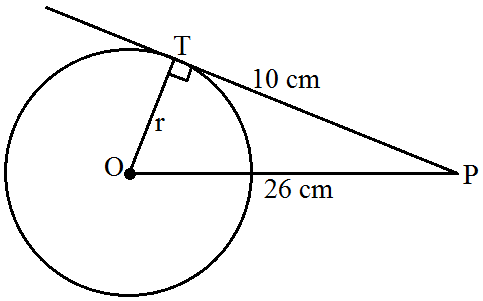
A point $P$ is $26\ cm$ away from the centre $O$ of a circle and the length $PT$ of the tangent drawn from $P$ to the circle is $10\ cm.$ Find the radius of the circle.
Answer
From a point $P$ outside the circle of centre $O$ and radius $OT, PT$ is the tangent to the circle $OP = 26\ cm, PT = 10\ cm.$

Now in right $\triangle\text{OPT}$
Let $r$ be the radius.
$ \mathrm{OP}^2=\mathrm{OT}^2+\mathrm{PT}^2 \text { (Pythagoras Theorem) } $
$ \Rightarrow(26)^2=\mathrm{r}^2+(10) $
$ \Rightarrow 676=\mathrm{r}^2+100$
$ \Rightarrow 676-100=\mathrm{r}^2$
$ \Rightarrow \mathrm{r}^2=576=(24)^2$
$r = 24$
Hence radius of the circle $= 24\ cm$
View full question & answer
Question 212 Marks
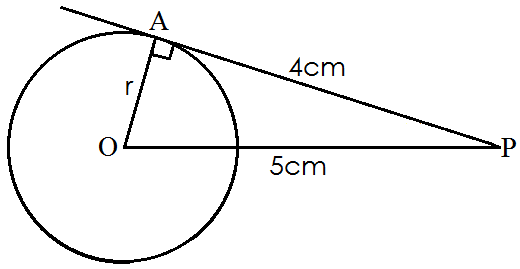
The length of tangent from a point $A$ at a distance of $5\ cm$ from the centre of the circle is $4\ cm.$ What is the radius of the circle$?$
Answer
$PA$ is a tangent to the circle from $P$ at a distance of $5\ cm$ from the centre $O.$
$PA = 4\ cm$
$OA$ is joined and let $OA = r.$

Now in right $\triangle\text{OAP},$
$ O P^2=O A^2+P A^2 $
$ \Rightarrow(5)^2=r^2+(4)^2 $
$ \Rightarrow 25=r^2+16 $
$ \Rightarrow r^2=25-16=9=(3)^2 $
$ r=3$
Radius of the circle $= 3\ cm.$
View full question & answer
2 Marks Questions - Maths STD 10 Questions - Vidyadip