Questions

3 Marks Question

🎯

Test yourself on this topic

29 questions · timed · auto-graded

Question 13 Marks
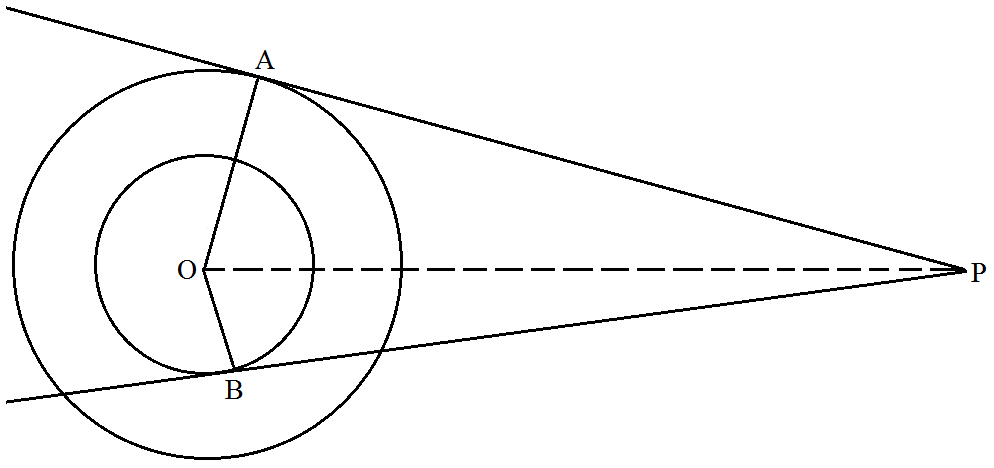
In the given figure, there are two concentric circles with centre $O$ of radii 5cm and 3cm. From an external point $P,$ tangent $PA$ and $PB$ are drawn to these circles.
If $AP = 12\ cm,$ find the length of $BP.$
Answer
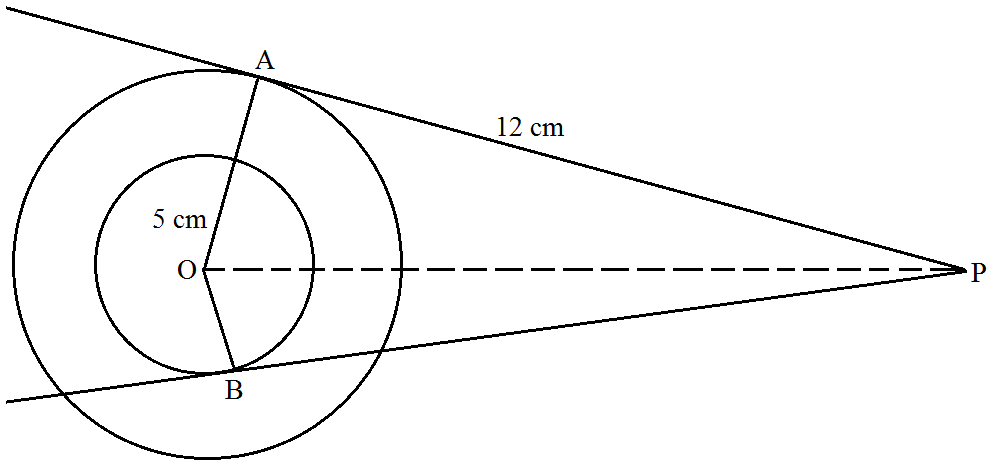
Given, $OA = 5\ cm$ and $OB = 3\ cm$
$AP = 12\ cm$
From the property of tangent we know radius of the circle is always perpendicular to tangent at the point of contact. so, $\triangle\text{OAP}$ is right angle triangle.
$ O P^2=A P^2+O A^2 $
$ \Rightarrow O P^2=(12)^2+(5)^2 $
$ \Rightarrow O P^2=144+25 $
$ \Rightarrow O P=\sqrt{169} $
$ \Rightarrow O P=13 \mathrm{~cm}$
$\text { Now consider } \triangle \mathrm{OBP} \text {, is also right angle triangle. }$
$ O P^2=B P^2+O B^2 $
$ 13^2=A P^2+(3)^2 $
$ \Rightarrow B P^2=169-9 $
$ \Rightarrow B P=\sqrt{160} $
$ \Rightarrow B P=4 \sqrt{10} \mathrm{~cm}$
$ \Rightarrow\text{BP}=\sqrt{160}$
$\Rightarrow\text{BP}=4\sqrt{10}\ \text {cm}$
Hence, length of $\text{BP}=4\sqrt{10} \text{cm.}$
View full question & answer
Question 23 Marks
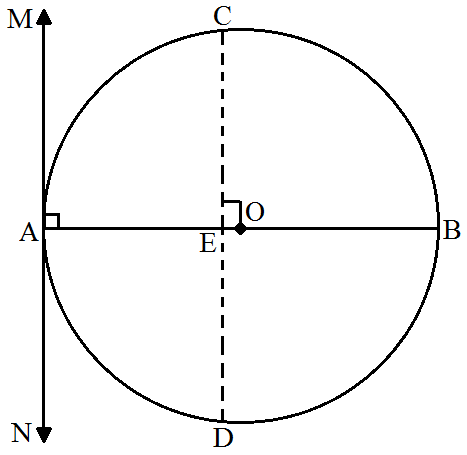
Prove that a diameter $AB$ of a circle bisects all those chords which are parallel to the tangent at the point $A.$
Answer
Given, $AB$ is a diameter of the circle.
$A$ tangent is drawn from point $A.$
Draw a chord $CD$ parallel to the tangent $MAN.$

So, $CD$ is a chord of the circle and $OA$ is a radius of the circle.
$\angle\text{MAO}=90^{\circ}$
$[$Tangent at any point of a circle is perpendicular to the radius through the point of contact.$]$
$\angle\text{CEO}=\angle\text{MAO}[$ corresponding angles.$]$
$\angle\text{CEO}=90^{\circ}$
Thus, $OE$ bisects $CD$
$[$perpendicular from centre of circle to chord bisects the chord.$]$
Similarly, the diameter $AB$ bisects all. Chord which are parallel to the tangent at the point $A.$
View full question & answer
Question 33 Marks
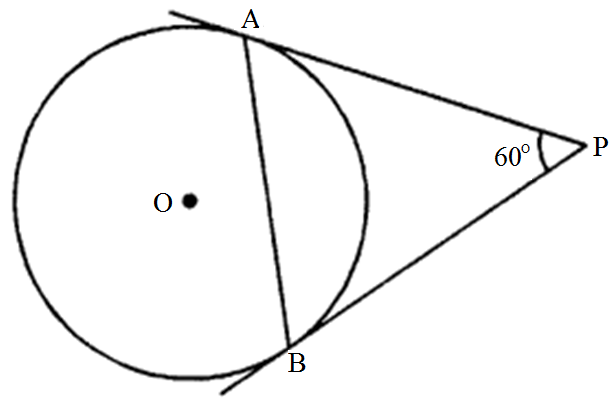
If $PA$ and $PB$ are tangents from an outside point $P$ such that $PA = 10\ cm$ and $\angle\text{APB}=60^{\circ}.$ Find the length of chord $AB.$
Answer
$PA$ and $PB$ are the tangents from a point $PQ$ outside the circle with centre $O. PA = 10\ cm$ and $\angle\text{APB}=60^{\circ}$
Tangents drawn from a point outside the circle are equal.
$\text{PA}+\text{PB}=10\text{cm}\ \angle\text{PAB}=\angle\text{PBA} ($Angles opposite to equal sides$)$
But in $\triangle\text{APB},$
$\angle\text{APB}+\angle\text{PAB}+\angle\text{PBA}=180^{\circ} ($Angles of a triangle$)$
$\Rightarrow60^{\circ}+\angle\text{PAB}+\angle\text{PAB}=180^{\circ}$
$\Rightarrow 2\angle\text{PAB}=180^{\circ}-60^{\circ}=120^{\circ}$
$\angle\text{PAB}=60^{\circ}$
$\angle\text{PBA}=\angle\text{PAB}=60^{\circ}$
$PA = PB = AB = 10\ cm$
Hence length of chord $AB = 10\ cm.$
View full question & answer
Question 43 Marks
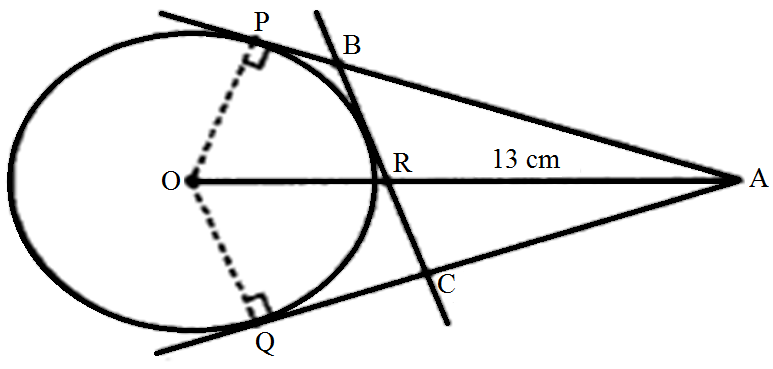
$A$ is a point at a distance $13\ cm$ from the centre $O$ of a circle of radius $5\ cm. AP$ and $AQ$ are the tangents to the circle at $P$ and $Q$. If a tangent $BC$ is drawn at a point $R$
lying on the minor arc $PQ$ to intersect $AP$ at $B$ and $AQ$ at $C,$ find the perimeter of the $\triangle\text{ABC}.$
Answer
Given: Two tangents are drawn from an external point $A$ to the circle with centre $O,$ Tangent $BC$ is drawn at a point $R,$ radius of circle equals to $5\ cm.$
To find: Perimeter of $\triangle\text{ABC}.$
Proof: $\angle\text{OPA}=90^{\circ}[$Tangent at any point of a circle is perpendicular to the radius through the point of contact$]$
$ \left.\mathrm{OA}^2=\mathrm{OP}^2+\mathrm{PA}^2 \text { [by Pythagoras Theorem }\right] $
$ (13)^2=5^2+\mathrm{PA}^2 $
$ \Rightarrow \mathrm{PA}^2=144^2=12^2$
$ \Rightarrow \mathrm{PA}=12 \mathrm{~cm}$
Now, perimeter of $\triangle\text{ABC}.  = AB + BC + CA = (AB + BR) + (RC + CA)$
$= AB + BP + CQ + CA [BR = BP, RC = CQ [$tangents from internal point to a circle are equal$]$
$= AP + AQ = 2AP = 2 × (12) = 24cm [AP = AQ$ tangent from internal point to a circle are equal$]$
Hence, the perimeter of $\triangle\text{ABC}. = 24\ cm.$
View full question & answer
Question 53 Marks
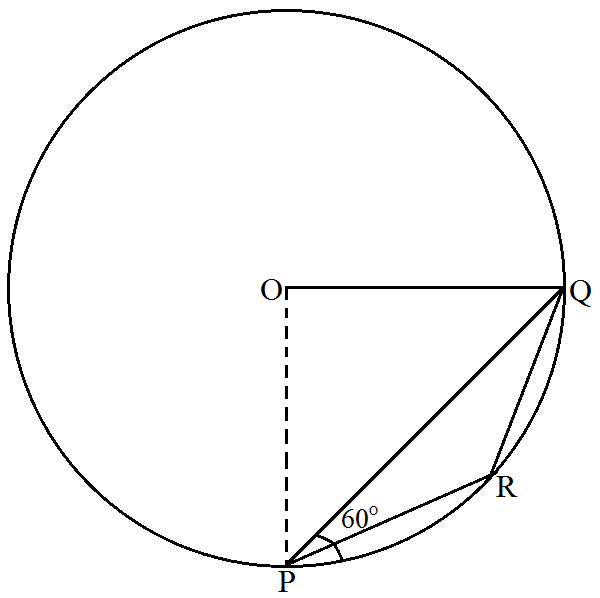
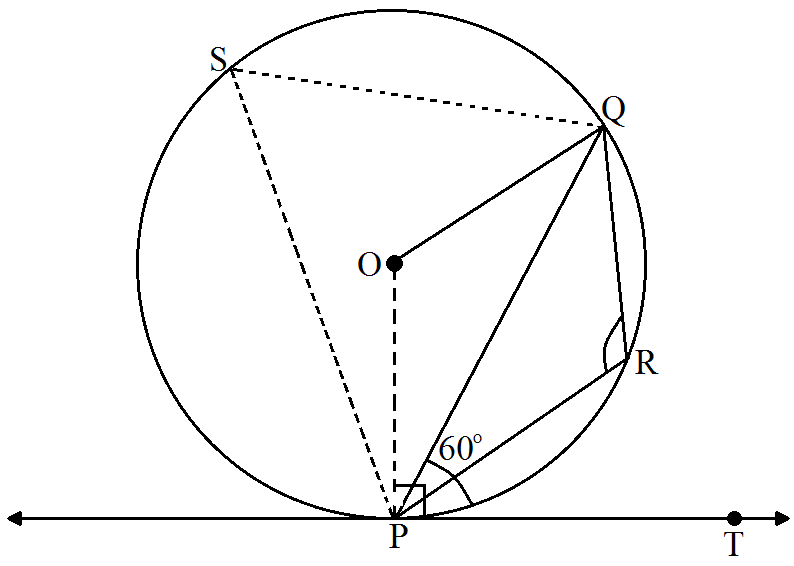
In the figure, $PQ$ is a chord of a circle and $PT$ is the tangent at $P$ such that $\angle\text{QPT}=60^{\circ}.$ Then, find $\angle\text{PRQ}$.
Answer

Construction: Take any point on major arc $PQ$ and name it $S.$ join $SQ$ and $SP.$
In the given fig. $PT$ is the tangent. SO, $\text{PT}\bot\text{PO}.$
$\angle\text{QPT}=60^{\circ}$
Thus, $\angle\text{OPQ}=90^{\circ}-60^{\circ}=30^{\circ}$
$OQ = OP ($Radii of the circle$.)$
$\angle\text{OQP}=\angle\text{OPQ}=30^{\circ}$
In $\triangle\text{OPQ},$
$\angle\text{OPQ}+\angle\text{OQP}+\angle\text{POQ}=180^{\circ}$
$\Rightarrow30^{\circ}+30^{\circ}+\angle\text{POQ}=180^{\circ}$
$\Rightarrow\angle\text{POQ}=120^{\circ}$
Now,
$\angle\text{PSQ}=\frac{1}{2}\angle\text{POQ}=\frac{1}{2}\times120=60^{\circ}$
$PSQR$ is a cyclic quadilateral. Thus,
$\angle\text{PSQ}+\angle\text{PRQ}=180^{\circ}$
$\Rightarrow60^{\circ}+\angle\text{PRQ}=180^{\circ}$
$\Rightarrow\angle\text{PRQ}=120^{\circ}$
View full question & answer
Question 63 Marks
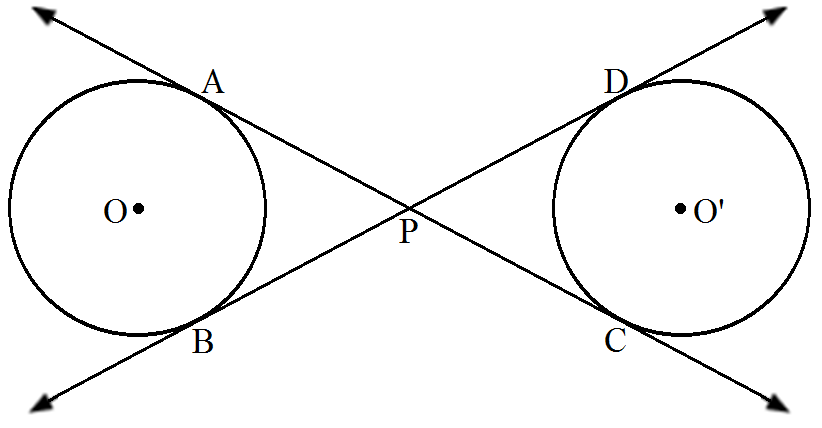
$AB$ and $CD$ are common tangents to two circles of equal radii. Prove that $AB = CD.$
Answer

Given: Two circles with center $O$ and $O'.$ $AB$ and $CD$ are common tangents to the circles which intersrcts in $P.$
To prove:
$AP = PC ($length of tangents drawn from an external point to the circle are equal$) ...(i)$
$PB = PD ($length of tangents drawn from an external point to the circle are equal$) ...(ii)$
Adding $(i)$ and $(ii),$ we get
$AP + PB = PC + PD$
$⇒ AB = CD$
Hence proved
View full question & answer
Question 73 Marks
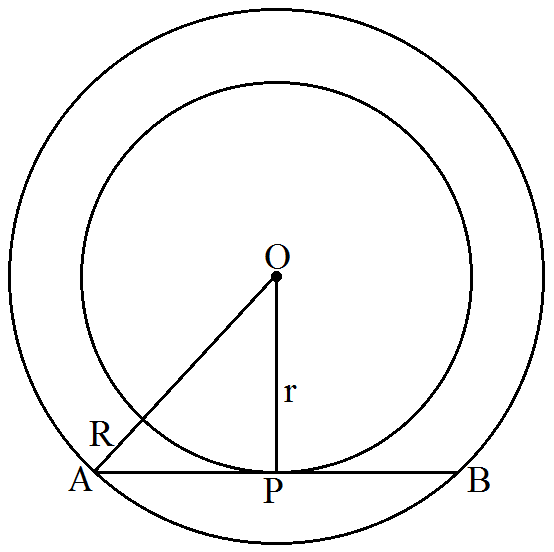
Two concentric circles are of diameters $30\ cm$ and $18\ cm.$ Find the length of the chord of the larger circle which touches the smaller circle.
Answer
Let $R$ be the radius of outer circle and $r$ be the radius if small circle of two concentric circle $AB$ is the chord of the outer circle and touches the smaller circle at $P$ Join
$OP, OA.$

$\therefore\text{OP}\bot\text{AB}$ and bisects it at $P$
$OA = R$ and $OP = r$
$\therefore\text{OA}=\frac{30}{2}=15\text{cm},\text{OP}=\frac{18}{2}=9\text{cm}$
$\therefore$ in Right $\triangle\text{OAP}$
$\text{AP}=\sqrt{\text{OA}^2-\text{OP}^2}$
$=\sqrt{{15^2}-{9^2}}$
$=\sqrt{225-81}$
$\sqrt{144}=12\text{cm}$
But $AB = 2AP = 2 × 12\ cm = 24\ cm.$
View full question & answer
Question 83 Marks
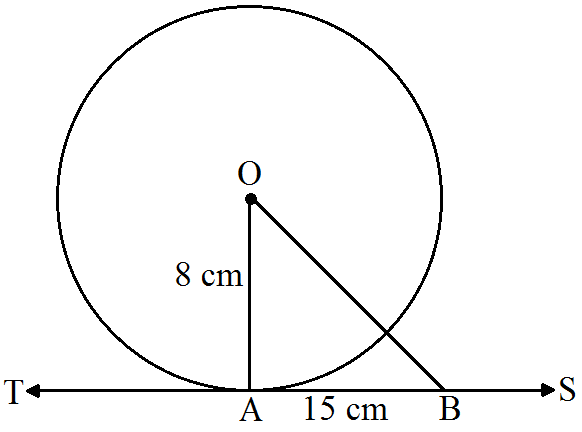
$O$ is the centre of a circle of a radius $8\ cm$ the tangent at a point $A$ on the circle cuts a line through $O$ at $B$ such that $AB = 15\ cm.$ Find $OB.$
Answer
Radius $OA = 8\ cm, ST$ is the tangent to the circle at A and $AB = 15\ cm$

$OA ⊥$ tangent $TS$
In right $\triangle \text{OAB},$
$\Rightarrow O B^2=O A^2+A B^2 \text { (Pythagoras Theorem) }$
$\Rightarrow O B^2=(8)^2+(15)^2$
$\Rightarrow O B^2=64+225$
$\Rightarrow O B^2=289=(17)^2$
$O B=17 \mathrm{~cm} .$
View full question & answer
Question 93 Marks
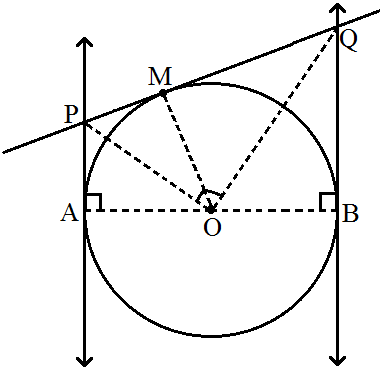
Prove that the intercept of a tangent between two parallel tangents to a circle subtends a right angle at the centre.
Answer
consider circle with center $'O'$ and has two parallel tangents through $A\ \&\ B$ at ends of diameter.

Let tangents through $M$ intersects the tangents parallel at $P$ and $Q$ required to prove is that $\text{POQ}=90^\circ$
From fig. It is clear that $ABQP$ is a quadilateral.
$\angle{\text{A}}+\angle\text{B}=90^\circ+90^\circ=180^\circ$[At point of contact tangent & radius are perpendicular]
$\angle{\text{A}}+\angle{\text{B}}+\angle{\text{P}}+\angle{\text{Q}}=360^\circ$ [Angle sum property]
$\angle{\text{P}}+\angle{\text{Q}}=360^\circ-180^\circ=180^\circ\dots(\text{i})$
$\text{At P&Q }\angle\text{APO}=\angle\text{OPQ}=\frac12\angle{\text{P}}$
$\angle{\text{BQO}}=\angle\text{PQO}=\frac12\angle{\text{Q}}\text{ in (i)}$
$2\angle\text{OPQ}+2\angle\text{PQO}=180^\circ$
$\angle\text{OPQ}+\angle\text{POQ}=90^\circ\dots{\text{(ii)}}$
In $\triangle\text{OPQ},\angle\text{OPQ}+\triangle\text{PQO}+\triangle\text{POQ}=180^\circ$ [Angle sum property]
$90^\circ+\angle\text{POQ}=180^\circ$ [from(ii)]
$\angle\text{OPQ}=180^\circ-90^\circ=90^\circ$
$\therefore\angle{\text{POQ}}=90^\circ$
View full question & answer
Question 103 Marks
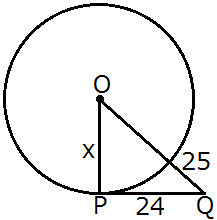
If the tangent at a point $P$ to a circle with centre $O$ cuts a line through $O$ at $Q$ such that $PQ = 24\ cm$ and $OQ = 25\ cm.$ Find the radius of the circle.
Answer

Given, $PQ = 15\ cm$
$OQ = 25\ cm$
$OP = x\ cm$
we know,
radius $OP$ is always perpendicular to tangent $PQ$
By using pythagouras, we find $OB$
$ O Q=O P^2+P Q^2 $
$ \Rightarrow(25)^2=(x)^2+(24)^2 $
$ \Rightarrow 625=x^2+576 $
$ \Rightarrow x^2=625-576$
$\Rightarrow\text{x}=\sqrt{49} $
Hence, length of $OP$ is $7\ cm.$
View full question & answer
Question 113 Marks
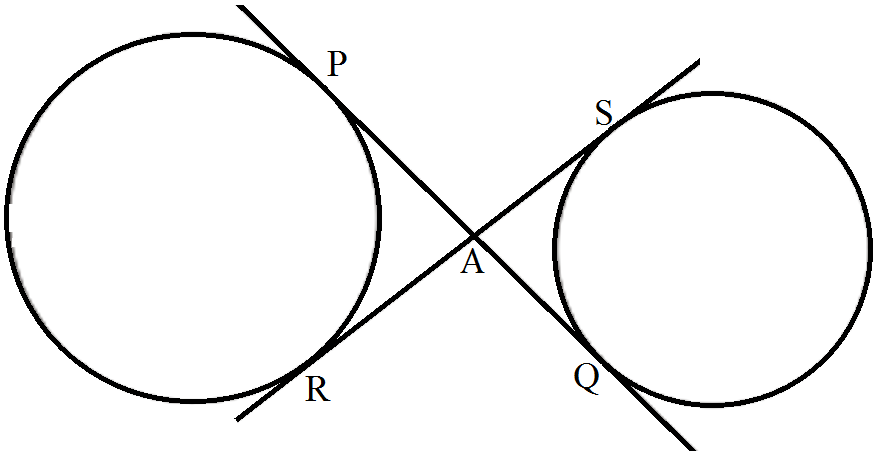
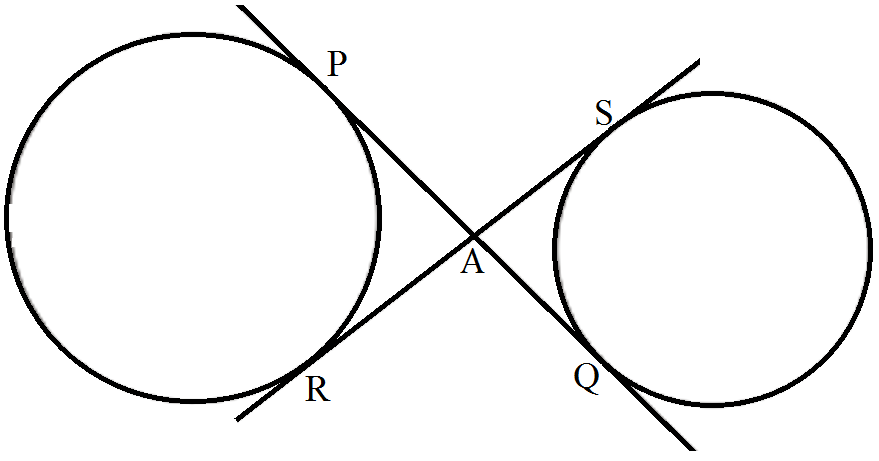
In the given figure, common tangents $PQ$ and $RS$ to two circles intersect at $A.$ Prove that $PQ = RS.$
Answer
The figure given in the question is,

We know from the property of tangents that the length of two tangents drawn from a common external point will be equal.
Therefore,
$PA = RA …… (1)$
$AQ = AS …… (2)$
Let us add equation $(1)$ and $(2)$
$PA + AQ = RA + AS$
$PQ = RS$
Thus we have proved that $PQ = RS.$
View full question & answer
Question 123 Marks
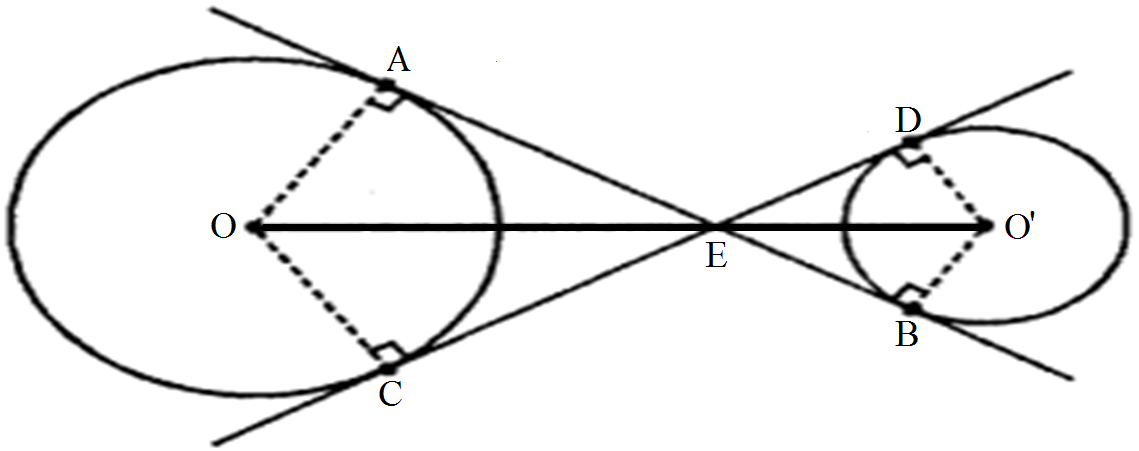
The common tangents $AB$ and $CD$ to two circles with centres $O$ and $O’$ intersect at $E$ between their centres. Prove that the points $O, E$ and $O’$ are collinear.
Answer
Joint $AO, OC$ and $O’D, O’B$
Now, in $\triangle\text{EO}'\text{D}$ and,
$O’D = O’B [$radius$]$
$O’E = O’E [$common side$]$
$ED = EB [$since, tangentdrawn from an external point to the circle are equal in the length.$]$

$\therefore\triangle\text{EO'D}\cong\triangle\text{EO'B} [$by $SSS$ congruence rule$]$
$\angle\text{EO'D}=\angle\text{EO'B}$
$O'E$ is the angle bisects of $\angle\text{DEB}\ ...\text{(i)}$
Similarily, $OE$ is the angle bisects of $\angle\text{AEC}$
Now, in quadilateral $DEBO'$
$\angle\text{OD'E}=\angle\text{O'BE}=90^{\circ}$[since, $CED$ is the tangent to the circle and $O'D$ is the radius, i.e,$\text{O'D}\bot\text{CED}$]
$\Rightarrow\angle\text{O'DE}+\angle\text{O'BE}=180^{\circ}$
$\therefore\angle\text{DEB}+\angle\text{DO'B}=180^{\circ}\ ...\text{(ii)}$
$[$since, $DEBo'$ is cyclic quadilateral$]$
since, $AB$ is a straight line.
$\therefore\angle\text{AED}+\text{DEB}=180^{\circ}$
$\Rightarrow\angle\text{AED}+180^{\circ}-\angle\text{DO'B}=180^{\circ}$
View full question & answer
Question 133 Marks
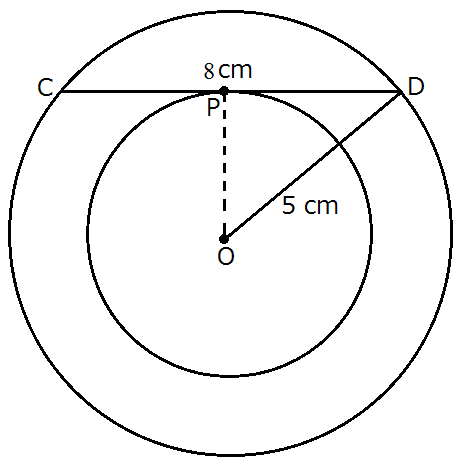
Out of the two concentric circles, the radius of the outer circle is 5cm and the chord $CD$ of length $8\ cm$ is a tangent to the inner circle. Find the radius of the inner circle.
Answer

Let the centre of the two concentric circles be $O.$
$CD$ is the tangent to the inner circle.
$OP$ joins the centre of the circle to the tangent at the point of contant.
$\text{OP}\bot\text{CD}$ and $OP$ bisects $CD.$
Thus, $PD = 4\ cm$
In $\triangle\text{OPD}$,
$ \Rightarrow O P^2+P D^2=O D^2 $
$ \Rightarrow O P^2=O D^2-P D^2 $
$ \Rightarrow O P^2=(5)^2-(4)^2=25-16=9 $
$ \Rightarrow O P=3 \mathrm{~cm}$
Hence, the radius of the inner circle $= 3\ cm$
View full question & answer
Question 143 Marks
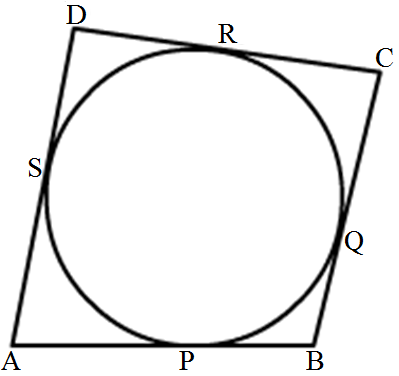
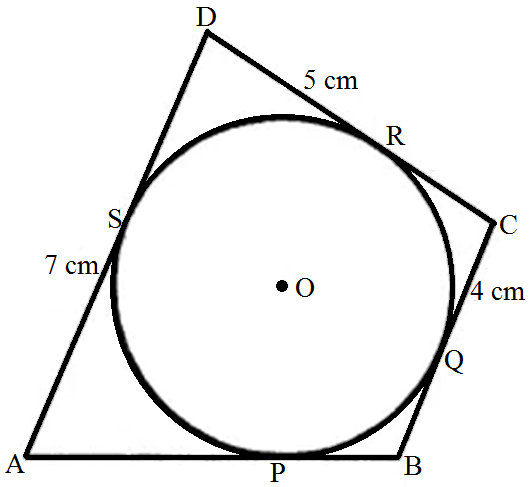
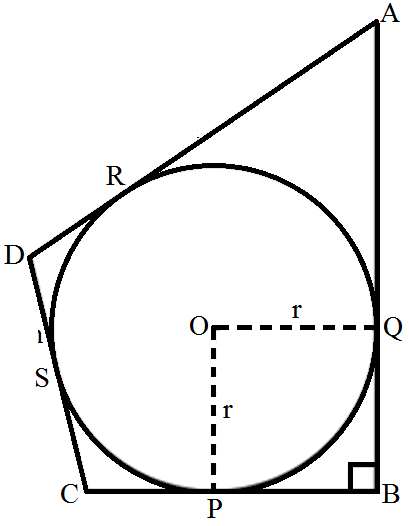
In the given figure, a circle touches all the four sides of a quadrilateral $ABCD$ with $AB = 6\ cm, BC = 7\ cm$ and $CD = 4\ cm.$ Find $AD.$
Answer
A circle touches the sides $AB, BC, CD$ and $DA$ of a quadrilateral $ABCD$ at $P, Q, R$ and $S$ respectively. $AB = 6\ cm, BC = 7\ cm, CD = 4\ cm$

Let $AD = x$
$AP$ and $AS$ are the tangents to the circle
$AP = AS$
Similarly,
$BP = BQ$
$CQ = CR$
and $DR = DS$
$AB + CD = AD + BC$
$⇒ 6 + 4 = 7 + x$
$⇒ 10 = 7 + x$
$⇒ x = 10 – 7 = 3$
$AD = 3\ cm$
View full question & answer
Question 153 Marks
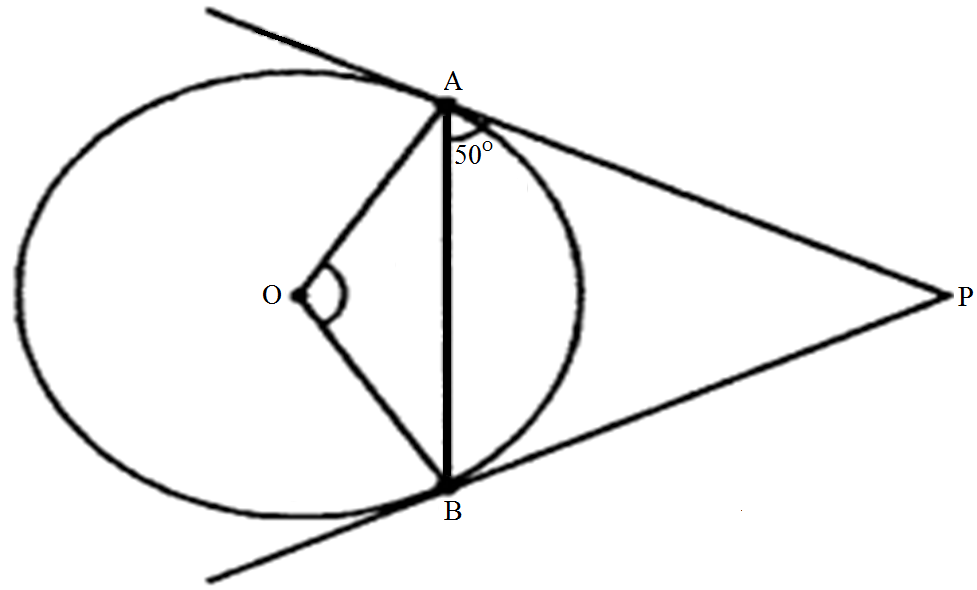
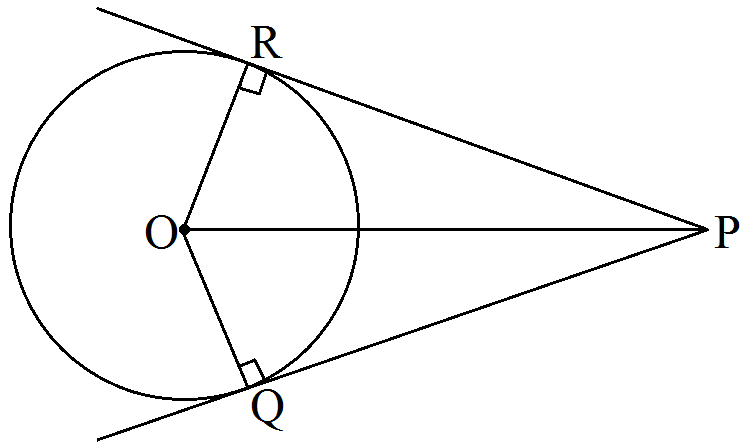
From an external point $P,$ tangents $PA = PB$ are drawn to a circle with centre $O.$ If $\angle\text{PAB}=50^{\circ}$, then find $\angle\text{AOB}$.
Answer

$A = PB [$tangents drawn from external point are equal$]$
$\angle\text{PAB}=\angle\text{PAB}=50^{\circ}[$angles equal to opposite sides$]$
$\angle\text{APB}=180^{\circ}-50^{\circ}=80^{\circ}[$angle-sum property of a $A]$
In cyclic quad. $OAPB$
$\angle\text{AOB}+\angle\text{APB}=180^{\circ}[$sum of opposite angles of a cyclic quadrilateral is $180^\circ ]$
$\angle\text{AOB}+80^{\circ}=180^{\circ}$
$\angle\text{AOB}=180^{\circ}-80^{\circ}=100^{\circ}.$
View full question & answer
Question 163 Marks
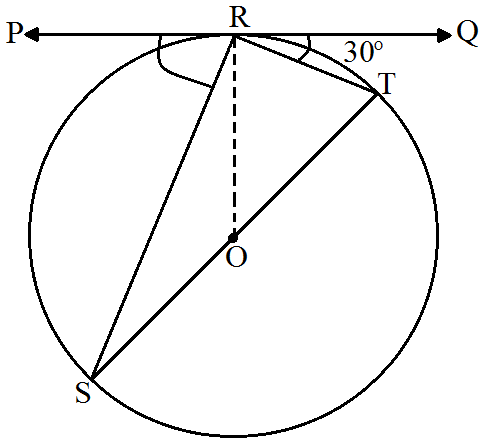
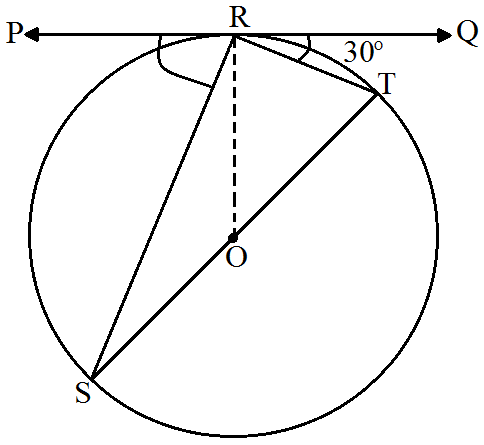
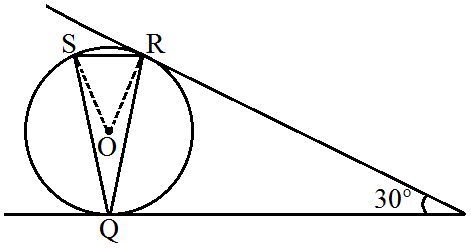
In the given figure, $PQ$ is tangent at a point $R$ of the circle with centre $O.$ If $\angle\text{TRQ}=30^{\circ},$ find $m$ $\angle\text{PRS}$.
Answer

Given, $\angle\text{TRQ}=30^{\circ}$
$ST$ is diameter and right angle present in the semi circle.
Then, $\angle\text{SRT}=90^{\circ}$
Now,
$\angle\text{TRQ}+\angle\text{SRT}+\angle\text{PRS}=180^{\circ}$
$\Rightarrow 30^{\circ}+90^{\circ}+\angle\text{PRS}=180^{\circ}$
$\Rightarrow 120^{\circ}+\angle\text{PRS}=180^{\circ}$
$\angle\text{PRS}=180^{\circ}-120^{\circ}$
Hence,
$\angle\text{PRS}=60^{\circ}$
View full question & answer
Question 173 Marks
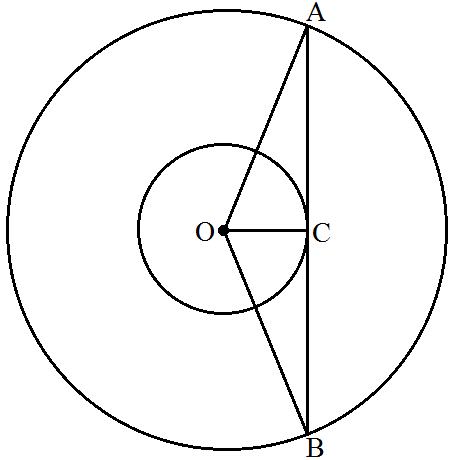
Two concentric circles are of radii $5\ cm$ and $3\ cm.$ Find the length of the chord of the larger circle which touches the smaller circle.
Answer
Let us first draw whatever is given in the problem so that we can understand the problem better.

We have to find the length of $AB,$ which is the chord of the larger circle which touches the smaller circle.
Clearly, $OC$ is the radius of the smaller circle and is touching the tangent $AB.$
We know that the radius of the circle will always form a right angle with the tangent at the point of contact.
We have draw $OA$ in order to complete the triangle $OAC$ which will be a right triangle.
From the figure it is very clear that $OA$ is the radius of the larger circle which is $5\ cm.$
We can now find $AC$ using Pythagoras theorem. We have,
$ \mathrm{AC}^2 \Rightarrow \mathrm{OA}^2-\mathrm{OC}^2 $
$ \mathrm{AC}^2=5^2-3^2 $
$ \mathrm{AC}^2=25-9 $
$ \mathrm{AC}^2=16 $
$ \mathrm{AC}=\sqrt{16} $
$ =4$
$\text { Similarly we can find } C B \text {. We have, }$
$ C B^2 \Rightarrow O B^2-O C^2 $
$ C B^2 \Rightarrow 5^2-3^2 $
$ C B^2 \Rightarrow 25-9 $
$ C B^2 \Rightarrow 16 $
$ C B=\sqrt{16} $
$ =4$
From the figure we can see that,
$AB = AC + CB$
Since we have found the values of $AC$ and $CB$, let us substitute the values in the above equation. We get,
$AB = 4 + 4$
$AB = 8$
Therefore, the length of the chord of the larger circle which touches the smaller circle is $8\ cm.$
View full question & answer
Question 183 Marks
In given fig. tangents $PQ$ and $PR$ are drawn from an external point to a circle with centre $O,$ such that $\angle\text{RPQ}=30^{\circ}$. $A$ chord $RS$ is drawn parallel to the tangent $PQ.$
Find $\angle\text{RQS}$
Answer

It is given that tangents $PQ$ and $PR$ are drawn from an external point $P$ to a circle with centre $O,$ such that $\angle\text{RPQ}=30^{\circ}$. Also, $\text{RS}\parallel\text{PQ}$.
join $OR$ and $OS. PQ$ and $PR$ are tangents drawn from an external point $P$ to a circle.
$\therefore$ $PQ = PR ($lengths of tangents frawn from an external point to a circle are equal$)$
In $\triangle\text{PQR},$
$PQ = PR$
$\therefore\angle\text{PRQ}=\angle\text{PQR} ($in a triangle, equal sides have equal anles opposite to them$)$
Now,
$\angle\text{PRQ}+\angle\text{PQR}+\angle\text{RPQ}=180^{\circ} ($Angle sum property$)$
$\Rightarrow2\angle\text{PRQ}=180^{\circ}-30^{\circ}=150^{\circ}$
$\Rightarrow\angle\text{PRQ}=75^{\circ}$
$\therefore\angle\text{PQR}=\angle\text{PRQ}=75^{\circ}...(1)$
Now, $PR$ is the tangent and $OR$ is the radius through the point of contact $R.$
$\therefore\angle\text{ORP}=90^{\circ} ($Tangent at any point of a circle is perpendicular to the radius through the point of a contact$)$
$\Rightarrow\angle\text{ORQ}=\angle\text{ORQ}-\angle\text{PRQ}=90^{\circ}-75^{\circ}=15^{\circ}$
$\therefore\angle\text{ORS}=\angle\text{SRQ}-\angle\text{ORQ}=75^{\circ}-15^{\circ}=60^{\circ}$
In $\triangle\text{SOR}, OR = OS ($Radii of the circle$)$
$\therefore\angle\text{ORS}+\angle\text{OSR}+\angle\text{ROS}=180^{\circ}($Angle sum property$)$
$\Rightarrow\angle\text{ROS}=180^{\circ}-120^{\circ}=60^{\circ}$
we know that the angle subtended by an arc at the center is twice the angle subtended by it any point on the remaining part of the circle.
$\therefore\angle\text{ROS}=2\angle\text{RQS}$
$\Rightarrow\angle\text{RQS}=\frac{1}{2}\angle\text{ROS}=\frac{1}{2}\times60^{\circ}=30^{\circ}$
View full question & answer
Question 193 Marks
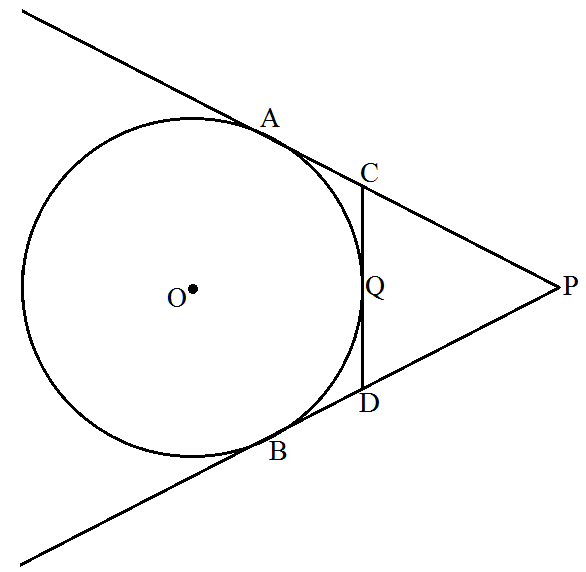
In the given fig. $PA$ and $PB$ are tangents to the circle from an external point $P. CD$ is another tangent touching the circle at $Q.$ if $PA = 12\ cm, QC = QD = 3\ cm,$ then find $PC + PD.$
Answer
Given: $PA$ and $PB$ are the tangents to the circle.
$PA = 12\ cm$
$QC = QD = 3\ cm$
To find: $PC + PD$
$PA = PB = 12\ cm ($The length of the tangents drawn from an external point to a circle are equal.$)$
Similarly, $QC = AC = 3\ cm.$
and $QD = BD = 3\ cm.$
Now, $PC = PA - AC = 12 - 3 = 9\ cm$
similarily, $PD = PB - BD = 12 - 3 = 9\ cm$
Hence,$ PC + PD = 9 + 9 = 18\ cm.$
View full question & answer
Question 203 Marks
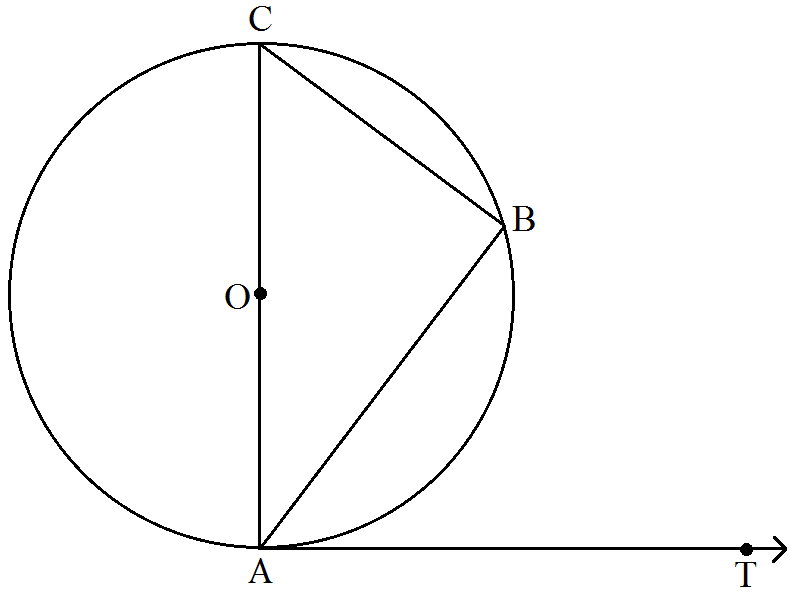
$AB$ is a chord of a circle with centre $O, AOC$ is a diameter and $AT$ is the tangent at $A$ as shown in the figure. Prove that $\angle\text{BAT}=\angle\text{ACB}.$
Answer
Since, $AC$ is a diameter line, so angle in semicircle makes an angle $90^{\circ}$.
$\angle\text{ABC}=90^{\circ}[ $by property$]$
In $\triangle\text{ABC}.$
$\angle\text{CAB}+\angle\text{ABC}+\angle\text{ACB}=180^{\circ} [$sum of all interior angles of any triangle is $180^\circ ]$
$\Rightarrow\angle\text{CAB}+\angle\text{ACB}=180^{\circ}-90^{\circ}=90^{\circ}\ ...\text{(i)}$
Since, diameter of a circle is perpendicular to the tangent.
i.e. $\text{CA}\bot\text{AT}$
$\angle\text{CAT}=90^{\circ}$
$\Rightarrow\angle\text{CAB}+\angle\text{BAT}=90^{\circ}\ ...\text{(ii)}$
From Eqs. $(i)$ and $(ii),$
$\angle\text{CAB}+\angle\text{ACB}=\angle\text{CAB}+\angle\text{BAT}$
$\Rightarrow\angle\text{ACB}=\angle\text{BAT}$
Hence proved.
View full question & answer
Question 213 Marks
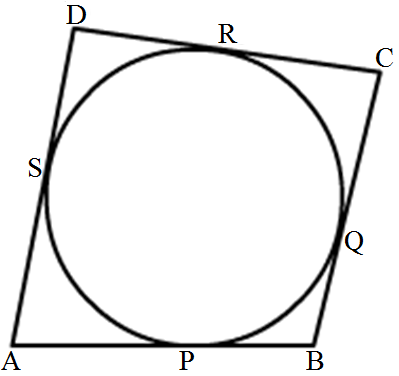
The length of three concesutive sides of a quadilateral circumscribing a circle are $4\ cm, 5\ cm, 7\ cm$ respectively. Determine the length of thefourth side.
Answer
Let us first put the given date in the form of a diagram.

From the property of tangents we know that the length of two tangents drawn from the same external will be equal. Therefore we have,
$AR = SA$
Let us represent $AR$ and $SA$ by $'a'.$
Similarily,
$QB = RB$
Let us represent $SD$ and $DP$ by $'b'.$
$PC = CQ$
Let us represent $PC$ and $PQ$ by $'c'.$
$SD = DP$
Let us represent $QB$ and $RB$ by $'d'.$
View full question & answer
Question 223 Marks
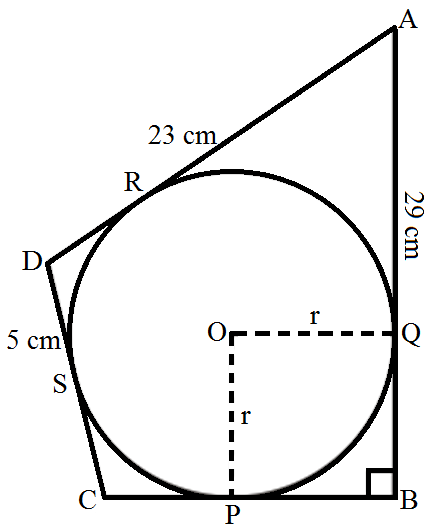
In the given figure, a circle is inscribed in a quadrilateral $ABCD$ in which $\angle\text{B}=90^{\circ}.$ It $AD = 23\ cm, AB = 29\ cm$ and $DS = 5\ cm,$ find the radius $r$ of the circle.
Answer
In the figure, $O$ is the centre of the circle inscribed in a quadrilateral $ABCD$ and $\angle\text{B}=90^{\circ} AD = 23\ cm, AB = 29\ cm, DS = 5\ cm.$

$OP = OQ ($radii of the same circle$)$
$AB$ and $BC$ are tangents to the circle and $OP$ and $OQ$ are radii
$OP ⊥ BC$ and $OQ ⊥ AB$
$\angle\text{OPB}=\angle\text{OQB}=90^{\circ}$
$PBQO$ is a square
$DS$ and $DR$ are tangents to the circle
$DR = DS = 5\ cm$
$AR = AD – DR = 23 – 5 = 18\ cm$
$AR$ and $AQ$ are the tangents to the circle
$AQ = AR = 18\ cm$ But $AB = 29\ cm$
View full question & answer
Question 233 Marks
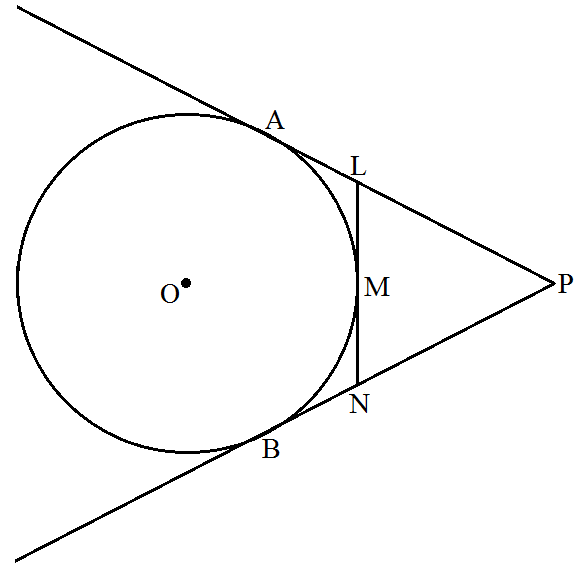
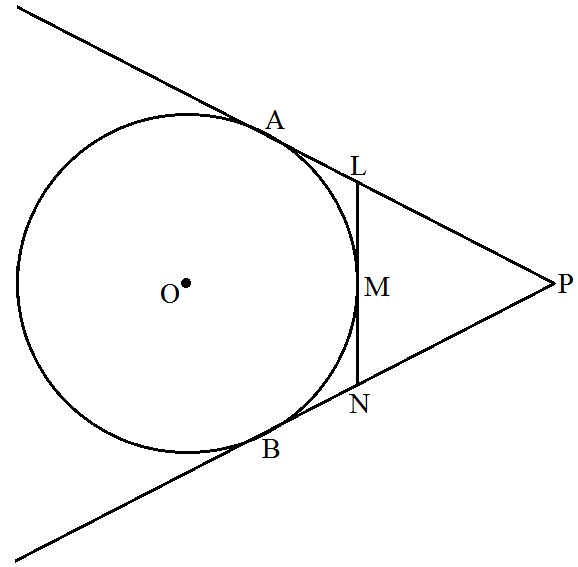
In the given figure, $PA$ and $PB$ are tangents from an external point $P$ to a circle with centre $O. LN$​​​​​​​ touches the circle at $M$. Prove that $PL + LM = PN + MN.$​​​​​​​
Answer
Given: In the figure, $PA$ and $PB$ are the tangents to the circle with centre $O$ from a point $P$ outside it $LN$ touches it at $M.$

To prove: $PL + LM = PN + MN$
Prove: $PA$ and $PB$ are tangents to the circle from $P$
$PA = PB$
Similarly from $L, LA$ and $LM$ are tangents
$LA = LM$
Similarly $NB = NM$​​​​​​​
Now $PA = PB ⇒ PL + LA = PN + NB$
$PL + LM = PN + NM$
Hence proved.
View full question & answer
Question 243 Marks
Prove that the centre of a circle touching two intersecting lines lies on the angle bisector of the lines.
Answer
Given: Two tangents $PQ$ and $PR$ are drawn from an external point $P$ to a circle with centre $O.$
To prove: Centre of a circle touching two intersecting line s lies on the angle bisector of the lines.

Construction: Join $OR,$ and $OQ.$
In $\triangle\text{POR}\ \text{and}\ \triangle\text{PQO}$
$\angle\text{PRO}=\angle\text{PQO}=90^{\circ}[$ tangent at any point of a circle is perpendicular to the radius through the point of contact$]$
$OR = OQ [$radii of same circle$]$
Since, $OP$ is common.
$\triangle\text{PRO}\cong\triangle\text{PQO} [SAS]$
Hence, $\angle\text{RPO}=\angle\text{QPO} [by CPCT]$
Thus, $O$ lies on angle bisector of $PR$ and $PQ.$
Hence proved.
View full question & answer
Question 253 Marks
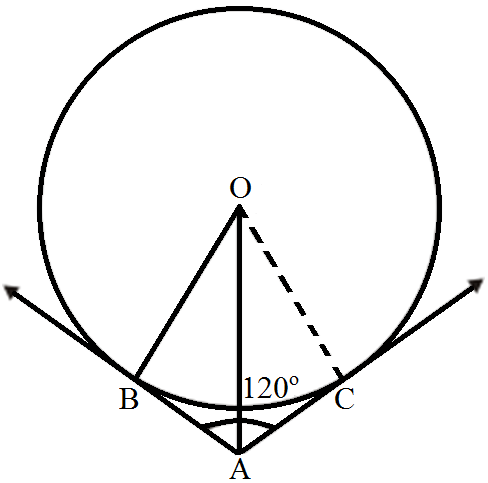
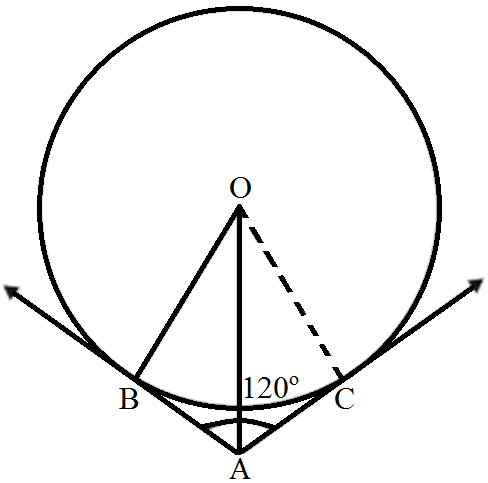
In the given figure, two tangents $AB$ and $AC$ are drawn to a circle with centre $O$ such that $\angle\text{BAC}=120^{\circ}$. Prove that $OA = 2AB.$
Answer
Cosider $\triangle\text{OAB}$ and $\triangle\text{OAC}. $

We have,
$OB = OC ($Since they are radii of the same circle.$)$
$AB = AC ($Since length of two tangents drawn from an external point will be equal.$)$
$OA$ is the common side.
Therefore by $SSS$ congruency, we can say that$\triangle\text{OAB}$ and $\triangle\text{OAC}$ are congruent triangles.
Therefore,
$\angle\text{OAB}=\angle\text{OAC}$
It is given that,
$\angle\text{OAB}+\angle\text{OAC}=120^{\circ}$
$2\angle\text{OAB}=120^{\circ}$
$\angle\text{OAB}=60^{\circ}$
We know that,
$\cos\angle\text{OAB}=\frac{\text{AB}}{\text{OA}}$
$\cos60^{\circ}=\frac{\text{AB}}{\text{OA}}$
we know that,
$\cos60^{\circ}=\frac{1}{2}$
Therefore,
$\frac{1}{2}=\frac{\text{AB}}{\text{OA}}$
$OA = 2AB$
View full question & answer
Question 263 Marks
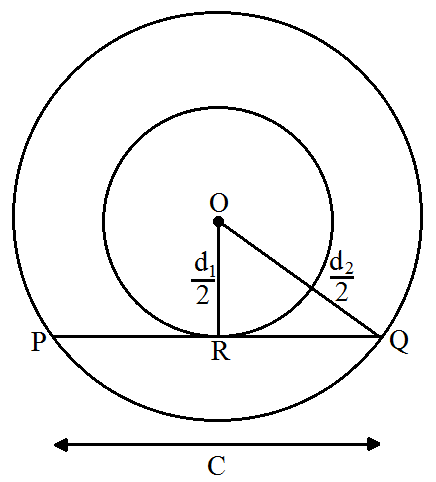
If $\mathrm{d}_1, \mathrm{~d}_2\left(\mathrm{~d}_2>\mathrm{d}_1\right)$ be the diameters of two concentric circles and $c$ be the length of a chord of a circle which is tangent to the other circle, prove that . $\text{d}^2_2=\text{c}^2+\text{d}^2_2$
Answer

Let $O$ be the center of two concentric circles and $PQ$ be the tangent to the inner circle that touches the circle at $R.$
Now, $\text{OQ}=\frac{1}{2}\text{d}_2$ and $\text{OR}=\frac{1}{2}\text{d}_1$
Also, $PQ = c$
As, $PQ$ is the tangent to the circle.
$\Rightarrow\text{OR}\bot\text{PQ}$
$\Rightarrow\text{QR}=\frac{1}{2}\text{PQ}=\frac{1}{2}\text{c}$
in triangle $OQR,$
$\therefore$ By pythagoras throrem,
$\mathrm{(OQ)^2= (OR)^2+ (RQ)^2}$
$\Rightarrow\Big(\frac{\text{d}_2}{2}\Big)^2=\Big(\frac{\text{d}_1}{2}\Big)^2+\Big(\frac{\text{c}}{2}\Big)^2$
$\Rightarrow \text{(d}_2)^{2} = \big(\text{d}_{1}\big)^{2} + \text{(c})^{2} $
View full question & answer
Question 273 Marks
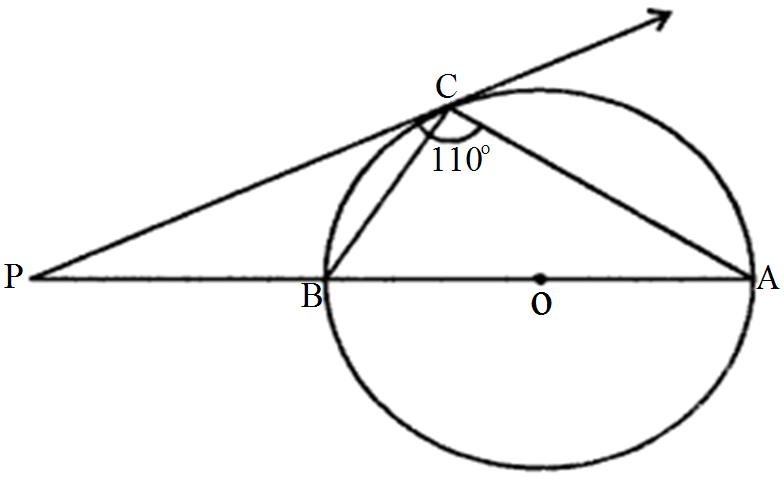
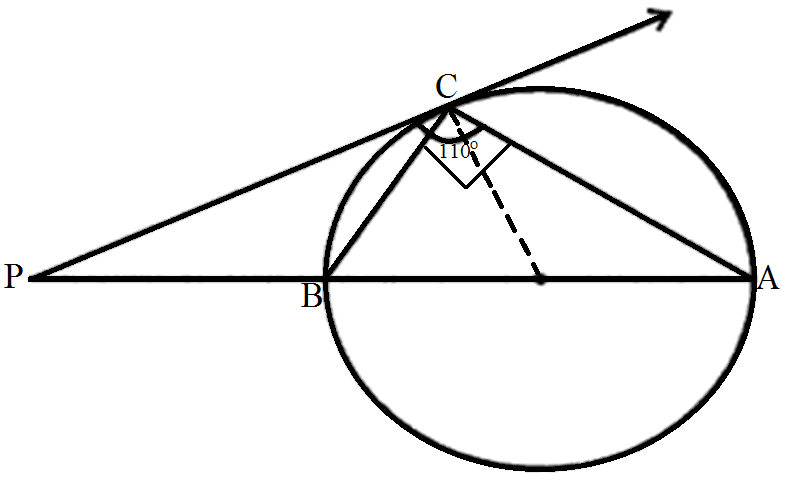
In the figure, the tangent at a point $C$ of a circle and a diameter $AB$ when extended itersect at $P.$ If $\angle\text{PCA}=110^{\circ},$ find $\angle\text{CBA}.$
Answer

$\angle\text{ACB}=90^{\circ}($Angle inscribed in a semi-circle$)$
$\angle\text{PCO}=90^{\circ}(PC$ is a tangent at $C)$
Now, $\angle\text{PCA}=\angle\text{PCO}+\angle\text{OCA}$
$\Rightarrow110^{\circ}=90^{\circ}+\angle\text{OCA}$
$\Rightarrow\angle\text{OCA}=20^{\circ}$ Since, $OC = OA ($radii of the circle.$)$
$\angle\text{OCA}=\angle\text{OAC}=20^{\circ}$
In $\triangle\text{ABC,}$
$\angle\text{BAC}+\angle\text{ACB}+\angle\text{CBA}=180^{\circ}$
$\Rightarrow90^{\circ}+20^{\circ}+\angle\text{CBA}=180^{\circ}$
$\angle\text{CBA}=70^{\circ}$
View full question & answer
Question 283 Marks
From an external point $P,$ tangents $PA$ and $PB$ are drawn to a circle with centre $O.$ If $CD$ is the tangent to the circle at a point $E$ and $PA = 14\ cm,$ find the perimeter of $\triangle\text{PCD}.$
Answer

We have to find perimeter of $\triangle\text{PCD}$
From property of tangent
$AP = PB$ are tangent from point $P$
there, $CA = CE$
$DB = ED$
Now $\text{perimeter}\ \text{of}\ \triangle\text{PCD}= \text{PC + CD + PD}$
$\Rightarrow\text{perimeter}\ \text{of}\ \triangle\text{PCD}= \text{PC + CA + DB + PD}$
$\Rightarrow\text{perimeter}\ \text{of}\ \triangle\text{PCD}= \text{PA + PB}$
$\Rightarrow\text{perimeter}\ \text{of}\ \triangle\text{PCD}= 2 \text{PA}$
$\Rightarrow\text{perimeter}\ \text{of}\ \triangle\text{PCD}= \text{PC} + 2 × 14$
Hence, $\Rightarrow\text{perimeter}\ \text{of}\ \triangle\text{PCD}$ is $28\ cm$
View full question & answer
Question 293 Marks
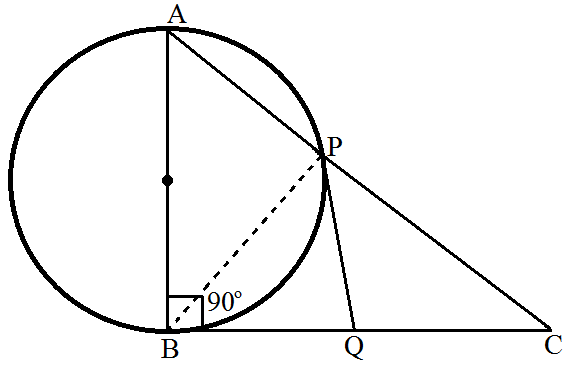
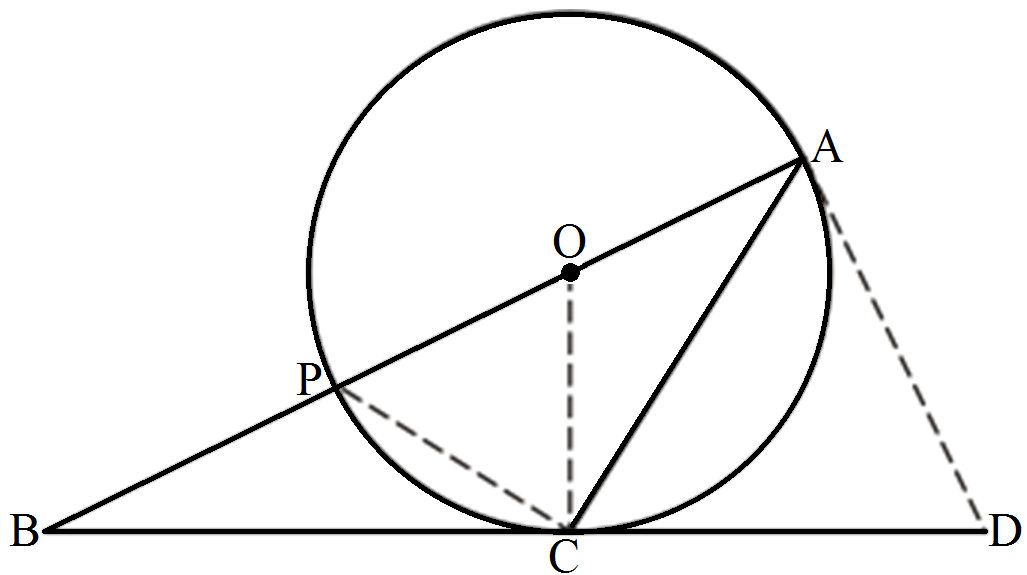
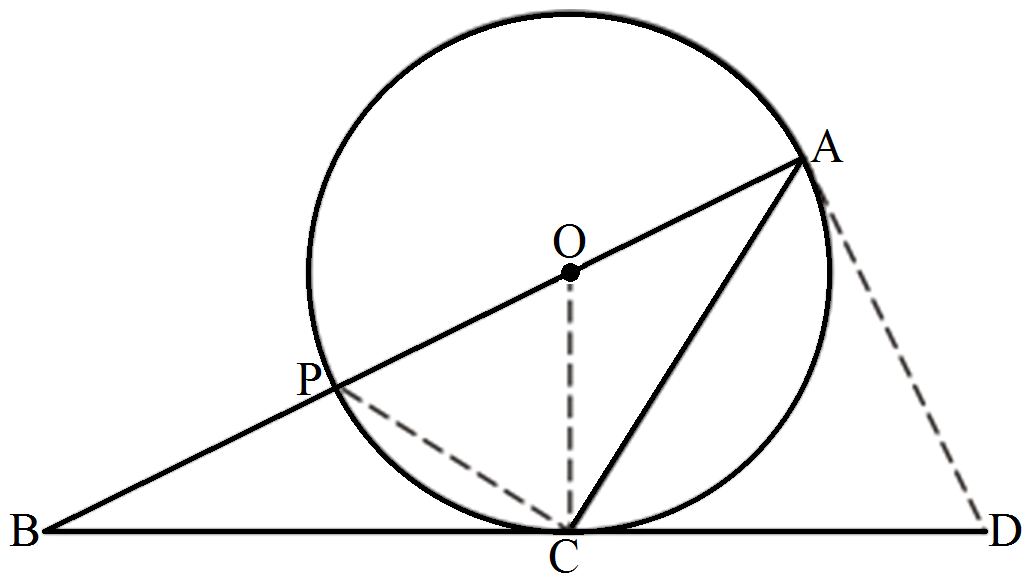
In the given figure, $O$ is the centre of the circle and $BCD$ is tangent to it at $C.$ Prove that $\angle\text{BAC}+\angle\text{ACD}=90^{\circ}.$
Answer
In the given figure, let us join $D$ an $A.$

Consider$\triangle\text{OCA}$ . We have,
$OC = OA ($Radii of the same circle$)$
We know that angles opposite to equal sides of a triangle will be equal.
It is clear from the figure that,
$\angle\text{DCA}+\angle\text{OCA}=\angle\text{OCD}$
Now from $(1)$
$\angle\text{DCA}+\angle\text{OAC}=\angle\text{OCD}$
Now as $BD$ is tangent therefore $\angle\text{OCD}=90^{\circ}$
Therefore $\angle\text{OCA}=\angle\text{OAC}\ \angle\text{DCA}+\angle\text{OAC}=90^{\circ}$
From the figure we can see that $\angle\text{OAC}=\angle\text{BAC}$
$\angle\text{DAC}+\angle\text{BAC}=90^{\circ}$
Thus we have proved.
View full question & answer
3 Marks Question - Maths STD 10 Questions - Vidyadip