Questions

4 Marks Questions

🎯

Test yourself on this topic

19 questions · timed · auto-graded

Question 14 Marks
$AB$ is a diameter and $AC$ is a chord of a circle with centre $O$ such that $\angle\text{BAC}=30^{\circ} $. The tangent at $C$ intersects $AB$ at a point $D$. Prove that $BC = BD.$
Answer
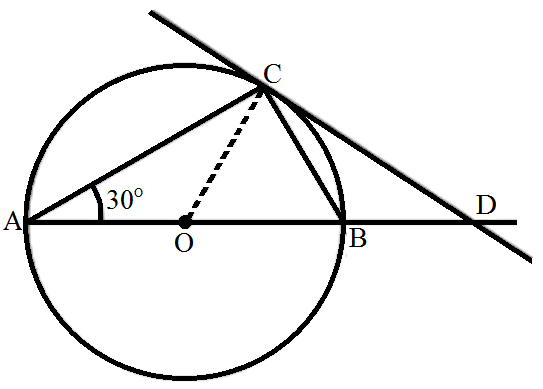
It is given that $\angle\text{BAC}=30^{\circ}$and $AB$ is diameter.
$\frac{AB}{2}=\text{OA}=\text{OC}$ (Radius.)
$\angle\text{ACB}=90^{\circ}$(angle formed by the diameter is 90°)
In $\triangle\text{ABC},$
$\angle\text{ACB}+\angle\text{BAC}+\angle\text{ABC}=180^{\circ}$
$\Rightarrow90^{\circ}+30^{\circ}+\angle\text{ABC}=180^{\circ}$
$\Rightarrow\angle\text{ABC}=60^{\circ}$
$\Rightarrow\angle\text{CBD}=180^{\circ}=60^{\circ}=120^{\circ}$($\angle\text{CBD}\text{and}\angle\text{ABC}$ from a linear pair.)
In $\triangle\text{OCD}$
$\angle\text{OCD}=90^{\circ}$(Angle made by radius on the tangent.)
$\angle\text{OBC}=\angle\text{ABC}=60^{\circ}$
Since OB = OC, $\angle\text{OCB}=\angle\text{OBC}=60^{\circ}$(OC = OB = radius.)
In $\triangle\text{OCD}$
$\angle\text{COD}+\angle\text{OCD}+\angle\text{ODC}=180^{\circ}$
$\Rightarrow60^{\circ}+90^{\circ}+\angle\text{ODC}=90^{\circ}(\angle\text{COD}=\angle\text{COB)}$
$\Rightarrow\angle\text{ODC}=30^{\circ}$
In $\triangle\text{CBD}$
$\angle\text{CBD}=120^{\circ}$
$\angle\text{BDC}=\angle\text{ODC}=30^{\circ}$
$\Rightarrow\angle\text{BCD}+\angle\text{BDC}+\angle\text{CBD}=180^{\circ}$
$\Rightarrow\angle\text{BCD}+30^{\circ}+120^{\circ}=180^{\circ}$
$\Rightarrow\angle\text{BCD}+30^{\circ}=\angle\text{BDC}$
Angle made by BC and BD on CD are equal, so $\triangle\text{CBD}$ is an isosceles triangle and therefore, BC = BD.
View full question & answer
Question 24 Marks
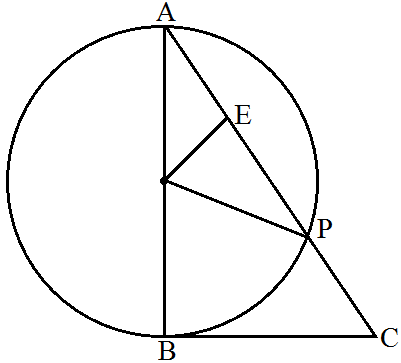
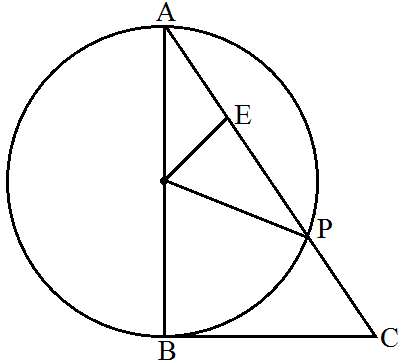
In the figure, $BC$ is a tangent to the circle with centre $O. OE$ bisects $AP$. Prove that $\triangle\text{AEO}\sim\triangle\text{ABC}.$
Answer
The figure given in the question is below.

Let us first take up $\triangle\text{AOP}.$
We have,
$OA = OP$ (Since they are the radii of the same circle)
Therefore,$\triangle\text{AOP}$ is an isosceles triangle. From the property of isosceles triangle, we know that, when a median drawn to the unequal side of the triangle will be
perpendicular to the unequal side. Therefore,
$\angle\text{OEA}=90^{\circ}$
Now let us take up$\triangle\text{AOE}\ \text{and}\ \triangle\text{ABC}.$
We know that the radius of the circle will always be perpendicular to the tangent at the point of contact. In this problem, OB is the radius and BC is the tangent
and B is the point of contact. Therefore,
$\angle\text{ABC}=90^{\circ}$
Also, from the property of isosceles triangle we have found that
$\angle\text{OEA}=90^{\circ}$
Therefore,
$\angle\text{A}$ is the common angle to both the triangles.
Therefore, from AA postulate of similar triangles,
$\triangle\text{AOE}\sim\triangle\text{ABC}$
Thus we have proved.
View full question & answer
Question 34 Marks
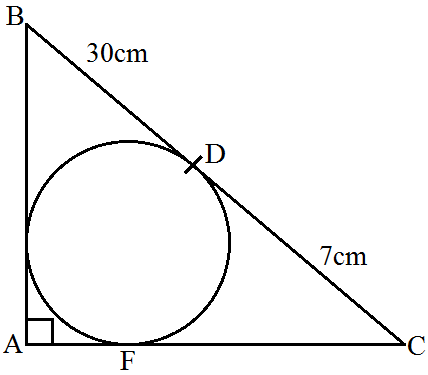
In the given figure, $BDC$ is a tangent to the given circle at point $D$ such that $BD =30 cm$ and $CD =7 cm$. The other tangents $BE$ and $CF$ are drawn respectively
from $B$ and $C$ to the circle and meet when produced at A making $BAC$ a right angle triangle. Calculate $(i) AF (ii)$ radius of the circle.
Answer
The given figure is below
  1. The given triangle $ABC$ is a right triangle where side $BC$ is the hypotenuse. Let us now apply Pythagoras theorem. We have,
$AB^2 + AC^2 = BC^2$
Looking at the figure we can rewrite the above equation as follows.
$(BE + EA)^2 + (AF + FC)^2 = (30 + 7)^2$
From the property of tangents we know that the length of two tangents drawn from the same external point will be equal. Therefore we have the following,
$BE = BD$
It is given that $BD = 30\ cm$. Therefore,
$BE = 30cm$
Similarly,
$CD = FC$
It is given that $CD = 7cm.$ Therefore,
$FC = 7cm$
Also, on the same lines,
$EA = AF$
Let us substitute these in equation $(1)$. We get,
$ (B E+E A)^2+(A F+F C)^2=(30+7)^2 $
$ (30+A F)^2+(A F+7)^2=(37)^2 $
$ 30^2+2 \times 30 \times A F+A F^2+14 A F+49=1369$
$ 2 A F^2+74 A F-420=0 $
$ A F^2+37 A F-210=0 $
$ A F^2+42 A F-5 A F-210=0 $
$ A F(A F+42)-5(A F+42)=0 $
$ (A F-5)(A F+42)=0$
$\text { Therefore, }$
$\mathrm{AF}=5 \mathrm{OR} A F=-42$
Since length cannot have a negative value,
$AF = 5$
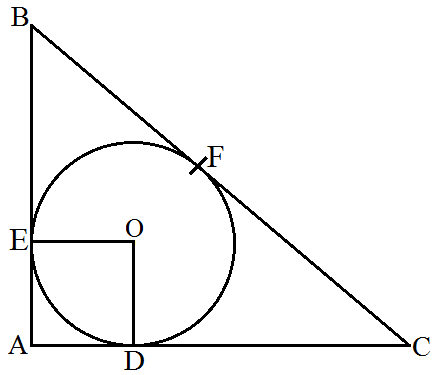
  1. Let us join the point of contact $E$ with the centre of the circle say $O$. Also, let us join the point of contact F with the centre of the circle $O$. Now we have a quadrilateral $AEOF.$

In this quadrilateral we have,
$\angle\text{EAD}=90^{\circ}$(Given in the problem)
$\angle\text{ODA}=90^{\circ}$(Since the radius will always be perpendicular to the tangent at the point of contact)
$\angle\text{OEA}=90^{\circ}$(Since the radius will always be perpendicular to the tangent at the point of contact)
We know that the sum of all angles of a quadrilateral will be equal to $360^{\circ}$. Therefore,
$\angle\text{EAD}+\angle\text{ODA}+\angle\text{EOD}+\angle\text{OEA}=360^{\circ}$
$90^{\circ}+90^{\circ}+90^{\circ}+\angle\text{EOD}=360^{\circ}$
$\angle\text{EOD}=90^{\circ}$
Since all the angles of the quadrilateral are equal to 90° and the adjacent sides are equal, this quadrilateral is a square. Therefore all the sides are equal. We have found that,
$AF = 5$
Therefore,
$OD = 5$
$OD$ is nothing but the radius of the circle.
Thus we have found that $AF = 5\ cm$ and radius of the circle is $5\ cm.$
View full question & answer
Question 44 Marks
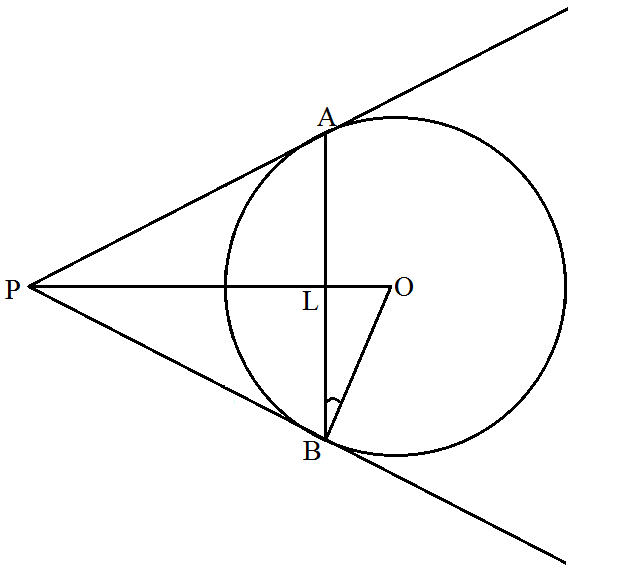
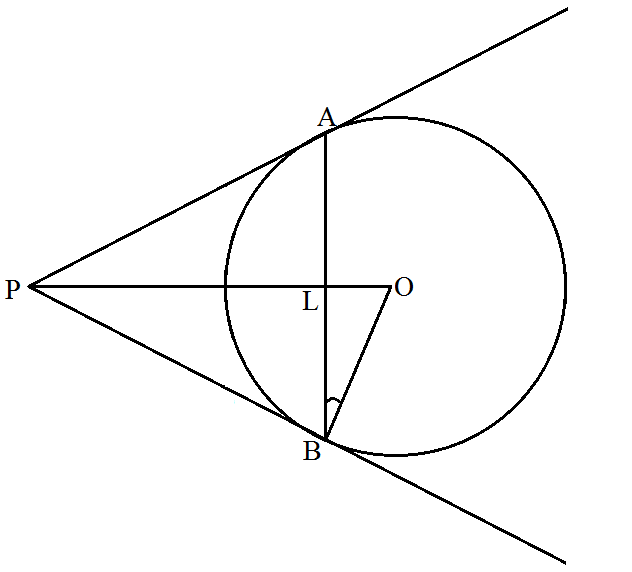
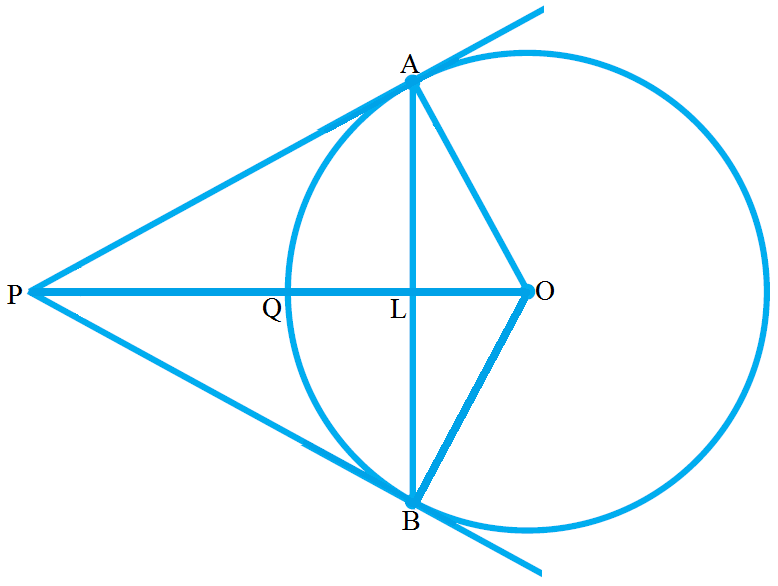
In the given figure, $AB$ is a chord of length $16\ cm$ of a circle of radius $10\ cm$. The tangents at $A$ and $B$ intersect at a point $P$. Find the length of $PA.$
Answer
Consider $\triangle\text{POB}$ and $\triangle\text{POA}$

From the property of tangents we know that the length of two tangents drawn form an external point will be equal. Therefore we have,
$PA = PB$
$OB = OA$ (They are the radii of the same circle)
$PO$ is the common side.
Therefore, from $SSS$ postulate of congruency, we have,
$\triangle\text{OPA}\cong\triangle\text{OPB}$
Hence,
$\angle\text{OPA}=\angle\text{OPB}...(1)$
Now consider $\triangle\text{PLA}$ and $\triangle\text{PLB}.$ We have,
$\angle\text{OPA}=\angle\text{OPB}$ (From (1))
PA is the common side.
From the property of tangents we know that the length of two tangents drawn form an external point will be equal. Therefore we have,
$PA = PB$
From SAS postulate of congruent triangles, we have,
$\triangle\text{PLA}\cong\triangle\text{PLB}$
Therefore,
$LA = LB$
It is given that $AB = 16$ That is,
$\Rightarrow LA + LB = 16$
$\Rightarrow LA + LA = 16$
$\Rightarrow 2LA = 16$
$\Rightarrow LA = 8$
$\Rightarrow LB = 8$
Also, ALB is a straight line. Therefore,
$\angle\text{ALB}=180^{\circ}$
That is,
$\angle\text{PLA}+\angle\text{PLB}=180^{\circ}$
since $\triangle\text{PLA}\cong\triangle\text{PLB}$
$\angle\text{PLA}=\angle\text{PLB}$
Therefore,
$2\angle\text{PLB}=180^{\circ}$
$\angle\text{PLB}=90^{\circ}$
Now let us consider$\triangle\text{OLB}.$
We have,
$ \Rightarrow O L^2=O B^2-O L^2 $
$ \Rightarrow O L^2=10^2-8^2 $
$\Rightarrow O L^2=100-64 $
$\Rightarrow O L^2=36$
$\Rightarrow O L=6$
Consider $\triangle \mathrm{OPB}$. here,
$\angle \mathrm{OBP}=90^{\circ}$ (Since the radius of the circle will always be perpendicular to the tangent at the point of contact.)
Therefore,
$P B^2=O P^2-O B^2 \ldots(1)$
Now consider $\triangle \mathrm{PLB}$
$\mathrm{PB}^2=\mathrm{PL}^2-\mathrm{LB}^2 \ldots \text { (2) }$
Since the Left Hand Side of equation (1) is same as the Left Hand Side of equation (2), we can equate the Right Hand Side of the two equations. Hence we have,
$O P^2-O B^2=P L^2-L B^2 \ldots(3)$
From the figure we can see that,
$O P=O L+L P$
Therefore, let us replace OP with $\mathrm{OL}+\mathrm{LP}$ in equation (3). We have,
$(\mathrm{OL}+\mathrm{PL})^2-\mathrm{OB}^2=\mathrm{PL}^2+\mathrm{LB}^2$
We have found that $O L=6$ and $L B=8$. Also it is given that $O B=10$. Substituting all these values in the above equation, we get,
$(6+P L)^2-10^2=P L^2+8^2 $
$ 36+\mathrm{PL}^2+2 \times 6 \times P L-100=\mathrm{PL}^2+64 $
$ 12 \mathrm{PL}=128$
$\text{PL}=\frac{32}{3}$
Now, let us substitute the value of PL in equation (2). We get,
$\text{PB}^2=\Big(\frac{32}{3}\Big)^2+8^2$
$\text{PB}^2=\frac{1024}{9}+64$
$\text{PB}=\sqrt{\frac{1600}{9}}$
$\text{PB}=\frac{40}{3}$
We know that tangents drawn from an external point will always be equal. Therefore,
PB = PA
Hence, we have,
$\text{PA}=\frac{40}{3}$
View full question & answer
Question 54 Marks
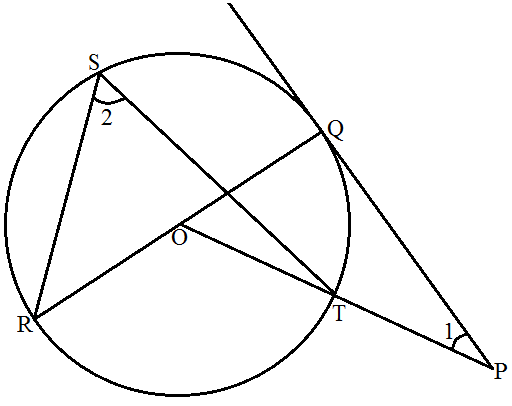
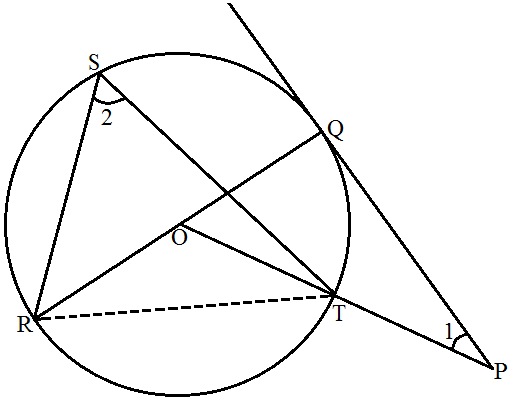
In the figure, $PQ$ is a tangent from an external point $P$ to a circle with centre $O$ and $OP$ cuts the circle at $T$ and $QOP$ is a diameter. If $\angle\text{POR}=130^{\circ}$ and $S$ is a point
on the circle, find $\angle1+\angle2.$
Answer
Construction: Join $RT.$

Given,
$\angle\text{POQ}=180^{\circ}-(\angle\text{POR})=180^{\circ}-130^{\circ}=50^{\circ}$
Since, $PQ$ is a tangent.
$\angle\text{POQ}=90^{\circ}$
Now, In
$\angle\text{POQ}+\angle\text{PQO}+\angle\text{QPO}=180^{\circ}$
$\Rightarrow50^{\circ}+90^{\circ}+\angle1=180^{\circ}$
$\Rightarrow\angle1=180^{\circ}-140^{\circ}$
$\Rightarrow\angle1=40^{\circ}$
Now, In
$\angle\text{RST}=\frac{1}{2}\angle\text{ROT}$ [Angle which is subtended by on arc at the centre of a circle is double the size of the angle subtended at any point on the circumference.]
$\Rightarrow\angle2=\frac{1}{2}\times130^{\circ}=65^{\circ}$
Now$\angle1+\angle2=40^{\circ}+65^{\circ}=105^{\circ}$
View full question & answer
Question 64 Marks
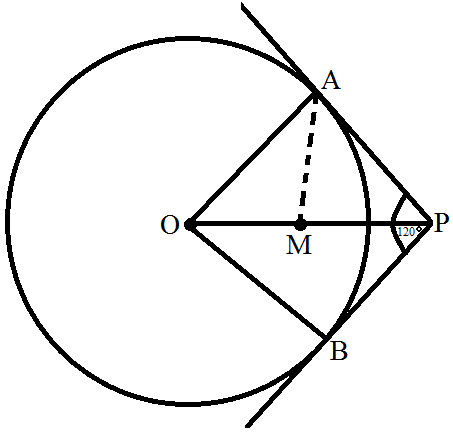
Two tangent segments $PA$ and $PB$ are drawn to a circle with centre $O$ such that $\angle\text{APB}=120^{\circ}$
$APB = 120^\circ $. Prove that $OP = 2 AP.$
Answer
Given: From a point P. Out side the circle with centre $O, PA$ and $PB$ are tangerts drawn and $\angle\text{APB}=120^{\circ}$
$OP$ is joined.
To prove: $OP = 2AP$
Const: Take mid point $M$ of $OP$ and join $AM$, join also $OA$ and $OB.$

Proof: In right $\triangle\text{OAP},$
$\angle\text{OPA}=\frac{1}{2}\angle\text{APB}=\frac{1}{2}\times120^{\circ}=60^{\circ}$
$\angle\text{AOP}=90^{\circ}-60^{\circ}=30^{\circ}$
M is mid point of hypotenuse $OP$ of $\triangle\text{AOP}$
$MO = MA = MP$
$\angle\text{OAM}=\angle\text{AOM}=30^{\circ}$ and $\angle\text{PAM}=90^{\circ}-30^{\circ}=60^{\circ}$
$\triangle\text{AMP}$ is an equilateral triangle.
$MA = MP = AP$
But M is mid point of $OP$
$OP = 2MP = 2AP$
Hence proved.
View full question & answer
Question 74 Marks
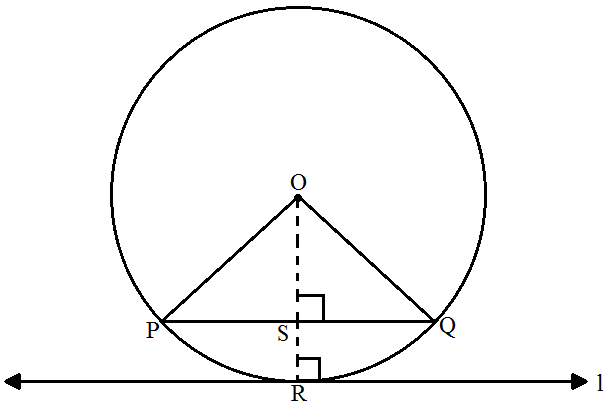
A chord $PQ$ of a circle is parallel to the tangent drawn at a point $R$ of the circle. Prove that $R$ bisects the arc $PRQ.$
Answer
Given: circle with centre $O . PQ$ is the chord parallel to the tangent/ at $R .$
To prove: The point $R$ bisects the arc $P R Q$.
construction: join $OR$ intersecting $PQ$ ae $S .$

Proof: $\text{OR}\bot$/ (Radius is perpendicular to the tangent at the point of contact.)
Given: $\text{PQ}\parallel$
$\therefore\angle\text{OSP}=\angle\text{OSQ}=90^{\circ}$ (pair of corresponding angles)
In $\triangle\text{OPS}\ \text{and}\ \triangle\text{OQS}$
$OP = OQ$ (Radii of the same circle)
$OS = OS$ (common)
$\angle\text{OSP}=\angle\text{OSQ}$ (proved)
so, $\triangle\text{OPS}\cong\triangle\text{OQS}$ ($RHS$ congruence ceiterion)
$\Rightarrow\angle\text{POS}=\angle\text{QOS} (C.P.C.T)$
⇒ arc$(PR) =$ arc$(QR)$ (measure of the arc is same as the angle substended by the arc at the centre)
Thus, the point $R$ bisects the arc$(PRQ).$
View full question & answer
Question 84 Marks
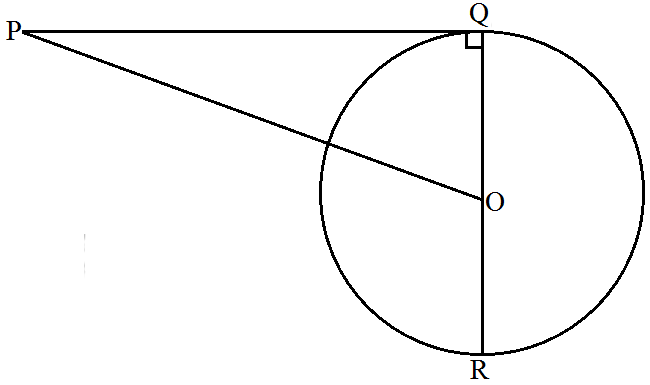
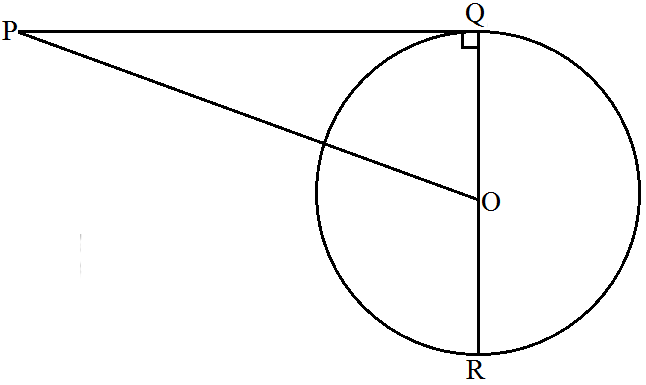
In the figure, $OQ:PQ = 3:4$ and perimeter of $\triangle\text{POQ} = 60\ cm$. Determine $PQ, QR$ and $OP.$
Answer
In the figure,

$\angle\text{PQO}=90^{\circ}.$ Therefore we can use pythagoras theorem to find the side $PO.$
$P O^2=P Q^2+O Q^2...(1)$
In the problem it is given that,
$\frac{\text{OQ}}{\text{PQ}}=\frac{3}{4}$
$\text{OQ}=\frac{3}{4}\text{PQ}...(2)$
Substituting this in equation $(1)$, we have,
$\text{PO}^2=\frac{9\text{PQ}^2}{16}+\text{PQ}^2$
$\text{PO}^2=\frac{25\text{PQ}^2}{16}$
$\text{PO}=\sqrt{\frac{25\text{PQ}^2}{16}}$
$\text{PO}=\frac{5}{4}\text{PQ}...(3)$
It is given that the perimeter of $\triangle\text{POQ}$is $60\ cm$. Therefore,
$PQ + OQ + PO = 60$
Substituting $(2)$ and $(3)$ in the above equation, we have,
$\text{PQ}+\frac{3}{4}\text{PQ}+\frac{5}{4}\text{PQ}=60$
$\frac{12}{4}\text{PQ}=60$
$3PQ = 60$
$PQ = 20$
Substituting for $PQ$ in equation $(2)$, we have,
$\text{PO}=\frac{5}{4}\times20$
$\text{OQ}=\frac{3}{4}\times20$
$OQ = 15$
$OQ$ is the radius of the circle and $QR$ is the diameter.
Therefore,
$QR = 2 × OQ$
$QR = 30$
Substituting for $PQ$ in equation $(3)$, we have,
$\text{PO}=\frac{5}{4}\times20$
$PO = 25$
Thus we have found that $PQ = 20cm, QR = 30cm$ and $PO = 25cm.$
View full question & answer
Question 94 Marks
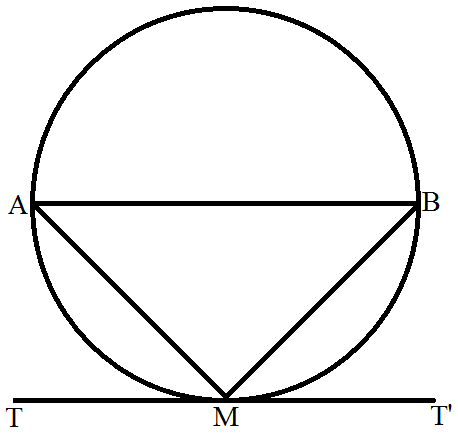
Prove that the tangent drawn at the mid-point of an arc of a circle is parallel to the chord joining the end points of the arc.
Answer
Let mid-point of an arc $AMB$ be $M$ and $TMT$’ be the tangent to the circle. Join $AB, AM$ and $MB.$

Since, arc $AM$ = arc $MB$
⇒ Chord $AM$ = Chord $MB$
In $\triangle\text{AMB}, AM = MB$
$\Rightarrow\angle\text{MAB}=\angle\text{MBA}...\text{(i)}$[equal sides corresponding to the equal angle]
Since, $TMT’$ is a tangent line.
$\angle\text{AMT}=\angle\text{MAB}$ [angle in alternate segment are equal]
$\angle\text{AMT}=\angle\text{MAB}$ [from Eq. $(i)]$
But $\angle\text{AMT}$ and $\angle\text{MAB}$ are alternate angles, which is possible only when $AB || TMT’$
Hence, the tangent drawn at the mid-point of an arc of a circle is parallel to the chord joining the end points of the arc.
Hence proved.
View full question & answer
Question 104 Marks
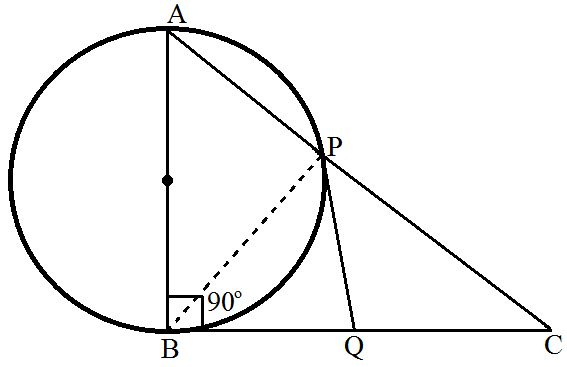
In a right triangle $ABC$ in which $\angle\text{B}=90^{\circ},$ a circle is drawn with $AB$ as diameter intersecting the hypotenuse $AC$ at $P.$ Prove that the tangent to the circle at $P$ bisects
$BC.$
Answer

Given: $\triangle\text{ABC}$ is right triangle in which $\angle\text{ABC}=90^{\circ}.$ A circle is drawn with side AB as diameter intersecting AC in P.
$PQ$ is the tangent to the circle when intersects $BC$ in $Q.$
Construction: join $BP.$
Proof: $PQ$ and $BQ$ are tangents drawn from an external point $Q.$
$\Rightarrow PQ = BQ....(i)$ [Length of tangents drawn from an external point to the circle are equal]
$\Rightarrow\angle\text{PBQ}=\angle\text{BPQ}$ [In a triangle, equal side have equal angles opposite to them]
As, it is the diameter of the circle.
$\therefore\angle\text{APB}=90^{\circ}$ [Angle in a semi-circle is 90°]
$\angle\text{APB}+\angle\text{BPC}=180^{\circ}$ [Linear pair]
$\Rightarrow\angle\text{BPC}=180^{\circ}-\angle\text{APB}=180^{\circ}-90^{\circ}=90^{\circ}$
In $\triangle\text{BPC},$
$\angle\text{BPC}+\angle\text{PBC}+\angle\text{PCB}=180^{\circ}$[Angle sum property]
$\Rightarrow\angle\text{PBC}+\angle\text{PCB}=180^{\circ}-90^{\circ}=90^{\circ}...\text{(ii)}$
Now,
$\angle\text{BPC}=90^{\circ}$
$\Rightarrow\angle\text{BPQ}+\angle\text{CPQ}=90^{\circ}...\text{(iii)}$
From $(ii)$ and $(iii)$, we get,
$\Rightarrow\angle\text{PBC}+\angle\text{PCB}=\angle\text{BPQ}+\angle\text{CPQ}$
$\Rightarrow\angle\text{PCQ}=\angle\text{CPQ}[\angle\text{BPQ}=\angle\text{PBQ}]$
In $\triangle\text{PQC},$
$\angle\text{PCQ}=\angle\text{PQC}$
$\therefore PQ = QC ...(iv)$
From $(i)$ and $(iv)$, we get,
$BQ = QC$
Thus, tangent at P bisects th side BC.
View full question & answer
Question 114 Marks
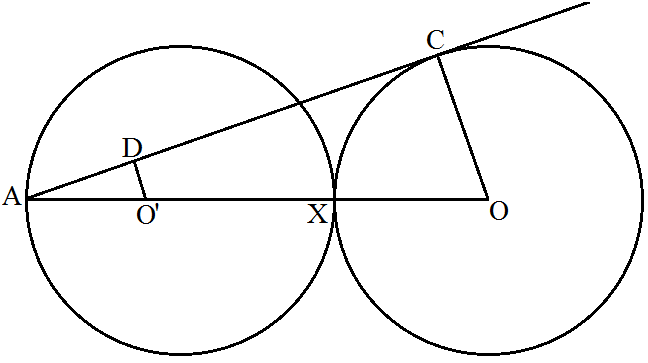
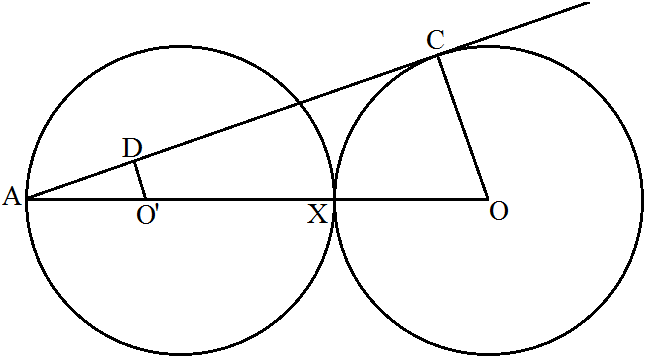
Equal circle with centres $O$ and $O'$ touches each other at $X. OO'$ produced to meet a circle with center $O'$ at A. $AC$ is a tangent to the circle whose centre is $O. O'D$ is
perpendicular to AC. Find the value of $\frac{\text{DO'}}{\text{CO}}.$
Answer
Two equal circles with centre $O$ and $O’$ touch each other externally at $X OO’$ produced to meet at $A.$

AC is the tangent of circle with centre $O,$
$\text{O'D}\bot\text{AC}$ is drawn OC is joined
AC is tangent and OC is the radius.
$\text{OC}\bot\text{AC}$
$\text{O'D}\bot\text{AC}$
$\text{OC}\parallel\text{O'D}$
Now $\text{O'A}=\frac{1}{2}\text{A}\times\text{or}\frac{1}{2}\text{AO}$
Now in $\triangle\text{O’AD}$ and $\triangle\text{OAC}$
$\angle\text{A}=\angle\text{A}$ (common)
$\angle\text{AO'D}=\angle\text{AOC}$ (corresponding angles.)
View full question & answer
Question 124 Marks
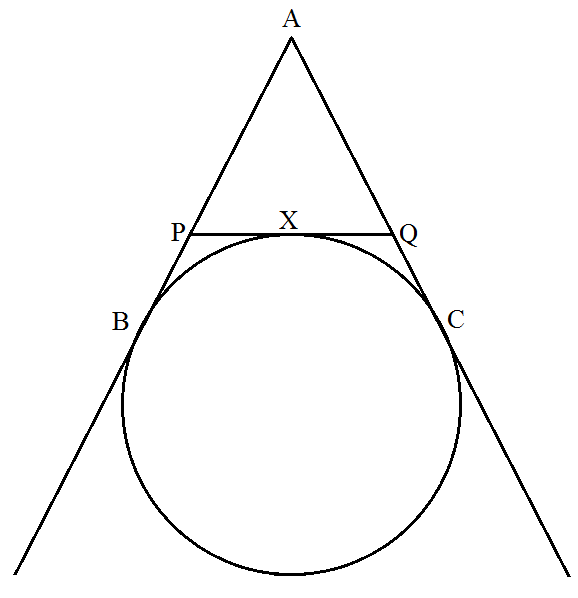
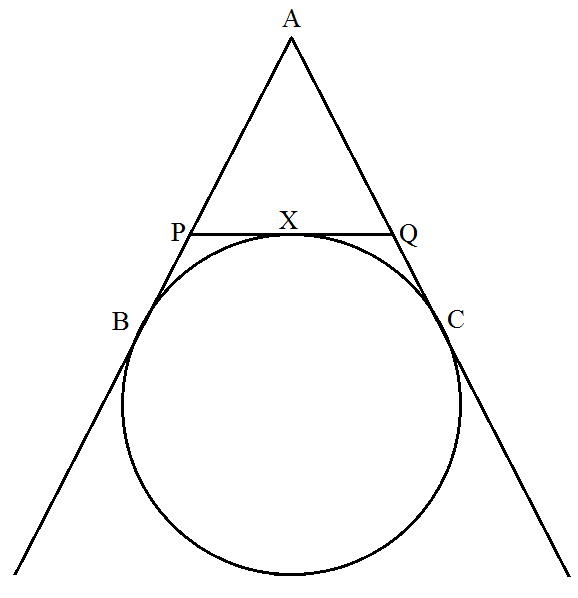
If $AB, AC, PQ$ are tangents in the given figure and $AB = 5\ cm$, find the perimeter of $\triangle\text{APQ}$.
Answer

We have been asked to find the perimeter of the triangle $APQ.$
Thus the perimeter of triangle $APQ$ is $10cm.$
Therefore,
Perimeter of $\triangle\text{APQ}$ is equal to $AP + AQ + PQ$
Let the Perimeter of $\triangle\text{APQ}$ be $P.$
So $P= AP + AQ + PX + XQ$

From the property of tangents we know that when two tangents are drawn to a circle from the same external point, the length of the two/ tangents will be equal.
Therefore we have,
$PX = PB$
$XQ = QC$
Replacing these in the above equation we have,
$P = AP + AQ + PB + QC$
From the figure we can see that,
$AP + PB = AB$
$AQ + QC = AC$
Therefore, we have, $P = AB + AC$
It is given that $AB = 5cm$
Again from the same property of tangents we know that that when two tangents are drawn to a circle from the same external point, the length of the two tangents will be equal.
Therefore we have,
$AB = AC$
Therefore,
$AC = 5cm$
Hence,
$P = 5 + 5 = 10cm$
View full question & answer
Question 134 Marks
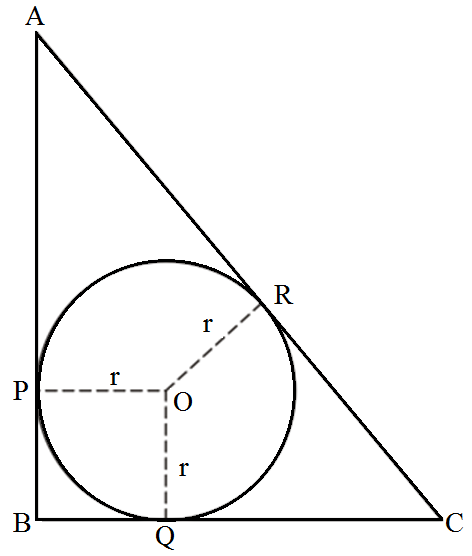
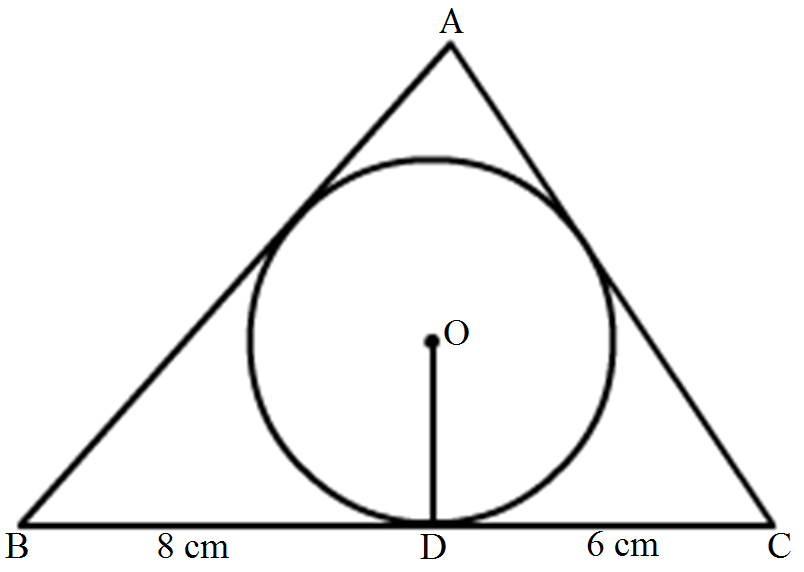
In the given figure, $ABC$ is a right triangle right-angled at $B$ such that $BC = 6\ cm$ and $AB = 8\ cm$. Find the radius of its in circle.
Answer
In right $\triangle\text{ABC},\angle\text{B}=90^{\circ}$
$BC = 6cm, AB = 8cm$
Let $r$ be the radius of incircle whose centre is $O$ and touches the sides $A B, B C$ and $C A$ at $P, Q$ and $R$ respectively.
$A P$ and $A R$ are the tangents to the circle $A P=A R$
Similarly $C R=C Q$ and $B Q=B P$
$O P$ and $O Q$ are radii of the circle
$O P \backslash$ perp AB and $OQ \backslash$ perp BC and $\angle B =90^{\circ}$ (given)
$BPOQ$ is a square
$BP = BQ = r$
$AR = AP = AB – BD = 8 – r$
and $CR = CQ = BC – BQ = 6 – r$
But $A C^2=A B^2+B C^2$ (Pythagoras Theorem)
$=(8)^2+(6)^2=64+36=100=(10)^2$
$AC = 10cm$
$\Rightarrow AR + CR = 10$
$\Rightarrow 8 – r + 6 – r = 10$
$\Rightarrow 14 – 2r = 10$
$\Rightarrow 2r = 14 – 10 = 4$
$\Rightarrow r = 2$
Radius of the in circle $= 2cm$
View full question & answer
Question 144 Marks
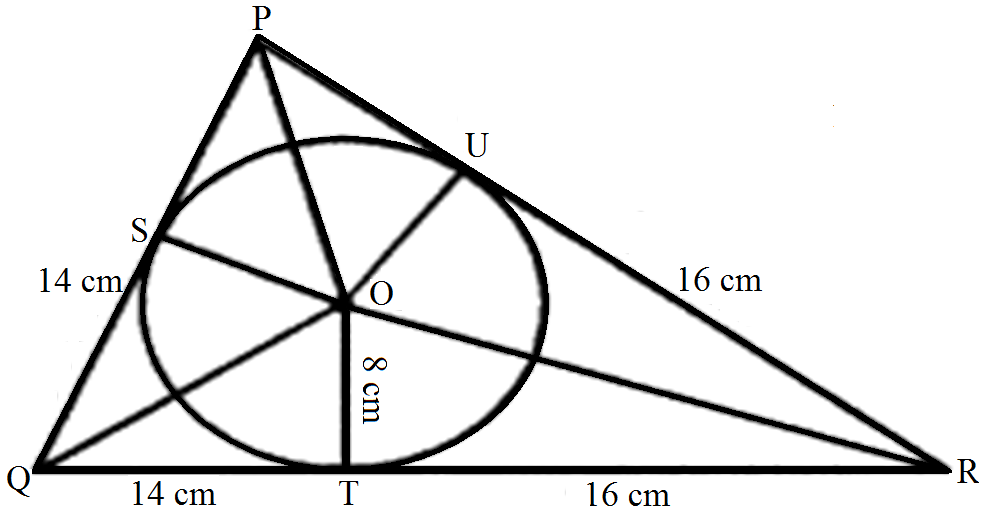
A triangle $PQR$ is drawn to circumscribe a circle of radius $8 \ cm$ such that the segments $QT$ and $TR$, into which $QR$ is divided by the point of contact $T$, are of lengths $14 \ cm$ and $16 \ cm$ respectively. If area of $\triangle P Q R$ is $336 cm^2$, find the sides $P Q$ and $P R$.
Answer
$\triangle\text{PQR}$ is circumscribed by a circle with centre $O$ and radius 8cm.
T is point of contact which divides the line segment $OT$ into two parts such that,
$QT = 14cm$ and $TR = 16cm$

Area of $\triangle\text{PQR} = 336cm^2$
Let $PS = x\ cm$
QT and QS are tangents to the circle from $Q.$
$QS = QT = 14cm$
Similarly RU and RT are tangents to the circle.
$RT = RU = 16cm$
Similarly PS and PU are tangents from P.
$PS = PU = x$
Now $PQ = x + 14$ and $PR = x + 16$ and $QR = 14 + 16 = 30cm$
Now, $\text{area}\ \text{of}\ \triangle\text{PQR}$ $=\text{area}\ \text{of}\ \triangle\text{POQ}$ $+\text{area}\ \text{of}\ \triangle\text{QOR}$ $+\text{area}\ \text{of}\ \triangle\text{POR}$
$\Rightarrow336 =\text{(QR)}\times8+ (14+\text{x}\times+\text{x}(16+\text{x})\times8$
$⇒ 336 = \frac{1}{2} × 30 × 8 + 4 (14 + x) + 4 (16 + x)$
$⇒ 336 = 120 + 56 + 4x + 64 + 4x$
$⇒ 336 = 8x + 240$
$⇒ 8x = 336 - 240$
$\Rightarrow\text{x}=\frac{96}{8}=12$
$\therefore PQ = x + 14 = 12 + 14 = 26cm$
and $PR = x + 16$
$= 12 + 16 = 28cm$
View full question & answer
Question 154 Marks
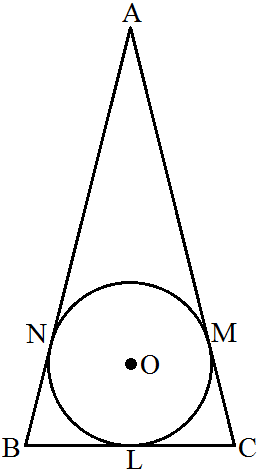
If $\triangle\text{ABC}$ is isosceles with $AB = AC$ and $(O, r)$ is the incircle of the $\triangle\text{ABC}$ touching $BC$ at $L,$ prove that $L$ bisects $BC.$
Answer
Given: In $\triangle\text{ABC},$ $AB = AC$ and a circle with centre $O$ and radius r touches the side $BC$ of $\triangle\text{ABC}$ at $L.$

To prove: L is midpoint of $BC.$
Proof: AM and AN are the tangents to the circle from A.
$AM = AN$
$But AB = AC (given)$
$AB – AN = AC – AM$
$BN = CM$
Now $BL$ and $BN$ are the tangents from $B.$
$BL = BN$
Similarly $CL$ and $CM$ are tangents.
$CL = CM$
But $BM = CM$ (proved)
$BL = CL$
$L$ is midpoint of $BC.$
View full question & answer
Question 164 Marks
From a point P, two tangents $PA$ and $PB$ are drawn to a circle with centre $O$. If $OP =$ diameter of the circle, show that $\triangle\text{APB}$ is equilateral.
Answer

Suppose op meets the circle at $Q.$
then join $AQ.$
we have,
$OP =$ diameter.
$\Rightarrow OQ + QP =$ diameter
$\Rightarrow QP =$ diameter - $OQ$ [$\therefore OQ =$ radius]
$\Rightarrow QP =$ radius
Thus, $OQ = PQ =$ radius
Thus,OP is the hypoteneus of right triangle $OAP$ and $Q$ is the mid point of $OP.$
$\therefore$ $OA = AQ = OQ$
$\triangle\text{OAQ}$ is equilateral.
$\Rightarrow\angle\text{AOQ}=60^{\circ}$
So,$\angle\text{APO}=30^{\circ}$
$\therefore\angle\text{APB}=2\angle\text{APO}=60^{\circ}$
Also,
$PA = PB$
$\Rightarrow\angle\text{PAB}=\angle\text{PBA}$
But, $\angle\text{APB}=60^{\circ}$
Therefore, $\angle\text{PAB}=\angle\text{PBA}=60^{\circ}$
Hence, $\triangle\text{APB}$ is equilateral.
View full question & answer
Question 174 Marks
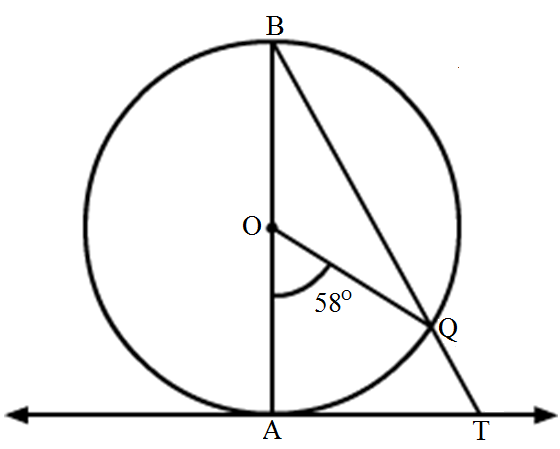
In the given figure, $AB$ is a diameter of a circle with centre $O$ and $AT$ is a tangent. If $\angle\text{AOQ}=58^{\circ},$find $\angle\text{ATQ}.$
Answer
In the given figure,
$AB$ is the diameter, $AT$ is the tangent,
and $\angle\text{AOQ}=58^{\circ}$
To find $\angle\text{ATQ}$
Arc $AQ$ subtends $\angle\text{AOQ}$ at the centre and $\angle\text{ABQ}$ at the remaining part of the circle.
$\angle\text{ABQ}=\frac{1}{2}\angle\text{AOQ}=\frac{1}{2}\times58^{\circ}=29^{\circ}$
Now in $\triangle\text{ABT},$
$\angle\text{BAT}=90^{\circ}(\text{OA}\bot\text{AT})$
$\angle\text{ABT}+\angle\text{ATB}=90^{\circ}$
$\Rightarrow\angle\text{ABT}+\angle\text{ATQ}=90^{\circ}$
$\Rightarrow29^{\circ}+\angle\text{ATQ}=90^{\circ}$
$\Rightarrow\angle\text{ATQ}=90^{\circ}-29^{\circ}=61^{\circ}$
View full question & answer
Question 184 Marks
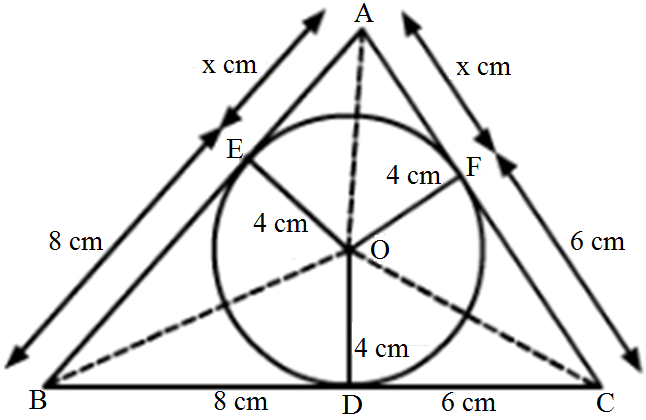
In the given figure, a $\triangle\text{ABC}$ is drawn to circumscribe a circle of radius 4cm such that the segments $BD$ and $DC$ are of lengths $8\ cm$ and $6\ cm$ respectively. Find the
lengths of sides $AB$ and $AC$, when area of $\triangle\text{ABC}$ is $84cm^2$.
Answer

Here, $D, E$ and $F$ are the point of the circle with sides $BC, AB$, and $AC$, respectively
$OD = OE = OF = 4cm$ (Radii of the circle)
we know that the lengths of tangents drawn from an external point to a circle are equal.
$\therefore BD = BE = 8cm$
$CD = CF = 6cm$
$AE = AF = x cm$(say)
so,$ BC = BD + CD = 8cm + 6cm = 14cm$
$AB = AE + BE = x cm + 8cm = (x + 8)cm$
$AC = AF + FC = x cm + 6cm = (x + 6)cm$
Also, the tangent at any point of a circle is perpendicular to the radius through the point of contact.
$\therefore\text{OD}\bot\text{BC},\text{OE}\bot\text{AB}\ \text{and}\text{OF}\bot\text{AC}$
Now,
$\text{ar}(\triangle\text{OBC})+\text{ar}(\triangle\text{OAB})+\text{ar}(\triangle\text{OAC})=\text{ar}(\triangle\text{ABC})$
$\therefore\frac{1}{2}\times\text{BC}\times\text{OD}+\frac{1}{2}\times\text{AB}\times\text{OE}+\frac{1}{2}\times\text{AC}\times\text{OF}=84\text{cm}^2$
$\Rightarrow\frac{1}{2}\times14\times4+\frac{1}{2}\times(\text{x}+8)\times4+\frac{1}{2}\times(\text{x}+6)\times4=84$
$\Rightarrow28+2\text{x}+16+2\text{x}+12=84$
$\Rightarrow4\text{x}+56=84$
$\Rightarrow4\text{x}=84-56=28$
$\Rightarrow\text{x}=7$
$\therefore$ $AB = (x + 8)cm = (7 + 8)cm = 15cm$
$AC = (x + 6)cm = (7 + 6)cm = 13cm$
Hence, the lengths of the sides $AB$ and $AC$ are $15\ cm$ and $13\ cm$, respectively.
View full question & answer
Question 194 Marks
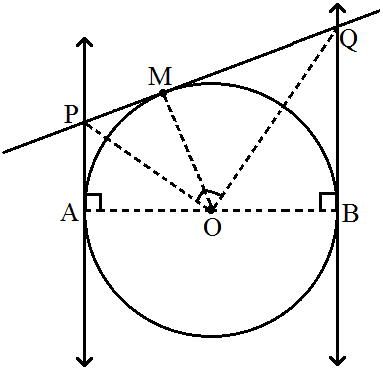
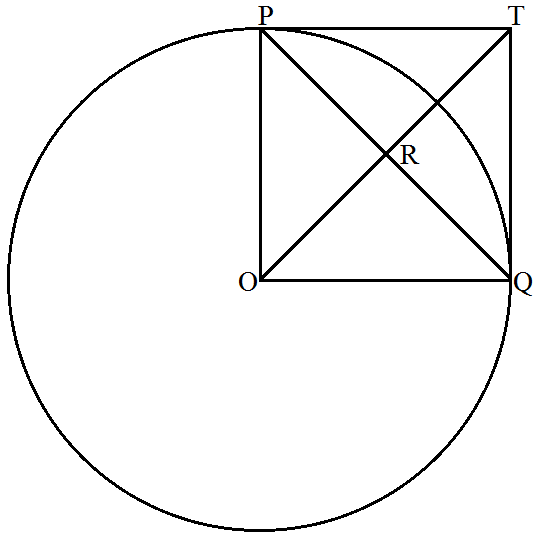
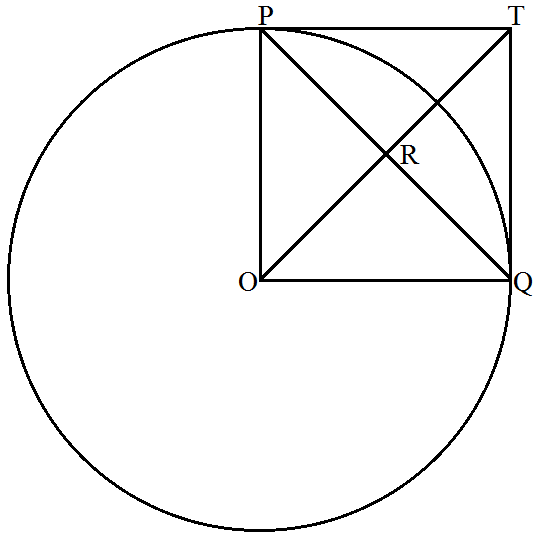
In the given figure,$\text{OP}\bot\text{OQ}.$ The tangents to the circle at $P$ and $Q$ intersect at a point $T.$ Prove that $PQ$ and $OT$ are right bisector of each other.
Answer
Given: In the figure, $O$ is the centre of the circle
$\text{OP}\bot\text{OQ}$
They tangents at P and Q intersect each other at $T.$
To prove: $PQ$ and $OT$ are right bisector of each other.
Proof: $PT$ and $QT$ are tangents to the circle.
$PT = QT$
$OP$ and $OQ$ are radii of the circle and $\angle\text{POQ}=90^{\circ}(\text{PO}\bot\text{OQ})$
$OQTP$ is a square Where $PQ$ and $OT$ are diagonals.
Diagonals of a square bisect each other at right angles.
$PQ$ and $OT$ bisect each other at right angles.
Hence $PQ$ and $QT$ are right bisectors of each other.
View full question & answer
4 Marks Questions - Maths STD 10 Questions - Vidyadip