Question 13 Marks
Find the coordinate of the point equidistant from three given points $A(5, 3), B(5, -5)$ and $C(1, -5).$
AnswerLet the required points be $P(x, y),$ then
$PA = PB = PC.$
The points $A, B, C$ are $(5,3), (5, -5)$ and $(1, -5)$ and $(1, -5)$ recpectively
$ \Rightarrow P A^2=P B^2=P C^2$
$\Rightarrow P A^2=P B^2 \text { and } P B^2=P C^2$
$P A^2=P B^2$
$\Rightarrow(5-x)^2+(3-y)^2=(5-x)^2+(-5-y)^2$
$25+x^2-10 x+9+y^2-6 y=25+x^2-10 x+25+y^2+10 y$
$-6 y-10 y=25-9 \Rightarrow-16 y=16$
$y=-1$
$\text { and } P B^2=P C^2$
$\Rightarrow(5-x)^2+(-5-y)^2=(1-x)+(-5-y)^2$
$25+x^2-10 x+25+y^2+10 y=1+x^2-2 x+25+y^2+10 y$
$-10 x+2 x=-24 \Rightarrow-8 x=-24$
$\text{x}=\frac{-24}{-8}=3$
Hence, the point $P$ is $(3, -1)$
View full question & answer→Question 23 Marks
Show that the following points are the vertices of a rectangle:
$A(-4, -1), B(-2, -4), C(4, 0)$ and $D(2, 3)$
AnswerLet $A(-4, -1), B(-2, -4) C(4, 0)$ and $D(2, 3)$ are the vertices of quadrilateral $ABCD.$
Then,
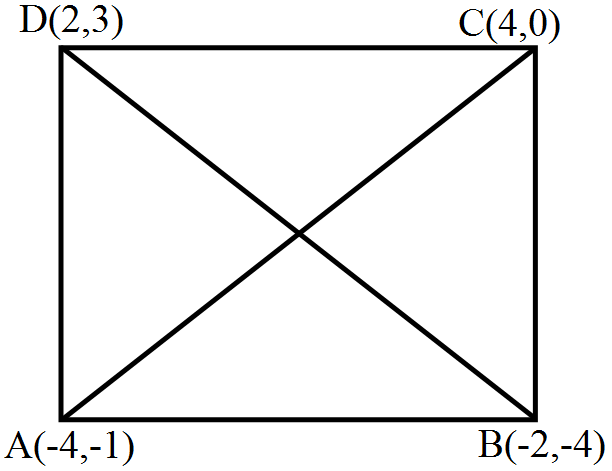
$\text{AB}=\sqrt{(-2+4)^2+(-4+1)^2}$
$=\sqrt{(2)^2+(-3)^2}$
$=\sqrt{4+9}=\sqrt{15}\text{ units}$
$\text{BC}=\sqrt{(4+2)^2+(0-4)^2}$
$=\sqrt{(6)^2+(-4)^2}$
$=\sqrt{36+16}=\sqrt{52}=7\sqrt{3}\text{ units}$
$\text{DC}=\sqrt{(2-4)^2+(3-0)^2}$
$=\sqrt{(-2)^2+(3)^2}$
$=\sqrt{4+9}=\sqrt{15}\text{ units}$
$\text{AD}=\sqrt{(-4-2)^2+(-1-3)^2}$
$=\sqrt{(-6)^2+(-4)^2}$
$=\sqrt{36+16}=\sqrt{52}=7\sqrt{3}\text{ units}$
Thus, $\text{AB}=\text{DC}$ and $\text{AD}=\text{BC}$
$\text{Diag}.\text{AC}=\sqrt{(4+4)^2+(0+1)^2}$
$=\sqrt{(8)^2+(1)^2}$
$=\sqrt{64+1}$
$=\sqrt{65}\text{ units}$
$\text{Diag}.\text{BD}=\sqrt{(2+2)^2+(3+4)^2}$
$=\sqrt{(4)^2+(7)^2}$
$=\sqrt{16+49}$
$=\sqrt{65}\text{ units}$
$\therefore\text{Diag}.\text{AC}\not=\text{Diag}.\text{BD}$
Thus, $ABCD$ is a quadrilateral whose opposite are equal and the diagonals are equal.
Hence, quad. $ABCD$ is a rectangle. View full question & answer→Question 33 Marks
Show taht the following points are collinear:
$A(2, -2), B(-3, 8)$ and $C(-1, 4)$
AnswerLet $\mathrm{A}\left(\mathrm{x}_1=2, \mathrm{y}_1=-2\right), \mathrm{B}\left(\mathrm{x}_2=-3, \mathrm{y}_2=8\right)$ and $\mathrm{C}\left(\mathrm{x}_3=-1, \mathrm{y}_3=4\right)$ be the given points.
Now
$ x_1\left(y_2-y_3\right)+x_2\left(y_3-y_1\right)+x_3\left(y_1-y_2\right)$
$ =2(8-4)+(-3)(4+2)+(-1)(-2-8)$
$ =8-18+10 $
$=0$
Hence the given point are collinear.
View full question & answer→Question 43 Marks
If three consecutive vertices of a parallelogram $ABCD$ are $A(1, -2), B(3, 6)$ and $C(5, 10)$, find its fourth vertex $D.$
AnswerLet $A(1, -2), B(3, 6)$ and $C(5, 10)$ are the given vertices of the parallelogram $ABCD.$
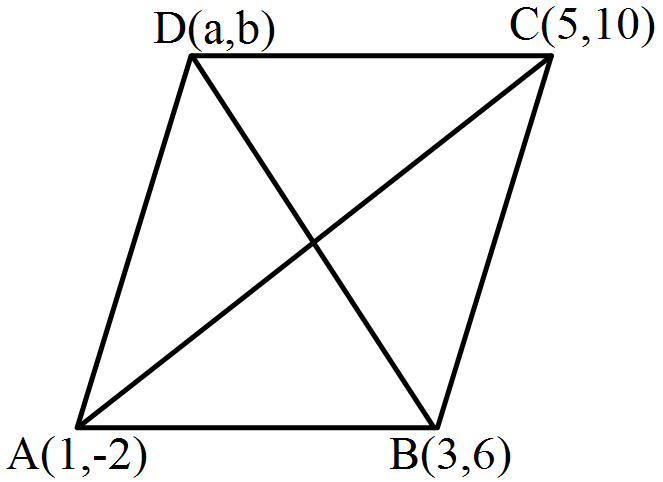
Let $D(a, b)$ be its fourth vertex. Join $AC$ and $BD.$
Let $AC$ and $BD$ intersect at the point $O.$
We know that the diagonal of a parallelogram bisect each other.
So, $O$ is the mid-point $AC$ as well as that of $BD.$
Mid-point of $AC$ is $\Big(\frac{1+5}{2},\frac{-2+10}{2}\Big)\text{i.e},(3,4)$
Mid-point of $BD$ is $\Big(\frac{3+\text{a}}{2},\frac{6+\text{b}}{2}\Big)$
$\frac{3+\text{a}}{2}=3$ and $\frac{6+\text{b}}{2}=4$
$⇒ a = 3$ and $b = 2$
Hence the fourth vertices is $D(3, 2).$ View full question & answer→Question 53 Marks
$ABCD$ is a rectangle formed by points $A(-1, -1), B(-1, 4), C(5, 4)$ and $D(5, -1).$ If $P, Q, R$ and $S$ be the midpoints of $AB, BC, CD$ and $DA$ respectively, show that $PQRS$ is a rhombus.
Answer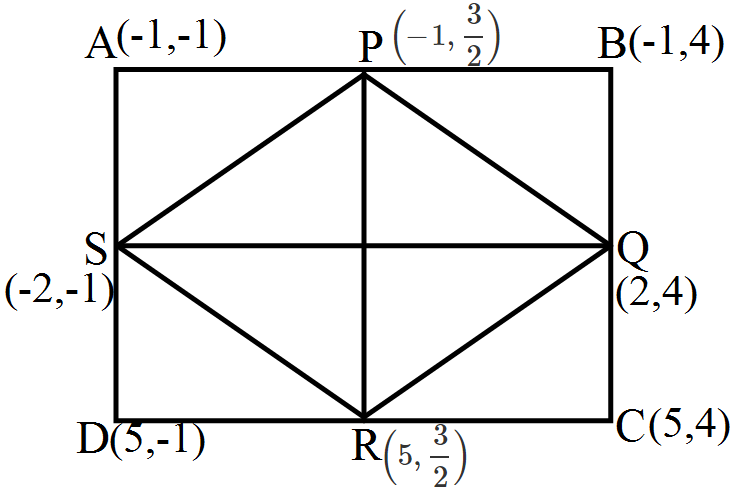
$ABCD$ is a rectangle and $P, Q, R$ and $S$ are the mid-points of $AB, BC, CD$ and $DA$ respectively.
Thus, we have
Coordinates of $P =\Big(\frac{-1-1}{2},\frac{{-1+4}}{2}\Big)=\Big(-1,\frac{3}{2}\Big)$
Coordinates of $Q =\Big(\frac{-1+5}{2},\frac{4+4}{2}\Big)=(2,4)$
Coordinates of $R =\Big(\frac{5+5}{2},\frac{-1+4}{2}\Big)=\Big(5,\frac{3}{2}\Big)$
Coordinates of $S =\Big(\frac{-1+5}{2},\frac{-1-1}{2}\Big)=(2,-1)$
Now,
Lenght of $PQ =\sqrt{(-2-1)^2+\Big(4-\frac{3}{2}\Big)^2}$
$=\sqrt{(-3)^2+\Big(\frac{5}{2}\Big)^2}$
$=\sqrt{9+\frac{25}{4}}=\sqrt{\frac{61}{4}}$
Lenght of $QR =\sqrt{(5-2)^2+\Big(\frac{3}{2}-4\Big)^2}$
$=\sqrt{(3)^2+\Big(\frac{-5}{2}\Big)^2}$
$=\sqrt{9+\frac{25}{4}}=\sqrt{\frac{61}{4}}$
Lenght of $RS =\sqrt{(2-5)^2+\Big(-1-\frac{3}{2}\Big)^2}$
$=\sqrt{(3)^2+\Big(\frac{-5}{2}\Big)^2}$
$=\sqrt{9+\frac{25}{4}}=\sqrt{\frac{61}{4}}$
Lenght of $SP =\sqrt{(-1-2)^2+\Big(\frac{3}{2}+1\Big)^2}$
$=\sqrt{(3)^2+\Big(\frac{-5}{2}\Big)^2}$
$=\sqrt{9+\frac{25}{4}}=\sqrt{\frac{61}{4}}$
Lenght of $PR =\sqrt{(5+1)^2+\Big(\frac{3}{2}-\frac{3}{2}\Big)^2}$
$=\sqrt{(6)^2+0}=\sqrt{36}=6$
Lenght of $SQ =\sqrt{(2-2)^2+(4+1)^2}$
$=\sqrt{0+(5)^2}=\sqrt{25}=5.$
Here, all sides of $PQRS$ are equal but diagonals are not equal.
Hence, $PQRS$ is a rhombus. View full question & answer→Question 63 Marks
If the points $P(a, -11), Q(5, b), R(2, 15)$ and $S(1, 1)$ are the vertices of a parallelogram $PQRS,$ find the value of $a$ and $b$
AnswerLet $P(a, -11), Q(5, b), R(2, 15)$ and $S(1, 1)$ are the vertices of a parallelogram $PQRS.$
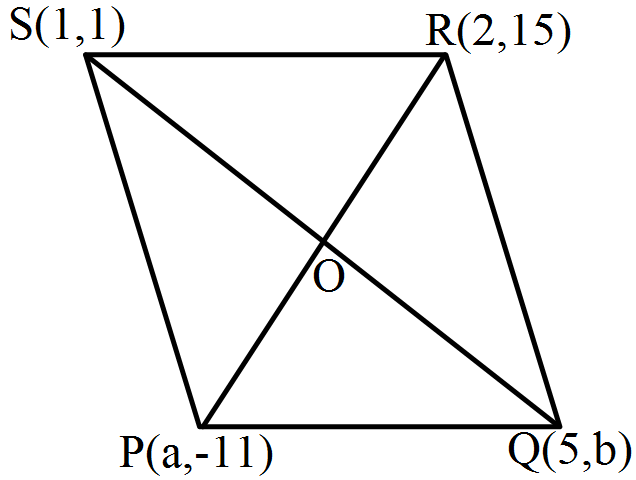
Join the diagonal $PR$ and $SQ.$ Then intersect each other at the point $O.$ We know that the diagonal of a parallelpgram bisect each other.
Now, mid-point of $PR$ is $\Big(\frac{\text{a}+2}{2},\frac{-11+15}{2}\Big)\text{i.e},\Big(\frac{\text{a}+2}{2},2\Big)$
And mid-point of $SQ$ is $\Big(\frac{5+1}{2},\frac{\text{b}+1}{2}\Big)\text{i.e},\Big(3,\frac{\text{b}+1}{2}\Big)$
$\therefore\ \frac{\text{a}+2}{2}=3$ and $\frac{\text{b}+1}{2}=2$
$⇒ a = 4$ and $b = 3$
Hence the required values are $a = 4$ and $b = 3.$ View full question & answer→Question 73 Marks
Show that the following points are the vertices of a rectangle:
$A(2, -2), B(14, 10), C(11, 13)$ and $D(-1, 1)$
AnswerLet $A(2, -2), B(14, 10), C(11, 13)$ and $D(-1, 1)$be the angular points of quad. $ABCD.$
Then,
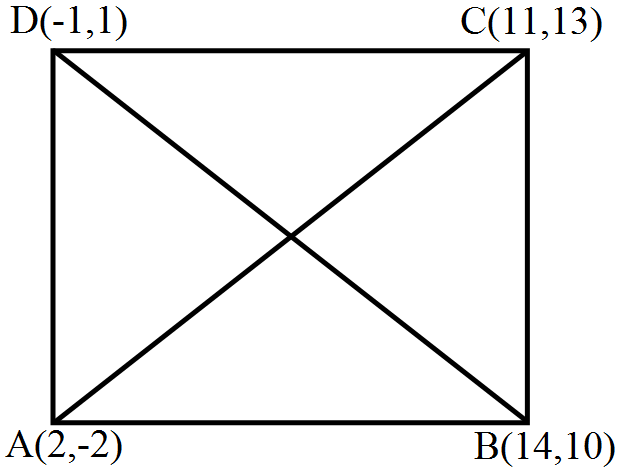
$\text{AB}=\sqrt{(14-2)^2+(10+2)^2}$
$=\sqrt{(12)^2+(12)^2}$
$=\sqrt{144+144}=\sqrt{288}=12\sqrt{2}\text{ units}$
$\text{BC}=\sqrt{(11-14)^2+(13-10)^2}$
$=\sqrt{(-3)^2+(3)^2}$
$=\sqrt{9+9}=\sqrt{18}=3\sqrt{2}\text{ units}$
$\text{DC}=\sqrt{(-1-11)^2+(1-13)^2}$
$=\sqrt{(-12)^2+(-12)^2}$
$=\sqrt{144+144}=\sqrt{288}=12\sqrt{2}\text{ units}$
$\text{AD}=\sqrt{(-1-2)^2+(1+2)^2}$
$=\sqrt{(-3)^2+(3)^2}$
$=\sqrt{9+9}=\sqrt{18}=3\sqrt{2}\text{ units}$
Thus, $\text{AB}=\text{DC}$ and $\text{AD}=\text{BC}$
$\text{Diag}.\text{AC}=\sqrt{(11-2)^2+(13+2)^2}$
$=\sqrt{(9)^2+(15)^2}$
$=\sqrt{81+150}$
$=\sqrt{306}=3\sqrt{34}\text{ units}$
$\text{Diag}.\text{BD}=\sqrt{(-1-14)^2+(1-10)^2}$
$=\sqrt{(-15)^2+(-9)^2}$
$=\sqrt{225+81}$
$=\sqrt{306}=3\sqrt{34}\text{ units}$
$=\sqrt{65}\text{ units}$
$\therefore\text{Diag}.\text{AC}=\text{Diag}.\text{BD}$
Thus, $ABCD$ is a quadrilateral whose opposite sides are equal and diagonals are equal.
Hence, quad. $ABCD$ is a rectangle. View full question & answer→Question 83 Marks
For what value of $k(k > 0)$ is the area of the triangle with vertices $(-2, 5), (k, -4)$ and $(2k + 1, 10)$ equal to $53$ square units$?$
AnswerLet $\mathrm{A}\left(\mathrm{x}_1=-2, \mathrm{y}_1=5\right), \mathrm{B}\left(\mathrm{x}_2=k, \mathrm{y}_2=-4\right)$ and $\mathrm{C}\left(\mathrm{x}_3=2 \mathrm{k}+1, \mathrm{y}_3=10\right)$ be the vertices of the triangle, so
$\text{ar}\big(\triangle\text{ABC)}=\frac{1}{2}[\text{x}_1(\text{y}_2-\text{y}_3)+\text{x}_2(\text{y}_3-\text{y}_1)+\text{x}_3(\text{y}_1-\text{y}_2)]$
$\Rightarrow53=\frac{1}{2}[(-2)(-4-10)+\text{k}(10-5)+(2\text{k}+1)(5+4)]$
$\Rightarrow53=\frac{1}{2}[28+5\text{k}+9(2\text{k}+1)]$
$\Rightarrow28+5\text{k}+18\text{k}+9=106$
$\Rightarrow37+23\text{k}=106$
$\Rightarrow23\text{k}=106-37=69$
$\Rightarrow\text{k}=\frac{69}{23}=3$
Hence, $k = 3$
View full question & answer→Question 93 Marks
Find the coordinates of the midpoint the line segment joining:
- $A(3, 0)$ and $B(-5, 4)$
- $P(-11, -8)$ and $Q(8, -2).$
Answer
- The coordinates of mid-points of the line segment joining $A(3, 0)$ and $B(-5, 4)$ are $\Big(\frac{3-5}{2},\frac{0+4}{2}\Big)$ or $(-1, 2)$
- Let $M(x, y)$ be the mid-point of $AB,$ where $A$ is $(-11, -8)$ and $B$ is $(8, -2).$ Then,
$\text{x}=\frac{8-11}{2}=\frac{-3}{2}$ and $\text{y}=\frac{-8-2}{2}=\frac{-10}{2}=-5$
Hence, the required point is $\Big(\frac{-3}{2},-5\Big)$ View full question & answer→Question 103 Marks
Find the area of $\triangle\text{ABC}$ whose vertices are:
$A(-5, 2), B(-4, -5)$ and $C(4, 5)$
Answer$A(-5, 7), B(-4, -5)$ and $C(4, 5)$ are the vertices of $\triangle\text{ABC}.$
Then, $\left(x_1=-5, y_1=7\right),\left(x_2=-4, y_2=-5\right)$ and $\left(x_3=4, y_3=5\right)$
Area of triangle $ABC$
$=\frac{1}{2}\big\{\text{x}_1(\text{y}_2-\text{y}_3)+\text{x}_2(\text{y}_3-\text{y}_1)+\text{x}_3(\text{y}_1-\text{y}_2)\big\}$
$=\frac{1}{2}\big\{(-5)(-5-5)+(-4)+(5-7)\\+(-4-2)+(4)(7-(-5))\big\}$
$=\frac{1}{2}\big\{(-5)(-10)-4(-2)+4(12)\big\}$
$=\frac{1}{2}\big\{50+8+48\big\}$
$=\frac{1}{2}(106)$
$=53\ \text{sq}.\text{units}$
View full question & answer→Question 113 Marks
Find the distance between the points:
$P(a + b, a - b)$ and $Q(a - b, a + b)$
AnswerThe given points are $P(a + b, a - b)$ and $Q(a - b, a + b)$
$\left[\mathrm{x}_1=(\mathrm{a}+\mathrm{b}), \mathrm{y}_1=(\mathrm{a}-\mathrm{b})\right]$ and $\left[\mathrm{x}_2=(\mathrm{a}-\mathrm{b})\right.$, and $\left.\mathrm{y}_2=(\mathrm{a}+\mathrm{b})\right]$
$\therefore\text{PQ}=\sqrt{(\text{x}_2-\text{x}_1)^2+(\text{y}_2-\text{y}_1)^2}$
$=\sqrt{(\text{a}-\text{b}-\text{a}-\text{b})^2+(\text{a}+\text{b}-\text{a}+\text{b})^2}$
$=\sqrt{(-\text{2b})^2+(\text{2b})^2}$
$=\sqrt{\text{4b}^2+\text{4b}^2}$
$=\sqrt{\text{8b}^2}=2\sqrt{2\text{b}}\text{ units}.$
View full question & answer→Question 123 Marks
Show that the points $A(3, 0), B(6, 4)$ and $C(-1, 3)$ are the vertices of an isosceles right triangle.
AnswerGiven: $A(3, 0), B(6, 4)$ and $C(-1, 3)$
Now,
$\text{AB}=\sqrt{(6-3)^2+(4-0)^2}=\sqrt{(3)^2+(4)^2}$
$=\sqrt{9+16}=\sqrt{25}=5\text{ units}$
$\text{BC}=\sqrt{(-1-6)^2+(3-4)^2}=\sqrt{(-7)^2+(-1)^2}$
$=\sqrt{49+1}=\sqrt{50}=\sqrt{50}\text{ units}$
$\text{AC}=\sqrt{(-1-3)^2+(3-0)^2}=\sqrt{(-4)^2+(3)^2}$
$=\sqrt{16+9}=\sqrt{25}=5\text{ units}$
We find that $AB = AC = 5$ units
$\therefore\triangle\text{ABC}$ is an isosceles treangle.
And,
$=\text{AB}^2+\text{AC}^2$
$=5^2+5^2$
$=25+25=50$
$\text{BC}^2=(\sqrt{50})^2=50$
$\Rightarrow\text{AB}^2+\text{AC}^2=\text{BC}^2$
This shows that $\triangle\text{ABC}$ is righta-angled at $B$.
Hence, the geven points are the vertices of an isosceles right triangle.
View full question & answer→Question 133 Marks
If the point $C(k, 4)$ divedes the join of $A(2, 6)$ and $B(5, 1)$ in the ratio $2 : 3$ then find the value of $k.$
AnswerHere, the point $C(k, 4)$ divides the join of $A(2, 6)$ and $B(5, 1)$ in the ratio $2 : 3.$ So
$\text{k}=\frac{2\times5+3\times2}{2+3}$
$=\dfrac{10+6}{5}$
$=\frac{16}{5}$
Hence, $\text{k}=\frac{16}{5}.$
View full question & answer→Question 143 Marks
Find the ratio in which the point $P(m, 6)$ divides the join of $A(-4, 3)$ and $B(2, 8).$ Also find the value of $m.$
AnswerLet $P$ dividing the join of line segment $A(-4, 3)$ and $B(2, 8)$ in the ratio $k : 1.$
$\therefore$ The point $P$ is
$\Big(\frac{\text{k}\times2+1\times(-4)}{\text{k}+1},\frac{\text{k}\times8+1\times3}{\text{k}+1}\Big)=\Big(\frac{2\text{k}-4}{\text{k}+1},\frac{8\text{k}+3}{\text{k}+1}\Big)$
$\Rightarrow\ \frac{2\text{k}-4}{\text{k}+1}=\text{m}\dots(1)$
And
$\frac{8\text{k}+3}{\text{k}+1}=6$
Or $8\text{k}+3=6\text{k}+6$ or $2\text{k}=3\ \therefore\ \text{k}=\frac{3}{2}$
Putting value of $k$ in $(1)$
$\frac{2\times\frac{3}{2}-4}{\frac{3}{2}+1}=\text{m}$
$\text{m}=\frac{3-4}{\frac{5}{2}}$
$\text{m}=-\frac{2}{5}$
Hence, $\text{m}=-\frac{2}{5},\text{k}=\frac{3}{2}$
View full question & answer→Question 153 Marks
The midpoint $P$ of the line segment joining the points $A(-10, 4)$ and $B(-2, 0)$ lies on the line segment joining the points $C(-9, -4)$ and $D(-4, y).$ Find the ratio in which $P$ divides $CD.$ Also find the value of $y.$
AnswerSince $P$ is the mid-point of line segment joining the points $A(-10, 4)$ and $B(-2, 0).$
Coordinates of $P=\Big(\frac{-10-2}{2},\frac{4+0}{2}\Big)=(-6,2)$
Let $P(-6, 2)$ divides the line segment joining the points $C(-9, -4)$ and $D(-4, y)$ in the ratio $k : 1.$
$\therefore$ By section formula, we have
Coordinates of $P$
$=\Big(\frac{\text{k}\times(-4)+1\times(-9)}{\text{k}+1},\frac{\text{k}\times\text{y}+1\times(-4)}{\text{k}+1}\Big)=\Big(\frac{-4\text{k}-9}{\text{k}+1},\frac{\text{ky}-4}{\text{k}+1}\Big)$
But, coordinates of $P$ are $(-4, 2).$
$\therefore\ \frac{-4\text{k}-9}{\text{k}+1}=-6\Rightarrow\ -4\text{k}-9=-6\text{k}-6$
$\Rightarrow\ 2\text{k}=3\Rightarrow\ \text{k}=\frac{3}{2}$
Thus, required ratio is $2 : 3.$
Also, $\frac{\text{ky}-4}{\text{k}+1}=2$
$\Rightarrow\ \text{ky}-4=2\text{k}+2$
$\Rightarrow\ \frac{3}{2}\text{y}-4=2\times\frac{3}{2}+2$
$\Rightarrow\ \frac{3}{2}\text{y}=9$
$\Rightarrow\ \text{y}=6$
View full question & answer→Question 163 Marks
The line segment joining the points $A(3, -4)$ and $B(1, 2)$ is trisected at the points $P(p, -2)$ and $\text{Q}\Big(\frac{5}{3},\text{q}\Big).$ Find the values of $p$ and $q.$
AnswerPoint $P$ divides the join of $A(3, -4)$ and $B(1, 2)$ in the ratio $1 : 2$
Coordinates of $P$ are:
$\Big(\frac{1\times1+2\times3}{1+2},\frac{1\times2+2\times(-4)}{1+2}\Big)$ or $\Big(\frac{7}{3},\frac{-6}{3}\Big)$ or $(\frac{7}{3}, -2)$
Also the point $P$ is $(p, -2) ⇒ \text{P}=\frac{7}{3}$
Further $Q$ is the midpoint of $PB$ when
$\text{P}\Big(\frac{7}{3},-2\Big)$ and $B(1, 2)$
$\therefore$ coordinates of $Q$ are $\bigg(\frac{\frac{7}{3}+1}{2},\frac{-2+2}{2}\bigg)$ or $\Big(\frac{5}{3},0\Big)$
Also, $Q$ is $\Big(\frac{5}{3},\text{q}\Big)\Rightarrow\text{q}=0$
Hence, $\text{p}=\frac{7}{3}$ and $q = 0$
View full question & answer→Question 173 Marks
Point $A$ lies on the line segment $PQ$ joinning $P(6, -6)$ and $Q(-4, -1)$ in such a way that $\frac{\text{PA}}{\text{PQ}}=\frac{2}{5}.$ If the point $A$ also lies on the line $3x + k(y + 1) = 0,$ find the value of $k.$
Answer
$\frac{\text{PA}}{\text{PQ}}=\frac{2}{5}$
$\Rightarrow\frac{\text{PQ}}{\text{PA}}=\frac{5}{2}$
$\Rightarrow\frac{\text{PA}+\text{AQ}}{\text{PA}}=\frac{5}{2}$
$\Rightarrow1+\frac{\text{AQ}}{\text{PA}}=\frac{5}{2}$
$\Rightarrow\frac{\text{AQ}}{\text{PA}}=\frac{7}{2}-1=\frac{5-2}{2}=\frac{3}{2}$
$\frac{\text{PA}}{\text{AQ}}=\frac{2}{3}$
$\Rightarrow\text{PA}:\text{AQ}=2:3$
$\therefore\text{Coordinates of A}=\Big(\frac{2\times(-4)+3\times6}{2+3},\frac{2\times(-1)+3\times(-6)}{2+3}\Big)$
$=\Big(\frac{-8+18}{5},\frac{-2-18}{5}\Big)$
$=\Big(\frac{10}{5},\frac{-20}{5}\Big)$
$=(2,-4)$
Since the point $A(2, -4)$ lies on the line
$3 × k(y + 1),$ we have $3 × 2 + k(-4 + 1) = 0$
$⇒ 6 - 3k = 0$
$⇒ 3k - 6$
$⇒ k = 2$ View full question & answer→Question 183 Marks
Show that the following points are the vertices of a square:
$A(3, 2), B(0, 5), C(-3, 2)$ and $D(0, -1)$
AnswerThe angular points of quadrilateral $ABCD$ are $A(3, 2), B(0, 5), C(-3, 2)$ and $D(0, 1)$
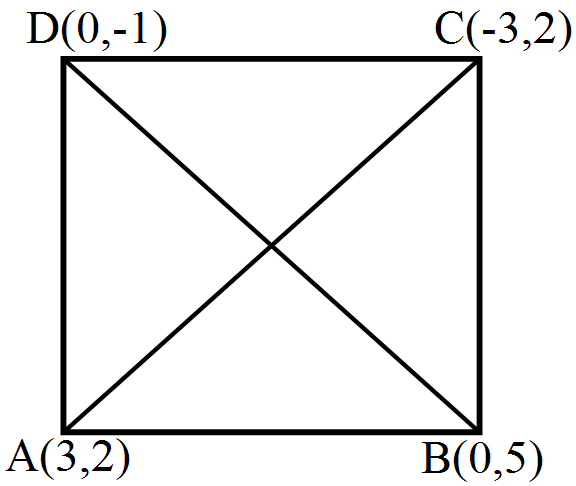
$\text{AB}=\sqrt{(0-3)^2+(5-2)^2}$
$=\sqrt{9+9}=\sqrt{18}=3\sqrt{2}$
$\text{BC}=\sqrt{(-3-0)^2+(2-5)^2}$
$=\sqrt{9+9}=\sqrt{18}=3\sqrt{2}$
$\text{CD}=\sqrt{(0+3)^2+(-1-2)^2}$
$=\sqrt{9+9}=\sqrt{18}=3\sqrt{2}$
$\text{DA}=\sqrt{(3-0)^2+(2+1)^2}$
$=\sqrt{9+9}=\sqrt{18}=3\sqrt{2}$
$\therefore\text{AB}=\text{BC}=\text{CD}+\text{DA}=3\sqrt{2}$
$\text{Diag}.\text{AC}=\sqrt{(-3-3)^2+(2-2)^2}=6$
$\text{Diag}.\text{BD}=\sqrt{(0-0)^2+(-1-5)^2}=6$
$\therefore\text{Diag}.\text{AC}=\text{Diag}.\text{BD}$
Thus, all sides of quad. $ABCD$ are equal and diagonals are also equal
Quad. $ABCD$ is a square. View full question & answer→Question 193 Marks
In what ratio is the line segments joining the points $A(-2, -3)$ and $B(3, 7)$ divided by the $y-$axis$?$ Also, find the coordinates of the point of division.
AnswerLet the $y-$axis cut the join $A(-2, -3)$ and $B(3, 7)$ at the point $P$ in the ratio $k : 1.$ Then,
By section formula, the co-ordinates of $P$ are
$\text{P}\Big(\frac{3\text{k}-2}{\text{k}+1},\frac{7\text{k}-3}{\text{k}+1}\Big)$
But $P$ lies on the $y-$axis so, its abscissa is $0.$
$\therefore\ \frac{3\text{k}-2}{\text{k}+1}=0\Rightarrow\ 3\text{k}-2=0\Rightarrow\text{k}=\frac{2}{3}$
So the required ratio is $\frac{2}{3}:1$ which is $2 : 3$
Putting $\text{k}=\frac{2}{3}$ in $\Big(0,\frac{7\text{k}-3}{\text{k}-1}\Big)$ we get the point $P$ as
$\text{P}\bigg(0,\frac{7\times\frac{2}{3}-3}{\frac{2}{3}+1}\bigg)_{\text{i.e},\text{P}(0,1)}$
Hence the points of intersection of $AB$ and the $y-$axis is $P(0, 1)$ and $P$ divides $AB$ in the ratio $2 : 3.$
View full question & answer→Question 203 Marks
Find the value of $x$ for which the distance between the points $P(x, 4)$ and $Q(9, 10)$ is $10$ units.
AnswerWe have, $P Q=10$
$\Rightarrow P Q^2=100$
$\Rightarrow(9-x)^2+(10-4)^2=100$
$\Rightarrow(9-x)^2+62=100$
$\Rightarrow(9-x)^2=64$
$\Rightarrow 9-x= \pm 8$
$\Rightarrow 9-x=8 \text { or } 9-x=-8$
$\Rightarrow x=1 \text { or } x=17$
Hence, the required values of $x$ are $1$ and $17.$
View full question & answer→Question 213 Marks
Show that the points $A(-3, 2), B(-5, -5), C(2, -3)$ and $D(4, 4)$ are the vertices of a rhombus. Find the area of this rhombus.
Hint: Area of a rhombus $=\frac{1}{2}\times(\text{product of its diagonals}).$
AnswerLet $A(-3, 2), B(-5, -5) C(2, -3)$ and $D(4, 4)$ be the angular points of quad. $ABCD$. Join $AC$ and $BD.$
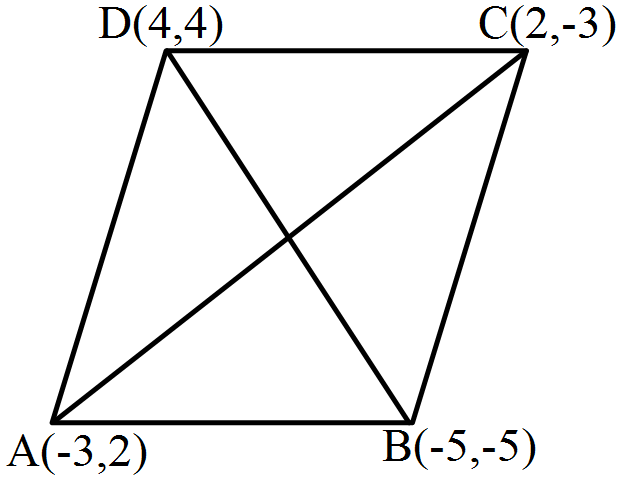
Now,
$\text{AB}=\sqrt{(-5+3)^2+(-5-2)^2}$
$=\sqrt{(-2)^2+(-7)^2}$
$=\sqrt{4+49}=\sqrt{53}\text{ units}$
$\text{BC}=\sqrt{(2+5)^2+(-3+5)^2}$
$=\sqrt{(7)^2+(2)^2}$
$=\sqrt{4+49}=\sqrt{53}\text{ units}$
$\text{CD}=\sqrt{(4-2)^2+(4+3)^2}$
$=\sqrt{(2)^2+(7)^2}$
$=\sqrt{4+49}=\sqrt{53}\text{ units}$
$\text{DA}=\sqrt{(-3-4)^2+(2-4)^2}$
$=\sqrt{(-7)^2+(2)^2}$
$=\sqrt{4+49}=\sqrt{53}\text{ units}$
Thus, $\text{AB}=\text{BC}=\text{CD}=\text{DA}=\sqrt{53}\text{ units}$
$\text{Diag}.\text{AC}=\sqrt{(2-3)^2+(-3-2)^2}$
$=\sqrt{(5)^2+(-5)^2}$
$=\sqrt{(25)+(25)}$
$=\sqrt{50}=5\sqrt{2}\text{ units}$
$\text{Diag}.\text{BD}=\sqrt{(4+5)^2+(4+5)^2}$
$=\sqrt{(81)+(81)}$
$=\sqrt{162}=9\sqrt{2}\text{ units}$
$\therefore\text{Diag}.\text{AC}\not=\text{Diag}.\text{BD}$
Thus, $ABCD$ is a quadrilateral having all sides equal but diagonals are unequal.
Hence, $ABCD$ is a rhombus.
$\text{Area of rhombus ABCD}$ $=\frac{1}{2}\times\text{product of its diagonals}.$
$=\Big(\frac{1}{2}\times\text{AC}\times\text{BD}\Big)=\Big(\frac{1}{2}\times5\sqrt{2}\times9\sqrt{2}\Big)$
$=45\text{ sq.units}$ View full question & answer→Question 223 Marks
Find the value of $k$ so that area of the triangle with triangle with vertices $A(k + 1, 1), B(4, -3)$ and $C(7, -k)$ is $6$ square units.
AnswerLet $\mathrm{A}\left(\mathrm{x}_1, \mathrm{y}_1\right)=\mathrm{A}(\mathrm{k}+1,1), \mathrm{B}\left(\mathrm{x}_2, \mathrm{y}_2\right)=\mathrm{B}(4,-3)$ and $\mathrm{C}\left(\mathrm{x}_3, \mathrm{y}_3\right)=\mathrm{C}(7,-\mathrm{k})$.
Now,
$\text{ar}\big(\triangle\text{ABC)}=\frac{1}{2}[\text{x}_1(\text{y}_2-\text{y}_3)+\text{x}_2(\text{y}_3-\text{y}_1)+\text{x}_3(\text{y}_1-\text{y}_2)]$
$\Rightarrow6=\frac{1}{2}[(\text{k+1})(-3+\text{k})+4(-\text{k}-1)+7(1+3)]$
$\Rightarrow6=\frac{1}{2}[\text{k}^2-2\text{k}-3-4\text{k}-4-28]$
$\Rightarrow\text{k}^2-6\text{k}+9=0$
$\Rightarrow\text{(k}-3)^2=0$
$\Rightarrow\text{k}=3$
Hence, $\text{k}=3$
View full question & answer→Question 233 Marks
Find the centroid of a $\triangle\text{ABC}$ whose vertices are $A(-1, 0), B(5, -2)$ and $C(8, 2)$
AnswerHere $\left(x_1=-1, y_1=0\right)\left(x_2=5, y_2=-2\right)$ and $\left(x_3=8, y_3=2\right)$
Let G(x, y) be the centroid of $\triangle\text{ABC},$ then
$\text{x}=\frac{1}{3}(\text{x}_1+\text{x}_2+\text{x}_3)$
$=\frac{1}{3}(-1+8+5)=4$
$\text{y}=\frac{1}{3}(\text{y}_1+\text{y}_2+\text{y}_3)$
$=\frac{1}{3}(0-2+2)=0$
Hence, the centroid of $\triangle\text{ABC},$ is $G(4, 0).$
View full question & answer→Question 243 Marks
Show that the points $\text{O}(0, 0),\text{A}(3,\sqrt{3})$ and $\text{B}(3,-\sqrt{3})$ are the vertices of an equilateral triangle. Find the area of this triangle.
AnswerLet $O(0, 0), \text{A}(3,\sqrt{3})$ and $\text{B}(3,-\sqrt{3})$ are the given points
$\therefore\text{OA}=\sqrt{(3-0)^2+(\sqrt{3}-0)^2}$
$=\sqrt{9+3}=\sqrt{12}=2\sqrt{3}\text{ units}$
$\text{AB}=\sqrt{(3-3)^2+(-\sqrt{3}-\sqrt{3})^2}$
$=\sqrt{0^2+(-2\sqrt{3})}=\sqrt{12}=2\sqrt{3}\text{ units}$
$\text{OB}=\sqrt{(3-0)^2+(\sqrt{3}-0)^2}$
$=\sqrt{(3)^2+(-\sqrt{3})^2}$
$=\sqrt{9+3}=\sqrt{12}=2\sqrt{3}\text{ units}$
$\therefore\text{OA}=\text{AB}=\text{AB}=2\sqrt{3}\text{ units}$
Hence, $DABC$ is equilateral and each of its sides being $2\sqrt{3}\text{ units}$
Area of $\triangle\text{ABC}=\Big[\frac{\sqrt{3}}{4}\times(\text{side})^2\Big]\text{sq.unit}$
$=\Big[\frac{\sqrt{3}}{4}\times(2\sqrt{3})^2\Big]\text{sq.unit}$
$=\Big[\frac{\sqrt{3}}{4}\times4\times3\Big]\text{sq.unit}$
$=3\sqrt{3}\text{ sq.unit}$
View full question & answer→Question 253 Marks
In what ratio does the point $P(2, 5)$ divide the join of $A(8, 2)$ and $B(-6, 9)?$
AnswerLet $P$ divided the join of $A(8, 2), B(-6, 9)$ in the ratio $k : 1.$
By section formula, the coordinates of $p$ are.

$\Big(\frac{-6\text{k}+8}{\text{k}+1},\frac{9\text{k}+2}{\text{k}+1}\Big)$
$\therefore\ \frac{-6\text{k}+8}{\text{k}+1}=2$ and $\frac{9\text{k}+2}{\text{k}+1}=5$
$\Rightarrow\ -6\text{k}+8=2\text{k}+2$ and $9\text{k}+2=5\text{k}+5$
$\Rightarrow\ -8\text{k}=-6$ and $4\text{k}=3$
$\Rightarrow\ \text{k}=\frac{-6}{-8}=\frac{3}{4}$ and $\text{k}=\frac{3}{4}$
$\Rightarrow\ \text{k}=\frac{3}{4}$ in each case
Hence, the required ratio of $\Big(\frac{3}{4}:1\Big)$ which is $(3 : 4)$ View full question & answer→Question 263 Marks
If $G(-2, 1)$ is the centroid of a $\triangle\text{ABC}$ and two of its vertices are $A(1, -6)$ and $B(-5, 2),$ find the third vertex of the triangle.
AnswerTwo vertices of $\triangle\text{ABC}$ are $A(1, -6)$ and $B(-5, 2)$ let the third vertex be $C(a, b).$ Then,
The co-ordinates of its centroid are
$\text{G}\Big(\frac{1-5+\text{a}}{3},\frac{-6+2+\text{b}}{3}\Big)\text{i.e}\ \text{G}\Big(\frac{-4+\text{a}}{3},\frac{-4+\text{b}}{3}\Big)$
But given that the centroid is $G(-2, 1)$
$\frac{-4+\text{a}}{3}=-2$ and $\frac{-4+\text{b}}{3}=1$
$-4 + a = -6$ and $-4 + b = 3$
$a = -2$ and $b = 7$
Hence, the third vertex $C$ of $\triangle\text{ABC}$ is $(-2, 7).$
View full question & answer→Question 273 Marks
If $P(x, y)$ is equidistant from the points $A(7, 1)$ and $B(3, 5),$ find the relation between $x$ and $y.$
AnswerLet the point $P(x, y)$ be equidistant from the points $A(7, 1)$ and $B(3, 5).$
Then,
$ P A=P B$
$\Rightarrow P A^2=P B^2$
$\Rightarrow(x-7)^2+(y-1)^2=(x-3)^2+(y-5)^2$
$\Rightarrow x^2+y^2-14 x-2 y+50=x^2+y^2-6 x-10 y+34$
$\Rightarrow 8 x-8 y=16$
$\Rightarrow x-y=2$
View full question & answer→Question 283 Marks
Show that $A(1, 2), B(4, 3), C(6, 6)$ and $D(3, 5)$ are the vertices of a Parallelogram. Show that $ABCD$ is not a rectangle.
AnswerLet $A(1, 2), B(4, 3) C(6, 6)$ and $D(3, 5)$ be the angular points of a quadrilateral $ABCD.$ Join $AC$ and $BD.$
Now,
$\text{AB}=\sqrt{(4-1)^2+(3-2)^2}$
$=\sqrt{(3)^2+(1)^2}$
$=\sqrt{9+1}=\sqrt{10}\text{ units}$
$\text{BC}=\sqrt{(6-4)^2+(6-3)^2}$
$=\sqrt{(2)^2+(3)^2}$
$=\sqrt{4+9}=\sqrt{13}\text{ units}$
$\text{CD}=\sqrt{(3-6)^2+(6-3)^2}$
$=\sqrt{(-3)^2+(-1)^2}$
$=\sqrt{9+1}=\sqrt{10}\text{ units}$
$\text{DA}=\sqrt{(3-1)^2+(5-2)^2}$
$=\sqrt{(2)^2+(3)^2}$
$=\sqrt{4+9}=\sqrt{13}\text{ units}$
$\therefore\text{AB}=\text{CD}$ and $\text{BC}=\text{DA}$
Thus, $ABCD$ is a parallelogram since its opposite sides are equal.
$\text{Diag}.\text{AC}=\sqrt{(6-1)^2+(6-2)^2}$
$=\sqrt{(5)^2+(4)^2}$
$=\sqrt{25+16}$
$=\sqrt{41}\text{ units}$
$\text{Diag}.\text{BD}=\sqrt{(3-4)^2+(5-3)^2}$
$=\sqrt{(-1)^2+(2)^2}$
$=\sqrt{1+4}$
$=\sqrt{5}\text{ units}$
$\therefore\text{Diag}.\text{AC}\not=\text{Diag}.\text{BD}$
Hence, it is not a rectangle.
View full question & answer→Question 293 Marks
Points $P, Q$ and $R$ in that order are dividing a line segment joining $A(1, 6)$ and $B(5, -2)$ in four equal parts. Find the coordinates of $P, Q$ and $R.$
AnswerPoints $P, Q, R$ divide the line segment joining the points $A(1, 6)$ and $(5, -2)$ in to four equal parts
$⇒$ Point $P$ divide $AB$ in the ratio $1 : 3$ where $A(1, 6), (5, -2)$

Therefore, the point $P$ is,
$\Big(\frac{1\times5+3\times1}{1+3},\frac{1\times(-2)+3\times6}{1+3}\Big)$ or $\Big(\frac{8}{4},\frac{16}{4}\Big)$ or $(2, 4)$
Now, $Q$ is the midpoint of $AB$
The point $Q$ is the midpoint of $AB$
The point $Q$ is $\Big(\frac{1+5}{2},\frac{6-2}{2}\Big)$ or $(3,2)$
Also, $R$ is the midpoint of the line segment joining $Q(3, 2)$ and $B(5, -2)$
$\therefore$ The point R is $\Big(\frac{3+5}{2},\frac{2-2}{2}\Big)$ or $(4, 0)$ View full question & answer→Question 303 Marks
If $P(x, y)$ is a point equidistant from the points $A(6, - 1)$ and $B(2, 3),$ show that $x - y = 3.$
AnswerLet $A(6, -1)$ and $B(2, 3)$ be the given point and $P(x, y)$ be the rwquired point, we get
$ P A=P B \Rightarrow(P A)^2=(P B)^2$
$\Rightarrow(x-6)^2+(y+1)^2=(2-x)^2+(3-y)^2$
$\Rightarrow 36+x^2-12 x+y^2+1+2 y=4+x^2-4 x+9+y^2-6 y$
$\Rightarrow-12 x+4 x+2 y+6 y=4+9-1-36$
$\Rightarrow-8 x+8 y=-24$
$\Rightarrow-8(x-y)=-24$
$\Rightarrow x-y=3$
Hence, $x - y = 3$
View full question & answer→Question 313 Marks
Find the area of $\triangle\text{ABC}$ whose vertices are:
$A(10, -6), B(2, 5)$ and $C(-1, 3)$
Answer$A(10, -6), B(2, 5)$ and $C(-1, -3)$ are the vertices of $\triangle\text{ABC}.$
Then, $\left(x_1=10, y_1=-6\right),\left(x_2=2, y_2=5\right)$ and $\left(x_3=-1, y_3=3\right)$
Area of triangle ABC
$=\frac{1}{2}\big\{\text{x}_1(\text{y}_2-\text{y}_3)+\text{x}_2(\text{y}_3-\text{y}_1)+\text{x}_3(\text{y}_1-\text{y}_2)\big\}$
$=\frac{1}{2}\big\{10(5-3)+2(3-(-6))+(-1)(-6-5)\big\}$
$=\frac{1}{2}\big\{10(2)+2(9)-1(-11)\big\}$
$=\frac{1}{2}\big\{20+18+11\big\}$
$=\frac{1}{2}(49)$
$=24.5\ \text{sq}.\text{units}$
View full question & answer→Question 323 Marks
Find the ratio in which the point $\text{P}\Big(\frac{3}{4},\frac{5}{12}\Big)$ divides the line segment joining the points $\text{A}\Big(\frac{1}{2},\frac{3}{2}\Big)$ and $B(2, -5).$
AnswerLet the required ratio be $k : 1.$
Then, by section formula,
Coordinates of $P =\bigg(\frac{\text{k}\times2+1\times\frac{1}{2}}{\text{k}+1},\frac{\text{k}\times(-5)+1\times\frac{3}{2}}{\text{k}+1}\bigg)$
$=\bigg(\frac{2\text{k}+\frac{1}{2}}{\text{k}+1},\frac{-5\text{k}+\frac{3}{2}}{\text{k}+1}\bigg)$
$=\bigg(\frac{4\text{k}+1}{2(\text{k}+1)},\frac{-10\text{k}+3}{2(\text{k}+1)}\bigg)$
Given, coordinates of P $=\Big(\frac{3}{4},\frac{5}{12}\Big)$
$\therefore\ \frac{4\text{k}+1}{2(\text{k}+1)}=\frac{3}{4}$
$\Rightarrow\ 16\text{k}+4=6\text{k}+6$
$\Rightarrow\ 10\text{k}=2$
$\Rightarrow\ \text{k}=\frac{1}{5}$
So, the required ratio is $1 : 5.$
View full question & answer→Question 333 Marks
Find the coordinate of the point which divides the join of $A(-1, 7)$ and $B(4, -3)$ in the ratio $2 : 3.$
AnswerThe point of $AB$ are $A(-1, 7)$ and $B(4, -3)$
$\therefore\left(\mathrm{x}_1=-1, \mathrm{y}_1=7\right)$ and $\left(\mathrm{x}_2=4, \mathrm{y}_2=-3\right)$
Also $m = 2$ and $n = 3$

Let the required point be $P(x, y)$
By section formula, we have
$\Rightarrow\text{x}=\frac{(\text{mx}_2+\text{nx}_1)}{(\text{m+n})},\text{y}=\frac{(\text{my}_2+\text{ny}_1)}{(\text{m+n})}$
$\Rightarrow\text{x}=\frac{2\times4+3\times(-1)}{(2+3)},\text{y}=\frac{(2\times-3+3\times7)}{(2+3)}$
$\Rightarrow\text{x}=\frac{8-3}{5},\frac{-6+21}{5}$
$\Rightarrow\text{x}=\frac{5}{5},\frac{15}{5}$ or $x = 1, y = 3$
Hence the required point is $P(1, 3)$ View full question & answer→Question 343 Marks
If the point $P(k - 1, 2)$ is equidistant from the points $A(3, k)$ and $B(k, 5),$ find the values of $k.$
AnswerIf the point $P(k-1,2), A(3, k)$ and $B(k, 5)$.
$ \because A P=B P$
$\because A P^2=B P^2$
$\Rightarrow(k-1-3)^2+(2-k)^2=(k-1-k)^2+(2-5)^2$
$\Rightarrow(k-4)^2+(2-k)^2=(-1)^2+(-3)^2$
$\Rightarrow k^2-8 y+16+4+k^2-4 k=1+9$
$\Rightarrow k^2-6 y+5=0$
$\Rightarrow(k-1)(k-5)=0$
$\Rightarrow k=1 \text { or } k=5$
Hence, $k=1$ or $k=5$.
View full question & answer→Question 353 Marks
Show that the points $A(7, 10), B(-2, 5)$ and $C(3, -4)$ are the vertices of an isosceles right triangle.
AnswerGiven: $A(7, 10), B(-2, 5)$ and $C(3, -4)$
Now,
$\text{AB}=\sqrt{(-2-7)^2+(5-10)^2}=\sqrt{(-9)^2+(-5)^2}$
$=\sqrt{81+25}=\sqrt{106}=\sqrt{106}\text{ units}$
$\text{BC}=\sqrt{(3+2)^2+(-4-5)^2}=\sqrt{(5)^2+(-9)^2}$
$=\sqrt{25+18}=\sqrt{20}=\sqrt{106}\text{ units}$
$\text{AC}=\sqrt{(3+7)^2+(-4-10)^2}=\sqrt{(-4)^2+(-14)^2}$
$=\sqrt{16+196}=\sqrt{212}=\sqrt{212}\text{ units}$
We find that $\text{ AB} = \text{BC}=\sqrt{106}$
$\therefore\triangle\text{ABC}$ is an isosceles treangle.
And,
$\text{AB}^2+\text{BC}^2$
$=(\sqrt{106})^2+(\sqrt{106})^2$
$=106+106=212$
$\text{AC}^2=(\sqrt{212})^2=212$
$\Rightarrow\text{AB}^2+\text{BC}^2=\text{AC}^2$
This shows that $\triangle\text{ABC}$ is righta-angled at $B.$
Hence, the geven points are the vertices of an isosceles right triangle.
View full question & answer→