Question 14 Marks
Find the centroid of $\triangle\text{ABC}$ whose vertices are $A(2, 2), B(-4, -4)$ and $C(5, -8).$
AnswerThe given points are $A(2, 2), B(-4, -4)$ and $C(5, -8).$
Here, $\left(x_1=2, y_1=2\right),\left(x_2=-4, y_2=-4\right)$ and $\left(x_3=5, y_3=-8\right)$
Let G(x, y) be the centroid of $\triangle\text{ABC}.$ Then,
$\text{x}=\frac{1}{3}(\text{x}_1+\text{x}_2+\text{x}_3)$
$=\frac{1}{3}(2-4+5)$
$=1$
$\text{y}=\frac{1}{3}(\text{y}_1+\text{y}_2+\text{y}_3)$
$=\frac{1}{3}(2-4-8)$
$=\frac{-10}{3}$
Hence, the centroid of $\triangle\text{ABC}$ is $\text{G}\Big(1,\frac{-10}{3}\Big).$
View full question & answer→Question 24 Marks
If the point $A(0, 2)$ is equidistant from the points $B(3, p)$ and $C(p, 5)$, find $P.$
AnswerThe given points are $A(0, 2), B(3, p)$ and $C(p, 5).$
$ A B=A C \Rightarrow A B^2=A C^2 $
$ \Rightarrow(3-0)^2+(p-2)^2=(p-0)^2+(5-2)^2 $
$ \Rightarrow 9+p^2-4 p+4=p^2+9 $
$ \Rightarrow 4 p=4 \Rightarrow p=1$
$\text { Hence, } p=1$
View full question & answer→Question 34 Marks
Find the lengths of the medians $A D$ and $B E$ of $\triangle A B C$ whose vertices are $A(7,-3), B(5,3)$ and $C(3,1)$.
AnswerThe given vertices are $A(7,-3), B(5,3)$ and $C(3,-1)$.
Since $D$ and $E$ are the mid-points of $B C$ and $A C$ respectively, therefore
Coordinates of $D$ $=\Big(\frac{5+3}{2},\frac{3-1}{2}\Big)=(4,1)$
Coordinates of $E$ $=\Big(\frac{7+3}{2},\frac{-3-1}{2}\Big)=(5,-2)$
Now,
$\text{AD}=\sqrt{(7-4)^2+(-3-1)^2}$
$=\sqrt{9+16}=5$
$\text{BE}=\sqrt{(5-5)^2+(3+2)^2}$
$=\sqrt{0+25}=5$
Hence, $AD = BE = 5$ units.
View full question & answer→Question 44 Marks
Find the coordinates of a point $A$, where $AB$ is a diameter of a circle with center $C(2, -3)$ and the other end of the diameter is $B(1, 4).$
Answer$A, B$ are the end points of a diameter. Let the coordinates of A be $(x, y)$. The point $B$ is $(1, 4).$
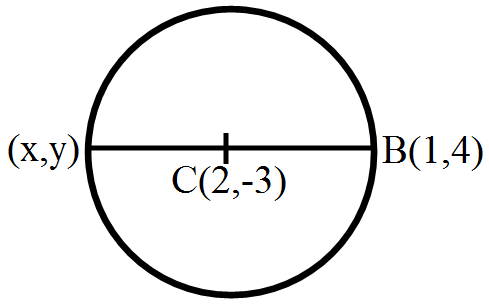
The center $C(2, -3)$ is the mid-point of $AB$
$\therefore\ \frac{\text{x}+1}{2}=2\Rightarrow\ \text{x}=3$
$\frac{\text{y}+2}{2}=-3\Rightarrow\ \text{y}=-10$
The points $A$ is $(3, -10)$ View full question & answer→Question 54 Marks
Find the ratio in which the point $P(x, 2)$ divides the join of $A(12,5)$ and $B(4,-3)$.
AnswerLet k be the ratio in which the point $P(x, 2)$ divides the joining the points $\mathrm{A}\left(\mathrm{x}_1=12, \mathrm{y}_1=5\right)$ and $\mathrm{B}\left(\mathrm{x}_2=4, \mathrm{y}_2=-3\right)$ Then
$\text{x}=\frac{\text{k}\times4+12}{\text{k}+1}$ and $2=\frac{\text{k}\times(-3)+5}{\text{k}+1}$
Now
$2=\frac{\text{k}\times(-3)+5}{\text{k}+1}\Rightarrow\ 2\text{k}+2=-3\text{k}+5\Rightarrow\ \text{k}=\frac{3}{5}$
Hence, the required ratio is $3 : 5.$
View full question & answer→Question 64 Marks
The base $Q R$ of an equilateral triangle $P Q R$ lies on $x$-axis. The coordinates of the point $Q$ are $(-4,0)$ and origin is the midpoint of the base. Find the coordinates of the points $P$ and $R$.
Answer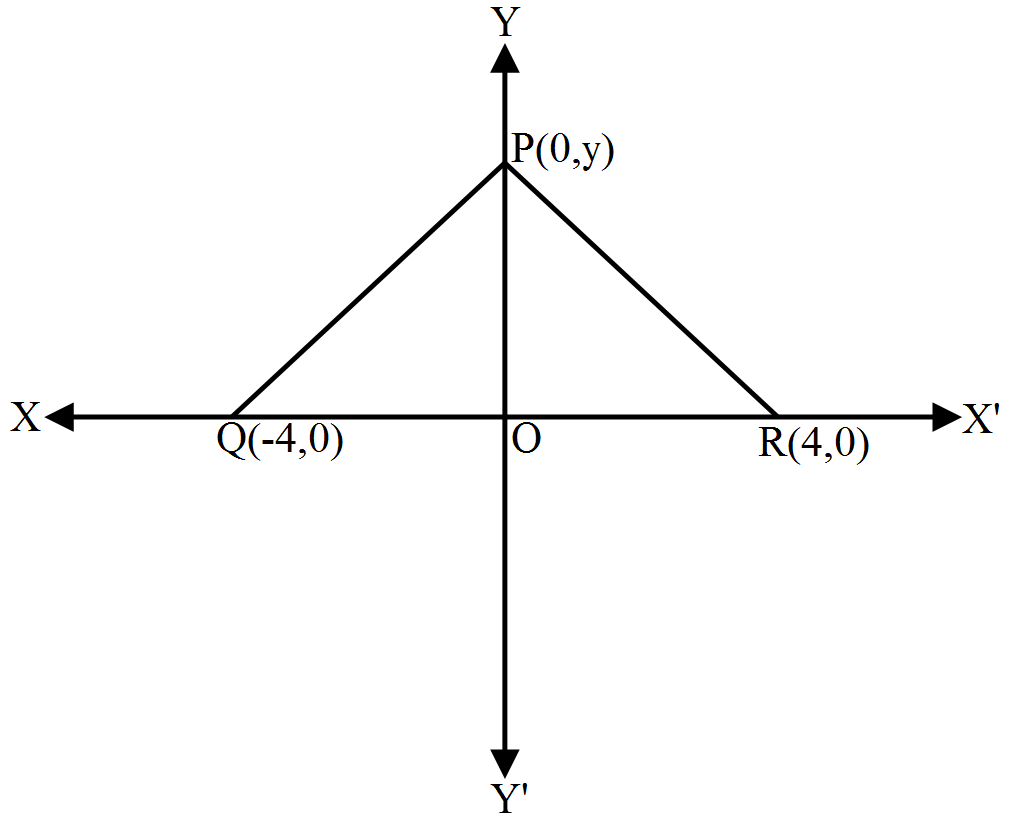
Given $P Q R$ is an equilateral triangle such that $QR$ lies on $x$-axis.
Clearly, orgin $O$ is the mid-point of $Q R$,
$\Rightarrow O Q=O R=4$ units
$\Rightarrow$ Coordinates of $R$ are $(4,0)$
Now, P lies on $y$-axis.
Let the coordinates of P be $(0, y )$.
Now, $PQ = QR = PR$
Consider $PQ = QR$
$\Rightarrow\ \sqrt{(-4-0)^2+(0-\text{y})^2}=\sqrt{(4+4)^2+(0-0)^2}$
$\Rightarrow\ \sqrt{16+\text{y}^2}=\sqrt{64}$
$\Rightarrow\ 16+\text{y}^2=64$
$\Rightarrow\ \text{y}^2=48$
$\Rightarrow\ \text{y}=\pm4\sqrt{3}$
Thus, coordinates of $P$ are $(0+4\sqrt{3})$ or $(0-4\sqrt{3})$. View full question & answer→Question 74 Marks
If the point $(x, y)$ is equidistant from the points $(a + b, b - a)$ and $(a - b, a + b),$
prove that $bx = ay.$
AnswerIt is being given that $(x, y)$ is equidustant from the points $(a + b, b - a)$ and $(a - b, a + b)$
Thus, we have
${[x-(a+b)]^2+[y-(b-a)]^2=[x-(a-b)]^2+[y-(a+b)]^2}$
$\Rightarrow[(x-a)-b]^2+[(y-b)+a]^2=[(x-a)+b]^2+[(y-b)-a]^2$
$\Rightarrow[(x-a)+b]^2-[(x-a)-b]^2=[(y-b)+a]^2-[(y-b)-a]^2$
$\Rightarrow(x-a)^2+b^2+2(x-a) b-(x-a)^2-b^2+2(x-a) b$
$\Rightarrow(y-b)^2+a^2+2(y-b) a-(y-b)^2-a^2+2(y-b) a$
$\Rightarrow 4(x-a) b=4(y-b) a$
$\Rightarrow b x-a b=a y-a b$
$\Rightarrow b x=a y$
View full question & answer→Question 84 Marks
Find the distance between the points:
$\text{P}(\text{a}\sin\alpha,\text{a}\cos\alpha)$ and $\text{Q}(\text{a}\cos\alpha, -\text{a}\sin\alpha)$
AnswerThe given points are $\text{P}(\text{a}\sin\alpha,\text{a}\cos\alpha)$ and $\text{Q}(\text{a}\cos\alpha, -\text{a}\sin\alpha)$
Then, $(\text{x}_1=\text{a}\sin\alpha,\text{y}_1=\text{a}\cos\alpha)$ and $(\text{x}_2=\text{a}\cos\alpha,\text{ y}_2=-\text{a}\sin\alpha)$
$\therefore\text{PQ}=\sqrt{(\text{x}_2-\text{x}_1)^2+(\text{y}_2-\text{y}_1)^2}$
$=\sqrt{(\text{a}\cos\alpha -\text{a}\sin\alpha)^2+(-\text{a}\sin\alpha -\text{a}\cos\alpha)^2}$
$=\sqrt{\text{a}^2\cos^2\alpha+\text{a}^2\sin^2\alpha+\text{a}^2\cos^2\alpha+\text{a}^2\sin^2\alpha}$
$=\sqrt{\text{a}^2(\cos^2\alpha+\sin^2\alpha)\text{a}^2(\cos^2\alpha+\sin^2\alpha)}$
$=\sqrt{\text{a}^2+\text{a}^2}$
$=\sqrt{\text{2a}^2}=\sqrt{2}\text{a}\text{ units}.$
View full question & answer→Question 94 Marks
Find the ratio in which the point $(-3, k)$ divides the join of $A(-5,-4)$ and $B(-2,3)$. Also find the value of $k$.
AnswerLet $P$ is dividing the given segment joining $A (-5,-4)$ and $B (-2,3)$ in the ratio $r : 1$.

$\therefore$ coordinates of point $P$
$\Big(\frac{-2\text{r}+1\times(-5)}{\text{r}+1},\frac{\text{r}\times3+1\times(-4)}{\text{r}+1}\Big)\text{i.e}\Big(\frac{-2\text{r}-5}{\text{r}+1},\frac{3\text{r}-4}{\text{r}+1}\Big)$
Also, the coordinates of points P are (-3, k).
$\therefore\ \frac{-2\text{r}-5}{\text{r}+1}=-3\Rightarrow\ -2\text{r}-5=-3\text{r}-3,$
$\Rightarrow\ \text{r}=2$
And
$\text{k}=\frac{3\text{r}-4}{\text{r}+1}=\frac{3\times2-4}{2+1}=\frac{2}{3}$
$\therefore$ P is dividing $AB$ in the ratio $2 : 1$ and $\text{k}=\frac{2}{3}$ View full question & answer→Question 104 Marks
Show taht the following points are collinear:
$A(5, 1), B(1, -1)$ and $C(11, 4)$
AnswerLet $\mathrm{A}\left(\mathrm{x}_1=5, \mathrm{y}_1=1\right), \mathrm{B}\left(\mathrm{x}_2=1, \mathrm{y}_2=-1\right)$ and $\mathrm{C}\left(\mathrm{x}_3=11, \mathrm{y}_3=4\right)$ be the given points.
Now
$x_1\left(y_2-y_3\right)+x_2\left(y_3-y_1\right)+x_3\left(y_1-y_2\right)$
$= 5(-1 - 4) + 1(4 - 1) + 11(1 + 1)$
$= -25+ 3 + 22$
$= 0$
Hence the given point are collinear.
View full question & answer→Question 114 Marks
If the vertices of $\triangle A B C$ be $A(1,-3), B(4, p)$ and $C(-9,7)$ and its area is $15$ square units, find the values of $p$.
AnswerLet $\mathrm{A}\left(\mathrm{x}_1, \mathrm{y}_1\right)=\mathrm{A}(1,-3), \mathrm{B}\left(\mathrm{x}_2, \mathrm{y}_2\right)=\mathrm{B}(4, \mathrm{p})$ and $\mathrm{C}\left(\mathrm{x}_3, \mathrm{x}_4\right)=C(-9,7)$.
Now,
$\text{ar}(\triangle\text{ABC})=\frac{1}{2}[\text{x}_1(\text{y}_2-\text{y}_3)+\text{x}_2(\text{y}_3-\text{y}_1)+\text{x}_3(\text{y}_1-\text{y}_2)]$
$\Rightarrow15=\frac{1}{2}[1(\text{p}-7)+4(7+3)-9(-3-\text{p})]$
$\Rightarrow15=\frac{1}{2}[10\text{p}+60]$
$\Rightarrow[10\text{p}+60]=30$
Therefore
$\Rightarrow[10\text{p}+60]=-30\text{ or}30$
$\Rightarrow10\text{p}=-9\text{ or}-30$
$\Rightarrow\text{p}=-9\text{ or}-3$
Hence, $p = -9 $ or $p = -3.$
View full question & answer→Question 124 Marks
Find the distance between of the following points from the origin:
$A(5, -12)$
AnswerThe gven point is $A(5, -12)$ and let $O(0, 0)$ be the origin
Then, $\text{AO}=\sqrt{(5-0)^2+(-12-0)^2}$
$=\sqrt{5^2+(-12)^2}$
$=\sqrt{25+144}$
$=\sqrt{169}=13\text{ units}.$
View full question & answer→Question 134 Marks
In what ratio does $y$-axis divide the line segment joining the points $(-4,7)$ and $(3,-7)$ ?
AnswerLet the $y$-axis cut the join of $A(-4,7)$ and $B(3,-7)$ at the point $p$ in the ratio $k: 1$. Then,
By section formula,
Coordinates of p $=\Big(\frac{\text{k}\times3+1\times(-4)}{\text{k}+1},\frac{\text{k}\times(-7)+1\times7}{\text{k}+1}\Big)$
$=\Big(\frac{3\text{k}-4}{\text{k}+1},\frac{-7\text{k}+7}{\text{k}+1}\Big)$
But p lies on y-axis. So, its abscissa is 0.
$\therefore\ \frac{3\text{k}-4}{\text{k}+1}=0$
$\Rightarrow\ 3\text{k}-4=0$
$\Rightarrow\ 3\text{k}=4$
$\Rightarrow\ \text{k}=\frac{4}{3}$
So, the required ratio is$ 4 : 3.$
View full question & answer→Question 144 Marks
Find the area of quadrilateral $PQRS$ whose vertices are $P(-5, -3), Q(-4, -6), R(2, -3)$ and $S(1, 2)$
AnswerBy joining $P$ and $R$, We get triangle $PQR$ and $PRS.$
Let
$P\left(x_1, y_1\right)=P(-5,-3), Q\left(x_2, y_2\right)=Q(-4,-6), R\left(x_3, y_3\right)=R(2,-3)$ and $S\left(x_4, y_4\right)=S(1,2)$.
Then
Area of $\triangle\text{PQR}=\frac{1}{2}[\text{x}_1(\text{y}_2-\text{y}_3)+\text{x}_2(\text{y}_3-\text{y}_1)+\text{x}_3(\text{y}_1-\text{y}_2)]$
$=\frac{1}{2}[(-5)(-6+3)-4(-3+3)+2(-3+6)]$
$=\frac{1}{2}[15-0+6]$
$=\frac{21}{2}\ \text{sq.units}$
Area of $\triangle\text{PRS}=\frac{1}{2}[\text{x}_1(\text{y}_3-\text{y}_4)+\text{x}_3(\text{y}_4-\text{y}_1)+\text{x}_4(\text{y}_1-\text{y}_3)]$
$=\frac{1}{2}[-5(-3-2)+2(2+3)+1(-3+3)]$
$=\frac{1}{2}[25+10+0]$
$=\frac{35}{2}\ \text{sq}.\text{units}$
So, the area of the quadrilateral is $=\frac{21}{2}+\frac{35}{2}=28\ \text{sq}.\text{units}$
View full question & answer→Question 154 Marks
Find the value of $x$ for which the points $A(x, 2), B(-3,-4)$ and $C(7,-5)$ are collinear.
AnswerLet $\mathrm{A}\left(\mathrm{x}_1, \mathrm{y}_1\right)=\mathrm{A}(\mathrm{x}, 2), \mathrm{B}\left(\mathrm{x}_2, \mathrm{y}_2\right)=\mathrm{B}(-3,-4)$ and $\mathrm{C}\left(\mathrm{x}_3, \mathrm{y}_3\right)=\mathrm{C}(7,-5)$ so, the condition for three collinear point is.
$x_1\left(y_2-y_3\right)+x_2\left(y_3-y_1\right)+x_3\left(y_1-y_2\right)=0$
$= x(-4 + 5) - 3(-5 - 2) + 7(2 + 4) = 0$
$= x + 21 + 42 = 0$
$= x = -63$
Hence, $x = -63.$
View full question & answer→Question 164 Marks
The midpoint of the line segment joining $A (2 a , 4)$ and $B (-2,3 b)$ is $C (1,2 a+1)$. Find the values of $a$ and $b$.
Answer$C (1,2 a +1)$ is the mid-point of $A (2 a , 4)$ and $B (-2,3 b)$
$\text{x}=\frac{\text{x}_2+\text{x}_1}{2}$ and $\text{y}=\frac{\text{y}_2-\text{y}_1}{2}$
$1=\frac{-2+2\text{a}}{2}$ and $2\text{a}+1=\frac{3\text{a}+4}{2}$
$2 = -2 + 2a$ and $4a + 2 = 3b + 4 ...(1)$
$a = 2 ...(2)$
Putting $a = 2$ in $(1)$, we get
$4 \times 2 + 2 = 3b + 4$
$\Rightarrow 10 - 4 = 3b$
$\Rightarrow 3b = 6$
$\Rightarrow\ \text{b}=\frac{6}{3}=2$
Hence, $a = 2$ and $b = 2$
View full question & answer→Question 174 Marks
Find a relation between $x$ and $y$, if the points $A(2, 1), B(x, y)$, and $C(7, 5)$ are collinear.
AnswerLet $\mathrm{A}\left(\mathrm{x}_1=2, \mathrm{y}_1=1\right), \mathrm{B}\left(\mathrm{x}_2=\mathrm{x}, \mathrm{y}_2=\mathrm{y}\right)$ and $\left(\mathrm{x}_3=7, \mathrm{y}_3=5\right)$ be the given points.
The given point are collinear if
$ x_1\left(y_2-y_3\right)+x_2\left(y_3-y_1\right)+x_3\left(y_1-y_2\right)=0 $
$ \Rightarrow 2(y-5)+x(5-1)+7(1-y)=0 $
$ \Rightarrow-2 y-10+4 x+7-7 y=0 $
$ \Rightarrow 2 y-10+4 x+7-7 y=0 $
$ \Rightarrow 4 x-5 y-3=0$
Hence, the required relation is $4x - 5y - 3 = 0.$
View full question & answer→Question 184 Marks
Find the point on the y-axis which is equidistant from the points $A(6, 5)$ and $B(-4, 3).$
AnswerLet the required point be $C(0, y)$
Then, we have
$ A C=B C $
$ \Rightarrow A C^2=B C^2 $
$ \Rightarrow(6-0)^2+(5-y)^2=(-4-0)^2+(3-y)^2 $
$ \Rightarrow(6)^2+\left(25+y^2-10 y\right)=(-4)^2+\left(9+y^2-6 y\right) $
$ \Rightarrow 36+25+y^2-10 y=16+9+y^2-6 y $
$ \Rightarrow 61-10 y=25-6 y $
$ \Rightarrow 4 y=36 $
$ \Rightarrow y=9$
Hence, the required point is $C(0, 9).$
View full question & answer→Question 194 Marks
Find the third vertex of a $\triangle\text{ABC}$ if two of its vertices are $B(-3, 1)$ and $C(0, -2),$ and its centroid is at the origin.
AnswerTwo vertices of $\triangle\text{ABC}$ are $B(-3, 1)$ and $C(0, -2)$ and third vertex be $A(a, b)$. Then,
The coordinates of its centroid are
$\text{G}\Big(\frac{-3+0+\text{a}}{3},\frac{1-2+\text{b}}{3}\Big),\text{i.e},\text{G}\Big(\frac{-3+\text{a}}{3},\frac{-1+\text{b}}{3}\Big)$
But it is given that the centroid is $G(0, 0).$
$\frac{-3+\text{a}}{3}=0$ and $\frac{-1+\text{b}}{3}=0$
$-3 + a = 0$ and $-1 + b = 0$
$\Rightarrow a = 3$ and $b = 1$
Hence the third vertices A of $\triangle\text{ABC}$ is $A(3, 1).$
View full question & answer→Question 204 Marks
Find the value of $y$ for which the points $A(-3,9), B(2, y)$ and $C(-4,-5)$ are collinear.
AnswerLet $\mathrm{A}\left(\mathrm{x}_1=-3, \mathrm{y}_1=9\right), \mathrm{B}\left(\mathrm{x}_2=2, \mathrm{y}_2=\mathrm{y}\right)$ and $\left(\mathrm{x}_3=4, \mathrm{y}_3=-5\right)$ be the given points.
The given point are collinear if
$ x_1\left(y_2-y_3\right)+x_2\left(y_3-y_1\right)+x_3\left(y_1-y_2\right)=0 $
$ \Rightarrow(-3)(y+5)+2(-5-9)+4(9-y)=0 $
$ \Rightarrow 3 y-15-28+36-4 y=0 $
$ \Rightarrow 7 y=36-43 $
$ \Rightarrow y=-1$
View full question & answer→Question 214 Marks
In what ratio does point $\left(\frac{24}{11}, y\right)$ divide the line segment joining the points $P(2,-2)$ and $Q(3,7)$ ? Also, find the value of $y$.
Answer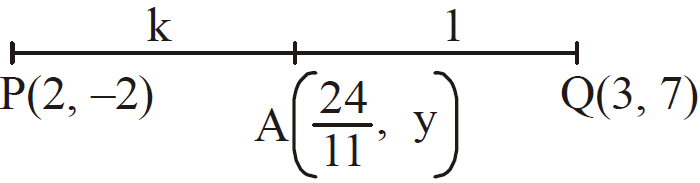
Let $PA : AQ = k : 1$
$\therefore \frac{2 + 3\text{k}}{\text{k + 1}} = \frac{24}{11}$
$\Rightarrow \text{k} = \frac{2}{9}$
Hence the ratio is $2 : 9.$
Therefore $\text{y} = \frac{-18 + 14}{11} = \frac{-4}{11}$ View full question & answer→Question 224 Marks
Find the area of $\triangle\text{ABC}$ with $A(1, -4)$ and midpoints of sides through A being $(2, -1)$ and $(0, -1).$
AnswerLet $(x_2, y_2)$ and $(x_3, y_3)$ be the coordinates of $B$ and $C$ respectively. Since, the cordinates of $A$ are $(1, -4)$, therefore
$\frac{1+\text{x}_2}{2}=2=\text{x}_2=3$
$\frac{-4+\text{y}_2}{2}=-1=\text{y}_2=2$
$\frac{-4+\text{y}_3}{2}=-1=\text{y}_3=2$
Let $A\left(x_1, y_1\right)=A(1,-4), B\left(x_2, y_2\right)=B(3,2)$ and $C\left(x_3, x_4\right)=C(-1,2)$.
Now,
$\text{ar}(\triangle\text{ADC})=\frac{1}{2}[\text{x}_1(\text{y}_2-\text{y}_3)+\text{x}_2(\text{y}_3-\text{y}_1)+\text{x}_3(\text{y}_1-\text{y}_2)]$
$=\frac{1}{2}[1(2-2)+3(2+4)-1(-4-2)$
$=\frac{1}{2}[0+18+6]$
$=12\text{sq. units}$
Hence, the area of the triangle $\triangle\text{ABC}$ is 12sq. units.
View full question & answer→Question 234 Marks
Find a relation between $x$ and $y$, if the points $A(x, y), B(-5,7)$, and $C(-4,5)$ are collinear.
AnswerLet $\mathrm{A}\left(\mathrm{x}_1=\mathrm{x}, \mathrm{y}_1=\mathrm{y}\right), \mathrm{B}\left(\mathrm{x}_2=-5, \mathrm{y}_2=7\right)$ and $\left(\mathrm{x}_3=-4, \mathrm{y}_3=5\right)$ be the given points.
The given point are collinear if
$x_1\left(y_2-y_3\right)+x_2\left(y_3-y_1\right)+x_3\left(y_1-y_2\right)=0$
$ \Rightarrow x(7-5)+(-5)(5-y)+(-4)(y-7)=0 $
$ \Rightarrow 7 x-5 x-25+5 y-4 y+28=0 $
$ \Rightarrow 2 x+y+3=0$
Hence, the required relation is $2 x+y+3=0$.
View full question & answer→Question 244 Marks
Find the value of $a$, so that the point $(3, a)$ lies on the line respresented by $2 x-3 y=5$.
AnswerThe point $(3, a)$ lies on the line $2 x-3 y=5$.
If point $(3, a)$ lies on the line $2 x-3 y=5$,
Then
$2x - 3y = 5$
$\Rightarrow (2 \times 3) - (3 \times a) = 5$
$\Rightarrow 6 - 3a = 5$
$\Rightarrow 3a = 1$
$\Rightarrow\ \text{a}=\frac{1}{3}$
Hence, the value of a is $\frac{1}{3}.$
View full question & answer→Question 254 Marks
Show that the points $A(3, 0), B(4, 5), C(-1, 4)$ and $D(-2, -1)$ are the vertices of a rhombus. Find its area.
Answer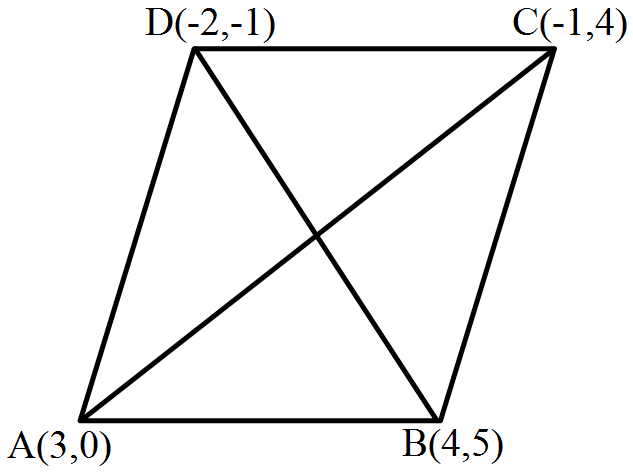
Let $A(3,0), B(4,5) C(-1,4)$ and $D(-2,-1)$ be the angular points of a quadrilateral $A B C D$. Join $A C$ and $B D$.
Now,
$\text{AB}=\sqrt{(4-3)^2+(5-0)^2}$
$=\sqrt{(1)^2+(5)^2}$
$=\sqrt{1+25}=\sqrt{26}\text{ units}$
$\text{BC}=\sqrt{(-1-4)^2+(4-5)^2}$
$=\sqrt{(-5)^2+(1)^2}$
$=\sqrt{25+1}=\sqrt{26}\text{ units}$
$\text{CD}=\sqrt{(-2+1)^2+(-1-4)^2}$
$=\sqrt{(-1)^2+(-5)^2}$
$=\sqrt{1+25}=\sqrt{26}\text{ units}$
$\text{DA}=\sqrt{(3+2)^2+(0+1)^2}$
$=\sqrt{(-7)^2+(2)^2}$
$=\sqrt{25+1}=\sqrt{26}\text{ units}$
$\therefore\text{AB}=\text{BC}=\text{CD}=\text{DA}=\sqrt{26}\text{ units}$
$\text{Diag}.\text{AC}=\sqrt{(-1-3)^2+(4-0)^2}$
$=\sqrt{(-4)^2+(4)^2}$
$=\sqrt{16+16}$
$=\sqrt{32}=4\sqrt{2}\text{ units}$
$\text{Diag}.\text{BD}=\sqrt{(-2-4)^2+(-1-5)^2}$
$=\sqrt{(-6)^2+(6)^2}$
$=\sqrt{36+36}$
$=\sqrt{72}=6\sqrt{2}\text{ units}$
$\therefore\text{Diag}.\text{AC}\not=\text{Diag}.\text{BD}$
Thus, $ABCD$ is a quadrilateral having all sides equal but diagonals are unequal.
$\therefore\text{ABCD}$ is a rhombus but not a square.
$\therefore\text{Area of rhombus ABCD}$ $=\frac{1}{2}\times\text{product of its diagonals}.$
$=\Big(\frac{1}{2}\times\text{AC}\times\text{BD}\Big)$
$=\Big(\frac{1}{2}\times4\sqrt{2}\times6\sqrt{2}\Big)$
$=24\text{ sq.units}$ View full question & answer→Question 264 Marks
If the point $\text{P}\Big(\frac{1}{2},\text{y}\Big)$ lies on the line segment joining the points $A(3, -5)$ and $B(-7, 9)$ then find the ratio in which $P$ divides $AB$. Also, find the value of $y.$
AnswerLet the point $\text{P}\Big(\frac{1}{2},\text{y}\Big)$ divides the line segment joining the points $A(3, -5)$ and $B(-7, 9)$ in the ratio $k : 1.$
Then, by section formula,
Coordinates of P $=\Big(\frac{\text{k}\times(-7)+1\times3}{\text{l}+1},\frac{\text{k}\times9+1\times(-5)}{\text{k}+1}\Big)$
$=\Big(\frac{-7\text{k}+3}{\text{k}+1},\frac{\text{k}\times9+1\times(-5)}{\text{k}+1}\Big)$
$=\Big(\frac{-7\text{k}+3}{\text{k}+1},\frac{9\text{k}-5}{\text{k}+1}\Big)$
Given, coordinates of P $=\Big(\frac{1}{2},\text{y}\Big)$
$\therefore\ \frac{-7\text{k}+3}{\text{k}+1}=\frac{1}{2}$
$\Rightarrow\ -14\text{k}+6=\text{k}+1$
$\Rightarrow\ 15\text{k}=5$
$\Rightarrow\ \text{k}=\frac{1}{3}$
So, the required ratio is $1 : 3.$
Also,
$\Rightarrow\ \frac{9\text{k}-5}{\text{k}+1}=\text{y}$
$\Rightarrow\ \frac{9\times\frac{1}{3}-5}{\frac{1}{3}+1}=\text{y}$
$\Rightarrow\ \frac{3-5}{\frac{4}{3}}=\text{y}$
$\Rightarrow\ \text{y}=\frac{-6}{4}=\frac{-3}{2}$
View full question & answer→Question 274 Marks
For what value of $y$ are the points $P(1,4), Q(3, y)$ and $R(-3,16)$ are collinear.
AnswerLet $P(1, 4) = Q(3, y) $ and $R(-3, 16)$ are the given points. then,
$\left(x_1=1, y_1=4\right),\left(x_2=3, y_2=y\right) \text { and }\left(x_3=-3, y_3=16\right)$
$\text { It is given that the points } A, B \text { and } C \text { are collinear. therefore, }$
$x_1\left(y_2-y_3\right)+x_2\left(y_3-y_1\right)+x_3\left(y_1-y_2\right)=0$
$⇒ 1(y - 16) + 3(16 - 4) + (-3) + (4 - y) = 0$
$⇒ 1(y - 16) + 3(12) - 3(4 - y) = 0$
$⇒ y - 16 + 36 - 12 + 3y = 0$
$⇒ 8 + 4y = 0$
$⇒ 4y = -8$
$\Rightarrow\text{y}=\frac{-8}{4}=-2$
when $y = -2,$ the given points are collinear.
View full question & answer→Question 284 Marks
Find the distance between of the following points from the origin:
$B(-5, 5)$
AnswerThe gven point is $A(-5, 5)$ and let $O(0, 0)$ be the origin
Then, $\text{BO}=\sqrt{(-5-0)^2+(5-0)^2}$
$=\sqrt{5^2+(-5)^2}$
$=\sqrt{25+25}$
$=\sqrt{50}=5\sqrt2\text{ units}.$
View full question & answer→Question 294 Marks
Find the area of the triangle formed by joining the midpoint of the sides of the triangle whose vertices are $A(2, 1), B(4, 3)$ and $C(2, 5).$
AnswerThe vertices of the teriangle are $A (2, 1), B (4, 3)$ and $C (2, 5).$
Coordinates of midpoint of $(A B=P x_1, y_1 )\Big(\frac{2+4}{2},\frac{1+3}{2}\Big)=(3,\ 2)$
Coordinates of midpoint of $B C=Q (x_2, y_2)=\Big(\frac{4+2}{2},\frac{3+5}{2}\Big)=(3,\ 4)$
Coordinates of midpoint of $A C=R (x_3, y_3)=\Big(\frac{2+2}{2},\frac{1,+5}{2}\Big)=(3,\ 2)$
Area of $\triangle\text{PQR}=\frac{1}{2}[\text{x}_1(\text{y}_2-\text{y}_3)+\text{x}_2(\text{y}_3-\text{y}_1)+\text{x}_3(\text{y}_1-\text{y}_2)]$
$=\frac{1}{2}[3(4-3)+3(3-2)+2(2-4)$
$=\frac{1}{2}[3+3-4]$
$=1 \text{sq.units}$
Hence, the area of the required triangle is 1sq. unit.
View full question & answer→Question 304 Marks
Show that the points $A(3, 1), B(0, -2), C(1, 1)$ and $D(4, 4)$ are the vertices of a parallelogram $ABCD.$
AnswerLet $A(3,1), B(0,-2), C(1,1)$ and $D(4,4)$ be the vertices of quadrilateral join $A C, B D . A C$ and $B D$, intersect other at the point $O$.
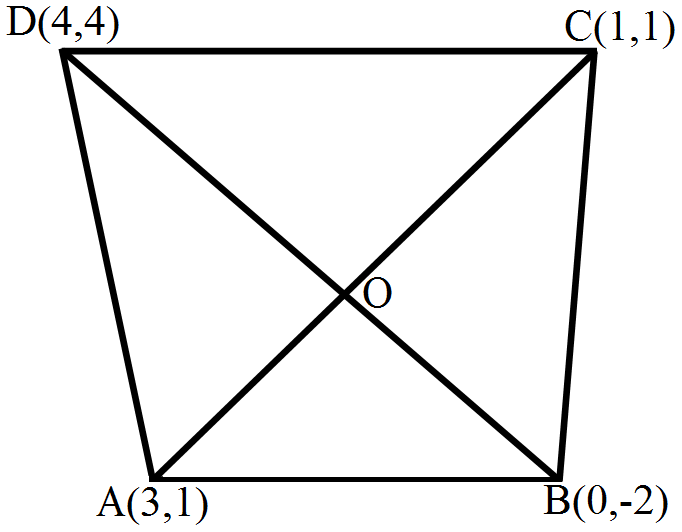
We know that the diagonal of a parallelogram bisect each other.
Therefore, $O$ is mid-point of $AC$ as well as that of $BD.$
Now mid-point of $AC$ is $\Big(\frac{3+1}{2},\frac{1+1}{2}\Big)\text{i.e},(2,1)$
And mid-point of $BD$ is $\Big(\frac{0+4}{2},\frac{-2+4}{2}\Big)\text{i.e},(2,1)$
Mid-point of $AC$ is the same as mid-point of $BD.$
Hence, $A, B, C, D$ are the vertices of a parallelogram $ABCD.$ View full question & answer→Question 314 Marks
Show that the following points are the vertices of a square:
$P(0, -2), Q(3, 1), R(0, 4)$ and $S(-3, 1)$
AnswerLet $P(0, -2), Q(3, 1) R(0, 4)$ and $S(-3, 1)$ be the angular points of quad. $PQRS.$
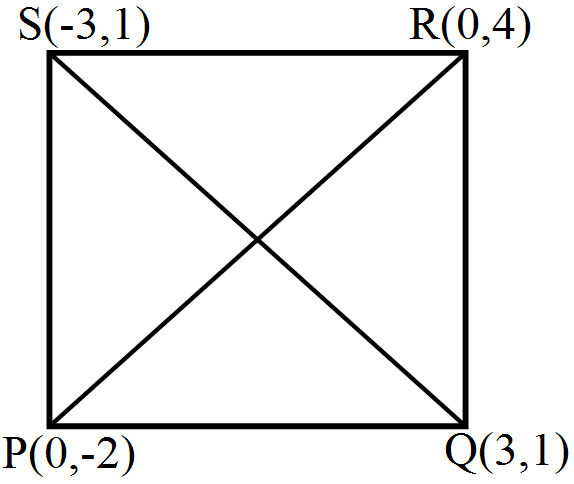
Join $PR$ and $QSD$
Now,
$\text{PQ}=\sqrt{(3-0)^2+(1+2)^2}$
$=\sqrt{(3)^2+(3)^2}$
$=\sqrt{9+9}=\sqrt{18}=3\sqrt{2}\text{ units}$
$\text{QR}=\sqrt{(0-3)^2+(4-1)^2}$
$=\sqrt{(-3)^2+(3)^2}$
$=\sqrt{9+9}=\sqrt{18}=3\sqrt{2}\text{ units}$
$\text{RS}=\sqrt{(-3-0)^2+(1-4)^2}$
$=\sqrt{(-3)^2+(-3)^2}$
$=\sqrt{9+9}=\sqrt{18}=3\sqrt{2}\text{ units}$
$\text{SP}=\sqrt{(0+3)^2+(-2-1)^2}$
$=\sqrt{(3)^2+(-3)^2}$
$=\sqrt{9+9}=\sqrt{18}=3\sqrt{2}\text{ units}$
Thus, $\text{PQ}=\text{QR}=\text{RS}=\text{SP}$
$\text{Diag}.\text{PR}=\sqrt{(0-0)^2+(4+2)^2}$
$=\sqrt{(6)^2}=6\text{ units}$
$\text{Diag}.\text{QS}=\sqrt{(-3-3)^2+(1-1)^2}$
$=\sqrt{(-6)^2}=6\text{ units}$
$\therefore\text{Diag}.\text{PR}=\text{Diag}.\text{QS}$
Thus, $PQRS$ is a quadrilateral in which all sides are equal and the diagonals are equal
Hence, quad. $PQRS$ is a square View full question & answer→Question 324 Marks
If two adjacent vertices of a parallelogram are $(3, 2)$ and $(-1, 0)$ and the diagonals intersect at $(2, -5)$ then find the coordinates of the other two vertices.
Answer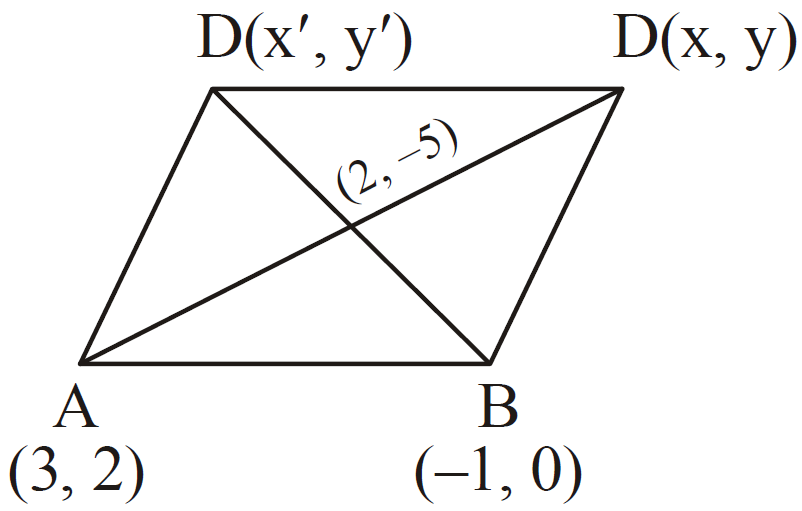
Let other two coordinates are:
$(x, y)$ and $(x', y')$
$2 = \frac{\text{x + 3}}{2}$
$\Rightarrow \text{x = 1}$
And
$-5 = \frac{2 + \text{y}}{2}$
$\text{y} = -12$
Again
$\frac{-1 +\text{x}'}{2} = 2$
$\text{x}' = 5$
And
$\frac{0 \text{ + } \text{y}'}{2} = -5$
$\text{y}' = -10$
Hence co-ordinates are $(1, –12)$ and $(5, –10).$ View full question & answer→Question 334 Marks
Find the area of $\triangle\text{ABC}$ whose vertices are:
$A(1, 2), B(-2, 3)$ and $C(-3, -4)$
Answer$A(1, 2), B(-2, 3)$ and $C(-3, -4)$ are the vertices of
Then, $\left(x_1=1, y_1=2\right),\left(x_2=-2, y_2=3\right)$ and $\left(x_3=-3, y_3=-4\right)$
Area of triangle ABC
$=\frac{1}{2}\big\{\text{x}_1(\text{y}_2-\text{y}_3)+\text{x}_2(\text{y}_3-\text{y}_1)+\text{x}_3(\text{y}_1-\text{y}_2)\big\}$
$=\frac{1}{2}\big\{1(3-(-4))+(-2))(-4-2)+(-3)(2-3)\big\}$
$=\frac{1}{2}\big\{1(3+4)-2(-6)-3(-1)\big\}$
$=\frac{1}{2}\big\{7+12+3\big\}$
$=\frac{1}{2}(22)$
$=11\ \text{sq}.\text{units}$
View full question & answer→Question 344 Marks
Show that the following points are the vertices of a square: $A(6,2), B(2,1), C(1,5)$ and $D(5,6)$
AnswerLet $A(6,2), B(2,1) C(1,5)$ and $D(5,6)$ be the angular points of quad. $A B C D$. Join $A C$ and $B D$
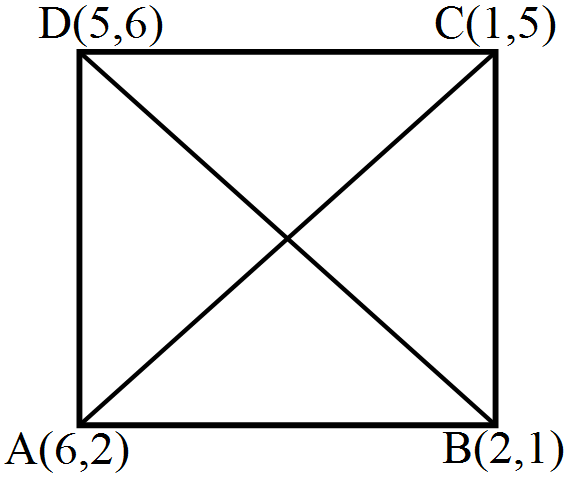
Now,
$\text{AB}=\sqrt{(2-6)^2+(1-2)^2}$
$=\sqrt{(-4)^2+(-1)^2}$
$=\sqrt{16+1}=\sqrt{17}\text{units}$
$\text{BC}=\sqrt{(1-2)^2+(5-1)^2}$
$=\sqrt{(-1)^2+(4)^2}$
$=\sqrt{1+16}=\sqrt{17}\text{units}$
$\text{CD}=\sqrt{(5-1)^2+(6-5)^2}$
$=\sqrt{(4)^2+(1)^2}$
$=\sqrt{16+1}=\sqrt{17}\text{units}$
$\text{DA}=\sqrt{(6-5)^2+(2-6)^2}$
$=\sqrt{(1)^2+(-4)^2}$
$=\sqrt{1+16}=\sqrt{17}\text{units}$
$\text{AB}=\text{BC}=\text{CD}=\text{DA}$
$\text{Diag}.\text{AC}=\sqrt{(1-6)^2+(5-2)^2}$
$=\sqrt{(-5)^2+(3)^2}$
$=\sqrt{25+9}=\sqrt{34}\text{units}$
$\text{Diag}.\text{BD}=\sqrt{(5-2)^2+(6-1)^2}$
$=\sqrt{(3)^2+(5)^2}$
$=\sqrt{9+25}=\sqrt{34}\text{units}$
$\therefore\text{Diag}.\text{AC}=\text{Diag}.\text{BD}$
Thus, all sides of quad. $ABCD$ are equal and diagonals are also equal
Quad. $ABCD$ is a square. View full question & answer→Question 354 Marks
$A(7,-3), B(5,3)$ and $C(3,-1)$ are the vertices of a $\triangle A B C$ and is its median. Prove that the median $A D$ divides $\triangle ABC$ into two triangles of equal areas.
AnswerThe vertices of the teriangle are $A (7, -3), B (5, 3)$ and $C (3, -1).$
Coordinates of D $=\Big(\frac{5+3}{2},\frac{3-3}{2}\Big)=(4,\ 1)$
For the area of the triangle ADC, let
$A\left(x_1, y_1\right)=A(7,-3), D\left(x_2, y_2\right)=D(4,1)$ and $C\left(x_3, x_4\right)=C(3,-1)$.
Then,
Area of $\triangle\text{ADC}=\frac{1}{2}[\text{x}_1(\text{y}_2-\text{y}_3)+\text{x}_2(\text{y}_3-\text{y}_1)+\text{x}_3(\text{y}_1-\text{y}_2)]$
$=\frac{1}{2}[7(1+1)+4(-1+3)+3(-3-1)$
$=\frac{1}{2}[14+8-12]$
$=5\text{sq. units}$
Now, for the area of triangle ABD, let
Area of $\triangle\text{ABC}=\frac{1}{2}[\text{x}_1(\text{y}_2-\text{y}_3)+\text{x}_2(\text{y}_3-\text{y}_1)+\text{x}_3(\text{y}_1-\text{y}_2)]$
$=\frac{1}{2}[7(3-1)+5(1+3)+4(-3-3)$
$=\frac{1}{2}[14+20-24]$
$=5\text{sq. units}$
Thus, $\text{ar}(\triangle\text{ADC})=\text{ar}(\triangle\text{ABD})=5\text{sq}.\ \text{units}.$
Hence, $AD$ divides $\triangle\text{ABC}$ into two triangles of equal areas.
View full question & answer→Question 364 Marks
Find the area of $\triangle ABC$ with vertices $A (0,-1), B (2,1)$ and $C (0,3)$. Also, find the area of the triangle formed by joining the midpoints of its sides. Show that the ratio of the areas of two triangles is $4: 1$
AnswerLet $\left.\mathrm{A}\left(\mathrm{x}_1=0\right), \mathrm{y}_1=-1\right), \mathrm{B}\left(\mathrm{x}_2=2, \mathrm{y}_2=1\right)$ and $\mathrm{C}\left(\mathrm{x}_3=0, \mathrm{y}_3=3\right)$ be the given points. then
$\text{ar}(\triangle\text{ABC})=\frac{1}{2}[\text{x}_1(\text{y}_2-\text{y}_3)+\text{x}_2(\text{y}_3-\text{y}_1)+\text{x}_3(\text{y}_1-\text{y}_2)]$
$=\frac{1}{2}[0(1-3)+2(3+1)+0(-1-1)$
$=\frac{1}{2}\times8=4\text{sq.}\ \text{units}$
So, the area of the triangle $\triangle\text{ABC}$ is 4sq. units.
Let $D\left(a_1, b_1\right), E\left(a_2, b_2\right)$, and $F\left(a_3, b_3\right)$ be the midpoint of $A B, B C$ and $A C$ respectively.Then,
$\text{a}_1=\frac{0+2}{2}=1,$ $\text{b}_1=\frac{-1+1}{2}=0$
$\text{a}_2=\frac{2+0}{2}=1,$ $\text{b}_2=\frac{1+3}{2}=2$
$\text{a}_3=\frac{0+0}{2}=0,$ $\text{b}_3=\frac{-1+3}{2}=1$
Thus, the coordinates of D, E and F are $D\left(a_1=1, b_1=0\right), E\left(a_2=1, b_2=2\right)$ and $F\left(a_3=0, b_3=1\right)$
Now,
$\text{ar}(\triangle\text{DEF})=\frac{1}{2}[\text{a}_1(\text{b}_2-\text{b}_3)+\text{a}_2(\text{b}_3-\text{b}_1)+\text{a}_3(\text{b}_1-\text{b}_2)]$
$=\frac{1}{2}[1(2-1)+1(1-0)+0(0-2)]$
$=\frac{1}{2}[1+1+1]$
$=1\text{sq.}\ \text{unit}$
So, the area of the triangle $\triangle\text{DEF}$ is 1sq. unit.
Hence, $\triangle\text{ABC}:\triangle\text{DEF}=4:1$
View full question & answer→Question 374 Marks
Using the distance formula, show taht the given points are collinear: $(6,9),(0,1)$ and $(-6,-7)$
AnswerLet $A(6,9), B(0,1)$ and $C(-6,-7)$ be the given points Then,
$\text{AB}=\sqrt{(0-6)^2+(1-9)^2}=\sqrt{(6)^2+(-8)^2}$
$=\sqrt{36+64}=\sqrt{100}=10\text{ units}$
$\text{BC}=\sqrt{(-6-0)^2+(-7-1)^2}=\sqrt{(-6)^2+(-8)^2}$
$=\sqrt{36+64}=\sqrt{100}=10\text{ units}$
$\text{AC}=\sqrt{(-6-6)^2+(-7-9)^2}=\sqrt{(-12)^2+(-16)^2}$
$=\sqrt{144+256}=\sqrt{400}=20\text{ units}$
$\therefore\text{AB}+\text{AC}=10+10=20\text{ units}=\text{BC}$
$\Rightarrow\text{AB}+\text{AC}=\text{BC}$
Hence, the given points are collinear.
View full question & answer→Question 384 Marks
Using the distance formula, show taht the given points are collinear:
$(1, -1), (5, 2)$ and $(9, 5)$
AnswerLet $A(1, -1), B(5, 2)$ and $C(9, 5)$ be the given points
Then,
$\text{AB}=\sqrt{(1-5)^2+(-1-2)^2}=\sqrt{(4)^2+(-3)^2}$
$=\sqrt{16+9}=\sqrt{25}=5\text{ units}$
$\text{BC}=\sqrt{(5-9)^2+(2-5)^2}=\sqrt{(-4)^2+(-3)^2}$
$=\sqrt{16+9}=\sqrt{25}=5\text{ units}$
$\text{AC}=\sqrt{(1-9)^2+(-1-5)^2}=\sqrt{(-8)^2+(-6)^2}$
$=\sqrt{64+36}=\sqrt{100}=10\text{ units}$
$\therefore\text{AB}+\text{AC}=5+5=10\text{ units}=\text{BC}$
$\Rightarrow\text{AB}+\text{AC}=\text{BC}$
Hence, the given points are collinear.
View full question & answer→Question 394 Marks
Show that the points $A(6, 1), B(8, 2), C(9, 4)$ and $D(7, 3)$ are the vertices of a rhombus. Find its area.
AnswerLet $A(6, 1), B(8, 2) C(9, 4)$ and $D(7, 3)$ be the angular points of quad. $ABCD$. Join $AC$ and $BD.$
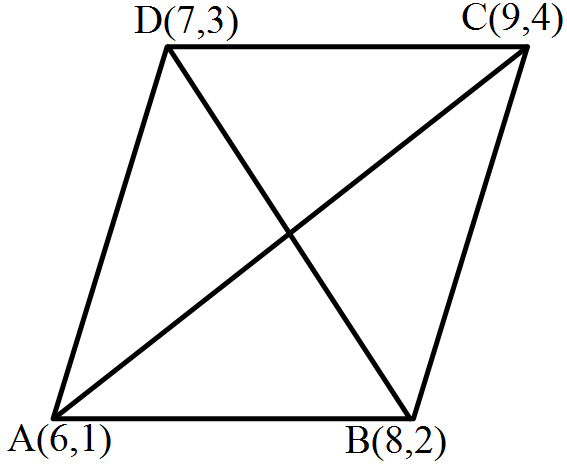
Now,
$\text{AB}=\sqrt{(8-6)^2+(2-1)^2}$
$=\sqrt{(2)^2+(1)^2}$
$=\sqrt{4+1}=\sqrt{5}\text{ units}$
$\text{BC}=\sqrt{(9-8)^2+(4-2)^2}$
$=\sqrt{(1)^2+(2)^2}$
$=\sqrt{1+4}=\sqrt{5}\text{ units}$
$\text{CD}=\sqrt{(7-9)^2+(3-4)^2}$
$=\sqrt{(-2)^2+(-1)^2}$
$=\sqrt{4+1}=\sqrt{5}\text{ units}$
$\text{DA}=\sqrt{(7-6)^2+(3-1)^2}$
$=\sqrt{(1)^2+(2)^2}$
$=\sqrt{1+4}=\sqrt{5}\text{ units}$
Thus, $\text{AB}=\text{BC}=\text{CD}=\text{DA}=\sqrt{5}\text{ units}$
$\text{Diag}.\text{AC}=\sqrt{(9-6)^2+(4-1)^2}$
$=\sqrt{(3)^2+(3)^2}$
$=\sqrt{9+9}$
$=\sqrt{18}=3\sqrt{2}\text{ units}$
$\text{Diag}.\text{BD}=\sqrt{(7-8)^2+(3-2)^2}$
$=\sqrt{(-1)^2+(1)^2}$
$=\sqrt{1+1}$
$=\sqrt{2}\text{ units}$
$\therefore\text{Diag}.\text{AC}\not=\text{Diag}.\text{BD}$
Thus, $ABCD$ is a quadrilateral having all sides equal but diagonals are unequal.
Hence, $ABCD$ is a rhombus.
$\text{Area of rhombus ABCD}$ $=\frac{1}{2}\times\text{product of its diagonals}.$
$=\Big(\frac{1}{2}\times\text{AC}\times\text{BD}\Big)$
$=\Big(\frac{1}{2}\times3\sqrt{2}\times\sqrt{2}\Big)$
$=3\text{ sq.units}$ View full question & answer→Question 404 Marks
Using the distance formula, show taht the given points are collinear: $(-2,5),(0,1)$ and $(2,-3)$.
AnswerLet $A(-2,5), B(0,1)$ and $C(2,-3)$ be the given points Then,
$\text{AB}=\sqrt{(0-2)^2+(1-5)^2}=\sqrt{(2)^2+(-4)^2}$
$=\sqrt{4+16}=\sqrt{20}=2\sqrt{5}\text{ units}$
$\text{BC}=\sqrt{(2+0)^2+(-3-1)^2}=\sqrt{(2)^2+(-4)^2}$
$=\sqrt{4+16}=\sqrt{20}=2\sqrt{5}\text{ units}$
$\text{AC}=\sqrt{(2+2)^2+(-3-5)^2}=\sqrt{(4)^2+(-8)^2}$
$=\sqrt{16+64}=\sqrt{80}=4\sqrt{5}\text{ units}$
$\therefore\text{AB}+\text{AC}=2\sqrt{5}+2\sqrt{5}=4\sqrt{5}\text{ units}=\text{BC}$
$\Rightarrow\text{AB}+\text{AC}=\text{BC}$
Hence, the given points are collinear.
View full question & answer→Question 414 Marks
In what ratio is the line segments joining $A(2,-3)$ and $B(5,6)$ divided by the $x$-axis? Also, find the coordinates of the point of divesion.
AnswerLet the $x$-axis cut the join of $A(2,-3)$ and $B(5,6)$ in the ratio $k: 1$, at the point $P$.
Then, by the section forfmula, the coordinates of P are $\left(\frac{5 k+2}{k+1}, \frac{6 k-3}{k+1}\right)$
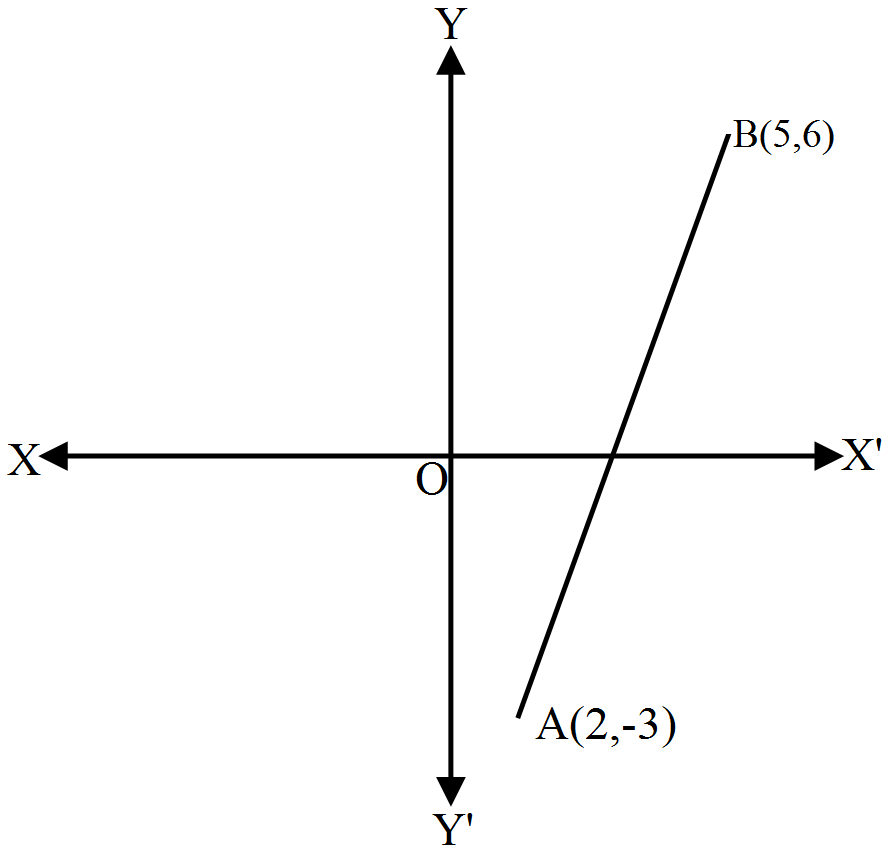
But P lies on the x-axis so, its ordinate must be $0.$
$\therefore\ \frac{6\text{k}-3}{\text{k}+1}=0$
$\Rightarrow\ 6\text{k}-3=0,\text{k}=\frac{1}{2}$
So the required ratio $1 : 2$
Thus the x-axis divides AB in the ratio $1 : 2$
Putting $\text{k}=\frac{1}{2}$ in $\frac{5\text{k}+2}{\text{k}+1},$ we get the point P as
$\text{P}\bigg(\frac{5\times\frac{1}{2}+2}{\frac{1}{2}+1},0\bigg)$ or $P(3, 0)$
Thus, $P$ is $(3, 0)$ and $k = 1 : 2.$ View full question & answer→Question 424 Marks
Show taht the following points are collinear:
$A(-5, 1), B(5, 5)$ and$ C(10, 7)$
AnswerLet $A\left(x_1=-5, y_1=1\right), B\left(x_2=5, y_2=5\right)$ and $C\left(x_3=10, y_3=7\right)$ be the given points.
Now
$x_1\left(y_2-y_3\right)+x_2\left(y_3-y_1\right)+x_3\left(y_1-y_2\right) $
$ =(-4)(5-7)+5(7-1)+10(1-5) $
$ =-5(-2)+5(6)+10(-4) $
$ =10+30-40 $
$ =0$
Hence the given point are collinear.
View full question & answer→Question 434 Marks
A line intersects the $y$-axis and $x$-axis at the points $P$ and $Q$ respectively. If $(2, -5)$ is the midpoint Of $PQ$ then find the coordinates of $P$ and $Q.$
AnswerThe mid-point of the line segment joining the points $P\left(x_1, y_1\right)$ and $Q\left(x_2, y_2\right)$ is $\Big(\frac{\text{x}_1+\text{x}_2}{2},\frac{\text{y}_1+\text{y}_2}{2}\Big)$
Let the coordinates of the point $P$ and $Q$ be $(0, b)$ and $(a, 0)$ respectively.
Mid point is $\Big(\frac{0+\text{a}}{2},\frac{\text{b}+0}{2}\Big)=\Big(\frac{\text{a}}{2},\frac{\text{b}}{2}\Big)$
Compare it with the given mid-point $(2, -5).$
$\frac{\text{a}}{2}=2,\frac{\text{b}}{2}=-5$
$\text{a}=4,\text{b}=-4$
Coordinates $P$ and $Q$ are $(0, -10)$ and ($4, 0)$ respectively.
View full question & answer→Question 444 Marks
Show that the following points are the vertices of a rectangle:
$A(0, -4), B(6, 2), C(3, 5)$ and $D(-3, -1)$
AnswerLet $A(0, -4), B(6, 2), C(3, 5)$ and $D(-3, -1)$ are the vertices of quad. $ABCD.$
Then,
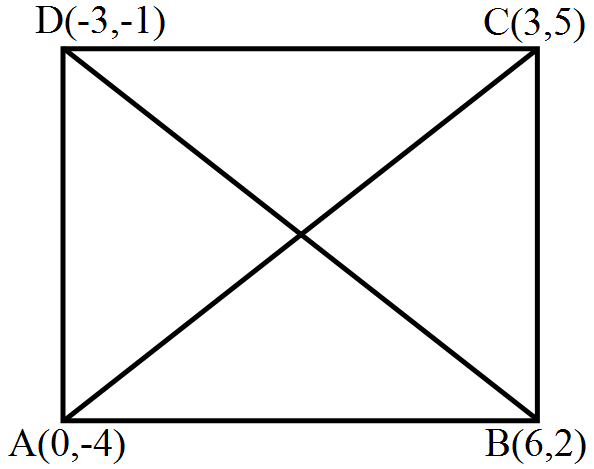
$\text{AB}=\sqrt{(6-0)^2+(2+4)^2}$
$=\sqrt{(6)^2+(6)^2}$
$=\sqrt{36+36}=\sqrt{72}=6\sqrt{2}\text{ units}$
$\text{BC}=\sqrt{(3-6)^2+(5-2)^2}$
$=\sqrt{(-3)^2+(3)^2}$
$=\sqrt{9+9}=\sqrt{18}=3\sqrt{2}\text{ units}$
$\text{DC}=\sqrt{(-3-3)^2+(-1-5)^2}$
$=\sqrt{(-6)^2+(-6)^2}$
$=\sqrt{36+36}=\sqrt{72}=6\sqrt{2}\text{ units}$
$\text{AD}=\sqrt{(-3-0)^2+(-1+4)^2}$
$=\sqrt{(-3)^2+(3)^2}$
$=\sqrt{9+9}=\sqrt{18}=3\sqrt{2}\text{ units}$
Thus, $\text{AB}=\text{DC}$ and $\text{AD}=\text{BC}$
$\text{Diag}.\text{AC}=\sqrt{(3-0)^2+(5+4)^2}$
$=\sqrt{(3)^2+(9)^2}$
$=\sqrt{9+81}$
$=\sqrt{90}=3\sqrt{10}\text{ units}$
$\text{Diag}.\text{BD}=\sqrt{(-3-6)^2+(-1-2)^2}$
$=\sqrt{(-9)^2+(-3)^2}$
$=\sqrt{81+9}$
$=\sqrt{90}=3\sqrt{10}\text{ units}$
Thus, $ABCD$ is a quadrilateral whose opposite sides are equal and the diagonals are equal.
Hence, quad. $ABCD$ is a rectangle. View full question & answer→Question 454 Marks
The base $BC$ of an equilateral triangle $ABC$ lies on y-axis. The coordinates of the point $C$ are $(0, -3)$. The origin is the midpoint of the base. Find the coordinates of the points $A$ and $B$. Also, find the coordinates of another points $D$ such that $ABCD$ is a rhombus.
Answer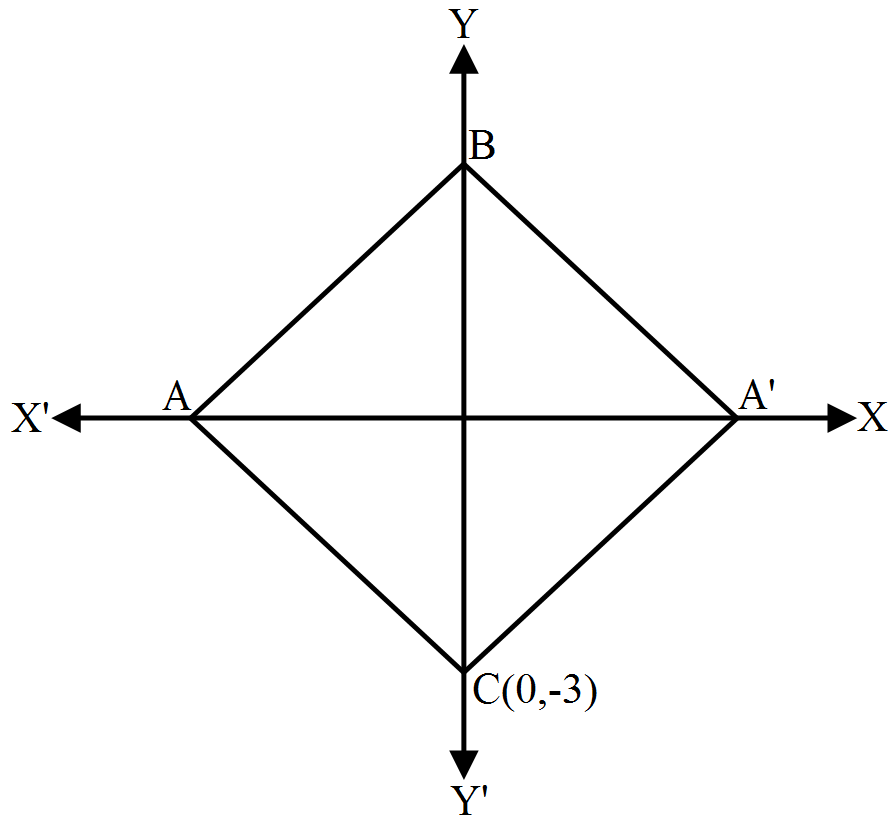
The base BC of an equilateral triangle $ABC$ lies on y-axis and $O$ is the mid-point of base $BC.$
$\Rightarrow OC = OB = 3$ units
$\therefore$ Coordinates of $B$ are $(0, 3).$
Since OX is perpendicular to BC and altitude of equilater triangle passes throught the opposite vertex $A, A$ lies on x-axis.
Let the coordinates of $A$ be $(x, 0).$
Since $AB = BC$, we have
$\sqrt{(\text{x}-0)^2+(0-3)^2}=\sqrt{(0-0)^2+(3+3)^2}$
$\Rightarrow\ \sqrt{\text{x}^2+9}=\sqrt{36}$
$\Rightarrow\ \text{x}^2+9=36$
$\Rightarrow\ \text{x}^2=27$
$\Rightarrow\ \text{x}=\pm3\sqrt{3}$
$\therefore$ Coordinates A are $(3\sqrt{3},0)$ or $(-3\sqrt{3},0)$
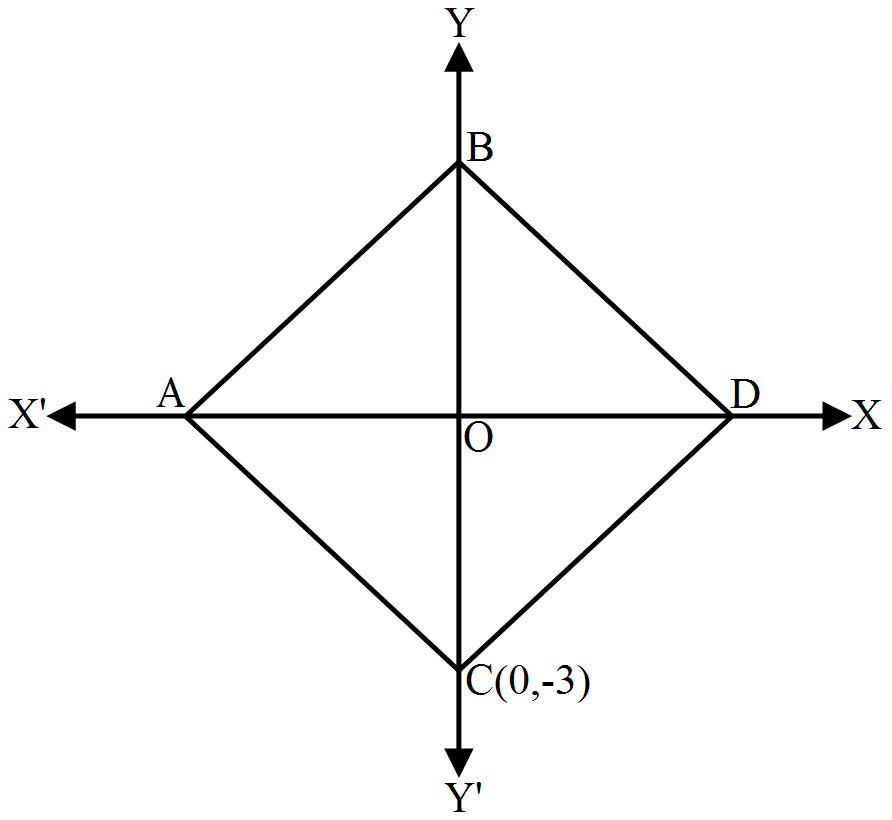
Since $ABCD$ is a rhombus,
$\Rightarrow$ Coordinates of $D =(3\sqrt{3},0)$ View full question & answer→Question 464 Marks
If the points $A(4, 3)$ and $B(x, 5)$ lie on the circle with centre $O(2, 3),$ find the value of $x.$
AnswerThe given points $A(4, 3)$ and $B(x, 5)$ lie on the circle with centre $O(2, 3).$
Then, $OA = OB$
$\Rightarrow\ \sqrt{(\text{x}-2)^2+(5-3)^2}=\sqrt{(4-2)^2+(3-3)^2}$
$ \Rightarrow(x-2)^2+2^2=2^2+0^2 $
$ \Rightarrow(x-2)^2=\left(2^2-2^2\right) $
$ \Rightarrow(x-2)^2=0 $
$ \Rightarrow x-2=0 $
$ \Rightarrow x=2$
Hence, the value of $x = 2.$
View full question & answer→Question 474 Marks
Prove that the point $A(2, 4), B(2, 6)$ and $\text{C}(2+\sqrt{3},5)$ are the vertices of an equilateral triangle.
AnswerGiven: A(2, 4), B(2, 6) and $\text{C}(2+\sqrt{3},5)$
$\text{AB}=\sqrt{(2-2)^2+(6-4)^2}$
$=\sqrt{0+2}=\sqrt{4}=2\text{ units}$
$\text{BC}=\sqrt{(2+\sqrt{3}-2)^2+(5-6)^2}$
$=\sqrt{(\sqrt{3})^2+(-1)^2}$
$=\sqrt{3+1}=\sqrt{4}=2\text{ units}$
$\text{AC}=\sqrt{(2+\sqrt{3}-2)^2+(5-4)^2}$
$=\sqrt{(\sqrt{3})^2+(1)^2}$
$=\sqrt{3+1}=\sqrt{4}=2\text{ units}$
We find that $AB = BC = AC$
Hence, the given points are the vertices of an equilateral triangle.
View full question & answer→Question 484 Marks
Show that $\triangle\text{ABC},$ with vertices $A(-2, 0), B(0, 2)$ and $C(2, 0)$ is similar to $\triangle\text{DEF}$ with vertices $D(-4, 0), F(4, 0)$ and $E(0, 4).$
Answer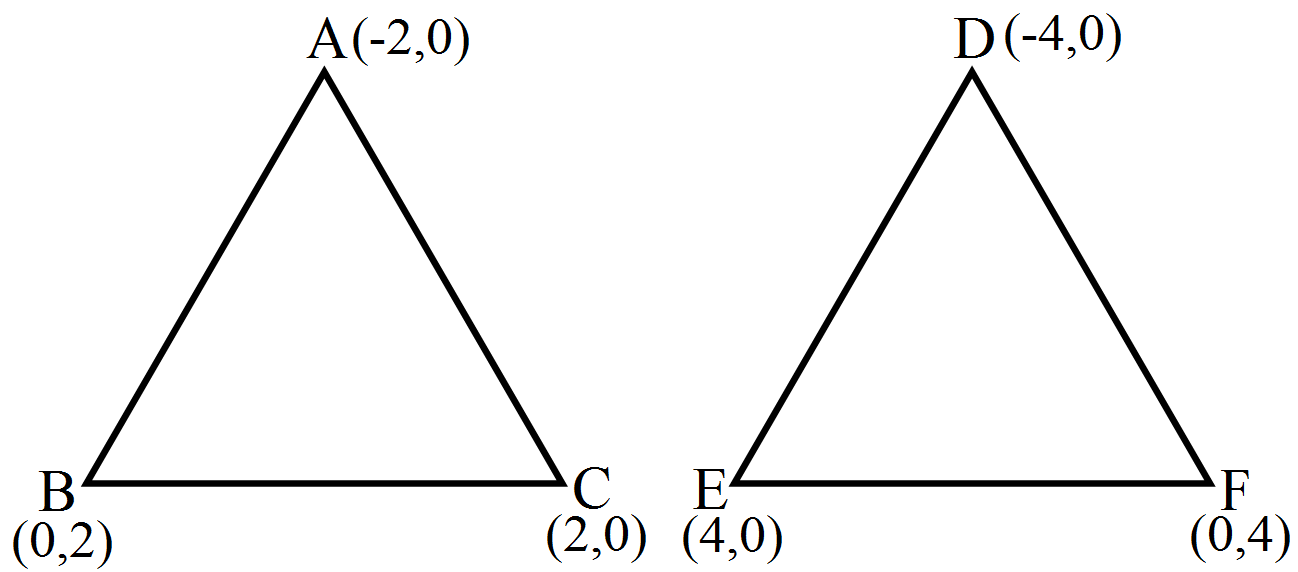
Using Distance formula
$\text{AB}=\sqrt{(0+2)^2+(2-0)^2}$
$=\sqrt{(2)^2+(2)^2}$
$=\sqrt{4+4}=\sqrt{8}=2\sqrt{2}\text{ units}$
$\text{BC}=\sqrt{(2-0)^2+(0-2)^2}$
$=\sqrt{(2)^2+(2)^2}$
$=\sqrt{4+4}=\sqrt{8}=2\sqrt{2}\text{ units}$
$\text{CA}=\sqrt{(-2-2)^2+(0-0)^2}$
$=\sqrt{(-4)^2+(0)^2}$
$=\sqrt{16+0}=\sqrt{16}=4\text{ units}$
$\text{DE}=\sqrt{(4+0)^2+(4-0)^2}$
$=\sqrt{(4)^2+(4)^2}$
$=\sqrt{16+16}=\sqrt{32}=4\sqrt{2}\text{ units}$
$\text{EF}=\sqrt{(4-0)^2+(0-4)^2}$
$=\sqrt{16+16}=\sqrt{32}=4\sqrt{2}\text{ units}$
$\text{FD}=\sqrt{(-4-4)^2+(0-0)^2}$
$=\sqrt{64+0}=\sqrt{64}=8\text{ units}$
i.e. $\frac{\text{AB}}{\text{DE}}=\frac{\text{BC}}{\text{EF}}=\frac{\text{AC}}{\text{DF}}$
$=\frac{2\sqrt{2}}{4\sqrt{2}}=\frac{2\sqrt{2}}{4\sqrt{2}}=\frac{4}{8}=\frac{1}{2}$ View full question & answer→Question 494 Marks
If the point $A(0, 2)$ is equidistance from the points $B(3, p)$ and $C(p, 5)$, find the value of $p$. Also, find the length of $AB.$
AnswerIt is being given that $A(0, 2)$ is equidistance from the points $B(3, p)$ and $C(p, 5)$
Thus, we have
$ A B=A C $
$ \Rightarrow A B^2=A C^2 $
$ \Rightarrow(0-3)^2+(2-p)^2=(0-p)^2+(2-5)^2 $
$ \Rightarrow(-3)^2+\left(4+p^2-4 p\right)^2=(-p)^2+(-3)^2 $
$ \Rightarrow 9+4+p^2-4 p=p^2+9 $
$ \Rightarrow 4 p=4 $
$ \Rightarrow p=1$
$\therefore\text{AB}=\sqrt{(0-3)^2+(2-1)^2}=\sqrt{(-3)^2+(1)^2}$
$=\sqrt{9+1}=\sqrt{10}$
$\Rightarrow\text{AB}=\sqrt{10}\text{ units}.$
View full question & answer→Question 504 Marks
Show that points $A(-5,6), B(3,0)$ and $C(9,8)$ are the vertices of an isosceles right-angled triangle. Calculate its area.
AnswerLet $A(-5,6), B(3,0)$ and $C(9,8)$ be the given points. Then
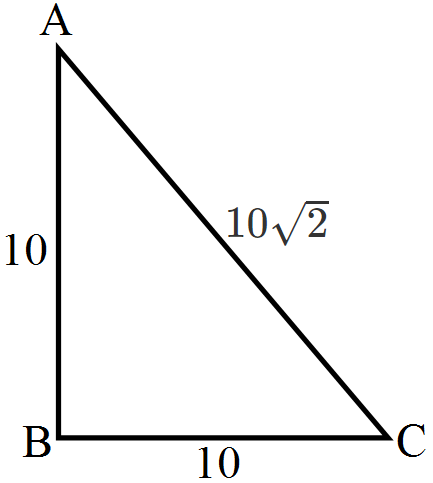
$\text{AB}=\sqrt{(3+5)^2+(0-6)^2}$
$=\sqrt{(8)^2+(-6)^2}=\sqrt{100}=10\text{ units}$
$\text{BC}=\sqrt{(9+5)^2+(8-0)^2}$
$=\sqrt{(6)^2+(8)^2}=\sqrt{100}=10\text{ units}$
$\text{AC}=\sqrt{(9+5)^2+(8-6)^2}$
$=\sqrt{(14)^2+(2)^2}=\sqrt{200}=10\sqrt{2}\text{ units}$
Thus, AB = BC = 10 units
$\therefore\triangle\text{ABC}$ is isosceeles
This show that $\triangle\text{ABC}$ is a right angled at $B$
In $\triangle\text{ABC},$ we have
Area of $\triangle\text{ABC}=\Big(\frac{1}{2}\times\text{base}\times\text{height}\Big)$
$=\Big(\frac{1}{2}\times\text{10}\times\text{10}\Big)\text{sq.unit}$
$=50\text{ sq.unit}$ View full question & answer→