Question 12 Marks
What is the distance between the points $A(c, 0)$ and $B(0, -c)?$
AnswerDistance between $A(c, 0)$ and $B(0, -c)$
$=\sqrt{(\text{x}_2-\text{x}_1)^2+(\text{y}_2-\text{y}_1)^2}$
$=\sqrt{(0-\text{c})^2+(-\text{c}-0)^2}$
$=\sqrt{\text{c}^2+\text{c}^2}=\sqrt{2\text{c}^2}=\sqrt{2}\text{c}$
View full question & answer→Question 22 Marks
Find the value of a so that the point $(3, a)$ lies on the line represented by $2x - 3y + 5 = 0$
AnswerIf a point $(x_1, y_1)$ is said lie on a line represented by $ax + by + c= 0,$ then the given equation of the line should hold true when the values of the co-ordinates of the points are substituted in it.
Here it is said that the point $(3, a)$ lies on the line represented by the equation $2x - 3y + 5 = 0.$
Substituting the co-ordinates of the values in the equation of the line we have,
$2x - 3y + 5 = 0$
$2(3) - 3(a) + 5 = 0$
$3a = 6 + 5$
$3a = 11$
$\text{a}=\frac{11}{3}$
Thus the value of ‘a’ satisfying the given conditions is $\text{a}=\frac{11}{3}.$
View full question & answer→Question 32 Marks
On which axis do the following points lie$?$
$S(0, 5).$
AnswerGiven that:
Point $S(0, 5)$
we have,
$x = 0, y = 5$
Here, $x = 0, y = 5$, then the points lies on the $Y-$axis.
View full question & answer→Question 42 Marks
Find the distance between the points $\Big(\frac{-8}{5},2\Big)$ and $\Big(\frac{2}{5},2\Big).$
AnswerDistance between the points $\Big(\frac{-8}{5},2\Big)$ and $\Big(\frac{2}{5},2\Big)$
$=\sqrt{(\text{x}_2-\text{x}_1)^2+(\text{y}_2-\text{y}_1)^2}$
$=\sqrt{\Big[\frac{2}{5}-\frac{(-8)}{5}\Big]^2+(2-2)^2}$
$=\sqrt{\Big(\frac{2}{5}+\frac{8}{5}\Big)^2+(0)^2}=\sqrt{\Big(\frac{10}{5}\Big)^2+0}$
$=\sqrt{(2)^2}=2\text{ units}$
View full question & answer→Question 52 Marks
If $P(2, 6)$ is the mid-point of the line segment joining $A(6, 5)$ and $B(4, y),$ find $y.$
Answer$P(2, 6)$ is the mid-point of the line segment $A(6, 5)$ and $B(4, y).$
$\therefore\ 6=\frac{\text{y}_1+\text{y}_2}{2}=\frac{5+\text{y}}{2}$
$⇒ 5 + y = 12$
$⇒ y = 12 - 5 = 7$
View full question & answer→Question 62 Marks
Find the centroid of the triangle whose vertices are:
$(-2, 3) (2, -1) (4, 0).$
AnswerThe coordinates of the centroid of a triangle whose vertices are $(-2, 3) (2, -1) (4, 0)$ are,
$=\Big(\frac{2-2+4}{3},\frac{3-1+0}{3}\Big)$
$=\Big(\frac{4}{3},\frac{2}{3}\Big)$
View full question & answer→Question 72 Marks
What is the distance between the points $(5\sin60^\circ,0)$ and $(0,5\sin30^\circ)?$
AnswerDistance between the given points,
$=\sqrt{(\text{x}_2-\text{x}_1)^2+(\text{y}_2-\text{y}_1)^2}$
$=\sqrt{(0-5\sin60^\circ)^2+(5\sin30^\circ-0)^2}$
$=\sqrt{\Big(-5\times\frac{\sqrt{3}}{2}\Big)^2+\Big[5\Big(\frac{1}{2}\Big)\Big]^2}$
$\begin{Bmatrix}\because\ \sin60^\circ=\frac{\sqrt{3}}{2}\\\ \ \ \ \ \sin30^\circ=\frac{1}{2}\end{Bmatrix}$
$=\sqrt{\frac{25\times3}{4}+\frac{25\times1}{4}}$
$=\sqrt{\frac{75}{4}+\frac{25}{4}}=\sqrt{\frac{100}{4}}$
$=\sqrt{25}=5\text{ units}$
View full question & answer→Question 82 Marks
Find the values of $x$ for which the distance between the point $P(2, -3)$, and $Q(x, 5)$ is $10.$
AnswerIt is given that distance between $P(2, -3)$ and $Q(x, 5)$ is $10.$
In general, the distance between $A\left(x_1, y_1\right)$ and $B\left(x_2, y_2\right)$ is given by,
$A B^2=\left(x_2-x_1\right)^2+\left(y_2-y_1\right)^2$
So,
$10^2=(x-2)^2+(5+3)^2$
On further simplification,
$(x-2)^2=36$
$\text{x}=2\pm6$
$= 8, -4$
View full question & answer→Question 92 Marks
$A(4, 2), B(6, 5)$ and $C(1, 4)$ are the vertices of $ΔABC.$
The median from $A$ meets $BC$ in $D$. Find the coordinates of the point $D.$
Answer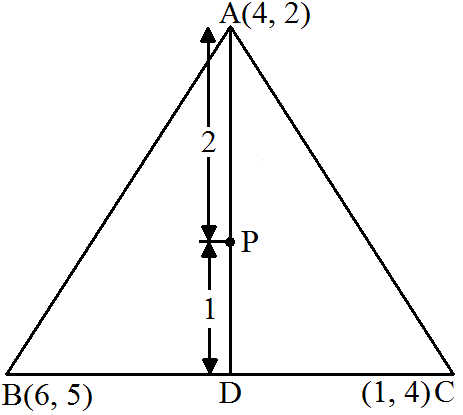
Median $AD$ of the triangle will divide the side $BC$ in two equals parts. So $D$ is the midpoint of side $BC.$
Coordinates of $\text{D}=\Big(\frac{6+1}{2},\frac{5+4}{2}\Big)$
$=\Big(\frac{7}{2},\frac{9}{2}\Big)$ View full question & answer→Question 102 Marks
If the distance between points $(x, 0)$ and $(0, 3)$ is 5, what are the values of $x?$
AnswerWe have to find the unknown $x$ using the distance between $A(x, 0)$ and $B(0, 3)$ which is $5.$ In general, the distance between $\mathrm{A}\left(\mathrm{x}_1, \mathrm{y}_1\right)$ and $\mathrm{B}\left(\mathrm{x}_2, \mathrm{y}_2\right)$ is given by,
$\text{AB}=\sqrt{(\text{x}_2-\text{x}_1)^2+(\text{y}_2-\text{y}_1)^2}$
So,
$5=\sqrt{(\text{x}-0)^2+(0-3)^2}$
Squaring both the sides we get,
$\text{x}^2-16=0$
So,
$\text{x}=\pm4$
View full question & answer→Question 112 Marks
Write the ratio in which the line segment joining the points $A(3, -6)$ and $B(5, 3)$ is divided by $x-$axis.
AnswerThe point lies on $x-$axis.
Its ordinate will be $= 0$
Let the point $P(x, 0)$ divides the line segment joining the points $A(3, -6)$ and $B(5, 3)$ in the ratio $m : n.$
$\therefore\ 0=\frac{\text{my}_2+\text{my}_1}{\text{m}+\text{n}}\Rightarrow\ 0=\frac{\text{m}\times3+\text{n}(-6)}{\text{m}+\text{n}}$
$⇒ 3m - 6n = 0 ⇒ 3m = 6n$
$\Rightarrow\ \frac{\text{m}}{\text{n}}=\frac{6}{3}=\frac{2}{1}$
$\therefore$ Ratio $= 2 : 1$
View full question & answer→Question 122 Marks
The points $A\left(x_1, y_1\right), B\left(x_2, y_2\right)$ and $C\left(x_3, y_3\right)$ are the vertices of $∆ABC.$
What are the coordinates of the centroid of the triangle $ABC?$
AnswerThe points $P, Q$ and $R$ coincides and is the centroid of the triangle $ABC.$
So, coordinates of the centroid is $\Big(\frac{\text{x}_1+\text{x}_2+\text{x}_3}{3},\frac{\text{y}_1+\text{y}_2+\text{y}_3}{3}\Big).$
View full question & answer→Question 132 Marks
On which axis do the following points lie$?$
$P(5, 0).$
AnswerGiven that:
Point $P(5, 0)$
we have
$x = 5, y = 0$
Here, $y = 0, \text{x}\neq0$ then the points lies on the $X-$axis.
View full question & answer→Question 142 Marks
The points $A\left(x_1, y_1\right), B\left(x_2, y_2\right)$ and $C\left(x_3, y_3\right)$ are the vertices of $∆ABC.$
The median from $A$ meets $BC$ at $D$. Find the coordinates of the point $D.$
AnswerMedian $AD$ of the triangle will divide the side $BC$ in two equal parts.
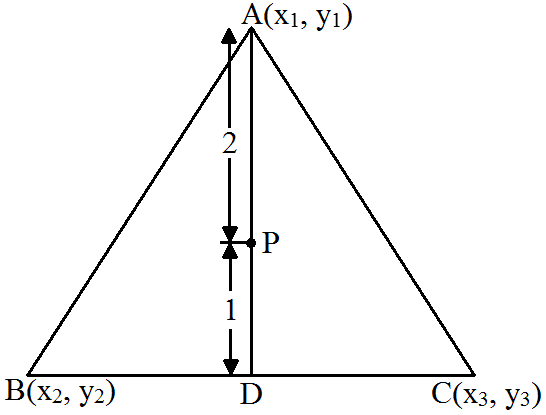
Therefore, $D$ is the midpoint of side $BC.$
Coordinates of $D$ are,
$\Big(\frac{\text{x}_2+\text{x}_3}{2},\frac{\text{y}_2+\text{y}_3}{2}\Big)$ View full question & answer→Question 152 Marks
Write the condition of collinearity of points $\left(x_1, y_1\right),\left(x_2, y_2\right)$ and $\left(x_3, y_3\right)$..
AnswerThree points $\left(x_1, y_1\right),\left(x_2, y_2\right)$ and $\left(x_3, y_3\right)$.. are said to be collinear if the area of the triangle formed by these point $= 0$ i.e.,
$\frac{1}{2}[\text{x}_1(\text{y}_2-\text{y}_3)+\text{x}_2(\text{y}_3-\text{y}_1)+\text{x}_3(\text{y}_1-\text{y}_2)]=0$
$\Rightarrow\ \text{x}_1(\text{y}_2-\text{y}_3)+\text{x}_2(\text{y}_3-\text{y}_1)+\text{x}_3(\text{y}_1-\text{y}_2)=0$
View full question & answer→Question 162 Marks
Find the coordinates of the point which is equidistant from the three vertices $A(2x, 0), O(0, 0)$ and $B(0, 2y)$ of $∆AOB.$
AnswerLet the coordinate of the point which is equidistant from the three vertices $O(0, 0), A(0, 2y)$ and $B(2x, 0)$ is $P(h, k).$
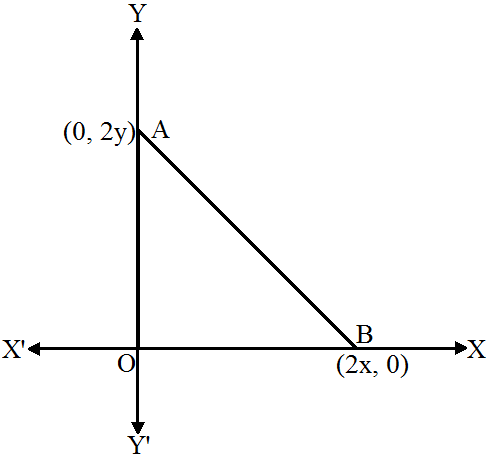
Then, $PO = PA = PB$
$⇒ (PO)^2= (PA)^2= (PB)^2......(i)$
By distance formula,
$\big[\sqrt{(\text{h}-0)^2+(\text{k}-0)^2}\big]^2$
$=\big[\sqrt{(\text{h}-0)^2+(\text{k}-2\text{y})^2}\big]^2$
$=\big[\sqrt{(\text{h}-2\text{x})^2+(\text{k}-0)^2}\big]^2$
$\Rightarrow h^2+k^2=h^2+(k-2 y)^2=(h-2 x)^2+k^2 \ldots \ldots \text { (ii) }$
Taking first two equations, we get
$ \Rightarrow h^2+k^2=h^2+(k-2 y)^2$
$ \Rightarrow k^2=k^2+4 y^2-4 y k$
$ \Rightarrow 4 y(y-k)=0$
$ \Rightarrow y=k[\because y \neq 0]$
Taking first and third equations, we get
$ h^2+k^2=(h-2 x)^2+k^2$
$\Rightarrow h^2=h^2+4 x^2-4 x h$
$⇒ 4x(x - h) = 0$
$⇒ x = h [\because\ \text{x}\neq0]$
$\therefore$ Required points $= (h, k) = (x, y)$ View full question & answer→Question 172 Marks
Find the area of the triangle with vertices $(a, b + c), (b, c + a)$ and $ (c, a + b)$
AnswerThe area $'A'$ encompassed by three points $\left(x_1, y_1\right),\left(x_2, y_2\right)$ and $\left(x_3, y_3\right)$ is given by the formula,
$\text{A}=\frac{1}{2}|\text{x}_1(\text{y}_2-\text{y}_3)+\text{x}_2(\text{y}_3-\text{y}_1)+\text{x}_3(\text{y}_1-\text{y}_2)|$
Here, three points $\left(x_1, y_1\right),\left(x_2, y_2\right)$ and $\left(x_3, y_3\right)$ are $(a, b + c), (b, c + a) and (c, a + b).$
Area is as follows:
$(a, b + c), (b, c + a)$ and $ (c, a + b)$
$\text{A}=\frac{1}{2}|\text{a}(\text{c}+\text{a}-\text{a}-\text{b})+\text{b}(\text{a}+\text{b}-\text{b}-\text{c})+\text{c(b}+\text{c}-\text{c}-\text{a})|$
$=\frac{1}{2}|\text{a(c}-\text{b})+\text{b(a}-\text{c})+\text{c(b}-\text{a})|$
$=\frac{1}{2}|\text{ac}-\text{ab}+\text{ba}-\text{bc}+\text{cb}-\text{ca}|$
$=0$
View full question & answer→Question 182 Marks
If $\text{a}\neq\text{b}\neq0,$ prove that the points $\left(a, a^2\right),\left(b, b^2\right),(0,0)$ will not be collinear.
AnswerLet $\left(a, a^2\right),\left(b, b^2\right)$ and $C(0, 0)$ be the coordinates of the given points.
We know that the area of triangle having vertices $\left(x_1, y_1\right),\left(x_2, y_2\right)$ and $\left(x_3, y_3\right)$ is $\Big|\frac{1}{2}[\text{x}_1(\text{y}_2-\text{y}_3)+\text{x}_2(\text{y}_3-\text{y}_1)+\text{x}_3(\text{y}_1-\text{y}_2)]\Big|$ square units.
So, Area of $\triangle\text{ABC}=\Big|\frac{1}{2}[\text{a}(\text{b}^2-0)+\text{b}(0-\text{a}^2)+0(\text{a}^2-\text{b}^2)]\Big|$
$=\Big|\frac{1}{2}(\text{ab}^2-\text{a}^2\text{b})\Big|$
$=\frac{1}{2}|\text{ab}(\text{b}-\text{a})|$
$\neq0\ \ (\because\ \text{a}\neq\text{b}\neq0)$
Since the area of the triangle formed by the points $\left(a, a^2\right),\left(b, b^2\right)$ and $C(0, 0)$ is not zero, so the given points are not collinear.
View full question & answer→Question 192 Marks
Write the coordinates of the point dividing line segment joining points $(2, 3)$ and $(3, 4)$ internally in the ratio $1 : 5.$
AnswerLet the coordinates of the required point be $(x, y),$ then
$\text{x}=\frac{\text{mx}_2+\text{mx}_1}{\text{m}+\text{n}}$ and $\text{y}=\frac{\text{my}_2+\text{my}_1}{\text{m}+\text{n}}$
Now, $\text{x}=\frac{1\times3+5\times2}{1+5}=\frac{3+10}{6}=\frac{13}{6}$
and $\text{y}=\frac{1\times4+5\times3}{1+5}=\frac{4+15}{6}=\frac{19}{6}$
Hence coordinates of the required point will be $\Big(\frac{13}{6},\frac{19}{6}\Big).$
View full question & answer→Question 202 Marks
Write the perimeter of the triangle formed by the points $O(0, 0), A(a, 0),$ and $B(0, b).$
AnswerThe vertices of a $∆OAB, O(0, 0), A(a, 0),$ and $B(0, b).$
Now length of $\text{OA}=\sqrt{(\text{x}_2-\text{x}_1)^2+(\text{y}_2-\text{y}_1)^2}$
$=\sqrt{(\text{a}-0)^2+(0-0)^2}$
$=\sqrt{\text{a}^2+0^2}=\sqrt{\text{a}^2}=\text{a}$
$\text{OB}=\sqrt{(0-0)^2+(\text{b}-0)^2}$
$=\sqrt{0^2+\text{b}^2}=\sqrt{\text{b}^2}=\text{b}$
$\text{AB}=\sqrt{(0-\text{a})^2+(\text{b}-0)^2}$
$=\sqrt{\text{a}^2+\text{b}^2}$
$\therefore$ Now area of $∆ABC$
$=\frac{1}{2}\times\text{OA}\times\text{OB}$
$=\frac{1}{2}\text{ab sq.units}$
View full question & answer→Question 212 Marks
Write the formula for the area of the triangle having its vertices at $\left(x_1, y_1\right),\left(x_2, y_2\right)$ and $\left(x_3, y_3\right)$.
AnswerArea of a triangle whose vertices are $\left(x_1, y_1\right),\left(x_2, y_2\right)$ and $\left(x_3, y_3\right)$.
$=\frac{1}{2}[\text{x}_1(\text{y}_2-\text{y}_3)+\text{x}_2(\text{y}_3-\text{y}_1)+\text{x}_3(\text{y}_1-\text{y}_2)]$
View full question & answer→Question 222 Marks
If $P(x, 6)$ is the mid-point of the line segment joining $A(6, 5)$ and $B(4, y)$, find $y.$
Answer$P(x, 6)$ is the mid-point of the line segment joining the points $A(6, 5), B(4, y)$
$\therefore\ 6=\frac{5+\text{y}}{2}$
$⇒ 5 + y = 12$
$⇒ y = 12 - 5 = 7$
$\therefore y = 7$
View full question & answer→Question 232 Marks
What is the area of the triangle formed by the points $O(0, 0), A(6, 0)$ and $B(0, 4)?$
AnswerThe vertices of the triangle $OAB$ are $O(0, 0), A(6, 0)$ and $B(0, 4)$
$\therefore$ Area $=\frac{1}{2}[\text{x}_1(\text{y}_2-\text{y}_3)+\text{x}_2(\text{y}_3-\text{y}_1)+\text{x}_3(\text{y}_1-\text{y}_2)]$
$=\frac{1}{2}[0(0-4)+6(4-0)+(0-0)]$
$=\frac{1}{2}[0+24+0]$
$=\frac{1}{2}\times24=12\text{ sq.units}$
View full question & answer→Question 242 Marks
$A(4, 2), B(6, 5)$ and $C(1, 4)$ are the vertices of $ΔABC.$
What do you observe?
Answer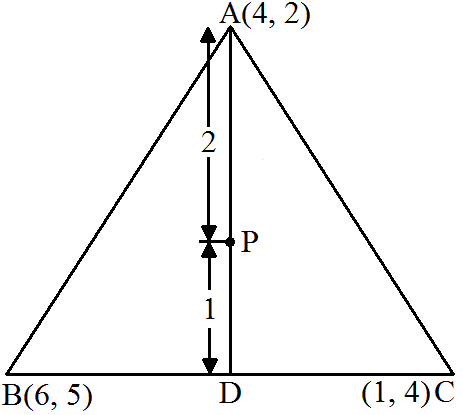
We see that co-ordinates of $P, Q$ and $R$ are same i.e., $P, Q$ and $R$ coincides eachother. Medians of the sides of a triangle pass through the same point which is called the centroid of the triangle. View full question & answer→Question 252 Marks
On which axis do the following points lie$?$
$Q(0, -2).$
AnswerGiven that:
Point $Q(0, -2)$
we have,
$x = 0, y = -2$
Here, $x = 0, \text{y}\neq0$ then the points lies on the $Y-$axis.
View full question & answer→Question 262 Marks
Write the coordinates the reflections of points $(3, 5)$ in x and $y-$axes.
AnswerWe have to find the reflection of $(3, 5)$ along $x-$axis and $y-$axis.
Reflection of any point $P(a, b)$ along $x-$axis is $(a, -b).$
So reflection of $(3, 5)$ along $x-$axis is $(3, -5).$
Similarly, reflection of any point $P(a, b)$ along $y-$axis is $(-a, b).$
So, reflection of $(3, 5)$ along $y-$axis is $(-3, 5).$
View full question & answer→Question 272 Marks
If $(x, y)$ be on the line joining the two points $(1, -3)$ and $(-4, 2),$ prove that $x + y + 2= 0.$
AnswerSince the point $(x, y)$ lie on the line joining the points $(1, -3)$ and $(-4, 2);$ the area of triangle formed by these points is $0.$
That is,
$\triangle=\frac{1}{2}\{\text{x}(-3-2)+1(2-\text{y})-4(\text{y}+3)\}=0$
$= -5x + 2 - y - 4y - 12 = 0$
$= -5x - 5y - 10 = 0$
$= x + y + 2 = 0$
Thus, the result is proved.
View full question & answer→Question 282 Marks
Two vertices of a triangle have co-ordinates $(-8, 7) $and $(9, 4).$ If the centroid of the triangle is at the origin, what are the co-ordinates of the third vertex$?$
AnswerTwo vertices of a triangle are $(-8, 7)$ and $(9, 4)$
Let the third vertex be $(x, y)$
Centroid of the triangle is $(0, 0)$
$\therefore\ \frac{\text{x}_1+\text{x}_2+\text{x}_3}{3}=0\Rightarrow\ \frac{-8+9+\text{x}}{3}=0$
$⇒ 1 + x = 0 ⇒ x = -1$
and $\frac{\text{y}_1+\text{y}_2+\text{y}_3}{3}=0\Rightarrow\ \frac{7+4+\text{y}}{3}=0$
$⇒ 11 + y = 0 ⇒ y = -11$
$\therefore$ Third vertex will be $(-1, -11).$
View full question & answer→Question 292 Marks
On which axis do the following points lie$?$
$R(-4, 0).$
AnswerGiven that:
Point $R(-4, 0)$
we have,
$x = -4, y = 0$
Here, $\text{x}\neq0, y = 0,$ then the points lies on the $X-$axis.
View full question & answer→Question 302 Marks
Find the centroid of the triangle whose vertices are:
$(1, 4) (-1, -1), (3, -2).$
AnswerWe know that the coordinates of the centroid of a triangle whose vertices are $\left(x_1, y_1\right),\left(x_2, y_2\right),\left(x_3, y_3\right)$ are,
$\Big(\frac{\text{x}_1+\text{x}_2+\text{x}_3}{3},\frac{\text{y}_1+\text{y}_2+\text{y}_3}{3}\Big)$
So, the coordinates of the centroid of a triangle whose vertices are $(1, 4), (-1, -1)$ and $(3, -2)$ are $\Big(\frac{1-1+3}{3},\frac{4-1-2}{3}\Big)$
$=\Big(1,\frac{1}{3}\Big)$
View full question & answer→Question 312 Marks
Name the type of triangle $PQR$ formed by the points $\text{P}(\sqrt{2},\sqrt{2}),\ \text{Q}(-\sqrt{2},-\sqrt{2})$ and $\text{R}(-\sqrt{6},\sqrt{6}).$
AnswerUsing distance formula,
$\text{PQ}=\sqrt{(\sqrt{2}+\sqrt{2})^2+(\sqrt{2}+\sqrt{2})^2}$
$=\sqrt{(2\sqrt{2})^2+(2\sqrt{2})^2}=\sqrt{16}=4$
$\text{PR}=\sqrt{(\sqrt{2}+\sqrt{6})^2+(\sqrt{2}-\sqrt{6})^2}$
$=\sqrt{2+6+2\sqrt{12}+2+6-2\sqrt{12}}=\sqrt{16}=4$
$\text{RQ}=\sqrt{(-\sqrt{2}+\sqrt{6})^2+(-\sqrt{2}-\sqrt{6})^2}$
$=\sqrt{2+6-2\sqrt{12}+2+6+2\sqrt{12}}=\sqrt{16}=4$
Since, $PQ = PR = RQ = 4,$ point $P, Q, R$ form an equilateral triangle.
View full question & answer→Question 322 Marks
Find the distance between the following pair of points:
$(a + b, b + c)$ and $(a - b, c - b).$
AnswerThe two given points are $(a + b, b + c)$ and $(a - b, c - b)$
The distance between these two points is,
$\text{d}=\sqrt{(\text{a}+\text{b}-\text{a}+\text{b})^2+(\text{b}+\text{c}-\text{c}+\text{b})^2}$
$=\sqrt{(2\text{b})^2+(2\text{b})^2}$
$=\sqrt{4\text{b}^2+4\text{b}^2}$
$=\sqrt{8\text{b}^2}$
$\text{d}=2\text{b}\sqrt{2}$
Hence the distance is $2\text{b}\sqrt{2}\text{units}.$
View full question & answer→Question 332 Marks
If the centroid of the triangle formed by points $P(a, b), Q(b, c)$ and $R(c, a)$ is at the origin, what is the value of $a + b + c?$
AnswerThe co-ordinates of the vertices are $(a, b); (b, c)$ and $(c, a)$
The co-ordinate of the centroid is $(0, 0)$
We know that the co-ordinates of the centroid of a triangle whose vertices are $\left(x_1, y_1\right),\left(x_2, y_2\right),\left(x_3, y_3\right)$ is,
$\Big(\frac{\text{x}_1+\text{x}_2+\text{x}_3}{3},\frac{\text{y}_1+\text{y}_2+\text{y}_3}{3}\Big)$
So,
$(0, 0)=\Big(\frac{\text{a}+\text{b}+\text{c}}{3},\frac{\text{b}+\text{c}+\text{a}}{3}\Big)$
Compare individual terms on both the sides,
$\frac{\text{a}+\text{b}+\text{c}}{3}=0$
Therefore,
$\text{a}+\text{b}+\text{c}=0$
View full question & answer→Question 342 Marks
If the centroid of the triangle formed by points $P(a, b), Q(b, c)$ and $R(c, a)$ is at the origin, what is the value of $\frac{\text{a}^2}{\text{bc}}+\frac{\text{b}^2}{\text{ca}}+\frac{\text{c}^2}{\text{ab}}?$
AnswerThe vertices of the triangle $PQR$ are $P(a, b), Q(b, c)$ and $R(c, a)$ and its centroid is $O(0, 0)$
$\therefore\ \frac{\text{x}_1+\text{x}_2+\text{x}_3}{3}=0\Rightarrow\ \frac{\text{a}+\text{b}+\text{c}}{3}=0$
$\Rightarrow\ \text{a}+\text{b}+\text{c}=0$
Now, $\frac{\text{a}^2}{\text{bc}}+\frac{\text{b}^2}{\text{ca}}+\frac{\text{c}^2}{\text{ab}}$
$=\frac{\text{a}^3+\text{b}^3+\text{c}^3}{\text{abc}}=\frac{3\text{abc}}{\text{abc}}$
$\left\{\therefore a^3+b^3+c^3=3 a b c\right.$ if $\left.a+b+c=0\right\}$
$= 3$
View full question & answer→Question 352 Marks
Write the ratio in which the line segment joining points $(2, 3)$ and $(3, -2)$ is divided by $x-$axis.
AnswerLet $P(x, 0)$ be the point of intersection of $x-$axis with the line segment joining $A(2, 3)$ and $B(3, -2)$ which divides the line segment $AB$ in the ratio $\lambda:1.$
Now according to the section formula if point a point $P$ divides be the point of intersection of $x-$axis with the line segment joining $A(2, 3)$ and $B(3, -2)$ which divides the line segment $AB$ in the ratio a line segment joining $A\left(x_1, y_1\right)$ and $B\left(x_2, y_2\right)$ in the ratio $m : n$ internally than,
$\text{P(x, y)}=\Big(\frac{\text{nx}_1+\text{mx}_2}{\text{m}+\text{n}},\frac{\text{ny}_1+\text{my}_2}{\text{m}+\text{n}}\Big)$
Now we will use section formula as,
$(\text{x},0)=\Big(\frac{3\lambda+2}{\lambda+1},\frac{3-2\lambda}{\lambda+1}\Big)$
Now equate the y component on both the sides,
$\frac{3-2\lambda}{\lambda+1}=0$
On further simplification,
$\lambda=\frac{3}{2}$
So $x-$axis divides $AB$ in the ratio $\frac{3}{2}.$
View full question & answer→Question 362 Marks
If $P(2, p)$ is the mid-point of the line segment joining the points $A(6, -5)$ and $B(-2, 11),$ find the value of $p.$
Answer$P(2, p)$ is the mid-point of the line segment joining the points $A(6, -5)$ and $B(-2, 11)$
$\therefore\ \text{P}=\frac{-5+11}{2}\Rightarrow\ \text{P}=\frac{6}{2}=3$
View full question & answer→Question 372 Marks
Write the distance between the points $\text{A}(10\cos\theta, 0)$ and $\text{B}(0,10\sin\theta).$
AnswerDistance between the points $\text{A}(10\cos\theta, 0)$ and $\text{B}(0,10\sin\theta).$
$=\sqrt{(\text{x}_2-\text{x}_1)^2+(\text{y}_2-\text{y}_1)^2}$
$=\sqrt{(0-10\cos\theta)^2+(10\sin\theta-0)^2}$
$=\sqrt{100\cos^2\theta+100\sin^2\theta}$
$=\sqrt{100(\sin^2\theta+\cos^2\theta)}$
$=\sqrt{100\times1}=\sqrt{100}$
$\{\because\ \sin^2\theta+\cos^2\theta=1\}$
$=10$
View full question & answer→Question 382 Marks
The points $A\left(x_1, y_1\right), B\left(x_2, y_2\right)$ and $C\left(x_3, y_3\right)$ are the vertices of $∆ABC.$
Find the coordinates of the point $P$ on $AD$ such that $AP : PD = 2 : 1.$
Answer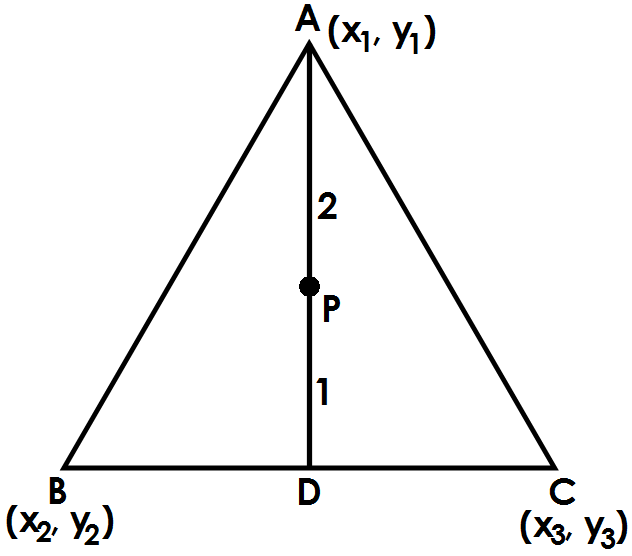
Let the co-ordinates of a point $P$ be $(x, y).$
Given that, the point $P(x, y),$ divide the line joining $A(x1, y3)$ and $\text{D}=\Big(\frac{\text{x}_2+\text{x}_3}{2},\frac{\text{y}_2+\text{y}_3}{2}\Big)$ in the ratio $2 : 1,$ then the coordinates of $P.$
$=\begin{bmatrix}\frac{2\Big(\frac{\text{x}_2+\text{x}_3}{2}\Big)+1.\text{x}_1}{2+1}\frac{2\Big(\frac{\text{y}_2+\text{y}_3}{2}\Big)+1.\text{y}_1}{2+1} \end{bmatrix}$
$\bigg[\because$ internal section formula $=\Big(\frac{\text{m}_2+\text{x}_2+\text{m}_2\text{x}_1}{\text{m}_1+\text{m}_2},\frac{\text{m}_1\text{y}_2+\text{m}_2\text{m}_1}{\text{m}_1+\text{m}_2}\Big)\bigg]$
$=\Big(\frac{\text{x}_2+\text{x}_3+\text{x}_1}{3},\frac{\text{y}_2+\text{y}_3+\text{y}_1}{2}\Big)$
$\therefore$ So, required coordinates of point $\text{P}=\Big(\frac{\text{x}_1+\text{x}_2+\text{x}_3}{3},\frac{\text{y}_1+\text{y}_2+\text{y}_3}{3}\Big)$ View full question & answer→Question 392 Marks
If the distance between the points $(4, k)$ and $(1, 0)$ is $5,$ then what can be the possible values of $k?$
AnswerConsider the points $A(4, k)$ and $B(1, 0).$
It is given that the distance $AB$ is $5$ units.
By distance formula, distance $AB$ is as follows:
$\text{AB}=\sqrt{(4-1)^2+(\text{k}-0)^2}$
$\Rightarrow\ 5=\sqrt{9+(\text{k})^2}$
$\Rightarrow\ 25=9+\text{k}^2$
$\Rightarrow\ 16=\text{k}^2$
$\Rightarrow\ \pm4=\text{k}$
Hence, value of $k$ are $\pm4.$
View full question & answer→Question 402 Marks
Find the distance between the following pair of points:
$(a, 0)$ and $(0, b).$
AnswerWe have $P(a, 0)$ and $Q(0, b)$
Here,
$\mathrm{x}_1=a, \mathrm{y}_1=0, \mathrm{x}_2=0, \mathrm{y}_2=b$
$\text{PQ}=\sqrt{(\text{x}_2-\text{x}_1)^2+(\text{y}_2-\text{y}_1)^2}$
$\text{PQ}=\sqrt{(0-\text{a})^2+(\text{b}-0)^2}$
$\text{PQ}=\sqrt{(-\text{a})^2+(\text{b})^2}$
$\text{PQ}=\sqrt{\text{a}^2+\text{b}^2}$
View full question & answer→Question 412 Marks
If the distance between the points $(3, 0)$ and $(0, y)$ is 5 units and $y$ is positive. then what is the value of $y?$
AnswerIt is given that distance between $A(3, 0)$ and $B(0, y)$ is $5.$
In general, the distance between $\mathrm{A}\left(\mathrm{x}_1, \mathrm{y}_1\right)$ and $\mathrm{B}\left(\mathrm{x}_2, \mathrm{y}_2\right)$ is given by,
$A B^2=\left(x_2-x_1\right)^2+\left(y_2-y_1\right)^2$
So,
$5^2=(0-3)^2+(y-0)^2$
On further simplification,
$y^2=16$
$\text{y}=\pm4$
We will neglect the negative value. So,
$y = 4.$
View full question & answer→