Question 14 Marks
Four points $A(6, 3), B(-3, 5), C(4, -2)$ and $D(x, 3x)$ are given in such a way that $\frac{\triangle\text{DBC}}{\triangle\text{ABC}}=\frac{1}{2},$ find $x.$
AnswerLet $A(6, 3), B(-3, 5), C(4, -2)$ and $D(x, 3x)$ are the vertices of quadrilateral $ABCD.$
$AC$ and $BD$ are joined
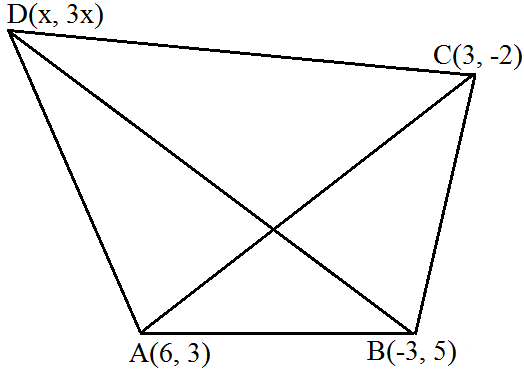
Now, area of $\triangle\text{ABC}$
$=\frac{1}{2}[\text{x}_1(\text{y}_2-\text{y}_3)+\text{x}_2(\text{y}_3-\text{y}_1)+\text{x}_3(\text{y}_1-\text{y}_2)]$
$=\frac{1}{2}[6(5+2)+(-3)(-2-3)+4(3-5)]$
$=\frac{1}{2}[6\times7+(-3)(-5)+4(-2)]$
$=\frac{1}{2}[42+15-8]=\frac{49}{2}$
and area of $\triangle\text{DBC},$
$=\frac{1}{2}[\text{x}(5+2)+(-3)(-2-3\text{x})+4(3\text{x}-5)]$
$=\frac{1}{2}[7\text{x}+6+9\text{x}+12\text{x}-20]$
$=\frac{1}{2}[28\text{x}-14]=14\text{x}-7$
Now, $\frac{\triangle\text{DBC}}{\triangle\text{ABC}}=\frac{14\text{x}-7}{\frac{49}{2}}$
$=\frac{(14\text{x}-7)\times2}{49}$
$=\frac{2(14\text{x}-7)}{49}$
$\therefore\ \Big|\frac{2(14\text{x}-7)}{49}\Big|=\frac{1}{2}$
$\Rightarrow\ 4|14\text{x}-7|=\pm49$
If $56\text{x}-28=49$
$\Rightarrow\ 56\text{x}=49+28=77$
$\Rightarrow\ \text{x}=\frac{77}{56}=\frac{11}{8}$
If $4(14\text{x}-7)=-49$
$\Rightarrow\ 56\text{x}-28=-49$
$\Rightarrow\ 56\text{x}=-49+28=-21$
$\Rightarrow\ \text{x}=\frac{-21}{56}=\frac{-3}{8}$
$\therefore\ \text{x}=\frac{11}{8}$ or $\frac{-3}{8}.$ View full question & answer→Question 24 Marks
Prove that the points $(3, -2), (4, 0), (6, -3)$ and $(5, -5)$ are the vertices of a parallelogram.
AnswerGiven that: Let $A(3, -2), B(4, 0), C (6, -3)$ and $D(5, -5)$ be vertices of quadrilateral $ABCD$. Then
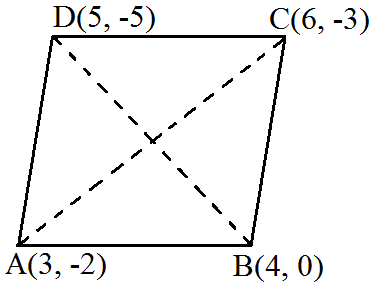
$\text{AB}=\sqrt{(4-3)^2+(0-(-2))^2}$
$=\sqrt{1+4}$
$=\sqrt{5}\text{ units}$
$\text{BC}=\sqrt{(6-4)^2+(-3-0)^2}$
$=\sqrt{4+9}$
$=\sqrt{13}\text{ unit}$
$\text{CD}=\sqrt{(5-6)^2+(-5-(-3))^2}$
$=\sqrt{1+4}$
$=\sqrt{5}\ \text{unit}$
$\text{AD}=\sqrt{(5-3)^2+(-5-(-2))^2}$
$=\sqrt{4+9}$
$=\sqrt{13}\ \text{unit}$
$\therefore$ $AB = CD$ and $AD = BC$
Diagonal $\text{AC}=\sqrt{(6-3)^2+(-3-(-2))^2}$
$=\sqrt{9+1}$
$=\sqrt{10}\text{ units}$
Diagonal $\text{BD}=\sqrt{(5-4)^2+(-5-0)^2}$
$=\sqrt{1+25}$
$=\sqrt{26}\text{ unit}$
$\therefore\ \text{AC}\neq\text{BC}$
Since opposite sides $AB = CD, BC = AD$ are equal but diagonal are not equal.
Hence, quadrilateral $ABCD$ is a parallelogram. View full question & answer→Question 34 Marks
$ABCD$ is a rectangle formed by joining the points $A(-1, -1), B(-1, 4) C(5, 4)$ and $D(5, -1). P, Q, R$ and $S$ are the mid-points of sides $AB, BC, CD$ and $DA$ respectively. Is the quadrilateral $PQRS$ a square? a rectangle? or a rhombus? Justify your answer.
Answer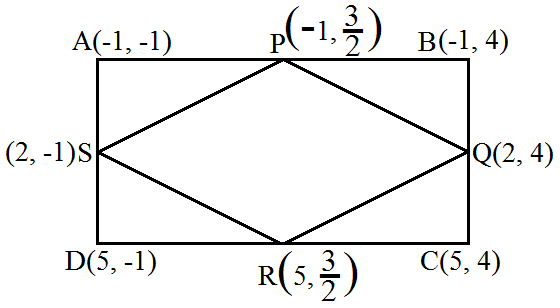
Length of $\text{PQ}=\sqrt{(-1-2)^2+\Big(\frac{3}{2}-4\Big)^2}$
$=\sqrt{9+\frac{25}{4}}=\sqrt{\frac{61}{4}}$
Length of $\text{QR}=\sqrt{(2-5)^2+\Big(4-\frac{3}{2}\Big)^2}$
$=\sqrt{9+\frac{25}{4}}=\sqrt{\frac{61}{4}}$
Length of $\text{RS}=\sqrt{(5-2)^2+\Big(\frac{3}{2}+1\Big)^2}$
$=\sqrt{9+\frac{25}{4}}=\sqrt{\frac{61}{4}}$
Length of $\text{SP}=\sqrt{(2+1)^2+\Big(-1-\frac{3}{2}\Big)^2}$
$=\sqrt{9+\frac{25}{4}}=\sqrt{\frac{61}{4}}$
Length of $\text{PR}\sqrt{(-1-5)^2+\Big(\frac{3}{2}-\frac{3}{2}\Big)^2}=6$
Length of $\text{QS}\sqrt{(2-2)^2+(4+1)^2}=5$
Here all sides of given quadrilateral is of same measure but the diagonals are of different lengths. So, $PQRS$ is a rhombus. View full question & answer→Question 44 Marks
Find the centre of the circle passing through $(5, -8), (2, -9)$ and $(2, 1).$
AnswerThe distance d between two points $(x_1, y_1)$ and $(x_2, y_2)$ is given by the formula,
$\text{d}=\sqrt{(\text{x}_1-\text{x}_2)^2+(\text{y}_1-\text{y}_2)^2}$
The centre of a circle is at equal distance from all the points on its circumference.
Here it is given that the circle passes through the points $A(5, -8), B(2, -9)$ and $C(2, 1).$
Let the centre of the circle be represented by the point $O(x, y).$
So we have $AO = BO = CO$
$\text{AO}=\sqrt{(5-\text{x})^2+(-8-\text{y})^2}$
$\text{BO}=\sqrt{(2-\text{x})^2+(-9-\text{y})^2}$
$\text{CO}=\sqrt{(2-\text{x})^2+(1-\text{y})^2}$
Equating the first pair of these equations we have,
$AO = BO$
$\sqrt{(5-\text{x})^2+(-8-\text{y})^2}=\sqrt{(2-\text{x})^2+(-9-\text{y})^2}$
Squaring on both sides of the equation we have,
$ (5-x)^2+(-8-y)^2=(2-x)^2+(-9-y)^2 $
$ 25+x^2-10 x+64+y^2+16 y=4+x^2-4 x+81+y^2+18 y $
$ 6 x+2 y=4 $
$ 3 x+y=2$
Equating another pair of the equations we have,
$ A O=C O $
$ =\sqrt{(5-x)^2+(-8-y)^2}=\sqrt{(2-x)^2+(1-y)^2}$
Squaring on both sides of the equation we have,
$ (5-x)^2+(-8-y)^2=(2-x)^2+(1-y)^2 $
$ 25+x^2-10 x+64+y^2+16 y=4+x^2-4 x+1+y^2-2 y $
$ 6 x-18 y=84 $
$ x-3 y=14$
Now we have two equations for ‘x’ and ‘y’, which are
$3x + y = 2$
$x - 3y = 14$
From the second equation we have $y = -3x + 2.$ Substituting this value of ‘y’ in the first equation we have,
$x - 3(-3x + 2) = 14$
$x + 9x - 6 = 14$
$10x = 20$
$x = 2$
Therefore the value of ‘y’ is,
$y = -3x + 2$
$y = -3(2) + 2$
$y = -4$
Hence the co-ordinates of the centre of the circle are $(2, -4).$
View full question & answer→Question 54 Marks
If the points $(-2, -1), (1, 0), (x, 3)$ and $(1, y)$ form a parallelogram, find the values of $x$ and $y.$
AnswerThe given points are $A(-2, -1), B(1, 0), C(x, 3)$ and $D(1, y).$
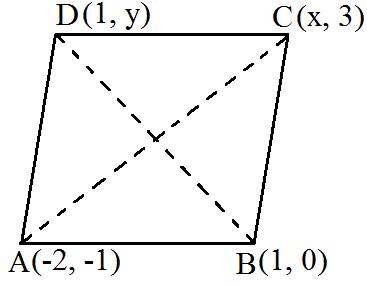
We know that the diagonals of a prallelogram bisect each other. Therefore, the coordinates of the mid-point of $AC$ are same as the coordinates of the mid-point of $BD.$
Let $P(x_m, y_m)$ be the mid-point of AC and $BD.$
$\text{P}(\text{x}_\text{m},\text{y}_\text{m})=\Big(\frac{-2+\text{x}}{2},\frac{-1+3}{2}\Big)=\Big(\frac{-2+\text{x}}{2},1\Big)$
$\text{P}(\text{x}_\text{m},\text{y}_\text{m})=\Big(\frac{1+1}{2},\frac{0+\text{y}}{2}\Big)=\Big(1,\frac{\text{y}}{2}\Big)$
$\because$ diagonals of parallelogram bisect each other,
$\therefore\ \Big(\frac{-2+\text{x}}{2},1\Big)=\Big(1,\frac{\text{y}}{2}\Big)$
Equating the individual components, we have,
$\Rightarrow\ \frac{-2+\text{x}}{2}=1$ and $1=\frac{\text{y}}{2}$
$\Rightarrow -2 + x = 2$ and $y = 2$
$\Rightarrow x = 4$ and $y = 2$
Hence, the value of x and y are $4$ and $2.$ View full question & answer→Question 64 Marks
Two vertices of an isosceles triangle are $(2, 0)$ and $(2, 5).$ Find the third vertex if the length of the equal sides is $3.$
Answer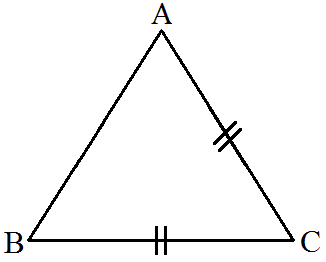
Given vertex are $A(2, 0)$ and $B(2, 5)$
Let third vertex be $C(x, y)$
$\text{AB}=\sqrt{(2-2)^2+(5-0)^2}$
$=\sqrt{25}=5\text{ units}$
$\text{BC}=\sqrt{(\text{x}-2)^2+(\text{y}-5)^2}$
$=\sqrt{\text{x}^2+4-4\text{x}+\text{y}^2+25-10\text{y}}$
$=\sqrt{\text{x}^2+\text{y}^2-4\text{x}-10\text{y}+29}\ .....(1)$
$\text{AC}=\sqrt{(\text{x}-2)^2+(\text{y}-0)^2}$
$=\sqrt{\text{x}^2+4-4\text{x}+\text{y}^2}$
$=\sqrt{\text{x}^2+\text{y}^2-4\text{x}+4}\ ......(2)$
$\because AB$ is not one of the equal sides of the isosceles triangle.
$\therefore BC = AC$
$\sqrt{\text{x}^2+\text{y}^2-4\text{x}-10\text{y}+29}=\sqrt{\text{x}^2+\text{y}^2-4\text{x}+4}$
Squaring both the sides,
$ \Rightarrow x^2+y^2-4 x-10 y+29=x^2+y^2-4 x+4 $
$ \Rightarrow x^2+y^2-4 x-10 y+29-x^2-y^2+4 x-4=0 $
$ \Rightarrow-10 y+25=0 $
$ \Rightarrow-10 y=-25$
$\Rightarrow\ \text{y}=\frac{-25}{-10}$
$\Rightarrow\ \text{y}=\frac{5}{2}$
$\because$ Length of the equal side is 3 units so putting the value of y in eq(2)
$\text{AC}=\sqrt{\text{x}^2+\text{y}^2-4\text{x}+4}$
$3=\sqrt{\text{x}^2+\Big(\frac{5}{2}\Big)^2-4\text{x}+4}$
Squaring both the sides,
$\Rightarrow\ 9=\text{x}^2+\frac{25}{4}-4\text{x}+4$
$\Rightarrow\ 9=\frac{4\text{x}^2+25-16\text{x}+16}{4}$
$ \Rightarrow 36=4 x^2+25-16 x+16 $
$ \Rightarrow-4 x^2-25+16 x-16+36=0 $
$ \Rightarrow-4 x^2+16 x-5=0 $
$ \Rightarrow-1\left(4 x^2-16 x+5\right)=0 $
$ \Rightarrow 4 x^2-16 x+5=0$
Now, solving the quadratic equation using quadratic formula,
$\text{x} = {-\text{b} \pm \sqrt{\text{b}^2-4\text{ac}} \over 2\text{a}}$
Here, $a = 4, b = -16, c = 5$
$\Rightarrow\ \text{x}=\frac{-(-16)\pm\sqrt{(-16)^2-4\times4\times5}}{2\times4}$
$\Rightarrow\ \text{x}=\frac{16\pm\sqrt{256-80}}{8}$
$\Rightarrow\ \text{x}=\frac{16\pm\sqrt{176}}{8}$
$\Rightarrow\ \text{x}=\frac{16\pm4\sqrt{11}}{8}$
$\Rightarrow\ \text{x}=\frac{4(4\pm\sqrt{11})}{8}=2\pm\frac{\sqrt{11}}{2}$
Hence, the third vertex of isosceles triangle are $\Big(2-\frac{\sqrt{11}}{2},\frac{5}{2}\Big),\Big(2+\frac{\sqrt{11}}{2},\frac{5}{2}\Big).$ View full question & answer→Question 74 Marks
Two opposite vertices of a square are $(-1, 2)$ and $(3, 2)$. Find the coordinates of other two vertices.
Answer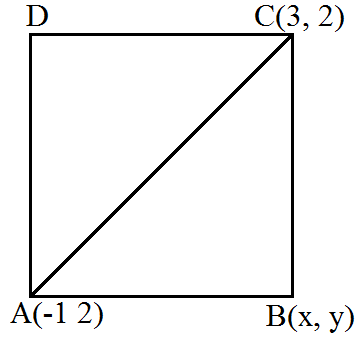
Let $ABCD$ is a square, in which co-ordinates of A are $(-1, 2)$ and of $C$ are $(3, 2)$ join $AC$.
Let co-ordinates of $B$ be $(x, y).$
$AB = BC$ (Sides of a square)
$\Rightarrow AB^2= BC^2$
Now, $\text{AB}=\sqrt{(\text{x}_2-\text{x}_1)^2+(\text{y}_2-\text{y}_1)^2}$
$=\sqrt{(\text{x}+1)^2+(\text{y}-2)^2}$
$ \Rightarrow A B^2=(x+1)^2+(y-2)^2 $
$ \text { Similarly, } B C^2=(x-3)^2+(y-2)^2 $
$ \because A B=B C $
$ \therefore(x+1)^2+(y-2)^2=(x-3)^2+(y-2)^2 $
$ \Rightarrow(x+1)^2=(x-3)^2 $
$ \Rightarrow x^2+2 x+1=x^2-6 x+9 $
$ \Rightarrow x^2+2 x+6 x-x^2=9-1=8 $
$ \Rightarrow 8 x=8$
$\Rightarrow\ \text{x}=\frac{8}{8}=1$
Now in right $\triangle\text{ABC}$
$ A C^2=A B^2+B C^2 $
$ (3+1)^2+(2-2)^2=(x+1)^2+(y-2)^2+(x-3)^2+(y-2)^2 $
$ \Rightarrow(4)^2+(0)^2=x^2+2 x+1+y^2-4 y+4+x^2-6 x+9+y^2-4 y+4 $
$ \Rightarrow 16=2 x^2+2 y^2-4 x-8 y+18 $
$ \Rightarrow 2 x^2+2 y^2-4 x-8 y=16-18 $
$ \Rightarrow 2 x^2+2 y^2-4 x-8 y=-2 $
$ \Rightarrow x^2+y^2-2 x-4 y=-1$
$\text { Substituting the value of } x \text {, }$
$ (1)^2+y^2-2 \times 1-4 y=-1 $
$ 1+y^2-2-4 y=-1 $
$ y^2-4 y=-1-1+2=0 $
$ y(y-4)=0$
Either $y = 0$
or $y - 4 = 0$, then $y = 4$
$\therefore$ Co-ordinates of other points will be
$(1, 0)$ and $(1, 4).$ View full question & answer→Question 84 Marks
Find the lengths of the medians of a $\triangle ABC$ having vertices at $A(5, 1), B(1, 5)$, and $C(-3, -1).$
AnswerLet $D, E, F$ be the mid-points of sides $BC, CA$ and $AB$ respectively.
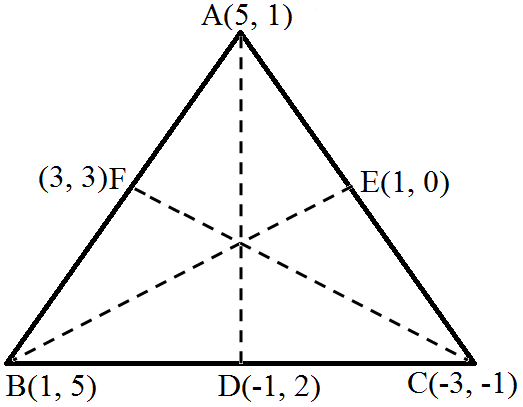
The coordinates of the mid-points $\left(x_{m}, y_m\right)$ between two points $\left(x_1, y_1\right)$ and $\left(x_2 y_2\right)$ is given by,
$(\text{x}_\text{m},\text{y}_\text{m})=\Big(\frac{\text{x}_1+\text{x}_2}{2},\frac{\text{y}_1+\text{y}_2}{2}\Big)$
Then, the coordinates of $D, E$ and $F$ are,
$\text{D}\Big(\frac{-3+1}{2},\frac{-1+5}{2}\Big)=\text{D}(-1,2)$
$\text{E}\Big(\frac{-3+5}{2},\frac{-1+1}{2}\Big)=\text{E}(1,0)$
$\text{F}\Big(\frac{1+5}{2},\frac{1+5}{2}\Big)=\text{F}(3,3)$
length of median $AD$ is,
$\text{AD}=\sqrt{(-1-5)^2+(2-1)^2}$
$=\sqrt{36+1}$
$=\sqrt{37}\ \text{units}$
length of median $BE$ is,
$\text{BE}=\sqrt{(1-1)^2+(0-5)^2}$
$=\sqrt{25}$
$=5\text{ units}$
length of median $CF$ is,
$\text{CF}=\sqrt{(-3-3)^2+(-1-3)^2}$
$=\sqrt{36+16}$
$=\sqrt{52}$
$=2\sqrt{13}\ \text{units}$ View full question & answer→Question 94 Marks
The three vertices of a parallelogram are $(3, 4) (3, 8)$ and $(9, 8)$. Find the fourth vertex.
AnswerLet $A(3, 4), B(3, 8)$ and $C(9, 8)$ be the three given vertex then fourth vertex be $D(x, y)$
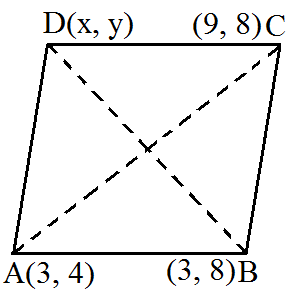
Since, $ABCD$ is parallelogram, the diagonals bisect each other.
Therefore, the mid-point of the diagonals of the parallelogram coincide.
Let $P(x, y)$ be the mid-point of diagonal $AC$ then,
$\text{P}(\text{x},\text{y})=\Big(\frac{3+9}{2},\frac{4+8}{2}\Big)$
$P(x, y) = (6, 6)$
Let $Q(x, y)$ be the mid-point of diagonal $BD$ then,
$\text{Q}(\text{x},\text{y})=\Big(\frac{3+\text{x}}{2},\frac{8+\text{y}}{2}\Big)$
Coordinates of mid-point $AC =$ Coordinates of mid-point $BD$
$P(x, y) = Q(x, y)$
$\Rightarrow\ (6,6)=\Big(\frac{3+\text{x}}{2},\frac{8+\text{y}}{2}\Big)$
Now, equating individual components,
$\Rightarrow\ 6=\frac{3+\text{x}}{2}$ and $6=\frac{8+\text{y}}{2}$
$\Rightarrow 3 + x = 12$ and $8 + y = 12$
$\Rightarrow x = 9$ and $y = 4$
Hence, coordinates of fourth point are $(9, 4).$ View full question & answer→Question 104 Marks
The points $A(2, 9), B(a, 5)$ and $C(5, 5)$ are the vertices of a triangle $ABC$ right angled at $B$. Find the values of a and hence the area of $\triangle\text{ABC}.$
AnswerGiven that, the points $A(2, 9), B(a, 5)$ and $C(5, 5)$ are the vertices of a $\triangle\text{ABC}$ right angled at $B.$
By pythagoras theorem, $AC^2= AB^2+ BC^2.....(i)$
Now, by distance formula,
$\text{AB}=\sqrt{(\text{a}-2)^2+(5-9)^2}$
$\Big[\because$ distance between two points $(x_1, y_1)$ and $(\text{x}_2,\text{y}_2)=\sqrt{(\text{x}_2-\text{x}_1)^2+(\text{y}_2-\text{y}_1)^2}\Big]$
$=\sqrt{\text{a}^2+4-4\text{a}+16}$
$=\sqrt{\text{a}^2-4\text{a}+20}$
$\text{BC}=\sqrt{(5-\text{a})^2+(5-5)^2}$
$=\sqrt{(5-\text{a})^2+0}=5-\text{a}$
and $\text{AC}=\sqrt{(2-5)^2+(9-5)^2}$
$=\sqrt{(-3)^2+(4)^2}=\sqrt{9+16}=\sqrt{25}=5$
Put the values of AB, BC and AC in Eq. (i), we get
$(5)^2=\sqrt{(\text{a}^2-4\text{a}+20)^2}+(5-\text{a})^2$
$ \Rightarrow 25=a^2-4 a+20+25+a^2-10 a $
$ \Rightarrow 2 a^2-14 a+20=0 $
$ \Rightarrow a^2-7 a+10=0 $
$ \Rightarrow a^2-2 a-5 a+10=0[\text { by factorisation method] } $
$ \Rightarrow a(a-2)-5(a-2)=0 $
$ \Rightarrow(a-2)(a-5)=0$
Here, $\text{a}\neq5,$ since at a = 5, the length of $BC = 0$. It is not possible because the sides $AB, BC$ and $CA$ from a right angled triangle.
So, $a = 2$
Now, the coordinate of $A, B$ and $C$ becomes $(2, 9), (2, 5)$ and $(5, 5)$ respectively.
$\therefore\ \text{Area of }\triangle\text{ABC}=\frac{1}{2}[\text{x}_1(\text{y}_2-\text{y}_3)+\text{x}_2(\text{y}_3-\text{y}_1)+\text{x}_3(\text{y}_1-\text{y}_2)]$
$\therefore\ \triangle=\frac{1}{2}[2(5-5)+2(5-9)+5(9-5)]$
$=\frac{1}{2}[2\times0+2(-4)+5(4)]$
$=\frac{1}{2}(0-8+20)=\frac{1}{2}\times12=6$
Hence, the required area of $\triangle\text{ABC}$ is 6sq. units.
View full question & answer→Question 114 Marks
Find the lengths of the medians of a triangle whose vertices are $A(-1, 3), B(1, -1)$ and $C(5, 1).$
Answer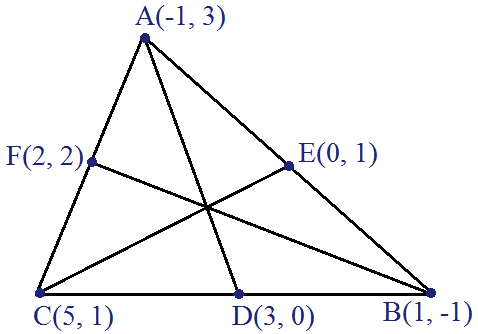
Let $AD, BF$ and $CE$ be the medians of $\triangle\text{ABCD}$
Coordinates of $D$ are $\Big(\frac{5+1}{2},\frac{1-1}{2}\Big)=(3,0)$
Coordinates of $E$ are $\Big(\frac{-1+1}{2},\frac{3-1}{2}\Big)=(0,1)$
Coordinates of $F$ are $\Big(\frac{5-1}{2},\frac{1+3}{2}\Big)=(2,2)$
Length of $\text{AD}=\sqrt{(-1-3)^2+(3-0)^2}=5\text{ units}$
Length of $\text{BF}=\sqrt{(2-1)^2+(2+1)^2}=\sqrt{10}\text{ units}$
Length of $\text{CE}=\sqrt{(5-0)^2+(1-1)^2}=5\text{ units}$ View full question & answer→Question 124 Marks
Find the ratio in which the point $(2, y)$ divides the line segment joining the points $A(-2, 2)$ and $B(3, 7)$. Also, find the value of $y.$
AnswerLet the point $P(2, y)$ divide the line segment joining the points $A(-2, 2)$ and $B(3, 7)$ in the ratio $k : 1$
Then, the coordinates of $P$ are,
$\bigg[\frac{3\text{k}+(-2)\times1}{\text{k+1}},\frac{7\text{k}+2\times1}{\text{k+1}}\bigg]$
$\bigg[\frac{3\text{k}-2}{\text{k+1}},\frac{7\text{k}+2}{\text{k}+1}\bigg]$
But the coordinates of P are given as $(2, y).$
$\therefore\ \frac{3\text{k}-2}{\text{k}+1}=2$
$\Rightarrow\ 3\text{k}-2=2\text{k}+2$
$\Rightarrow\ 3\text{k}-2\text{k}=2+2$
$\Rightarrow\ \text{k}=4$
$\frac{7\text{k}+2}{\text{k}+1}=\text{y}$
Putting the value of k, we get
$\frac{7\times4+2}{4+1}=\text{y}$
$\frac{30}{5}=\text{y}$
$6=\text{y}$
i.e., $\text{y}=6$
Hence, the ratio is $4 : 1$ and $y = 6.$
View full question & answer→Question 134 Marks
Prove that the points $(-4, -1), (-2, 4), (4, 0)$ and $(2, 3)$ are the vertices of a rectangle.
AnswerLet the vertices of a quadrilateral $ABCD$ are $A(-4, -1), B(-2, -4), C(4, 0)$ and $D(2, 3)$
Join $AC$ and $BD$ which intersect each other at $O.$
If $O$ is the mid-point of $AC$ then its coordinates will be $=\Big(\frac{\text{x}_1+\text{x}_2}{2},\frac{\text{y}_1+\text{y}_2}{2}\Big)$
or $\Big(\frac{-4+4}{2},\frac{-1+0}{2}\Big)$
$=\Big(\frac{0}{2},\frac{-1}{2}\Big)$ or $\Big(0,\frac{-1}{2}\Big)$
If $O$ is the mid-point of $BD$, then its co-ordinates will be $=\Big(\frac{-2+2}{2},\frac{-4+3}{2}\Big)$
or $\Big(\frac{0}{2},\frac{-1}{2}\Big)$ or $\Big(0,\frac{-1}{2}\Big)$
$\because$ The mid-points of $AC$ and $BD$ are the same.
$\therefore$ $AC$ and $AD$ bisect eachother at $O$
Now, $\text{AC}=\sqrt{(\text{x}_2-\text{x}_1)^2+(\text{y}_2-\text{y}_1)^2}$
$=\sqrt{[4-(-4)]^2+[0-(-1)]^2}$
$=\sqrt{(4+4)^2+(1)^2}=\sqrt{(8)^2+(1)^2}$
$=\sqrt{64+1}=\sqrt{65}$
and $\text{BD}=\sqrt{[2-(-2)]^2+[3-(-4)]^2}$
$=\sqrt{(2+2)^2+(3+4)^2}=\sqrt{(4)^2+(7)^2}$
$=\sqrt{16+49}=\sqrt{65}$
$\because$ Diagonal bisect eachother at $O$ and are equal.
$\therefore$ $ABCD$ is a rectangle.
View full question & answer→Question 144 Marks
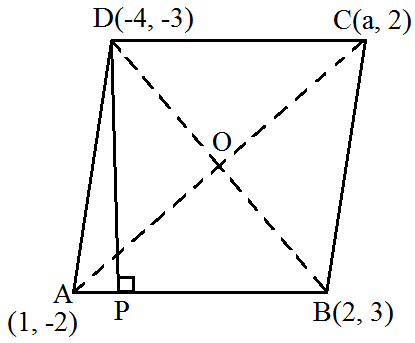
If the points $A(1, -2), B(2, 3), C(a, 2)$ and $D(-4, -3)$ form a parallelogram, find the value of a and height of the parallelogram taking $AB$ as base.
AnswerIn parallelogram, we know that, diagonals bisects each other i.e., mid-point of $AC =$ mid-point of $BD$
$\Rightarrow\ \Big(\frac{1+\text{a}}{2},\frac{-2+2}{2}\Big)=\Big(\frac{2-4}{2},\frac{3-3}{2}\Big)$
$\Rightarrow\ \frac{1+\text{a}}{2}=\frac{2-4}{2}=\frac{-2}{2}=-1$
$\bigg[$Since, mid-point of a line segment having points $(x_1, y_1)$ and $(x_2, y_2)$ is $\Big(\frac{\text{x}_1+\text{x}_2}{2},\frac{\text{y}_1+\text{y}_2}{2}\Big)\bigg]$
$\Rightarrow 1 + a = -2$
$\Rightarrow a = -3$
So, the required value of a is $-3.$
Given that, $AB$ as base of a parallelogram and drawn a perpendicular from $D$ to $AB$ which meet $AB$ at $P$. So, $DP$ is a height of a parallelogram.
Now, equation of base AB, passing through the points $(1, -2)$ and $(2, 3)$ is
$\Rightarrow\ (\text{y}-\text{y}_1)=\frac{\text{y}_2-\text{y}_1}{\text{x}_2-\text{x}_1}(\text{x}-\text{x}_1)$
$\Rightarrow\ (\text{y}+2)=\frac{3+2}{2-1}(\text{x}-1)$
$\Rightarrow (y + 2) = 5(x - 1)$
$\Rightarrow 5x - y = 7 .......(i)$
Slope of AB, say $\text{m}_1=\frac{\text{y}_2-\text{y}_1}{\text{x}_2-\text{x}_1}=\frac{3+2}{2-1}=5$
Let the slope of $DP$ be $m_2$.
Since, $DP$ is perpendicular to $AB.$
By condition of perpendicularity
$m_1\times m_2= -1 \Rightarrow 5m_2= -1$
$\Rightarrow\ \text{m}_2=-\frac{1}{5}$
Now, Eq. of DP, having slope $\Big(-\frac{1}{5}\Big)$ and passing the point $(-4, -3)$ is
$(y - y_1) = m_2(x - x_1)$
$\Rightarrow\ (\text{y}+3)=-\frac{1}{5}(\text{x}+4)$
$\Rightarrow 5y + 15 = -x - 4$
$\Rightarrow x + 5y = -19 ......(ii)$
On adding Eq. $(i)$ and $(ii)$, then we get the intersection point P.
Put the value of y from Eq. $(i)$ in Eq. $(ii),$ we get
$x + 5(5x - 7) = -19$ [using Eq. $(i)]$
$\Rightarrow x + 25x - 35 = -19$
$\Rightarrow 26x = 16$
$\therefore\ \text{x}=\frac{8}{13}$
Put the value of x in Eq. (i), we get
$\text{y}=5\Big(\frac{8}{13}\Big)-7=\frac{40}{13}-7$
$\Rightarrow\ \text{y}=\frac{40-91}{13}\Rightarrow\ \text{y}=\frac{-51}{13}$
$\therefore$ Coordinates of point $\text{P}=\Big(\frac{8}{13},\frac{-51}{13}\Big)$
So, length of the height of a parallelogram,
$\text{DP}=\sqrt{\Big(\frac{8}{13}+4\Big)^2+\Big(\frac{-51}{13}+3\Big)^2}$
$\Big[\because$ by distance formula, distance two points $(x_1, y_1)$ and $(x_2, y_2)$ is $\text{d}=\sqrt{(\text{x}_2-\text{x}_1)^2(\text{y}_2-\text{y}_1)^2}\Big]$
$\Rightarrow\ \text{DP}=\sqrt{\Big(\frac{60}{13}\Big)^2+\Big(\frac{-12}{13}\Big)^2}$
$=\frac{1}{13}\sqrt{3600+144}$
$=\frac{1}{13}\sqrt{3744}=\frac{12\sqrt{26}}{13}$
Hence, the required length of height of a parallelogram is $\frac{12\sqrt{26}}{13}.$ View full question & answer→Question 154 Marks
The points $(3, -4)$ and $(-6, 2)$ are the extremities of a diagonal of a parallelogram. If the third vertex is $(-1, -3).$ Find the coordinates of the fourth vertex.
Answer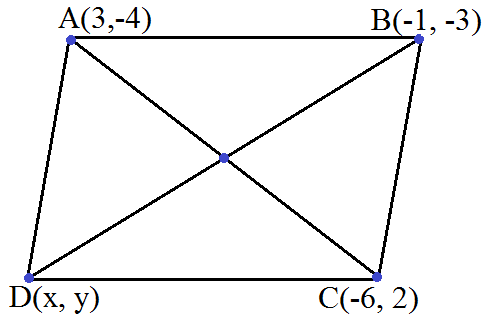
Let $A(3, -4)$ and $C(-6, -2)$ be the extremities of diagonal $AC$ and $B(-1, -3), D(x, y)$ be the extremities of diagonal $BD.$
Since the diagonals of a parallelogram bisect each other.
$\therefore$ Coordinates of mid-point of $AC =$ Coordinates of mid-point of $BD.$
$\Rightarrow\ \frac{3-6}{2}=\frac{\text{x}-1}{2}$
$\Rightarrow\ \frac{-3}{2}=\frac{\text{x}-1}{2}$
$\Rightarrow\ \text{x}=-2$
And, $\frac{-4+2}{2}=\frac{\text{y}-3}{2}$
$\Rightarrow\ \frac{-2}{2}=\frac{\text{y}-3}{2}$
$\Rightarrow\ \text{y}=1$
Hence, fourth vertex of parallelogram is $(-2, 1).$ View full question & answer→Question 164 Marks
The centre of a circle is $(2a, a - 7)$. Find the values of a if the circle passes through the point $(11, -9)$ and has diameter $10\sqrt{2}$ units.
AnswerBy given condition,
Distance between the centre $C (2a, a - 7)$ and the point $P (11, -9)$, which lie on the circle = Radius of circle
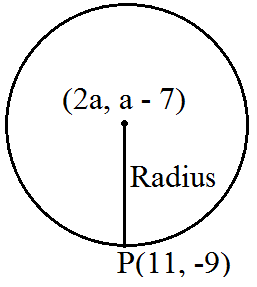
$\therefore$ Radius of circle $=\sqrt{(11-2\text{a})^2+(-9-\text{a}+7)^2}\ .......(\text{i})$
$\Big[\because$ distance between two points $(x_1, y_1)$ and $(\text{x}_2,\text{y}_2)=\sqrt{(\text{x}_2-\text{x}_1)^2+(\text{y}_2-\text{y}_1)^2}\Big]$
Given that, length of diameter $=10\sqrt{2}$
$\therefore$ Length of radius $=\frac{\text{Lenght of diameter}}{2}$
$=\frac{10\sqrt{2}}{2}=5\sqrt{2}$
Put this value in eq.(i), we get
$5\sqrt{2}=\sqrt{(11-2\text{a})^2+(-2-\text{a})^2}$
Squaring on both sides, we get
$ 50=(11-2 a)^2+(2+a)^2$
$ \Rightarrow 50=121+4 a^2-44 a+4+a^2+4 a $
$ \Rightarrow 5 a^2-40 a+75=0$
$ \Rightarrow a^2-8 a+15=0$
$ \Rightarrow a^2-5 a-3 a+15=0$
[By factorisation method]
$⇒ a(a - 5) - 3(a - 5) = 0$
$⇒ (a - 5)(a - 3) = 0$
$\therefore a = 3, 5$
Hence, the required values of a are $5$ and $3.$ View full question & answer→Question 174 Marks
Find the coordinates of the points which divide the line segment joining the points $(-4, 0)$ and $(0, 6)$ in four equal parts.
AnswerThe co-ordinates of the midpoint $\left(x_m, y_m\right)$ between two points $\left(x_1, y_1\right)$ and $\left(x_2, y_2\right)$ is given by,
$(\text{x}_\text{m},\text{y}_\text{m})=\bigg[\Big(\frac{\text{x}_1+\text{x}_2}{2}\Big),\Big(\frac{\text{y}_1+\text{y}_2}{2}\Big)\bigg]$
Here we are supposed to find the points which divide the line joining $A(-4, 0)$ and $B(0, 6)$ into $4$ equal parts.
We shall first find the midpoint $M(x, y)$ of these two points since this point will divide the line into two equal parts,
$(\text{x}_\text{m},\text{y}_\text{m})=\bigg[\Big(\frac{-4+0}{2}\Big),\Big(\frac{0+6}{2}\Big)\bigg]$
$(\text{x}_\text{m},\text{y}_\text{m})=(-2,3)$
So the point $M(-2, 3)$ splits this line into two equal parts.
Now, we need to find the midpoint of $A(-4, 0)$ and $M(-2, 3)$ separately and the midpoint of $B(0, 6)$ and $M(-2, 3)$. These two points along with $M(-2, 3)$ split the line joining the original two points into four equal parts.
Let $M_1(e, d)$ be the midpoint of $A(-4, 0)$ and $M(-2, 3).$
$(\text{e},\text{d})=\bigg[\Big(\frac{-4-2}{2}\Big),\Big(\frac{0+3}{2}\Big)\bigg]$
$(\text{e},\text{d})=\Big(-3,\frac{3}{2}\Big)$
Now let $M_2(g, h)$ be the midpoint of $B(0, 6)$ and $M(-2, 3).$
$(\text{g},\text{h})=\bigg[\Big(\frac{0-2}{2}\Big),\Big(\frac{6+3}{2}\Big)\bigg]$
$(\text{g},\text{h})=\Big(-1,\frac{9}{2}\Big)$
Hence the co-ordinates of the points which divide the line joining the two given points are $\Big(-3,\frac{3}{2}\Big),$ $(-2, 3)$ and $\Big(-1,\frac{9}{2}\Big).$
View full question & answer→Question 184 Marks
Find the ratio in which the line segment joining $(-2, -3)$ and $(5, 6)$ is divided by $(i)$ x-axis $(ii)$ y-axis. Also, find the coordinates of the point of division in each case.
Answer
- Let x-axis divides $PQ$ in the ratio.
$\lambda:1$
Let $R(x, y)$ be the coordinates of the point of division.
Then, the coordinates of the point of division are,
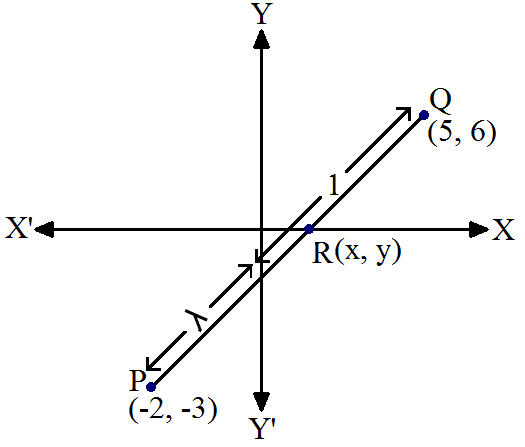
$\text{R}\bigg(\frac{5\times\lambda+(-2)\times1}{\lambda+1},\frac{6\times\lambda+(-3)\times1}{\lambda+1}\bigg)=\bigg(\frac{5\lambda-2}{\lambda+1},\frac{6\lambda-3}{\lambda+1}\bigg)$
Since R lies on x-axis.
Therefore, y-coordinates of every point on x-axis is zero.
$\therefore\ \frac{6\lambda-3}{\lambda+1}=0$
$\Rightarrow\ 6\lambda-3=0$
$\Rightarrow\ 6\lambda=3$
$\Rightarrow\ \lambda=\frac{3}{6}=\frac{1}{2}$
Hence, the required ratio is $\frac{1}{2}:1$ or $1 : 2$
Let point R(x, y) divide the line joining in the ratio $1 : 2.$
Putting $\lambda=\frac{1}{2}$ in the coordinates of $R$, we get
$\text{R}(\text{x, y})=\Bigg[\Bigg(\frac{5\times\frac{1}{2}-2}{\frac{1}{2}+1}\Bigg)\Bigg(\frac{6\times\frac{1}{2}-3}{\frac{1}{2}+1}\Bigg)\Bigg]$
Now, equating the individual components,
$\Rightarrow\ \text{x}=\frac{\frac{5-2}{2}}{\frac{1+1}{2}}$ and $\text{y}=\frac{3-3}{\frac{1+2}{1}}$
$\Rightarrow\ \text{x}=\frac{1}{3}$ and $\text{y}=0$
$\text{R}(\text{x,y})=\Big(\frac{1}{3},0\Big)$
Hence, the point $\Big(\frac{1}{3},0\Big)$ divide the line joining $PQ$ in the ratio $1 : 2.$
- $\because$ Abscissa of a point on y-axis is zero.
Let the point be $(0, y).$
Let this point divides the line segment joining $(-2, -3)$ and $(5, 6)$ in the ratio m : n.
$\therefore\ 0=\frac{\text{mx}_2+\text{nx}_1}{\text{m+n}}=\frac{\text{m(5)+n(-2)}}{\text{m+n}}$
$\Rightarrow\ 0=\frac{5\text{m}-2\text{n}}{\text{m+n}}\Rightarrow5\text{m}-2\text{n}=0$
$\Rightarrow\ 5\text{m}=2\text{n}\Rightarrow\ \frac{\text{m}}{\text{n}}=\frac{2}{5}$
$\therefore$ Ratio $= 2 : 5$
and $\text{y}=\frac{2\times6+5\times(-3)}{2+5}=\frac{12-15}{7}=\frac{-3}{7}$
$\therefore$ Required point $=\Big(0,\frac{-3}{7}\Big)$ View full question & answer→Question 194 Marks
Prove that $(4, 3), (6, 4) (5, 6)$ and $(3, 5)$ are the angular points of a square.
AnswerLet the given points be, $A(4, 3), B(6, 4) C(5, 6)$ and $D(3, 5)$ respectively. Then,
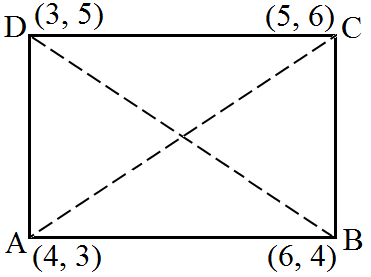
Now, $\text{AB}=\sqrt{(6-4)^2+(4-3)^2}$
$=\sqrt{4+1}$
$=\sqrt{5}\ \text{units}$
and $\text{BC}=\sqrt{(5-6)^2+(6-4)^2}$
$=\sqrt{1+4}$
$=\sqrt{5}\ \text{units}$
$\text{CD}=\sqrt{(3-5)^2+(5-6)^2}$
$=\sqrt{4+1}$
$=\sqrt{5}\ \text{units}$
$\text{AD}=\sqrt{(3-4)^2+(5-3)^2}$
$=\sqrt{1+4}$
$=\sqrt{5}\ \text{units}$
Thus, AB = BC = CD = AD
Diagonal $\text{AC}=\sqrt{(5-4)^2+(6-3)^2}$
$=\sqrt{1+9}$
$=\sqrt{10}\ \text{units}$
Diagonal $\text{BD}=\sqrt{(3-6)^2+(5-4)^2}$
$=\sqrt{9+1}$
$=\sqrt{10}\ \text{units}$
$\therefore$ $AB = BC = CD = AD$ and diagonal $AC =$ diagonal $BD.$
Thus, $ABCD$ is a quadrilateral in which all sides are equal and the diagonal are equal.
Hence, $ABCD$ is a square. View full question & answer→Question 204 Marks
If $P(-5, -3), Q(-4, -6), R(2, -3)$ and $S(1, 2)$ are the vertices of a quadrilateral $PQRS$, find its area.
Answer$P(-5, -3), Q(-4, -6), R(2, -3)$ and $S(1,2)$ are the vertices of a quadrilateral $PQRS$. Join $PR$ which forms two triangles $PQR$ and $PSR,$
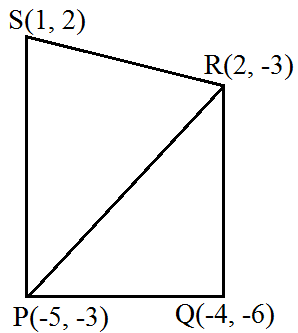
Now area of $\triangle\text{PQR}$
$=\frac{1}{2}[\text{x}_1(\text{y}_2-\text{y}_3)+\text{x}_2(\text{y}_3-\text{y}_1)+\text{x}_3(\text{y}_1-\text{y}_2)]$
$=\frac{1}{2}[-5(-6+3)+(-4)(-3+3)+2(-3+6)$
$=\frac{1}{2}[-5\times(-3)+(-4\times0)+2\times3]$
$=\frac{1}{2}(15+0+6)=\frac{1}{2}\times21=\frac{21}{2}$
and area of $\triangle\text{PSR}$
$=\frac{1}{2}[-5\times(2+3)+1(-3+3)+2(-3-2)]$
$=\frac{1}{2}[-5\times5+1\times0+2\times(-5)]$
$=\frac{1}{2}[-25+0-10]=\frac{1}{2}\times(-35)=\frac{-35}{2}$
$\therefore$ Area of quadrilateral $PQRS =\frac{21}{2}+\frac{35}{2}=\frac{56}{2}=28\text{ sq units}$ View full question & answer→Question 214 Marks
Find the area of a triangle whose vertices are,
$(\text{at}_1^2, 2\text{at}_1), (\text{at}_2^2, 2\text{at}_2)$ and $(\text{at}_3^2, 2\text{at}_3).$
AnswerCo-ordinates of $\triangle\text{ABC}$ are $\text{A}(\text{at}_1^2, 2\text{at}_1), \text{B}(\text{at}_2^2, 2\text{at}_2)$ and $\text{C}(\text{at}_3^2, 2\text{at}_3)$
$\therefore$ Area of $\triangle=\frac{1}{2}|\text{x}_1(\text{y}_2-\text{y}_3)+\text{x}_2(\text{y}_3-\text{y}_1)+\text{x}_3(\text{y}_1-\text{y}_2)|$
$=\frac{1}{2}|\text{at}_1^2(2\text{at}_2-2\text{at}_3)+\text{at}_2^2(2\text{at}_3-2\text{at}_1)+\text{at}_3^2(2\text{at}_1-2\text{at}_2)|$
$=\frac{1}{2}|2\text{a}^2\text{t}_1^2\text{t}_2-2\text{a}^2\text{t}_1^2\text{t}_3+2\text{a}^2\text{t}_2^2\text{t}_3-2\text{a}^2\text{t}_2^2\text{t}_1+2\text{a}^2\text{t}_3^2\text{t}_1-2\text{a}^2\text{t}_3^2\text{t}_2|$
$=\frac{1}{2}\times2\text{a}^2|\text{t}_1^2\text{t}_2-\text{t}_1^2\text{t}_3+\text{t}_2^2\text{t}_3-\text{t}_2^2\text{t}_1+\text{t}_3^2\text{t}_1-\text{t}_3^2\text{t}_2|$
$= \text{a}^2|\text{t}_1^2\text{t}_2 - \text{t}_1^2\text{t}_3 + \text{t}_2^2\text{t}_3 - \text{t}_3^2\text{t}_2 -\text{t}_2^2\text{t}_1 + \text{t}_3^2\text{t}_1|$
$= \text{a}^2|\text{t}_1^2(\text{t}_2 - \text{t}_3) + \text{t}_2\cdot\text{t}_3(\text{t}_2 - \text{t}_3) - \text{t}_1(\text{t}_2^2 -\text{ t}_3^2)|$
$= \text{a}^2|\text{t}_1^2(\text{t}_2 - \text{t}_3) + \text{t}_2\text{t}_3(\text{t}_2 - \text{t}_3) - \text{t}_1(\text{t}_2 +\text{ t}_3)(\text{t}_2-\text{t}_3)|$
$= \text{a}^2|(\text{t}_2 - \text{t}_3)[\text{t}_1^2 +\text{t}_2\text{t}_3 - \text{t}_1\text{t}_2 - \text{t}_1\text{t}_3]|$
$= \text{a}^2|(\text{t}_2 - \text{t}_3)[\text{t}_1^2 -\text{t}_1\text{t}_2 - \text{t}_1\text{t}_3 +\text{t}_2\text{t}_3]|$
$= \text{a}^2|(\text{t}_2 - \text{t}_3)[\text{t}_1(\text{t}_1 - \text{t}_2) - \text{t}_3(\text{t}_1 - \text{t}_2)]|$
$= \text{a}^2|(\text{t}_2 - \text{t}_3)(\text{t}_1 - \text{t}_2)(\text{t}_1 - \text{t}_3)|$
$= \text{a}^2(\text{t}_1 - \text{t}_2)(\text{t}_2 - \text{t}_3)(\text{t}_3 - \text{t}_1)$
View full question & answer→Question 224 Marks
Prove that the points $(3, 0), (6, 4)$ and $(-1, 3)$ are vertices of a right-angled isosceles triangle.
Answer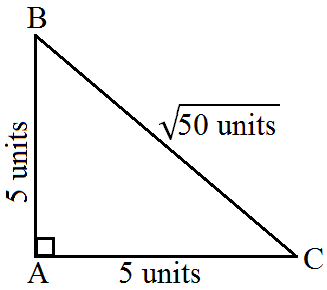
Let $A(3, 0), B(6, 4)$ and $C(-1, 3)$ be the given points. Then,
$\text{AB}=\sqrt{(6-3)^2+(4-0)^2}$
$=\sqrt{9+16}=5\text{ units}$
$\text{BC}=\sqrt{(-1-6)^2+(3-4)^2}$
$=\sqrt{49+1}=\sqrt{50}\text{ units}$
$\text{AC}=\sqrt{(-1-3)^2+(3-0)^2}$
$=\sqrt{16+9}=5\text{ units}$
Thus, AB = AC = 5 units
$\therefore\ \triangle\text{ABC}$ is isosceles.
Also, $A B^2+A C^2=5^2+5^2=50$ and
$\text{BC}^2=(\sqrt{50})^2=50$
Thus, $AB^2+ AC^2= BC^2$
This shows that $\triangle\text{ABC}$ is right-angled at A. View full question & answer→Question 234 Marks
The points $A(2, 0), B(9, 1) C(11, 6)$ and $D(4, 4)$ are the vertices of a quadrilateral $ABCD$. Determine whether $ABCD$ is a rhombus or not.
AnswerThe co-ordinates of vertices of a quadrilateral $ABCD $are $A(2, 0), B(9, 1), C(11, 6)$ and $D(4, 4)$
$AC$ and $BD$ are its diagonals which intersect each other at $O.$
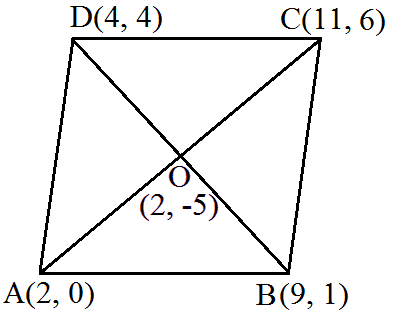
Let $O$ is the mid-point of $AC$ then co-ordinates of $O$ will be $\Big(\frac{2+11}{2},\frac{0+6}{2}\Big)$ or $\Big(\frac{13}{2},\frac{6}{2}\Big)$ or $\Big(\frac{13}{2},3\Big)$
Let $O$ is the mid-point of $BD$, then co-ordinates of $O$ will be $\Big(\frac{9+4}{2},\frac{1+4}{2}\Big)$
or $\Big(\frac{13}{2},\frac{5}{2}\Big)$
The co-ordinates of $O$ in both cases are not same.
It is not a parallelogram and also not a rhombus. View full question & answer→Question 244 Marks
Three consecutive vertices of a parallelogram are $(-2, 1), (1, 0)$ and $(4, 3)$. Find the fourth vertex.
AnswerLet the co-ordinates of three vertices are $A(-2, -1), B(1, 0)$ and $C(4, 3)$ and let the diagonals $AC$ and $BD$ bisect each other at $O.$
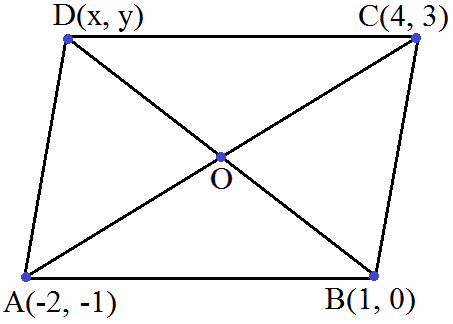
$\because$ O is the mid-point of $AC.$
$\therefore$ Vertices of $O$ will be
$\Big(\frac{\text{x}_1+\text{x}_2}{2},\frac{\text{y}_1+\text{y}_2}{2}\Big)$ or $\Big(\frac{-2+4}{2},\frac{-1+3}{2}\Big)$
or $\Big(\frac{2}{2},\frac{2}{2}\Big)$ or $(1, 1)$
Let co-ordinates of the fourth vertex D be (x, y)
$\because$ O is the mid-point of $BD$
$\therefore$ co-ordinates of O will be $\Big(\frac{1+\text{x}}{2},\frac{0+\text{y}}{2}\Big)$
or $\Big(\frac{1+\text{x}}{2},\frac{\text{y}}{2}\Big)$
$\therefore\ \frac{1+\text{x}}{2}=1$
$\Rightarrow\ 1+\text{x}=2\Rightarrow\ \text{x}=2-1=1$
and $\frac{\text{y}}{2}=1\Rightarrow\ \text{y}=2$
Co-ordinates of D will be $(1, 2).$ View full question & answer→Question 254 Marks
The vertices of $\triangle ABC$ are $(-2, 1), (5, 4)$ and $(2, -3)$ respectively. Find the area of the triangle and the length of the altitude through A.
AnswerGiven: The vertices of triangle $ABC$ are $A(-2, 1)$ and $B(5, 4)$ and $C(2, -3)$
To find: The area of triangle $ABC$ and length if the altitude through A.
Proof: We know area of triangle formed by three points $\left(x_1, y_1\right),\left(x_2, y_2\right)$ and $\left(x_3, y_3\right)$ is given by
$\triangle=\frac{1}{2}|\text{x}_1(\text{y}_2-\text{y}_3)+\text{x}_2(\text{y}_3-\text{y}_1)+\text{x}_3(\text{y}_1-\text{y}_2)|$
Now Area of $\triangle\text{ABC}$
Taking three points A(-2, 1) and B(5, 4) and C(2, -3)
Area $(\triangle\text{ABC})=\frac{1}{2}|(-8-15+2)-(5+8+6)|$
$=\frac{1}{2}|(-21)-(19)|$
$=\frac{1}{2}|(-40)|$
$=\frac{1}{2}(40)$
$=20$
We have, $\text{BC}=\sqrt{(5-2)^2+(4+3)^2}$
$\text{BC}=\sqrt{(3)^2+(7)^2}$
$\text{BC}=\sqrt{9+49}$
$\text{BC}=\sqrt{58}$
Now, Area $(\triangle\text{ABC})=\frac{1}{2}$ $\times BC \times $length of altitude through A
$20=\frac{1}{2}\times\sqrt{58}$ × length of altitude through A
length of altitude through $\text{A}=\frac{40}{\sqrt{58}}$
View full question & answer→Question 264 Marks
The point $A$ divides the join of $P(-5,1)$ and $Q(3,5)$ in the ratio $k$ : 1 . Find the two values of $k$ for which the area of $\triangle A B C$ where $B$ is $(1,5)$ and $C(7,-2)$ is equal to 2 units.
AnswerGiven that,
Point $A$ divides the line segment joining $P(-5,1)$ and $Q(3,5)$ in the ratio $k$ : 1 .
So the coordinates of A are,
$\Big(\frac{3\text{k}-5}{\text{k}+1},\frac{5\text{k}+1}{\text{k}+1}\Big)$
We know that, area of triangle formed by three points $\left(x_1, y_1\right),\left(x_2, y_2\right)$ and $\left(x_3, y_3\right)$ is given by.
$\triangle=\frac{1}{2}|\text{x}_1(\text{y}_2-\text{y}_3)+\text{x}_2(\text{y}_3-\text{y}_1)+\text{x}_3(\text{y}_1-\text{y}_2)|$
It is given that area of $\triangle\text{ABC}$ is 2 square units.
Now, three points are
$\text{A}\Big(\frac{3\text{k}-5}{\text{k}+1},\frac{5\text{k}+1}{\text{k}+1}\Big),$
$B(1, 5)$ and $C(7, -2)$
$\Rightarrow\ 2=\frac{1}{2}\Big|\frac{3\text{k}-5}{\text{k}+1}(5-(-2))+1\Big[(-2)-\Big(\frac{5\text{k}+1}{\text{k}+1}\Big)\Big]+7\Big(\frac{5\text{k}+1}{\text{k}+1}-5\Big)\Big|$
$\Rightarrow\ 2=\frac{1}{2}\Big|\frac{21\text{k}-35}{\text{k}+1}+\Big(\frac{-2\text{k}-2-5\text{k}-1}{\text{k}+1}\Big)+\Big(\frac{35\text{k}+7-35\text{k}-35}{\text{k}+1}\Big)\Big|$
$\Rightarrow\ 2=\frac{1}{2}\Big|\frac{21\text{k}-35-7\text{k}-3-28}{\text{k}+1}\Big|$
$\Rightarrow\ 2=\frac{1}{2}\Big|\frac{14\text{k}-66}{\text{k}+1}\Big|$
$\Rightarrow\ 2=\frac{1}{2}\times2\Big|\frac{7\text{k}-33}{\text{k}+1}\Big|$
$\Rightarrow\ \frac{7\text{k}-33}{\text{k}+1}=\pm2$
$\Rightarrow\ 7\text{k}-33=\pm2(\text{k}+1)$
$\Rightarrow 7k - 33 = 2k + 2$ or $7k - 33 = -2k - 2$
$\Rightarrow 5k = 35$ or $9k = -2 + 33$
$\Rightarrow k = 7$ or $\text{k}=\frac{31}{9}$
Hence, the value of k is either 7 or $\frac{31}{9}.$
View full question & answer→Question 274 Marks
Find the area of a quadrilateral $ABCD$, the coordinates of whose varities are $A(-3, 2), B(5, 4), C(7, -6)$ and $D(-5, -4).$
AnswerArea of quadrilateral $ABCD =$ area of $\triangle ABC +$ area of $\triangle ACD$

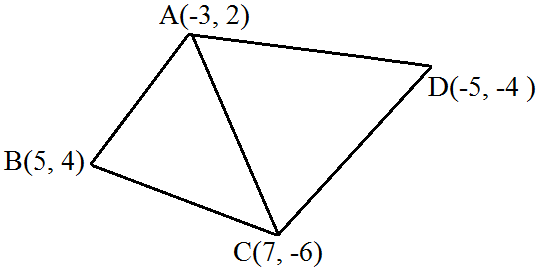
$=\frac{1}{2}|(-12-30+14)-(10+28+18)|$$+\frac{1}{2}(18-28-10)-(14+30+12)|$
$=\frac{1}{2}|-28-56|+\frac{1}{2}|-20-56|$
$=\frac{1}{2}|-84|+\frac{1}{2}|-76|$
$=42+38=80\text{ sq.units}$
$\therefore$ Area of quadrilateral $= 80$ sq.units View full question & answer→Question 284 Marks
The base $PQ$ of two equilateral triangles $P Q R$ and $P Q R^{\prime}$ with side $2 a$ lies along $y$-axis such that the mid-point of $P Q$ is at the origin. Find the coordinates of the vertices $R$ and $R^{\prime}$ of the triangles.
Answer$\triangle P Q R$ and $P Q R^{\prime}$ are equilateral triangles with side 2 a each and base $P Q$ and mid of point of $P Q$ is $O(0,0)$ and $P Q$ lies along $y$-axis,
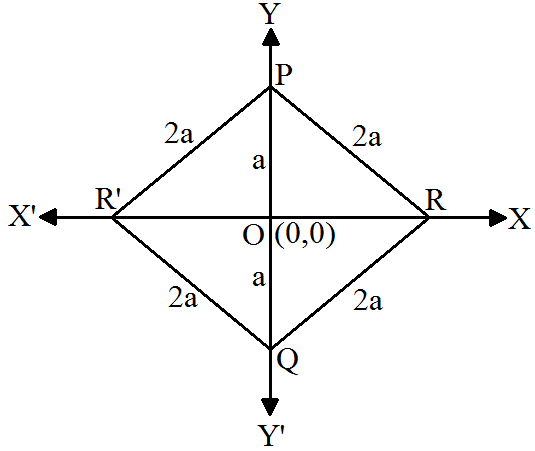
$\because PR = QR = PR' = QR' = 2a$
$PO = OQ = a$
$\therefore$ In right $∆PRO,$
$ P R^2=P O^2+O R^2 \text { (Pythagoras Theorem) }$
$ \Rightarrow(2 a)^2=(a)^2+O R^2$
$ \Rightarrow 4 a^2=a^2+O R^2$
$ O R^2=4 a^2-a^2=3 a^2$
$\therefore\ \text{OR}=\sqrt{3}\text{a}$
Similarly $\text{OR}'=-\sqrt{3}\text{a},$
Now, co-ordinates of R will be $(\sqrt{3}\text{a},0)$ and
co-ordinates of R will be $(-\sqrt{3}\text{a},0)$ View full question & answer→Question 294 Marks
The area of a triangle is $5 .$ Two of its vertices are $(2,1)$ and $(3,-2)$. The third vertex lies on $y=x+3$. Find the third vertex.
AnswerGiven: The area of triangle is 5 . Two of its vertices are $(2,1)$ and $(3,-2)$. The third vertex lies on $y=x+3$.
To find: The third vertex.
Proof: Let the third vertex be ( $x , y$ )
We know area of triangle formed by three points $\left(x_1, y_1\right),\left(x_2, y_2\right)$ and $\left(x_3, y_3\right)$ is given by,
$\triangle=\frac{1}{2}|(\text{x}_1\text{y}_2+\text{x}_2\text{y}_3+\text{x}_3\text{y}_1)-(\text{x}_2\text{y}_1+\text{x}_3\text{y}_2+\text{x}_1\text{y}_3)|$
Now,
Taking three points (x, y), (2, 1) and (3, -2)
$\triangle=\frac{1}{2}|(\text{x}-4+3\text{y})-(2\text{y}+3-2\text{x})|$
$\triangle=\frac{1}{2}|3\text{x}+\text{y}-7|$
$5=\frac{1}{2}|3\text{x}+\text{y}-7|$
$\pm10=3\text{x}+\text{y}-7$
$10 = 3x + y - 7$ or $-10 = 3x + y - 7$
$0 = 3x + y - 17........(i)$ or $0 = 3x + y + 3 ......(ii)$
Also, it is given the third vertex lies on $y = x + 3$
Substituting the value in equation $(i)$ and $(ii)$ we get
$\pm10=3\text{x}+\text{y}-7$
$10 = 3x + y - 7$
$0 = 3x + y - 17........(i)$
$0 = 3x + (x + 3) - 17$
$\text{x}=\frac{7}{2}$
Again substituting the value of x in equation $(i)$ we get
$0 = 3x + y - 17........(i)$
$0=3\Big(\frac{7}{2}\Big)+\text{y}-17$
$\text{y}=\frac{13}{2}$
Hence, $\Big(\frac{7}{2},\frac{13}{2}\Big)$
Similarly,
$-10 = 3x + y - 7$
$0 = 3x + y + 3 ......(ii)$
$0 = 3x + (x + 3) + 3$
$\text{x}=\frac{-3}{2}$
Again substituting the value of x in equation $(ii)$ we get
$0 = 3x + y + 3 ......(ii)$
$0=3\Big(\frac{-3}{2}\Big)+\text{y}+3$
$\text{y}=\frac{3}{2}$
Hence, $\Big(\frac{-3}{2},\frac{3}{2}\Big)$
Hence the coordinates of $\Big(\frac{7}{2},\frac{13}{2}\Big)$ and $\Big(\frac{-3}{2},\frac{3}{2}\Big).$
View full question & answer→Question 304 Marks
The coordinates of the point $P$ are $(-3, 2)$. Find the coordinates of the point $Q$ which lies on the line joining $P$ and origin such that $OP = OQ.$
AnswerCo-ordinates of $P$ are $(-3, 2)$ and origin $O$ are $(0, 0)$
Let co-ordinates of $Q$ be $(x, y)$
$O$ is the mid point of $PQ$
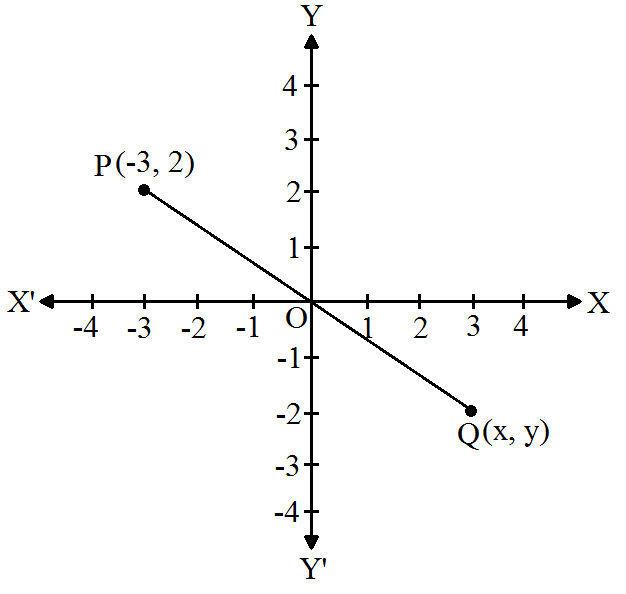
$O $is the mid point so that
$\text{O}=\frac{-3+\text{x}}{2}$
$\text{O}=-3+\text{x}$
$\text{x}=3$
$\text{O}=\frac{2+\text{y}}{2}$
$\text{O}=2+\text{y}$
$\text{y}=-2$
Therefore Co-ordinate of $Q(x, y) = (3, -2).$ View full question & answer→Question 314 Marks
Prove that the points $(4, 5) (7, 6), (6, 3), (3, 2)$ are the vertices of a parallelogram. Is it a rectangle.
AnswerLet $A(4, 5); B(7, 6); C(6, 3)$ and $D(3, 2)$ be the vertices of a quadrilateral. We have to prove that the quadrilateral $ABCD$ is a parallelogram.
We should proceed with the fact that if the diagonals of a quadrilateral bisect each other than the quadrilateral is a parallelogram.
Now to find the mid-point $P(x, y)$ of two points $A\left(x_1, y_1\right)$ and $B\left(x_2, y_2\right)$ we use section formula as,
$\text{P(x, y)}=\bigg(\frac{\text{x}_1+\text{x}_2}{2},\frac{\text{y}_1+\text{y}_2}{2}\bigg)$
So the mid-point of the diagonal $AC$ is,
$\text{Q(x, y)}=\bigg(\frac{4+6}{2},\frac{5+3}{2}\bigg)$
$= (5, 4)$
Similarly mid-point of diagonal $BD$ is,
$\text{R(x,y)}=\bigg(\frac{7+3}{2},\frac{6+2}{2}\bigg)$
$= (5, 4)$
Therefore the mid-points of the diagonals are coinciding and thus diagonal bisects each other.
Hence $ABCD$ is a parallelogram.
Now to check if $ABCD$ is a rectangle, we should check the diagonal length.
$\text{AC}=\sqrt{(6-4)^2+(3-5)^2}$
$=\sqrt{4+4}$
$=2\sqrt{2}$
Similarly,
$\text{BD}=\sqrt{(7-3)^2+(6-2)^2}$
$=\sqrt{16+16}$
$=4\sqrt{2}$
Diagonals are of different lengths.
Hence $ABCD$ is not a rectangle.
View full question & answer→Question 324 Marks
The length of a line segment is of $10$ units and the coordinates of one end-point are $(2, -3)$. If the abscissa of the other end is $10$, find the ordinate of the other end.
AnswerThe distance d between two points $(x_1, y_1)$ and $(x_2, y_2)$ is given by the formula,
$\text{d}=\sqrt{(\text{x}_1-\text{x}_2)^2+(\text{y}_1-\text{y}_2)^2}$
Here it is given that one end of a line segment has co-ordinates $(2, -3)$. The abscissa of the other end of the line segment is given to be $10$. Let the ordinate of this point be $‘y’.$
So, the co-ordinates of the other end of the line segment is $(10, y).$
The distance between these two points is given to be 10 units.
Substituting these values in the formula for distance between two points we have,
$\text{d}=\sqrt{(2-10)^2+(-3-\text{y})^2}$
$10=\sqrt{(-8)^2+(-3-\text{y})^2}$
Squaring on both sides of the equation we have,
$ 100=(-8)^2+(-3-y)^2 $
$ 100=64+9+y^2+6 y $
$ 27=y^2+6 y$
$\text { We have a quadratic equation for ' } y \text { '. Solving for the roots of this equation we have, }$
$y^2+6 y-27=0 $
$ y^2+9 y-3 y-27=0 $
$ y(y+9)-3(y+9)=0 $
$ (y+9)(y-3)=0$
The roots of the above equation are $‘-9’$ and $‘3’.$
Thus the ordinates of the other end of the line segment could be $-9$ or $3.$
View full question & answer→Question 334 Marks
Prove that $(2, -2) (-2, 1)$ and $(5, 2)$ are the vertices of a right angled triangle. Find the area of the triangle and the length of the hypotenuse.
AnswerLet $A(2, -2), B(-2, 1)$ and $C(5, 2)$ be the given points.
$\text{AB}=\sqrt{(-2-2)^2+(1+2)^2}$
$\Rightarrow\ \text{AB}=\sqrt{(-4)^2+(3)^2}$
$\Rightarrow\ \text{AB}=\sqrt{16+9}$
$\Rightarrow\ \text{AB}=\sqrt{25}$
$\text{BC}=\sqrt{(5+2)^2+(2-1)^2}$
$\Rightarrow\ \text{BC}=\sqrt{(7)^2+(1)^2}$
$\Rightarrow\ \text{BC}=\sqrt{49+1}$
$\Rightarrow\ \text{BC}=\sqrt{50}$
$\text{AC}=\sqrt{(5-2)^2+(2+2)^2}$
$\Rightarrow\ \text{AC}=\sqrt{(3)^2+(4)^2}$
$\Rightarrow\ \text{AC}=\sqrt{9+16}$
$\Rightarrow\ \text{AC}=\sqrt{25}$
$\text{AB}^2=(\sqrt{25})^2$
$\Rightarrow\ \text{AB}^2=25$
$\text{BC}^2=(\sqrt{50})^2$
$\Rightarrow\ \text{BC}^2=50$
Since, $AB^2+ AC^2= BC^2$
$\therefore$ ABC is a right angled triangle.
Length of the hypotenuse $\text{BC}=\sqrt{50}=5\sqrt{2}$
$\text{Area of }\triangle\text{ABC}=\frac{1}{2}\times\text{AB}\times\text{AC}$
$=\frac{1}{2}\times\sqrt{25}\times\sqrt{25}$
$=\frac{25}{2}\text{square units}.$
View full question & answer→Question 344 Marks
If two opposite vertices of a square are $(5,4)$ and $(1,-6)$, find the coordinates of its remaining two vertices.
AnswerTwo opposite points of a square are $(5,4)$ and $(1,-6)$.
Let $A B C D$ be a square and $A(5,4)$ and $C(1,-6)$ are the opposite points.
Let the co-ordinates of $B$ be $(x, y)$. Join $A C$.
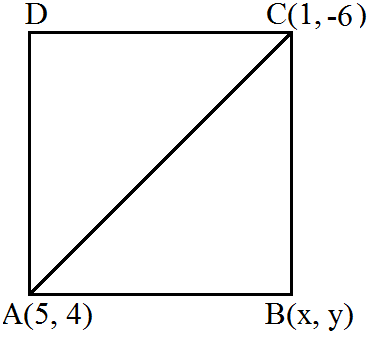
Now,
$ \because A B=B C(\text { Sides of a square }) $
$ \Rightarrow A B^2=B C^2 $
$ \Rightarrow(x-5)^2+(y-4)^2=(x-1)^2+(y+6)^2 $
$ \Rightarrow x^2-10 x+25+y^2-8 y+16=x^2-2 x+1+y^2+12 y+36 $
$ \Rightarrow-10 x+2 x-8 y-12 y=37-41 $
$ \Rightarrow-8 x-20 y=-4 $
$ \Rightarrow 2 x+5 y=1 \text { (Dividing by -4) } $
$ \Rightarrow 2 x=1-5 y $
$ \Rightarrow x=\frac{1-5 y}{2}$
$\because A B C$ is a right angled triangle.
$ \therefore A C^2=A B^2+B C^2 $
$ \Rightarrow(5-1)^2+(4+6)^2=x^2-10 x+25+y^2-8 y+16+x^2-2 x+1+y^2+12 y+36 $
$ \Rightarrow(4)^2+(10)^2=2 x^2+2 y^2-12 x+4 y+78 $
$ \Rightarrow 16+100=2 x^2+2 y^2-12 x+4 y+78 $
$ \Rightarrow 2 x^2+2 y^2-12 x+4 y+78-16-100=0 $
$ \Rightarrow x^2+y^2-6 x+2 y-19=0 \text { (Dividing by 2) }$
Substituting $\mathrm{x}=\frac{1-5 \mathrm{y}}{2}$
Substituting $\text{x}=\frac{1-5\text{y}}{2}$
$\Big(\frac{1-5\text{y}}{2}\Big)^2+\text{y}^2-6\Big(\frac{1-5\text{y}}{2}\Big)+2\text{y}-19=0$
$\Rightarrow\ \frac{1+25\text{y}^2-10\text{y}}{4}+\text{y}^2-3(1-5\text{y})+2\text{y}-19=0$
$ \Rightarrow 1+25 y^2-10 y+4 y^2-12(1-15 y)+8 y-76=0 $
$ \Rightarrow 1+25 y^2-10 y+4 y^2-12+60 y+8 y-76=0 $
$ \Rightarrow 29 y^2+58 y-87=0 $
$ \left.\Rightarrow y^2+2 y-3=0 \text { (Dividing by } 29\right) $
$ \Rightarrow y^2+3 y-y-3=0 $
$ \Rightarrow y(y+3)-1(y+3)=0 $
$ \Rightarrow(y+3)(y-1)=0$
Either $y + 3 = 0$, then $y = -3$
or $y - 1 = 0$, then $y = 1$
If $y = 1$, then
$\text{x}=\frac{1-5\text{y}}{2}=\frac{1-5\times1}{2}$
$=\frac{1-5}{2}=\frac{-4}{2}=-2$
If y = -3, then
$\text{x}=\frac{1-5(-3)}{2}=\frac{1+15}{2}$
$=\frac{16}{2}=8$
$\therefore$ Other points are $(-2, 1)$ and $(8, -3).$ View full question & answer→Question 354 Marks
Prove analytically that the line segment joining the middle points of two sides of a triangle is equal to half of the third side.
AnswerIn $\triangle ABC, D$ and $E$ are the mid points of the sides $AB$ and $AC$ respectively,
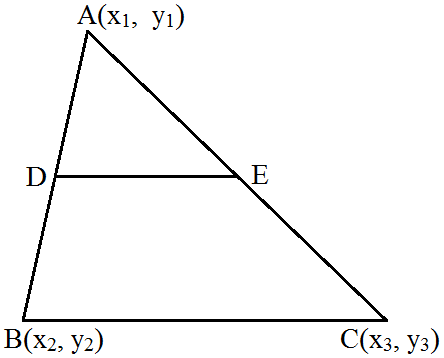
Then $\text{DE}=\frac{1}{2}\text{BC}$
Let the co-ordinates of the vertices of a ∆ABC be $A\left(x_1, y_1\right), B\left(x_2, y_2\right)$ and $C\left(x_3, y_3\right)$
Then coordinates of D will be,
$\Big(\frac{\text{x}_1+\text{x}_2}{2},\frac{\text{y}_1+\text{y}_2}{2}\Big)$
Then coordinates of E will be,
$\Big(\frac{\text{x}_1+\text{x}_3}{2},\frac{\text{y}_1+\text{y}_3}{2}\Big)$
Now length of $\text{BC}=\sqrt{(\text{x}_2-\text{x}_3)^2+(\text{y}_2-\text{y}_3)^2}\ ....(\text{i})$
and length of $\text{DE}=\sqrt{\Big(\frac{\text{x}_1+\text{x}_2}{2}-\frac{\text{x}_1+\text{x}_3}{2}\Big)^2+\Big(\frac{\text{y}_1+\text{y}_2}{2}-\frac{\text{y}_1+\text{y}_3}{2}\Big)^2}$
$=\sqrt{\Big(\frac{\text{x}_1+\text{x}_2-\text{x}_1-\text{x}_3}{2}\Big)^2+\Big(\frac{\text{y}_1+\text{y}_2-\text{y}_1-\text{y}_3}{2}\Big)^2}$
$=\sqrt{\Big(\frac{\text{x}_2-\text{x}_3}{2}\Big)^2+\Big(\frac{\text{y}_2-\text{y}_3}{2}\Big)^2}$
$=\frac{1}{2}\sqrt{(\text{x}_2-\text{x}_3)^2+(\text{y}_2-\text{y}_3)^{2}}$
$=\frac{1}{2}\text{BC}$ [From (i)]
Hence proved. View full question & answer→Question 364 Marks
Find the centre of the circle passing through $(6, -6), (3, -7)$ and $(3, 3).$
AnswerThe distance d between two points $\left(x_1, y_1\right)$ and $\left(x_2, y_2\right)$ is given by the formula,
$\text{d}=\sqrt{(\text{x}_1-\text{x}_2)^2+(\text{y}_1-\text{y}_2)^2}$
The centre of a circle is at equal distance from all the points on its circumference.
Here it is given that the circle passes through the points $A(6,-6), B(3,-7)$ and $C(3,3)$.
Let the centre of the circle be represented by the point $O(x, y)$.
So we have $A O=B O=C O$
$\text{AO}=\sqrt{(6-\text{x})^2+(-6-\text{y})^2}$
$\text{BO}=\sqrt{(3-\text{x})^2+(-7-\text{y})^2}$
$\text{CO}=\sqrt{(3-\text{x})^2+(3-\text{y})^2}$
Equating the first pair of these equations we have,
$AO = BO$
$\sqrt{(6-\text{x})^2+(-6-\text{y})^2}=\sqrt{(3-\text{x})^2+(-7-\text{y})^2}$
Squaring on both sides of the equation we have,
$ (6-x)^2+(-6-y)^2=(3-x)^2+(-7-y)^2 $
$ 36+x^2-12 x+36+y^2+12 y=9+x^2-6 x+49+y^2+14 y $
$ 6 x+2 y=14 $
$ 3 x+y=7$
Equating another pair of the equations we have,
$ A O=C O $
$ \sqrt{(6-x)^2+(-6-y)^2}=\sqrt{(3-x)^2+(3-y)^2}$
Squaring on both sides of the equation we have,
$ (6-x)^2+(-6-y)^2=(3-x)^2+(3-y)^2 $
$ 36+x^2-12 x+36+y^2+12 y=9+x^2-6 x+9+y^2-6 y$
$6x - 18y = 54$
$x - 3y = 9$
Now we have two equations for $‘x’$ and $‘y’,$ which are
$3x + y = 7$
$x - 3y = 9$
From the second equation we have $y = -3x + 7$. Substituting this value of ‘y’ in the first equation we have,
$x - 3(-3x + 7) = 9$
$x + 9x - 21 = 9$
$10x = 30$
$x = 3$
Therefore the value of ‘y’ is,
$y = -3x + 7$
$y = -3(3) + 7$
$y = -2$
Hence the co-ordinates of the centre of the circle are $(3, -2).$
View full question & answer→Question 374 Marks
In what ratio does the point $(-4, 6)$ divide the line segment joining the points $A(-6, 10)$ and $B(3, -8)?$
AnswerLet $(-4, 6)$
Divide AB internally in the ratio $k : 1$ using three section formula, we get
$(-4,6)=\Big(\frac{3\text{k}-6}{\text{k}+1},\frac{-8\text{k}+10}{\text{k}+1}\Big)$
So, $-4=\frac{3\text{k}-6}{\text{k}+1}$
i.e.,$ -4k - 4 = 3k - 6$
i.e., $7k = 2$
i.e., $k : 1 = 2 : 7$
You check for the y-coordinate also, So, the point $(-4, 6)$ divides the line segment joining the points $A(-6, 10)$ and $B(3, -8)$ in the ratio $2 : 7.$
View full question & answer→Question 384 Marks
If $(-4,3)$ and $(4,3)$ are two vertices of an equilateral triangle, find the coordinates of the third vertex, given that the origin lies in the,
i. interior,
ii. exterior of the triangle.
AnswerLet the third vertex of an equilateral triangle be $(x, y)$.
Let $A(-4,3), B(4,3)$ and $C(x, y)$.
We know that, in equilateral triangle the angle between two adjacent side is $60$ and all three sides are equal.
$\therefore AB = BC = CA$
$\Rightarrow AB^2 = BC^2 = CA^2 .......(i)$
Now taking first two parts.
$AB^2 = BC^2$
$\Rightarrow (4 + 4)^2 + (3 - 3)^2 = (x - 4)^2 + (y - 3)^2$
$\Rightarrow 64 + 0 = x^2 + 16 - 8x + y^2 + 9 - 6y$
$\Rightarrow x^2 + y^2 - 8x - 6y = 39 ......(ii)$
Now, taking first and third parts.
$AB^2 = CA^2$
$\Rightarrow (4 + 4)^2 + (3 - 3)^2 = (-4 - x)^2 + (3 - y)^2$
$\Rightarrow 64 + 0 = 16 + x^2 + 8x + 9 + y^2 - 6y$
$\Rightarrow x^2 + y^2 + 8x - 6y = 39 .....(iii)$
On subtracting eq.(ii) from eq.(iii), we get
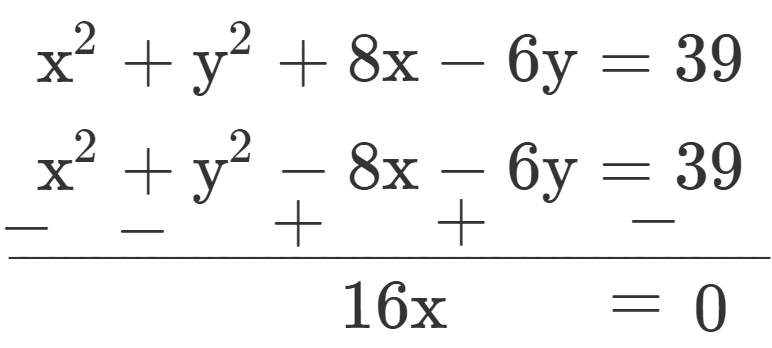
\Rightarrow $x = 0$
Now, put the value of x in eq.$(ii)$, we get
$0 + y^2 - 0 - 6y = 39$
$\Rightarrow y^2 - 6y - 39 = 0$
$\therefore\ \text{y}=\frac{6\pm\sqrt{(-6)^2-4(1)(-39)}}{2\times1}$
$\bigg[\because$ Solution of $ax^2+ bx + c = 0$ is $\text{x}={-\text{b}\pm\sqrt{\text{b}^2-4\text{ac}}\over2\text{a}}\bigg]$
$\Rightarrow\ \text{y}=\frac{6\pm\sqrt{36+156}}{2}$
$\Rightarrow\ \text{y}=\frac{6\pm\sqrt{192}}{2}$
$\Rightarrow\ \text{y}=\frac{6\pm2\sqrt{48}}{2}$
$\Rightarrow\ \text{y}=3\pm\sqrt{48}$
$\Rightarrow\ \text{y}=3\pm4\sqrt{3}$
$\Rightarrow\ \text{y}=3+4\sqrt{3}$ or $3-4\sqrt{3}$
So, the points of third vertex are,
$(0, 3+4\sqrt{3})$ or $(3-4\sqrt{3})$
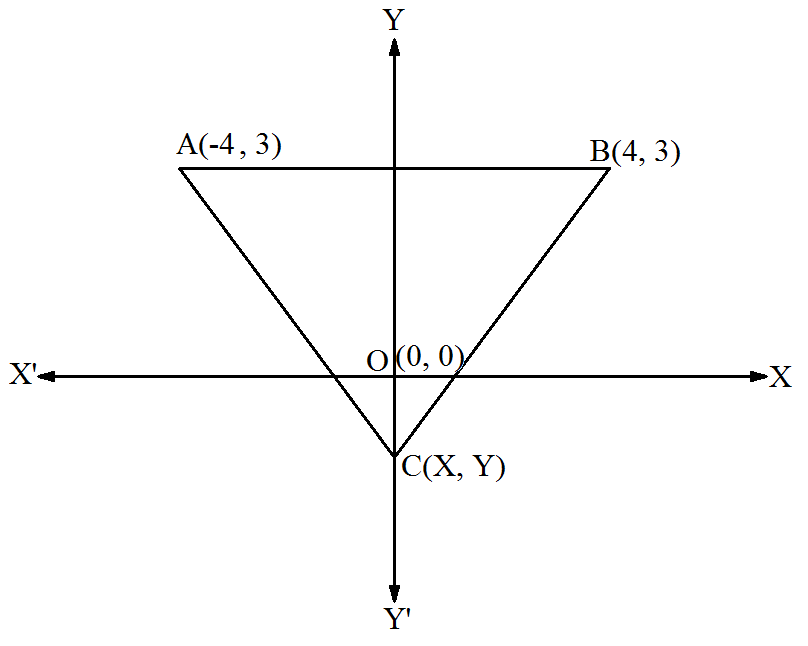
But given that, the origin lies in the interior of the $\triangle ABC$ and the x-coordinate of third vertex is zero.
Then, y-coordinate of third vertex should be negative.
Hence, the require coordinate of third vertex,
$\text{C}=(0,3-4\sqrt{3}).[\text{C}\neq(0,3+4\sqrt{3})]$ View full question & answer→Question 394 Marks
If $(-2,3),(4,-3)$ and $(4,5)$ are the mid-points of the sides of a triangle, find the coordinates of its centroid.
AnswerIn $\triangle A B C, D, E$ and $F$ are the mid-points of the sides $B C, C A$ and $A B$ respectively.
The co-ordinates of $D$ are $(-2,3)$, of $E$ are $(4,-3)$ and of $F$ are $(4,5)$.
Let the co-ordinates of A, B and C be $(x_1, y_1), (x_2, y_2), (x_3, y_3)$ respectively.
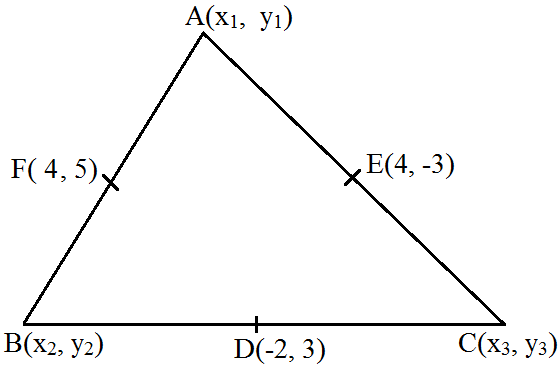
$\because$ D is mid point of BC
$\therefore\ \text{x}=\frac{\text{x}_2+\text{x}_3}{2}$ and $\text{y}=\frac{\text{y}_2+\text{y}_3}{2}$
$\Rightarrow\ -2=\frac{\text{x}_2+\text{x}_3}{2}$
$\Rightarrow\ \text{x}_2+\text{x}_3=-4$
and $3=\frac{\text{y}_2+\text{y}_3}{2}\Rightarrow\text{y}_2+\text{y}_3=6$
Similarly E and F are the mid points of AC and AB respectively.
$\therefore\ 4=\frac{\text{x}_3+\text{x}_1}2{}\Rightarrow\text{x}_3+\text{x}_1=8$
and $-3=\frac{\text{y}_3+\text{y}_1}{2}\Rightarrow\text{y}_3+\text{y}_1=-6$
$4=\frac{\text{x}_1+\text{x}_2}{2}\Rightarrow\text{x}_1+\text{x}_2=8$
and $5=\frac{\text{y}_1+\text{y}_2}{2}\Rightarrow\text{y}_1+\text{y}_2=10$
Now, $x_2 + x_3 = -4 ......(i)$
$x_3 + x_1 = 8 ......(ii)$
$x_1 + x_2 = 8 ......(iii)$
Adding we get,
$2(\text{x}_1+\text{x}_2+\text{x}_3)=12$
$\Rightarrow\ \text{x}_1+\text{x}_2+\text{x}_3=\frac{12}{2}$
$\Rightarrow x_1 + x_2 + x_3 = 6 .......(iv)$
Subtracting (i), (ii) and (iii) from (iv)
$x_1 = 10$
$x_2 = -2$
$x_3 = -2$
Similarly, $y_2 + y_3 = 6 ......(v)$
$y_3 + y_1 = -6 ......(vi)$
$y_1 + y_2 = 10 ........(vii)$
Adding, we get
$2(\text{y}_1+\text{y}_2+\text{y}_3)=10\Rightarrow\ \text{y}_1+\text{y}_2+\text{y}_3=\frac{10}{2}$
$\Rightarrow y_1 + y_2 + y_3 = 5 .......(viii)$
Subracting (v), (vi) and (vii) from (viii)
$y_1 = -1$
$y_2 = 11$
$y_3 = -5$
$\therefore$ Co-ordinates of $A, B$ and $C$ will be $(10, -1), (-2, 11), (-2, -5)$
$=\bigg(\frac{\text{x}_1+\text{x}_2+\text{x}_3}{3},\frac{\text{y}_1+\text{y}_2+\text{y}_3}{3}\bigg)$
or $\Big(\frac{10-2-2}{3},\frac{-1+11-5}{3}\Big)$ or $\Big(\frac{6}{3},\frac{5}{3}\Big)$
or $\Big(2,\frac{5}{2}\Big)$ View full question & answer→Question 404 Marks
Prove that the lines joining the middle points of the opposite sides of a quadrilateral and the join of the middle points of its diagonals meet in a point and bisect one another.
Answer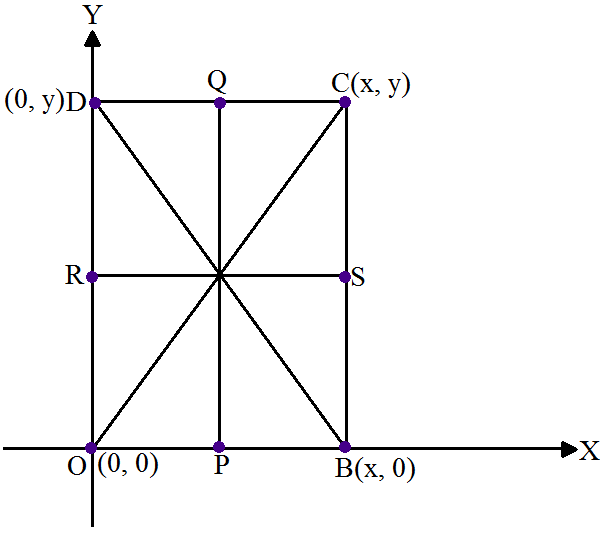
Let $OBCD$ be the quadrilateral $P, Q, R, S$ be the midpoint off $OB, CD, OD$ and $BC.$
Let the coordinates of $O, B, C, D$ are $(0, 0), (x, 0), (x, y)$ and $(0, y).$
coordinates of $P$ are $\Big(\frac{\text{x}}{2},0\Big)$
coordinates of $Q$ are $\Big(\frac{\text{x}}{2},\text{y}\Big)$
coordinates of $R$ are $\Big(0,\frac{\text{y}}{2}\Big)$
coordinates of $S$ are $\Big(\text{x},\frac{\text{y}}{2}\Big)$
Coordinates of midpoint of $PQ$ are $\bigg[\frac{\frac{\text{x}}{2}+\frac{\text{x}}{2}}{2},\frac{0+\text{y}}{2}\bigg]=\Big(\frac{\text{x}}{2},\frac{\text{y}}{2}\Big)$
Coordinates of midpoint of $RS$ are $\bigg[\frac{(0+\text{x})}{2},\frac{\frac{\text{y}}{2}+\frac{\text{y}}{2}}{2}\bigg]=\Big[\frac{\text{x}}{2},\frac{\text{y}}{2}\Big]$
Since, the coordinates of the mid-point of $PQ =$ coordinates of mid-point of $RS$
$\therefore$ $PQ$ and $RS$ bisect each other. View full question & answer→Question 414 Marks
If $\text{D}\Big(\frac{-1}{2},\frac{5}{2}\Big),$ E(7, 3) and $\text{F}\Big(\frac{7}{2},\frac{7}{2}\Big)$ are the mid-points of sides of $\triangle ABC$, find the area of $\triangle ABC.$
Answer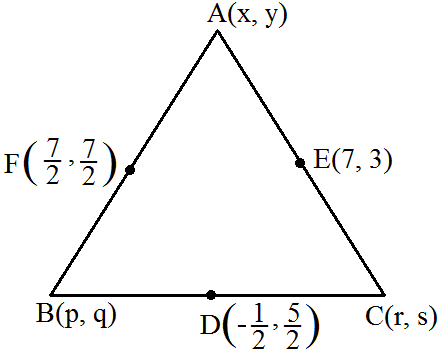
The midpoint of BC is $\text{D}\Big(\frac{-1}{2},\frac{5}{2}\Big)$
The midpoint of AB is $\text{F}\Big(\frac{7}{2},\frac{7}{2}\Big)$
The midpoint of AC is E(7, 3),
Consider the line segment BC,
$\Rightarrow\ \frac{\text{p}+\text{r}}{2}=-\frac{1}{2};\ \frac{\text{q}+\text{s}}{2}=\frac{5}{2}$
$\Rightarrow\ \text{p}+\text{r}=-1;\ \text{q}+\text{s}=5\ .....(\text{i})$
Consider the line segment AB,
$\Rightarrow\ \frac{\text{p}+\text{x}}{2}=\frac{7}{2};\ \frac{\text{q}+\text{y}}{2}=\frac{7}{2}$
$\Rightarrow\ \text{p}+\text{x}=7;\ \text{q}+\text{y}=7\ .....(\text{ii})$
Consider the line segment AC,
$\Rightarrow\ \frac{\text{r}+\text{x}}{2}=7;\ \frac{\text{s}+\text{y}}{2}=3$
$\Rightarrow\ \text{r}+\text{x}=14;\ \text{s}+\text{y}=6\ ....(\text{iii})$
Solve (i), (ii) and (iii) to get $A(x, y) = A(11, 4), B(p, q) = B(-4, 3), C(r, s) = C(3, 2)$
Let us assume that BC is base of the triangle,
$\overline{\text{BC}}=\sqrt{(-4-3)^2+(3-2)^2}=\sqrt{50}$
Equation of the line BC is,
$\frac{\text{x}+4}{-4-3}=\frac{\text{y}-3}{3-2}$
$\Rightarrow\ \text{x}+7\text{y}-17=0$
The perpendicular distance from a point $P(x_1, y_1)$ is,
$\text{P}=\Big|\frac{1(11)+7(4)-17}{\sqrt{50}}\Big|=\frac{22}{\sqrt{50}}$
The area of the triangle is $\text{A}=\frac{1}{2}\times\sqrt{50}\times\frac{22}{\sqrt{50}}$
$= 11$sq. units View full question & answer→Question 424 Marks
In Fig., a right triangle $BOA$ is given $C$ is the mid-point of the hypotenuse $AB$. Show that it is equidistant from the vertices $O, A$ and $B.$
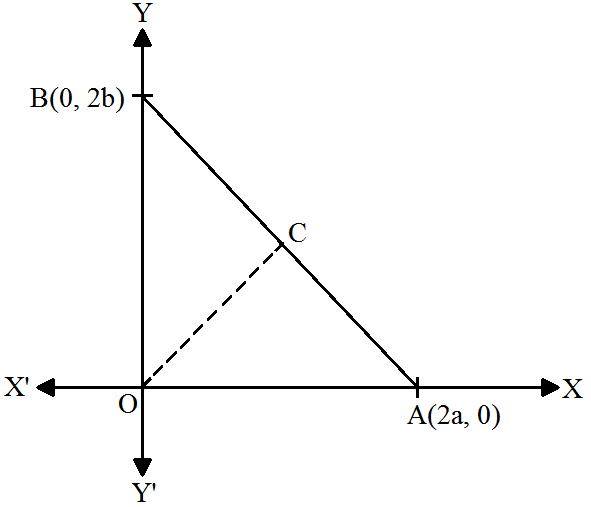
AnswerWe have a right angle triangle $\triangle\text{BOA,}$ right angled at $O$. Co-ordinates are $B(0, 2b), A(2a, 0)$ and $C(0, 0).$
We have to prove that mid-point $C$ of hypotenuse $AB$ is equidistant from the vertices.
In general to find the mid-point $P(x, y)$ of two points $\mathrm{A}\left(\mathrm{x}_1, \mathrm{y}_1\right)$ and $\mathrm{B}\left(\mathrm{x}_2, \mathrm{y}_2\right)$ we use section formula as,
$\text{P}(\text{x, y})=\Big(\frac{\text{x}_1+\text{x}_2}{2},\frac{\text{y}_1+\text{y}_2}{2}\Big)$
So co-ordinates of $C$ is,
$C(a, b)$
In general, the distance between $\mathrm{A}\left(\mathrm{x}_1, \mathrm{y}_1\right)$ and $\mathrm{B}\left(\mathrm{x}_2, \mathrm{y}_2\right)$ is given by,
$\text{AB}=\sqrt{(\text{x}_2-\text{x}_1)^2+(\text{y}_2-\text{y}_1)^2}$
So,
$\text{CO}=\sqrt{(\text{a}-0)^2+(\text{b}-0)^2}$
$=\sqrt{\text{a}^2+\text{b}^2}$
$\text{CB}=\sqrt{(\text{a}-0)^2+(\text{b}-2\text{b})^2}$
$=\sqrt{\text{a}^2+\text{b}^2}$
$\text{CA}=\sqrt{(\text{a}-2\text{a})^2+(\text{b}-0)^2}$
$=\sqrt{\text{a}^2+\text{b}^2}$
Hence, mid-point $C$ of hypotenuse $AB$ is equidistant from the vertices.
View full question & answer→Question 434 Marks
Determine the ratio in which the point $(-6, a)$ divides the join of $A(-3, 1)$ and $B(-8, 9)$. Also find the value of a.
AnswerThe co-ordinates of a point which divided two points $\left(\mathrm{x}_1, \mathrm{y}_1\right)$ and $\left(\mathrm{x}_2, \mathrm{y}_2\right)$ internally in the ratio m : n is given by the formula,
$(\text{x},\text{y})=\bigg[\Big(\frac{\text{mx}_2+\text{nx}_1}{\text{m}+\text{n}}\Big),\Big(\frac{\text{my}_2+\text{ny}_1}{\text{m}+\text{n}}\Big)\bigg]$
Here we are given that the point P(-6, a) divides the line joining the points $A(-3, 1)$ and $B(-8, 9)$ in some ratio.
Let us substitute these values in the earlier mentioned formula.
$(-6,\text{a})=\bigg[\Big(\frac{\text{m}(-8)+\text{n}(-3)}{\text{m}+\text{n}}\Big),\Big(\frac{\text{m}(9)+\text{n}(1)}{\text{m}+\text{n}}\Big)\bigg]$
Equating the individual components we have,
$-6=\frac{\text{m}(-8)+\text{n}(-3)}{\text{m}+\text{n}}$
$-6\text{m}-6\text{n}=-8\text{m}-3\text{n}$
$2\text{m}=3\text{n}$
$\frac{\text{m}}{\text{n}}=\frac{3}{2}$
We see that the ratio in which the given point divides the line segment is $3 : 2.$
Let us now use this ratio to find out the value of ‘a’.
$(-6,\text{a})=\bigg[\Big(\frac{\text{m}(-8)+\text{n}(-3)}{\text{m}+\text{n}}\Big),\Big(\frac{\text{m}(9)+\text{n}(1)}{\text{m}+\text{n}}\Big)\bigg]$
$(-6,\text{a})=\bigg[\Big(\frac{3(-8)+2(-3)}{3+2}\Big),\Big(\frac{3(9)+2(1)}{3+2}\Big)\bigg]$
Equating the individual components we have
$\text{a}=\frac{3(9)+2(1)}{3+2}$
$\text{a}=\frac{29}{5}$
Thus the value of 'a' is $\frac{29}{5}.$
View full question & answer→Question 444 Marks
In what ratio is the line segment joining the points $(-2, -3)$ and $(3, 7)$ divided by the y-axis? Also, find the coordinates of the point of division.
AnswerLet y-axis divides $PQ$ in the ratio.
$\lambda:1$
Let $R(x, y)$ be the coordinates of the point of division.
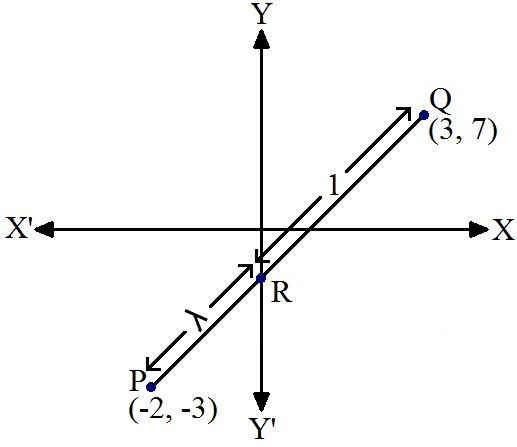
Then, the coordinates of the point of division are,
$\text{R}\bigg(\frac{3\times\lambda+(-2)\times1}{\lambda+1},\frac{7\times\lambda+(-3)\times1}{\lambda+1}\bigg)=\bigg(\frac{3\lambda-2}{\lambda+1},\frac{7\lambda-3}{\lambda+1}\bigg)$
Since R lies on y-axis and x-coordinates of every point on y-axis is zero.
$\therefore\ \frac{3\lambda-2}{\lambda+1}=0$
$\Rightarrow\ 3\lambda-2=0$
$\Rightarrow\ 3\lambda=2$
$\Rightarrow\ \lambda=\frac{2}{3}$
Hence, the required ratio is $\frac{2}{3}:1$ i.e., $2 : 3$ putting $\lambda=\frac{2}{3}$ in the coordinates of $R$, we get
$\Rightarrow\ \frac{7\lambda-3}{\lambda+1}=\frac{7\times\frac{2}{3}-3}{\frac{2}{3}+1}$
$\Rightarrow\ \frac{\frac{14-9}{3}}{\frac{2+3}{3}}=\frac{\frac{5}{3}}{\frac{5}{3}}=1$
Hence, the coordinates of $R(0, 1).$ View full question & answer→Question 454 Marks
If $Q(0,1)$ is equidistant from $P(5,-3)$ and $R(x, 6)$, find the values of $x$. Also, find the distances $Q R$ and $P R$.
AnswerGiven $Q(0,1)$ is equidistant from $P(-5,-3)$ and $R(x, 6)$ so $P Q=Q R$
$\sqrt{(5-0)^2+(-3-1)^2}=\sqrt{(0-\text{x})^2+(1-6)^2}$
$\sqrt{(5)^2+(-4)^2}=\sqrt{(-\text{x})^2+(-5)^2}$
$\sqrt{25+16}=\sqrt{\text{x}^2+25}$
$41=\text{x}^2+25$
$16=\text{x}^2$
$\text{x}=\pm4$
So, point R is $(4, 6)$ or $(-4, 6)$
When point R is $(4, 6)$
$\text{PR}=\sqrt{(5-4)^2+(-3-6)^2}$
$=\sqrt{1^2+(-9)^2}=\sqrt{1+81}=\sqrt{82}$
$\text{QR}=\sqrt{(0-4)^2+(1-6)^2}$
$=\sqrt{(-4)^2+(-5)^2}=\sqrt{16+25}=\sqrt{41}$
When point R is (-4, 6)
$\text{PR}=\sqrt{(5-(-4))^2+(-3-6)^2}$
$=\sqrt{(9)^2+(-9)^2}=\sqrt{81+81}=9\sqrt{2}$
$\text{QR}=\sqrt{(0-(-4))^2+(1-6)^2}$
$=\sqrt{(4)^2+(-5)^2}=\sqrt{16+25}=\sqrt{41}$
View full question & answer→Question 464 Marks
Find the area of a parallelogram $ABCD$ if three of its vertices are $A(2, 4)$, $\text{B}(2+\sqrt{3},\ 5)$ and $C(2, 6).$
AnswerThree vertices of a ||gm $ABCD$ are $A(2, 4)$, $\text{B}(2+\sqrt{3},\ 5)$ and $C(2, 6).$
Draw one diagonal $AC$ of ||gm $ABCD$
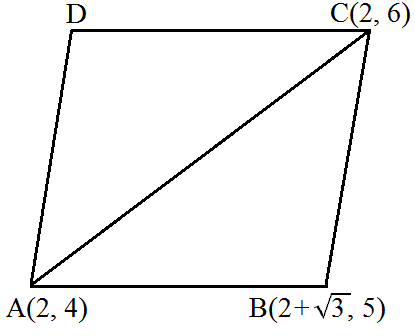
$\because$ Diagonal bisects the ||gm into triangle equal in area
Area of $\triangle\text{ABC}=\frac{1}{2}[\text{x}_1(\text{y}_2-\text{y}_3)+\text{x}_2(\text{y}_3-\text{y}_1)+\text{x}_3(\text{y}_1-\text{y}_2)]$
$=\frac{1}{2}[2(5-6)+(2+\sqrt{3})(6-4)+2(4-5)]$
$=\frac{1}{2}[2\times(-1)+(2+\sqrt{3})\times2+2\times(-1)]$
$=\frac{1}{2}[-2+4+2\sqrt{3}-2]$
$=\frac{1}{2}(2\sqrt{3})=\sqrt{3}\text{ sq.units}$
$\therefore$ Area of ||gm $ABCD = 2 \times $ area $(\triangle\text{ABC})$
$=2\times(\sqrt{3})=2\sqrt{3}\text{ sq.units}$ View full question & answer→Question 474 Marks
Show that $A (-3,2), B (-5,-5), C (2,-3)$, and $D (4,4)$ are the vertices of a rhombus.
AnswerVertices of a quadrilateral $A B C D$ are $A(-3,2), B(-5,-5), C(2,-3)$ and $D(4,4)$. Join the diagonals $A C$ and $B D$ which intersect each other at $O$.
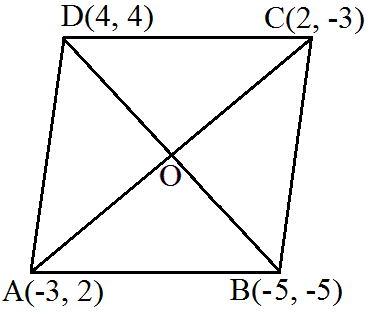
Let O is the mid-point of AC, then co-ordinates of O will be $\Big(\frac{\text{x}_1+\text{x}_2}{2},\frac{\text{y}_1+\text{y}_2}{2}\Big)$
or $\Big(\frac{-3+2}{2},\frac{2-3}{2}\Big)$ or $\Big(\frac{-1}{2},\frac{-1}{2}\Big)$
If O is the mid-point of BD, their co-ordinates of O will be.
$\Big(\frac{-5+4}{2},\frac{-5+4}{2}\Big)$ or $\Big(\frac{-1}{2},\frac{-1}{2}\Big)$
$\because$ The co-ordinates of O in both case are same length of $\text{AC}=\sqrt{(\text{x}_2-\text{x}_1)^2+(\text{y}_2-\text{y}_1)^2}$
$=\sqrt{(-3-2)^2+(2+3)^2}$
$=\sqrt{(-5)^2+(5)^2}=\sqrt{25+25}$
$=\sqrt{50}=\sqrt{25\times2}=5\sqrt{2}$
and $\text{BD}=\sqrt{(-5-4)^2+(-5-4)^2}$
$=\sqrt{(-9)^2+(-9)^2}$
$=\sqrt{81+81}=\sqrt{162}=\sqrt{2\times81}=9\sqrt{2}$
Side $\text{AB}=\sqrt{(-3+5)^2+(2+5)^2}$
$=\sqrt{(2)^2+(7)^2}=\sqrt{4+49}=\sqrt{53}$
$\text{BC}=\sqrt{(2+5)^2+(-3+5)^2}$
$=\sqrt{(7)^2+(2)^2}=\sqrt{49+4}=\sqrt{53}$
$\text{CD}=\sqrt{(4-2)^2+(4+3)^2}$
$\text{CD}=\sqrt{(2)^2+(7)^2}$
$\text{CD}=\sqrt{4+49}$
$\text{CD}=\sqrt{53}$
and $\text{DA}=\sqrt{(-3-4)^2+(2-4)^2}$
$\text{DA}=\sqrt{(-7)^2+(-2)^2}$
$\text{DA}=\sqrt{49+4}$
$\text{DA}=\sqrt{53}$
$\because$ The diagonals bisect each other, but length of diagonals is not equal and sides are equal.
$\therefore$ The figure is of a rhombus.
Hence proved. View full question & answer→Question 484 Marks
Which point on x-axis is equidistant from $(5, 9)$ and $(-4, 6)?$
AnswerLet $A(5, 9)$ and $B(-4, 6)$ be the given points.
Let $C(x, 0)$ be the point on x-axis
Now,
$\text{AC}=\sqrt{(\text{x}-5)^2+(0-9)^2}$
$\Rightarrow\ \text{AC}=\sqrt{\text{x}^2+25-10\text{x}+(-9)^2}$
$\Rightarrow\ \text{AC}=\sqrt{\text{x}^2-10\text{x}+25+81}$
$\Rightarrow\ \text{AC}=\sqrt{\text{x}^2-10\text{x}+106}$
$\text{BC}=\sqrt{(\text{x}+4)^2+(0-6)^2}$
$\Rightarrow\ \text{BC}=\sqrt{\text{x}^2+16+8\text{x}+(-6)^2}$
$\Rightarrow\ \text{BC}=\sqrt{\text{x}^2+8\text{x}+16+36}$
$\Rightarrow\ \text{BC}=\sqrt{\text{x}^2+8\text{x}+52}$
Since, $AC = BC$
$ \text { Or, } A C^2=B C^2 $
$ x^2-10 x+106=x^2+8 x+52 $
$ \Rightarrow-10 x+106=8 x+52 $
$ \Rightarrow-10 x-8 x=52-106 $
$ \Rightarrow-18 x=-54$
$\Rightarrow\ \text{x}=\frac{54}{18}$
$\Rightarrow x = 3$
Hence the points on x-axis is $(3, 0).$
View full question & answer→Question 494 Marks
If $P(9 a-2,-b)$ divides the line segment joining $A(3 a+1,-3)$ and $B(8 a, 5)$ in the ratio $3: 1$, find the values of $a$ and $b$.
AnswerLet $P(9 a-2,-b)$ divides $A B$ internally in the ratio $3: 1$.
By section formula,
$9\text{a}-2=\frac{3(8\text{a})+1(3\text{a}+1)}{3+1}$
$\Bigg[\because$ internal section formula, the coordinates of point P divides the line segment joining the point $\left(\mathrm{x}_1, \mathrm{y}_1\right)$ and $\left(\mathrm{x}_2, \mathrm{y}_2\right)$ in the ratio $\mathrm{m}_1: \mathrm{m}_2$ internally is $\bigg(\frac{\text{m}_2\text{x}_1+\text{m}_1\text{x}_2}{\text{m}_1+\text{m}_2},\frac{\text{m}_2\text{y}_1+\text{m}_1\text{y}_2}{\text{m}_1+\text{m}_2}\bigg)\Bigg]$
and $-\text{b}=\frac{3(5)+1(-3)}{3+1}$
$\Rightarrow9\text{a}-2=\frac{24\text{a}+3\text{a}+1}{4}$
and $-\text{b}=\frac{15-3}{4}$
$\Rightarrow9\text{a}-2=\frac{27\text{a}+1}{4}$
and $-\text{b}=\frac{12}{4}$
$\Rightarrow 36a - 8 = 27a + 1$
and $b = -3$
$\Rightarrow 36a - 27a - 8 - 1 = 0$
$\Rightarrow 9a - 9 = 0$
$a = 1$
View full question & answer→Question 504 Marks
If $G$ be the centroid of a triangle $ABC$ and $P$ be any other point in the plane, prove that $\mathrm{PA}^2+\mathrm{PB}^2+\mathrm{PC}^2=\mathrm{GA}^2+\mathrm{GB}^2+\mathrm{GC}^2+3 \mathrm{GP}^2$.
AnswerLet $\triangle\text{ABC}$ be any triangle whose coordinates are $A\left(x_1, y_1\right), B\left(x_2, y_2\right)$ and $C\left(x_3, y_3\right)$..
Let P be the origin and G be the centraid of the triangle.
Now, we have to prove that
$\mathrm{PA}^2+\mathrm{PB}^2+\mathrm{PC}^2=\mathrm{GA}^2+\mathrm{GB}^2+\mathrm{GC}^2+3 \mathrm{GP}^2
.......(i)$
We know that,
Coordinates of the centraid G of the triangle ABC whose coordinates are $A\left(x_1, y_1\right), B\left(x_2, y_2\right)$ and $C\left(x_3, y_3\right)$. is given by,
$\text{G}\Big(\frac{\text{x}_1+\text{x}_2+\text{x}_3}{3},\frac{\text{y}_1+\text{y}_2+\text{y}_3}{3}\Big)$
The distance between $A(x_1, y_1)$ and $B(x_2, y_2)$ is given by,
$\text{AB}=\sqrt{(\text{x}_2-\text{x}_1)^2+(\text{y}_2-\text{y}_1)^2}$
So,
$ P A^2=\left(x_1-0\right)^2+\left(y_1-0\right)^2$
$ P A^2=x_1^2+y_1^2$
$ P B^2=\left(x_2-0\right)^2+\left(y_2-0\right)^2$
$ P B^2=x_2^2+y_2^2$
$P C^2=\left(x_3-0\right)^2+\left(y_3-0\right)^2$
$P C^2=x_3{ }^2+y_3{ }^2$
Now,
$\text{GP}^2=\Big(\frac{\text{x}_1+\text{x}_2+\text{x}_3}{3}-0\Big)^2+\Big(\frac{\text{y}_1+\text{y}_2+\text{y}_3}{3}-0\Big)^2$
$=\frac{(\text{x}_1+\text{x}_2+\text{x}_3)^2}{9}+\frac{\text{(y}_1+\text{y}_2+\text{y}_3)^2}{9}$
$\text{GA}^2=\Big(\text{x}_1-\frac{\text{x}_1+\text{x}_2+\text{x}_3}{3}\Big)^2+\Big(\text{y}_1-\frac{\text{y}_1+\text{y}_2+\text{y}_3}{3}\Big)^2$
$=\Big(\frac{\text{3x}_1-\text{x}_1-\text{x}_2-\text{x}_3}{3}\Big)^2+\Big(\frac{\text{3y}_1-\text{y}_1-\text{y}_2-\text{y}_3}{3}\Big)^2$
$=\frac{\text{(2x}_1-\text{x}_2-\text{x}_3)^2}{9}+\frac{\text(\text{2y}_1-\text{y}_2-\text{y}_3)^2}{9}$
$\text{GB}^2=\Big(\text{x}_2-\frac{\text{x}_1+\text{x}_2+\text{x}_3}{3}\Big)^2+\Big(\text{y}_2-\frac{\text{y}_1+\text{y}_2+\text{y}_3}{3}\Big)^2$
$=\frac{(2\text{x}_2-\text{x}_1-\text{x}_3)^2}{9}+\frac{(2\text{y}_2-\text{y}_1-\text{y}_3)^2}{9}$
$\text{GC}^2=\Big(\text{x}_3-\frac{\text{x}_1+\text{x}_2+\text{x}_3}{3}\Big)^2+\Big(\text{y}_3-\frac{\text{y}_1+\text{y}_2+\text{y}_3}{3}\Big)^2$
$\text{GC}^2=\frac{(3\text{x}_3-\text{x}_1-\text{x}_2)^2}{9}+\frac{(3\text{y}_3-\text{y}_1-\text{y}_2)^2}{9}$
Now, we get the value of left hand side of equation (i) as
$P A^2+P B^2+P C^2=x_1^2+x_2^2+x_3^2+y_1^2+y_2^2+y_3^2$Similarly, we get the value of right hand side of equation (i) as
$GA^2+ GB^2+ GC^2+ 3GP^2=\frac{(2\text{x}_1-\text{x}_2-\text{x}_3)^2}{9}+\frac{(2\text{y}_1-\text{y}_2-\text{y}_3)^2}{9}+\frac{(2\text{x}_2-\text{x}_1-\text{x}_3)^2}{9}+\frac{(2\text{y}_2-\text{y}_1-\text{y}_3)^2}{9}$$+\frac{(2\text{x}_3-\text{x}_1-\text{x}_2)^2}{9}+\frac{\text{(2y}_3-\text{y}_1-\text{y}_2)^2}{9}+3\times\Big[\frac{(\text{x}_1+\text{x}_2+\text{x}_3)^2}{9}+\frac{(\text{y}_1+\text{y}_2+\text{y}_3)^2}{9}\Big]$
$=\Big[\frac{2}{3}(\text{x}^2_1+\text{x}^2_2+\text{x}^2_3)+\frac{1}{3}(\text{x}^2_1+\text{x}^2_2+\text{x}^2_3)\Big]+\Big[\frac{2}{3}(\text{y}^2_1+\text{y}^2_2+\text{y}^2_3)+\frac{1}{3}(\text{y}^2_1+\text{y}^2_2+\text{y}^2_3)\Big]$
$ =x_1^2+x_2^2+x_3^2+y_1^2+y_2^2+y_3^2$
$ \text { Hence, } P A^2+P B^2+P C^2=G A^2+G B^2+G C^2+3 G P^2$.
View full question & answer→