Question 12 Marks
If $A$ and $B$ are $(-2, -2)$ and $(2, -4)$ respectively, find the coordinates of $P$ such that $AP =$ $\frac{3}{7}$ $AB$ and $P$ lies on the line segment $AB$.
Answer$A = (-2, -2)$ and $B=(2, -4)$
It is given that $AP=$ $\frac{3}{7}$ $AB$
$PB = AB - AP = AB$ −$\frac{3}{7}$$AB =$ $\frac{4}{7}$$AB$
So, we have $AP:PB = 3:4$
Let coordinates of $P$ be $(x, y)$
Using Section formula to find coordinates of $P$, we get
$x = \frac{{( - 2) \times 4 + 2 \times 3}}{{3 + 4}} = \frac{{6 - 8}}{7} = \frac{{ - 2}}{7}$
$y = \frac{{( - 2) \times 4 + ( - 4) \times 3}}{{3 + 4}} = \frac{{ - 8 - 12}}{7} = \frac{{ - 20}}{7}$
Therefore, Coordinates of point $P$ are $\left( {\frac{{ - 2}}{7},\frac{{ - 20}}{7}} \right)$.
View full question & answer→Question 22 Marks
Find the coordinates of a point $A$, where $AB$ is the diameter of a circle whose centre is $(2, -3)$ and $B$ is $(1, 4)$.
AnswerWe want to find coordinates of point $A$. $AB$ is the diameter and coordinates of centerare $(2, -3)$ and, coordinates of point $B$ are $(1, 4)$.
Let coordinates of point $A$ are $(x, y)$. Using section formula, we get
$2 = \frac{{x + 1}}{2}$
$\Rightarrow 4 = x + 1$
$\Rightarrow x = 3$
Using section formula, we get
$ - 3 = \frac{{4 + y}}{2}$
$\Rightarrow 4 + y = −6$
$\Rightarrow y =− 6 − 4 = −10$
Therefore, Coordinates of point $A$ are $(3, −10).$
View full question & answer→Question 32 Marks
If $(1, 2), (4, y), (x, 6)$ and $(3, 5)$ are the vertices of a parallelogram taken in order, find $x$ and $y$.
AnswerLet $A \rightarrow (1, 2), B \rightarrow (4, y), C\rightarrow (x, 6)$ and $D\rightarrow (3, 5)$.
We know that the diagonals of parallelogram bisect each other.
So, Coordinates of the mid-point of diagonal $AC$
= Coordinates of the mid-point of diagonal $BD$
$\Rightarrow \left( {\frac{{1 + x}}{2},\frac{{2 + 6}}{2}} \right) = \left( {\frac{{4 + 3}}{2},\frac{{y + 5}}{2}} \right)$
$\Rightarrow \left( {\frac{{1 + x}}{2},4} \right) = \left( {\frac{7}{2},\frac{{y + 5}}{2}} \right)$
$\Rightarrow \frac{{1 + x}}{2} = \frac{7}{2}$
$\Rightarrow$ $1 + x = 7$
$\Rightarrow$ $x = 6$
and $4 = \frac{{y + 5}}{2}$
$\Rightarrow$ $y + 5 = 8$
$\Rightarrow$ $y = 3$
View full question & answer→Question 42 Marks
Find the ratio in which the segment joining $A(1, -5)$ and $B(-4, 5)$ is divided by the $x$-axis. Also find the coordinates of the point of division.
AnswerLet the point of division be $P$. Let the ratio be $K : 1$.

Then
$ P \to \left\{ {\frac{{(K)( - 4) + (1)(1)}}{{K + 1}},\frac{{(K)(5) + (1)( - 5)}}{{K + 1}}} \right\}$
$P \to \left\{ {\frac{{ - 4K + 1}}{{K + 1}},\frac{{5K - 5}}{{K + 1}}} \right\}$
$\because$ $P$ lies on the $x$-axis and we know that on the x-axis the ordinate is $0$.
$\therefore \;\frac{{5K - 5}}{{K + 1}} = 0$
$\Rightarrow$ $5K - 5 = 0$
$\Rightarrow$ $5K = 5$
$\Rightarrow K = \frac{5}{5} = 1$
Hence, the required ratio is $1 : 1$.
Putting $K = 1$, we get
$P \to \left\{ {\frac{{ - 4(1) + 1}}{{1 + 1}},\frac{{5(1) - 5}}{{1 + 1}}} \right\}$
$P \to \left\{ { - \frac{3}{2},0} \right\}$ View full question & answer→Question 52 Marks
If $Q(0, 1)$ is equidistant from $P(5, -3)$ and $R(x, 6)$, find the values of $x$. Also find the distances $QR$ and $PR$.
Answer$PQ = RQ$
$\Rightarrow PQ^2 = RQ^2$
$\Rightarrow (0 - 5)^2 + [1 - (-3)]^2 = (0 - x)^2 + (1 - 6)^2$
$\Rightarrow ^25 + 16 = x^2 + ^25$
$\Rightarrow x^2 = 16$
$\Rightarrow x = \pm4$
$\therefore$ $R$ $\rightarrow$ ($\pm$$4, 6)$
$QR = \sqrt {{{(0 \pm 4)}^2} + {{(1 - 6)}^2}} = \sqrt {41}$
$PR = \sqrt {{{( \pm 4 - 5)}^2} + {{\{ 6 - ( - 3)\} }^2}}$
$= \sqrt {{{(4 - 5)}^2} + 81} \;{\text{or}}\;\sqrt {{{( - 4 - 5)}^2} + 81}$
$= \sqrt {8^2} $ or $9\sqrt 2$.
View full question & answer→Question 62 Marks
Find the values of $y$ for which the distance between the points $P (2, -3)$ and $Q (10, y)$ is $10$ units.
AnswerUsing Distance formula, we have
$10 = \sqrt {{{(2 - 10)}^2} + {{( - 3 - y)}^2}} $
$ \Rightarrow 10 = \sqrt {{{( - 8)}^2} + 9 + {y^2} + 6y} $
$ \Rightarrow 10 = \sqrt {64 + 9 + {y^2} + 6y} $
Squaring both sides, we get
$ 100=73+y^2+6 y $
$ \Rightarrow y^2+6 y-27=0$
$\text { Solving this Quadratic equation by factorization, we can write }$
$ \Rightarrow y^2+9 y-3 y-27=0 $
$ \Rightarrow y(y+9)-3(y+9)=0 $
$ \Rightarrow(y+9)(y-3)=0 $
$ \Rightarrow y=3,-9$
View full question & answer→Question 72 Marks
Check whether $(5, –2), (6, 4)$ and $(7, –2)$ are the vertices of an isosceles triangle.
AnswerLet A $\rightarrow$ $(5, -2), B$ $\rightarrow$ $(6, 4)$ and $C$ $\rightarrow$ $(7, -2)$
Then,
$AB = \sqrt {{{(6 - 5)}^2} + {{(4 - ( - 2))}^2}} = \sqrt {{{(1)}^2} + {{(6)}^2}}$
$ = \sqrt {1 + 36} = \sqrt {37}$
$BC = \sqrt {{{(7 - 6)}^2} + {{( - 2 - 4)}^2}} = \sqrt {{{(1)}^2} + {{( - 6)}^2}}$
$= \sqrt {1 + 36} = \sqrt {37}$
$CA =$ $\sqrt {{{(7 - 5)}^2} + {{( - 2 - (-2))}^2}} = \sqrt {{{(2)}^2} + {{(0)}^2}}$
We see that AB = BC $\neq$ $CA$
So, the $A, B$ and $C$ are vertices of an isosceles triangle.
View full question & answer→Question 82 Marks
Determine if the points $(1, 5), (2, 3)$ and $(-2, -11)$ are collinear.
AnswerLet $A$ $\rightarrow$ $(1, 5)$
$B$ $\rightarrow$ $(2, 3)$
$C$ $\rightarrow$ $(-2, -11)$
Then $AB = \sqrt {{{(2 - 1)}^2} + {{(3 - 5)}^2}} = \sqrt {1 + 4} = \sqrt 5$
$BC = \sqrt {{{( - 2 - 2)}^2} + {{( - 11 - 3)}^2}}$$= \sqrt {{{( - 4)}^2} + {{( - 14)}^2}}$
$= \sqrt {16 + 196} = \sqrt {212}$
$CA = \sqrt {{{[1 - (-2)]}^2} + [5 - {{( - 11)]}^2}}$$= \sqrt {{{(3)}^2} + {{(16)}^2}}$
$= \sqrt {9 + 256} = \sqrt {265}$
We see that
$AB + BC ≠ CA$
$BC + CA ≠ AB$
and $CA + AB ≠ BC$
Hence, the given points are not collinear.
View full question & answer→Question 92 Marks
Find a relation between x and y such that the point (x, y) is equidistant from the point (3, 6) and (-3, 4).
AnswerIt is given that P (x,y) is equidistant from A(3, 6) and B(-3, 4).
Using Distance formula, we can write
$PA = PB$
$\sqrt {{{(x - 3)}^2} + {{(y - 6)}^2}} = \sqrt {{{[x - ( - 3)]}^2} + {{(y - 4)}^2}} $
$ \Rightarrow \sqrt {{x^2} + 9 - 6x + {y^2} + 36 - 12y} = \sqrt {{x^2} + 9 + 6x + {y^2} + 16 - 8y} $
Squaring both sides, we get
$\Rightarrow x^2+9-6 x+y^2+36-12 y=x^2+9+6 x+y^2+16-8 y$
$⇒ −6x − 12y + 45 = 6x - 8y + 25$
$⇒ 12x + 4y = 20$
$⇒ 3x + y = 5$
View full question & answer→Question 102 Marks
Find the coordinates of the point of trisection (i.e., points dividing in three equal parts) of the line segment joining the points $A(2, – 2)$ and $B(–7, 4)$.
AnswerLet $P$ and $Q$ be the points of trisection of $AB$ i.e., $AP = PQ = QB$
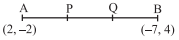
Therefore, $P$ divides $AB$ internally in the ratio $1 : 2$. Therefore, the coordinates of $P$, by applying the section formula, are
$\left(\frac{1(-7)+2(2)}{1+2}, \frac{1(4)+2(-2)}{1+2}\right), \text { i.e., }(-1,0)$
Now, $Q$ also divides $AB$ internally in the ratio $2 : 1$. So, the coordinates of $Q$ are
$\left(\frac{2(-7)+1(2)}{2+1}, \frac{2(4)+1(-2)}{2+1}\right), \text { i.e., }(-4,2)$
Therefore, the coordinates of the points of trisection of the line segment joining $A$ and $B$ are $(–1, 0)$ and $(– 4, 2)$. View full question & answer→Question 112 Marks
Find a point on the $y-$axis which is equidistant from the points $A(6, 5)$ and $B (- 4, 3)$.
AnswerWe have to find a point on the $y$-axis which is equidistant from the points $A(6, 5)$ and $B (- 4, 3)$. We know that a point on $y$-axis is of the form $(0, y)$. So, let the required point be $P (0, y)$.
Then,
$PA = PB$
$\Rightarrow \sqrt { ( 0 - 6 ) ^ { 2 } + ( y - 5 ) ^ { 2 } } = \sqrt { ( 0 + 4 ) ^ { 2 } + ( y - 3 ) ^ { 2 } }$
$\Rightarrow 36+(y-5)^2=16+(y-3)^2$
$ \Rightarrow 36+y^2-10 y+25=16+y^2-6 y+9$
$ \Rightarrow 4 y=36$
$ \Rightarrow y=9$
So, the required point is $ (0, 9).$
View full question & answer→Question 122 Marks
Find the relation between $x$ and $y$ such that the point $(x, y)$ is equidistant from the points $(7, 1)$ and $(3, 5)$.
AnswerLet $P(x, y)$ be equidistant from the points $A(7, 1)$ and $B(3, 5)$
$AP = BP$ (Given)
$ \Rightarrow A P^2=B P^2 $
$ \Rightarrow(x-7)^2+(y-1)^2=(x-3)^2+(y-5)^2 $
$ \Rightarrow x^2+49-14 x+y^2+1-2 y=x^2+9-6 x+y^2+25-10 y $
$ \Rightarrow 49-14 x+1-2 y=9-6 x+25-10 y $
$ \Rightarrow-14 x+6 x-2 y+10 y=34-50 $
$ \Rightarrow-8 x+8 y=-16 $
$ \Rightarrow x-y=2$
View full question & answer→Question 132 Marks
Fig. given below shows the arrangement of desks in a classroom. Ashima, Bharti and Camella are seated at $A(3, 1), B(6, 4)$ and $C(8, 6)$ respectively. Do you think they are seated in a line? Give a reason for your answer.
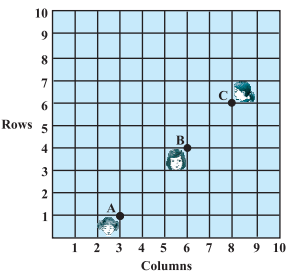
AnswerUsing the distance formula, we have
$A B=\sqrt{(6-3)^{2}+(4-1)^{2}}=\sqrt{9+9}=\sqrt{18}=3 \sqrt{2}$
$\mathrm{BC}=\sqrt{(8-6)^{2}+(6-4)^{2}}=\sqrt{4+4}=\sqrt{8}=2 \sqrt{2}$
$A C=\sqrt{(8-3)^{2}+(6-1)^{2}}=\sqrt{25+25}=\sqrt{50}=5 \sqrt{2}$
Since, $\mathrm{AB}+\mathrm{BC}=3 \sqrt{2}+2 \sqrt{2}=5 \sqrt{2}=\mathrm{AC}$
So, we can say that points $A, B$ and $C$ are collinear. Therefore, they are seated in a line.
View full question & answer→