MCQ 11 Mark
The angle of elevation of the top of a tower from a point on the ground $30m$ away from the foot of the tower is $30^\circ$. The height of the tower is:
- A
$30\text{m}$
- ✓
$10\sqrt{3}\text{m}$
- C
$20\text{m}$
- D
$10\sqrt{2}\text{m}$
AnswerCorrect option: B. $10\sqrt{3}\text{m}$
Let $AB$ be the tower and $O$ be the point of observation.
Also,
$\angle\text{AOB}=30^\circ,$ and $OB = 30m$
Let:
$AB = h\ m$
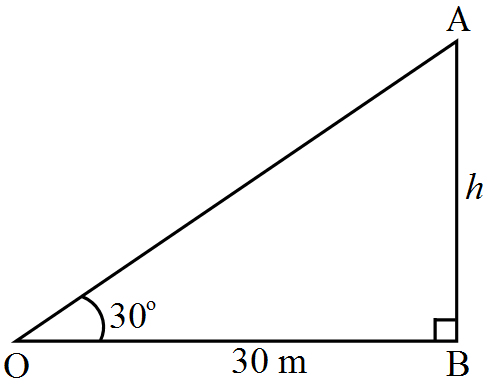
In $\triangle\text{AOB},$
We have:
$\tan30^\circ=\frac{\text{AB}}{\text{OB}}$
$\Rightarrow\frac{1}{\sqrt{3}}$
$\Rightarrow\frac{\text{h}}{30}=\frac{1}{\sqrt{3}}$
$\Rightarrow\text{h}=\frac{30}{\sqrt{3}}\times\frac{\sqrt{3}}{\sqrt{3}}$
$=\frac{30\sqrt{3}}{3}=10\sqrt{3}\text{m}$
Hence, the height of the tower is $10\sqrt{3}\text{m}.$ View full question & answer→MCQ 21 Mark
The tops of two towers of heights $x$ and $y$, standing on a level ground subtend angles of $30^\circ$ and $60^\circ$, respectively at the centre of the line joining their feet. Then, $x : y$ is:
- A
- B
$2 : 1$
- ✓
$1 : 3$
- D
$3 : 1$
AnswerCorrect option: C. $1 : 3$
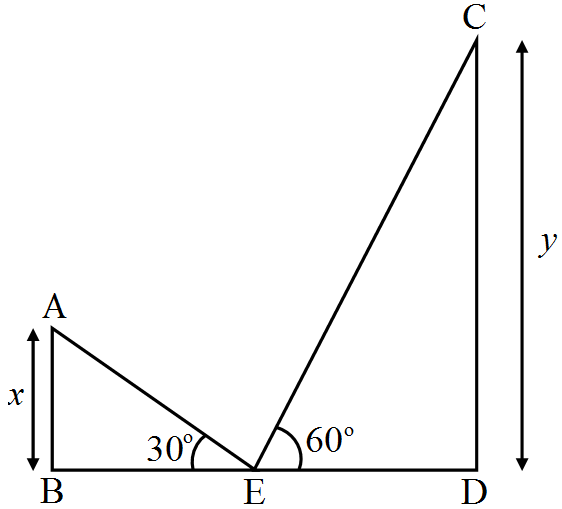
Let $AB$ and $CD$ be the two towers such that $AB = x$ and $CD = y.$
We have,
$\angle\text{AEB}=30^\circ,\angle\text{CED}=60^\circ$ and $BE = DE$
In $\triangle\text{ABE},$
$\tan30^\circ=\frac{\text{AB}}{\text{BE}}$
$\Rightarrow\frac{1}{\sqrt{3}}=\frac{\text{x}}{\text{BE}}$
$\Rightarrow\text{BE}=\text{x}{\sqrt{3}}$
Also, in $\triangle\text{CDE},$
$\Rightarrow\tan60^\circ=\frac{\text{CD}}{\text{DE}}$
$\Rightarrow\sqrt{3}=\frac{\text{y}}{\text{DE}}$
$\Rightarrow\text{DE}=\frac{\text{y}}{\sqrt{3}}$
As, $BE = DE$
$\Rightarrow\text{x}\sqrt{3}=\frac{\text{y}}{\sqrt{3}}$
$\Rightarrow\frac{\text{x}}{\text{y}}=\frac{1}{\sqrt{3}\times\sqrt{3}}$
$\Rightarrow\frac{\text{x}}{\text{y}}=\frac13$
$\therefore\ \text{x}:\text{y}=1:3$
View full question & answer→MCQ 31 Mark
In a rectangle, the angle between a diagonal and a side is $30^\circ$ and the length of this diagonal is $8\ cm$. the area of the rectangle is:
AnswerCorrect option: C. $16\sqrt{3}\text{cm}^2$
Let $ABCD$ be the rectangle in which $\angle\text{BAD}=30^\circ$ and $AC = 8\ cm.$
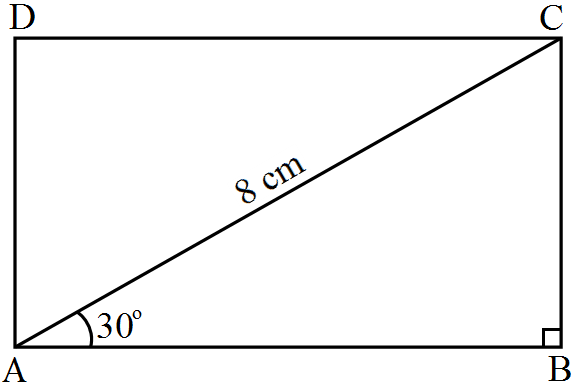
In $\triangle\text{BAC},$
We have:
$\frac{\text{AB}}{\text{AC}}=\cos30^\circ=\frac{\sqrt{3}}{2}$
$\Rightarrow\frac{\text{BC}}{8}=\frac{1}{2}$
$\Rightarrow\text{BC}=\frac82=4\text{m}$
$\therefore$ Area of the rectangle $=(\text{AB}\times\text{BC})=(4\sqrt{3}\times4)=16\sqrt{3}\text{cm}^2$
View full question & answer→MCQ 41 Mark
From the top of a cliff $20m$ high, the angle of elevation of the top of a tower is found to be equal to the angle of depression of the foot of the tower. The height of the tower is:
Answer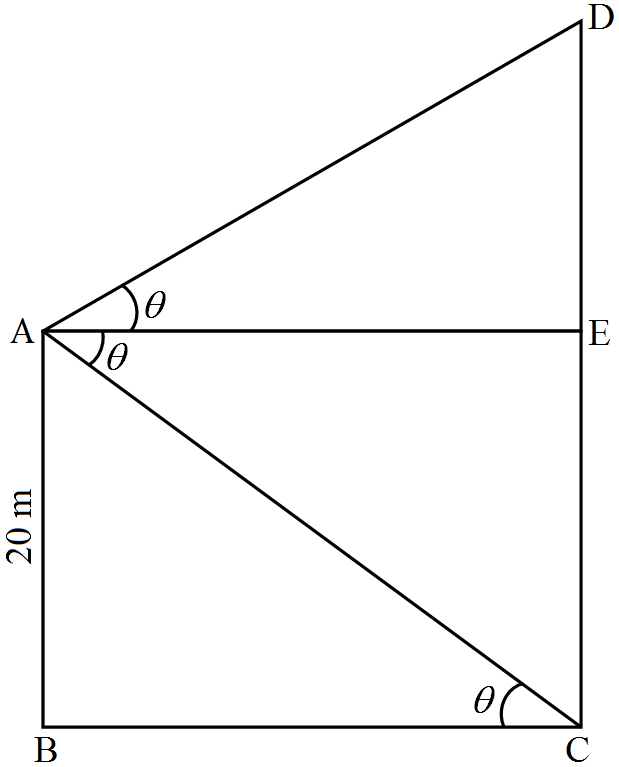
Let $AB$ be the cliff and $CD$ be the tower.
We have,
$AB = 20m$
Also, $CE = AB = 20m$
Let $\angle\text{ACB}=\angle\text{CAE}=\angle\text{DAE}=\theta$
In $\triangle\text{ABC},$
$\tan\theta=\frac{\text{AB}}{\text{BC}}$
$\Rightarrow\tan\theta=\frac{20}{\text{BC}}$
$\Rightarrow\tan\theta=\frac{20}{\text{AE}}$ $($As, $BC = AE)$
$\Rightarrow\text{AE}=\frac{20}{\tan\theta}\dots(\text{i})$
Also, in $\triangle\text{ADE},$
$\tan\theta=\frac{\text{DE}}{\text{AE}}$
$\Rightarrow\tan\theta=\frac{\text{DE}}{\Big(\frac{20}{\tan\theta}\Big)}$ $[$Using $(i)]$
$\Rightarrow\tan\theta=\frac{\text{DE}\times\tan\theta}{20}$
$\Rightarrow\text{DE}=\frac{20\times\tan\theta}{\tan\theta}$
$\Rightarrow\text{DE}=20\text{m}$
Now, $\text{CD} = \text{DE} + \text{CE}$
$=20+20$
$\therefore\ \text{CD}=40\text{m}$
Disclaimer: The answer given in the textbook is incorrect, The same has been rectified above.
View full question & answer→MCQ 51 Mark
The string of a kite is $100m$ long and it makes an angle of $60^\circ$ with the horizontal. If these is no slack in the string, the height of the kite from the ground is:
- ✓
$50\sqrt{3}\text{m}$
- B
$100\sqrt{3}\text{m}$
- C
$50\sqrt{2}\text{m}$
- D
$100\text{m}$
AnswerCorrect option: A. $50\sqrt{3}\text{m}$
Let $AB$ be the string of the kite and $AX$ br the horizontal line.
If $\text{BC}\perp\text{AX},$ then $AB = 100m$ and $\angle\text{BAC}=60^\circ.$
Let:
$BC = h\ m$
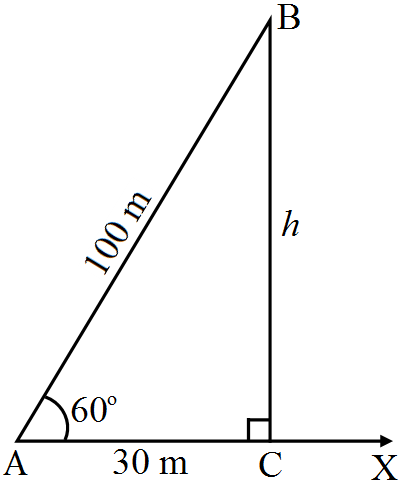
In the right $\triangle\text{ACB},$
We have:
$\frac{\text{BC}}{\text{AB}}=\sin60^\circ=\frac{\sqrt{3}}{2}$
$\Rightarrow\frac{\text{h}}{100}=\frac{\sqrt{3}}{2}$
$\Rightarrow\text{h}=\frac{100\sqrt{3}}{2}$
$=50\sqrt{3}\text{m}$
Hence, the height of the kite is $=50\sqrt{3}\text{m}.$ View full question & answer→MCQ 61 Mark
If a pole $12m$ high casts a shadow $4\sqrt{3}\text{m}$ long on the ground, then the sun's elevation is:
- ✓
$60^\circ$
- B
$45^\circ$
- C
$30^\circ$
- D
$90^\circ$
AnswerCorrect option: A. $60^\circ$
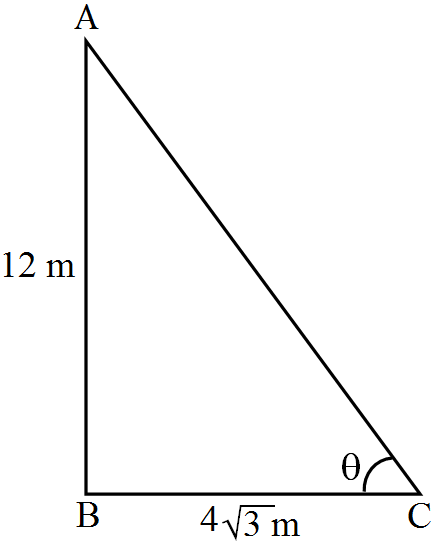
Let $AB$ be the pole and $BC$ be its shadow and $\theta$ be the sun's elevation.
We have,
$AB = 12m$ and $\text{BC}=4\sqrt{3}\text{m}$
In $\triangle\text{ABC},$
$\tan\theta=\frac{\text{AB}}{\text{BC}}$
$\Rightarrow\tan\theta=\frac{12}{4\sqrt{3}}$
$\Rightarrow\tan\theta=\frac{3}{\sqrt{3}}$
$\Rightarrow\tan\theta=\frac{3}{\sqrt{3}}\times\frac{\sqrt{3}}{\sqrt{3}}$
$\Rightarrow\tan\theta=\frac{3\sqrt{3}}{3}$
$\Rightarrow\tan\theta=\sqrt{3}$
$\Rightarrow\tan\theta=\tan60^\circ$
$\therefore\ \theta=60^\circ$
View full question & answer→MCQ 71 Mark
A kite is flying at a height of $30m$ from the ground. The length of string from the kite to the ground is 60m. Assuming that there is no slack in the string, the angle of elevation of the kite at the ground is:
- A
$45^\circ$
- ✓
$30^\circ$
- C
$60^\circ$
- D
$90^\circ$
AnswerCorrect option: B. $30^\circ$
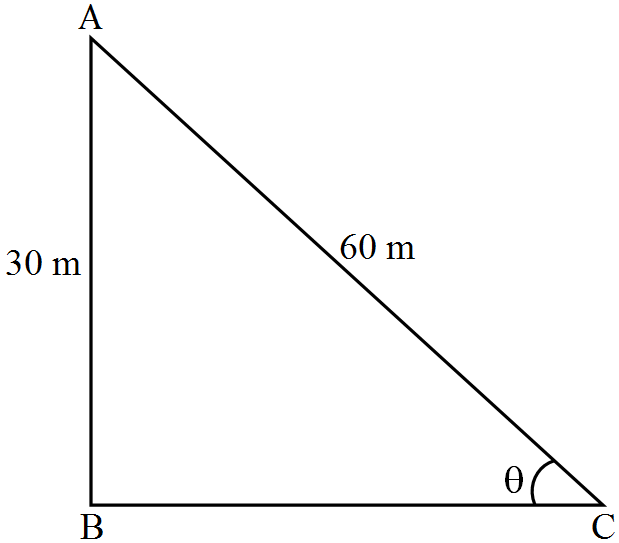
Let point $A$ be the position of the kite and $AC$ be its string.
We have,
$AB = 30m$, and $AC = 60m$
Let $\angle\text{ACB}=\theta$
In $\triangle\text{ABC},$
$\sin\theta=\frac{\text{AB}}{\text{AC}}$
$\Rightarrow\sin\theta=\frac{30}{60}$
$\Rightarrow\sin\theta=\frac{1}{2}$
$\Rightarrow\sin\theta=\sin30^\circ$
$\therefore\ \theta=30^\circ$
View full question & answer→MCQ 81 Mark
On the level ground, the angle of elevation of a tower is $30^\circ$. On moving 20m nearer, the angle of elevation is $60^\circ$. The height of the tower is:
- A
$10\text{m}$
- ✓
$10\sqrt{3}\text{m}$
- C
$15\text{m}$
- D
$5\sqrt{3}\text{m}$
AnswerCorrect option: B. $10\sqrt{3}\text{m}$
Let $AB$ be the tower and $C$ and $D$ be the points of observation such that $\angle\text{BCD}=30^\circ,\angle\text{BDA}=60^\circ,\text{CD}=20\text{m}$ and $AD = x m$.
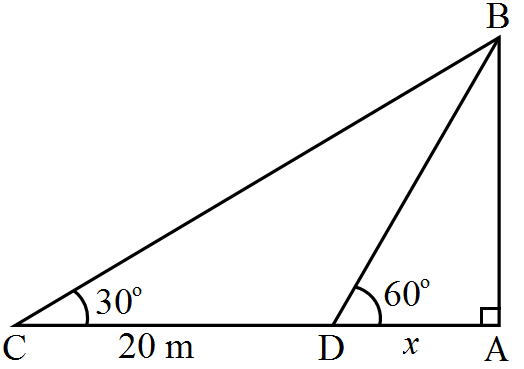
Now, in $\triangle\text{ADB},$
We have:
$\frac{\text{AB}}{\text{AD}}=\tan60^\circ=\sqrt{3}$
$\Rightarrow\frac{\text{AB}}{\text{x}}=\sqrt{3}$
$\Rightarrow\text{AB}=\sqrt{3}\text{x}$
In $\triangle\text{ACB},$
We have:
$\frac{\text{AB}}{\text{AC}}=\tan30^\circ=\frac{1}{\sqrt{3}}$
$\frac{\text{AB}}{20+\text{x}}=\frac{1}{\sqrt{3}}$
$\Rightarrow\text{AB}=\frac{20+\text{x}}{\sqrt{3}}$
$\therefore\sqrt{3}\text{x}=\frac{20+\text{x}}{\sqrt{3}}$
$\Rightarrow3\text{x}=20+\text{x}$
$\Rightarrow2\text{x}=20\Rightarrow\text{x}=10$
$\therefore$ Height of the tower $\text{AB}=\sqrt{3}\text{x}=10\sqrt{3}\text{m}$ View full question & answer→MCQ 91 Mark
In the given figure, a tower $AB$ is $20m$ high and $BC$, its shadow on the ground is $20\sqrt{3}\text{m}$ long. The sun's altitude is:
- ✓
$30^\circ$
- B
$45^\circ$
- C
$60^\circ$
- D
AnswerCorrect option: A. $30^\circ$
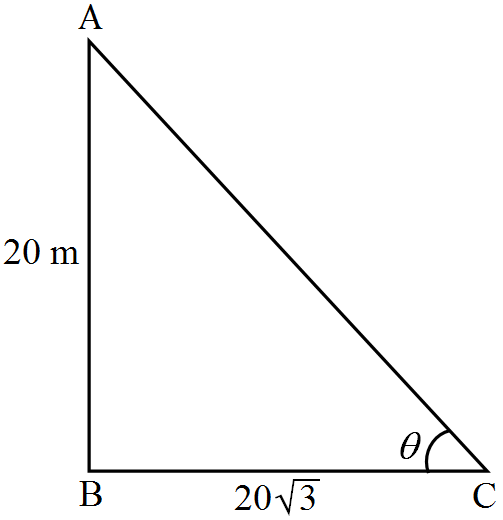
Let the sun's altitude be $\theta.$
We have,
$AB = 20m$ and $\text{BC}=20\sqrt{3}\text{m}$
In $\triangle\text{ABC},$
$\tan\theta=\frac{\text{AB}}{\text{BC}}$
$\Rightarrow\tan\theta=\frac{20}{20\sqrt{3}}$
$\Rightarrow\tan\theta=\frac{1}{\sqrt{3}}$
$\Rightarrow\tan\theta=\tan30^\circ$
$\therefore\ \theta=30^\circ$
View full question & answer→MCQ 101 Mark
The length of the shadow of a tower standing on level ground is found to be $2x$ metres longer when the sun's elevation is $30^\circ$ than when it was $45^\circ$. The height of the tower is:
- A
$\big(2\sqrt{3}\text{x}\big)\text{m}$
- B
$\big(3\sqrt{2}\text{x}\big)\text{m}$
- C
$\big(\sqrt{3}-1\big)\text{x }\text{m}$
- ✓
$\big(\sqrt{3}+1\big)\text{x }\text{m}$
AnswerCorrect option: D. $\big(\sqrt{3}+1\big)\text{x }\text{m}$
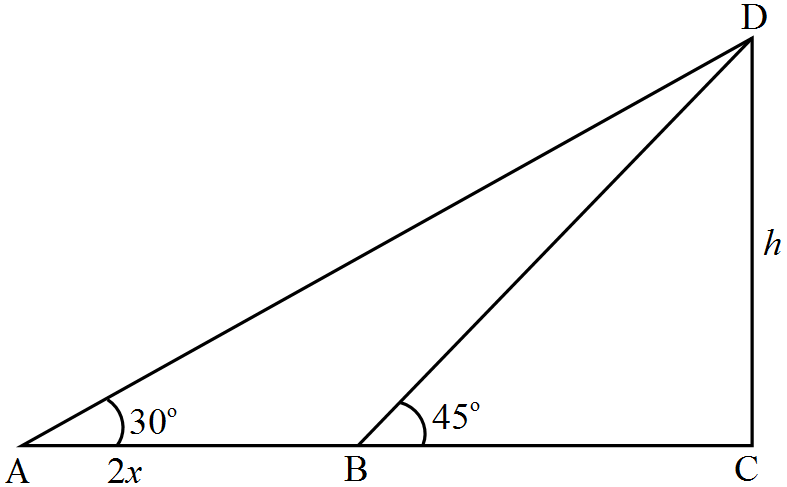
Let $CD = h$ be the height if the tower.
We have,
$AB = 2x$, $\angle\text{DAC}=30^\circ$ and $\angle\text{DBC}=45^\circ$
In $\triangle\text{BCD},$
$\tan45^\circ=\frac{\text{CD}}{\text{BE}}$
$\Rightarrow1=\frac{\text{h}}{\text{BC}}$
$\Rightarrow\text{BC}=\text{h}$
Now, in $\triangle\text{ACD},$
$\tan30^\circ=\frac{\text{CD}}{\text{AC}}$
$\Rightarrow\frac{1}{\sqrt{3}}=\frac{\text{h}}{\text{AB}+\text{BC}}$
$\Rightarrow\frac{1}{\sqrt{3}}=\frac{\text{h}}{2\text{x}+\text{h}}$
$\Rightarrow2\text{x}+\text{h}=\text{h}\sqrt{3}$
$\Rightarrow\text{h}\sqrt{3}-\text{h}=2\text{x}$
$\Rightarrow\text{h}\big(\sqrt{3}-1\big)=2\text{x}$
$\Rightarrow\text{h}=\frac{2\text{x}}{\big(\sqrt{3}-1\big)}\times\frac{\big(\sqrt{3}+1\big)}{\big(\sqrt{3}+1\big)}$
$\Rightarrow\text{h}=\frac{2\text{x}\big(\sqrt{3}+1\big)}{(3-1)}$
$\Rightarrow\text{h}=\frac{2\text{x}\big(\sqrt{3}+1\big)}{2}$
$\therefore\ \text{h}=\text{x}\big(\sqrt{3}+1\big)\text{m}$ View full question & answer→MCQ 111 Mark
An observer $1.5m$ tall $28.5$ away from a tower and the angle of elevation of the top of the tower form the eye of the observer is $45^\circ$. The height of the tower is:
AnswerLet $AB$ be the observer and $CD$ be the tower.
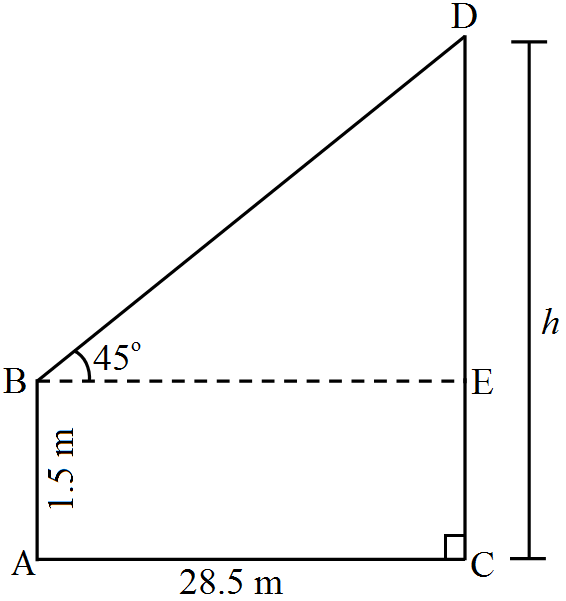
Draw $\text{BE}\perp\text{CD},$ let $CD = h$ metres.
Then, $\text{AB}=1.5\text{m},\text{BE}=\text{AC}=28.5\text{m}$ and $\angle\text{EBD}=45^\circ.$
$DE = (CD - EC) = (CD - AB) = (h - 1.5)m$.
In right $\triangle\text{BED},$
We have:
${\frac{\text{DE}}{\text{BE}}}=\tan45^\circ=1$
$\Rightarrow\frac{(\text{h}-1.5)}{28.5}=1$
$\Rightarrow\text{h}-1.5=28.5$
$\Rightarrow\text{h}=28.5+1.5=30\text{m}$
Hence the height of the tower is $30m$.
View full question & answer→MCQ 121 Mark
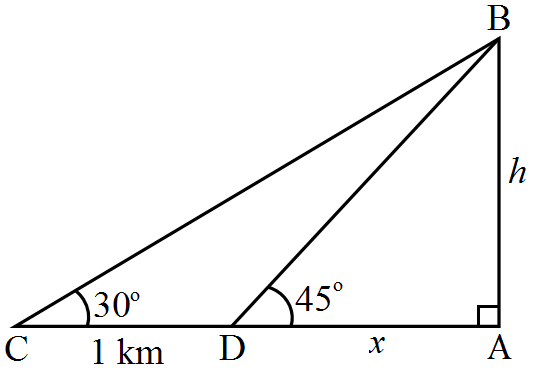
From the top of a hill, the angles of depression of two consecutive km stones due east are found to be $30^\circ$ and $45^\circ$. The height of the hill is:
- A
$\frac{1}{2}\big(\sqrt{3}-1\big)\text{km}$
- ✓
$\frac{1}{2}\big(\sqrt{3}+1\big)\text{km}$
- C
$\big(\sqrt{3}-1\big)\text{km}$
- D
$\big(\sqrt{3}+1\big)\text{km}$
AnswerCorrect option: B. $\frac{1}{2}\big(\sqrt{3}+1\big)\text{km}$
Let $AB$ be the hill making angles of depression at points $C$ and $D$ such that $\angle\text{ADB}=45^\circ,\angle\text{ACB}=30^\circ$ and $CD = 1km$.
Let:
$AB = h\ km$ and $AD = x\ km$
In $\triangle\text{ADB},$
We have:
$\frac{\text{AB}}{\text{AD}}=\tan45^\circ=1$
$\Rightarrow\frac{\text{h}}{\text{x}+1}=\frac{1}{\sqrt{3}}\dots(\text{ii})$
On putting the value of h taken from $(i)$ in $(ii)$, we get:
$\frac{\text{h}}{\text{h}+1}=\frac{1}{\sqrt{3}}$
$\Rightarrow\sqrt{3}\text{h}=\text{h}+1$
$\Rightarrow\big(\sqrt{3}-1\big)\text{h}=1$
$\Rightarrow\text{h}=\frac{1}{\big(\sqrt{3}-1\big)}$
On multiplying the numerator and denominator of the above equation by $\big(\sqrt{3}+1\big),$
We get:
$\text{h}=\frac{1}{\big(\sqrt{3}-1\big)}\times\frac{\big(\sqrt{3}+1\big)}{\big(\sqrt{3}+1\big)}$
$=\frac{\big(\sqrt{3}+1\big)}{2}=\frac12\big(\sqrt{3}+1\big)\text{km}$
Hence, the height of the hill is $\frac12\big(\sqrt{3}+1\big)\text{km}.$ View full question & answer→MCQ 131 Mark
The lengths of a vertical rod and its shadow are in the ratio $1:\sqrt{3}.$ The angle of elevation of the sun is:
- ✓
$30^\circ$
- B
$45^\circ$
- C
$60^\circ$
- D
$90^\circ$
AnswerCorrect option: A. $30^\circ$
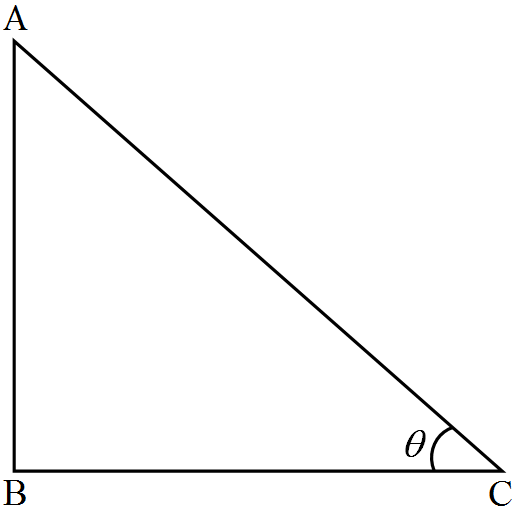
Let $AB$ be the rod and $BC$ be its shadow; and $\theta$ be the angle of elevation of the sun.
We have,
$\text{AB}:\text{BC}=1:\sqrt{3}$
Let $AB = x$
Then, $\text{BC}=\text{x}\sqrt{3}$
In $\triangle\text{ABC},$
$\tan\theta=\frac{\text{AB}}{\text{BC}}$
$\Rightarrow\tan\theta=\frac{1}{\sqrt{3}}$
$\Rightarrow\tan\theta=\tan30^\circ$
$\therefore\ \theta=30^\circ$ View full question & answer→MCQ 141 Mark
The angle of depression of a car parked on the road from the top of a $150$-m-high tower is $30^\circ$. The distance of the car from the tower is:
- A
$50\sqrt{3}\text{m}$
- ✓
$150\sqrt{3}\text{m}$
- C
$150\sqrt{2}\text{m}$
- D
$75\text{m}$
AnswerCorrect option: B. $150\sqrt{3}\text{m}$
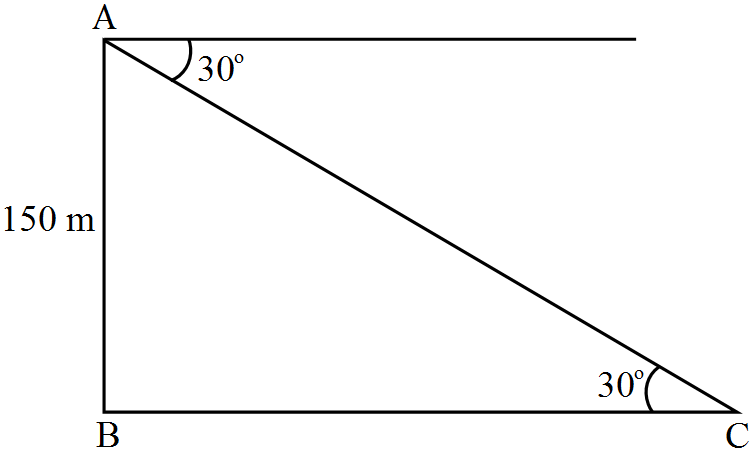
Let $AB$ be the tower and point $C$ be the position of the car.
We have,
$AB = 150m$, and $\angle\text{ACB}=30^\circ$
In $\triangle\text{ABC},$
$\tan30^\circ=\frac{\text{AB}}{\text{BC}}$
$\Rightarrow\frac{1}{\sqrt{3}}=\frac{150}{\text{BC}}$
$\therefore\ \text{BC}=150\sqrt{3}\text{m}$
View full question & answer→MCQ 151 Mark
A ladder $15m$ long just reaches the top of a vertical wall. If the ladder makes an angle of $60°$ with the wall, then the height of the wall is:
AnswerCorrect option: C. $\frac{15}{2}\text{m}$
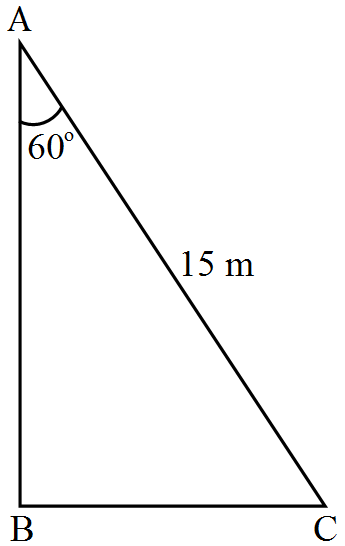
Let $AB$ be the wall and $AC$ be the ladder
We have,
$AC = 15m$, and $\angle\text{BAC}=60^\circ$
In $\triangle\text{ABC},$
$\cos60^\circ=\frac{\text{AB}}{\text{AC}}$
$\Rightarrow\frac{1}{2}=\frac{\text{AB}}{15}$
$\therefore\ \text{AB}=\frac{15}{2}\text{m}$ View full question & answer→MCQ 161 Mark
A ladder makes an angle of $60^\circ$ with the ground when placed against a wall. If the foot of the ladder is $2m$ away from the wall, then the length of the ladder is:
AnswerCorrect option: D. $4\text{m}$
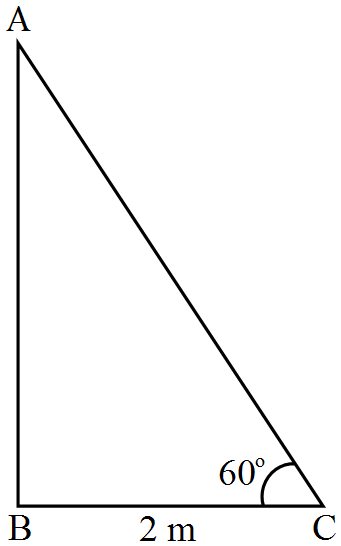
Let $AB$ be the wall and $AC$ be the ladder
We have,
$BC = 2m$, and $\angle\text{ACB}=60^\circ$
In $\triangle\text{ABC},$
$\cos60^\circ=\frac{\text{BC}}{\text{AC}}$
$\Rightarrow\frac{1}{2}=\frac{2}{\text{AC}}$
$\therefore\ \text{AC}=4\text{m}$
View full question & answer→MCQ 171 Mark
If the length of the shadow of a tower is $\sqrt{3}\text{ times}$ its height then the angle of elevation of the sun is:
- A
$45^\circ$
- ✓
$30^\circ$
- C
$60^\circ$
- D
$90^\circ$
AnswerCorrect option: B. $30^\circ$
Let $AB$ be the pole and $BC$ be its shadow.
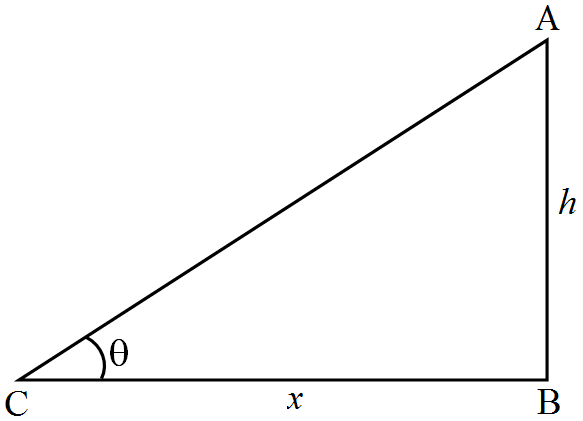
Let $AB = h$ and $BC = x$ such that $\text{x}=\sqrt{3}\text{h}$ (given) and $\theta$ be the angle of elevation.
From $\triangle\text{ABC},$ we have:
$\frac{\text{AB}}{\text{BC}}=\tan\theta$
$\Rightarrow\frac{\text{h}}{\text{x}}=\frac{\text{h}}{\sqrt{3}\text{h}}=\tan\theta$
$\Rightarrow\tan\theta=\frac{1}{\sqrt{3}\text{h}}$
$\Rightarrow\theta=30^\circ$
View full question & answer→MCQ 181 Mark
A pole casts a shadow of length $2\sqrt{3}\text{m}$ on the ground when the sun's elevation is $60^\circ$. The height of the pole is:
- A
$4\sqrt{3}\text{m}$
- B
$6\text{m}$
- C
$12\text{m}$
- ✓
$3\text{m}$
AnswerCorrect option: D. $3\text{m}$
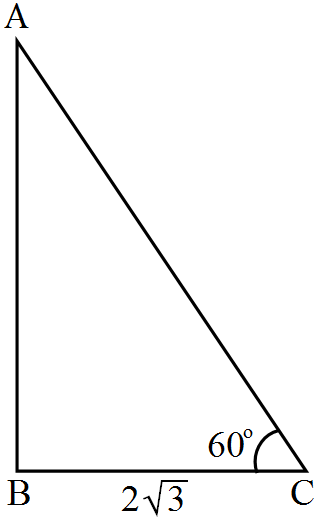
Let $AB$ be the pole and $BC$ be its shadow.
We have,
$\text{BC}=2\sqrt{3}\text{m}$ and $\angle\text{ACB}=60^\circ$
In $\triangle\text{ABC},$
$\tan60^\circ=\frac{\text{AB}}{\text{BC}}$
$\Rightarrow\sqrt{3}=\frac{\text{AB}}{2\sqrt{3}}$
$\therefore\ \text{AB}=6\text{m}$ View full question & answer→MCQ 191 Mark
From a point on the ground, $30m$ away from the foot of a tower, the angle of elevation of the top of the tower is $30^\circ$. The height of the tower is:
- A
$30\text{m}$
- ✓
$10\sqrt{3}\text{m}$
- C
$10\text{m}$
- D
$30\sqrt{3}\text{m}$
AnswerCorrect option: B. $10\sqrt{3}\text{m}$
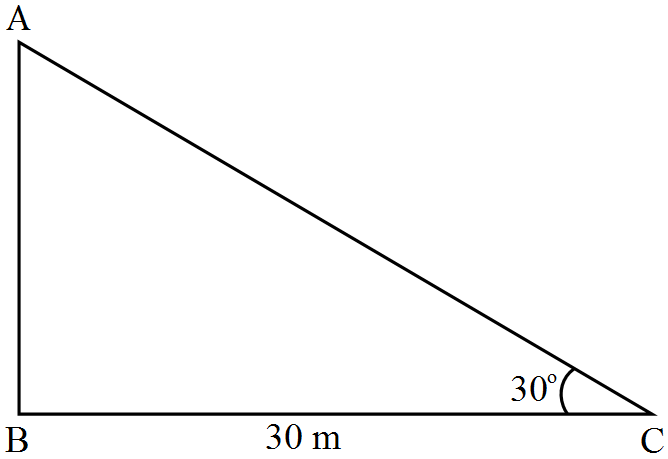
Let $AB$ be the tower and point $C$ be the point of obseevation on the ground.
We have,
$BC = 30m$, and $\angle\text{ACB}=30^\circ$
In $\triangle\text{ABC},$
$\tan30^\circ=\frac{\text{AB}}{\text{BC}}$
$\Rightarrow\frac{1}{\sqrt{3}}=\frac{\text{AB}}{30}$
$\Rightarrow\text{AB}=\frac{30}{\sqrt{3}}$
$\Rightarrow\text{AB}=\frac{30}{\sqrt{3}}\times\frac{\sqrt{3}}{\sqrt{3}}$
$\Rightarrow\text{AB}=\frac{30\sqrt{3}}{3}$
$\therefore\ \text{AB}=10\sqrt{3}\text{m}$ View full question & answer→MCQ 201 Mark
If the elevation of the sun changes form $30^\circ$ to $60^\circ$, then the difference between the lengths of shadows of a pole $15m$ high, is:
- A
$7.5\text{m}$
- B
$15\text{m}$
- ✓
$10\sqrt{3}\text{m}$
- D
$5\sqrt{3}\text{m}$
AnswerCorrect option: C. $10\sqrt{3}\text{m}$
Let $AB$ be the pole and $AC$ and $AD$ be its shadows.
We have:
$\angle\text{ACB}=30^\circ,\angle\text{ADB}=60^\circ$ and AB = 15m.
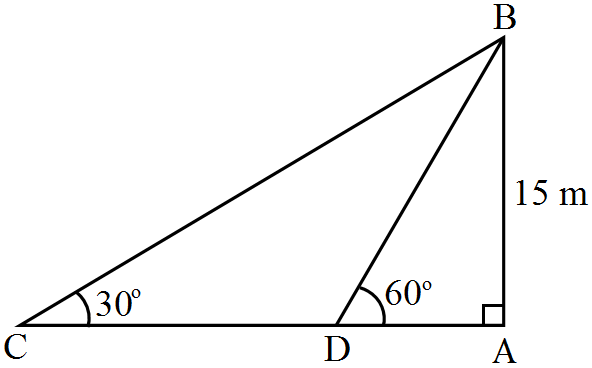
In $\triangle\text{ACB},$
We have:
$\frac{\text{AC}}{\text{AB}}=\cot30^\circ=\sqrt{3}$
$\Rightarrow\frac{\text{AC}}{15}={\sqrt{3}}\Rightarrow\text{AC}=15\sqrt{3}\text{m}$
Now, in $\triangle\text{ADB},$ we have:
$\frac{\text{AD}}{\text{AB}}=\cot60^\circ=\frac{1}{\sqrt{3}}$
$\Rightarrow\frac{\text{AD}}{15}=\frac{1}{\sqrt{3}}$
$\Rightarrow\text{AD}=\frac{15}{\sqrt{3}}=\frac{15\times\sqrt{3}}{\sqrt{3}\times\sqrt{3}}$
$\Rightarrow\frac{15\sqrt{3}}{3}=5\sqrt{3}\text{m}$
$\therefore$ Difference between the lengths of the shadows $=\text{AC}-\text{AD}=15\sqrt{3}-5\sqrt{3}=10\sqrt{3}\text{m}$
View full question & answer→MCQ 211 Mark
If a $l.5$-m-tall girl stands at a distance of $3m$ from a lamp post and casts a shadow of length $4.5m$ on the ground, then the height of the lamp post is:
- A
$1.5m$
- B
$2m$
- ✓
$2.5m$
- D
$2.8m$.
AnswerCorrect option: C. $2.5m$
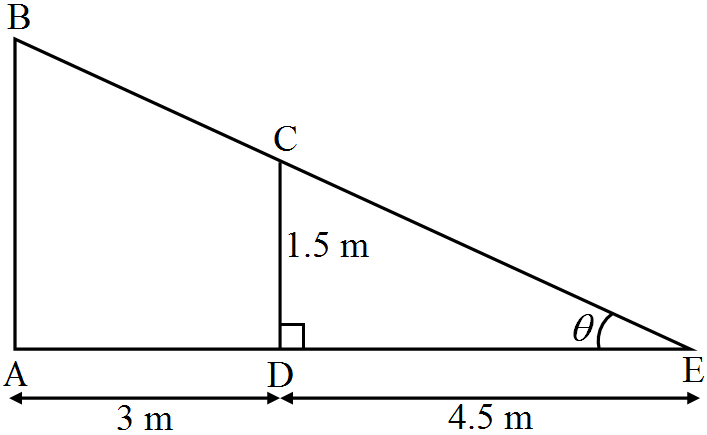
Let $AB$ be the lamp-post; $CD$ be the girl and $DE$ be her shadow.
We have,
$CD = 1.5m, AD =3m, DE = 4.5m$
Let $\angle\text{E}=\theta$
In $\triangle\text{CDE},$
$\tan\theta=\frac{\text{CD}}{\text{DE}}$
$\Rightarrow\tan\theta=\frac{1.5}{4.5}$
$\Rightarrow\tan\theta=\frac{1}{3}\dots(\text{i})$
Now, in $\triangle\text{ABE},$
$\tan\theta=\frac{\text{AB}}{\text{AE}}$
$\Rightarrow\frac{1}{3}=\frac{\text{AB}}{\text{AD}+\text{DE}}$ $[$Using $(i)]$
$\Rightarrow\frac{1}{3}=\frac{\text{AB}}{3+4.5}$
$\Rightarrow\text{AB}=\frac{7.5}{3}$
$\therefore\ \text{AB}=2.5\text{m}$
View full question & answer→MCQ 221 Mark
If the height of a vertical pole is equal to the length of its shadow on the ground, the angle of elevation of the sun is:
- A
$0^\circ$
- B
$30^\circ$
- ✓
$45^\circ$
- D
$60^\circ$
AnswerCorrect option: C. $45^\circ$
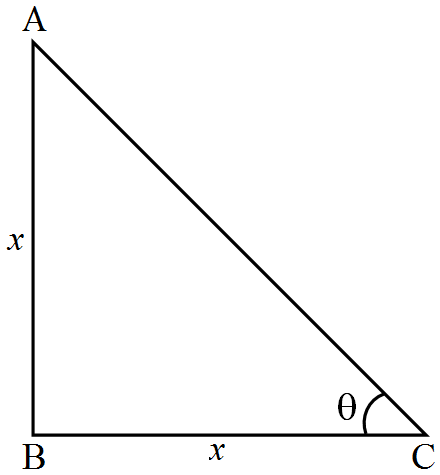
Let $AB$ represents the vertical pole and $BC$ represents the shadow on the ground and $\theta$ represents angle of elevation the sun.
In $\triangle\text{ABC},$
$\tan\theta=\frac{\text{AB}}{\text{BC}}$
$\Rightarrow\tan\theta=\frac{\text{x}}{\text{x}}$ $($As, the height of the pole, $AB =$ the shadow, $BC = x)$
$\Rightarrow\tan\theta=1$
$\Rightarrow\tan\theta=\tan45^\circ$
$\therefore\theta=45^\circ$
View full question & answer→MCQ 231 Mark
If the angles of elevation of the top of a tower form tow points at distances $a$ and $b$ from the base and in the same straight line with it are complementary, then the height of the tower is:
- A
$\sqrt{\frac{\text{a}}{\text{b}}}$
- ✓
$\sqrt{\text{ab}}$
- C
$\sqrt{\text{a}+\text{b}}$
- D
$\sqrt{\text{a}-\text{b}}$
AnswerCorrect option: B. $\sqrt{\text{ab}}$
Let $AB$ be the tower and $C$ and $D$ be the points of observation on $AC$.
Let:
$\angle\text{ACB}=\theta,\angle\text{ADB}=90-\theta$ and $AB = h\ m$
Thus,
We have:
$AC = a, AD = b$ and $CD = a - b$
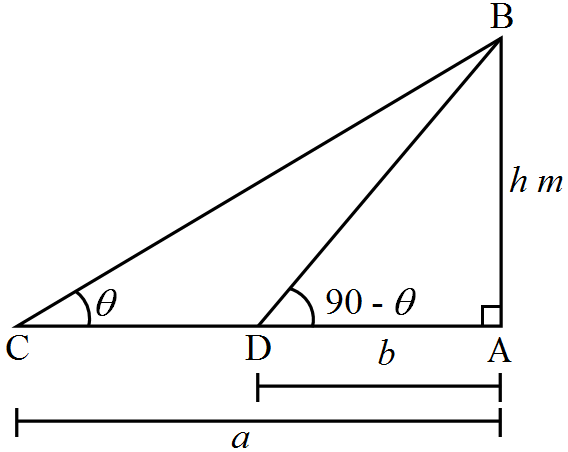
Now, in the right $\triangle\text{ABC},$
We have:
$\tan\theta=\frac{\text{AB}}{\text{AC}}$
$\Rightarrow\frac{\text{h}}{\text{a}}=\tan\theta\dots(\text{i})$
In the right $\triangle\text{ABD},$
We have:
$\tan(90-\theta)=\frac{\text{AB}}{\text{AD}}$
$\Rightarrow\cot\theta=\frac{\text{h}}{\text{b}}\dots(\text{ii})$
On multiplying $(i)$ and $(ii)$,
We have:
$\tan\theta\times\cot\theta=\frac{\text{h}}{\text{a}}\times\frac{\text{h}}{\text{b}}$
$\Rightarrow\frac{\text{h}}{\text{a}}\times\frac{\text{h}}{\text{b}}=1$ $\Big[\because\tan\theta=\frac{1}{\cot\theta}\Big]$
$\Rightarrow\text{h}^2=\text{ab}$
$\Rightarrow\text{h}=\sqrt{\text{ab}}\text{m}$
Hence, the height of the tower is $\sqrt{\text{ab}}\text{m}.$ View full question & answer→MCQ 241 Mark
The shadow of a $5$-m-long stick is $2m$ long. At the same time the length of the shadow of a $12.5$-m-high tree is:
Answer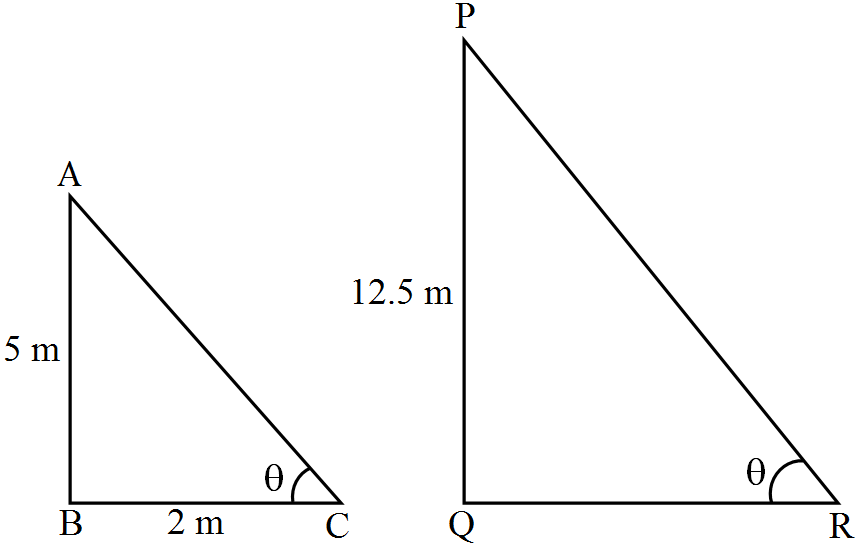
Let $AB$ be the stick and $BC$ be its shadow and $PQ$ be the tree and $QR$ be its shadow.
We have,
$AB = 5m, BC = 2m, PQ = 12.5m$
In $\triangle\text{ABC},$
$\tan\theta=\frac{\text{AB}}{\text{BC}}$
$\Rightarrow\tan\theta=\frac{5}{2}$
Now, In $\triangle\text{PQR},$
$\tan\theta=\frac{\text{PQ}}{\text{QR}}$
$\Rightarrow\frac{5}{2}=\frac{12.5}{\text{QR}}$ [Using (i)]
$\Rightarrow\text{QR}=\frac{12.5\times2}{5}=\frac{25}{5}$
$\therefore\ \text{QR}=5\text{m}$ View full question & answer→MCQ 251 Mark
If the height of a vertical pole is $\sqrt{3}\text{times}$ the length of its shadow on ground then the angle of elevation of the sun at that time is:
- A
$30^\circ$
- B
$45^\circ$
- ✓
$60^\circ$
- D
$75^\circ$
AnswerCorrect option: C. $60^\circ$
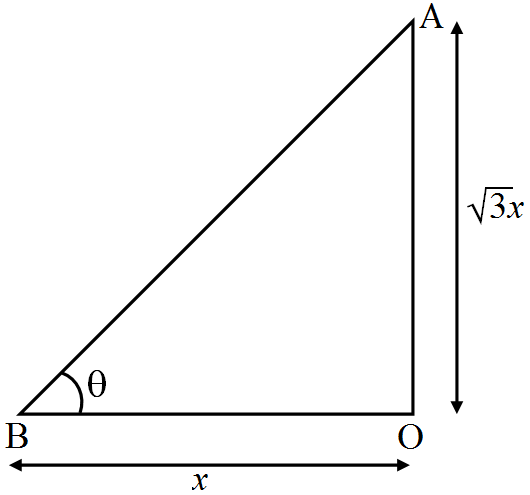
Here, $AO$ be the pole; $BO$ be its shadow and $\theta$ be the angle of elevation of the sun.
Let $BO = x$
Then, $\text{AO}=\text{x}\sqrt{3}$
In $\triangle\text{AOB},$
$\tan\theta=\frac{\text{AO}}{\text{BO}}$
$\Rightarrow\tan\theta=\frac{\text{x}\sqrt{3}}{\text{x}}$
$\Rightarrow\tan\theta=\sqrt{3}$
$\Rightarrow\tan\theta=\tan60^\circ$
$\therefore\theta=60^\circ$
View full question & answer→