MCQ 11 Mark
The angle of elevation of the top of a tower from a point on the ground $30m$ away from the foot of the tower is $30^\circ $. The height of the tower is:
- A
$30\text{m}$
- ✓
$10\sqrt{3}\text{m}$
- C
$20\text{m}$
- D
$10\sqrt{2}\text{m}$
AnswerCorrect option: B. $10\sqrt{3}\text{m}$
Let $AB$ be the tower and $O$ be the point of observation.
Also,
$\angle\text{AOB}=30^\circ,$ and $OB = 30m$
Let:
$AB = h m$
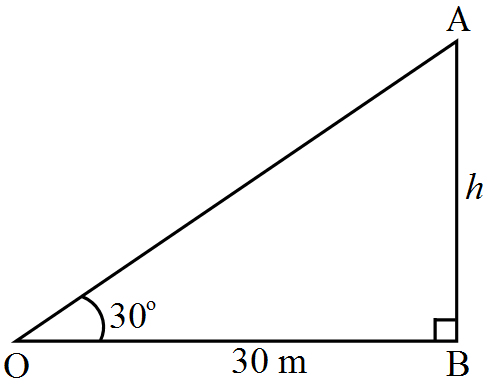
In $\triangle\text{AOB},$
We have:
$\tan30^\circ=\frac{\text{AB}}{\text{OB}}$
$\Rightarrow\frac{1}{\sqrt{3}}$
$\Rightarrow\frac{\text{h}}{30}=\frac{1}{\sqrt{3}}$
$\Rightarrow\text{h}=\frac{30}{\sqrt{3}}\times\frac{\sqrt{3}}{\sqrt{3}}$
$=\frac{30\sqrt{3}}{3}=10\sqrt{3}\text{m}$
Hence, the height of the tower is $10\sqrt{3}\text{m}.$ View full question & answer→MCQ 21 Mark
The tops of two towers of heights $x$ and $y$, standing on a level ground subtend angles of $30^\circ$ and $60^\circ $, respectively at the centre of the line joining their feet. Then, $x : y$ is:
- A
- B
$2 : 1$
- ✓
$1 : 3$
- D
$3 : 1.$
AnswerCorrect option: C. $1 : 3$
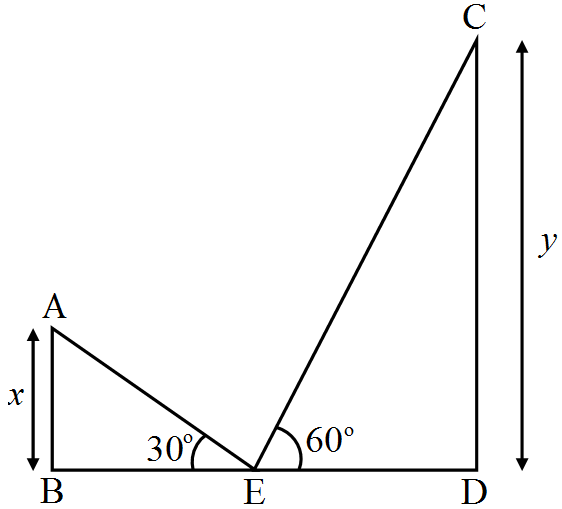
Let $AB$ and $CD$ be the two towers such that $AB = x$ and $CD = y$.
We have,
$\angle\text{AEB}=30^\circ,\angle\text{CED}=60^\circ$ and $BE = DE$
In $\triangle\text{ABE},$
$\tan30^\circ=\frac{\text{AB}}{\text{BE}}$
$\Rightarrow\frac{1}{\sqrt{3}}=\frac{\text{x}}{\text{BE}}$
$\Rightarrow\text{BE}=\text{x}{\sqrt{3}}$
Also, in $\triangle\text{CDE},$
$\Rightarrow\tan60^\circ=\frac{\text{CD}}{\text{DE}}$
$\Rightarrow\sqrt{3}=\frac{\text{y}}{\text{DE}}$
$\Rightarrow\text{DE}=\frac{\text{y}}{\sqrt{3}}$
As, BE = DE
$\Rightarrow\text{x}\sqrt{3}=\frac{\text{y}}{\sqrt{3}}$
$\Rightarrow\frac{\text{x}}{\text{y}}=\frac{1}{\sqrt{3}\times\sqrt{3}}$
$\Rightarrow\frac{\text{x}}{\text{y}}=\frac13$
$\therefore\ \text{x}:\text{y}=1:3$ View full question & answer→MCQ 31 Mark
In a rectangle, the angle between a diagonal and a side is $30^\circ $ and the length of this diagonal is $8cm$. the area of the rectangle is:
AnswerCorrect option: C. $16\sqrt{3}\text{cm}^2$
Let $ABCD$ be the rectangle in which $\angle\text{BAD}=30^\circ$ and $AC = 8cm$.
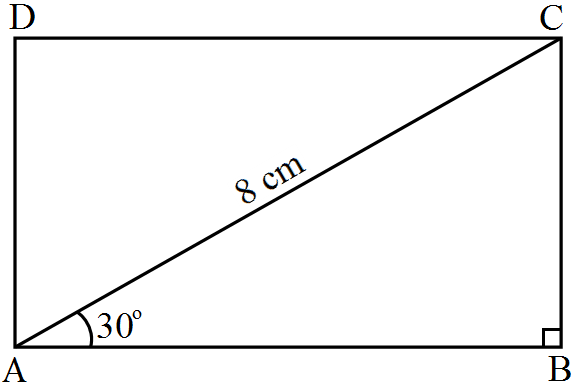
In $\triangle\text{BAC},$
We have:
$\frac{\text{AB}}{\text{AC}}=\cos30^\circ=\frac{\sqrt{3}}{2}$
$\Rightarrow\frac{\text{BC}}{8}=\frac{1}{2}$
$\Rightarrow\text{BC}=\frac82=4\text{m}$
$\therefore$ Area of the rectangle $=(\text{AB}\times\text{BC})=(4\sqrt{3}\times4)=16\sqrt{3}\text{cm}^2$ View full question & answer→MCQ 41 Mark
From the top of a cliff $20m$ high, the angle of elevation of the top of a tower is found to be equal to the angle of depression of the foot of the tower. The height of the tower is:
Answer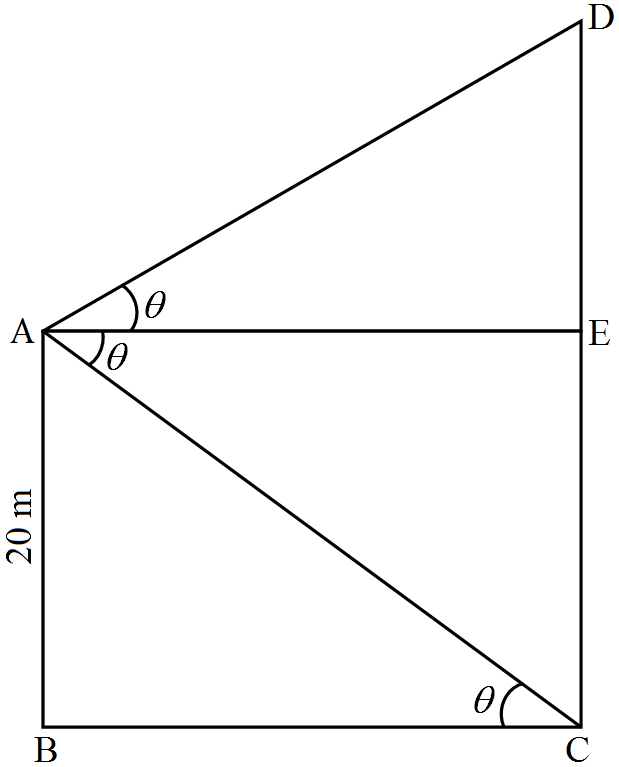
Let $AB$ be the cliff and $CD$ be the tower.
We have,
$AB = 20m$
Also, $CE = AB = 20m$
Let $\angle\text{ACB}=\angle\text{CAE}=\angle\text{DAE}=\theta$
In $\triangle\text{ABC},$
$\tan\theta=\frac{\text{AB}}{\text{BC}}$
$\Rightarrow\tan\theta=\frac{20}{\text{BC}}$
$\Rightarrow\tan\theta=\frac{20}{\text{AE}}$ (As, BC = AE)
$\Rightarrow\text{AE}=\frac{20}{\tan\theta}\dots(\text{i})$
Also, in $\triangle\text{ADE},$
$\tan\theta=\frac{\text{DE}}{\text{AE}}$
$\Rightarrow\tan\theta=\frac{\text{DE}}{\Big(\frac{20}{\tan\theta}\Big)}$ [Using (i)]
$\Rightarrow\tan\theta=\frac{\text{DE}\times\tan\theta}{20}$
$\Rightarrow\text{DE}=\frac{20\times\tan\theta}{\tan\theta}$
$\Rightarrow\text{DE}=20\text{m}$
Now, $\text{CD} = \text{DE} + \text{CE}$
$=20+20$
$\therefore\ \text{CD}=40\text{m}$
Disclaimer: The answer given in the textbook is incorrect, The same has been rectified above. View full question & answer→MCQ 51 Mark
The string of a kite is $100m$ long and it makes an angle of $60^\circ$ with the horizontal. If these is no slack in the string, the height of the kite from the ground is:
- ✓
$50\sqrt{3}\text{m}$
- B
$100\sqrt{3}\text{m}$
- C
$50\sqrt{2}\text{m}$
- D
$100\text{m}$
AnswerCorrect option: A. $50\sqrt{3}\text{m}$
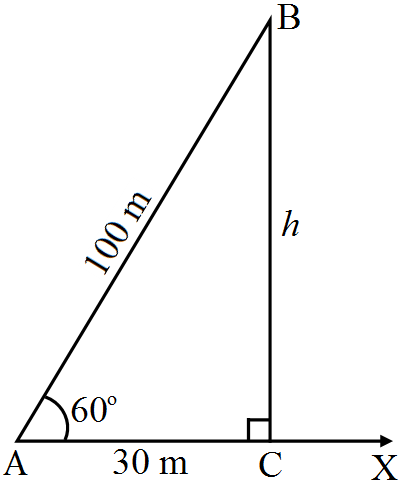
Let AB be the string of the kite and AX br the horizontal line.
If $\text{BC}\perp\text{AX},$ then $AB = 100m$ and $\angle\text{BAC}=60^\circ.$
Let:
$BC = h m$
In the right $\triangle\text{ACB},$
We have:
$\frac{\text{BC}}{\text{AB}}=\sin60^\circ=\frac{\sqrt{3}}{2}$
$\Rightarrow\frac{\text{h}}{100}=\frac{\sqrt{3}}{2}$
$\Rightarrow\text{h}=\frac{100\sqrt{3}}{2}$
$=50\sqrt{3}\text{m}$
Hence, the height of the kite is $=50\sqrt{3}\text{m}.$ View full question & answer→MCQ 61 Mark
If a pole $12m$ high casts a shadow $4\sqrt{3}\text{m}$ long on the ground, then the sun's elevation is:
- ✓
$60^\circ$
- B
$45^\circ$
- C
$30^\circ$
- D
$90^\circ$
AnswerCorrect option: A. $60^\circ$
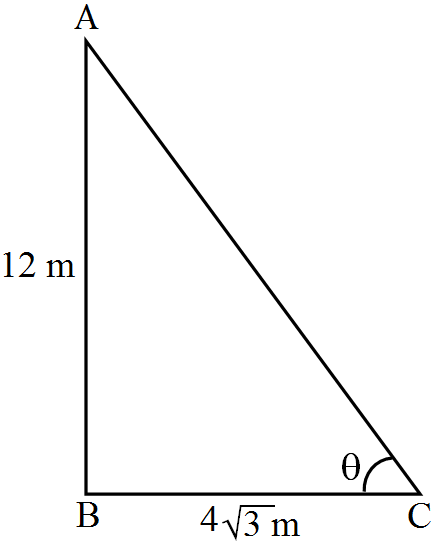
Let $AB$ be the pole and $BC$ be its shadow and $\theta$ be the sun's elevation.
We have,
$AB = 12m$ and $\text{BC}=4\sqrt{3}\text{m}$
In $\triangle\text{ABC},$
$\tan\theta=\frac{\text{AB}}{\text{BC}}$
$\Rightarrow\tan\theta=\frac{12}{4\sqrt{3}}$
$\Rightarrow\tan\theta=\frac{3}{\sqrt{3}}$
$\Rightarrow\tan\theta=\frac{3}{\sqrt{3}}\times\frac{\sqrt{3}}{\sqrt{3}}$
$\Rightarrow\tan\theta=\frac{3\sqrt{3}}{3}$
$\Rightarrow\tan\theta=\sqrt{3}$
$\Rightarrow\tan\theta=\tan60^\circ$
$\therefore\ \theta=60^\circ$ View full question & answer→MCQ 71 Mark
A kite is flying at a height of $30m$ from the ground. The length of string from the kite to the ground is $60m$. Assuming that there is no slack in the string, the angle of elevation of the kite at the ground is:
Answer
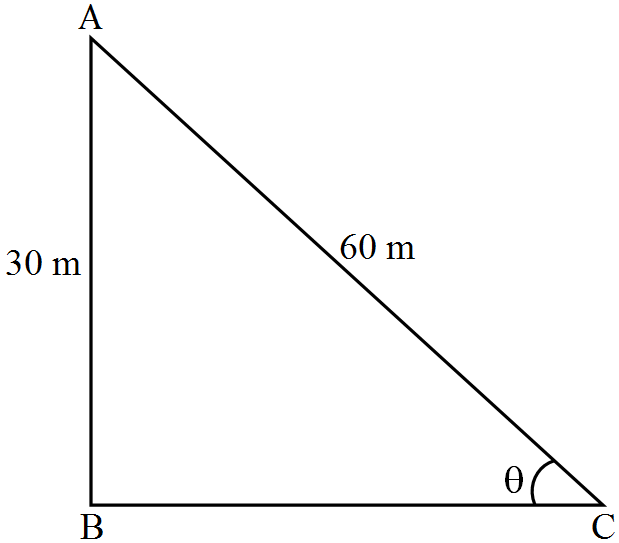
Let point $A$ be the position of the kite and $AC$ be its string.
We have,
$AB = 30m$, and $AC = 60m$
Let $\angle\text{ACB}=\theta$
In $\triangle\text{ABC},$
$\sin\theta=\frac{\text{AB}}{\text{AC}}$
$\Rightarrow\sin\theta=\frac{30}{60}$
$\Rightarrow\sin\theta=\frac{1}{2}$
$\Rightarrow\sin\theta=\sin30^\circ$
$\therefore\ \theta=30^\circ$ View full question & answer→MCQ 81 Mark
On the level ground, the angle of elevation of a tower is $30^\circ.$ On moving $20\text{m}$ nearer, the angle of elevation is $60^\circ.$ The height of the tower is:
- A
$10\text{m}$
- ✓
$10\sqrt{3}\text{m}$
- C
$15\text{m}$
- D
$5\sqrt{3}\text{m}$
AnswerCorrect option: B. $10\sqrt{3}\text{m}$
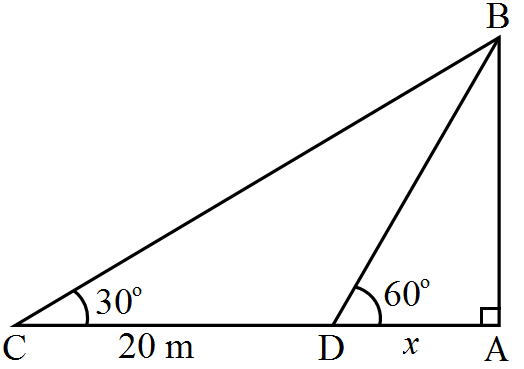
Let $AB$ be the tower and $C$ and $D$ be the points of observation such that $\angle\text{BCD}=30^\circ,\angle\text{BDA}=60^\circ,\text{CD}=20\text{m}$ and $\text{AD = x m.}$
Now, in $\triangle\text{ADB},$
We have:
$\frac{\text{AB}}{\text{AD}}=\tan60^\circ=\sqrt{3}$
$\Rightarrow\frac{\text{AB}}{\text{x}}=\sqrt{3}$
$\Rightarrow\text{AB}=\sqrt{3}\text{x}$
In $\triangle\text{ACB},$
We have:
$\frac{\text{AB}}{\text{AC}}=\tan30^\circ=\frac{1}{\sqrt{3}}$
$\frac{\text{AB}}{20+\text{x}}=\frac{1}{\sqrt{3}}$
$\Rightarrow\text{AB}=\frac{20+\text{x}}{\sqrt{3}}$
$\therefore\sqrt{3}\text{x}=\frac{20+\text{x}}{\sqrt{3}}$
$\Rightarrow3\text{x}=20+\text{x}$
$\Rightarrow2\text{x}=20\Rightarrow\text{x}=10$
$\therefore$ Height of the tower $\text{AB}=\sqrt{3}\text{x}=10\sqrt{3}\text{m}$ View full question & answer→MCQ 91 Mark
In the given figure, a tower $AB$ is $20m$ high and $BC$, its shadow on the ground is $20\sqrt{3}\text{m}$ long. The sun's altitude is:
Answer
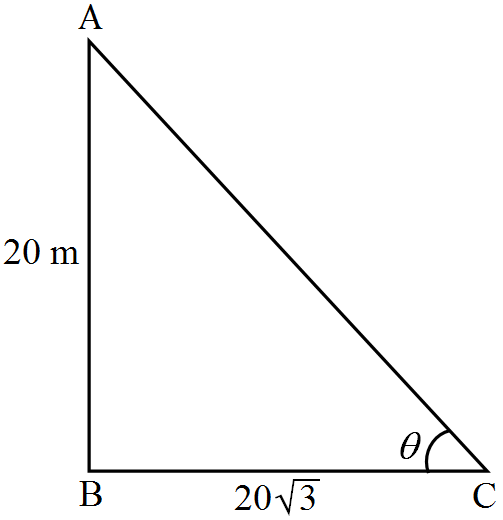
Let the sun's altitude be $\theta.$
We have,
$AB = 20m$ and $\text{BC}=20\sqrt{3}\text{m}$
In $\triangle\text{ABC},$
$\tan\theta=\frac{\text{AB}}{\text{BC}}$
$\Rightarrow\tan\theta=\frac{20}{20\sqrt{3}}$
$\Rightarrow\tan\theta=\frac{1}{\sqrt{3}}$
$\Rightarrow\tan\theta=\tan30^\circ$
$\therefore\ \theta=30^\circ$ View full question & answer→MCQ 101 Mark
The length of the shadow of a tower standing on level ground is found to be $2x$ metres longer when the sun's elevation is $30^\circ$ than when it was $45^\circ$. The height of the tower is:
- A
$\big(2\sqrt{3}\text{x}\big)\text{m}$
- B
$\big(3\sqrt{2}\text{x}\big)\text{m}$
- C
$\big(\sqrt{3}-1\big)\text{x }\text{m}$
- ✓
$\big(\sqrt{3}+1\big)\text{x }\text{m}$
AnswerCorrect option: D. $\big(\sqrt{3}+1\big)\text{x }\text{m}$
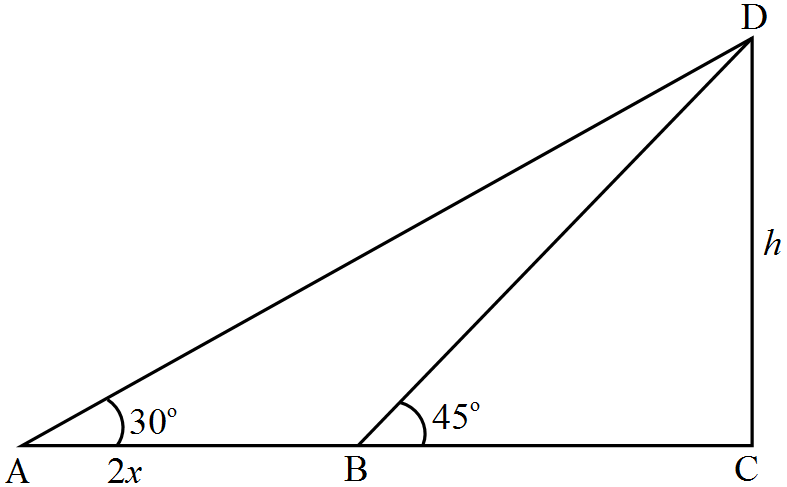
Let $CD = h$ be the height if the tower.
We have,
$AB = 2x$, $\angle\text{DAC}=30^\circ$ and $\angle\text{DBC}=45^\circ$
In $\triangle\text{BCD},$
$\tan45^\circ=\frac{\text{CD}}{\text{BE}}$
$\Rightarrow1=\frac{\text{h}}{\text{BC}}$
$\Rightarrow\text{BC}=\text{h}$
Now, in $\triangle\text{ACD},$
$\tan30^\circ=\frac{\text{CD}}{\text{AC}}$
$\Rightarrow\frac{1}{\sqrt{3}}=\frac{\text{h}}{\text{AB}+\text{BC}}$
$\Rightarrow\frac{1}{\sqrt{3}}=\frac{\text{h}}{2\text{x}+\text{h}}$
$\Rightarrow2\text{x}+\text{h}=\text{h}\sqrt{3}$
$\Rightarrow\text{h}\sqrt{3}-\text{h}=2\text{x}$
$\Rightarrow\text{h}\big(\sqrt{3}-1\big)=2\text{x}$
$\Rightarrow\text{h}=\frac{2\text{x}}{\big(\sqrt{3}-1\big)}\times\frac{\big(\sqrt{3}+1\big)}{\big(\sqrt{3}+1\big)}$
$\Rightarrow\text{h}=\frac{2\text{x}\big(\sqrt{3}+1\big)}{(3-1)}$
$\Rightarrow\text{h}=\frac{2\text{x}\big(\sqrt{3}+1\big)}{2}$
$\therefore\ \text{h}=\text{x}\big(\sqrt{3}+1\big)\text{m}$ View full question & answer→MCQ 111 Mark
An observer $1.5m$ tall $28.5$ away from a tower and the angle of elevation of the top of the tower form the eye of the observer is $45^\circ$. The height of the tower is:
AnswerLet $AB$ be the observer and $CD$ be the tower.
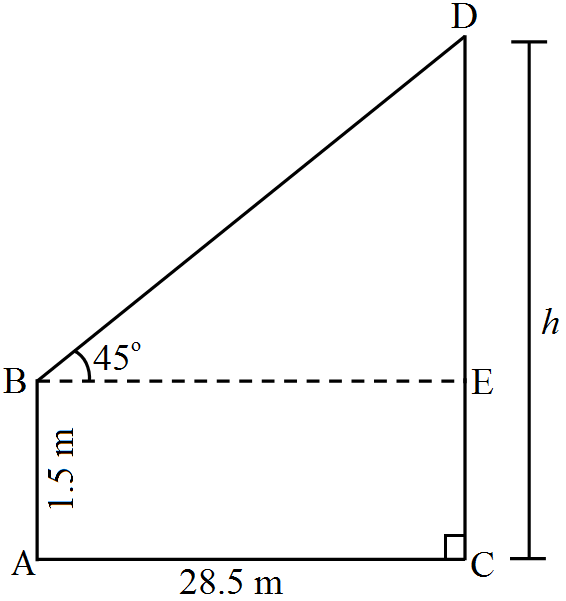
Draw $\text{BE}\perp\text{CD},$ let CD = h metres.
Then, $\text{AB}=1.5\text{m},\text{BE}=\text{AC}=28.5\text{m}$ and $\angle\text{EBD}=45^\circ.$
$DE = (CD - EC) = (CD - AB) = (h - 1.5)m.$
In right $\triangle\text{BED},$
We have:
${\frac{\text{DE}}{\text{BE}}}=\tan45^\circ=1$
$\Rightarrow\frac{(\text{h}-1.5)}{28.5}=1$
$\Rightarrow\text{h}-1.5=28.5$
$\Rightarrow\text{h}=28.5+1.5=30\text{m}$
Hence the height of the tower is $30m$. View full question & answer→MCQ 121 Mark
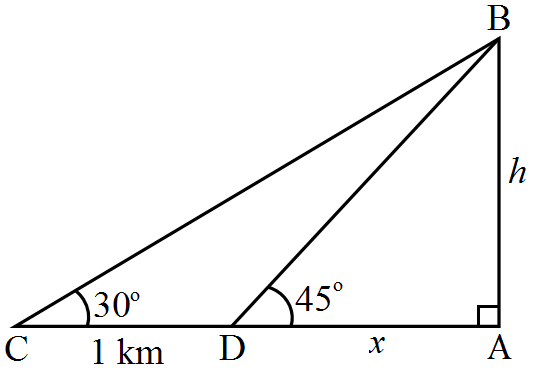
From the top of a hill, the angles of depression of two consecutive km stones due east are found to be $30^\circ $ and $45^\circ$. The height of the hill is:
- A
$\frac{1}{2}\big(\sqrt{3}-1\big)\text{km}$
- ✓
$\frac{1}{2}\big(\sqrt{3}+1\big)\text{km}$
- C
$\big(\sqrt{3}-1\big)\text{km}$
- D
$\big(\sqrt{3}+1\big)\text{km}$
AnswerCorrect option: B. $\frac{1}{2}\big(\sqrt{3}+1\big)\text{km}$
Let $AB$ be the hill making angles of depression at points $C$ and $D$ such that
$\angle\text{ADB}=45^\circ,\angle\text{ACB}=30^\circ$ and $CD = 1km$.
Let:
$AB = h km$ and $AD = x km$
In $\triangle\text{ADB},$
We have:
$\frac{\text{AB}}{\text{AD}}=\tan45^\circ=1$
$\Rightarrow\frac{\text{h}}{\text{x}+1}=\frac{1}{\sqrt{3}}\dots(\text{ii})$
On putting the value of h taken from (i) in (ii), we get:
$\frac{\text{h}}{\text{h}+1}=\frac{1}{\sqrt{3}}$
$\Rightarrow\sqrt{3}\text{h}=\text{h}+1$
$\Rightarrow\big(\sqrt{3}-1\big)\text{h}=1$
$\Rightarrow\text{h}=\frac{1}{\big(\sqrt{3}-1\big)}$
On multiplying the numerator and denominator of the above equation by $\big(\sqrt{3}+1\big),$
We get:
$\text{h}=\frac{1}{\big(\sqrt{3}-1\big)}\times\frac{\big(\sqrt{3}+1\big)}{\big(\sqrt{3}+1\big)}$
$=\frac{\big(\sqrt{3}+1\big)}{2}=\frac12\big(\sqrt{3}+1\big)\text{km}$
Hence, the height of the hill is $\frac12\big(\sqrt{3}+1\big)\text{km}.$ View full question & answer→MCQ 131 Mark
The lengths of a vertical rod and its shadow are in the ratio $1:\sqrt{3}.$ The angle of elevation of the sun is:
Answer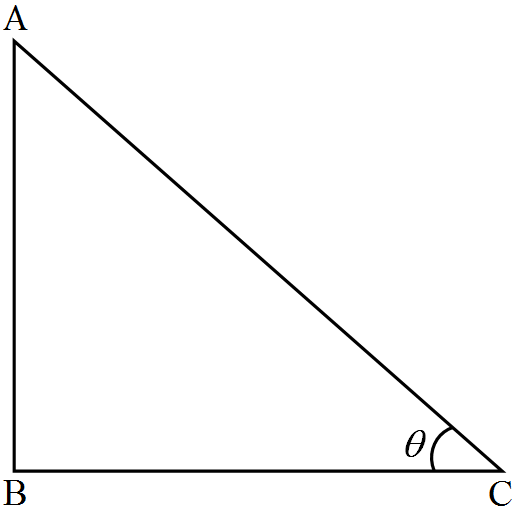
Let $AB$ be the rod and $BC$ be its shadow; and $\theta$ be the angle of elevation of the sun.
We have,
$\text{AB}:\text{BC}=1:\sqrt{3}$
Let $AB = x$
Then, $\text{BC}=\text{x}\sqrt{3}$
In $\triangle\text{ABC},$
$\tan\theta=\frac{\text{AB}}{\text{BC}}$
$\Rightarrow\tan\theta=\frac{1}{\sqrt{3}}$
$\Rightarrow\tan\theta=\tan30^\circ$
$\therefore\ \theta=30^\circ$ View full question & answer→MCQ 141 Mark
The angle of depression of a car parked on the road from the top of a $150$-m-high tower is $30^\circ$. The distance of the car from the tower is:
- A
$50\sqrt{3}\text{m}$
- ✓
$150\sqrt{3}\text{m}$
- C
$150\sqrt{2}\text{m}$
- D
$75\text{m}$
AnswerCorrect option: B. $150\sqrt{3}\text{m}$
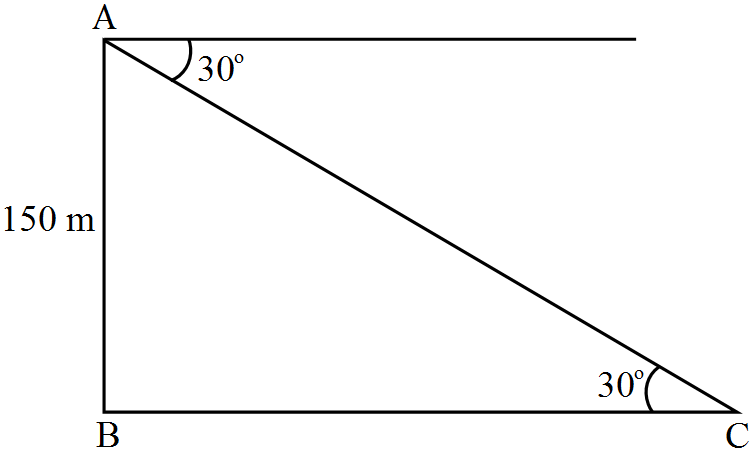
Let $AB$ be the tower and point $C$ be the position of the car.
We have,
$AB = 150m$, and $\angle\text{ACB}=30^\circ$
In $\triangle\text{ABC},$
$\tan30^\circ=\frac{\text{AB}}{\text{BC}}$
$\Rightarrow\frac{1}{\sqrt{3}}=\frac{150}{\text{BC}}$
$\therefore\ \text{BC}=150\sqrt{3}\text{m}$ View full question & answer→MCQ 151 Mark
A ladder $15m$ long just reaches the top of a vertical wall. If the ladder makes an angle of $60^\circ$ with the wall, then the height of the wall is:
AnswerCorrect option: C. $\frac{15}{2}\text{m}$
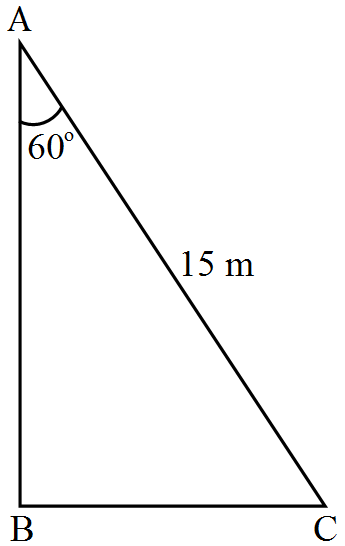
Let $AB$ be the wall and $AC$ be the ladder
We have,
$AC = 15m$, and $\angle\text{BAC}=60^\circ$
In $\triangle\text{ABC},$
$\cos60^\circ=\frac{\text{AB}}{\text{AC}}$
$\Rightarrow\frac{1}{2}=\frac{\text{AB}}{15}$
$\therefore\ \text{AB}=\frac{15}{2}\text{m}$ View full question & answer→MCQ 161 Mark
A ladder makes an angle of $60^\circ$ with the ground when placed against a wall. If the foot of the ladder is $2m$ away from the wall, then the length of the ladder is:
AnswerCorrect option: D. $4\text{m}$
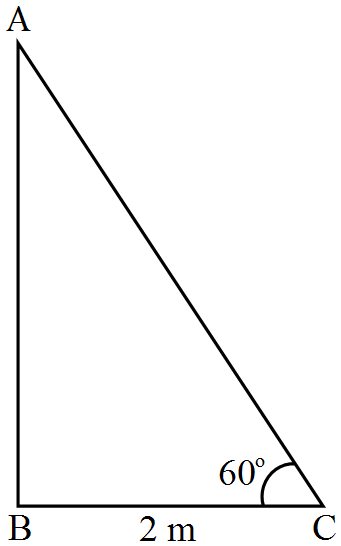
Let $AB$ be the wall and $AC$ be the ladder
We have,
$BC = 2m$, and $\angle\text{ACB}=60^\circ$
In $\triangle\text{ABC},$
$\cos60^\circ=\frac{\text{BC}}{\text{AC}}$
$\Rightarrow\frac{1}{2}=\frac{2}{\text{AC}}$
$\therefore\ \text{AC}=4\text{m}$ View full question & answer→MCQ 171 Mark
If the length of the shadow of a tower is $\sqrt{3}\text{ times}$ its height then the angle of elevation of the sun is:
- A
$45^\circ$
- ✓
$30^\circ$
- C
$60^\circ$
- D
$90^\circ$
AnswerCorrect option: B. $30^\circ$
Let $AB$ be the pole and $BC$ be its shadow.
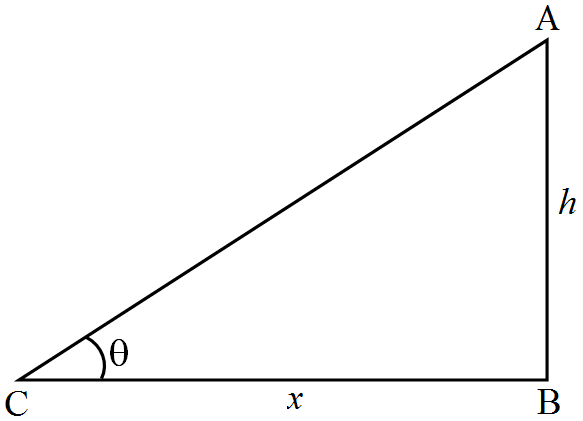
Let $AB = h$ and $BC = x$ such that $\text{x}=\sqrt{3}\text{h}$ (given) and $\theta$ be the angle of elevation.
From $\triangle\text{ABC},$ we have:
$\frac{\text{AB}}{\text{BC}}=\tan\theta$
$\Rightarrow\frac{\text{h}}{\text{x}}=\frac{\text{h}}{\sqrt{3}\text{h}}=\tan\theta$
$\Rightarrow\tan\theta=\frac{1}{\sqrt{3}\text{h}}$
$\Rightarrow\theta=30^\circ$ View full question & answer→MCQ 181 Mark
A pole casts a shadow of length $2\sqrt{3}\text{m}$ on the ground when the sun's elevation is $60^\circ$. The height of the pole is:
- A
$4\sqrt{3}\text{m}$
- ✓
$6\text{m}$
- C
$12\text{m}$
- D
$3\text{m}$
AnswerCorrect option: B. $6\text{m}$
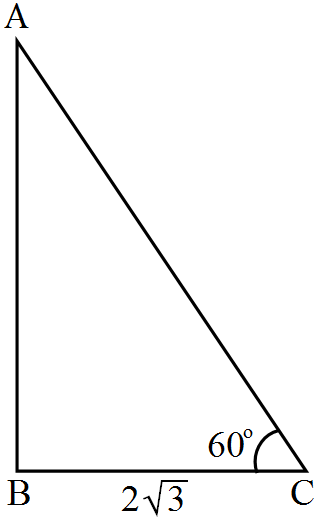
Let $AB$ be the pole and $BC$ be its shadow.
We have,
$\text{BC}=2\sqrt{3}\text{m}$ and $\angle\text{ACB}=60^\circ$
In $\triangle\text{ABC},$
$\tan60^\circ=\frac{\text{AB}}{\text{BC}}$
$\Rightarrow\sqrt{3}=\frac{\text{AB}}{2\sqrt{3}}$
$\therefore\ \text{AB}=6\text{m}$ View full question & answer→MCQ 191 Mark
From a point on the ground, $30m$ away from the foot of a tower, the angle of elevation of the top of the tower is $30^\circ$. The height of the tower is:
- A
$30\text{m}$
- ✓
$10\sqrt{3}\text{m}$
- C
$10\text{m}$
- D
$30\sqrt{3}\text{m}$
AnswerCorrect option: B. $10\sqrt{3}\text{m}$
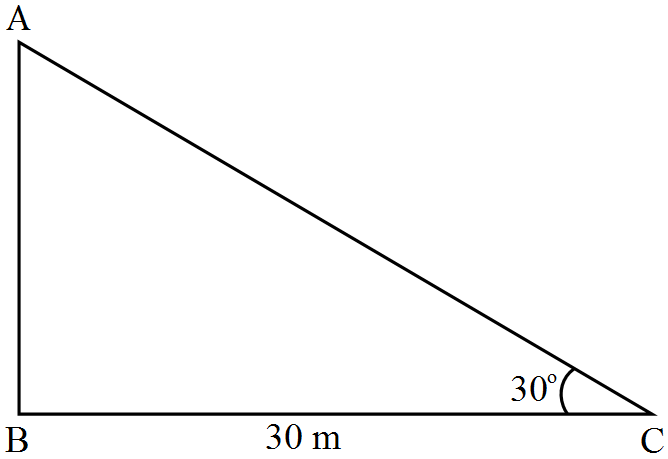
Let $AB$ be the tower and point $C$ be the point of obseevation on the ground.
We have,
$BC = 30m$, and $\angle\text{ACB}=30^\circ$
In $\triangle\text{ABC},$
$\tan30^\circ=\frac{\text{AB}}{\text{BC}}$
$\Rightarrow\frac{1}{\sqrt{3}}=\frac{\text{AB}}{30}$
$\Rightarrow\text{AB}=\frac{30}{\sqrt{3}}$
$\Rightarrow\text{AB}=\frac{30}{\sqrt{3}}\times\frac{\sqrt{3}}{\sqrt{3}}$
$\Rightarrow\text{AB}=\frac{30\sqrt{3}}{3}$
$\therefore\ \text{AB}=10\sqrt{3}\text{m}$ View full question & answer→MCQ 201 Mark
If the elevation of the sun changes form $30^\circ$ to $60^\circ$, then the difference between the lengths of shadows of a pole $15m$ high, is:
- A
$7.5\text{m}$
- B
$15\text{m}$
- ✓
$10\sqrt{3}\text{m}$
- D
$5\sqrt{3}\text{m}$
AnswerCorrect option: C. $10\sqrt{3}\text{m}$
Let $AB$ be the pole and $AC$ and $AD$ be its shadows.
We have:
$\angle\text{ACB}=30^\circ,\angle\text{ADB}=60^\circ$ and $AB = 15m$.
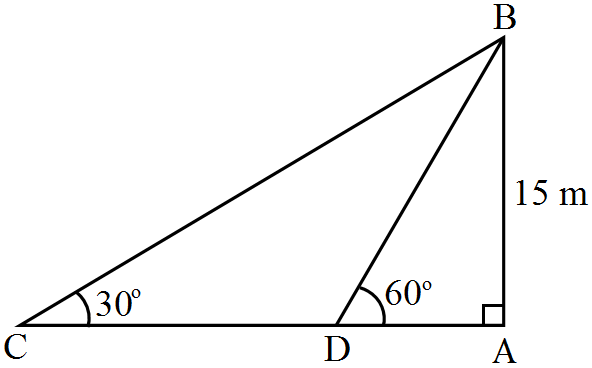
In $\triangle\text{ACB},$
We have:
$\frac{\text{AC}}{\text{AB}}=\cot30^\circ=\sqrt{3}$
$\Rightarrow\frac{\text{AC}}{15}={\sqrt{3}}\Rightarrow\text{AC}=15\sqrt{3}\text{m}$
Now, in $\triangle\text{ADB},$ we have:
$\frac{\text{AD}}{\text{AB}}=\cot60^\circ=\frac{1}{\sqrt{3}}$
$\Rightarrow\frac{\text{AD}}{15}=\frac{1}{\sqrt{3}}$
$\Rightarrow\text{AD}=\frac{15}{\sqrt{3}}=\frac{15\times\sqrt{3}}{\sqrt{3}\times\sqrt{3}}$
$\Rightarrow\frac{15\sqrt{3}}{3}=5\sqrt{3}\text{m}$
$\therefore$ Difference between the lengths of the shadows $=\text{AC}-\text{AD}=15\sqrt{3}-5\sqrt{3}=10\sqrt{3}\text{m}$ View full question & answer→MCQ 211 Mark
If a $1.5m$ tall girl stands at a distance of $3m$ from a lamp post and casts a shadow of length $4.5m$ on the ground, then the height of the lamp post is:
Answer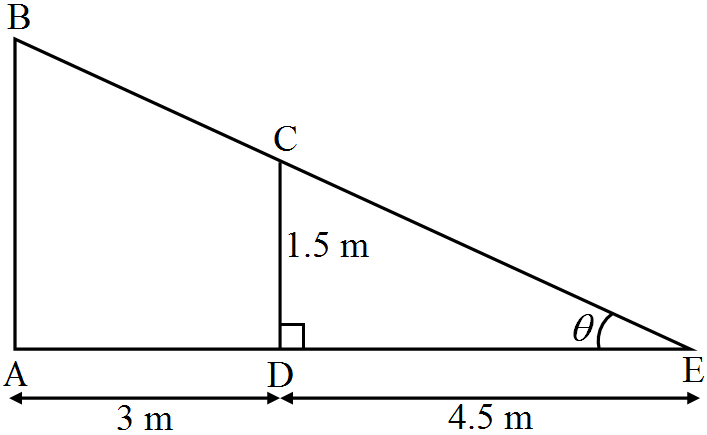
Let $AB$ be the lamp-post; $CD$ be the girl and $DE$ be her shadow.
We have,
$CD = 1.5m, AD =3m, DE = 4.5m$
Let $\angle\text{E}=\theta$
In $\triangle\text{CDE},$
$\tan\theta=\frac{\text{CD}}{\text{DE}}$
$\Rightarrow\tan\theta=\frac{1.5}{4.5}$
$\Rightarrow\tan\theta=\frac{1}{3}\dots(\text{i})$
Now, in $\triangle\text{ABE},$
$\tan\theta=\frac{\text{AB}}{\text{AE}}$
$\Rightarrow\frac{1}{3}=\frac{\text{AB}}{\text{AD}+\text{DE}}$ [Using (i)]
$\Rightarrow\frac{1}{3}=\frac{\text{AB}}{3+4.5}$
$\Rightarrow\text{AB}=\frac{7.5}{3}$
$\therefore\ \text{AB}=2.5\text{m}$ View full question & answer→MCQ 221 Mark
If the height of a vertical pole is equal to the length of its shadow on the ground, the angle of elevation of the sun is:
- A
$0^\circ$
- B
$30^\circ$
- ✓
$45^\circ$
- D
$60^\circ$
AnswerCorrect option: C. $45^\circ$
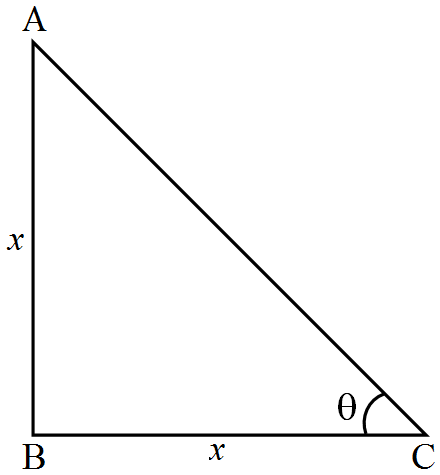
Let $AB$ represents the vertical pole and $BC$ represents the shadow on the ground and $\theta$ represents angle of elevation the sun.
In $\triangle\text{ABC},$
$\tan\theta=\frac{\text{AB}}{\text{BC}}$
$\Rightarrow\tan\theta=\frac{\text{x}}{\text{x}}$ (As, the height of the pole, $AB$ = the shadow, $BC = x$)
$\Rightarrow\tan\theta=1$
$\Rightarrow\tan\theta=\tan45^\circ$
$\therefore\theta=45^\circ$ View full question & answer→MCQ 231 Mark
If the angles of elevation of the top of a tower form tow points at distances a and b from the base and in the same straight line with it are complementary, then the height of the tower is:
- A
$\sqrt{\frac{\text{a}}{\text{b}}}$
- ✓
$\sqrt{\text{ab}}$
- C
$\sqrt{\text{a}+\text{b}}$
- D
$\sqrt{\text{a}-\text{b}}$
AnswerCorrect option: B. $\sqrt{\text{ab}}$
Let $AB$ be the tower and $C$ and $D$ be the points of observation on $AC$.
Let:
$\angle\text{ACB}=\theta,\angle\text{ADB}=90-\theta$ and $AB = h m$
Thus,
We have:
$AC = a, AD = b$ and $CD = a - b$
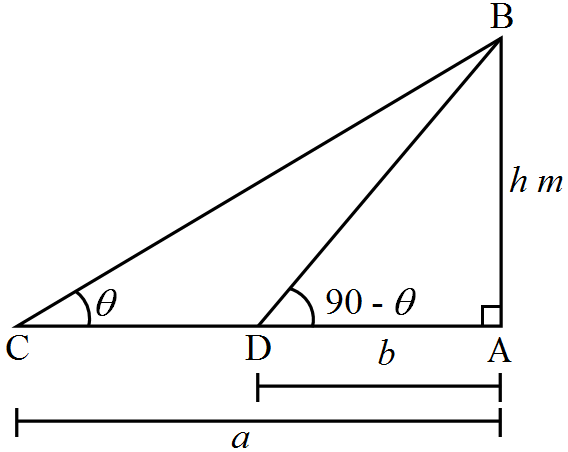
Now, in the right $\triangle\text{ABC},$
We have:
$\tan\theta=\frac{\text{AB}}{\text{AC}}$
$\Rightarrow\frac{\text{h}}{\text{a}}=\tan\theta\dots(\text{i})$
In the right $\triangle\text{ABD},$
We have:
$\tan(90-\theta)=\frac{\text{AB}}{\text{AD}}$
$\Rightarrow\cot\theta=\frac{\text{h}}{\text{b}}\dots(\text{ii})$
On multiplying (i) and (ii),
We have:
$\tan\theta\times\cot\theta=\frac{\text{h}}{\text{a}}\times\frac{\text{h}}{\text{b}}$
$\Rightarrow\frac{\text{h}}{\text{a}}\times\frac{\text{h}}{\text{b}}=1$ $\Big[\because\tan\theta=\frac{1}{\cot\theta}\Big]$
$\Rightarrow\text{h}^2=\text{ab}$
$\Rightarrow\text{h}=\sqrt{\text{ab}}\text{m}$
Hence, the height of the tower is $\sqrt{\text{ab}}\text{m}.$ View full question & answer→MCQ 241 Mark
The shadow of a $5$-m-long stick is $2m$ long. At the same time the length of the shadow of a $12.5$-m-high tree is:
Answer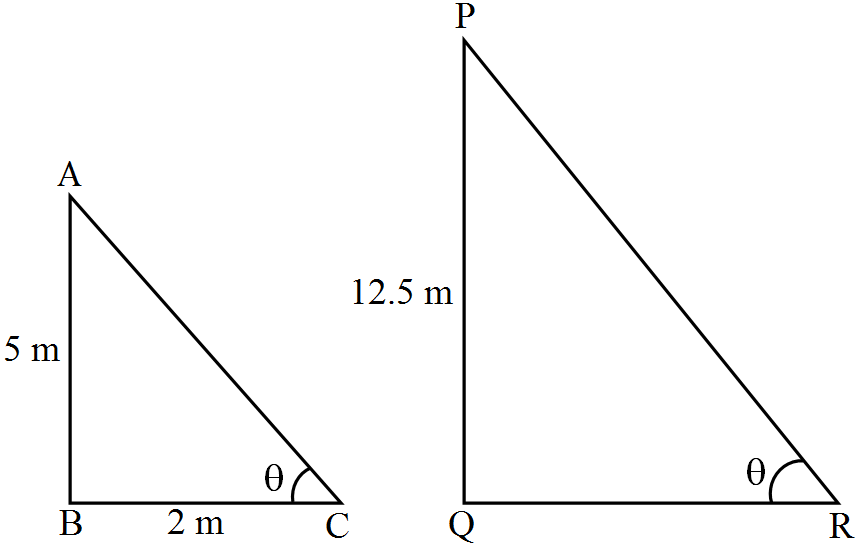
Let $AB$ be the stick and $BC$ be its shadow and $PQ$ be the tree and $QR$ be its shadow.
We have,
$AB = 5m, BC = 2m, PQ = 12.5m$
In $\triangle\text{ABC},$
$\tan\theta=\frac{\text{AB}}{\text{BC}}$
$\Rightarrow\tan\theta=\frac{5}{2}$
Now, In $\triangle\text{PQR},$
$\tan\theta=\frac{\text{PQ}}{\text{QR}}$
$\Rightarrow\frac{5}{2}=\frac{12.5}{\text{QR}}$ [Using $(i)$]
$\Rightarrow\text{QR}=\frac{12.5\times2}{5}=\frac{25}{5}$
$\therefore\ \text{QR}=5\text{m}$ View full question & answer→MCQ 251 Mark
If the height of a vertical pole is $\sqrt{3}\text{times}$ the length of its shadow on ground then the angle of elevation of the sun at that time is:
- A
$30^\circ $
- B
$45^\circ$
- ✓
$60^\circ $
- D
$75^\circ$
AnswerCorrect option: C. $60^\circ $
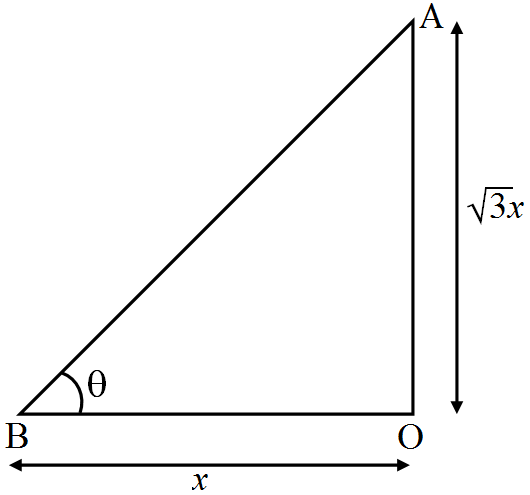
Here, $AO$ be the pole; $BO$ be its shadow and $\theta$ be the angle of elevation of the sun.
Let $BO = x$
Then, $\text{AO}=\text{x}\sqrt{3}$
In $\triangle\text{AOB},$
$\tan\theta=\frac{\text{AO}}{\text{BO}}$
$\Rightarrow\tan\theta=\frac{\text{x}\sqrt{3}}{\text{x}}$
$\Rightarrow\tan\theta=\sqrt{3}$
$\Rightarrow\tan\theta=\tan60^\circ$
$\therefore\theta=60^\circ$ View full question & answer→