Question 14 Marks
The angle of elevation of a stationery cloud from a point $2500m$ above a lake is $15^\circ $ and the angle of depression of its reflection in the lake is $45^\circ $. What is the height of the cloud above the lake level? (Use tan $15^\circ = 0.268)$
Answer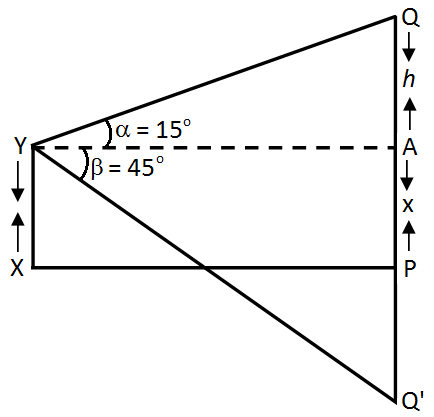
Let cloud be at height $PQ$ as represented from lake level
From point x, $2500$ meters above the lake angle of elevation of top of cloud $\alpha=15^\circ$
Angle of depression of shadow reflection in water $\beta=45^\circ$
Here $PQ = PQ$' draw $\text{AY}\bot\text{PQ}$
Let $AQ = 'h' m, AP = 'x' m$
$PQ = (h + x)m, PQ' = (h + x)m$
The above data is represented in from of figure as shown,
In right triangle if one of included angle is $\theta$ then,
$\tan\theta=\frac{\text{Opposite side}}{\text{Adjacent side}}$
$\tan15^\circ=\frac{\text{AQ}}{\text{AY}}$
$\Rightarrow\ 0.268=\frac{\text{h}}{\text{AY}}$
$\Rightarrow\ \text{AY}=\frac{\text{h}}{0.268}\ ......(1)$
$\tan45^\circ=\frac{\text{AB}'}{\text{AY}}=\frac{\text{AP}+\text{PQ}'}{\text{AY}}$
$\Rightarrow\ \text{AY}=\text{x}+(\text{h}+\text{x})$
$=\text{h}+2\text{x}$
$\Rightarrow\ \text{AY}=\text{h}+2\text{x}\ ......(2)$
From (1) and (2)
$\frac{\text{h}}{0.268}=\text{h}+2\text{x}$
$\Rightarrow\ 3.131\text{h}-\text{h}=2\times2500$
$\Rightarrow\ \text{h}=\frac{5000}{0.731}=1830.8312$
Height of cloud above lake $= h + x$
$= 1830.8312 + 2500$
$= 4300.8312m$ View full question & answer→Question 24 Marks
If the angle of elevation of a cloud from a point h metres above a lake is a and the angle of depression of its reflection in the lake be b, prove that the distance of the cloud from the point of observation is, $\frac{2\text{h}\sec\alpha}{\tan\beta-\tan\alpha}.$
AnswerLet $C′$ be the image of cloud $C.$ We have $\angle\text{CAB}=\alpha$ and $\angle\text{BAC}'=\beta.$
Again let $BC = x$ and $AC$ be the distance of cloud from point of observation.
We have to prove that,
$\text{AC}=\frac{2\text{h}\sec\alpha}{(\tan\beta-\tan\alpha)}$
The corresponding figure is as follows,
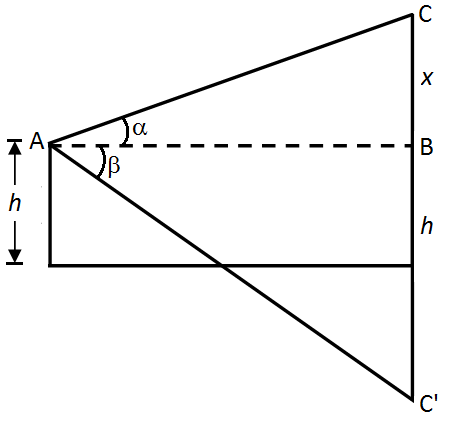
We use trigonometric ratios.
In $\triangle\text{ABC}$
$\Rightarrow\ \tan\alpha=\frac{\text{BC}}{\text{AB}}$
$\Rightarrow\ \tan\alpha=\frac{\text{x}}{\text{AB}}$
Again in $\triangle\text{ABC}'$
$\Rightarrow\ \tan\beta=\frac{\text{BC}'}{\text{AB}}$
$\Rightarrow\ \tan\beta=\frac{\text{x}+2\text{h}}{\text{AB}}$
Now,
$\Rightarrow\ \tan\beta-\tan\alpha=\frac{\text{x}+2\text{h}}{\text{AB}}-\frac{\text{x}}{\text{AB}}$
$\Rightarrow\ \tan\beta-\tan\alpha=\frac{2\text{h}}{\text{AB}}$
$\Rightarrow\ \text{AB}=\frac{2\text{h}}{\tan\beta-\tan\alpha}$
Again in $\triangle\text{ABC}$
$\Rightarrow\ \cos\alpha=\frac{\text{AB}}{\text{AC}}$
$\Rightarrow\ \text{AC}=\frac{\text{AB}}{\cos\alpha}$
$\Rightarrow\ \text{AC}=\frac{2\text{h}\sec\alpha}{(\tan\beta-\tan\alpha)}$
Hence distance of cloud from points of observation is $\frac{2\text{h}\sec\alpha}{(\tan\beta-\tan\alpha)}.$ View full question & answer→Question 34 Marks
A fire in a building $B$ is reported on telephone to two fire stations $P$ and $Q, 20 km$ a part from each other on a straight road. $P$ observes that the fire is at an angle of $60^{\circ}$ to the road and $Q$ observes that it is at an angle of $45^{\circ}$ to the road. Which station should send its team and how much will this team have to travel?
AnswerLet B is the building one fire and $P$ and $Q$ the fire stations which are 20km apart i.e., $PQ = 20\ km.$
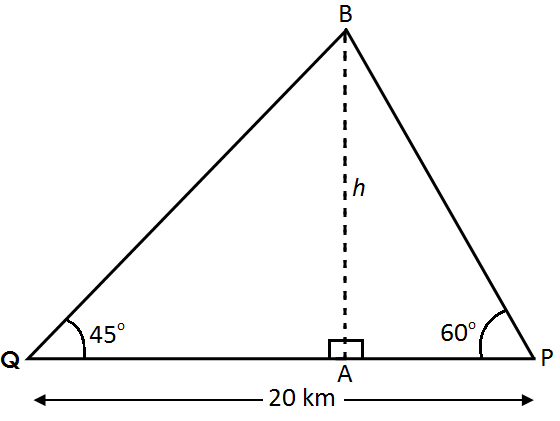
P and Q observes the angles with $B$, as $60^\circ $ and $45^\circ $ respectively.
Draw $\text{BA}\bot\text{PQ}$
Let AB = h Now in right $\triangle\text{BAQ}$
$\tan\theta=\frac{\text{Perpendicular}}{\text{Base}}=\frac{\text{BA}}{\text{AQ}}$
$\Rightarrow\ \tan45^\circ=\frac{\text{h}}{\text{AQ}}$
$\Rightarrow\ 1=\frac{\text{h}}{\text{AQ}}\Rightarrow\ \text{AQ}=\text{h}$
$\therefore$ PA = 20 - h
Similarly in right $\triangle\text{BAP}$
$\tan60^\circ=\frac{\text{BA}}{\text{AP}}$
$\Rightarrow\ \sqrt{3}=\frac{\text{h}}{20-\text{h}}$
$\Rightarrow\ (20-\text{h})\sqrt{3}=\text{h}$
$\Rightarrow\ 20\sqrt{3}-\sqrt{3}\text{h}=\text{h}$
$\Rightarrow\ \sqrt{3}\text{h}+\text{h}=20\sqrt{3}$
$\Rightarrow\ \text{h}(\sqrt{3}+1)=20\sqrt{3}$
$\Rightarrow\ \text{h}=\frac{20\sqrt{3}}{\sqrt{3}+1}=\frac{20\sqrt{3}(\sqrt{3}-1)}{(\sqrt{3}+1)(\sqrt{3}-1)}$
$=\frac{20\sqrt{3}(\sqrt{3}-1)}{3-1}$
$=\frac{20\sqrt{3}(\sqrt{3}-1)}{2}$
$=10\sqrt{3}(\sqrt{3}-1)$
$=10\times3-10\sqrt{3}$
$= 30 - 10 \times 1.732$
$= 30 - 17.3 = 12.7km$
$\therefore$ AQ = 12.7km and $AP = 20.0 - 12.7 = 7.3km$
Now, $\sin45^\circ=\frac{\text{Perpendicular}}{\text{Hypotenuse}}$
$\Rightarrow\ \frac{1}{\sqrt{2}}=\frac{\text{h}}{\text{BQ}}$
$\Rightarrow\ \frac{1}{\sqrt{2}}=\frac{12.7}{\text{BQ}}$
$\Rightarrow\ \text{BQ}=12.7\times\sqrt{2}=12.7\times1.41$
$\Rightarrow\ \text{BQ}=17.91\text{km}$
Similarly, $\sin60^\circ=\frac{\text{BA}}{\text{BP}}=\frac{12.7}{\text{BP}}$
$\Rightarrow\ \frac{\sqrt{3}}{2}=\frac{12.7}{\text{BP}}\Rightarrow\ \text{BP}=\frac{12.7\times2}{\sqrt{3}}$
$\Rightarrow\ \text{BP}=\frac{25.4}{1.73}=14.68$
It is clear that P fire station is nearer and its team will reach the building after coming $14.6km$ View full question & answer→Question 44 Marks
A tree standing on a horizontal plane is leaning towards east. At two points situated at distances a and b exactly due west on it, the angles of elevation of the top are respectively $\alpha$ and $\beta.$ Prove that the height of the top from the ground is, $\frac{(\text{b}-\text{a})\tan\alpha\tan\beta}{\tan\alpha-\tan\beta}.$
AnswerLet $CD$ is the tree which is leaning towards east and $A$ and $B$ are two points on the West making angles of elevation with top $C$ of the tree as $\alpha$ and $\beta.$
$A$ and $B$ are at the distance of a and b from the foot of the tree $CD$, then $AD = a, BD = b.$
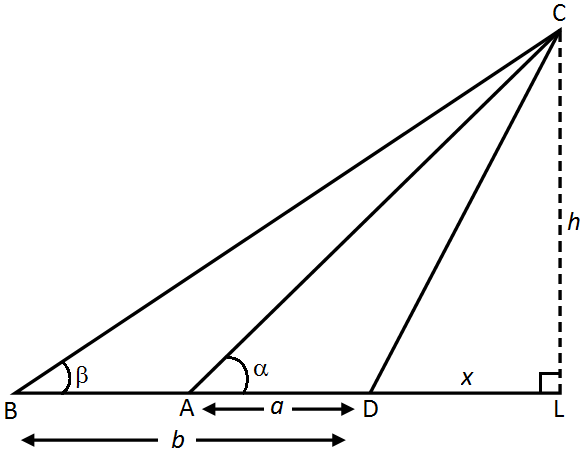
Draw $\text{CL}\bot\text{BD}$ produced and let $DL = x$ and $CL = h$
Now in right $\triangle\text{CAL,}$
$\tan\alpha=\frac{\text{Perpendicular}}{\text{Base}}=\frac{\text{CL}}{\text{AL}}=\frac{\text{h}}{\text{a}+\text{x}}$
$\Rightarrow \text{a}+\text{x}=\frac{\text{h}}{\tan\alpha}\ .....(\text{i})$
Similarly in right $\triangle\text{CBL,}$
$\tan\beta=\frac{\text{CL}}{\text{BL}}=\frac{\text{h}}{\text{b}+\text{x}}$
$\Rightarrow\ \text{b}+\text{x}=\frac{\text{h}}{\tan\beta}\ .....(\text{ii})$
From $(i)$ and $(ii)$
$\text{x}=\frac{\text{h}}{\tan\alpha}-\text{a}$
$\text{x}=\frac{\text{h}}{\tan\beta}-\text{b}$
$\therefore\ \frac{\text{h}}{\tan\alpha}-\text{a}=\frac{\text{h}}{\tan\beta}-\text{b}$
$\Rightarrow\ \frac{\text{h}}{\tan\beta}-\frac{\text{h}}{\tan\alpha}=\text{b}-\text{a}$
$\Rightarrow\ \text{h}\Big(\frac{1}{\tan\beta}-\frac{1}{\tan\alpha}\Big)=\text{b}-\text{a}$
$\Rightarrow\ \text{h}\Big(\frac{\tan\alpha-\tan\beta}{\tan\beta\tan\alpha}\Big)=\text{b}-\text{a}$
$\Rightarrow\ \text{h}=\frac{(\text{b}-\text{a})\tan\alpha\tan\beta}{\tan\alpha-\tan\beta}.$
Hence proved. View full question & answer→Question 54 Marks
$PQ$ is a post of given height a, and $AB$ is a tower at some distance. If $\alpha$ and $\beta$ are the angles of elevation of $B$, the top of the tower, at $P$ and $Q$ respectively. Find the height of the tower and its distance from the post.
Answer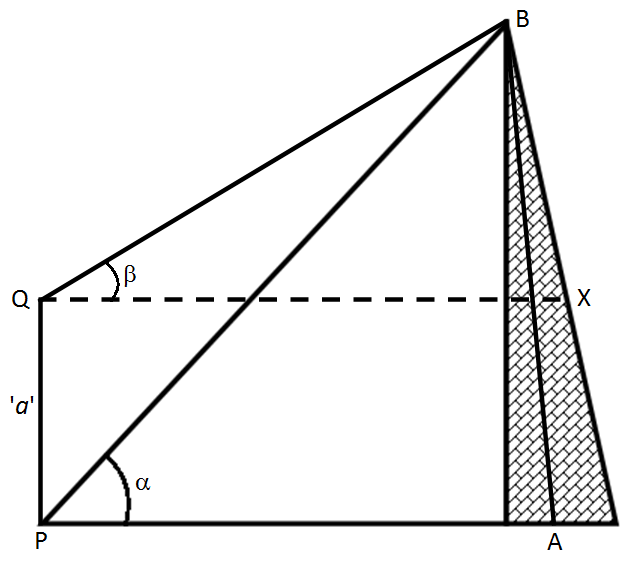
PQ is part height = 'a' m $AB$ is tower height
Angle of elevation of $B$ from $\text{P}=\alpha$
Angle of elevation of $B$ from $\text{Q}=\beta$
The above information is represented in form of figure as shown
In right triangle if one of the included angle is $\theta,$ then $\tan\theta=\frac{\text{Opposite side}}{\text{Adjacent side}}$
Draw $\text{QX}\bot\text{AB},$ PQ = AK
In $\triangle\text{BQX}$
$\tan\beta=\frac{\text{BX}}{\text{QX}}$
$\Rightarrow\ \tan\beta=\frac{\text{AB}-\text{AX}}{\text{QX}}$
$\Rightarrow\ \tan\beta=\frac{\text{AB}-\text{a}}{\text{QX}}\ .....(1)$
In $\triangle\text{BPA}$
$\tan\alpha=\frac{\text{AB}}{\text{AP}}$
$\Rightarrow\ \tan\beta=\frac{\text{AB}}{\text{QX}}\ .....(2)$
$(1)$ divided by $(2)$
$\Rightarrow\ \frac{\tan\beta}{\tan\alpha}=\frac{\text{AB}-\text{a}}{\text{AB}}=1-\frac{\text{a}}{\text{AB}}$
$\Rightarrow\ \frac{\text{a}}{\text{AB}}=1-\frac{\tan\beta}{\tan\alpha}=\frac{\tan\alpha-\tan\beta}{\tan\alpha}$
$\Rightarrow\ \text{AB}=\frac{\text{a}\tan\alpha}{\tan\alpha-\tan\beta}$
Height of power $=\text{a}\tan\alpha(\tan\alpha-\tan\beta)$
Distance between past and tower $=\text{a}(\tan\alpha-\tan\beta).$ View full question & answer→Question 64 Marks
A ladder rests against a wall at an angle $\alpha$ to the horizontal. Its foot is pulled away from the wall through a distance a, so that it slides a distance b down the wall making an angle $\beta$ with the horizontal. Show that, $\frac{\text{a}}{\text{b}}=\frac{\cos\alpha-\cos\beta}{\sin\beta-\sin\alpha}.$
AnswerLet $PQ$ be the ladder such that its top $Q$ is on the wall $OQ$ and bottom $P$ is on the ground. The ladder is pulled away from the wall through a distance a, so that its top $Q$ slides and takes position $Q'$. So $PQ = P'Q'$
$\angle\text{OPQ}=\alpha$ and $\angle\text{OP}'\text{Q}'=\beta.$ Let $PQ = h$
We have to prove that,
$\frac{\text{a}}{\text{b}}=\frac{\cos\alpha-\cos\beta}{\sin\beta-\sin\alpha}$
We have the corresponding figure as follows,
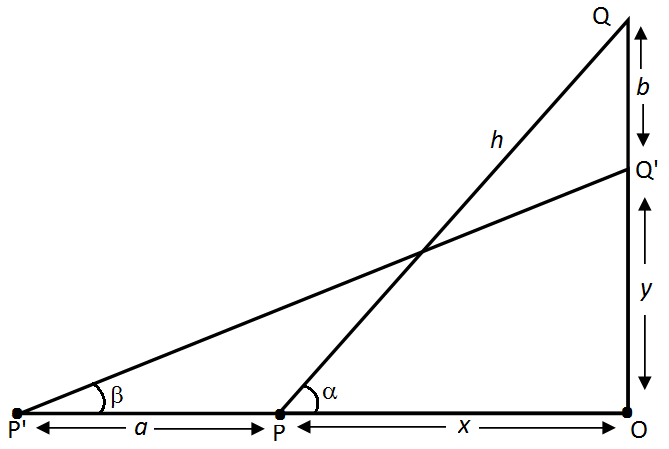
We use trigonometric ratios.
In $\triangle\text{POQ}$
$\Rightarrow\ \sin\alpha=\frac{\text{OQ}}{\text{PQ}}$
$\Rightarrow\ \sin\alpha=\frac{\text{b}+\text{y}}{\text{h}}$
And,
$\Rightarrow\ \cos\alpha=\frac{\text{OP}}{\text{PQ}}$
$\Rightarrow\ \cos\alpha=\frac{\text{x}}{\text{h}}$
Again in $\triangle\text{P}'\text{OQ}'$
$\Rightarrow\ \sin\beta=\frac{\text{OQ}'}{\text{P}'\text{Q}'}$
$\Rightarrow\ \sin\beta=\frac{\text{y}}{\text{h}}$
And,
$\Rightarrow\ \cos\beta=\frac{\text{OP}'}{\text{P}'\text{Q}'}$
$\Rightarrow\ \cos\beta=\frac{\text{a}+\text{x}}{\text{h}}$
Now,
$\Rightarrow\ \sin\alpha-\sin\beta=\frac{\text{b}+\text{y}}{\text{h}}-\frac{\text{y}}{\text{h}}$
$\Rightarrow\ \sin\alpha-\sin\beta=\frac{\text{b}}{\text{h}}$
And,
$\Rightarrow\ \cos\beta-\cos\alpha=\frac{\text{a}+\text{x}}{\text{h}}-\frac{\text{x}}{\text{h}}$
$\Rightarrow\ \cos\beta-\cos\alpha=\frac{\text{a}}{\text{h}}$
So,
$\Rightarrow\ \frac{\sin\alpha-\sin\beta}{\cos\beta-\cos\alpha}=\frac{\text{b}}{\text{a}}$
$\Rightarrow\ \frac{\text{a}}{\text{b}}=\frac{\cos\beta-\cos\alpha}{\sin\alpha-\sin\beta}$
$\Rightarrow\ \frac{\text{a}}{\text{b}}=\frac{\cos\alpha-\cos\beta}{\sin\beta-\sin\alpha}$
Hence $\frac{\text{a}}{\text{b}}=\frac{\cos\alpha-\cos\beta}{\sin\beta-\sin\alpha}.$ View full question & answer→Question 74 Marks
The angle of elevation of a tower from a point on the same level as the foot of the tower is $30^\circ $. On advancing $150$ metres towards the foot of the tower, the angle of elevation of the tower becomes $60^\circ $. Show that the height of the tower is $129.9$ metres. $(\text{Use }\sqrt{3}=1.7323=1.732)$
AnswerLet, height of tower, AB = h
angle of elevation $\angle\text{D}=30^\circ,\ \angle\text{C}=60^\circ$
Distance, DC = 150°
Now, we have to prove that height of tower is 129.9m
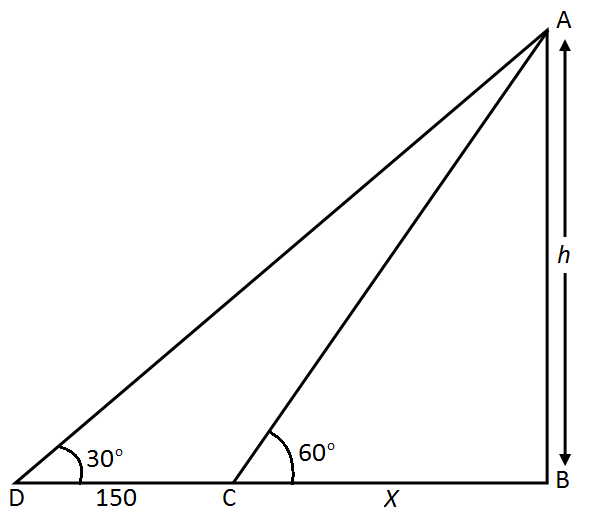
In $\triangle\text{ABC},$
$\tan\text{C}=\frac{\text{AB}}{\text{BC}}$
$\Rightarrow\ \tan60^\circ=\frac{\text{h}}{\text{x}}$
$\Rightarrow\ \sqrt{3}=\frac{\text{h}}{\text{x}}$
$\Rightarrow\ \text{x}=\frac{\text{h}}{\sqrt{3}}$
In $\triangle\text{ABD},$
$\tan\text{D}=\frac{\text{AB}}{\text{BD}}$
$\Rightarrow\ \tan30^\circ=\frac{\text{AB}}{\text{DC}+\text{BC}}$
$\Rightarrow\ \tan30^\circ=\frac{\text{h}}{150+\text{x}}$
$\Rightarrow\ \frac{1}{\sqrt{3}}=\frac{\text{h}}{150+\text{x}}$
$\Rightarrow\ \text{h}=\frac{150+\text{x}}{\sqrt{3}}$
$\Rightarrow\ \text{h}=\frac{150+\frac{\text{h}}{\sqrt{3}}}{\sqrt{3}}$ $[\because\ \sqrt{3}=1.732]$
$\Rightarrow\ \text{h}=129.9$
Hence proved, height of tower is 129.9m View full question & answer→Question 84 Marks
A man on the deck of a ship is $10\ m$ above the water level. He observes that the angle of elevation of the top of a cliff is $45^\circ $ and the angle of depression of the base is $30^\circ $. Calculate the distance of the cliff from the ship and the height of the cliff.
Answer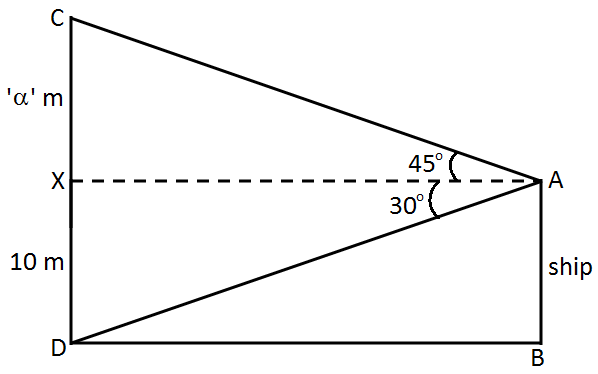
Height of ship from water level $= 10cm = AB$
Angle of elevation of top of cliff $\alpha=45^\circ$
Angle of depression of bottom of cliff $\alpha=30^\circ$
Height of cliff $CD =$ 'h' m.
Distance of ship from foot of tower cliff
Height of cliff above ship be 'a' m
Then height of cliff $= DX + XC$
$= (10 + a)m$
The above data is represented in form of figure as shown
In right triangle, if one of the included angle is $\theta,$ then
$\tan\theta=\frac{\text{Opposite side}}{\text{Adjacent side}}$
$\Rightarrow\ \tan45^\circ=\frac{\text{CX}}{\text{AX}}$
$\Rightarrow\ 1=\frac{\text{a}}{\text{AX}}$
$\Rightarrow AX = 'a' m$
$\Rightarrow\ \tan30^\circ=\frac{\text{XD}}{\text{AX}}$
$\Rightarrow\ \frac{1}{\sqrt{3}}=\frac{10}{\text{AX}}$
$\Rightarrow\ \text{AX}=10\sqrt{3}$
$\therefore\ \text{a}=10\sqrt{3}\text{m}$
Height of cliff $=10+10\sqrt{3}=10(\sqrt{3}+1)\text{m}$
Distance between ship and cliff $=10\sqrt{3}\text{m.}$ View full question & answer→Question 94 Marks
The shadow of a tower, when the angle of elevation of the sun is $45^\circ $, is found to be $10m$ longer than when it was $60^\circ $. Find the height of the tower.
AnswerLet, height of tower, $AC = h$
angle of elevation $\angle\text{B}=45^\circ,\ \angle\text{D}=60^\circ$
distance $BC = 10 + x, CD = x$
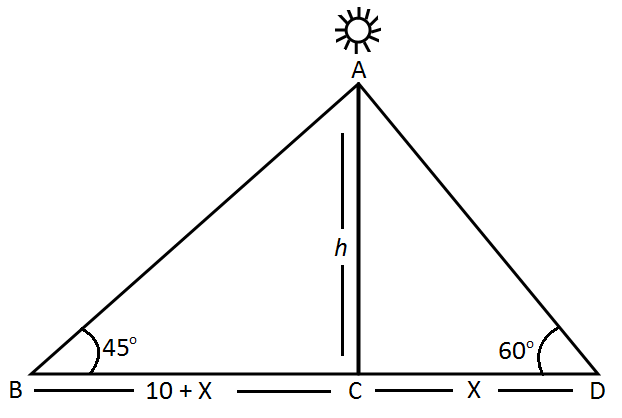
In $\triangle\text{ABC},$
$\tan\text{B}=\frac{\text{AC}}{\text{BC}}$
$\tan45^\circ=\frac{\text{h}}{10+\text{x}}$
$1=\frac{\text{h}}{10+\text{x}}$
$\text{h}=10+\text{x}$
$\text{x}=\text{h}-10\ .....(\text{i})$
In $\triangle\text{ACD},$
$\tan\text{D}=\frac{\text{h}}{\text{x}}$
$\tan60^\circ=\frac{\text{h}}{\text{x}}$
$\sqrt{3}=\frac{\text{h}}{\text{x}}$
$\text{h}=\sqrt{3}\text{x}\ ......(\text{ii})$
From eq. (i) put the value of x in eq. (ii)
$\text{h}=\sqrt{3}(\text{h}-10)$
$\text{h}=\sqrt{3}\text{h}-10\sqrt{3}$
$\text{h}(\sqrt{3}-1)=10\sqrt{3}$
$\text{h}=\frac{10\sqrt{3}}{\sqrt{3}-1}$
$\text{h}=\frac{10\times1.732}{1.732-1}$
$\text{h}=\frac{17.32}{0.732}$
$\text{h}=23.66$
Hence, height of tower is 23.66m. View full question & answer→Question 104 Marks
There are two temples, one on each bank of a river, just opposite to each other. One temple is $50$ m high. From the top of this temple, the angles of depression of the top and the foot of the other temple are $30^{\circ}$ and $60^{\circ}$ respectively. Find the width of the river and the height of the other temple.
AnswerLet $A B$ and $C E$ are two temples each at the bank of river. The top of the temple $CE$ makes angle of depressions at the top and bottom of tower $A B$ are $30^{\circ}$ and $60^{\circ}$
Let $CE =50 m$ and $AB = Hm$ and $\angle CBE =60^{\circ}, \angle DAE =30^{\circ}$
The corresponding figure is as follows,
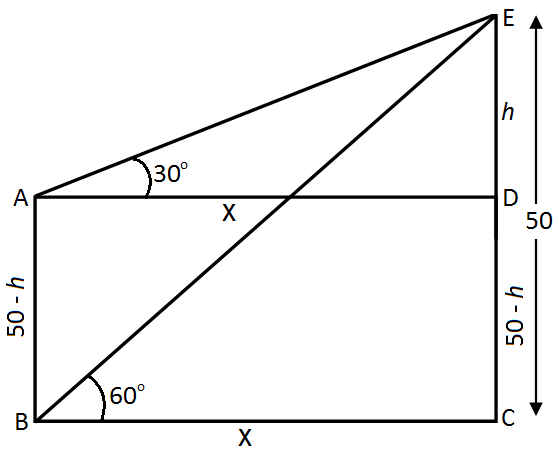
In $\triangle\text{ADE},$
$\Rightarrow\ \tan30^\circ=\frac{\text{h}}{\text{x}}$
$\Rightarrow\ \frac{1}{\sqrt{3}}=\frac{\text{h}}{\text{x}}$
$\Rightarrow\ \text{x}=\text{h}\sqrt{3}$
Again in $\triangle\text{BCE},$
$\Rightarrow\ \tan60^\circ=\frac{50}{\text{x}}$
$\Rightarrow\ \sqrt{3}=\frac{50}{\text{x}}$
$\Rightarrow\ 50=\sqrt{3}\times\text{h}\sqrt{3}$
$\Rightarrow\ \text{h}=\frac{50}{3}$
Now the distance between the temples,
$\text{x}=\text{h}\sqrt{3}$
$=\frac{50}{3}\times\sqrt{3}$
$=\frac{50}{\sqrt{3}}$
Therefore, $\text{H}=50-\frac{50}{3}$
$\Rightarrow H = 33.33$
Hence distance between the temples is $\frac{50}{\sqrt{3}}\text{m}=28.83\text{m}$ and height of temple is $33.33m.$ View full question & answer→Question 114 Marks
From an aeroplane vertically above a straight horizontal road, the angles of depression of two consecutive mile stones on opposite sides of the aeroplane are observed to be $\alpha$ and $\beta.$ Show that the height in miles of aeroplane above the road is given by, $\frac{\tan\alpha\tan\beta}{\tan\alpha+\tan\beta}.$
AnswerLet A is aeroplane and $C$ and $D$ are two such points that the angles of depression from A are a and p respectively and $CD = 1km$
Let height of the plane be $h$
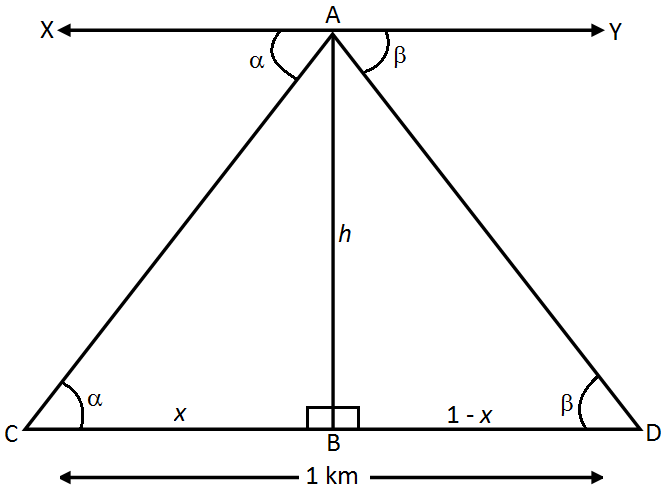
$XY || CD$
$\therefore\ \angle\text{C}=\alpha,\ \angle\text{D}=\beta$ (Alternate angles)
Let $BC =$ xkm, then $BD = (1 - x)km$
Now in right $\triangle\text{ACB,}$
$\tan\alpha=\frac{\text{AB}}{\text{BC}}=\frac{\text{h}}{\text{x}}$
$\Rightarrow\ \text{x}=\frac{\text{h}}{\tan\alpha}$
Similarly in right $\triangle\text{ABD,}$
$\tan\beta=\frac{\text{AB}}{\text{BD}}=\frac{\text{h}}{1-\text{x}}$
$\Rightarrow\ \text{h}=\tan\beta(1-\text{x})$
$\Rightarrow\ \text{h}=\tan\beta-\text{x}\tan\beta$
$=\tan\beta-\frac{\text{h}}{\tan\alpha}\tan\beta$
$\Rightarrow\ \text{h}+\text{h}\frac{\tan\beta}{\tan\alpha}=\tan\beta$
$\Rightarrow\ \text{h}\Big(1+\frac{\tan\beta}{\tan\alpha}\Big)=\tan\beta$
$\Rightarrow\ \text{h}\frac{(\tan\alpha+\tan\beta)}{\tan\alpha}=\tan\beta$
$\Rightarrow\ \text{h}=\frac{\tan\beta+\tan\alpha}{\tan\alpha+\tan\beta}$
$\therefore$ Height of aeroplane $\frac{\tan\beta+\tan\alpha}{\tan\alpha+\tan\beta}\text{km.}$
Hence proved. View full question & answer→Question 124 Marks
The lower window of a house is at a height of $2 \ m$ above the ground and its upper window is $4 \ m$ vertically above the lower window. At certain instant the angles of elevation of a balloon from these windows are observed to be $60^{\circ}$ and $30^{\circ}$ respectively. Find the height of the balloon above the ground.
Answer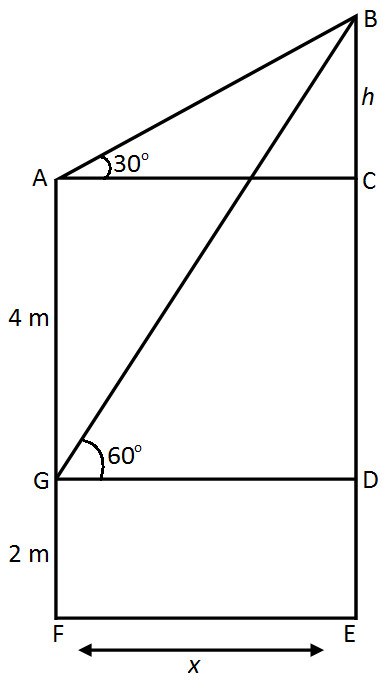
Let the window $G$ be $2m$ above the ground.
Window A be $4m$ above the window G.
Balloon be at point B above the ground.
$\tan30^\circ=\frac{\text{h}}{\text{x}}$
$\Rightarrow\ \frac{1}{\sqrt{3}}=\frac{\text{h}}{\text{x}}$
$\Rightarrow\ \text{x}=\text{h}\sqrt{3}\ ....(\text{i})$
In $\triangle\text{BGD,}$
$\tan60^\circ=\frac{\text{BD}}{\text{GD}}$
$\Rightarrow\ \sqrt{3}=\frac{\text{h}+4}{\text{x}}$
$\Rightarrow\ \text{x}=\frac{\text{h}+4}{\sqrt{3}}\ .....(\text{ii})$
From (i) and (ii) we get,
$\text{h}\sqrt{3}=\frac{\text{h}+4}{\sqrt{3}}$
$\Rightarrow\ 3\text{h}=\text{h}+4$
$\Rightarrow\ 2\text{h}=4$
$\Rightarrow\ \text{h}=2$
Hence, the height of the balloon above the ground $= 2 + 4 + 2 = 8m.$ View full question & answer→Question 134 Marks
From the top of a light house, the angles of depression of two ships on the opposite sides of it are observed to be $\alpha$ and $\beta.$ If the height of the light house be h metres and the line joining the ships passes through the foot of the light house, show that the distance between the ship is, $\frac{\text{h}(\tan\alpha+\tan\beta)}{\tan\alpha+\tan\beta}\text{meters.}$
Answer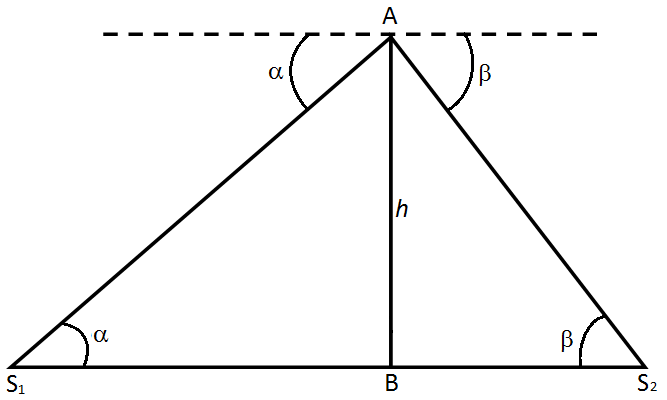
Height of light house = 'h' meters $= AB$
S and S be two ships on opposite sides of light house $=\alpha$
Angle of depression of $1S$ from top of light house $=\alpha$
Angle of depression of $2S$ from top of light house
Required to prove that,
Distance between ships $=\frac{\text{h}(\tan\alpha+\tan\beta)}{\tan\alpha.\tan\beta}\text{meters}$
The above information is represented in the form of figure as shown
In $\triangle\text{ABS}_1$
$\tan\alpha=\frac{\text{Opposite side}}{\text{Adjacent side}}=\frac{\text{AB}}{\text{S}_1\text{B}}$
$\text{S}_1\text{B}=\frac{\text{h}}{\tan\alpha}\ ......(1)$
In $\triangle\text{ABS}_2$
$\tan\beta=\frac{\text{AB}}{\text{BS}_2}\Rightarrow\ \text{BS}_2=\frac{\text{h}}{\tan\beta}\ ....(2)$
$(1)$ and $(2)$
$\Rightarrow\ \text{BS}_1+\text{BS}_2$
$=\frac{\text{h}}{\tan\alpha}+\frac{\text{h}}{\tan\beta}$
$\Rightarrow\ \text{S}_1\text{S}_2=\text{h}\Big\{\frac{1}{\tan\alpha}+\frac{1}{\tan\beta}\Big\}$
$=\frac{\text{h}(\tan\alpha+\tan\beta)}{\tan\alpha.\tan\beta}$
$\therefore$ Distance between ships $=\frac{\text{h}(\tan\alpha+\tan\beta)}{\tan\alpha.\tan\beta}\text{meters}.$ View full question & answer→Question 144 Marks
The angle of elevation of an aeroplane from a point on the ground is $45^{\circ}$. After a flight of $15$ seconds, the elevation changes to $30^{\circ}$. If the aeroplane is flying at a height of $3000$ metres, find the speed of the aeroplane.
Answer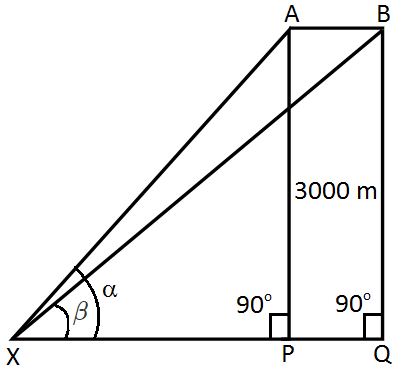
Let aeroplane travelled from $A$ to $B$ in $15$ sec
Angle of elevation of points A $\alpha=45^\circ$
Angle of elevation of points $B$ $\beta=30^\circ$
Height of aeroplane from ground $= 3000$ meters $= AP = BQ$
Distance travelled in $15$ secs $= AB = PQ$
Velocity (or) speed = distance travelled time the above data is represents is form of figure as shown
In right triangle one of the included angle is $\theta$ then,
$\tan\theta=\frac{\text{Opposite side}}{\text{Adjacent side}}$
$\tan\alpha=\frac{\text{AP}}{\text{XP}}$
$\Rightarrow\ \tan45^\circ=\frac{3000}{\text{XP}}$
$\Rightarrow\ 1=\frac{3000}{\text{XP}}$
$\Rightarrow\ \text{XP}=3000\text{m}$
$\Rightarrow\ \tan\beta=\frac{\text{BQ}}{\text{XQ}}$
$\Rightarrow\ \tan30^\circ=\frac{3000}{\text{XQ}}$
$\Rightarrow\ \text{XQ}=3000\sqrt{3}$
$\Rightarrow\ \text{PQ}=\text{XQ}-\text{XP}$
$=3000(\sqrt{3}-1)\text{m}$
$\Rightarrow\ \text{Speed}=\frac{\text{PQ}}{\text{time}}=\frac{3000(\sqrt{3}-1)}{15}$
$=200(\sqrt{3}-1)$
$= 200(0.732)$
$= 146$.4m/sec
Speed of aeroplane =$ 146.4m/sec.$ View full question & answer→Question 154 Marks
The angle of elevation of the top of a vertical tower $P Q$ from a point $X$ on the ground is $60^{\circ}$. At a point $Y, 40 m$ vertically above $X$, the angle of elevation of the top is $45^{\circ}$. Calculate the height of the tower.
AnswerLet $T R$ is the tower From a point $X$, the angle of elevation of $T$ is $60^{\circ}$ and $40 \ m$ above $X$, from the point $Y$, the angle of elevation is $45^{\circ}$.
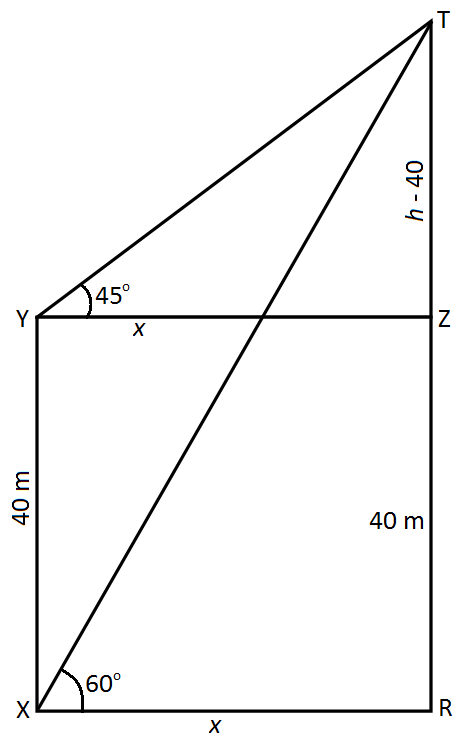
From $Y$, draw $YZ || XR$
Let $TR = h$ and $XR = YZ = x$
The $ZR = YX = 40m$ and $TZ = (h - 40)m$
Now in right $\triangle\text{TXR},$
$\tan\theta=\frac{\text{Perpendicular}}{\text{Base}}=\frac{\text{TR}}{\text{XR}}$
$\Rightarrow\ \tan60^\circ=\frac{\text{h}}{\text{x}}\Rightarrow\ \sqrt{3}=\frac{\text{h}}{\text{x}}$
$\Rightarrow\ \text{x}=\frac{\text{h}}{\sqrt{3}}\ ....(\text{i})$
Similarly in right $\triangle\text{TYZ,}$
$\tan45^\circ=\frac{\text{TZ}}{\text{YZ}}\Rightarrow\ 1=\frac{\text{h}-40}{\text{x}}$
$\Rightarrow\ \text{x}=\text{h}-40\ .......(\text{ii})$
From $(i)$ and $(ii)$
$\frac{\text{h}}{\sqrt{3}}=\text{h}-40$
$\Rightarrow\ \text{h}=\sqrt{3}\text{h}-40\sqrt{3}$
$\Rightarrow\ \sqrt{3}\text{h}-\text{h}=40\sqrt{3}$
$\Rightarrow\ \text{h}(\sqrt{3}-1)=40\sqrt{3}$
$\Rightarrow\ \text{h}=\frac{40\sqrt{3}}{\sqrt{3}-1}=\frac{40\sqrt{3}(\sqrt{3}+1)}{(\sqrt{3}-1)(\sqrt{3}+1)}$
$=\frac{40\sqrt{3}(\sqrt{3}+1)}{3-1}=\frac{40\sqrt{3}(\sqrt{3}+1)}{2}$
$=20\sqrt{3}(\sqrt{3}+1)=20\times3+20\sqrt{3}$
$= 60 + 20 \times 1.732$
$= 60 + 34.640 = 94.64$
Hence height of the tower $= 94.64\ m$ View full question & answer→Question 164 Marks
A carpenter makes stools for electricians with a square top of side $0.5 \ m$ and at a height of $1.5 \ m$ above the ground. Also, each leg is inclined at an angle of $60^{\circ}$ to the ground. Find the length of each leg and also the lengths of two steps to be put at equal distances.
AnswerLet the length of stool, $A B=0.5 m$, height $AC =1.5 m$ and its leg inclined at an angle of $60^{\circ}$ to the ground.
Let length of leg $A E=h m$
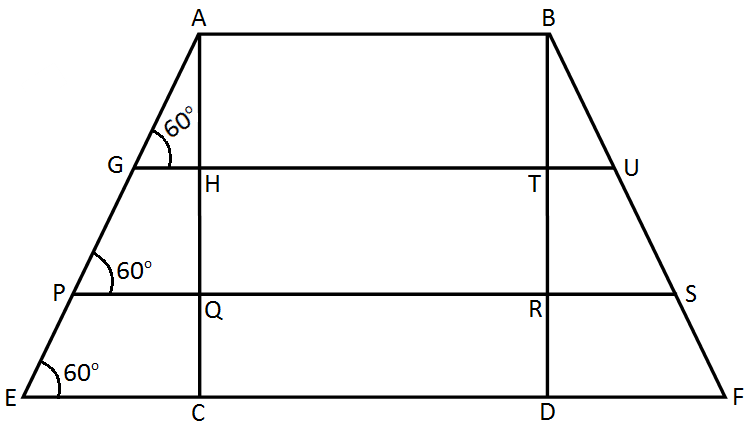
We have to find length of leg, lengths of two steps equal in length.
In $\triangle\text{AEC},\ \angle\text{AEC}=60^\circ$
$\sin60^\circ=\frac{\text{AC}}{\text{AE}}$
$\Rightarrow\ \frac{\sqrt{3}}{2}=\frac{1.5}{\text{h}}$
$\Rightarrow\ \text{h}=\frac{3}{\sqrt{3}}$
$\Rightarrow\ \text{h}=1.732$
In $\triangle\text{AGH},\ \angle\text{AGH}=60^\circ$ and $AH = 0.5m$
$\tan60^\circ=\frac{\text{AH}}{\text{GH}}$
$\Rightarrow\ \sqrt{3}=\frac{0.5}{\text{GH}}$
$\Rightarrow\ \text{GH}=\frac{0.5}{\sqrt{3}}$
$\Rightarrow\ \text{GH}=0.2886$
Total length $= 0.5 + (0.2886 \times 2) = 1.1077m$
In $\triangle\text{APQ},\ \angle\text{APQ}=60^\circ$ and $AQ = 1m$
$\tan60^\circ=\frac{\text{AQ}}{\text{PQ}}$
$\Rightarrow\ \sqrt{3}=\frac{1}{\text{PQ}}$
$\Rightarrow\ \text{PQ}=\frac{1}{\sqrt{3}}$
$\Rightarrow\ \text{PQ}=0.577$
Total lengths $0.5 + (0.577 \times 2) = 1.654m$
Hence the length of leg is $1.732m$
And lengths of each step are $1.1077m$ and $1.654m$ View full question & answer→Question 174 Marks
The angle of elevation of the top of a tower as observed form a point in a horizontal plane through the foot of the tower is $32^\circ $. When the observer moves towards the tower a distance of $100\ m$, he finds the angle of elevation of the top to be $63^\circ $. Find the height of the tower and the distance of the first position from the tower. [Take $\tan32^\circ = 0.6248$ and $\tan 63^\circ = 1.9626]$
AnswerLet h be height of tower and the angle of elevation as observed from the foot of tower is $32^\circ $ and observed move towards the tower with distance $100\ m$ then angle of elevation becomes $63^\circ .$
Let $BC = x$ and $CD = 100$
Now we have to find height of tower, So we use trigonometrical ratios.
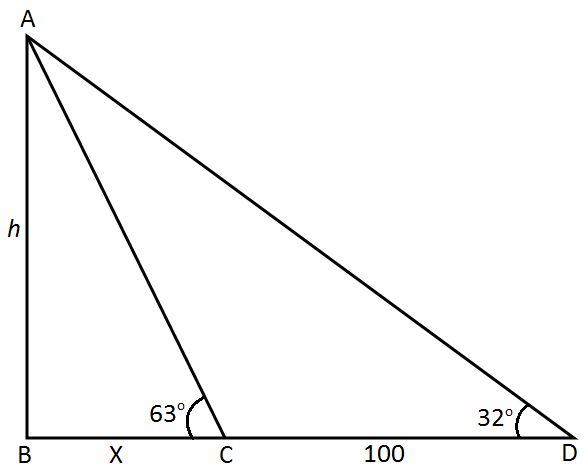
In a triangle$ ABC,$
$\Rightarrow\ \tan\text{C}=\frac{\text{AB}}{\text{BC}}$
$\Rightarrow\ \tan63^\circ=\frac{\text{AB}}{\text{BC}}$
$\Rightarrow\ 1.9626=\frac{\text{h}}{\text{x}}$
$\Rightarrow\ \text{x}=\frac{\text{h}}{1.9626}$
Again in a triangle $ABD,$
$\Rightarrow\ \tan\text{D}=\frac{\text{AB}}{\text{BC}+\text{CD}}$
$\Rightarrow\ \tan32^\circ=\frac{\text{h}}{\text{x}+100}$
$\Rightarrow\ 0.6248=\frac{\text{h}}{\text{x}+100}$
$\Rightarrow\ \text{x}+100=\frac{\text{h}}{0.6248}$
$\Rightarrow\ 100=\frac{\text{h}}{0.6248}-\frac{\text{h}}{1.9626}$
$\Rightarrow\ 100=\frac{\text{h}\times1.9626-\text{h}\times0.6248}{0.6248\times1.9626}$
$\Rightarrow\ 100=\frac{\text{h}(1.9626-0.6248)}{0.6248\times1.9626}$
$\Rightarrow\ 100=\frac{\text{h}(1.3378)}{0.6248\times1.9626}$
$\Rightarrow\ 100\times0.6248\times1.9626=\text{h}\times1.3378$
$\Rightarrow\ \text{h}=\frac{100\times0.6248\times1.9626}{1.3378}$
$\Rightarrow\ \text{h}=\frac{122.6232}{1.3378}$
$\Rightarrow\ \text{h}=91.66$
$\Rightarrow\ \text{x}=\frac{91.66}{1.9626}$
$\Rightarrow\ \text{x}=46.7$
So distance of the first position from the tower is $= 100 + 46.7 = 146.7m$
Hence the height of tower is $91.66m$ and the desires distance is $146.7m$ View full question & answer→Question 184 Marks
An aeroplane is flying at a height of $210\ m$. Flying at this height at some instant the angles of depression of two points in opposite directions on both the banks of the river are $45^\circ $ and $60^\circ $. Find the width of the river. $(\text{Use }\sqrt{3}=1.73)$
AnswerHeight of aeroplane $AB = 210\ m$
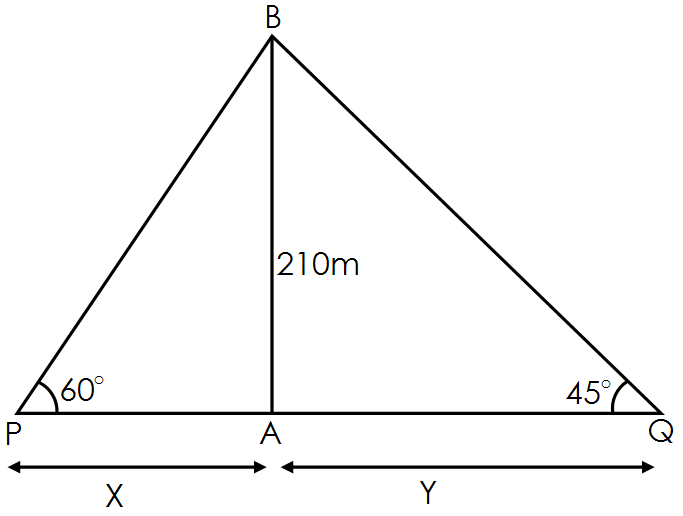
$\tan45^\circ=\frac{\text{AB}}{\text{AQ}}$
$1=\frac{210}{\text{AQ}}$
$\text{AQ}=210\text{m}$
$\text{y}=210\text{m}$
Now, $\tan60^\circ=\frac{\text{AB}}{\text{PA}}$
$\Rightarrow\sqrt{3}=\frac{210}{\text{x}}$
$\text{x}=\frac{210}{\sqrt{3}}\times\frac{\sqrt{3}}{\sqrt{3}}=70\sqrt{3}$
Distance below bank $= x + y$
$=70\sqrt{3}+210$
$121.24+210$
$=331.24\text{m}$ View full question & answer→Question 194 Marks
Two boats approach a light house in mid-sea from opposite directions. The angles of elevation of the top of the light house from two boats are $30^\circ $ and $45^\circ $ respectively. If the distance between two boats is 100m, find the height of the light house.
Answer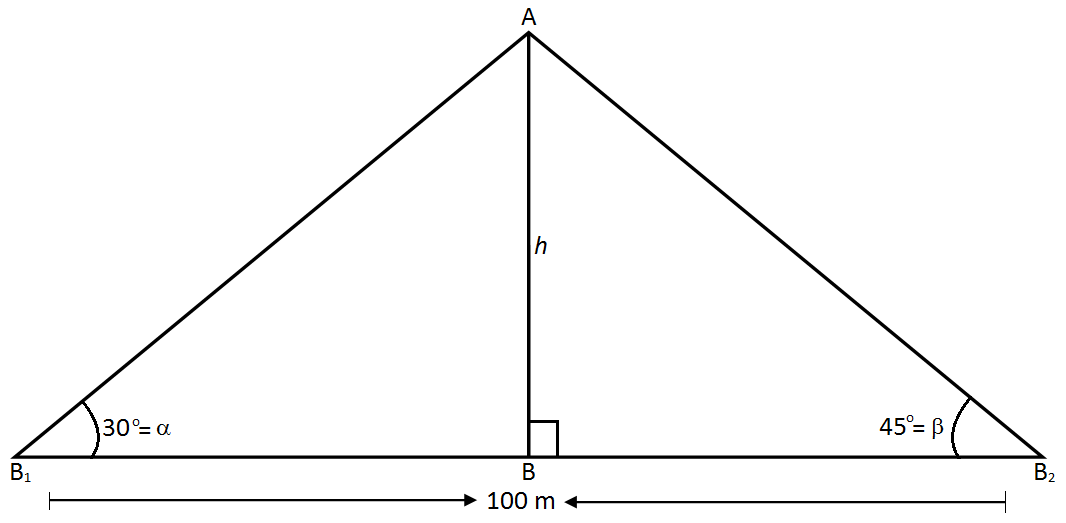
Let $B_1$ be boat 1 and $B_2$ be boat $2.$
Height of light house $= 'h' m = AB$
Distance between $B_1B_2= 100m$
Angle of elevation of A from $B_1 \alpha=30^\circ$
Angle of elevation of B from $B_2 \beta=45^\circ$
The above information is represented in the form of figure as shown here,
In $\triangle\text{ABB}_1$
$\tan30^\circ=\frac{\text{Opposite side}}{\text{Adjacent side}}=\frac{\text{AB}}{\text{B}_1\text{B}}$
$\text{B}_1\text{B}=\text{AB}\sqrt{3}=\text{h}\sqrt{3}\ .......(1)$
In $\triangle\text{ABB}_2$
$\tan45^\circ=\frac{\text{Opposite side}}{\text{Adjacent side}}=\frac{\text{AB}}{\text{B}\text{B}_2}\ ......(2)$
$(1) + (2)$
$\Rightarrow\ \text{B}_1\text{B}+\text{BB}_2=\text{h}\sqrt{3}+\text{h}$
$\Rightarrow\ \text{B}_1\text{B}_2=\text{h}(\sqrt{3}+1)$
$\Rightarrow\ \text{h}=\frac{\text{B}_1\text{B}_2}{\sqrt{3}+1}=\frac{100}{\sqrt{3}+1}\times\frac{\sqrt{3}-1}{\sqrt{3}-1}$
$=\frac{100(\sqrt{3}-1)}{2}=50(\sqrt{3}-1)$
Height of light house $=50(\sqrt{3}-1)$ View full question & answer→Question 204 Marks
A boy is standing on the ground and flying a kite with $100\ m$ of string at an elevation of $30^\circ $. Another boy is sanding on the roof of a $10\ m$ high building and is flying his kite at an elevation of $45^\circ $. Both the boys are on opposite sides of both the kites. Find the length of the string that the second boy must have so that the two kites meet.
AnswerLet $K$ be the kite. $A$ and $B$ are two boys flying kites. Boy $B$ is standing on a building 10 m high. The string $A K$ of kite of boy $A$ is 100 m Let h be the height of the kite and x is the length of string of kite of second boy B .
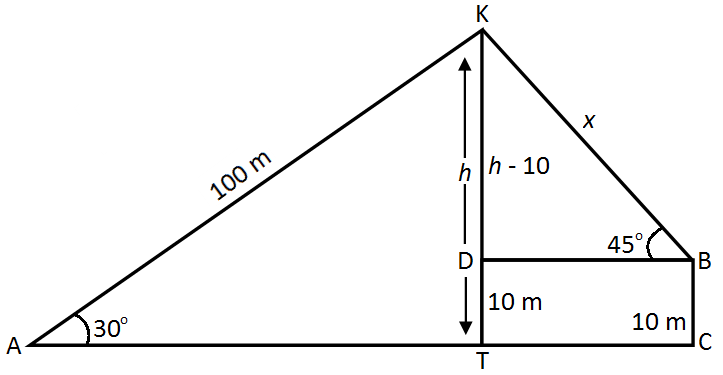
$\therefore KD = (h - 10)m$
Now in right $\triangle\text{AKT,}$
$\sin\theta=\frac{\text{Perpendicular}}{\text{Hypotenuse}}=\frac{\text{KT}}{\text{AK}}$
$\sin30^\circ=\frac{\text{h}}{100}=\frac{1}{2}=\frac{\text{h}}{100}$
$\Rightarrow\ \text{h}=\frac{100}{2}=50\text{m}$
Similarly in right $\triangle\text{KDB,}$
$\sin45^\circ=\frac{\text{KD}}{\text{KB}}\Rightarrow\ \frac{1}{\sqrt{2}}=\frac{50-10}{\text{x}}$
$\Rightarrow\ \frac{1}{\sqrt{2}}=\frac{40}{\text{x}}\Rightarrow\ \text{x}=40\sqrt{2}$
$=40(1.414)=456560$
$\therefore$ Length of string of second kite $=40\sqrt{2}\text{m}$ or 45.656m View full question & answer→Question 214 Marks
An aeroplane flying horizontally $1\ km$ above the ground is observed t an elevation of $60^\circ $. After $10$ seconds, its elevation is observed to be $30^\circ $. Find the speed of the aeroplane in km/hr.
AnswerAn aero plane is flying 1km above the ground making an angle of elevation of aero plane $60^\circ $. After $10$ seconds angle of elevation is changed to $30^\circ $. Let $CE = x, BC = y$, $\angle\text{AEB}=30^\circ,\ \angle\text{DEC}=60^\circ,$ AB = 1km and $CD = 1km$. Here we have to find speed of aero plane.
The corresponding figure is as follows,
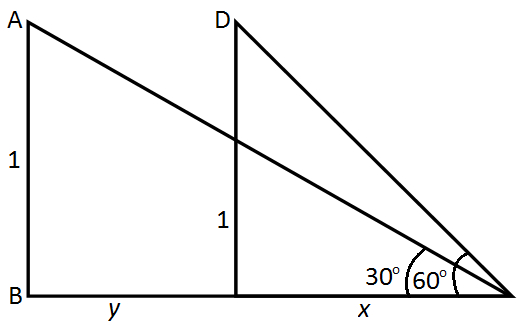
So we use trigonometric ratios.
In $\triangle\text{DCE},$
$\Rightarrow\ \tan60^\circ=\frac{1}{\text{x}}$
$\Rightarrow\ \sqrt{3}=\frac{1}{\text{x}}$
$\Rightarrow\ \text{x}=\frac{1}{\sqrt{3}}$
Again in $\triangle\text{ABE},$
$\Rightarrow\ \tan30^\circ=\frac{1}{\text{x}+\text{y}}$
$\Rightarrow\ \frac{1}{\sqrt{3}}=\frac{1}{\text{x}+\text{y}}$
$\Rightarrow\ \text{x}+\text{y}=\sqrt{3}$
$\Rightarrow\ \text{y}=\sqrt{3}-\frac{1}{\sqrt{3}}$
$\Rightarrow\ \text{y}=\frac{2}{\sqrt{3}}$
$\text{Speed}=\frac{\text{distance}}{\text{time}}$
$=\frac{\text{y}}{10\text{ sec}}$
$=\frac{\frac{2}{\sqrt{3}}}{\frac{10}{60\times60}}$
$=415.68$
Hence the speed of aeroplane is $415.68km/h.$ View full question & answer→Question 224 Marks
A moving boat is observed from the top of a $150m$ high cliff moving away from the cliff. The angle of depression of the boat changes from $60^\circ $ to $45^\circ $ in $2$ minutes. Find the speed of the boat in m/h.
AnswerLet the distance $BC$ be xm and $CD$ be ym.
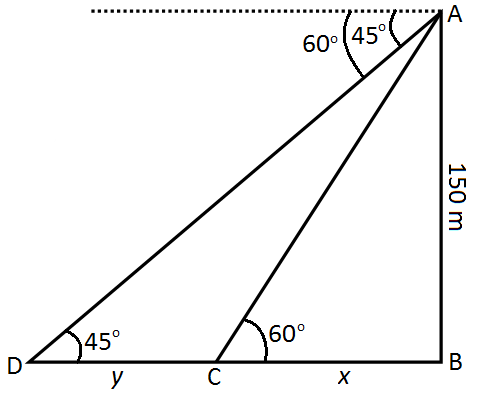
In $\triangle\text{ABC,}$
$\tan60^\circ=\frac{\text{AB}}{\text{BC}}=\frac{150}{\text{x}}$
$\Rightarrow\ \sqrt{3}=\frac{150}{\text{x}}$
$\Rightarrow\ \text{x}=\frac{150}{\sqrt{3}}\ ......(\text{i})$
In $\triangle\text{ABD,}$
$\tan45^\circ=\frac{\text{AB}}{\text{BD}}=\frac{150}{\text{x}+\text{y}}$
$\Rightarrow\ 1=\frac{150}{\text{x}+\text{y}}$
$\Rightarrow\ \text{x}+\text{y}=150$
$\Rightarrow\ \text{y}=150-\text{x}$
Using (i), we get
$\Rightarrow\ \text{y}=150-\frac{150}{\sqrt{3}}=\frac{150(\sqrt{3}-1)}{\sqrt{3}}\text{m}$
Time taken to move from point C to point D is 2 min $=\frac{2}{60}\text{h}=\frac{1}{30}\text{h}$
Now, $\text{Speed}=\frac{\text{Distance}}{\text{Time}}=\frac{\text{y}}{\frac{1}{30}}$
$=\frac{\frac{150(\sqrt{3}-1)}{\sqrt{3}}}{\frac{1}{30}}=1500\sqrt{3}(\sqrt{3}-1)\text{m/h}$
$= 1500 \times 1.732(1.732 - 1)m/h$
$= 2598 \times .732 = 1902m/h$ View full question & answer→Question 234 Marks
The horizontal distance between two poles is $15\ m$. The angle of depression of the top of the first pole as seen from the top of the second pole is $30^\circ $. If the height of the second pole is $24\ m$, find the height of the first pole. $(\sqrt{3}=1.732)$
AnswerLet $AB$ and $CD$ are two poles and distance between them $= 15m$, and $AB = 24m$ Angle of elevation from top of pole $CD$, to pole $AB = 30^\circ $
From $C,$ draw $CE || DB$
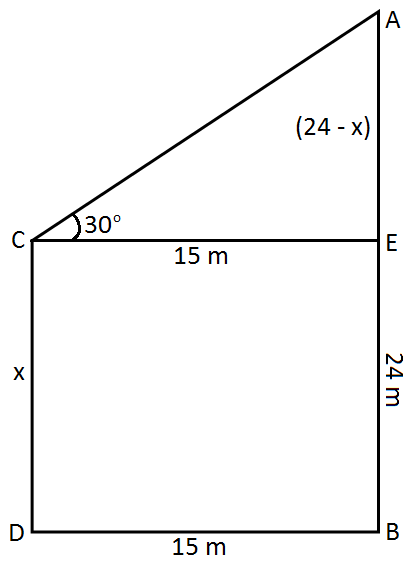
Let $CD =$ xm, then
$CE = DB = 15m$ and $AE = AB - EB$
$\Rightarrow AE = AB - CD = (24 - x)m$
Now in $\triangle\text{ACE}$
$\tan\theta=\frac{\text{AE}}{\text{CE}}$
$\Rightarrow\ \tan30^\circ=\frac{24-\text{x}}{15}$
$\Rightarrow\ \frac{1}{\sqrt{3}}=\frac{24-\text{x}}{15}$
$\Rightarrow\ 15=\sqrt{3}(24-\text{x})$
$\Rightarrow\ \frac{15}{\sqrt{3}}=24-\text{x}$
$\Rightarrow\ \text{x}=24-\frac{15}{\sqrt{3}}=24-\frac{15\sqrt{3}}{\sqrt{3}\times\sqrt{3}}$
$=24-\frac{15\sqrt{3}}{3}=24-5\sqrt{3}$
$=24-5(1.732)=24-8.660$
$=15.34\text{m}$ View full question & answer→Question 244 Marks
The angle of elevation of the top of a chimney from the top of a tower is $60^{\circ}$ and the angle of depression of the foot of the chimney from the top of the tower is $30^{\circ}$. If the height of the tower is $40 \ m$ , find the height of the chimney. According to pollution control norms, the minimum height of a smoke emitting chimney should be $100 \ m$ . State if the height of the above mentioned chimney meets the pollution norms. What value is discussed in this question?
Answer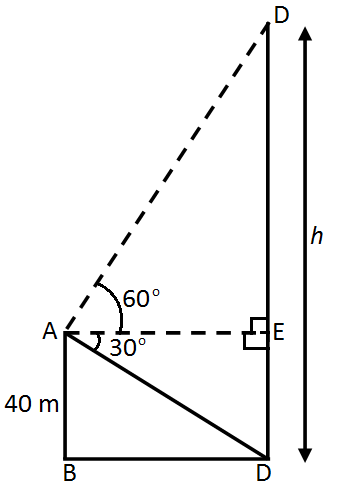
Let $AB$ be the tower and $CD$ be the chimney.
Height of the tower, $AB = 40m$
Suppose the height of the chimney be h m.
Draw $\text{AE}\bot\text{CD}.$
Here, $CE = AB = 40m$
$DE = CD - CE = (h - 40)m$
In right $\triangle\text{AEC},$
$\tan30^\circ=\frac{\text{CE}}{\text{AE}}$
$\Rightarrow\ \frac{1}{\sqrt{3}}=\frac{40}{\text{AE}}$
$\Rightarrow\ \text{AE}=40\sqrt{3}\text{m}$
In right $\triangle\text{AED},$
$\tan60^\circ=\frac{\text{DE}}{\text{AE}}$
$\Rightarrow\ \sqrt{3}=\frac{\text{h}-40}{40\sqrt{3}}$
$\Rightarrow\ \text{h}-40=40\sqrt{3}\times\sqrt{3}=120$
$\Rightarrow\ \text{h}=120+40=160\text{m}$
Thus, the height of the chimney is $160m$.
Clearly, the height of the chimney meets the pollution norms.
We should follow the pollution control norms and contribute to the cleaniness of the environment. View full question & answer→Question 254 Marks
Two ships are there in the sea on either side of a light house in such away that the ships and the light house are in the same straight line. The angles of depression of two ships are observed from the top of the light house are $60^\circ $ and $45^\circ $ respectively. If the height of the light house is $200m$, find the distance between the two ships. $(\text{Use }\sqrt{3}=1.73)$
Answer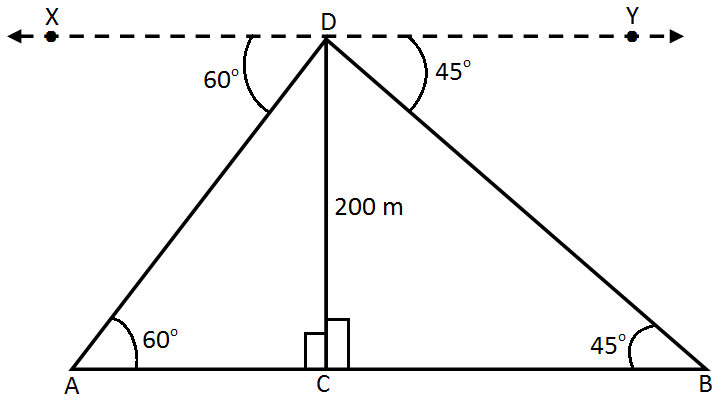
Let CD be the light house and A and B be the positions of the two ships.
Height of the light house, $CD = 200m$
Now,
$\angle\text{CAD}=\angle\text{ADX}=60^\circ$ (Alternate angles)
$\angle\text{CBD}=\angle\text{BDY}=45^\circ$ (Alternate angles)
In right $\triangle\text{ACD},$
$\tan60^\circ=\frac{\text{CD}}{\text{AC}}$
$\Rightarrow\ \sqrt{3}=\frac{200}{\text{AC}}$
$\Rightarrow\ \text{AC}=\frac{200}{\sqrt{3}}=\frac{200\sqrt{3}}{3}\text{m}$
In right $\triangle\text{BCD},$
$\tan45^\circ=\frac{\text{CD}}{\text{BC}}$
$\Rightarrow\ 1=\frac{200}{\text{BC}}$
$\Rightarrow\ \text{BC}=200\text{m}$
$\therefore$ Distance between the two ships, $AB = BC + AC$
$=200+\frac{200\sqrt{3}}{3}$
$=200+\frac{200\times1.73}{3}$
$=200+115.33$
$=315.33\text{m}$ (approx)
Hence, the distance between the two ships is approximately $315.33m$ View full question & answer→Question 264 Marks
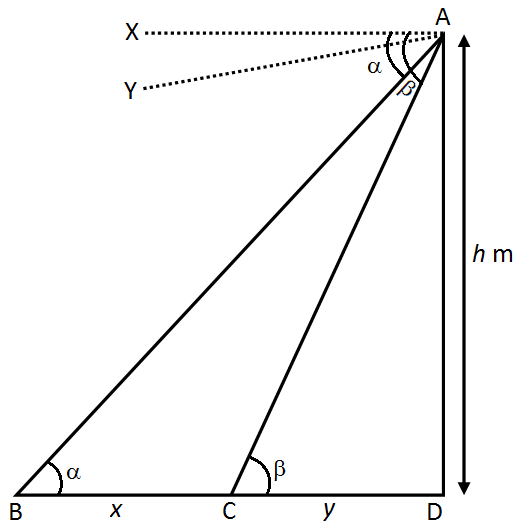
From the top of a tower h meter high, the angles of depression of two objects, which are in the line with the foot of the tower are $\alpha$ and $\beta(\beta>\alpha).$ Find the distance between the two objects.
AnswerLet the distance between two objects is xm
and $CD = ym$
Given that, $\angle\text{BAX}=\alpha=\angle\text{ABD}$ [alternate angle]
$\angle\text{CAY}=\beta=\angle\text{ACD}$ [alternate angle]
and the height of tower, $AD = h m$
Now, in $\triangle\text{ACD,}$
$\tan\beta=\frac{\text{AD}}{\text{CD}}=\frac{\text{h}}{\text{y}}$
$\Rightarrow\ \text{y}=\frac{\text{h}}{\tan\beta}\ ....(\text{i})$
and in $\triangle\text{ABD},$
$\tan\alpha=\frac{\text{h}}{\text{x}+\text{y}}\Rightarrow\ \text{x}+\text{y}=\frac{\text{h}}{\tan\alpha}$
$\Rightarrow\ \text{y}=\frac{\text{h}}{\tan\alpha}-\text{x}\ .....(\text{ii})$
From eq. (i) and (ii),
$\frac{\text{h}}{\tan\beta}=\frac{\text{h}}{\tan\alpha}-\text{x}$
$\therefore\ \text{x}=\frac{\text{h}}{\tan\alpha}-\frac{\text{h}}{\tan\beta}$
$=\text{h}\Big(\frac{1}{\tan\alpha}-\frac{1}{\tan\beta}\Big)=\text{h}(\cot\alpha-\cot\beta)$
$\Big[\because\ \cot\theta=\frac{1}{\tan\theta}\Big]$
Which is the required distance between the two objects. View full question & answer→Question 274 Marks
A window of a house is h metre above the ground. From the window, the angles of elevation and depression of the top and bottom of another house situated on the opposite side of the lane are found to be $\alpha$ and $\beta$ respectively. Prove that the height of the house is $\text{h}(1+\tan\alpha\tan\beta)\text{meters.}$
AnswerLet the height of the other house $= OQ = H$
and $OB = MW = xm$
Given that, height of the first house $= WB = h = MO$
and $\angle\text{QWM}=\alpha,\ \angle\text{OWM}=\beta=\angle\text{WOB}$ [alternate angle]
Now, in $\triangle\text{WOB,}$
$\tan\beta=\frac{\text{WB}}{\text{OB}}=\frac{\text{h}}{\text{x}}$
$\Rightarrow\ \text{x}=\frac{\text{h}}{\tan\beta}\ ......(\text{i})$
And in $\triangle\text{QWM,}$
$\tan\alpha=\frac{\text{QM}}{\text{WM}}=\frac{\text{OQ}-\text{MO}}{\text{WM}}$
$\Rightarrow\ \tan\text{a}=\frac{\text{H}-\text{h}}{\text{x}}$
$\Rightarrow\ \text{x}=\frac{\text{H}-\text{h}}{\tan\alpha}\ .....(\text{ii})$
From eq. (i) and (ii),
$\frac{\text{h}}{\tan\beta}=\frac{\text{H}-\text{h}}{\tan\alpha}$
$\Rightarrow\ \text{h}\tan\alpha=(\text{H}-\text{h})\tan\beta$
$\Rightarrow\ \text{h}\tan\alpha=\text{H}\tan\beta-\text{h}\tan\beta$
$\Rightarrow\ \text{H}\tan\beta=\text{h}(\tan\alpha+\tan\beta)$
$\therefore\ \text{H}=\text{h}\Big(\frac{\tan\alpha+\tan\beta}{\tan\beta}\Big)$
$\text{H}=\text{h}\Big(1+\tan\alpha.\frac{1}{\tan\beta}\Big)$
$=\text{h}(1+\tan\alpha.\cot\beta)$ $\Big(\because\ \cot\theta=\frac{1}{\tan\theta}\Big)$
Hence, the required height of the other house is $\text{h}(1+\tan\alpha.\cot\beta).$
Hence proved.
View full question & answer→Question 284 Marks
An observer, $1.5\ m$ tall, is $28.5\ m$ away from a a tower $30\ m$ high. Determine the angle elevation of the top of the tower from his eye.
Answer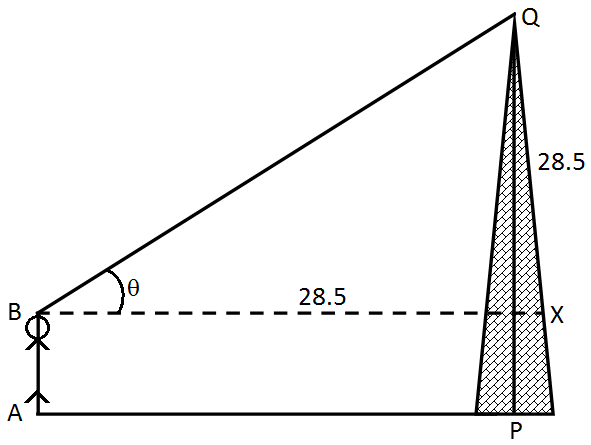
Height of observer $= AB = 1.5m$
Height of tower $= PQ = 30m$
Height of tower above the observe eye $= 30 - 1.5$
$QX = 28.5m$
Distance between tower and observe $XB = 28.5m$
$\theta$ be angle of elevation of tower top from eye
The above data is represented in form of figure as shown from figure,
$\tan\theta=\frac{\text{Opposite side}}{\text{Adjacent side}}$
$\tan\theta=\frac{\text{QX}}{\text{BX}}=\frac{28.5}{28.5}=1$
$\Rightarrow\ \theta=\tan^{-1}(1)=45^\circ$
Angle of elevation $= 45^\circ $ View full question & answer→Question 294 Marks
The angles of depression of two ships from the top of a light house and on the same side of it are found to be $45^{\circ}$ and $30^{\circ}$ respectively. If the ships are $200 \ m$ apart, find the height of the light house.
Answer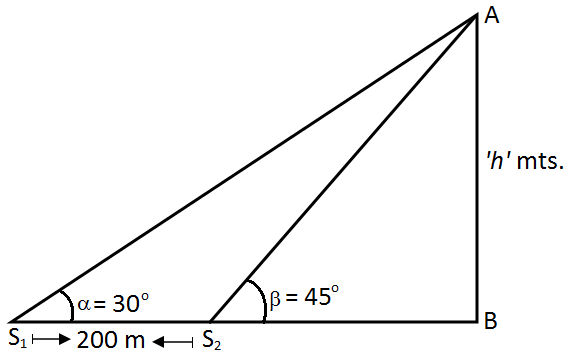
Height of light house AB = 'h' meters
Let $\mathrm{S}_1$ and $\mathrm{S}_2$ be ships distance between ships $\mathrm{S}_1 \mathrm{~S}_2$
Angle of depression of $S_1 [\alpha=30^\circ]$
Angle of depression of $S_2 [\beta=45^\circ]$
The above data is represented in form of figure as shown
In $\triangle\text{ABS}_2$
$\tan\beta=\frac{\text{AB}}{\text{BS}_2}$
$\tan45^\circ=\frac{\text{h}}{\text{BS}_2}$
$\text{BS}_2=\text{h}\ ......(1)$
In $\triangle\text{ABS}_1$
$\tan\alpha=\frac{\text{AB}}{\text{BS}_1}$
$\tan30^\circ=\frac{\text{h}}{\text{BS}_1}$
$\text{BS}_1=\text{h}\sqrt{3}\ .....(2)$
$(2)$ and $(1)$
$\Rightarrow\ \text{BS}_1-\text{BS}_2=\text{h}(\sqrt{3}-1)$
$\Rightarrow\ 200=\text{h}(\sqrt{3}-1)$
$\Rightarrow\ \text{h}=\frac{200}{\sqrt{3}-1}\times\frac{\sqrt{3}+1}{\sqrt{3}+1}$
$=\frac{200}{2}(\sqrt{3}+1)=100(\sqrt{3}+1)\text{ meters}$
$\text{h}=100(1.732+1)=273.2\text{ meters}$
Height of light house $= 273.2$ meters View full question & answer→Question 304 Marks
A straight highway leads to the foot of a tower of height $50\ m$. From the top of the tower, the angles of depression of two cars standing on the highway are $30^\circ $ and $60^\circ $ respectively. What is the distance the two cars and how far is each car from the tower?
AnswerLet $TR$ be the tower and $A$ and $B$ are two cars on the road making angles of elevation with $T$ the top of tower as $30^{\circ}$ and $60^{\circ}$.
Height of the tower $T R=50 m$
Let $A R=x$ and $B R=y$
Now in right $\triangle\text{TAR},$
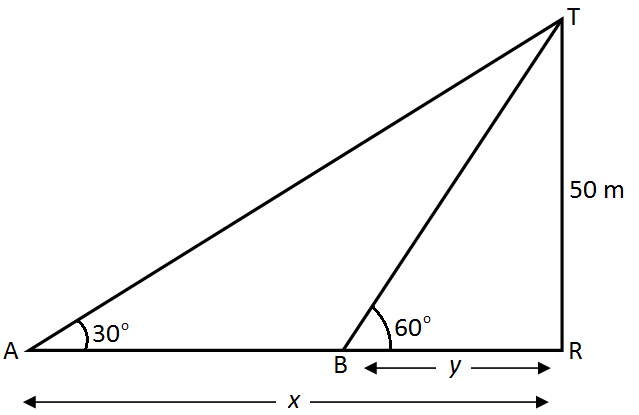
$\tan\theta=\frac{\text{Perpendicular}}{\text{Base}}=\frac{\text{TR}}{\text{AR}}$
$\tan30^\circ=\frac{50}{\text{x}}$
$\Rightarrow\ \frac{1}{\sqrt{3}}=\frac{50}{\text{x}}$
$\Rightarrow\ \text{x}=50\sqrt{3}\ ......(1)$
Similarly in right $\triangle\text{TRB,}$
$\tan60^\circ=\frac{\text{TR}}{\text{BR}}=\frac{50}{\text{y}}$
$\Rightarrow\ \sqrt{3}=\frac{50}{\text{y}}$
$\Rightarrow\ \text{y}=\frac{50}{\sqrt{3}}\ .....(2)$
- $AB = AR - BR = x - y$
$=\Big(50\sqrt{3}-\frac{50}{\sqrt{3}}\Big)=50\Big(\sqrt{3}-\frac{1}{\sqrt{3}}\Big)$
$=50\Big(\frac{3-1}{\sqrt{3}}\Big)=\frac{50\times2}{\sqrt{3}}$
$=\frac{100\times\sqrt{3}}{\sqrt{3}\times\sqrt{3}}=\frac{100\sqrt{3}}{3}$
$=\frac{100(1.732)}{3}=\frac{173.2}{3}=57.7\text{m}$
- Distance of A car $=\text{x}=50\sqrt{3}=50(1.732)$
= 86.600 = 86.65m
Distance of B car $=\text{y}=\frac{50}{\sqrt{3}}=\frac{50\times\sqrt{3}}{\sqrt{3}\times\sqrt{3}}$
$=\frac{50\sqrt{3}}{3}=\frac{86.6}{3}$
= 28.83m View full question & answer→Question 314 Marks
A man standing on the deck of a ship, which is $8 \ m$ above water level. He observes the angle of elevation of the top of a hill as $60^{\circ}$ and the angle of depression of the base of the hill as $30^{\circ}$. Calculate the distance of the hill from the ship and the height of the hill.
AnswerLet $M$ is the man on the deck MN such that $MN =8 m . AB$ is the hill From M , the angle of elevation of A is $60^{\circ}$ and angle of depression of $B$ is $30^{\circ}$
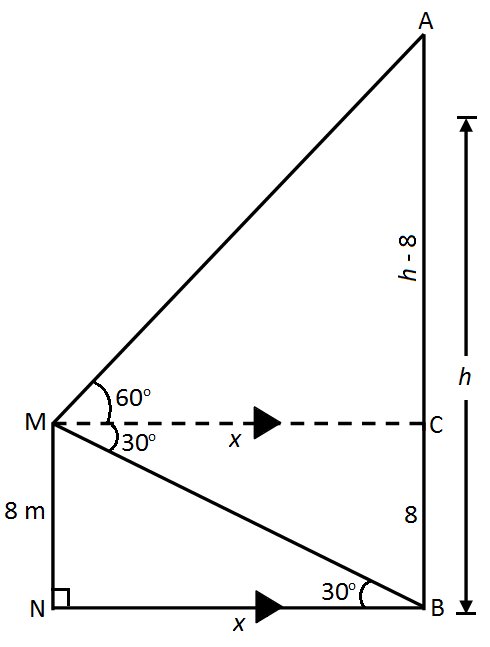
Draw $MC || NB$
$\therefore\ \angle\text{MBN}=\angle\text{CMB}$ (alternate angles)
Let $AB = h, NB = MC = x, AC = h - 8$ $(\because$ CB = MN = 8m$)$
Now in right $\triangle\text{AMC,}$
$\tan\theta=\frac{\text{Perpendicular}}{\text{Base}}=\frac{\text{AC}}{\text{MC}}$
$\Rightarrow\ \tan60^\circ=\frac{\text{h}-8}{\text{x}}$
$\Rightarrow\ \sqrt{3}=\frac{\text{h}-8}{\text{x}}$
$\Rightarrow\ \text{x}=\frac{\text{h}-8}{\sqrt{3}}\ ......(\text{i})$
Similarly in right $\triangle\text{MBN,}$
$\tan30^\circ=\frac{\text{MN}}{\text{NB}}=\frac{8}{\text{x}}$
$\Rightarrow\ \frac{1}{\sqrt{3}}=\frac{8}{\text{x}}\Rightarrow\ \text{x}=8\sqrt{3}\ .....(\text{ii})$
From (i) and (ii)
$\Rightarrow\ 8\sqrt{3}=\frac{\text{h}-8}{\sqrt{3}}$
$\Rightarrow 8 \times 3 = h - 8$
$\Rightarrow 24 = h - 8 \Rightarrow h = 24 + 8 = 32$
and $\text{x}=8\sqrt{3}$ or $8(1.732) = 13.858m$
$\therefore$ Height of the hill $= 32m$
and distance between the ships $= 13.858m$ View full question & answer→Question 324 Marks
A tower subtends an angle $\alpha$ at a point A in the plane of its base and the angles of depression of the foot of the tower at a point b metres just above A is $\beta.$ Prove that the height of the tower is $\text{b}\tan\alpha\cot\beta.$
AnswerLet $TR$ is the tower which subtends angle $\alpha$ at a point $A$ on the same plane $AB = b$ and angle of depression of $R$ from $B$ is $\beta$
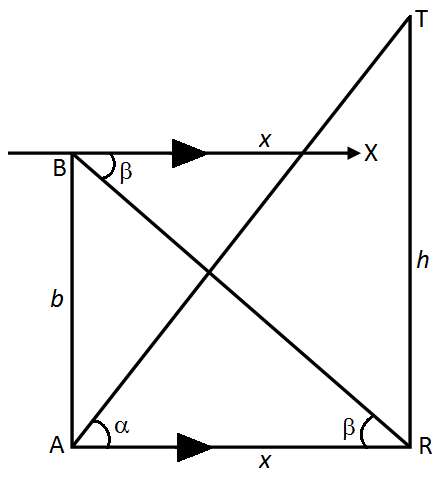
$\because BX || AR$
$\therefore\ \angle\text{ARB}=\angle\text{XBR}=\beta$
Let height of tower $TR = h$
and $AR = x$
Now in right $\triangle\text{ATR,}$
$\tan\alpha=\frac{\text{h}}{\text{x}}\Rightarrow\ \text{x}=\frac{\text{h}}{\tan\alpha}\ ....(\text{i})$
Similarly in right $\triangle\text{ABR,}$
$\tan\beta=\frac{\text{AB}}{\text{AR}}=\frac{\text{b}}{\text{x}}\Rightarrow\ \text{x}=\frac{\text{b}}{\tan\beta}\ ....(\text{ii})$
From $(i)$ and $(ii)$
$\frac{\text{h}}{\tan\alpha}=\frac{\text{b}}{\tan\beta}$
$\Rightarrow\ \text{h}=\text{b}\frac{\tan\alpha}{\tan\beta}=\text{b}\tan\alpha\cot\beta$
Hence height of the tower $=\text{b}\tan\alpha\cot\beta$
Hence proved. View full question & answer→