Questions

2 Marks Questions

🎯

Test yourself on this topic

21 questions · timed · auto-graded

Question 12 Marks
Prove the given identity, where the angles involved are acute angles for which the expressions are defined. $\frac { \sin \theta - 2 \sin ^ { 3 } \theta } { 2 \cos ^ { 2 } \theta - \cos \theta } = \tan \theta$
Answer
$LHS$
$= \frac { \sin \theta - 2 \sin ^ { 3 } \theta } { 2 \cos ^ { 2 } \theta - \cos \theta } = \frac { \sin \theta \left( 1 - 2 \sin ^ { 2 } \theta \right) } { \cos \theta \left( 2 \cos ^ { 2 } \theta - 1 \right) }$
$= \frac { \sin \theta \left( \cos ^ { 2 } \theta + \sin ^ { 2 } \theta - 2 \sin ^ { 2 } \theta \right) } { \cos \theta \left( 2 \cos ^ { 2 } \theta - \cos ^ { 2 } \theta - \sin ^ { 2 } \theta \right) } \quad \because \cos ^ { 2 } \theta + \sin ^ { 2 } \theta = 1$
$= \frac { \sin \theta \left( \cos ^ { 2 } \theta - \sin ^ { 2 } \theta \right) } { \cos \theta \left( \cos ^ { 2 } \theta - \sin ^ { 2 } \theta \right) } = \tan \theta$
$= RHS$
View full question & answer
Question 22 Marks
Prove the given identity, where the angles involved are acute angles for which the expressions are defined. $\frac { \cos A } { 1 + \sin A } + \frac { 1 + \sin A } { \cos A } = 2 \sec A$
Answer
$L H S = \frac { \cos A } { 1 + \sin A } + \frac { 1 + \sin A } { \cos A }$
$= \frac { \cos ^ { 2 } A + ( 1 + \sin A ) ^ { 2 } } { ( 1 + \sin A ) \cos A } = \frac { \cos ^ { 2 } A + 1 + \sin ^ { 2 } A + 2 \sin A } { ( 1 + \sin A ) \cos A }$
$= \frac { 1 + 1 + 2 \sin A } { ( 1 + \sin A ) \cos A } \because \sin ^ { 2 } A + \cos ^ { 2 } A = 1$
$= \frac { 2 + 2 \sin A } { ( 1 + \sin A ) \cos A } = \frac { 2 ( 1 + \sin A ) } { ( 1 + \sin A ) \cos A }$
$= \frac { 2 } { \cos A } = 2 \cdot \frac { 1 } { \cos A } = 2 \sec A = R H S$
View full question & answer
Question 32 Marks
If $tan\ (A + B) =$ $\sqrt3$ and $tan\ (A - B) =$ $\frac{1}{\sqrt3}$; $0^\circ < A + B$ $\leq$ $90^\circ ; A > B$, then find $A$ and $B$.
Answer
We have, $tan\ (A + B) =$ $\sqrt3$ $\Rightarrow$$tan(A+B) = \tan 60^\circ$
$A + B = 60^\circ ..........(i)$
Again, $tan\ (A - B ) =$$\frac{1}{\sqrt3}$ $\Rightarrow$$tan(A-B) = tan 30^\circ$
$A - B = 30^\circ ..........(ii)$
Adding, $(i)$ and $(ii)$
$2A = 90^\circ$
$\therefore$ A = $\frac{90^\circ}{2}$ $=45^\circ$
Putting $A=45$$^o$ in equation $(i)$,
$B = 60^\circ - A = 60^\circ - 45^\circ = 15^\circ $
Therefore, $A = 45^\circ$ and $B = 15^\circ$.
View full question & answer
Question 42 Marks
Evaluate: $\frac { 5 \cos ^ { 2 } 60 ^ { \circ } + 4 \sec ^ { 2 } 30 ^ { \circ } - \tan ^ { 2 } 45 ^ { \circ } } { \sin ^ { 2 } 30 ^ { \circ } + \cos ^ { 2 } 30 ^ { \circ } }$
Answer
Given: $\frac { 5 \cos ^ { 2 } 60 ^ { \circ } + 4 \sec ^ { 2 } 30 ^ { \circ } - \tan ^ { 2 } 45 ^ { \circ } } { \sin ^ { 2 } 30 ^ { \circ } + \cos ^ { 2 } 30 ^ { \circ } }$
$= \frac { 5 \left( \frac { 1 } { 2 } \right) ^ { 2 } + 4 \left( \frac { 2 } { \sqrt { 3 } } \right) ^ { 2 } - ( 1 ) ^ { 2 } } { \left( \frac { 1 } { 2 } \right) ^ { 2 } + \left( \frac { \sqrt { 3 } } { 2 } \right) ^ { 2 } }$
$= \frac { 5 \times \frac { 1 } { 4 } + 4 \times \frac { 4 } { 3 } - 1 } { \frac { 1 } { 4 } + \frac { 3 } { 4 } }$
$= \frac { \frac { 5 } { 4 } + \frac { 16 } { 3 } - 1 } { \frac { 1 + 3 } { 4 } }$
$= \frac { \frac { 15 + 64 - 12 } { 12 } } { \frac { 4 } { 4 } }$
$= \frac { \frac { 67 } { 12 } } { 1 }$
$= \frac { 67 } { 12 }$
View full question & answer
Question 52 Marks
Evaluate: $\frac{\sin 30^{\circ}+\tan 45^{\circ}-\ cosec 60^{\circ} }{\sec 30^{\circ}+\cos 60^{\circ}+\cot 45^{\circ}}$
Answer
We have $\frac{\sin 30^{\circ}+\tan 45^{\circ}- \ cosec 60^{\circ}}{\sec 30^{\circ}+\cos 60^{\circ}+\cot 45^{\circ}}$
after putting values,we get
$=\frac{\frac{1}{2}+1-\frac{2}{\sqrt{3}}}{\frac{2}{\sqrt{3}}+\frac{1}{2}+1}$
$=\frac{\frac{3}{2}-\frac{2}{\sqrt{3}}}{\frac{3}{2}+\frac{2}{\sqrt{3}}}$
$=\frac{3 \sqrt{3}-4}{3 \sqrt{3}+4}$ Rationalise it, we get
$=\frac{3 \sqrt{3}-4}{3 \sqrt{3}+4} \times \frac{3 \sqrt{3}-4}{3 \sqrt{3}-4}$
$=\frac{(3 \sqrt{3}-4)^{2}}{(3 \sqrt{3})^{2}-(4)^{2}}$
$=\frac{27+16-24 \sqrt{3}}{27-16}$
$=\frac{43-24 \sqrt{3}}{11}$
View full question & answer
Question 62 Marks
Evaluate: $\frac{\cos 45^{\circ}}{\sec 30^{\circ}+ \ cosec 30^{\circ}}$
Answer
We have $\frac{\cos \left(45^{\circ}\right)}{\sec \left(30^{\circ}\right)+\ cosec \left(30^{\circ}\right)}$
$=\frac{\frac{1}{\sqrt{2}}}{\frac{2}{\sqrt{3}}+2}$
$=\frac{\frac{1}{\sqrt{2}}}{2\left(\frac{1}{\sqrt{3}}+1\right)}$
$=\frac{1}{2 \sqrt{2}\left(\frac{1+\sqrt{3}}{\sqrt{3}}\right)}$
$=\frac{\sqrt{3}}{2 \sqrt{2}(1+\sqrt{3})}$
it is clear that the denominator has an irrational number, we need to rationalize it, we get
$=\frac{\sqrt{3}}{2 \sqrt{2}(1+\sqrt{3})} \times \frac{\sqrt{2}(1-\sqrt{3})}{\sqrt{2}(1-\sqrt{3})}$
$=\frac{\sqrt{2}(\sqrt{3}-3)}{2(2)\left(1^{2}-(\sqrt{3})^{2}\right)}$
$=\frac{\sqrt{6}-3 \sqrt{2}}{4(1-3)}$
$=\frac{\sqrt{6}-3 \sqrt{2}}{4(-2)}$
$=\frac{\sqrt{6}-3 \sqrt{2}}{-8}$
$=\frac{3 \sqrt{2}-\sqrt{6}}{8}$
View full question & answer
Question 72 Marks
If cot $\theta$ $= \frac { 7 } { 8 }$, evaluate $\frac { ( 1 + \sin \theta ) ( 1 - \sin \theta ) } { ( 1 + \cos \theta ) ( 1 - \cos \theta ) }$.
Answer
Given: cot $\theta$ $= \frac { 7 } { 8 }$
To Evaluate: $\frac { ( 1 + \sin \theta ) ( 1 - \sin \theta ) } { ( 1 + \cos \theta ) ( 1 - \cos \theta ) }$
$= \frac { 1 - \sin ^ { 2 } \theta } { 1 - \cos ^ { 2 } \theta } = \frac { \cos ^ { 2 } \theta } { \sin ^ { 2 } \theta }$
$= cot^2 \theta$
$= \left( \frac { 7 } { 8 } \right) ^ { 2 }$
$= \frac { 49 } { 64 }$
View full question & answer
Question 82 Marks
If $\sin A = \frac { 3 } { 4 }$, calculate $cos\ A$ and $tan\ A$.
Answer
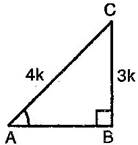
Given: $A$ triangle $ABC$ in which $\angle B = 90 ^ { \circ }$

$SinA=\frac34=\frac PH$
Let $BC = 3k$ and $AC = 4k$ where $k$ is a positive integer.
Using Pythagoras theorem,
$AB^2=AC^2-BC^2$
$A B = \sqrt { ( A C ) ^ { 2 } - ( B C ) ^ { 2 } } = \sqrt { ( 4 k ) ^ { 2 } - ( 3 k ) ^ { 2 } }$
$= \sqrt { 16 k ^ { 2 } - 9 k ^ { 2 } } =\sqrt{7k^2}= k \sqrt { 7 }$
Therefore,$\cos A = \frac { B } { H } = \frac { A B } { A C } = \frac { k \sqrt { 7 } } { 4 k } = \frac { \sqrt { 7 } } { 4 }$
$\tan \mathrm { A } = \frac { \mathrm { P } } { \mathrm { B } } = \frac { \mathrm { BC } } { \mathrm { AB } } = \frac { 3 k } { k \sqrt { 7 } } = \frac { 3 } { \sqrt { 7 } }$
View full question & answer
Question 92 Marks
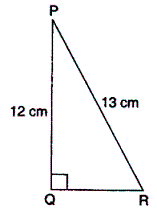
In figure, find $tan\ P - cot\ R$.
Answer
In $\triangle P Q R$ ,
$\therefore \angle Q = 90 ^ { \circ }$
$\therefore P R^2=P Q^2+Q R^2$.... By Pythagoras theorem 
$ \Rightarrow(13)^2=(12)^2+Q R^2 $
$\Rightarrow 169=144+Q R^2 $
$ \Rightarrow Q R^2=169-144 \Rightarrow Q R^2=25$
$\Rightarrow Q R = \sqrt { 25 } = 5 \mathrm { cm }$
$\therefore \tan \mathrm { P } - \cot \mathrm { R } = \frac { \mathrm { QR } } { \mathrm { PQ } } - \frac { \mathrm { QR } } { \mathrm { PQ } } = 0$
View full question & answer
Question 152 Marks
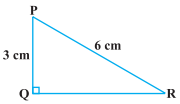
In $\triangle$$PQR$, right-angled at $Q, PQ = 3\ cm$ and $PR = 6\ cm$. Determine $\angle$$QPR$ and $\angle$$PRQ$.
Answer
We have given that $PQ = 3\ cm$ and $PR = 6\ cm$
from $\triangle$$PQR$, $\frac{P Q}{P R}=\sin R$
or $\sin R=\frac{3}{6}=\frac{1}{2}$
So, $\angle$$PRQ = 30^\circ$
and therefore, $\angle$$QPR = 60^\circ ($by using angle sum property of triangle$)$
View full question & answer
Question 162 Marks
Prove that: $\frac{\cot A-\cos A}{\cot A+\cos A}$$=\frac{\ cosec A-1}{\ cosec A+1}$
Answer
$LHS =$ $\frac{\cot A-\cos A}{\cot A+\cos A}$
$=\frac{\frac{\cos A}{\sin A}-\cos A}{\frac{\cos A}{\sin A}+\cos A}$
$=\frac{\frac{\cos A-\sin A \cos A}{\sin A}}{\frac{\cos A+\sin A \cos A}{\sin A}}$
$=\frac{\cos A(1-\sin A)}{\cos A(1+\sin A)}$
$=\frac{1-\sin A}{1+\sin A}$
$=\frac{\frac{1}{\sin A}-1}{\frac{1}{\sin A}+1}$
$=\frac{\ cosec A-1}{\ cosec A+1}$ $= RHS$
View full question & answer
Question 172 Marks
Prove that: $sec\ A (1 - \sin A) (sec\  A + \tan A) = 1$
Answer
$L.H.S. = sec\ A(1 - \sin\  A)(sec\  A + \tan A)$
$=\frac{1}{cos A}$$(1 - sin\  A)($ $\frac{1}{cos A}$ + $\frac{sin A}{cos A}$)
$=\frac{(1 - sin A)}{cos A}$($\frac{1 + sin A}{cos A}$)
$= \frac{(1-\sin A)(1+\sin A)}{\cos A \times \cos A}$
$=\frac{\left(1^{2}-\sin ^{2} A\right)}{\cos ^{2} A}$ .
$[ $Since, $(a - b ) (a + b ) = a^2- b^2]​$​
$=\frac{\left(1-\sin ^{2} A\right)}{\cos ^{2} A}$ = $\frac{cos^2 A}{cos^2A}$
$= 1$
$=RHS$
Hence, proved.
View full question & answer
Question 182 Marks
Express the ratios $\cos A, \tan A$ and $sec\ A$ in terms of $\sin\  A$.
Answer
As we know that $\cos ^2 \mathrm{~A}+\sin ^2 \mathrm{~A}=1$
therefore $\cos ^2 A=1-\sin ^2 A$
This gives $\cos A=\sqrt{1-\sin ^{2} A}$
Hence,$\tan A=\frac{\sin A}{\cos A}=\frac{\sin A}{\sqrt{1-\sin ^{2} A}} $
and $\sec A=\frac{1}{\cos A}=\frac{1}{\sqrt{1-\sin ^{2} A}}$
View full question & answer
Question 192 Marks
If $\sin 3 A = \cos \left( A - 26 ^ { \circ } \right)$, where $3A$ is an acute angle, find the value of $A$.
Answer
We are given that sin $3A = cos (A - 26^\circ) ...... (1)$
Since sin $3A = cos (90^\circ- 3A),$ we can write $(1)$ as
$cos (90^\circ- 3A) = cos (A - 26^\circ)$
Since $90^\circ- 3A$ and $A - 26^\circ$ are both acute angles, therefore,
$90^\circ- 3A = A - 26$
$4A = 116^\circ$
$\Rightarrow A=29^\circ$
View full question & answer
Question 202 Marks
Prove that $(\sin A+\operatorname{cosec} A)^2+(\cos A+\sec A)^2=7+\tan ^2 A+\cot ^2 A$.
Answer
LHS: $(\sin A+\operatorname{cosec} A)^2+(\cos A+\sec A)^2$
$=\left(\sin ^2 A+2 \sin A \operatorname{cosec} A+\operatorname{cosec}^2 A\right)+\left(\cos ^2 A+2 \cos A \sec A+\sec ^2 A\right)$
$=\left(\sin ^2 A+\cos ^2 A\right)+2\left(\sin A \cdot \frac{1}{\sin A}\right)+2\left(\cos A \cdot \frac{1}{\cos A}\right)+\left(1+\cot ^2 A\right)+\left(1+\tan ^2 A\right)$
$\begin{array}{l}=1+2(1)+2(1)+1+\cot ^2 A+1+\tan ^2 A \\ =1+2+2+1+\cot ^2 A+1+\tan ^2 A \\ =7+\tan ^2 A+\cot ^2 A\end{array}$
LHS = RHS,
View full question & answer
Question 212 Marks
If $\sin (A-B)=\frac{1}{2}$ and $\cos ( A + B )=\frac{1}{2}, 0^{\circ}< A + B \leq 90^{\circ}, A > B$,find A and B.
Answer
Given $\sin (A-B)=\frac{1}{2}$. We know that  $\sin 30^{\circ}=\frac{1}{2}$.
Therefore,
$A-B=30^{\circ}$ ...(1)
Given $\cos (A+B)=\frac{1}{2}$  We know that $\cos 60^{\circ}=\frac{1}{2}$.
Therefore,
$A+B=60^{\circ}$ ...(2)
Now we have a system of two linear equations. Add equation (1) and equation (2):
$(A-B)+(A+B)=30^{\circ}+60^{\circ}$
$\begin{array}{l}2 A=90^{\circ} \\ A=45^{\circ}\end{array}$
Substitute the value of $A=45^{\circ}$ into equation (2):
$\begin{array}{l}45^{\circ}+B=60^{\circ} \\ B=60^{\circ}-45^{\circ} \\ B=15^{\circ}\end{array}$
So, the values are $A=45^{\circ}$ and $B=15^{\circ}$.
View full question & answer
2 Marks Questions - Maths STD 10 Questions - Vidyadip