MCQ 11 Mark
$\frac { 1 + \tan ^ { 2 } A } { 1 + \cot ^ { 2 } A }=$
- A
$sec^2A$
- B
$–1$
- C
$cot^2A$
- ✓
$tan^2A$
AnswerCorrect option: D. $tan^2A$
$tan^2A$
View full question & answer→MCQ 21 Mark
$(sec A + tan A) (1 – sin A)$
- A
$sec A$
- B
$sin A$
- C
$cosec A$
- ✓
$cos A$
AnswerCorrect option: D. $cos A$
$cos A$
View full question & answer→MCQ 31 Mark
$(1 +$ $tan $$\theta$ $+ sec$ $\theta$$) (1 + cot$$\theta$ $– cosec$$\theta$) =
View full question & answer→MCQ 41 Mark
$9\ sec^2 A – 9$ $tan^2 A =$
View full question & answer→MCQ 51 Mark
$\tan 30^{\circ} \cdot \tan 60^{\circ}=$ _______
- A
$\sqrt{3}$
- B
$\frac{1}{\sqrt{3}}$
- C
$0$
- ✓
$1$
View full question & answer→MCQ 61 Mark
$\cos ^2 45^{\circ}+\frac{1}{2}=$ _______
- A
$\frac{1}{2}$
- B
$\frac{1}{\sqrt{2}}$
- ✓
$1$
- D
$\frac{1}{4}$
View full question & answer→MCQ 71 Mark
$\sin ^2 \theta+\cos ^2 \theta=$ _______
View full question & answer→MCQ 81 Mark
$\tan 45^{\circ} \cdot \cot 45^{\circ}=$ _______ .
- A
$\frac{1}{\sqrt{3}}$
- B
$\sqrt{3}$
- ✓
$1$
- D
$0$
View full question & answer→MCQ 91 Mark
$\tan 30^{\circ}=$ _______ .
- A
$\sqrt{3}$
- ✓
$\frac{1}{\sqrt{3}}$
- C
$\frac{1}{\sqrt{2}}$
- D
$0$
AnswerCorrect option: B. $\frac{1}{\sqrt{3}}$
$\frac{1}{\sqrt{3}}$
View full question & answer→MCQ 101 Mark
$sin ^2 45^{\circ}$=_________.
- A
$\frac{1}{\sqrt{2}}$
- ✓
$\frac{1}{2}$
- C
$\frac{1}{4}$
- D
$\sqrt{2}$
AnswerCorrect option: B. $\frac{1}{2}$
$\frac{1}{2}$
View full question & answer→MCQ 111 Mark
The maximum value of $\sin \theta$ is
- A
$\frac{1}{2}$
- B
$\frac{\sqrt{3}}{2}$
- ✓
- D
$\frac{1}{\sqrt{2}}$
Answer(c) : Since, the hypotenuse is the largest side in a right triangle, therefore the value of $\sin \theta$ is always loses than or equal to 1.
View full question & answer→MCQ 121 Mark
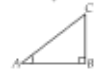
If $A$ is an acute angle of a $\triangle A B C$, right angled at $B$, then the value of $\sin A+\cos A$ is
View full question & answer→MCQ 131 Mark
If $\tan \theta=\frac{a}{b}$, then $\frac{(a \sin \theta-b \cos \theta)}{(a \sin \theta+b \cos \theta)}=$
- A
$\frac{\left(a^2+b^2\right)}{\left(a^2-b^2\right)}$
- ✓
$\frac{\left(a^2-b^2\right)}{\left(a^2+b^2\right)}$
- C
$\frac{a^2}{\left(a^2+b^2\right)}$
- D
$\frac{b^2}{\left(a^2+b^2\right)}$
AnswerCorrect option: B. $\frac{\left(a^2-b^2\right)}{\left(a^2+b^2\right)}$
(b) : We have, $\tan \theta=\frac{a}{b}$
Now, $\frac{(a \sin \theta-b \cos \theta)}{(a \sin \theta+b \cos \theta)}=\frac{(a \tan \theta-b)}{(a \tan \theta+b)}$
[Dividing numerator and denominatoe by $108 \theta$ ] $=\frac{\left(a \times \frac{a}{b}-b\right)}{\left(a \times \frac{a}{b}+b\right)}=\frac{\left(a^2-b^2\right)}{\left(a^2+b^2\right)}$
View full question & answer→MCQ 141 Mark
If $2 \sin 2 \theta=\sqrt{3}$, then $\theta=$
- ✓
$30^{\circ}$
- B
$45^{\circ}$
- C
$60^{\circ}$
- D
AnswerCorrect option: A. $30^{\circ}$
(a) : We have, $2 \sin 2 \theta=\sqrt{3}$
$\Rightarrow \sin 2 \theta=\frac{\sqrt{3}}{2} \Rightarrow 20=60^{\circ}$
$
\left[\because \sin 60^{ n }=\frac{\sqrt{3}}{2}\right]
$
$\Rightarrow \theta=\frac{60^{\circ}}{2}=30^{\circ}$
View full question & answer→MCQ 151 Mark
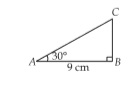
In $\triangle A B C, \angle B=90^{\circ}, \angle A=30^{\circ}$ and $A B=9 cm$.Then, $B C=$
- A
$3 cm$
- B
$2 \sqrt{8} cm$
- ✓
$3 \sqrt{3} cm$
- D
$6 cm$
AnswerCorrect option: C. $3 \sqrt{3} cm$
(c) $=$ We have, $^{\tan 30^{\circ}}=\frac{B C}{A B}=\frac{1}{\sqrt{3}}$
$\Rightarrow \frac{B C}{9}=\frac{1}{\sqrt{3}}$
[Given, $A B=9 cm$ ]
$\Rightarrow B C=\left(9 \times \frac{1}{\sqrt{3}}\right) cm =3 \sqrt{3} cm$
View full question & answer→MCQ 161 Mark
Evaluate : $\left(\sin 30^{\circ}+\sin 45^{\circ}\right)\left(\cos 60^{\circ}-\cos 459\right)$
- A
$\frac{5}{8}$
- B
$\frac{-5}{8}$
- C
$\frac{1}{2}$
- ✓
$\frac{-1}{2}$
AnswerCorrect option: D. $\frac{-1}{2}$
(d) : We have, $\left(\sin 30^{\circ}+\sin 45^{\circ}\right)\left(\cos 60^{\circ}-\cos 45^{\circ}\right)$
$=\left(\frac{1}{2}+\frac{1}{\sqrt{2}}\right)\left(\frac{1}{2}-\frac{1}{\sqrt{2}}\right)=\left(\frac{1}{2}\right)^2-\left(\frac{1}{\sqrt{2}}\right)^2=\left(\frac{1}{4}-\frac{1}{2}\right)=\frac{-1}{2}$
View full question & answer→MCQ 171 Mark
The value of $\frac{\tan ^2 60^{\circ}+4 \cos ^2 45^{\circ}+3 \sec ^2 30^{\circ}+5}{\operatorname{cosec} 30^{\circ}+\sec 60^{\circ}-\cot ^2 90^{\circ}}$ is
- ✓
$14$
- B
$\frac{1}{9}$
- C
$3$
- D
$\frac{1}{3}$
AnswerWe have,
$\frac{\tan ^2 60^{\circ}+4 \cos ^2 45+3 \operatorname{coc}^2 30^{\circ}+5}{\operatorname{cosec} 30^{\circ}+\sec 60^{\circ}-\cot ^2 30^{\circ}}$
$=\frac{(\sqrt{3})^2+4\left(\frac{1}{\sqrt{2}}\right)^2+3\left(\frac{2}{\sqrt{3}}\right)^2+5}{2+2-(\sqrt{3})^2}$
$=\frac{3+2+4+5}{4-3}=14$
View full question & answer→MCQ 181 Mark
If $\cot \theta=\frac{1}{\sqrt{3}}$, then the value of $\frac{1-\cos ^2 \theta}{2-\sin ^2 \theta}$ is
- A
$\frac{1}{5}$
- B
$\frac{2}{5}$
- ✓
$\frac{3}{5}$
- D
$\frac{5}{3}$
AnswerCorrect option: C. $\frac{3}{5}$
We have, $\cot \theta=\frac{1}{\sqrt{3}}$
$\Rightarrow \theta=60^4$
$\therefore \frac{1-\cos ^2 \theta}{2-\sin ^2 \theta}=\frac{\sqrt{3}}{2-\cos ^2 60^2 60}$
$=\frac{1-\left(\frac{1}{2}\right)^2}{2-\left(\frac{\sqrt{3}}{2}\right)^2}=\frac{1-\frac{1}{4}}{2-\frac{3}{4}}=\frac{\frac{4-1}{4}}{\frac{3-3}{4}}=\frac{3}{5}$
$\left[\because \cot 60^{\circ}=\frac{1}{\sqrt{3}}\right]$
View full question & answer→MCQ 191 Mark
In $\triangle \text{A B C}, \angle B=90^{\circ}$. If $\tan A=\sqrt{3}$, then the value of $\sin A \cdot \cos C-\cos A \cdot \sin C$ is
- ✓
$\frac{1}{2}$
- B
$-1$
- C
$1$
- D
$0$
AnswerCorrect option: A. $\frac{1}{2}$
We have, $\tan A=\sqrt{3}$
$\Rightarrow \angle A=60^{\circ}\ \left[\because \tan 60^{\circ}=\sqrt{3}\right]$
$\Rightarrow \angle C=180^{\circ}-90^{\circ}-\angle A=90^{\circ}-60^{\circ}=30^{\circ}$
$\therefore \sin A \cdot \cos C-\cos A-\sin C$
$=\sin 60^{\circ}+\cos 30^{\circ}-\cos 60^{\circ} \cdot \sin 30^{\circ}$
$=\frac{\sqrt{3}}{2} \times \frac{\sqrt{3}}{2}-\frac{1}{2} \times \frac{1}{2}=\frac{3}{4}-\frac{1}{4}=\frac{2}{4}=\frac{1}{2}$
View full question & answer→MCQ 201 Mark
If $\tan ^2 45^{\circ}-\cos ^2 30^{\circ}=x \sin 45^{\circ} \cos 45^{\circ}$, then $x=$
- A
$2$
- B
$-2$
- C
$-\frac{1}{2}$
- ✓
$\frac{1}{2}$
AnswerCorrect option: D. $\frac{1}{2}$
We have, $\tan ^2 45^{\circ}-\cos ^2 30^{\circ}=x \sin 45^{\circ} \cos 45^{\circ}$
$\Rightarrow 1^2-\left(\frac{\sqrt{3}}{2}\right)^2=x\left(\frac{1}{\sqrt{2}}\right)\left(\frac{1}{\sqrt{2}}\right)$
$\Rightarrow 1-\frac{3}{4}=\frac{x}{2}$
$\Rightarrow \frac{1}{4}=\frac{x}{2}$
$\Rightarrow x=2 \times \frac{1}{4}=\frac{1}{2}$
View full question & answer→MCQ 211 Mark
If $\frac{x \operatorname{cosec}^2 30^{\circ} \sec ^2 45^{\circ}}{8 \cos ^2 45^{\circ} \sin ^2 60^{\circ}}=\tan ^2 60^{\circ}-\tan ^2 30^{\circ}$, then $x=$
AnswerWe have,
$\frac{\operatorname{sactax^{2}30^{\circ }\operatorname {sec}^{2}45^{\prime }}}{8 \cos ^2 45^{\circ} \sin ^2 60^{\circ}}=\tan ^2 60^{\circ}-\tan ^2 30^{\circ}$
$\Rightarrow \frac{x(2)^2(\sqrt{2})^2}{8\left(\frac{1}{\sqrt{2}}\right)^2\left(\frac{\sqrt{3}}{2}\right)^2}$
$=(\sqrt{3})^2-\left(\frac{1}{\sqrt{3}}\right)^2$
$\Rightarrow \frac{8 x}{3}=3-\frac{1}{3} $
$\Rightarrow \frac{8 x}{3}=\frac{8}{3} $
$\Rightarrow k=\frac{3}{8} \times \frac{8}{3}$
$=1$
View full question & answer→MCQ 221 Mark
If $\theta$ is an acute angle such that $\tan ^2 \theta=\frac{8}{7}$, then the value of $\frac{(1+\sin \theta)(1-\sin \theta)}{(1+\cos \theta)(1-\cos \theta)}$ is
- ✓
$\frac{7}{8}$
- B
$\frac{8}{7}$
- C
$\frac{7}{4}$
- D
$\frac{64}{49}$
AnswerCorrect option: A. $\frac{7}{8}$
We have,
$\frac{(1+\sin \theta)(1-\sin \theta)}{(1+\cos \theta)(1-\cos \theta)}$
$=\frac{1-\sin ^2 \theta}{1-\cos ^2 \theta}\left[\because(a-b)(a+b)=\theta^2-\theta^2\right]$
$=\frac{\cos ^2 \theta}{\sin ^2 \theta} \quad\left[\because 1-\sin ^2 \theta=\cos ^2 \theta \text { and } 1-\cos ^2 \theta=\sin ^2 \theta\right]$
$=\cot ^2 \theta$
$=\frac{1}{\tan ^2 \theta}$
$=\frac{7}{8}$
View full question & answer→MCQ 231 Mark
If $a \cos \theta+b \sin \theta=m$ and $a \sin \theta-b \cos \theta=n$, then $a^2+b^2=$
- A
$m^2-n^2$
- B
$n^2-m^2$
- ✓
$m^2+n^2$
- D
$m^2 n^2$
AnswerCorrect option: C. $m^2+n^2$
We have, $a \cos \theta+b \sin \theta=m$
and $a \operatorname{san} \theta-b \cos \theta=n$
Squaring and adding $(i)$ and $(i),$ we get
$H^2+H^2=\left(a^2 \cos ^2 \theta+b^2 \sin ^2 \theta+2 a b \cos \theta \sin \theta\right) +\left(a^2 \sin ^2 \theta+b^2 \cos ^2 \theta-2 a b \sin \theta \cos \theta\right)$
$=a^2\left(\cos ^2 \theta+\sin ^2 \theta\right)+b^2\left(\sin ^2 \theta+\cos ^2 \theta\right)$
$=a^2+b^2 \left[\because \cos ^2 \theta+\sin ^2 \theta=1\right]$
Hence, $a ^2+ br ^2= m ^2+ w ^2$
View full question & answer→MCQ 241 Mark
If $\tan \theta+\cot \theta=2$, then $\tan ^2 \theta+\cot ^2 \theta$ equals
AnswerWe have, $\tan \theta+\cot \theta=2$
Squaring both sides, we get $(\tan \theta+\cot \theta)^2=4$
$\Rightarrow \tan ^2 \theta+\cot ^2 \theta+2 \tan 0 \cot \theta=4$
$\Rightarrow \tan ^2 \theta+\cot ^2 \theta+2(1)=4$
$\Rightarrow \tan ^2 \theta+\cot ^2 \theta-4-2$
$=2\ [\because \tan \theta \cot \theta=1]$
View full question & answer→MCQ 251 Mark
If $2 x=\sec \theta$ and $\frac{2}{x}=\tan \theta$, then $2\left(x^2-\frac{1}{x^2}\right)=$
- ✓
$\frac{1}{2}$
- B
$2$
- C
$\frac{1}{4}$
- D
$4$
AnswerCorrect option: A. $\frac{1}{2}$
We have, $2 x=\operatorname{sect}$ and $\frac{2}{x}=\tan \theta$
$\Rightarrow x=\frac{\sec \theta}{2}$ and $\frac{1}{x}=\frac{\tan \theta}{2}$
$\therefore 2\left(x^2-\frac{1}{x^2}\right)-2\left(\frac{\sec ^2 \theta}{4}-\frac{\tan ^2 \theta}{4}\right) \left[\because \sec ^2 \theta-\tan ^2 \theta=1\right]$
$=\frac{2}{4}\left(\sec ^2 \theta-\tan ^2 \theta\right)$
$=\frac{1}{2} \cdot 1 [(\theta)]$
$=\frac{1}{2}$
View full question & answer→MCQ 261 Mark
If $\tan ^2 A=1+2 \tan ^2 B$, then $\frac{\cos ^2 A}{\cos ^2 B}=$
- A
$1$
- ✓
$\frac{1}{2}$
- C
$\frac{1}{4}$
- D
$\frac{\sqrt{3}}{2}$
AnswerCorrect option: B. $\frac{1}{2}$
We have, $\tan ^2 A=1+2 \tan ^2 B$
$\Rightarrow \sec ^2 A-1=1+2\left(\sec ^2 B-1\right) \left[\because \tan ^2 \theta=\sec ^2 \theta-1\right]$
$\Rightarrow \sec ^2 A=2+2 \sec ^2 B-2$
$\Rightarrow \sec ^2 A=2 \sec ^2 B$
$\Rightarrow \frac{1}{\cos ^2 A}=\frac{2}{\cos ^2 B}$
$\Rightarrow \frac{\cos ^2 A}{\cos ^2 B}=\frac{1}{2}$
View full question & answer→MCQ 271 Mark
$\sqrt{\frac{1-\cos \theta}{1+\cos \theta}}$ is equal to
- ✓
$\operatorname{cosec}\theta-\cos\theta$
- B
$\operatorname{cosec} \theta+\cot \theta$
- C
$\operatorname{cosec}^2 \theta+\cot ^2 \theta$
- D
$\operatorname{cosec}^2 \theta-\cot ^2 \theta$
AnswerCorrect option: A. $\operatorname{cosec}\theta-\cos\theta$
(a) : We have, $\sqrt{\frac{1-\cos \theta}{1+\cos \theta}}-\sqrt{\frac{1-\cos \theta}{1+\cos \theta} \times \frac{1-\cos \theta}{1-\cos \theta}}$
$=\sqrt{\frac{(1-\cos \theta)^2}{1-\cos ^2 \theta}}$
$
\left[\because(a+b)(a-b)=a^2-b^2\right]
$
$=\sqrt{\frac{(1-\cos \theta)^2}{\sin ^2 \theta}}$
$
\left[\because 1-\cos ^2 \theta=\sin ^2 \theta\right]
$
$=\frac{1-\cos \theta}{\sin \theta}=\frac{1}{\sin \theta}-\frac{\cos \theta}{\sin \theta}=\operatorname{cosec} \theta-\cot \theta$
View full question & answer→MCQ 281 Mark
If $x=a \tan \theta$ and $y=b$ eec $\theta$, then
- ✓
$\frac{y^2}{b^2}-\frac{x^2}{a^2}=1$
- B
$\frac{x^2}{a^2}+\frac{y^2}{b^2}=1$
- C
$\frac{x^2}{a^2}-\frac{y^2}{b^2}=1$
- D
$\frac{x^2}{a^2}-\frac{y^2}{b^2}=0$
AnswerCorrect option: A. $\frac{y^2}{b^2}-\frac{x^2}{a^2}=1$
(a) : We have, $x=a \tan \theta$ and $y=b \sec \theta$
$\Rightarrow \tan \theta=\frac{x}{2}$ and $\sec \theta=\frac{z}{b}$
Putting these values in $\sec ^2 \theta-\tan ^2 \theta=1$, we got
$
\frac{y^2}{ b ^2}-\frac{ x ^2}{a^2}=1
$
View full question & answer→MCQ 291 Mark
$\left(\sec ^4 A-\sec ^2 A\right)=$
- A
$\tan^4A-\tan^2A$
- ✓
$\tan ^2 A+\tan ^4 A$
- C
$\tan ^2 A-\tan ^4 A$
- D
AnswerCorrect option: B. $\tan ^2 A+\tan ^4 A$
We have, $\left(\sec ^4 A=\sec ^2 A\right)$
$=\sec ^2 A\left(\sec ^2 A-1\right)$
$=\sec ^2 A\left(1+\tan ^2 A-1\right)$
$=\sec ^2 A \tan ^2 A$
$=\left(1+\tan ^2 A\right) \tan ^2 A$
$=\left(\tan ^2 A+\tan ^4 A\right)$
View full question & answer→MCQ 301 Mark
Evaluate $: \sqrt{\frac{\sec \theta-1}{\sec \theta+1}}+\sqrt{\frac{\sec \theta+1}{\sec \theta-1}}$
- A
$2\sin\theta$
- B
$2 \cos \theta$
- ✓
2 cosec $\theta$
- D
$2 \sec \theta$
AnswerCorrect option: C. 2 cosec $\theta$
(c) : We have, $\sqrt{\frac{\sec \theta-1}{\sec \theta+1}}+\sqrt{\frac{\sec \theta+1}{\sec \theta-1}}$
$
=\frac{(\sec \theta-1)+(\sec \theta+1)}{\sqrt{\sec ^2 \theta-1}}=\frac{2 \sec \theta}{\sqrt{\tan ^2 \theta}} \quad\left[\because \sec ^2 \theta-1=\tan ^2 \theta\right]
$
$
=\frac{2 \sec \theta}{\tan \theta}=\frac{2}{\cos \theta} \times \frac{\cos \theta}{\sin \theta}=\frac{2}{\sin \theta}=2 \operatorname{cosec} \theta
$
View full question & answer→MCQ 311 Mark
If $\cos A=\frac{4}{5}$, then the value of $\tan A$ is
- A
$\frac{3}{5}$
- ✓
$\frac{3}{4}$
- C
$\frac{4}{3}$
- D
$\frac{5}{3}$
AnswerCorrect option: B. $\frac{3}{4}$
given, $\cos A=4 / 5$
$\because \sin A=\sqrt{1-\cos ^2 A} \quad\left[\because \sin ^2 A+\cos ^2 A=1\right]$
$\Rightarrow \sin A=\sqrt{1-\left(\frac{4}{5}\right)^2}$
$=\sqrt{1-\frac{16}{25}}$
$=\sqrt{\frac{9}{25}}$
$=\frac{3}{5}$
Now, $\tan A=\frac{\sin A}{\cos A}$
$=\frac{\frac{3}{5}}{\frac{4}{5}}$
$=\frac{3}{4}$
View full question & answer→MCQ 321 Mark
If $\sin A=\frac{1}{2}$, then the value of $\cot A$ is
- ✓
$\sqrt{3}$
- B
$\frac{1}{\sqrt{3}}$
- C
$\frac{\sqrt{3}}{2}$
- D
AnswerCorrect option: A. $\sqrt{3}$
(a) : Given, $\sin A=\frac{1}{2}$
$
\because \quad \cos A=\sqrt{1-\sin ^2 A} \quad\left[\because \sin ^2 A+\cos ^2 A=1\right]
$
$
\Rightarrow \cos A=\sqrt{1-\left(\frac{1}{2}\right)^2}=\sqrt{1-\frac{1}{4}}=\sqrt{\frac{3}{4}}=\frac{\sqrt{3}}{2}
$
Now, $\cot A=\frac{\cos A}{\sin A}=\frac{\sqrt{3} / 2}{1 / 2}=\sqrt{3}$
View full question & answer→MCQ 331 Mark
Given that $\sin \theta=\frac{a}{b}$, then $\cos \theta$ is equal to
- A
$\frac{b}{\sqrt{b^2-a^2}}$
- B
$\frac{b}{a}$
- ✓
$\frac{\sqrt{b^2-a^2}}{b}$
- D
$\frac{a}{\sqrt{b^2-a^2}}$
AnswerCorrect option: C. $\frac{\sqrt{b^2-a^2}}{b}$
Given $\sin \theta=\frac{a}{b}$
$\because \cos \theta=\sqrt{1-\sin ^2 \theta} \ \left[\because \sin ^2 \theta+\cos ^2 \theta=1\right]$
$\Rightarrow \cos \theta=\sqrt{1-\left(\frac{a}{b}\right)^2}$
$=\sqrt{1-\frac{a^2}{b^2}}=\frac{\sqrt{b^2-a^2}}{b}$
View full question & answer→MCQ 341 Mark
If $\sin A+\sin ^2 A=1$, then the value of the expression $\left(\cos ^2 A+\cos ^4 A\right)$ is
Answer(a) : Given $\sin A+\sin ^2 A=1$
$\Rightarrow \sin A=1-\sin ^2 A=\cos ^2 A \quad\left[\because \cos ^2 A+\sin ^2 A=1\right]$
On equaring both sides, we get
$
\begin{aligned}
& \sin ^2 A=\cos ^4 A \\
\Rightarrow \quad & 1-\cos ^2 A=\cos ^4 A \Rightarrow \cos ^2 A+\cos ^4 A-1
\end{aligned}
$
View full question & answer→MCQ 351 Mark
If $4 \tan \theta=3$, then $\left(\frac{4 \sin \theta-\cos \theta}{4 \sin \theta+\cos \theta}\right)$ is equal to
- A
$\frac{2}{3}$
- B
$\frac{1}{3}$
- ✓
$\frac{1}{2}$
- D
$\frac{3}{4}$
AnswerCorrect option: C. $\frac{1}{2}$
(c) : Given, $4 \tan \theta=3 \Rightarrow \tan \theta=\frac{3}{4}$
$
\therefore \frac{4 \sin \theta-\cos \theta}{4 \sin \theta+\cos \theta}=\frac{4 \frac{\sin \theta}{\cos \theta}-1}{4 \frac{\sin \theta}{\cos \theta}+1}
$
[Dividing numerator and denominatoe by $\cos \theta$ ]
$
=\frac{4 \tan \theta-1}{4 \tan \theta+1}
$
$
\left[\because \tan \theta-\frac{\sin \theta}{\cos \theta}\right]
$
$=\frac{4\left(\frac{3}{4}\right)-1}{4\left(\frac{3}{4}\right)+1}=\frac{3-1}{3+1}=\frac{2}{4}=\frac{1}{2}$
View full question & answer→MCQ 361 Mark
If $\tan A=\sqrt{2}-1$, then what is the value of $\frac{\tan A}{1+\tan ^2 A}$ ?
- ✓
$\frac{\sqrt{2}}{4}$
- B
$\frac{4}{\sqrt{2}}$
- C
$\frac{1}{\sqrt{3}}$
- D
$\frac{\sqrt{3}}{4}$
AnswerCorrect option: A. $\frac{\sqrt{2}}{4}$
We have, $\frac{\tan A}{1+\tan ^2 A}=\frac{\sqrt{2}-1}{1+(\sqrt{2}-1)^2}$
$=\frac{\sqrt{2}-1}{1+2+1-2 \sqrt{2}}=\frac{\sqrt{2}-1}{4-2 \sqrt{2}}$
$=\frac{\sqrt{2}-1}{2 \cdot 2-2 \sqrt{2}}$
$=\frac{\tan A=\sqrt{2}-1]}{2 \sqrt{2} \sqrt{2}-2 \sqrt{2}}$
$=\frac{\sqrt{2}-1}{2 \sqrt{2}(\sqrt{2}-1)}$
$=\frac{1}{2 \sqrt{2}}=\frac{1}{2 \sqrt{2}} \times \frac{\sqrt{2}}{\sqrt{2}}=\frac{\sqrt{2}}{4}$
View full question & answer→MCQ 371 Mark
Find the acute angle $\theta$, satisfying the equation $\sec ^2 \theta+\tan ^2 \theta=3$.
- A
$30^{\circ}$
- ✓
$45^{\circ}$
- C
$60^{\circ}$
- D
AnswerCorrect option: B. $45^{\circ}$
We have, $\sec ^2 \theta+\tan ^2 \theta-3$
$\left.\Rightarrow 1+\tan ^2 \theta+\tan ^2 \theta=3 [\because \sec ^2 \theta=1+\tan ^2 \theta\right]$
$\Rightarrow 1+2 \tan ^2 \theta=3$
$\Rightarrow 2 \tan ^2 \theta=2$
$\Rightarrow \tan ^2 \theta=1$
$\Rightarrow(\tan \theta)^2=1^2$
$\Rightarrow \tan \theta=1$
$\Rightarrow \theta=45^{\circ} \left[\because \tan 45^{\circ}=1\right]$
View full question & answer→MCQ 381 Mark
If $\tan \theta=\sqrt{3}$, then find the value of $\sin \theta \cos \theta$.
- A
$\frac{\sqrt{3}}{2}$
- B
$\sqrt{3}$
- ✓
$\frac{\sqrt{3}}{4}$
- D
$\frac{1}{\sqrt{3}}$
AnswerCorrect option: C. $\frac{\sqrt{3}}{4}$
( c ) ; We have, $\tan \theta=\sqrt{3}$
$\begin{aligned} & \Rightarrow \theta=60^{\circ} \quad\left[\because \tan 60^{\circ}=\sqrt{3}\right] \\ & \therefore \quad \sin \theta \cos \theta=\sin 60^{\circ} \cos 60^{\circ}=\frac{\sqrt{3}}{2} \cdot \frac{1}{2}=\frac{\sqrt{3}}{4}\end{aligned}$
View full question & answer→MCQ 391 Mark
If $\theta$ is an acute angle and $\sin \theta=\cos \theta$, then find the value of $2 \tan ^2 \theta-1$.
AnswerWe have, $\sin \theta-\cos \theta$
$\Rightarrow \frac{\sin \theta}{\cos \theta}=\frac{\cos \theta}{\cos \theta}$
$[$ Dividing both sides by $\cos \theta ]$
$\Rightarrow \tan \theta-1$
$\Rightarrow 0=45^{\circ} \left[\because \tan 45^{\circ}=1\right]$
$\therefore 2 \tan ^2 \theta-1$
$=2 \tan ^2 45^{\circ}-1$
$=2(1)^2-1$
$=2-1$
$=1$
View full question & answer→MCQ 401 Mark
Find the value of $x$, if $\cos 2 x=\sin 60^{\circ}-\cos 30^{\circ} = \cos 60^{\circ} \cdot \sin 30^{\circ}$.
- ✓
$30^{\circ}$
- B
$60^{\circ}$
- C
$45^{\circ}$
- D
AnswerCorrect option: A. $30^{\circ}$
Wehave, $\cos 2 x-\sin 60^{\circ}-\cos 30^{\circ}-\cos 60^{\circ} \cdot \sin 30^{\circ}$
$=\cos 2 x=\frac{\sqrt{3}}{2} \times \frac{\sqrt{3}}{2}-\frac{1}{2} \times \frac{1}{2}$
$\Rightarrow \cos 2 x=\frac{3}{4}-\frac{1}{4}=\frac{1}{2} $
$\rightarrow 2 x=600^{\circ}\ \left[\because \cos 60^{\circ}=\frac{1}{2}\right]$
$=x=30^{\circ}$
View full question & answer→MCQ 411 Mark
If cot $\theta=\frac{15}{8}$, then evaluate $\frac{(2+2 \sin \theta)(1-\sin \theta)}{(1+\cos \theta)(2-2 \cos \theta)}$.
- A
$\frac{64}{225}$
- B
$\frac{32}{225}$
- ✓
$\frac{225}{64}$
- D
$\frac{225}{32}$
AnswerCorrect option: C. $\frac{225}{64}$
We have, $\frac{(2+2 \sin \theta)(1-\sin \theta)}{(1+\cos \theta)(2-2 \cos \theta)}$
$=\frac{2(1+\sin \theta)(1-\sin \theta)}{2(1+\cos \theta)(1-\cos \theta)}=\frac{\left(1-\sin ^2 \theta\right)}{\left(1-\cos ^2 \theta\right)}$
${\left[\because(e+b)(e-b)=a^2-b^2\right]}$
$=\frac{\cos ^2 \theta}{\sin ^2 \theta} \left[\because \cos ^2 \theta+\sin ^2 \theta-1\right]$
$=\left(\frac{\cos \theta}{\sin \theta}\right)^2-(\cos \theta)^2$
$=\left(\frac{15}{8}\right)^2$
$=\frac{225}{64}\left[\because \cot \theta-\frac{15}{8}\right]$
View full question & answer→MCQ 421 Mark
$\frac{\sin ^3 \theta+\cos ^3 \theta}{\sin \theta+\cos \theta}+\sin \theta \cos \theta$ is equal to
AnswerWe have, $\frac{\sin ^3 \theta+\cos ^3 \theta}{\sin \theta+\cos \theta}+\sin \theta \cos \theta$
$=\frac{(\sin \theta+\cos \theta)\left(\sin ^2 \theta+\cos ^2 \theta-\sin \theta \cos \theta\right)}{\sin \theta+\cos \theta}+\sin \theta \cos \theta$
${\left[\because\left(a^3+b^3\right)=(a+b)\left(\alpha^2+b^2-a b\right) ]\right.}$
$=1-\sin \theta \cos \theta+\sin \theta \cos \theta-1$
View full question & answer→MCQ 431 Mark
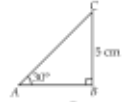
In $\triangle A B C$, right angled at $B, B C=5 cm$, $\angle B A C=30^{\circ}$, find the length of the side $A C$.
- A
$5 cm$
- B
$2 cm$
- C
$7 cm$
- D
$10 cm$
View full question & answer→MCQ 441 Mark
In a $\triangle A B C$, right angled at $B$, if $\tan A=\sqrt{3}$, then find the value of $2 \sin A \cot A$.
Answer(a) : We have, $\tan A=\sqrt{3}$
$
\Rightarrow \angle A=60^{\circ} \quad\left[\because \tan 60^{\circ}=\sqrt{3}\right]
$
Now, $2 \sin A \cot A=2 \sin 60^{\circ} \cot 60^{\circ}$
$
=2 \times \frac{\sqrt{3}}{2} \times \frac{1}{\sqrt{3}}=1
$
View full question & answer→MCQ 451 Mark
If $\sin A-\cos A=\frac{\sqrt{3}-1}{2}$ and $\sin A \cos A=\frac{\sqrt{3}}{x}$, then find the value of $x$.
AnswerWe have, $\sin A-\cos A=\frac{\sqrt{3}-1}{2}$
Squaring both sides,
we get $\sin ^2 A+\cos ^2 A-2 \sin A \cos A=\frac{3+1-2 \sqrt{3}}{4}$
$\Rightarrow 1-2 \sin A \cos A=\frac{4-2 \sqrt{3}}{4} \left[\because \sin ^2 A+\cos ^2 A=1\right]$
$\Rightarrow 1-2 \sin A \cos A=1-\frac{\sqrt{3}}{2}$
$\Rightarrow 2 \sin A \cos A=\frac{\sqrt{3}}{2} \rightarrow \sin A \cos A=\frac{\sqrt{3}}{4}=\frac{\sqrt{3}}{x}$
Hence, $x=4$.
View full question & answer→MCQ 461 Mark
Find the value of $(1+\cos \theta)(1-\cos \theta) \times\left(1+\cot ^2 \theta\right)$.
Answer$\begin{aligned} & \text {(a) : We have, }(1+\cos \theta)(1-\cos \theta)\left(1+\cot ^2 \theta\right) \\ & =\left(1-\cos ^2 \theta\right)\left(1+\cot ^2 \theta\right)\left[\because(a+b)(a-b)=a^2-b^2\right] \\ & =\sin ^2 \theta\left(1+\frac{\cos ^2 \theta}{\sin ^2 \theta}\right) \quad\left(\because 1-\cos ^2 \theta=\sin ^2 \theta, \cot \theta=\frac{\cos \theta}{\sin \theta}\right) \\ & =\sin ^2 \theta\left(\frac{\sin ^2 \theta+\cos ^2 \theta}{\sin ^2 \theta}\right)=1\end{aligned}$
View full question & answer→MCQ 471 Mark
Find the value of $5+\frac{\left(1+\tan ^2 \theta\right) \sin \theta \cos \theta}{\tan \theta}$.
AnswerWe have, $5+\frac{\left(1+\tan ^2 \theta\right) \sin \theta \cos \theta}{\tan \theta}$
$=5+\frac{\operatorname{scc}^2 \theta \sin \theta \cos \theta}{\frac{\sin \theta}{\cos \theta}}\left[\because 1+\tan ^2 \theta=\sec ^2 \theta, \tan \theta=\frac{\sin \theta}{\cos \theta}\right]$
$=5+\frac{\sec ^2 \theta \sin \theta \cos ^2 \theta}{\sin \theta} \ \left[\because \sec \theta=\frac{1}{\cos \theta}\right]$
$=5+1=6$
View full question & answer→MCQ 481 Mark
If $0^{\circ} \leq \theta \leq 45^{\circ}$ such that $\cos ^2 \theta-\sin ^2 \theta=\alpha$ and $\cos \theta-\sin \theta=b$, then find the value of $\left(\frac{a}{b}\right)^2+b^2$.
AnswerWe have,
$\left(\frac{a}{b}\right)^2+b^2-\left(\frac{\cos ^2 \theta-\sin ^2 \theta}{\cos \theta-\sin \theta}\right)^2+(\cos \theta-\sin \theta)^2$
$=\left(\frac{(\cos \theta-\sin \theta)(\cos \theta+\sin \theta)}{\cos \theta-\sin \theta}\right)^2$
$=\left(\cos \theta+\sin ^2 \theta+1-2 \sin \theta \cos \theta \left[\because \cos ^2 \theta+\sin ^2 \theta-2 \sin \theta \cos \theta\right.\right.$
$=\cos ^2 \theta+\sin ^2 \theta+2 \sin \theta \cos \theta+1-2 \sin \theta \cos \theta$
$=1+1-2$
View full question & answer→MCQ 491 Mark
If $\cos \left(40^{\circ}+x\right)=\cos 60^{\circ}$, then $x$ is equal to
- ✓
$20^{\circ}$
- B
$30^{\circ}$
- C
$CO ^{\circ}$
- D
$0^{\circ}$
AnswerCorrect option: A. $20^{\circ}$
(a): We have, $\cos \left(40^{\circ}+x\right)=\cos 60^{\circ}$
$
\Rightarrow 40^{\circ}+x=60^{\circ} \Rightarrow x=20^{\circ}
$
View full question & answer→MCQ 501 Mark
$\left(\cos ^4 x-\sin ^4 x\right)$ is equal to
- A
$2 \sin ^2 x-1$
- B
$1-2 \cos ^2 x$
- C
$\sin ^2 x-\cos ^2 x$
- ✓
$2 \cos ^2 x-1$
AnswerCorrect option: D. $2 \cos ^2 x-1$
$=\left(\cos ^2 x+\sin ^2 x\right)\left(\cos ^2 x=\sin ^2 x\right)$
$=1\left(\cos ^2 x-\left(1-\cos ^2 x\right)\right\}$
$=\cos ^2 x-1+\cos ^2 x$
$=2 \cos ^2 x-1$
View full question & answer→