Question 12 Marks
Solve the system of equations: $x - 2y = 0, 3x + 4y = 20$
AnswerThe given equations are as follows:
$x - 2y = 0 ....(i)$
$3x + 4y = 20 ...(ii)$
On multiplying $(i)$ by $2,$ we get
$2x - 4y = 0 ...(iii)$
On adding $(ii)$ and $(iii)$, we get
$4 - 2y = 0$
$\Rightarrow 4 = 2y$
$\Rightarrow y = 2$
Hence, the required solution is $x = 4$ and $y = 2$.
View full question & answer→Question 22 Marks
Very-Short and Short-Answer Questions:
If $\frac{2}{\text{x}}+\frac{3}{\text{y}}=\frac{9}{\text{xy}}$ and $\frac{4}{\text{x}}+\frac{9}{ \text{y}}=\frac{21}{\text{xy}},$ find the values of $x$ and $y$.
AnswerThe given pair of equation is:
$\frac{2}{\text{x}}+\frac{3}{\text{y}}=\frac{9}{\text{xy}}\ ...(\text{i})$
$\frac{4}{\text{x}}+\frac{9}{\text{y}}=\frac{21}{\text{xy}}\ ...(\text{ii})$
Multiplying $(i)$ and $(ii)$ by $xy$, we have
$3x + 2y = 9 ....(iii)$
$9x + 4y = 21 ...(iv)$
Now, multiplying $(iii)$ by $2$ and subtracting from $(iv)$, we get
$9\text{x}-6\text{x}=21-18$
$\Rightarrow\text{x}=\frac{3}{3}=1$
Putting $x = 1$ in $(iii),$ we have
$3\times1+2\text{y}=9$
$\Rightarrow\text{y}=\frac{9-3}{2}=3 $
Hence, $x = 1$ and $y = 3$.
View full question & answer→Question 32 Marks
Solve the following system of equations graphically:
$2x - 3y = 1, 4x - 3y + 1 = 0$
AnswerOn the graph paper, draw a horizontal line $X'OX$ and a vertical line $YOY'$ as the $x$-axis and $y$-axis, respectively.
Graph of $2x - 3y = 1:$
$2x - 3y = 1$
$\Rightarrow 3y = (2x - 1)$
$\therefore\text{y}=\frac{2\text{x}-1}{3}\ ...(\text{i})$
Putting $x = -1$, we get:
$\Rightarrow y = -1$
Putting $x = 2$, we get:
$\Rightarrow y = 1$
Putting $x = 5$, we get:
$\Rightarrow y = 3$
Thus, we have the following table for the equation $2x - 3y = 1$.
|
$x:$
|
$-1$
|
$2$
|
$5$
|
|
$y:$
|
$-1$
|
$1$
|
$3$
|
Now, plot the points $A(-1, -1), B(2, 1)$ and $C(5, 3)$ on the graph paper.
Join $AB$ and $BC$ to get the graph line $AC$. Extend it on both the sides.
Thus, the line $AC$ is the graph of $2x - 3y = 1$.
Graph of $4x - 3y + 1 = 0:$
$4x - 3y + 1 = 0$
$\Rightarrow 3y = (4x + 1)$
$\therefore\text{y}=\frac{4\text{x}-1}{3}\ ...(\text{ii})$
Putting $x = -1$, we get:
$\Rightarrow y = -1$
Putting $x = 2$, we get:
$\Rightarrow y = 3$
Putting $x = 5$, we get:
$\Rightarrow y = 7$
Thus, we have the following table for the equation 4x - 3y + 1 = 0.
|
$x:$
|
$-1$
|
$2$
|
$5$
|
|
$y:$
|
$-1$
|
$3$ |
$7$ |
Now, plots the points $P(2, 3)$ and $Q(5, 7)$. The point $A(-1, -1)$ has already been plotted.
Join $PA$ and $QP$ to get the graph line $AQ$. Extend it on both the sides.
Thus, the line $AQ$ is the graph of the equation $4x - 3y + 1 = 0$.
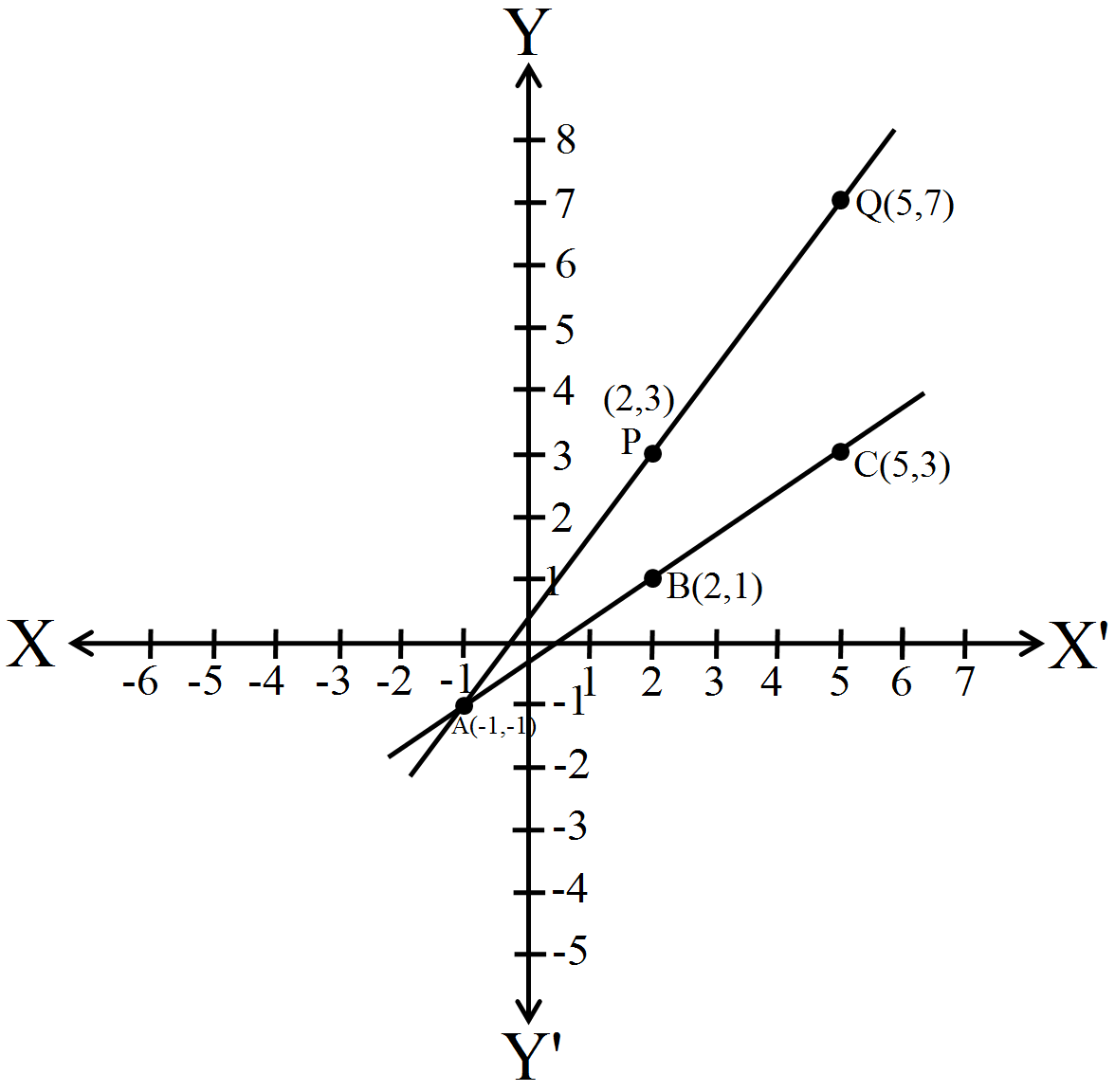
The two lines intersect at $A(-1, -1)$.
Thus, $x = -1$ and $y = -1$ is the solution of the given system of equations. View full question & answer→Question 42 Marks
Solve for $x$ and $y$:
$0.4x + 0.3y = 1.7,$
$0.7x - 0.2y = 0.8$.
AnswerThe given equations are:
$0.4x + 0.3y = 1.7 ...(i)$
$0.7x - 0.2y = 0.8 ...(ii)$
Multiply $(i)$ by $0.2$ and $(ii)$ by $0.3$ add them
$\Rightarrow 0.8x + 2.1x = 3.4 + 2.4$
$\Rightarrow 2.9x = 5.8$
$\Rightarrow x = 2$
Substitute $x = 2$ in $(i)$, we get
$\Rightarrow 0.4(2) + 0.3y = 1.7$
$\Rightarrow y = 3$
So, $x = 2$ and $y = 3$.
View full question & answer→Question 52 Marks
Show that the equations $9x - 10y = 21,$ $\frac{\text{3x}}{2}-\frac{\text{5y}}{3}=\frac{7}{2}$ have infinitely many solutions.
AnswerThe given system of equations can be written as follows:
$9\text{x}-10\text{y}-21=0$ and $\frac{3\text{x}}{2}-\frac{5\text{y}}{3}-\frac{7}{2}=0$
The given equations are of the following form:
$a_1 x+b_1 y+c_1=0 \text { and } a_2 x+b_2 y+c_2=0$
$\text { Here, } a_1=9, b_1=-10, c_1=-21 \text { and } a_1=\frac{3}{2}, b_2=-\frac{-5}{3} \text { and } c_2=\frac{-7}{2}$
$\therefore\frac{\text{a}_1}{\text{a}_2}=\frac{9}{\frac{3}{2}}=6,\ \frac{\text{b}_1}{\text{b}_2}=\frac{-10}{\big(\frac{-5}{3}\big)}=6$ and $\frac{\text{c}_1}{\text{c}_2}=-21\times\frac{2}{-7}=6$
$\therefore\frac{\text{a}_1}{\text{a}_2}=\frac{\text{b}_1}{\text{b}_2}=\frac{\text{c}_1}{\text{c}_2}$
This shows that the given system has an infinite number of solutions.
View full question & answer→Question 62 Marks
Show that the system of equations $-x + 2y + 2 = 0$ and $\frac{1}{2}\text{x}-\frac{1}{4}\text{y}-1=0$ has a unique solution.
AnswerThe given system of equations:
$-\text{x}+2\text{y}+2=0$ and $\frac{1}{2}\text{x}-\frac{1}{4}\text{y}-1=0$
The given equations are of the following form:
$a_1 x+b_1 y+c_1=0 \text { and } a_2 x+b_2 y+c_2=0$
$\text { Here, } a_1=-1, b_1=2, c_1=2 \text { and } a_1=\frac{1}{4}, b_2=-\frac{1}{4} \text { and } c_3=-1$
$\therefore\frac{\text{a}_1}{\text{a}_2}=\frac{-1}{\big(\frac{1}{2}\big)}=-2,\ \frac{\text{b}_1}{\text{b}_2}=\frac{2}{\big(\frac{-1}{4}\big)}=-8$ and $\frac{\text{c}_1}{\text{c}_2}=\frac{2}{-1}=-2$
$\therefore\frac{\text{a}_1}{\text{a}_2}\neq\frac{\text{b}_1}{\text{b}_2}$
The given system has a unique has a unique solution.
Hence, the lines intersect at one point.
View full question & answer→Question 72 Marks
The difference between two numbers is $26$ and one number is three times the other. Find the numbers.
AnswerLet the larger number be $x$ and the smaller number be $y$.
Then, we have:
$x - y = 26 ....(i)$
$x = 3y ...(ii)$
On substituting $x = 3y$ in $(i)$, we get:
$3y - y = 26$
$\Rightarrow 2y = 26$
$\Rightarrow y = 13$
On Substituting $y = 13$ in $(i)$, we get:
$x - 13 = 26$
$\Rightarrow x = 26 + 13 = 39$
Hence, the required number are $39$ and $13$.
View full question & answer→Question 82 Marks
Very-Short and Short-Answer Questions:
Find $k$ for which the system $x + 2y = 3$ and $5x + ky + 7 = 0$ is inconsistent.
AnswerThe given system is
$x + 2y - 3 = 0 ...(i)$
$5x + ky + 7 = 0 ...(ii)$
Here, $a_1=1, b_1=2, c_1=-3, a_2=5, b_2=k$ and $c_2=7$
For the system to be inconsistent, we must have
$\frac{\text{a}_1}{\text{a}_2}=\frac{\text{b}_1}{\text{b}_2}\neq\frac{\text{c}_1}{\text{c}_2}$
$\Rightarrow\frac{1}{5}=\frac{2}{\text{k}}\neq\frac{-3}{7}$
$\Rightarrow\frac{1}{5}=\frac{2}{\text{k}}$
$\Rightarrow\text{k}=10$
Hence, $k = 10$.
View full question & answer→Question 92 Marks
Very-Short and Short-Answer Questions:
If $\frac{\text{x}}{4}+\frac{\text{y}}{\text{3}}=\frac{5}{\text{12}}$ and $\frac{\text{x}}{\text{2}}+\text{y}=1$ then find the value of $(x + y)$.
AnswerThe given pair of equation is
$\frac{\text{x}}{4}+\frac{\text{y}}{3}=\frac{58}{12}\ ...(\text{i})$
$\frac{\text{x}}{2}+\text{y}=1\ ...(\text{ii})$
Multiplying $(i)$ by $12$ and $(ii)$ by $4$, we get
$3x + 4y = 5 ....(iii)$
$2x + 4y = 4 ...(iv)$
Now, subtracting $(iv)$ from $(iii)$, we get
$\Rightarrow x = 1$
Putting $x = 1$ in $(iv)$, we have
$2 + 4y = 4$
$\Rightarrow 4y = 2$
$\Rightarrow\text{y}=\frac{1}{2}$
$\therefore\text{x}+\text{y}=1+\frac{1}{2}=\frac{3}{2}$
Hence, the value of $x + y$ is $\frac{3}{2}.$
View full question & answer→Question 102 Marks
Very-Short and Short-Answer Questions:
Show that the system $2x + 3y - 1 = 0, 4x + 6y - 4 = 0$ has no solution.
AnswerThe given system is:
$2x + 3y - 1 = 0 ...(i)$
$4x + 6y - 4 = 0 ...(ii)$
Here, $a_1=2, b_1=3, c_1=-1, a_2=4, b_2=6$ and $c_2=-4$
Now,
$\frac{\text{a}_1}{\text{a}_2}=\frac{2}{4}=\frac{1}{2}$
$\frac{\text{b}_1}{\text{b}_2}=\frac{3}{6}=\frac{1}{2}$
$\frac{\text{c}_1}{\text{c}_2}=\frac{-1}{-4}=\frac{1}{4}$
Thus, $\frac{\text{a}_1}{\text{a}_2}=\frac{\text{b}_1}{\text{b}_2}\neq\frac{\text{c}_1}{\text{c}_2}$ and therefore the given system has no solution.
View full question & answer→Question 112 Marks
Very-Short and Short-Answer Questions:
The sum of two numbers is $80$. The larger number exceeds four times the smaller one by $5$. Find the numbers.
AnswerLet the larger number be $x$ and the smaller number be $y$.
Then as per the question
$x + y = 80 ....(i)$
$x = 4y + 5$
$x - 4y = 5 ...(ii)$
Subtracting $(ii)$ from $(i)$, we get
$5y = 75$
$\Rightarrow y = 15$
Now, putting $y = 15$ in $(i)$, we have
$x + 15 = 80$
$\Rightarrow x = 65$
Hence, the numbers are $65$ and $15$.
View full question & answer→Question 122 Marks
Very-Short and Short-Answer Questions:
Find $k$ for which the system $2x + 3y - 5 = 0$ and $4x + ky - 10 = 0$ has an infinite number of solutions.
AnswerThe given system is
$2x + 3y - 5 = 0 ...(i)$
$4x + ky - 10 = 0 ...(ii)$
Here, $a_1=2, b_1=3, c_1=-5, a_2=4, b_2=k$ and $c_2=-10$
For the system, to have an infinite number of solutions, we must have
$\frac{\text{a}_1}{\text{a}_2}=\frac{\text{b}_1}{\text{b}_2}=\frac{\text{c}_1}{\text{c}_2}$
$\Rightarrow\frac{2}{4}=\frac{3}{\text{k}}=\frac{-5}{-10}$
$\Rightarrow\frac{1}{2}=\frac{3}{\text{k}}=\frac{1}{2}$
$\Rightarrow\text{k}=6$
Hence, $\text{k}=6.$
View full question & answer→Question 132 Marks
Very-Short and Short-Answer Questions:
Find the value of $k$ for which the system $3x + 5y = 0$ and $kx + 10y = 0$ has a nonzero solution.
AnswerThe given system is
$3x + 5y = 0 ...(i)$
$kx + 10y = 0 ...(ii)$
This is a homogeneous system of linear differential equation, so it always has a zero solution i.e., $x = y = 0.$
But to have a nonzero solution, it must have infinitely many solutions
For this, we have
$\frac{\text{a}_1}{\text{a}_2}=\frac{\text{b}_1}{\text{b}_2}$
$\Rightarrow\frac{3}{\text{k}}=\frac{5}{10}=\frac{1}{2}$
$\Rightarrow\text{k}=6$
Hence, $k = 6.$
View full question & answer→Question 142 Marks
Solve: $6x + 3y = 7xy$ and $3x + 9y =11xy$.
AnswerThe given equations are as follow:
$6x + 3y = 7xy ...(i)$
$3x + 9y = 11 ....(ii)$
For equation (i), we have:
$\frac{6\text{x}+3\text{y}}{\text{xy}}=7$
$\frac{6\text{x}}{\text{xy}}+\frac{3\text{y}}{\text{xy}}=7$
$\frac{6\text{}}{\text{y}}+\frac{3\text{}}{\text{x}}=7...(\text{iii})$
For equation (ii), we have:
$\frac{3\text{x}+9\text{y}}{\text{xy}}=11$
$\frac{3\text{x}}{\text{xy}}+\frac{9\text{y}}{\text{xy}}=11$
$\frac{3\text{}}{\text{y}}+\frac{9\text{}}{\text{x}}=11...(\text{iv})$
On Substituting $\frac{1}{\text{y}}=\text{v}$ and $\frac{1}{\text{x}}=\text{u}$ in $(iii)$ and $(iv)$, we get:
$6v + 3u = 7 ...(v)$
$3v + 9u = 11 ....(vi)$
On multipiying $(v)$ by $3$, We get:
$18v + 9u = 21 ....(vii)$
On subtracting $(vi)$ from $(vii)$, we get:
$15v = 10$
$\Rightarrow\text{v}=\frac{10}{15}=\frac{2}{3}$
$\Rightarrow\frac{1}{\text{y}}=\frac{2}{3}$
$\Rightarrow\text{y}=\frac{3}{2}$
On subtracting $\text{y}=\frac{3}{2}$ in $(iii)$, we get:
$\frac{6}{\frac{3}{2}}+\frac{3}{\text{x}}=7$
$\Rightarrow4+\frac{3}{\text{x}}=7$
$\Rightarrow\frac{3}{\text{x}}=3$
$\Rightarrow3\text{x}=3$
$\Rightarrow\text{x}=1$
Hence, the required solution is $x = 1$ and $\text{y}=\frac{3}{2}$
View full question & answer→Question 152 Marks
Very-Short and Short-Answer Questions:
Find $k$ for which the system $kx - y = 2$ and $6x - 2y = 3$ has a unique solution.
AnswerThe given system is
$kx - y - 2 = 0 ...(i)$
$6x - 2y - 3 = 0 ...(ii)$
Here, $a_1=k, b_1=-1, c_1=-2 . a_2=6, b_2=-2$ and $c_2=-3$
For the system, to have a unique solution, we must have
$\frac{\text{a}_1}{\text{a}_2}\neq\frac{\text{b}_1}{\text{b}_2}$
$\Rightarrow\frac{\text{k}}{6}\neq\frac{-1}{-2}=\frac{1}{2}$
$\Rightarrow\text{k}\neq3$
Hence, $\text{k}\neq3.$
View full question & answer→Question 162 Marks
In $\triangle\text{ABC},\ \angle\text{C}=3\angle\text{B}=2(\angle\text{A}+\angle\text{B}).$ find the measure of each one of $\angle\text{A},\ \angle\text{B}$ and $\angle\text{C}.$
AnswerLet $\angle\text{A}=\text{x}^\circ$ and $\angle\text{B}=\text{y}^\circ$
Then, $\angle\text{C}=3\angle\text{B}=(3\text{y})^\circ$
Now, we have:
$\angle\text{A}+\angle\text{B}+\angle\text{C}=180^\circ$
$\Rightarrow x + y + 3y = 180$
$\Rightarrow x + 4y = 180 ...(i)$
Also, $\angle\text{C}=2(\angle\text{A}+\angle\text{B})$
$\Rightarrow 3y = 2(x + y)$
$\Rightarrow 2x - y = 0 ...(ii)$
On multiplying $(ii)$ by $4$, we get:
$8x - 4y = 0 ...(iii)$
On adding $(i)$ and $(ii)$, we get:
$9x = 180$
$\Rightarrow x = 20$
On Substituting $x = 20$ in $(i)$, we get:
$20 + 4y = 180$
$\Rightarrow 4y = (180 - 20) = 160$
$\Rightarrow y = 40$
$\therefore$ $x = 20$ and $y = 40$
$\therefore\angle\text{A}=20^\circ,\ \angle\text{B}=40^\circ,$ $\angle\text{C}=(3\times40^\circ)=120^\circ$
View full question & answer→Question 172 Marks
Very-Short and Short-Answer Questions:
For what value of $k$ will the following pair of linear equations have no solution?:
$2x + 3y = 9, 6x + (k - 2)y = (3k - 2)$
AnswerThe given pair of linear equation are:
$2x + 3y - 9 = 0 ...(i)$
$6x + (k - 2)y - (3k - 2) = 0 ...(ii)$
Which is of the form $a_1 x+b_1 y+c_1=0$ and $a_2 x+b_2 y+c_2=0$,
where $a_1=2, b_1=3, c_1=-9, a_2=6, b_2=k-2$ and $c_2=-(3 k-2)$
For the given pair of linear equations to have no solution, we must have
$\frac{\text{a}_1}{\text{a}_2}=\frac{\text{b}_1}{\text{b}_2}\neq\frac{\text{c}_1}{\text{c}_2}$
$\Rightarrow\frac{2}{6}=\frac{3}{\text{k}-2}\neq\frac{-9}{-(3\text{k}-2)}$
$\Rightarrow\frac{2}{6}=\frac{3}{\text{k}-2},\ \frac{3}{\text{k}-2}\neq\frac{-9}{-(3\text{k}-2)}$
$\Rightarrow\text{k}=11,\ \frac{3}{\text{k}-2}\neq\frac{9}{(3\text{k}-2)}$
$\Rightarrow\text{k}=11,\ 3(3\text{k}-2)\neq9(\text{k}-2)$
$\Rightarrow\text{k}=11,\ 1\neq3$ (true)
Hence, $k = 11.$
View full question & answer→Question 182 Marks
For what values of $k$ is the system of equations $kx + 3y = k - 2, 12x + ky = k$ inconsistent?
AnswerThe given system of equations can be written as follows:
$kx + 3y - (k - 2) = 0$ and $12x + ky - k = 0$
The given equations are of the following form:
$a_1 x+b_1 y+c_1=0 \text { and } a_2 x+b_2 y+c_2=0$
$\text { Here, } a_1=k, b_1=3, c_1=-(k-2) \text { and } a_2=12, b_2=k \text { and } c_2=-k$
$\therefore\frac{\text{a}_1}{\text{a}_2}=\frac{\text{k}}{12},\ \frac{\text{b}_1}{\text{b}_2}=\frac{3}{\text{k}}$ and $\frac{\text{c}_1}{\text{c}_2}=\frac{-(\text{k}-2)}{-\text{k}}=\frac{(\text{k}-2)}{\text{k}}$
For inconsistency, we must have:
$\frac{\text{a}_1}{\text{a}_2}=\frac{\text{b}_1}{\text{b}_2}\neq\frac{\text{c}_1}{\text{c}_2}$
$\Rightarrow\frac{\text{k}}{12}=\frac{3}{\text{k}}\neq\frac{(\text{k}-2)}{\text{k}}$
$\Rightarrow\text{k}^2=(3\times12)=36$
$\Rightarrow\text{k}=\sqrt{36}=\pm6$
Hence, the pair of equations is inconsistency if $\text{k}=\pm6.$
View full question & answer→Question 192 Marks
Very-Short and Short-Answer Questions:
The cost of $5$ pens and $8$ pencils is $₹ 120,$ while the cost of $8$ pens and $5$ pencils is $₹ 153$. Find the cost of $1$ pen and that of $1$ pencil.
AnswerLet the cost of $1$ pen and $1$ pencil are $Rs.\ x$ and $Rs.\ y$ respectively.
Then as per the question
$5x + 8y = 120 ...(i)$
$8x + 5y = 153 ...(ii)$
Adding $(i)$ and $(ii)$, we get
$3x - 3y = 3$
$\Rightarrow x - y = 11 ...(iv)$
Now, adding $(iii)$ and $(iv)$, we get
$2x = 32$
$\Rightarrow x = 16$
Substituting $x = 16$ in $(iii)$, we have
$16 + y = 21$
$\Rightarrow y = 5$
Hence, the cost of $1$ pen and $1$ pencil are respectively $₹ 16$ and $₹ 5$.
View full question & answer→Question 202 Marks
Very-Short and Short-Answer Questions:
If $12x + 17y = 53$ and $17x + 12y =63$, then find the value of $(x + y)$.
AnswerThe given pair of equation is
$12x + 17y = 53 ...(i)$
$17x + 12y = 63 ...(ii)$
Adding $(i)$ and $(ii)$, we get
$29x + 29y = 116$
$\Rightarrow x + y = 4 ($Dividing by $4)$
Hence, the value of $x + y$ is $4$.
View full question & answer→Question 212 Marks
Find the value of $k$ for which the system of equations $3x + y = 1$ and $kx + 2y = 5$ has:
- A unique solution,
- No solution.
AnswerThe given system of equation:
$3x + y = 1$
$3x + y - 1 = 0 ...(i)$
$kx + 2y = 5$
$kx + 2y - 5 = 0 ...(ii)$
These equations are of the following form:
$a_1 x+b 1 y+c_1=0, a_2 x+b_2 y+c_2=0$
Here, $a_1=3, b_1=1, c_1=-1$ and $a_2=k, b_2=2, c_2=-5$
- For a unique solution, we must have:
$\frac{\text{a}_1}{\text{a}_2}\neq\frac{\text{b}_1}{\text{b}_2}\text{ i.e }\frac{3}{\text{k}}\neq\frac{1}{2}$
$\Rightarrow\text{k}\neq6$
- In order that the given equations have no solution, we must have:
$\frac{\text{a}_1}{\text{a}_2}=\frac{\text{b}_1}{\text{b}_2}\neq\frac{\text{c}_1}{\text{c}_2}$
$\frac{\text{3}}{\text{k}}=\frac{\text{1}}{\text{2}}\neq\frac{\text{-1}}{\text{-5}}$
$\Rightarrow\frac{3}{\text{k}}=\frac{1}{2}$ and $\frac{3}{\text{k}}\neq\frac{-1}{-5}$
$\Rightarrow\text{k}=6,\ \text{k}\neq15$
Thus, for $k = 6$, the given system of equations will have no solution. View full question & answer→Question 222 Marks
Show that the paths represented by the equations $x - 3y = 2$ and $-2x + 6y = 5$ are parallel.
AnswerThe given system of equations can be written as follows:
$x - 3y - 2 = 0$ and $-2x + 6y - 5 = 0$
The given equations are of the following form:
$a_1 x+b_1 y+c_1=0 \text { and } a_2 x+b_2 y+c_2=0$
Here, $a_1=1, b_1=-3, c_1=-2$ and $a_2=-2, b_2=6$ and $c_2=-5$
$\therefore\frac{\text{a}_1}{\text{a}_2}=\frac{1}{-2}=\frac{-1}{2},\ \frac{\text{b}_1}{\text{b}_2}=\frac{-3}{6}=\frac{-1}{2}$ and $\frac{\text{c}_1}{\text{c}_2}=\frac{-2}{-5}=\frac{2}{5}$
For inconsistency, we must have:
$\frac{\text{a}_1}{\text{a}_2}=\frac{\text{b}_1}{\text{b}_2}\neq\frac{\text{c}_1}{\text{c}_2}$
Hence, the paths represented by the equations are parallel.
View full question & answer→Question 232 Marks
Very-Short and Short-Answer Questions:
A man purchased $47$ stamps of $20p$ and $25p$ for $₹\ 10$. Find the number of each type of stamps.
AnswerLet the number of stamps of $20p$ and $25p$ be $x$ and $y$ respectively.
As per the question
$x + y = 47 ....(i)$
$0.20x + 0.25y = 10$
$4x + 5y = 200 ...(ii)$
From $(i)$, we get
$y = 47 - x$
Now, substituting $y = 47 - x$ in $(ii)$, we have
$4x + 5(45 - x) = 200$
$\Rightarrow 4x - 5x + 235 = 200$
$\Rightarrow x = 235 - 200 = 35$
Putting $x = 35$ in $(i)$, we get
$35 + y = 47$
$\Rightarrow y = 47 - 35 = 12$
Hence, the number of $20p$ stamps amd $25p$ stamps are $35$ and $12$ respectively.
View full question & answer→Question 242 Marks
Very-Short and Short-Answer Questions:
A number consists of two digits whose sum is $10$. If $18$ is subtracted from the number, its digits are reversed. Find the number.
AnswerLet the ones digit and tens digit be $x$ and $y$ respectively.
Then as per the question
$x + y = 10 ....(i)$
$(10y + x) - 18 = 10x + y$
$x - y = -2 ...(ii)$
Adding $(i)$ and $(ii)$, we get
$2x = 8$
$\Rightarrow x = 4$
Now, putting $x = 4$ in $(i)$, we have
$4 + y = 10$
$\Rightarrow y = 6$
Hence, the numbers is $64$.
View full question & answer→Question 252 Marks
Solve: $23x + 29y = 98, 29x + 23y =110$
AnswerThe given equations are as follow:
$23x + 29y = 98 ...(i)$
$29x + 23y = 110 ....(ii)$
On adding $(i)$ and $(ii)$, we get,
$52x + 52y = 208$
$\Rightarrow x + y = 4 ....(iii)$
On subtracting $(i)$ from $(ii)$, we get:
$6x - 6y = 12$
$\Rightarrow x - y = 2 ....(iv)$
On additing $(iii)$ and $(iv)$, we get:
$2x = 6$
$\Rightarrow x = 3$
On subtracting $x = 3$ in $(iii)$, we get:
$3 + y = 4$
$\Rightarrow y = 4 - 3 = 1$
Hence, the required solution is $x = 3$ and $y = 1$.
View full question & answer→Question 262 Marks
$5$ pencils and $7$ pens together cost $₹ 195$ while $7$ pencils and $5$ pens together cost $₹ 153$. Find the cost of each one of the pencil and the pen.
AnswerLet the cost of each pencil be $₹ x$ and that of each pen be $₹ y$.
Then, we have:
$5x + 7y = 195 ...(i)$
$7x + 5y = 153 ...(ii)$
Adding $(i)$ and $(ii)$, we get:
$12x + 12y = 348$
$\Rightarrow 12(x + y) = 348$
$\Rightarrow x + y = 29 ...(iii)$
Subtracting (i) from (ii), we get:
$2x - 2y = -42$
$\Rightarrow 2(x - y) = -42$
$\Rightarrow x - y = -21 ...(iv)$
On adding $(iii)$ and $(iv)$, we get:
$2x = 8$
$\Rightarrow x = 4$
On Substituting $x = 4$ in $(iii)$, we get:
$4 + y = 29$
$\Rightarrow y = (29 - 4) = 25$
Hence, the cost of each pencil is $₹ 4$ and the cost of each pen is $₹ 25$.
View full question & answer→Question 272 Marks
Very-Short and Short-Answer Questions:
The difference between two numbers is $5$ and the difference between their squares is $65$. Find the numbers.
AnswerLet the number be $x$ and $y$, where $x > y$.
Then as per the question
$x - y = 5 ...(i)$
$x^2- y^2= 65 ...(ii)$
Dividing $(ii)$ by $(i)$, we get
$\frac{\text{x}^2-\text{y}^2}{\text{x}-\text{y}}=\frac{65}{5}$
$\Rightarrow\frac{(\text{x+y})(\text{x+y})}{\text{x}-\text{y}}=13$
$\text{x}+\text{y}=13\ ...(\text{iii})$
Now, adding $(i)$ and $(ii)$, we have
$2x = 18$
$\Rightarrow x = 9$
Substituting $x = 9$ in $(iii)$, we have
$9 + y = 13$
$\Rightarrow y = 4$
Hence, the number are $9$ and $4$.
View full question & answer→Question 282 Marks
Very-Short and Short-Answer Questions:
A man has some hens and cows. If the number of heads be $48$ and the number of feet be $140$, how many cows are there?
AnswerLet the number of hens and cow be $x$ and $y$ respectively.
As per the question
$x + y = 48 ....(i)$
$2x + 4y = 140$
$x + 2y = 70 ...(ii)$
Subtracting $(i)$ from $(ii)$, we have
$y = 22$
Hence, the number of cow is $22$.
View full question & answer→