Question 513 Marks
Find the value of k for which the system has (i) a unique solution, and (ii) no solution:
$kx + 2y = 5$
$3x + y = 1$
AnswerGiven,
$kx + 2y = 5$
$3x + y = 1$
To find: To determine for what value of k the system of equation has:
- Unique solution.
- No solution.
We know that the system of equations
$a_1 x+b_1 y=c_1 $
$ a_2 x+b_2 y=c_2$
- For Unique solution
$\frac{\text{a}_1}{\text{a}_2}\neq\frac{\text{b}_1}{\text{b}_2}$
Here,
$\frac{\text{k}}{3}\neq\frac{2}{1}$
$\text{k}\neq6$
Hence for $\text{k}\neq6$ the system of equation has unique solution.
- For no solution
$\frac{\text{a}_1}{\text{a}_2}=\frac{\text{b}_1}{\text{b}_2}\neq\frac{\text{c}_1}{\text{c}_1}$
$\frac{\text{k}}{3}=\frac{2}{1}\neq\frac{5}{1}$
$\text{k}=6$
Hence for k = 6 the system of equation has no solution. View full question & answer→Question 523 Marks
For what value of k, the following pair of linear equation has infinitely many solutions?
$10x + 5y - (k - 5) = 0$
$20x + 10y - k = 0$
AnswerThe given equation are
$10x + 5y - (k - 5) = 0 .....(i)$
$20x + 10y - k = 0 ......(ii)$
The given equations are of the from
$ a_1 x+b_1 y+c_1=0 \ldots \ldots \text { (iii) }$
$ a_2 x+b_2 y+c_2=0 \ldots \ldots \text { (iv) } $
$\text { Where, } a_1=10, b_1=5, c_1=-(k-2), a_2=20, b_2=10 \text { and } c_2=-k$
For infinitely solution,
$\frac{\text{a}_1}{\text{a}_2}=\frac{\text{b}_1}{\text{b}_2}=\frac{\text{c}_1}{\text{c}_2}$
$\Rightarrow\frac{10}{20}=\frac{5}{10}=\frac{-(\text{k}-5)}{-\text{k}}$
$\Rightarrow\frac{10}{20}=\frac{-(\text{k}-5)}{-\text{k}}$
$\Rightarrow\frac{1}{2}=\frac{\text{k}-5}{\text{k}}$
$\Rightarrow\text{k}=2\text{k}-10$
$\Rightarrow\text{k}=10$
View full question & answer→Question 533 Marks
In a competitive examination, one mark is aw awarded for each correct answer while $\frac{1}{2}$ mark is deducted for every wrong answer. Jayanti answered $120$ questions and got $90$ marks. How many questions did she answer correctly.
AnswerLet $x$ be the number of correct answer of the questions in a competitive examination, then $(120 - x)$ be the number of wrong answers of the questions.
Then, by given condition,
$\text{x}\times1-(120-\text{x})\times\frac{1}{2}=90$
$\Rightarrow\text{x}-60+\frac{\text{x}}{2}=90$
$\Rightarrow\frac{3\text{x}}{2}=150$
$\therefore\text{x}=\frac{150\times2}{3}$
$=50\times2=100$
Hence, Jayanti answered correctly $100$ questions.
View full question & answer→Question 543 Marks
A part of monthly hostel charges in a college are fixed and the remaining depend on the number of days one has taken food in the mess. When a student A takes foods for $20$ days, he has to pay $Rs. 1000$ as hostel charges whereas a students $B,$ who takes food for $26$ days, pays $Rs. 1180$ as hostel charges. Find the fixed charge and the cost of food per day.
AnswerLet the fixed charges of hostel be $Rs. x$ and the cvost of food charges be $Rs. y$ per day.
According to the question
$⇒ x + 20y = 1000$
$⇒ x + 20y - 1000 = 0 .....(i)$
$⇒ x + 26y = 1180$
$⇒ x + 26y - 1180 .....(ii)$
Now, subtracting equation $(i)$ from eq. $(ii)$
$⇒ x + 26y - 1180 - (x + 20y - 1000) = 0$
$⇒ x + 26y - 1180 - x - 20y + 1000 = 0$
$⇒ 6y - 180 = 0$
$⇒ 6y = 180$
$\Rightarrow\text{y}=\frac{180}{6}$
$⇒ y = 30$
Now, putting the value y in eq. $(i)$
$⇒ x + 20y - 1000 = 0$
$⇒ x + 20 × 30 - 1000 = 0$
$⇒ x + 600 - 1000 = 0$
$⇒ x - 400 = 0$
$⇒ x = 400$
Hence, the fixed chagres of hostel is $Rs. 400.$ The cost of food per day is $Rs. 30$
View full question & answer→Question 553 Marks
Find the value of k for which the following system of equations has no solution:
$3x - 4y + 7 = 0$
$kx + 3y - 5 = 0$
AnswerThe given equations are,
$3x - 4y + 7 = 0 .....(i)$
$kx + 3y - 5 = 0 ........(ii)$
The given equations are of the form,
$ a_1 x+b_1 y+c_1=0$
$ a_2 x+b_2 y+c_2=0$
Where, $a_1=3, b_1=-4, c_1=7$
and, $a_2=k, b_2=3, c_2=-5$
For a solutions,
$\frac{\text{a}_1}{\text{a}_2}=\frac{\text{b}_1}{\text{b}_2}\neq\frac{\text{c}_1}{\text{c}_2}$
$\Rightarrow\frac{3}{\text{k}}=\frac{-4}{3}\neq\frac{7}{-5}$
$\Rightarrow\frac{3}{\text{k}}=\frac{-4}{3}$
$\Rightarrow\text{k}=\frac{-9}{4}$
Thus, the given of equations will have no solution for $\text{k}=\frac{-9}{4}$
View full question & answer→Question 563 Marks
Write the number of solution of the following pair of linear equations:
$x + 2y - 8 = 0$
$2x + 4y = 16$
AnswerThe given equation are
$x + 2y - 8 = 0$
$2x + 4y - 16 = 0$
Where, $a_1=1, a_2=2, b_1=2, b_2=4, c_1=8, c_2=16$
$\frac{\text{a}_1}{\text{a}_2}=\frac{1}{2},\frac{\text{b}_1}{\text{b}_2}=\frac{2}{4},\frac{\text{c}_1}{\text{c}_2}=\frac{8}{16}$
$\frac{\text{a}_1}{\text{a}_2}=\frac{1}{2},\frac{\text{b}_1}{\text{b}_2}=\frac{1}{2},\frac{\text{c}_1}{\text{c}_2}=\frac{1}{2}$
$\frac{\text{a}_1}{\text{a}_2}=\frac{\text{b}_1}{\text{b}_2}=\frac{\text{c}_1}{\text{c}_2}$
Every solution of the second equation is also a solution of the first equation.
Hence, there are infinite-solution, the system equation is consistent.
View full question & answer→Question 573 Marks
Find the value of k for which the following system of equations has a unique solution:
$4x - 5y = k$
$2x - 3y = 12$
AnswerThe given system of equation is
$4x - 5y - k = 0$
$2x - 3y - 12 = 0$
The given system of equation is of the form
$ a_1 x+b_1 y+c_1=0 $
$ a_2 x+b_2 y+c_2=0$
Where, $a_1=4, b_1=-5, c_1=-k$
And, $a_2=2, b_2=-3, c_2=-12$
For unique solution we must have,
$\frac{\text{a}_1}{\text{a}_2}\neq\frac{\text{b}_1}{\text{b}_2}$
$\therefore\frac{4}{2}\neq\frac{-5}{-3}$
$\therefore\text{k}$ is any real number.
So, the given system of equations will have a unique solution for all real values of k.
View full question & answer→Question 583 Marks
Find the value of k for which the following system of equations has a unique solution:
$4x + ky + 8 = 0$
$2x + 2y + 2 = 0$
AnswerThe given equation are
$4x + ky + 8 = 0 .....(i)$
$2x + 2y + 2 = 0 .......(ii)$
The given equation are of the form
$a_1 x+b_1 y+c_1=0 $
$ a_2 x+b_2 y+c_2=0$
Where, $a_1=4, b_1=k, c_1=8$
And, $a_2=2, b_2=2, c_2=2$
For unique solution
$\frac{\text{a}_1}{\text{a}_2}\neq\frac{\text{b}_1}{\text{b}_2}$
$\Rightarrow\frac{4}{2}\neq\frac{\text{k}}{2}$
$\Rightarrow\text{k}\neq4$
Thus, the given system of equations has a unique solution if $\text{k}\neq4$
View full question & answer→Question 593 Marks
Find the value of k for which the following system of equations has a unique solution:
$x + 2y = 3$
$5x + ky + 7 = 0$
AnswerGiven
$x + 2y = 3$
$5x + ky + 7 = 0$
To find: To determine to value of k for which the system has a unique solution.
We know that the system of equations,
$ a_1 x+b_1 y=c_1$
$ a_2 x+b_2 y=c_2$
For unique solution
$\frac{\text{a}_1}{\text{a}_2}\neq\frac{\text{b}_1}{\text{b}_2}$
Here,
$\frac{1}{5}\neq\frac{2}{\text{k}}$
$\text{k}\neq5\times2$
$\text{k}\neq10$
Hence for $\text{k}\neq10$ the system of equation has unique solution.
View full question & answer→Question 603 Marks
Solve the following systems of equations:
$0.4x + 0.3y = 1.7,$
$0.7x - 0.2y = 0.8.$
AnswerThe given equations are
$0.4x + 0.3y = 1.7 ......(i)$
$0.7x - 0.2y = 0.8 ......(ii)$
Multiplying both sides of $(i)$ and $(ii),$ by $10,$ we get
$4x + 3y = 17 .....(iii)$
$7x - 2y = 8 ......(iv)$
From $(iv),$ we get
$7x = 8 + 2y$
$\Rightarrow\text{x}=\frac{8+2\text{y}}{7}$
Substituting $\text{x}=\frac{8+2\text{y}}{7}$ in $(iii),$ we get
$4\Big(\frac{8+2\text{y}}{7}\Big)+3\text{y}=17$
$\Rightarrow\frac{32+8\text{y}}{7}+3\text{y}=17$
$\Rightarrow32+29\text{y}=17\times7$
$\Rightarrow29\text{y}=119-32$
$\Rightarrow29\text{y}=87$
$\Rightarrow\text{y}=\frac{87}{29}=3$
Putting y = 3 in $\text{x}=\frac{8+2\text{y}}{7},$ we get
$\text{x}=\frac{8+2\times3}{7}$
$=\frac{8+6}{7}$
$=\frac{14}{7}$
$=2$
Hence, the solution of the given system of equation is $x = 2, y = 3.$
View full question & answer→Question 613 Marks
Six years hence a man's age will be three times the age of his son and three years ago he was nine times as old as his son. Find their present ages.
AnswerLet the present age of a man and his son be $x$ and $y$ years respectively.
$6$ years leave (later)
Age of man $= (x + 6)$ years
Age of his son $= (y + 6)$ years
$3$ years ago
Age of man $= (x - 3)$ years
Age of his son $= (y - 3)$ years
According to question
$(x + 6) = 3(y + 6)$
$⇒ x + 6 = 3y + 18$
$⇒ x - 3y - 12 = 0 .....(i)$
and,$(x - 3) = 9(y - 3)$
$⇒ x - 3 = 9y - 27$
$⇒ x - 9y + 24 = 0 .....(ii)$
Subtracting $(ii)$ from $(i)$ we get
$⇒ 6y - 36 = 0$
$⇒ 6y = 36$
$\Rightarrow\text{y}=\frac{36}{6}$
$⇒ y = 6$ years
Putting $y = 6$ in $(i)$ we get
$⇒ x - 3 × 6 - 12 = 0$
$⇒ x - 18 - 12 = 0$
$⇒ x - 30 = 0$
$⇒ x = 30$ years
Thus, present ages of man and his son are $30$ years and $6$ years respectively.
View full question & answer→Question 623 Marks
$3$ bags and $4$ pens together cost $Rs. 257$ whereas $4$ bags and $3$ pens together cost $Rs. 324.$ Find the total cost of $1$ bag and $10$ pens.
AnswerLet the cost of a be $Rs. x$ and that of a pen be $Rs. y$. Then,
$3x + 4y = 257 .....(i)$
and, $4x + 3y = 324 .....(ii)$
Multiplying equation $(i)$ by $3$ and equation $(ii)$ by $4$ we get
$9x + 12y = 770 ......(iii)$
$16x + 12y = 1296 ......(iv)$
Subtracting equation $(iii)$ by equation $(iv)$ we get
$16x - 9x = 1296 - 771$
$⇒ 7x = 525$
$\Rightarrow\text{x}=\frac{525}{7}=75$
Cost of a bag $= Rs. 75$
Putting $x = 75$ in equation $(i)$ we get
$3 × 75 + 4y = 257$
$⇒ 225 + 4y = 257$
$⇒ 4y = 257 - 225$
$⇒ 4y = 32$
$\Rightarrow\text{y}=\frac{32}{4}=8$
$\therefore$ Cost of a pen $= Rs. 8$
$\therefore$ Cost of $10$ pens $= 8 × 10 = Rs 80$
Hence, the total cost of $1$ bag and $10$ pens $= 75 + 80 = Rs. 155.$
View full question & answer→Question 633 Marks
Solve the following systems of equations:
$2(3u - ν) = 5uν,$
$2(u + 3ν) = 5uν.$
AnswerThe given equation are
$2(3u − ν) = 5uν ⇒ 6u - 2v = 5uv ......(i)$
$2(u + 3ν) = 5uν ⇒ 2u + 6v = 5uv .......(ii)$
On dividing both sides of $(i)$ and $(ii)$ by uv we get
$\Rightarrow\frac{6}{\text{v}}-\frac{2}{\text{u}}=5\ ......(\text{iii})$
$\Rightarrow\frac{2}{\text{v}}+\frac{6}{\text{u}}=5\ ......(\text{iv})$
Let $\frac{1}{\text{v}}=\text{x}$ and $\frac{1}{\text{u}}=\text{y}$
$\Rightarrow6\text{x}-2\text{y}=5\ ......(\text{v})$
$\Rightarrow2\text{x}+6\text{y}=5\ ......(\text{vi})$
Multiplying $(v)$ by $3$ and adding it with $(vi)$ we get
$18\text{x}-6\text{y}=15\\\underline{2\text{x}\ \ +6\text{y}=\ \ 5}\\20\text{x}\ \ \ \ \ \ \ \ \ =20$
$\text{x}=1$
So, that $\text{y}=\frac{1}{2}$
$\because\frac{1}{\text{v}}=\text{x}\Rightarrow\text{v}=\frac{1}{\text{x}}=1$
and $\frac{1}{\text{u}}=\text{y}\Rightarrow\text{u}=\frac{1}{\text{y}}=2$
Thus $\text{u}=0$ and $\text{v}=1$
View full question & answer→Question 643 Marks
Write the value of k for which the system of equations $3x - 2y = 0$ and $kx + 5y = 0$ has infinitely may solutions.
AnswerThe given equation are
$3x - 2y = 0$
$kx + 5y = 0$
For the equations to have infinitely number of solution,
$\frac{\text{a}_1}{\text{a}_2}=\frac{\text{b}_1}{\text{b}_2}=\frac{\text{c}_1}{\text{c}_2}$
$\therefore\frac{\text{a}_1}{\text{a}_2}=\frac{\text{b}_1}{\text{b}_2}$
$\frac{3}{\text{k}}=\frac{-2}{5}$
By cross multiplication we have
$3\times5=-2\times\text{k}$
$15=-2\text{k}$
$\frac{15}{-2}=\text{k}$
Hence, the value of k for the system of equation $3 × -2y = 0$ and $kx + 5y = 0$ is $\frac{15}{-2}$
View full question & answer→Question 653 Marks
A two-digit number is obtained by either multiplying the sum of the digits by $8$ and then subtracting $5$ or by multiplying the difference of the digits by $16$ and then adding $3.$ Find the number.
AnswerLet the two-digit number $= 10x + y$
Case I: Multiplying the sum of the digits by $8$ and then subtracting $5 =$ two-digit number
$⇒ 8 × (x + y) - 5 = 10x + y$
$⇒ 8x + 8y - 5 = 10x + y$
$⇒ 2x - 7y = -5 ......(i)$
Case II: Multiplying the difference of the digits by $16$ and then adding $3 =$ two-digit number
$⇒16 × (x - y) + 3 = 10x + y$
$⇒ 16x - 16y + 3 = 10x + y$
$⇒ 6x - 17y = -3 ......(ii)$
Now, multiplying in eq. $(i)$ by $3$ and then subtracting from eq. $(ii)$ we get
(image)
$⇒ y = 3$
Now, Put the value of y in eq. $(i)$ we get
$2x - 7 × 3 = -5$
$⇒ 2x = 21 - 5 = 16$
$⇒ x = 8$
Hence, the required two-digit number
$= 10x + y$
$= 10 × 8 + 3 = 80 + 3 = 83$
View full question & answer→Question 663 Marks
There are two examination rooms $A$ and $B$. If $10$ candidates are sent from $A$ to $B,$ the number of students in each room is same. If $20$ candidates are sent from $B$ to $A,$ the number of students in $A$ is double the number of students in $B.$ Find the number of students in each room.
AnswerLet us take the $A$ examination room will be $x$ and the $B$ examination room will be $y.$
If 10 candidates are sent from $A$ to $B,$ the number of students in each room is same. According to the above condition equation will be,
$y + 10 = x - 10$
$0 = x - y - 10 - 10$
$x - y - 20 = 0 ....(i)$
If $20$ candidates are sent from $B$ to $A$, the number of students in $A$ is double the number of students in $B,$ then equation will be,
$x + 20 = 2(y - 20)$
$x + 20 = 2y - 40$
$x + 20 - 2y + 40 = 0$
$x - 2y + 20 + 40 = 0$
$x - 2y + 60 = 0 ......(ii)$
By subtracting the equation $(i)$ from $(ii)$ we get $y = 80$ Substituting $y = 80$ in equation $(i)$ we get,
Hence 100 candidates are in $A$ examination Room, $80$ candidates are in $B$ examination Room.
View full question & answer→Question 673 Marks
Solve the following system of equations by the method of cross-multiplication:
$ax + by = a - b,$
$bx - ay = a + b.$
AnswerThe given system of equations is
$ax + by = a - b ....(i)$
$bx - ay = a + b .....(ii)$
By cross-multiplication we get
$\Rightarrow\frac{\text{x}}{\text{b}\big\{-(\text{a}+\text{b})\big\}-\big\{-(\text{a}-\text{b})\big\}(-\text{a})}=\frac{\text{y}}{-(\text{a}-\text{b})(\text{b})-\big\{-(\text{a}+\text{b})\big\}\text{a}}\\=\frac{1}{\text{a}\times(-\text{a})-\text{b}\times\text{b}}$
$\Rightarrow\frac{\text{x}}{-\text{ab}-\text{b}^2-\text{a}^2+\text{ab}}=\frac{\text{y}}{-\text{ab}+\text{b}^2+\text{a}^2+\text{ab}}=\frac{1}{-\text{a}^2-\text{b}^2}$
$\Rightarrow\frac{\text{x}}{-(\text{a}^2+\text{b}^2)}=\frac{\text{y}}{(\text{a}^2+\text{b}^2)}=\frac{1}{-(\text{a}^2+\text{b}^2)}$
$\text{x}=\frac{-(\text{a}^2+\text{b}^2)}{-(\text{a}^2+\text{b}^2)}=1$ and $\text{y}=\frac{(\text{a}^2+\text{b}^2)}{-(\text{a}^2+\text{b}^2)}=-1$
Thus, $x = 1$ and $y = -1.$
View full question & answer→Question 683 Marks
Five years ago, Nuri was thrice as old as Sonu. Ten years later, Nuri will be twice as old as Sonu. How old are Nuri and Sonu$?$
AnswerLet the present age of Nuri be $x$ years and the present age of sonu be $y$ years.
After $10$ years, Nuri's age will be$(x + 10)$ years and the age of sonu will be$(y + 10)$ years. Thus using the given information, we have
$x + 10 = 2(y + 10)$
$⇒ x + 10 = 2y + 20$
$⇒ x - 2y - 10 = 0$
Before 5 years, the age of Nuri was $(x - 5)$ years and the age of sonu was $(y - 5)$ years. Thus using the given information, we have
$x - 5 = 3(y - 5)$
$⇒ x - 5 = 3y - 15$
$⇒ x - 3y + 10 = 0$
So, we have two equations
$x - 2y - 10 = 0$
$x - 3y + 10 = 0$
Here x and y are unknowns. We have to solve the above equations for $x$ and $y.$
By using cross-multiplication, we have
$\Rightarrow\frac{\text{x}}{(-2)\times10-(-3)\times(-10)}=\frac{-\text{y}}{1\times10-1\times(-10)}\\ =\frac{1}{1\times(-3)-1\times(-2)}$
$\Rightarrow\frac{\text{x}}{-20-30}=\frac{-\text{y}}{10+10}=\frac{1}{-3+2}$
$\Rightarrow\frac{\text{x}}{-50}=\frac{-\text{y}}{20}=\frac{1}{-1}$
$\Rightarrow\frac{\text{x}}{50}=\frac{\text{y}}{20}=1$
$\Rightarrow\text{x}=50,\ \text{y}=20$
Hence, the present age of nuri is $50$ years and the present age of sonu is $20$ years.
View full question & answer→Question 693 Marks
Write an equation of a line passing through the point representing solution of the pair of linear equations $x + y = 2$ and $2x - y = 1.$ How many such lines can we find$?$
AnswerGiven pair of linear equation is
$x + y - 2 = 0 ......(i)$
and $2x - y - 1 = 0 ......(ii)$
On Comparing with $ax + by + c = 0$ we get
$ a_1=1, b_1=1 \text { and } c_1=-2 \text { [from eq. (i)] } $
$ a_2=2, b_2=-1 \text { and } c_2=-1 \text { [from eq. (ii)] }$
Here, $\frac{\text{a}_1}{\text{a}_2}=\frac{1}{2},\frac{\text{b}_1}{\text{b}_2}=\frac{1}{-1}$
and $\frac{\text{c}_1}{\text{c}_2}=\frac{-2}{-1}=\frac{2}{1}$
$\Rightarrow\frac{\text{a}_1}{\text{a}_2}\neq\frac{\text{b}_1}{\text{b}_2}$
So, both lines intersect at a point. Therefore, the pair of equations has a unique solution.
Hence, these equations are consistent.
Now, $x + y = 2 ⇒ y = 2 - x$
if $x = 0,$ then $ y = 2$ and if $x = 2,$ then $y = 0$
and $2x - y - 1 = 0 ⇒ y = 2x - 1$
If $x = 0,$ then $y = -1,$
If $\text{x}=\frac{1}{2},$ then $y = 0$
and if $x = 1,$ then $y = 1$
|
x
|
0
|
$\frac{1}{2}$
|
1
|
|
y
|
-1
|
0
|
1
|
|
Points
|
C
|
D
|
E
|
Plotting the points A(2, 0) and B(0, 2), we get the straight line AB. Plotting the points C(0, -1) and $\text{D}\Big(\frac{1}{2},0\Big)$ we get the straight line CD. The lines AB and CD intersect at E(1, 1).
Hence, infinite lines can pass through the intersection point of linear equations.
$x + y = 2$ and $2x - y = 1 i.e., E(1, 1)$ like as $y = x, 2x + y = 3, x + 2y = 3,$ so no.
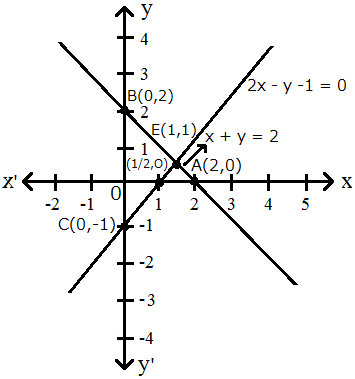
View full question & answer→Question 703 Marks
Solve the following systems of equations:
$\frac{\text{x}+\text{y}}{\text{xy}}=2,$
$\frac{\text{x}-\text{y}}{\text{xy}}=6.$
AnswerThe given equations are
$\frac{\text{x}+\text{y}}{\text{xy}}=2$
$\text{x}+\text{y}=2{\text{xy}}\ ......(\text{i})$
$\frac{\text{x}-\text{y}}{\text{xy}}=6$
$\text{x}-\text{y}=6{\text{xy}}\ ......(\text{ii})$
Adding both equations we get,
$\frac{\text{x}\ +\ \text{y}\ =\ 2\text{xy}\\\text{x}\ -\ \text{y}\ =\ 6\text{xy}}{2\text{x}\ \ \ \ \ \ \ =\ 8\text{xy}}$
$\Rightarrow\text{y}=\frac{1}{4}$
Put the value of $y$ in equation $(i)$ we get,
$\text{x}+\frac{1}{4}=2\text{x}\times\frac{1}{4}$
$\Rightarrow\frac{-\text{x}}{2}=\frac{1}{4}$
$\Rightarrow\text{x}=-\frac{1}{2}$
Hence the values of $\text{x}=-\frac{1}{2}$ and $\text{y}=\frac{1}{4}$
View full question & answer→Question 713 Marks
$5$ books and $7$ pens together cost $Rs. 79$ whereas $7$ books and $5$ pens together cost $Rs. 77.$ Find the total cost of $1$ book and $2$ pens.
AnswerLet cost of a book and a pen be $Rs. x$ and $y$ respectively.
According to question,
$5x + 7y = 79 .....(i)$
$7x + 5y = 77 .......(ii)$
Adding $(i)$ and $(ii)$ we get
$⇒ 12x + 12y = 156$
$⇒ x + y = 13 .....(iii)$
Subtracting $(i)$ from $(ii)$ we get
$⇒ 2x - 2y = -2$
$⇒ x - y = -1 ......(iv)$
Adding $x = 6$ in $(iii)$ we get
$⇒ 6 + y = 13$
$⇒ y = 7$
Thus total cost of $1$ book and $2$ pens $= (6 + 2 × 7)$
$= (6 + 14)$
$= Rs. 20$
View full question & answer→Question 723 Marks
The sum of digits of a two digit number is $13$. If the number is subtracted from the one obtained by interchanging the digits, the result is $45.$ What is the number$?$
AnswerLet the digit in the units place be $x$ and digit in the ten's place be $y.$ Then
$x + y = 13 [$given$] ......(i)$
and, Number $= 10y + x$
Number obtained by reversing the digits $= 10x + y$
It is given that the number is subtracted from the one obtained by interchanging the digits, the result is $45.$
i.e., (Number obtained by interchanging the digits) - Number $= 45$
$\therefore 10x + y - (10y + x) = 45$
$⇒ 9x - 9y = 45$
$⇒ 9(x - y) = 45$
$⇒ x - y = 5 .....(ii)$
Adding equation $(i)$ and equation $(ii),$ we get
$2x = 13 + 5$
$⇒ 2x = 18$
$\Rightarrow\text{x}=\frac{18}{2}$
$⇒ x = 9$
Putting $x = 9$ in equation $(i)$ we get
$9 + y = 13$
$⇒ y = 13 - 9$
$⇒ y = 4$
Hence, the number is $10y + x = 10 × 4 + 9 = 49$
View full question & answer→Question 733 Marks
Solve the following systems of equations:
$0.5x + 07y = 0.74$
$0.3x + 0.5y = 0.5$
AnswerThe given equations are
$0.5x + 0.7y = 0.74 ...(i)$
$0.3x + 0.5y = 0.5 .....(ii)$
Multiply equation $(i)$ by $0.5$ and $(ii)$ by $2$ and subtract equation $(ii)$ from $(i)$ we get
$0.25x + 0.35y = 0.37$
(image)
$⇒ x = 0.5$
Put the value of $x$ in equation $(i),$ we get
$0.5 × 0.5 + 0.7y = 0.74$
$⇒ y = 0.7$
Hence the value of $x = 0.5$ and $y = 0.7$
View full question & answer→Question 743 Marks
For what value of k, the following system of equations will represent the coincident lines?
$x + 2y + 7 =0$
$2x + ky + 14 = 0$
AnswerThe given system of equations may be written as
$x + 2y + 7 =0$
$2x + ky + 14 = 0$
The given equations are of the form,
$a_1 x+b_1 y+c_1=0 $
$ a_2 x+b_2 y+c_2=0$
Where, $a_1=1, b_1=2, c_1=7$
And, $a_2=2, b_2=k$, and $c_2=14$
The givenequations will represent coincident lines if they have infinitely many solutions.
The condition for which is,
$\frac{\text{a}_1}{\text{a}_2}=\frac{\text{b}_1}{\text{b}_2}=\frac{\text{c}_1}{\text{c}_1}$
$\Rightarrow\frac{1}{2}=\frac{2}{\text{k}}$
$\Rightarrow\text{k}=4$
Hence, the given system of equations will represent coincident lines, if $k = 4.$
View full question & answer→Question 753 Marks
A shopkeeper gives books pn rent for reading. She takes a fixed charge for the first two days, and an additional charge for each day thereafter. Latika paid $₹\ 22$ for a book kept for $6$ days, while Anand paid $₹\ 16$ for the book kept for four days. Find the fixed charges and charge for each extra.
AnswerLet Latika takes a fixed charge for the first two day is $₹ x$ and additional charge for each day thereafter is $₹ y.$
Now, by first condition,
Latika paid $₹ 22$ for a book kept for six days
i.e., $x + 4y = 22 .....(i)$
and by second condition,
Anand paid $₹ 16$ for a book kept for four days
i.e., $x + 2y = 16 ....(ii)$
Now, subtracting Eq. $(ii)$ from Eq. $(i),$ we get
$2y = 6$
$⇒ y = 3$
On putting the value of y in Eq. $(ii),$ we get
$x + 2 × 3 = 16$
$x = 16 - 6 = 10$
Hence, the fixed charge $= ₹ 10$ and the charge for each extra day $= ₹ 3$
View full question & answer→Question 763 Marks
Find the value of k for which each of the following system of equations have infinitely many solutions:
$kx + 3y = 2k + 1$
$2(k + 1)x + 9y = 7k + 1$
AnswerGiven,
$kx + 3y = 2k + 1$
$2(k + 1)x + 9y = 7k + 1$
To find: To determine for what value of k the system of equation has infinitely many solutions
We know that the system of equations
$ a_1 x+b_1 y=c_1 $
$ a_2 x+b_2 y=c_2$
Where, $a_1=k, b_1=3, c_1=-(2 k+1)$
and, $a_2=2(k+1), b_2=9$, and $c_2=-(7 k+1)$
For infinitely many solutions,
$\frac{\text{a}_1}{\text{a}_2}=\frac{\text{b}_1}{\text{b}_2}=\frac{\text{c}_1}{\text{c}_2}$
Here,
$\frac{\text{k}}{2(\text{k}+1)}=\frac{3}{9}=\frac{2\text{k}+1}{7\text{k}+1}$
Consider the following relation to find k,
$\frac{\text{k}}{2(\text{k}+1)}=\frac{3}{9}$
$⇒ 9k = 6(k + 1)$
$⇒ 9k - 6k - 6 = 0$
$⇒ 3k = 6$
$⇒ k = 2$
Now consider the following
$\frac{3}{9}=\frac{2\text{k}+1}{7\text{k}+1}$
$⇒ 3(7k + 1) = 9(2k + 1)$
$⇒ 21k + 3 = 18k + 9$
$⇒ 21k - 18k = 9 - 3$
$⇒ 3k = 6$
$⇒ k = 2$
Hence for $k = 2$ the system of equation have infinitely many solutions.
View full question & answer→Question 773 Marks
Write the number of solutions of the following pair of linear equations:
$x + 3y - 4 = 0$
$2x + 6y = 7$
AnswerThe given equation are
$x + 3y - 4 = 0 .....(i)$
$2x + 6y - 7 = 0 ......(ii)$
The given equations are of the form
$a_1 x+b_1 y+c_1=0 .....(iii)$
$a_2 x+b_2 y+c_2=0......(iv)$
Where, $ a_1=1, b_1=3, c_1=-4, a_2=2, b_2=6 \text { and } c_2=-7$
$\frac{\text{a}_1}{\text{a}_2}=\frac{1}{2},\frac{\text{b}_1}{\text{b}_2}=\frac{3}{6}=\frac{1}{2}$
and $\frac{\text{c}_1}{\text{c}_2}=\frac{-4}{-7}=\frac{4}{7}$
Thus, $\frac{\text{a}_1}{\text{a}_2}=\frac{\text{b}_1}{\text{b}_2}\neq\frac{\text{c}_1}{\text{c}_2}$
Thus, given pair of linear equation has no solution.
View full question & answer→Question 783 Marks
Write the value of k for which the system of equations $x + ky = 0, 2x - y = 0$ has unique solution.
AnswerThe given equations are,
$x + ky = 0 .....(i)$
$2x - y = 0 ......(ii)$
The given equations are of the form,
$a_1 x+b_1 y+c_1=0.....(iii)$
$a_2 x+b_2 y+c_2=0......(iv)$
$\text { Where, } a_1=1, b_1=k, c_1=0, a_2=2, b_2=-1 \text { and } c_2=0$
For unique solution,
$\frac{\text{a}_1}{\text{a}_2}\neq\frac{\text{b}_1}{\text{b}_2}$
$\Rightarrow\frac{1}{2}\neq\frac{\text{k}}{-1}$
$\Rightarrow\text{k}\neq\frac{-1}{2}$
Thus, given system of equations has unique solution if $\text{k}\neq\frac{-1}{2}$
View full question & answer→Question 793 Marks
In the following system of equation determine whether the system has a unique solution, no solution or infinitely many solutions. In case there is a unique solution, find it:
$2x + y = 5$
$4x + 2y = 10$
AnswerThe given equations are,
$2x + y = 5 .....(i)$
$4x + 2y = 10 .......(ii)$
The given equations are of the from,
$ a_1 x+b_1 y+c_1=0 $
$ a_2 x+b_2 y+c_2=0$
$\text { Where } a_1=2, b_1=1, c_1=-5$
$a_2=4, b_2=2 \text { and } c_2=-10$
We have,
$\frac{\text{a}_1}{\text{a}_2}=\frac{2}{4}=\frac{1}{2},$
$\frac{\text{b}_1}{\text{b}_2}=\frac{1}{2},$
$\frac{\text{c}_1}{\text{c}_2}=\frac{-5}{-10}=\frac{1}{2}$
$\therefore\frac{\text{a}_1}{\text{a}_2}=\frac{\text{b}_1}{\text{b}_2}=\frac{\text{c}_1}{\text{c}_2}$
Thus, the given system of equations has infinitely many solution.
View full question & answer→Question 803 Marks
The car hire charges in a city comprise of a fixed charges together with the charge for the distance covered. For a journey of $12\ km$, the charge paid is $Rs. 89$ and the journey of $20\ km,$ the charge paid is $Rs. 145.$ What will a person have to pay for travelling a distance of $30\ km?$
AnswerLet the fixed charges of car be $Rs. x$ per km and the running charges be $Rs.\ y\ km/hr.$
According to the given condition we have
$x + 12y = 89 .....(i)$
$x + 20y = 145 ......(ii)$
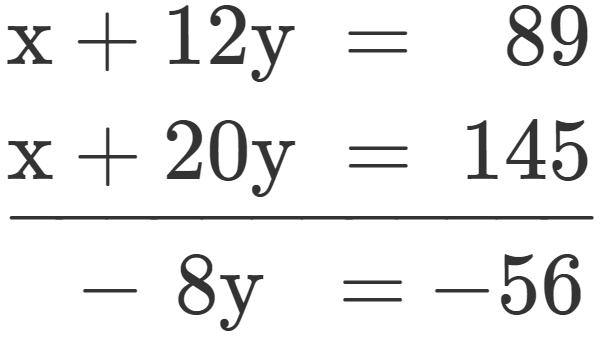
$\text{y}=\frac{-56}{-8}$
$y = 7$
Putting $y = 7$ in equation $(i)$ we get
$x + 12y = 89$
$x + 12 × 7 = 89$
$x + 84 = 89$
$x = 89 - 84$
$x = 5$
Therefore, Total charges for travelling distance of $30\ km$
$= x + 30y$
$= 5 + 30 × 7$
$= 5 + 210$
$= Rs. 215$
Hence, a person have to pay $Rs. 215$ for travelling a distance of $30\ km.$ View full question & answer→Question 813 Marks
Write the value of k for which the system of equations has infinitely many solutions.
$2x - y = 5$
$6x + ky = 15$
AnswerThe given equation are
$2x - y = 5 ....(i)$
$6x + ky = 15 .....(ii)$
The given equations are of the from
$a_1 x+b_1 y+c_1=0 .....(iii)$
$a_2 x+b_2 y+c_2=0......(iv)$
Where, $a_1=2, b_1=-1, c_1=-5, a_2=6, b_2=k, c_2=-15$
For infinitely solution,
$\frac{\text{a}_1}{\text{a}_2}=\frac{\text{b}_1}{\text{b}_2}=\frac{\text{c}_1}{\text{c}_2}$
$\Rightarrow\frac{2}{6}=\frac{-1}{\text{k}}=\frac{-5}{15}$
$\Rightarrow\frac{2}{6}=\frac{-1}{\text{k}}$
$\Rightarrow\frac{1}{3}=\frac{-1}{\text{k}}$
$\Rightarrow\text{k}=-3$
Thus, $k = -3$
View full question & answer→Question 823 Marks
Find the value of k for which the following system of equations has no solution:
$2x - ky + 3 = 0$
$3x + 2y - 1 = 0$
AnswerThe given system of equations is
$2x - ky + 3 = 0$
$3x + 2y - 1 = 0$
The system of equations is of the form
$ a_1 x+b_1 y+c_1=0$
$a_2 x+b_2 y+c_2=0$
Where, $a_1=2, b_1=-k, c_1=3$
and, $a_2=3, b_2=2, c_2=-1$
For no solutions, we must have
$\frac{\text{a}_1}{\text{a}_2}=\frac{\text{b}_1}{\text{b}_2}\neq\frac{\text{c}_1}{\text{c}_2}$
We have,
$\frac{\text{a}_1}{\text{a}_2}=\frac{2}{3}$
and, $\frac{\text{c}_1}{\text{c}_2}=\frac{3}{-1}$
Clearly, $\frac{\text{a}_1}{\text{a}_2}\neq\frac{\text{c}_1}{\text{c}_2}$
So, the given system of equations will have no solution, if
$\frac{\text{a}_1}{\text{a}_2}=\frac{\text{b}_1}{\text{b}_2}$
i.e., $\frac{2}{3}=\frac{-\text{k}}{2}$
$\Rightarrow\text{k}=\frac{-4}{3}$
Hence, the given system of equations will have no solution, if $\text{k}=\frac{-4}{3}$
View full question & answer→Question 833 Marks
A two-digit number is $4$ times the sum of its digits and twice the product of the digits. Find the number.
AnswerLet the digit in the unit's place be $x$ and the digit at the ten's place be $y.$ Then,
Number $= 10y + x$
The number obtained by reversing the order of the digits is $10x + y$
According to the given conditions we have
$10y + x = 4(x + y)$
$⇒ 10y + x = 4x + 4y$
$⇒ 10y - 4y + x - 4x = 0$
$⇒ 6y - 3x = 0$
$⇒ -3x + 6y = 0$
$⇒ 3x - 6y = 0$
$⇒ 3(x- 2y) = 0$
$⇒ x - 2y = 0 ......(i)$
and, $10y + x = 2(xy)$
$⇒ 10y + x = 2xy .......(ii)$
Substituting $x = 2y$ in equation $(ii)$ we get
$10 y+2 y=2 \times(2 y) \times y $
$\Rightarrow 12 y=4 y^2 $
$ \Rightarrow 3 y=y^2 $
$ \Rightarrow y^2-3 y=0$
$ \Rightarrow y(y-3)=0$
$\Rightarrow\text{y}\neq0$ or $ y = 3 [ \because$ Ten's digit can not be $0]$
Putting $y = 3$ in equation $(i)$ we get
$x = 2 × 3 = 6$
Hence, the required number is $10y + x$
$= 10 × 3 + 6 = 36$
View full question & answer→Question 843 Marks
Solve the following systems of equations:
$\frac{2}{\text{x}}+\frac{5}{\text{y}}=1,$
$\frac{60}{\text{x}}+\frac{40}{\text{y}}=19,\text{x}\neq0,\text{y}\neq0.$
AnswerThe given equations are
$\frac{2}{\text{x}}+\frac{5}{\text{y}}=1\ ......(\text{i})$
$\frac{60}{\text{x}}+\frac{40}{\text{y}}=19\ ......(\text{ii})$
Multiply equation $(i)$ by $8$ and subtract $(ii)$ from equation $(i),$ we get
$-\frac{44}{\text{x}}=-11$
$\Rightarrow\text{x}=4$
Put the value of $x$ in equation $(i)$ we get
$\Rightarrow\frac{2}{4}+\frac{5}{\text{y}}=1$
$\Rightarrow\frac{5}{\text{y}}=1-\frac{2}{4}$
$\Rightarrow\text{y}=10$
Hence the value of $x = 4$ and $y = 10.$
View full question & answer→Question 853 Marks
Write the value of k for which the system of equations $x + y - 4 = 0$ and $2x + ky - 3 = 0$ has no solution.
AnswerThe given system of equation is
$x + y - 4 = 0$
$2x + ky - 3 = 0$
$a_1=1, a_2=2, b_1=1, b_2=k, c_1=4, c_2=3$
For the equations to have no solutions $\frac{\text{a}_1}{\text{a}_2}=\frac{\text{b}_1}{\text{b}_2}\neq\frac{\text{c}_1}{\text{c}_2}$
$\frac{1}{2}=\frac{1}{\text{k}}$
By cross-multiplication we get,
$1 × k = 1 × 2$
$k = 2$
Hence, the value of $k$ is $2$ when system equations has no solution.
View full question & answer→Question 863 Marks
Find the value of k for which each of the following system of equations have infinitely many solutions:
$4x + 5y = 3$
$kx + 15y = 9$
AnswerThe given system of equation is
$4x + 5y - 3 = 0$
$kx + 15y - 9 = 0$
The given system of equation is of the form
$ a_1 x+b_1 y+c_1=0 $
$ a_2 x+b_2 y+c_2=0$
Where, $a_1=4, b_1=5, c_1=-3$
$a_2=k, b_2=15, c_2=-9$
For a unique solution we must have,
$\frac{\text{a}_1}{\text{a}_2}=\frac{\text{b}_1}{\text{b}_2}=\frac{\text{c}_1}{\text{c}_2}$
$\Rightarrow\frac{4}{\text{k}}=\frac{5}{15}=\frac{-3}{-9}$
Now,
$\frac{4}{\text{k}}=\frac{5}{15}$
$\Rightarrow\frac{4}{\text{k}}=\frac{1}{3}$
$\Rightarrow\text{k}=12$
Hence, the given system of equations will have infinitely many solutions if $k = 12.$
View full question & answer→