Questions

3 Marks Question

🎯

Test yourself on this topic

17 questions · timed · auto-graded

Question 13 Marks
Meena went to a bank to withdraw $₹ 2000$. She asked the cashier to give her $₹ 50$ and $₹ 100$ notes only. Meena got $25$ notes in all. Find how many notes of $₹ 50$ and $₹ 100$ she received. Solve the pair of the linear equation obtained by the elimination method.
Answer
Let the number of $₹ 50$ notes and $₹ 100$ notes be $x$ and $y$ respectively.
According to given condition,
Meena got $25$ notes in all.
$⇒ x + y = 25 ...........(i)$
and Meena withdraw$ ₹ 2000.$
$⇒ 50x + 100y = 2000 ............(ii)$
Multiplying equation $(i)$ by $50$, we obtain:
$50x + 50y = 1250 ............. (iii)$
Subtracting equation $(iii)$ from equation $(ii),$ we obtain:
$(50x + 100y ) - (50x + 50y) = 2000 - 1250$
$50x + 100y - 50x - 50y = 750$
$50y = 750$
$y = 15$
Substituting the value of $y$ in equation $(i),$ we obtain:
$x = 10$
Hence, Meena received $10$ notes of $₹ 50$ and $15$ notes of $₹ 100.$
View full question & answer
Question 23 Marks
The sum of the digits of a two-digit number is $9$. Also, nine times this number is twice the number obtained by reversing the order of the number. Find the number. Solve the pair of the linear equation obtained by the elimination method.
Answer
Let the unit's digit and the ten's digit in the two-digit number be $x$ and $y$ respectively.
Then the number$ = 10y + x$
Also, the number obtained by reversing the order of the digits $= 10x + y$
According to the question,
$x + y = 9...............(1)$
$9(10y + x) = 2(10x + y)$
$\Rightarrow 90y + 9x = 20x + 2y$
$\Rightarrow 11x - 88y = 0$
$\Rightarrow x - 8y = 0 ..............(2)$
Subtracting equation$(2)$ from equation$(1), $we get
$9y = 9$
$\Rightarrow \quad y = \frac { 9 } { 9 } = 1$
Substituting this value of $y$ in equation $(1)$, we get
$x + 1 = 9$
$\Rightarrow x = 9-1=8$
Hence, the required number is $18.$
Verification: substituting $x = 8$ and $y = 1,$
we find that both the equations $(1)$ and $(2)$ are satisfied as shown below:
$x + y = 8 + 1 = 9$
$x - 8y = 8 - 8(1) = 0$
Hence, the solution is correct.
View full question & answer
Question 33 Marks
Five years ago, Nuri was thrice as old as Sonu. Ten years later, Nuri will be twice as old as Sonu. How old are Nuri and Sonu? Solve the pair of the linear equation obtained by the elimination method.
Answer
Let the present age of Nuri and Sonu be $x$ years and $y$ years respectively.
Then, according to the question,
$x – 5 = 3(y – 5)$
$ \Rightarrow ​ x – 5 = 3y – 15$
$ \Rightarrow x – 3y = –10 ............. (1)$
$x + 10 = 2(y + 10)$
$​x + 10 = 2y + 20$
$​ \Rightarrow ​ x – 2y = 10 ------------ (2)$
Subtracting equation $(2)$ from equation $(1)$, we get
$– y= – 20$
$​ \Rightarrow ​ y = 20$
Subtracting equation $(2)$ from equation $(1)$, we get
$x – 2(20) = 10$
$​ \Rightarrow ​ x – 40 = 10$
$ \Rightarrow x = 40 + 10$
$ \Rightarrow x = 50$
Hence, Nuri and Sonu are $50$ years and $20$ years old respectively at present.
Verification.Subtracting the value of $x = 50$ and $y = 20$,we find that both the eqations $(1)$ and $(2)$ are satisfied as shown below:
$x – 3y = 50 – 3(20) = 50 – 60 = – 10$
$x – 2y = 50 – 2(20) = 50 – 40=10$
Hence,the solution is correct.
View full question & answer
Question 43 Marks
If we add $1$ to the numerator and subtract $1$ from the denominator, a fraction reduces to $1$. It becomes $\frac 12$ if we only add $1$ to the denominator. What is the fraction? Solve the pair of the linear equation obtained by the elimination method.
Answer
Let the fraction be $\frac xy$
Then, according to the question,
$ \frac { x + 1 } { y - 1 } = 1 ......(1)$
$ \frac { x } { y + 1 } = \frac { 1 } { 2 } .........(2)$
$ \Rightarrow x + 1 = y - 1 ...........(3)$
$2x = y + 1................(4)$
$ \Rightarrow x - y = - 2................(5)$
$2x - y = 1......................(^)$
Substituting equation $(5)$ from equation $(6)$, we get $x =3$
Substituting this value of $x$ in equation $(5)$, we get
$3 - y = -2$
$\Rightarrow y = 3 + 2$
$\Rightarrow y = 5$
Hence, the required fraction is $\frac35$ Verification: Substituting the value of $x = 3$ and $y = 5$,
we find that both the equations$(1)$ and $( 2)$ are satisfied as shown below:
$\frac { x + 1 } { y - 1 } = \frac { 3 + 1 } { 5 - 1 } = \frac { 4 } { 4 } = 1$
$\frac { x } { y + 1 } = \frac { 3 } { 5 + 1 } = \frac { 3 } { 6 } = \frac { 1 } { 2 }$
Hence, the solution is correct.
View full question & answer
Question 53 Marks
The larger of two supplementary angles exceeds the smaller by $18$ degrees. Find them by substitution method.
Answer
Let the larger and smaller of two supplementary angles be $x^\circ$ and $y^\circ$ respectively.
Then, according to the question.
The pair of linear equations formed is
$x ^ { \circ } = y ^ { \circ } + 18 ^ { \circ }$ $x ^ { 0 } + y ^ { 0 } = 180 ^ { \circ }$ $\because $ The two angles and supplementary
Substitute the value of $x^\circ$ from equation (1) in equation (2), we get
$y ^ { \circ } + 18 ^ { \circ } + y ^ { \circ } = 180 ^ { \circ }$
$\Rightarrow \quad 2 y ^ { 0 } + 18 ^ { \circ } = 180 ^ { \circ }$
$\Rightarrow \quad 2 y ^ { \circ } = 180 ^ { \circ } - 18 ^ { \circ }$
$\Rightarrow \quad 2 y = 162 ^ { \circ }$
$\Rightarrow \quad y ^ { \circ } = \frac { 162 ^ { \circ } } { 2 } = 81 ^ { \circ }$
Substituting this value of $y^\circ$ in equation (1), we get
$x ^ { 0 } = 81 ^ { \circ } + 18 ^ { \circ } = 99 ^ { \circ }$
Hence, the larger and smaller of the two supplementary angles are $99^\circ$ and $81^\circ$ respectively.
$Verification$, Substituting $x^\circ= 99^\circ$ and $4y^\circ= 81^\circ$, we find that both the equations $(1)$ and $(2)$ are satisfied as shown below:
$y ^ { \circ } + 18 ^ { \circ } = 81 ^ { \circ } + 18 = 99 ^ { \circ } = x ^ { \circ }$
$x ^ { 0 } + y ^ { \circ } = 99 ^ { \circ } + 81 ^ { \circ } = 180 ^ { \circ }$
This verifies the solution.
View full question & answer
Question 63 Marks
The difference between the two numbers is $26$ and one number is three times the other. Find them by substitution method.
Answer
Let the two numbers be $x$ and $y (x > y)$ then, according to the question,
the pair of linear equations formed is:
$x - y = 26.........(1)$
$x = 3y.............(2)$
Substitute the value of $x$ from equation $(2)$ in equation $(1),$ we get
$3y - y = 26$
$\Rightarrow \quad 2 y = 26$
$\Rightarrow \quad y = \frac { 26 } { 2 }$
$\Rightarrow \quad y = 13$
Substituting this value of $y$ in equation $(2),$ we get
$x = 3(13) = 39$
Hence, the required numbers are $39$ and $13.$
verification: Substituting $x = 39$ and $y = 13$, we find that both
the equation $(1)$ and $(2)$ are satisfied as shown below:
$x - y = 39 - 13 = 26$
$3y = 3(13) = 39 = x.$
This verifies the solution.
View full question & answer
Question 73 Marks
Solve the pair of linear equations by substitution method: $0.2x + 0.3y = 1.3; 0.4x + 0.5y = 2.3$
Answer
$0.2 x + 0.3 y = 1.3 ; 0.4 x + 0.5 y = 2.3$
The given system of linear equations is:
$0.2 x + 0.3 y = 1.3..............(1)$
$0.4 x + 0.5 y = 2.3...................(2)$
From equation $(1),$
$0.3 y = 1.3 - 0.2 x$
$\Rightarrow \quad y = \frac { 1.3 - 0.2 x } { 0.3 } .........................(3)$
Substituting this value of y in equation$(2),$ we get
$0.4 x + 0.5 \left( \frac { 1.3 - 0.2 x } { 0.3 } \right) = 2.3 $
$ \Rightarrow 0.12 x + 0.65 - 0.1 x = 0.69$
$ \Rightarrow 0.12 x - 0.1 x = 0.69 - 0.65$
$ \Rightarrow 0.02 x = 0.04$
$ \Rightarrow \mathrm { x } = \frac { 0.04 } { 0.02 } = 2$
Substituting this value of x in equation$(3)$, we get
$y = \frac { 1.3 - 0.2 ( 2 ) } { 0.3 } = \frac { 1.3 - 0.4 } { 0.3 } = \frac { 0.9 } { 0.3 } = 3$
Therefore, the solution is $x = 2, y = 3$, we find that both equation $(1)$ and $(2)$ are satisfied as shown below:
$0.2 x + 0.3 y = ( 0.2 )( 2 )+( 0.3)( 3 ) = 0.4 + 0.9 = 1.3$
$0.4 x + 0.5 y= ( 0.4 )( 2 ) + ( 0.5 )( 3 )  = 0.8 + 1.5 = 2.3$
This verifies the solution.
View full question & answer
Question 83 Marks
Solve the pair of linear equations by substitution method: s – t = 3; $\frac { s } { 3 } + \frac { t } { 2 } = 6$
Answer
$s - t = 3; \frac { s } { 3 } + \frac { t } { 2 } = 6$
The given pair of linear equations is :
$s - t = 3...............(1)$
$\frac { s } { 3 } + \frac { t } { 2 } = 6$..........(2)
From equation$(1),$
$s = t + 3..............(3)$
Substitute this value of s in equation$(2)$, we get
$\frac { t + 3 } { 3 } + \frac { t } { 2 } = 6$
$\Rightarrow \quad \frac { 2 ( t + 3 ) + 3 t } { 6 } = 6$
$\Rightarrow 2(t + 3) + 3t = 36$
$\Rightarrow 2t + 6 + 3t = 36$
$\Rightarrow 5t + 6 = 36$
$\Rightarrow 5t = 30$
$\Rightarrow \quad t = \frac { 30 } { 5 } = 6$
Substituting this value of t in equation $(3)$, we get
$s = 6 + 3= 9$
therefore the solution is
$s = 9, t = 6$
$Verification $: Substituting $s = 9$ and $t = 6$, we find that both equation $(1)$ and $(2)$ are satisfied as shown below:
$s - t = 9 - 6 = 3$
$\frac { s } { 3 } + \frac { t } { 2 } = \frac { 9 } { 3 } + \frac { 6 } { 2 } = 3 + 3 = 6$
This verifies the solution.
View full question & answer
Question 93 Marks
Solve the pair of linear equations by substitution method: $x + y = 14; x – y = 4$
Answer
$x + y = 14; x - y = 4$
the given pair of linear equations is
$x + y = 14.................(1)$
$x - y = 4....................(2)$
From equation$(1),$
$y = 14 - x...................(3)$
Substitute this value of $y$ in equation$(2),$ we get
$x - (14 - x) = 4$
$\Rightarrow x - 14 + x = 4$
$\Rightarrow 2x - 14 = 4$
$\Rightarrow 2x = 4 + 14$
$\Rightarrow 2x = 18$
$\Rightarrow x = \frac { 18 } { 2 } = 9$
Substituting this value of x in equation $(3)$, we get $y = 14 - 9 = 5$
Therefore, the solution is $x = , y = 5$
verification: Substituting $x = 9$ and $y = 5$, we find that both the equations $(1)$ and $(2)$ are satisfied as shown below:
$x + y = 9 + 5 = 14$
$x - y = 9 - 5=4$
This verifies the solution.
View full question & answer
Question 103 Marks
Given the linear equation $2x + 3y - 8 = 0$, write another linear equation in two variables such that the geometrical representation of the pair so formed is:
  1. intersecting lines
  2. parallel lines
  3. coincident lines
Answer
Given, linear equation is $2x + 3y - 8 = 0 ...(i)$
Given: $2x + 3y - 8 = 0 ..... (i)$
  1. For intersecting lines, $\frac { a _ { 1 } } { a _ { 2 } } \neq \frac { b _ { 1 } } { b _ { 2 } }$
    $\therefore$ Any line intersecting with eq $(i)$ may be taken as $3x + 2y - 9 = 0$
    or $3x + 2y - 7 = 0$
  2. For parallel lines, $\frac { a _ { 1 } } { a _ { 2 } } = \frac { b _ { 1 } } { b _ { 2 } } \neq \frac { c _ { 1 } } { c_ { 2 } }$
    $\therefore$ Any line parallel with eq$(i)$ may be taken as $6x + 9y + 7 = 0$
    or $2x +3y - 2 = 0$
  3. For coincident lines, $\frac { a _ { 1 } } { a _ { 2 } } = \frac { b _ { 1 } } { b _ { 2 } } = \frac { c _ { 1 } } { c_ { 2 } }$
    $\therefore$ Any line coincident with eq $(i)$ may be taken as $4x + 6y - 16 = 0$
    or $6x + 9y - 24 = 0$
View full question & answer
Question 113 Marks
Form the pair of linear equations in the problem, and find its solution graphically:
$5$ pencils and $7$ pens together cost $₹ 50$ whereas $7$ pencils and $5$ pens together cost $₹ 46$. Find the cost of one pencil and that of one pen.
Answer
Let, cost(in RS) of one pencil $= x$
and cost (in RS) of one pen $= y$
Therefore , according to question
$5x+7y = 50 ........ (1)$
$7x + 5y = 46 .........(2)$
Multiply equation $(1)$ by $7$ and equation $(2)$ by $5$ we get
$7(5x+7y)= 7 \times 50$
$35x +49y = 350 .......(3)$
and
$5(7x +5y) = 5 \times 46$
$35x +25y = 230 ....... (4)$
Subtract equation $(4)$ from equation $3$ , we get
$35x + 49y - 35x - 25y = 350 -230$
$49y -25y = 120$
$24y = 120$
$y = \frac{120}{24}$
$y= 5$
Substitute $y = 5$ in equation $1$ , we get
$5x + 7 \times 5 =50$
$5x + 35 = 50$
$5x = 50 - 35$
$5x = 15$
$x= \frac{15}{5}$
$x=3$
Hence, Cost of One Pen $= y =5$
View full question & answer
Question 123 Marks
Solve the following question-Aftab tells his daughter, Seven years ago, I was seven times as old as you were then. Also, three years from now, I shall be three times as old as you will be. (Isn’t this interesting?) Represent this situation algebraically and graphically by the method of substitution.
Answer
Let the present age of Aftab and his daughter be $x$ and $y$ years respectively. Then, the pair of linear equations that represent the situation is
$x - 7 = 7(y - 7), i.e., x - 7y + 42 = 0 ...(1)$
and $x + 3 = 3(y + 3), i.e., x - 3y = 6 ...(2)$
from equation $(2),$ we get $x = 3y + 6$
By putting this value of $x$ in equation $(1)$, we get
$(3y + 6) -7y + 42 = 0,$
i.e.,$ -4y = -48$, which gives $y = 12$
Again by putting this value of y in equation $(2)$, we get
$x = 3\times12 + 6 = 42$
So, the present age of Aftab and his daughter are $42$ and $12$ years respectively.
View full question & answer
Question 133 Marks
Solve the following pair of equations by substitution method:
$7x – 15y = 2 ...(1)$
$x + 2y = 3 ...(2)$
Answer
Step 1: By substitution method, we pick either of the equations and write one variable in terms of the other.
$7x – 15y = 2 ...(1)$
and $x + 2y = 3 ...(2)$
Let us consider the Equation $(2):$
$x + 2y = 3$ and write it as $x = 3 – 2y ...(3)$
Step 2: Now substitute the value of x in Equation $(1)$
We get $7(3 – 2y) – 15y = 2$
i.e.,$ 21 – 14y – 15y = 2$
i.e.,$ – 29y = –19$
Therefore $\mathrm{y}=\frac{19}{29}$
Step 3: Substituting this value of y in Equation (3), we get
$\mathrm{x}=3-2\left(\frac{19}{29}\right)=\frac{49}{29}$
Therefore, the solution is x = $\frac{49}{29}, \mathrm{y}=\frac{19}{29}$
View full question & answer
Question 143 Marks
Champa went to a Sale to purchase some pants and skirts. When her friends asked her how many of each she had bought, she answered, The number of skirts is two less than twice the number of pants purchased. Also, the number of skirts is four less than four times the number of pants purchased. Help her friends to find how many pants and skirts Champa bought.
Answer
Let us denote the number of pants by $x$ and the number of skirts be $y.$
Then the equations formed are:
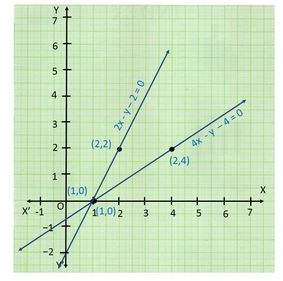
$y = 2x - 2 ………… (i)$
$y = 4x - 4………..(ii)$
From $(i)$
When $x = 2$, then$ y = 2$
When $x = 1$, then $y = 0$
$x$ $2$ $1$
$y$ $2$ $0$
From $(ii)$
When $x = 2$, then $y = 4$
When $x = 1$, then $y = 0$
$x$ $2$ $1$
$y$ $4$ $0$
The graphs of two equations of line is shown below.

From the graph, the lines intersect at point $(1,0)$
Thus, the value of $x = 1$ and $y = 0$
Hence, the number of pants she purchased are $2$ and the number of skirts she purchased are $0.$
View full question & answer
Question 153 Marks
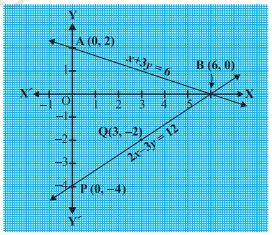
Check whether the pair of equations $x + 3y = 6$ and $2x – 3y = 12$ is consistent. If so, solve them graphically.
Answer
The solution of pair of linear equations:
$x + 3y = 6$ and $2x – 3y = 12$
$x$ $0$ $6$
$y=\frac{6-x}{3}$ $2$ $0$
and
$x$ $0$ $3$
$y=\frac{2 x-12}{3}$ $-4$ $-2$
Plot the points $A(0,2), B(6,0), P(0,-4)$ and $Q(3,-2)$ on graph paper, and join the points to form the lines $A B$ and $P Q$

We observe that there is a point $B(6,0)$ common to both the lines $A B$ and $P Q$. So, the solution of the pair of linear equations is $x=6$ and $y=0$, i.e., the given pair of equations is consistent.
View full question & answer
Question 163 Marks
Solve the linear pair of equations in two variables \begin{equation}x+y=5,2 x-3 y=4\end{equation} by elimination method.
Answer
Let the given equations be:
$x+y=5$ ...(1)
$2 x-3 y=4$ ...(2)
To eliminate a variable, the coefficient of that variable in both equations must be the same. Let's choose to eliminate x. The coefficient of x in Equation (1) is 1, and in Equation (2) is 2. To make them equal, multiply Equation (1) by 2.
Multiply Equation (1) by 2:
$\begin{array}{l}2(x+y)=2(5) \\ 2 x+2 y=10\end{array}$
Let's call this Equation (3): $2 x+2 y=10$
Now, subtract Equation (2) from Equation (3) to eliminate $x$.
$\begin{array}{l}(2 x+2 y)-(2 x-3 y)=10-4 \\ 2 x+2 y-2 x+3 y=6 \\ 5 y=6\end{array}$
Solve the resulting equation for $y$ :
$\begin{array}{l}5 y=6 \\ y=\frac{6}{5}\end{array}$
Substitute the value of $y=\frac{6}{5}$ into Equation (1) to find the value of $x$.
$\begin{array}{l}x+y=5 \\ x+\frac{6}{5}=5 \\ x=5-\frac{6}{5} \\ x=\frac{5 \times 5-6}{5} \\ x=\frac{25-6}{5} \\ x=\frac{19}{5}\end{array}$
The solution to the pair of linear equations is $x=\frac{19}{5}$  and $y=\frac{6}{5}$.
View full question & answer
Question 173 Marks
Alok has some Pigeons and Cows. The total number of their eyes is 120 and total number of their legs is 180. How many Pigeons and Cows the Alok has?
Answer
Let the number of pigeons be P and the number of cows be C.
A pigeon has 2 eyes and 2 legs.
A cow has 2 eyes and 4 legs.
The total number of eyes is 120:
$2 P+2 C=120$
The total number of legs is 180:
$2 P+4 C=180$
We have a system of two linear equations:
$\begin{array}{l}2 P+2 C=120 \\ 2 P+4 C=180\end{array}$
To solve this, we can use the elimination method. Subtract Equation 1 from Equation 2:
$\begin{array}{l}(2 P+4 C)-(2 P+2 C)=180-120 \\ 2 P+4 C-2 P-2 C=60 \\ 2 C=60 \\ C=\frac{60}{2} \\ C=30\end{array}$
Now, substitute the value of C into Equation 1 to find P:
$\begin{array}{l}2 P+2(30)=120 \\ 2 P+60=120 \\ 2 P=120-60 \\ 2 P=60 \\ P=\frac{60}{2} \\ P=30\end{array}$
Alok has 30 pigeons and 30 cows.
View full question & answer